Japan Solar Encapsulation Market by Material Type (Ethylene Vinyl Acetate (EVA), Polyolefin Elastomers (POE), Polyvinyl Butyral (PVB), Silicone & Ionomer, Other Material Types) Market by Technology (Module Construction) (Glass-Backsheet, Glass-Glass (Double Glass), Building-Integrated Photovoltaics (BIPV)) Market by Application (Photovoltaics (PV) (Utility-Scale, Commercial & Industrial (C&I), Residential), Transportation & Mobility, Consumer Electronics)
JAPAN SOLAR ENCAPSULATION MARKET OVERVIEW
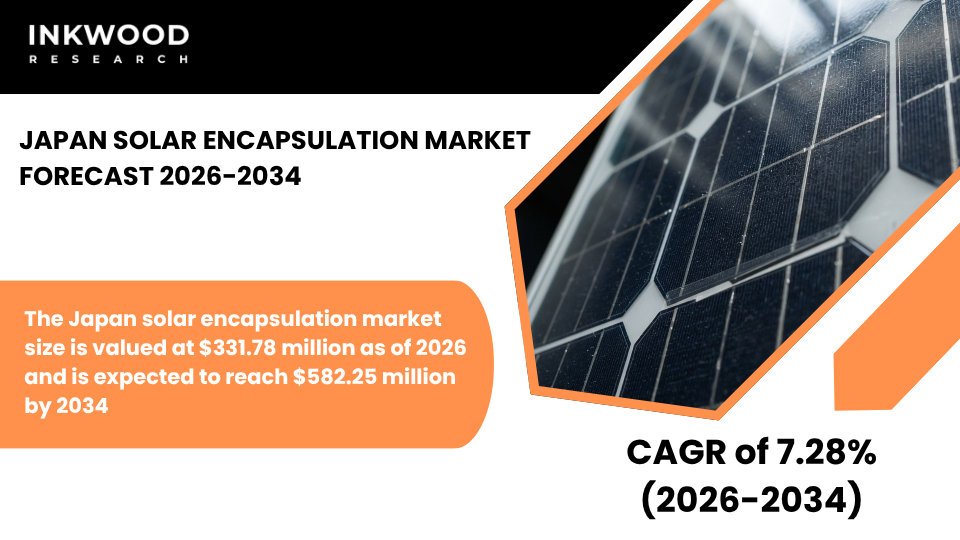
The Japan solar encapsulation market size is valued at $331.78 million as of 2026 and is expected to reach $582.25 million by 2034, progressing with a CAGR of 7.28% during the forecast years, 2026-2034.
Japan’s solar encapsulation market demonstrates distinctive characteristics shaped by stringent quality standards and space-constrained installation environments unique to the island nation. The country’s emphasis on long-term module reliability and weather resilience drives demand for premium encapsulation materials that withstand Japan’s diverse climatic conditions, from typhoon-prone coastal regions to heavy snowfall areas.
Moreover, high electricity prices sustained throughout recent years continue to incentivize solar adoption across commercial and residential segments despite land availability constraints limiting utility-scale project development. This deployment pattern directly influences encapsulant specifications, as rooftop systems require materials compatible with architectural integration and urban environmental stresses.
Furthermore, Japan’s transition from guaranteed feed-in tariffs to feed-in premium mechanisms introduces market price exposure, encouraging module manufacturers to prioritize high-efficiency crystalline silicon solar cells paired with advanced encapsulants, maximizing energy yields throughout extended operational periods.
To Know More About This Report, Request a Free Sample Copy
The market also benefits from repowering initiatives targeting aging solar assets installed during earlier boom periods, creating replacement demand for next-generation encapsulation materials offering improved performance characteristics. Additionally, mandatory solar requirements implemented in Tokyo and Kawasaki for new residential construction establish baseline market support, sustaining encapsulant consumption despite broader installation growth moderation compared to peak years.
The Japan solar encapsulation market is segmented into material type, technology (module construction), and application. The material type segment is further categorized into ethylene vinyl acetate (EVA), polyolefin elastomers (POE), polyvinyl butyral (PVB), silicone & ionomer, and other material types.
Polyolefin elastomers are experiencing accelerated adoption throughout Japan’s solar encapsulation market due to superior moisture resistance and potential-induced degradation protection increasingly valued by quality-conscious module manufacturers. Traditional ethylene-vinyl acetate materials, while maintaining a dominant market share globally, face competition from POE alternatives offering enhanced durability characteristics essential for Japan’s humid climate conditions and demanding performance standards.
Japanese module producers serving premium residential and commercial segments prioritize encapsulants, minimizing long-term degradation risks, as installation costs in space-constrained urban environments make maximizing per-square-meter energy generation economically critical. Consequently, POE-based encapsulation systems command higher pricing but deliver lifecycle value through reduced module failure rates and sustained efficiency performance exceeding 30-year operational timelines.
The material’s exceptional resistance to moisture ingress proves particularly advantageous for rooftop installations exposed to Japan’s significant seasonal rainfall and humidity fluctuations affecting module longevity. Furthermore, POE encapsulants enable module manufacturers to offer extended warranties, differentiating products in competitive residential markets where homeowners evaluate total ownership costs rather than solely upfront pricing.
Glass-glass module configurations incorporating POE layers are gaining popularity for building-integrated photovoltaic applications where aesthetic considerations and structural durability align with Japan’s architectural standards. Additionally, floating photovoltaic installations deployed across Japan’s numerous water bodies benefit from POE’s superior moisture barrier properties, protecting cells from aquatic environmental stresses.
The technology crystalline silicon solar segment particularly drives POE adoption, as high-efficiency heterojunction and TOPCon cell architectures require encapsulation materials preventing performance degradation from potential-induced effects. However, POE’s premium pricing relative to conventional EVA formulations creates market segmentation, with utility-scale projects maintaining preference for cost-optimized acetate EVA thermoplastic solutions while residential and commercial installations increasingly specify polyolefin alternatives.
Some of the top players operating in the Japanese solar encapsulation market include Mitsui Chemicals Inc, Kuraray Co Ltd, DuPont de Nemours Inc, Bridgestone Corporation, etc.
Kuraray Co Ltd operates as a prominent Japanese specialty chemical company with established capabilities in advanced polymer materials serving photovoltaic encapsulation applications. Headquartered in Tokyo, Kuraray manufactures polyvinyl butyral and specialty ionomer-based encapsulants offering unique performance characteristics suited for premium module segments.
The company’s Trosifol brand PVB interlayer films, originally developed for automotive and architectural laminated glass applications, provide exceptional optical clarity and adhesion properties valuable for building-integrated photovoltaic installations where aesthetic considerations rank alongside energy generation requirements.
Kuraray’s deep expertise in polymer chemistry enables the development of encapsulant formulations addressing Japan’s specific environmental challenges, including typhoon-resistant bonding strength and thermal cycling durability across extreme seasonal temperature variations. Moreover, the company supplies materials for glass-glass module constructions increasingly popular in Japanese residential markets where homeowners prioritize long-term reliability and minimal maintenance requirements.
Kuraray’s domestic manufacturing presence ensures responsive technical support for Japanese module producers while maintaining quality standards aligned with the nation’s stringent regulatory framework governing solar installations. The company also develops bio-based and recyclable encapsulant alternatives addressing growing environmental consciousness among Japanese consumers and corporate procurement policies emphasizing sustainability credentials.
Recent innovations include low-temperature processable encapsulant systems, reducing module manufacturing energy consumption, thereby improving overall lifecycle carbon footprints important for renewable energy projects. Furthermore, Kuraray collaborates with Japanese research institutions advancing next-generation solar technologies, including perovskite tandem cells requiring specialized encapsulation approaches protecting sensitive materials from moisture and oxygen exposure while maintaining optical transmission efficiency essential for multi-junction device performance.
REPORT SYNOPSIS
| REPORT SCOPE | DETAILS |
|---|---|
| Market Forecast Years | 2026-2034 |
| Base Year | 2025 |
| Market Historical Years | 2022-2024 |
| Forecast Units | Revenue ($ Million) |
| Segments Analyzed | Material Type, Technology (Module Construction), and Application |
| Country Analyzed | Japan |
| Companies Analyzed | DuPont de Nemours Inc, 3M Company, Dow Inc, Mitsui Chemicals Inc, Bridgestone Corporation, Hangzhou First Applied Material Co Ltd, Kuraray Co Ltd, Eastman Chemical Company |
TABLE OF CONTENTS
RESEARCH SCOPE & METHODOLOGY
- STUDY OBJECTIVES
- METHODOLOGY
- ASSUMPTIONS & LIMITATIONS
EXECUTIVE SUMMARY
- MARKET SIZE & FORECAST
- MARKET OVERVIEW
- SCOPE OF STUDY
- CRISIS SCENARIO ANALYSIS
- MAJOR MARKET FINDINGS
- JAPAN’S SOLAR ENCAPSULATION DEMAND IS STRONGLY INFLUENCED BY HIGH QUALITY STANDARDS AND LONG MODULE LIFETIME REQUIREMENTS
- GLASS GLASS MODULE CONFIGURATIONS ARE SEEING HIGHER ADOPTION DUE TO JAPAN’S FOCUS ON DURABILITY AND WEATHER RESILIENCE
- DOMESTIC MANUFACTURERS PREFER PREMIUM ENCAPSULANTS TO MINIMIZE DEGRADATION IN LIMITED LAND INSTALLATIONS
- ROOFTOP AND URBAN SOLAR PROJECTS ACCOUNT FOR A SIGNIFICANT SHARE OF ENCAPSULANT CONSUMPTION
MARKET DYNAMICS
- KEY DRIVERS
- STRINGENT QUALITY AND SAFETY REGULATIONS ARE DRIVING DEMAND FOR ADVANCED AND RELIABLE ENCAPSULATION MATERIALS
- REPOWERING OF AGING SOLAR ASSETS IS SUPPORTING STEADY REPLACEMENT DEMAND
- HIGH ELECTRICITY PRICES CONTINUE TO INCENTIVIZE SOLAR DEPLOYMENT ACROSS COMMERCIAL AND RESIDENTIAL SEGMENTS
- TECHNOLOGICAL INNOVATION IN HIGH-EFFICIENCY MODULES IS INCREASING THE NEED FOR SPECIALIZED ENCAPSULANTS
- KEY RESTRAINTS
- LIMITED LAND AVAILABILITY RESTRICTS LARGE-SCALE SOLAR PROJECT DEVELOPMENT
- HIGH MATERIAL AND MANUFACTURING COSTS IMPACT PRICE SENSITIVITY AMONG MODULE PRODUCERS
- SLOW PERMITTING AND GRID CONSTRAINTS CAN DELAY PROJECT EXECUTION
- DEPENDENCE ON IMPORTED RAW MATERIALS EXPOSES THE MARKET TO SUPPLY CHAIN RISKS
- KEY DRIVERS
KEY ANALYTICS
- KEY MARKET TRENDS
- INCREASING USE OF POE ENCAPSULANTS TO REDUCE PID AND MOISTURE-RELATED FAILURES
- GROWING DEMAND FOR THIN AND LIGHTWEIGHT MODULE DESIGNS FOR ROOFTOP INSTALLATIONS
- RISING INTEGRATION OF SOLAR WITH ENERGY STORAGE SYSTEMS
- FOCUS ON LONG-TERM PERFORMANCE WARRANTIES BY MODULE MANUFACTURERS
- PORTER’S FIVE FORCES ANALYSIS
- BUYERS POWER
- SUPPLIERS POWER
- SUBSTITUTION
- NEW ENTRANTS
- INDUSTRY RIVALRY
- GROWTH PROSPECT MAPPING
- GROWTH PROSPECT MAPPING FOR JAPAN
- MARKET MATURITY ANALYSIS
- MARKET CONCENTRATION ANALYSIS
- VALUE CHAIN ANALYSIS
- RAW MATERIAL SUPPLIERS
- POLYMER COMPOUNDING
- ENCAPSULANT MANUFACTURING
- FILM EXTRUSION
- MODULE ASSEMBLY
- SOLAR PROJECT DEPLOYMENT
- KEY BUYING CRITERIA
- LONG-TERM DURABILITY
- CELL COMPATIBILITY
- COST EFFICIENCY
- SUPPLIER RELIABILITY
- REGULATORY FRAMEWORK
- KEY MARKET TRENDS
SOLAR ENCAPSULATION MARKET BY MATERIAL TYPE
- ETHYLENE VINYL ACETATE (EVA)
- POLYOLEFIN ELASTOMERS (POE)
- POLYVINYL BUTYRAL (PVB)
- SILICONE & IONOMER
- OTHER MATERIAL TYPES
SOLAR ENCAPSULATION MARKET BY TECHNOLOGY (MODULE CONSTRUCTION)
- GLASS-BACKSHEET
- GLASS-GLASS (DOUBLE GLASS)
- BUILDING-INTEGRATED PHOTOVOLTAICS (BIPV)
SOLAR ENCAPSULATION MARKET BY APPLICATION
- PHOTOVOLTAICS (PV)
- UTILITY-SCALE
- COMMERCIAL & INDUSTRIAL (C&I)
- RESIDENTIAL
- TRANSPORTATION & MOBILITY
- CONSUMER ELECTRONICS
- PHOTOVOLTAICS (PV)
COMPETITIVE LANDSCAPE
- KEY STRATEGIC DEVELOPMENTS
- MERGERS & ACQUISITIONS
- PRODUCT LAUNCHES & DEVELOPMENTS
- PARTNERSHIPS & AGREEMENTS
- BUSINESS EXPANSIONS & DIVESTITURES
- COMPANY PROFILES
- DUPONT DE NEMOURS INC
- COMPANY OVERVIEW
- PRODUCT LIST
- STRENGTHS & CHALLENGES
- 3M COMPANY
- COMPANY OVERVIEW
- PRODUCT LIST
- STRENGTHS & CHALLENGES
- DOW INC
- COMPANY OVERVIEW
- PRODUCT LIST
- STRENGTHS & CHALLENGES
- MITSUI CHEMICALS INC
- COMPANY OVERVIEW
- PRODUCT LIST
- STRENGTHS & CHALLENGES
- BRIDGESTONE CORPORATION
- COMPANY OVERVIEW
- PRODUCT LIST
- STRENGTHS & CHALLENGES
- HANGZHOU FIRST APPLIED MATERIAL CO LTD
- COMPANY OVERVIEW
- PRODUCT LIST
- STRENGTHS & CHALLENGES
- KURARAY CO LTD
- COMPANY OVERVIEW
- PRODUCT LIST
- STRENGTHS & CHALLENGES
- EASTMAN CHEMICAL COMPANY
- COMPANY OVERVIEW
- PRODUCT LIST
- STRENGTHS & CHALLENGES
- DUPONT DE NEMOURS INC
- KEY STRATEGIC DEVELOPMENTS
LIST OF TABLES
TABLE 1: MARKET SNAPSHOT – SOLAR ENCAPSULATION
TABLE 2: SOLAR ENCAPSULATION MARKET REGULATORY FRAMEWORK
TABLE 3: MARKET BY MATERIAL TYPE, HISTORICAL YEARS, 2022-2024 (IN $ MILLION)
TABLE 4: MARKET BY MATERIAL TYPE, FORECAST YEARS, 2026-2034 (IN $ MILLION)
TABLE 5: MARKET BY TECHNOLOGY (MODULE CONSTRUCTION), HISTORICAL YEARS, 2022-2024 (IN $ MILLION)
TABLE 6: MARKET BY TECHNOLOGY (MODULE CONSTRUCTION), FORECAST YEARS, 2026-2034 (IN $ MILLION)
TABLE 7: MARKET BY APPLICATION, HISTORICAL YEARS, 2022-2024 (IN $ MILLION)
TABLE 8: MARKET BY APPLICATION, FORECAST YEARS, 2026-2034 (IN $ MILLION)
TABLE 9: MARKET BY PHOTOVOLTAICS (PV), HISTORICAL YEARS, 2022-2024 (IN $ MILLION)
TABLE 10: MARKET BY PHOTOVOLTAICS (PV), FORECAST YEARS, 2026-2034 (IN $ MILLION)
TABLE 11: KEY PLAYERS OPERATING IN THE JAPANESE MARKET
TABLE 12: LIST OF MERGERS & ACQUISITIONS
TABLE 13: LIST OF PRODUCT LAUNCHES & DEVELOPMENTS
TABLE 14: LIST OF PARTNERSHIPS & AGREEMENTS
TABLE 15: LIST OF BUSINESS EXPANSIONS & DIVESTITURES
LIST OF FIGURES
FIGURE 1: KEY MARKET TRENDS
FIGURE 2: PORTER’S FIVE FORCES ANALYSIS
FIGURE 3: GROWTH PROSPECT MAPPING FOR JAPAN
FIGURE 4: MARKET MATURITY ANALYSIS
FIGURE 5: MARKET CONCENTRATION ANALYSIS
FIGURE 6: VALUE CHAIN ANALYSIS
FIGURE 7: KEY BUYING CRITERIA
FIGURE 8: SEGMENT GROWTH POTENTIAL, BY MATERIAL TYPE, IN 2025
FIGURE 9: ETHYLENE VINYL ACETATE (EVA) MARKET SIZE, 2026-2034 (IN $ MILLION)
FIGURE 10: POLYOLEFIN ELASTOMERS (POE) MARKET SIZE, 2026-2034 (IN $ MILLION)
FIGURE 11: POLYVINYL BUTYRAL (PVB) MARKET SIZE, 2026-2034 (IN $ MILLION)
FIGURE 12: SILICONE & IONOMER MARKET SIZE, 2026-2034 (IN $ MILLION)
FIGURE 13: OTHER MATERIAL TYPES MARKET SIZE, 2026-2034 (IN $ MILLION)
FIGURE 14: SEGMENT GROWTH POTENTIAL, BY TECHNOLOGY (MODULE CONSTRUCTION), IN 2025
FIGURE 15: GLASS-BACKSHEET MARKET SIZE, 2026-2034 (IN $ MILLION)
FIGURE 16: GLASS-GLASS (DOUBLE GLASS) MARKET SIZE, 2026-2034 (IN $ MILLION)
FIGURE 17: BUILDING-INTEGRATED PHOTOVOLTAICS (BIPV) MARKET SIZE, 2026-2034 (IN $ MILLION)
FIGURE 18: SEGMENT GROWTH POTENTIAL, BY APPLICATION, IN 2025
FIGURE 19: PHOTOVOLTAICS (PV) MARKET SIZE, 2026-2034 (IN $ MILLION)
FIGURE 20: SEGMENT GROWTH POTENTIAL, BY PHOTOVOLTAICS (PV), IN 2025
FIGURE 21: UTILITY-SCALE MARKET SIZE, 2026-2034 (IN $ MILLION)
FIGURE 22: COMMERCIAL & INDUSTRIAL (C&I) MARKET SIZE, 2026-2034 (IN $ MILLION)
FIGURE 23: RESIDENTIAL MARKET SIZE, 2026-2034 (IN $ MILLION)
FIGURE 24: TRANSPORTATION & MOBILITY MARKET SIZE, 2026-2034 (IN $ MILLION)
FIGURE 25: CONSUMER ELECTRONICS MARKET SIZE, 2026-2034 (IN $ MILLION)
FAQ’s
RELATED REPORTS
-

UNITED STATES AI-DRIVEN CLOUD MIGRATION SERVICES MARKET FORECAST 2026-2034
-

UNITED KINGDOM AI-DRIVEN CLOUD MIGRATION SERVICES MARKET FORECAST 2026-2034
-

UNITED ARAB EMIRATES AI-DRIVEN CLOUD MIGRATION SERVICES MARKET FORECAST 2026-2034
-

SOUTH KOREA AI-DRIVEN CLOUD MIGRATION SERVICES MARKET FORECAST 2026-2034
-

SINGAPORE AI-DRIVEN CLOUD MIGRATION SERVICES MARKET FORECAST 2026-2034
-

SAUDI ARABIA AI-DRIVEN CLOUD MIGRATION SERVICES MARKET FORECAST 2026-2034
-

AUSTRALIA AI-DRIVEN CLOUD MIGRATION SERVICES MARKET FORECAST 2026-2034
-

JAPAN AI-DRIVEN CLOUD MIGRATION SERVICES MARKET FORECAST 2026-2034
-

INDIA AI-DRIVEN CLOUD MIGRATION SERVICES MARKET FORECAST 2026-2034
-

CHINA AI-DRIVEN CLOUD MIGRATION SERVICES MARKET FORECAST 2026-2034