
JAPAN AUTONOMOUS ROBOTIC PROCESS AUTOMATION (RPA) BOTS MARKET FORECAST 2026-2034
SCOPE OF THE REPORT
Japan Autonomous Robotic Process Automation (RPA) Bots Market by Autonomy Level (Semi-Autonomous RPA Bots, Fully Autonomous RPA Bots) Market by Capability Type (Self-Healing Automation, Self-Learning Automation, Decision-Aware Automation, Adaptive Workflow Automation) Market by Deployment Model (Cloud-Based, On-Premise, Hybrid) Market by Enterprise Size (Large Enterprises, SMEs) Market by Industry Vertical (BFSI, Healthcare, Telecom, Retail & E-Commerce, Manufacturing, Government & Public Sector)
REPORTS » REGIONAL REPORTS » COUNTRY » JAPAN AUTONOMOUS ROBOTIC PROCESS AUTOMATION (RPA) BOTS MARKET FORECAST 2026-2034
JAPAN AUTONOMOUS ROBOTIC PROCESS AUTOMATION (RPA) BOTS MARKET OVERVIEW
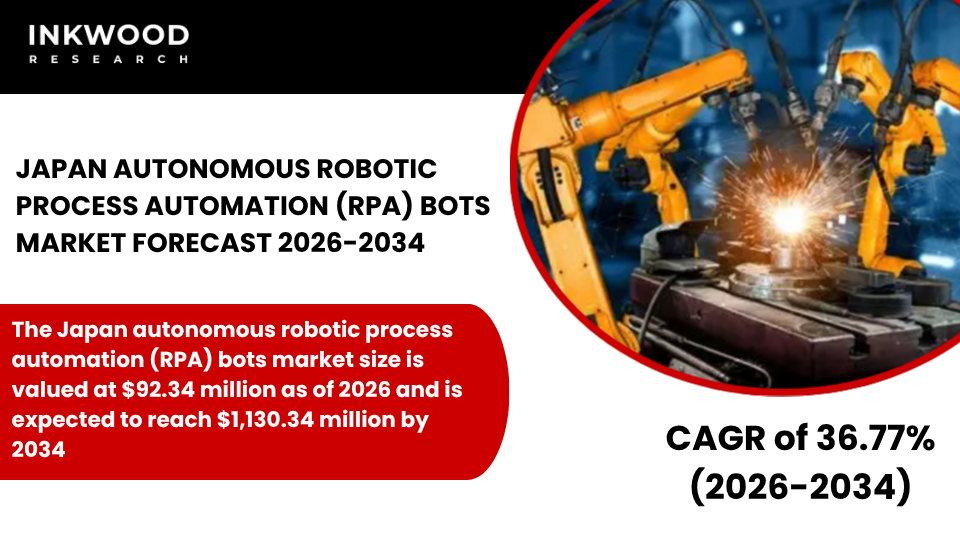
The Japan autonomous robotic process automation (RPA) bots market size is valued at $92.34 million as of 2026 and is expected to reach $1,130.34 million by 2034, progressing with a CAGR of 36.77% during the forecast years, 2026–2034.
MARKET INSIGHTS
Japan occupies a uniquely compelling position in the global autonomous robotic process automation (RPA) bots market. Unlike many other high-growth automation markets where cost reduction is the primary driver, Japan’s adoption imperative is structural and demographic in nature.
The country faces one of the most severe labor shortage crises in the developed world. According to the Ministry of Internal Affairs and Communications (MIC), Japan’s working-age population has been declining steadily for decades, and this trend shows no sign of reversing. As a result, enterprises across virtually every sector are under mounting pressure to maintain and grow operational output with a shrinking workforce.
Autonomous robotic process automation (RPA) bots have emerged as a direct response to this challenge, enabling organizations to automate high-volume, repetitive workflows without relying on headcount that is simply no longer available. This demographic urgency is converting what might elsewhere be a discretionary technology investment into a strategic operational necessity for Japanese enterprises.
The Japanese government has also been proactive in creating a policy environment that actively encourages autonomous RPA adoption. The Cabinet Office’s Society 5.0 initiative articulates a national vision for a human-centered digital society in which AI and automation technologies are deeply integrated into economic and social systems.
Complementing this, the Ministry of Economy, Trade and Industry (METI) has championed DX (Digital Transformation) promotion guidelines that specifically encourage large enterprises and SMEs alike to accelerate their adoption of intelligent automation platforms. On the regulatory side, Japan’s Act on the Protection of Personal Information (APPI), overseen by the Personal Information Protection Commission (PPC), governs how automated systems handle personal data.
This framework is shaping how enterprises design their autonomous RPA architectures, driving demand for solutions that embed privacy compliance and audit-ready data governance as default capabilities. For vendors seeking market entry, alignment with APPI requirements and demonstrated DX initiative compatibility are increasingly important differentiators in Japanese enterprise procurement processes.
Beyond demographics and policy, Japan’s industrial structure creates particularly rich opportunities for next-generation RPA automation. The country’s manufacturing sector, which encompasses globally dominant automotive, electronics, and precision engineering industries, is deploying intelligent RPA bots extensively across procurement reconciliation, supply chain data management, production reporting, and ERP workflow automation. At the same time, Japan’s BFSI sector, one of the world’s largest by asset value, is channeling significant investment into AI-powered RPA bots to manage compliance reporting, transaction processing, and back-office operations more efficiently.
The growing availability of Japanese-language compatible automation platforms and localized implementation support from both global vendors and domestic technology partners is further accelerating enterprise deployment timelines. Collectively, these factors are set to sustain strong and accelerating growth in the Japan autonomous robotic process automation (RPA) bots market throughout the forecast period.
To Know More About This Report, Request a Free Sample Copy
SEGMENTATION ANALYSIS
The Japan autonomous robotic process automation (RPA) bots market is segmented by autonomy level, capability type, deployment model, enterprise size, and industry vertical. The autonomy level segment is further categorized into semi-autonomous RPA bots and fully autonomous RPA bots.
The fully autonomous RPA bots sub-segment is gaining significant traction within the Japan autonomous robotic process automation (RPA) bots market, driven by the country’s acute need for uninterrupted, human-independent process execution across business-critical workflows. Fully autonomous RPA bots operate end-to-end without requiring human intervention, leveraging AI, machine learning, and cognitive automation capabilities to handle exceptions, make contextual decisions, and continuously optimize process performance in real time.
In Japan, where staffing constraints make the human-in-the-loop model increasingly impractical for high-volume operations, this level of autonomy is not simply desirable but operationally essential. Large Japanese banks, insurers, and manufacturers are particularly drawn to fully autonomous configurations for processes such as nightly reconciliation runs, regulatory report generation, and supply chain exception management, all of which must execute reliably outside of standard working hours.
Furthermore, METI’s DX promotion guidelines specifically encourage enterprises to move beyond attended automation toward fully autonomous digital workforce models, providing institutional validation for this sub-segment’s growth trajectory. As AI capabilities embedded within leading RPA platforms continue to mature, the barrier to deploying fully autonomous bots across complex, multi-system environments is steadily lowering, making this sub-segment the highest-growth opportunity within Japan’s broader autonomous RPA automation landscape.
COMPETITIVE INSIGHTS
Some of the top players operating in the Japan autonomous robotic process automation (RPA) bots market include UiPath Inc, Microsoft Corporation, IBM Corporation, SS&C Blue Prism Limited, etc.
Appian Corporation is a McLean, Virginia-headquartered enterprise software company that offers a unified low-code automation platform combining autonomous RPA bots, AI-powered process orchestration, and business process management capabilities. In Japan, Appian serves enterprises across the BFSI, manufacturing, and government sectors, enabling organizations to design and deploy intelligent RPA bots through a low-code interface that significantly reduces implementation complexity and time-to-value. Its platform’s emphasis on process governance, compliance auditability, and seamless integration with existing enterprise systems makes it particularly well-suited to the structured, compliance-conscious automation requirements of large Japanese organizations navigating DX transformation mandates.
REPORT SYNOPSIS
| REPORT SCOPE | DETAILS |
|---|---|
| Market Forecast Years | 2026-2034 |
| Base Year | 2025 |
| Market Historical Years | 2022-2024 |
| Forecast Units | Revenue ($ Million) |
| Segments Analyzed | Autonomy Level, Capability Type, Deployment Model, Enterprise Size, Industry Vertical |
| Country Analyzed | Japan |
| Companies Analyzed | UiPath Inc, Automation Anywhere Inc, SS&C Blue Prism Limited, Microsoft Corporation, IBM Corporation, SAP SE, NICE Ltd, Appian Corporation |
TABLE OF CONTENTS
RESEARCH SCOPE & METHODOLOGY
- STUDY OBJECTIVES
- METHODOLOGY
- ASSUMPTIONS & LIMITATIONS
EXECUTIVE SUMMARY
- MARKET SIZE, SHARE & ESTIMATES
- MARKET OVERVIEW
- SCOPE OF STUDY
- MAJOR MARKET FINDINGS
- HIGH LABOR SHORTAGES AND AN AGING WORKFORCE ARE DRIVING ENTERPRISES IN JAPAN TO DEPLOY AUTONOMOUS RPA BOTS FOR CONTINUOUS BUSINESS PROCESS AUTOMATION
- JAPANESE ENTERPRISES ARE RAPIDLY INTEGRATING AI-ENABLED RPA WITH LEGACY ENTERPRISE SYSTEMS TO IMPROVE OPERATIONAL EFFICIENCY AND REDUCE HUMAN DEPENDENCY
- THE BFSI AND MANUFACTURING SECTORS REPRESENT THE LARGEST ADOPTERS OF AUTONOMOUS RPA BOTS FOR DATA PROCESSING, COMPLIANCE MONITORING, AND SUPPLY CHAIN AUTOMATION
- LOCAL TECHNOLOGY VENDORS AND GLOBAL AUTOMATION PROVIDERS ARE EXPANDING INVESTMENTS IN JAPAN TO SUPPORT ADVANCED AUTONOMOUS DIGITAL WORKFORCE IMPLEMENTATION
MARKET DYNAMICS
- KEY DRIVERS
- SEVERE LABOR SHORTAGES AND DEMOGRAPHIC PRESSURES ARE ENCOURAGING JAPANESE ORGANIZATIONS TO IMPLEMENT AUTONOMOUS RPA FOR SUSTAINABLE WORKFORCE AUGMENTATION
- STRONG DIGITAL TRANSFORMATION INITIATIVES ACROSS FINANCIAL SERVICES AND MANUFACTURING ARE ACCELERATING ADOPTION OF INTELLIGENT AUTOMATION SOLUTIONS
- GOVERNMENT SUPPORT FOR AI AND ROBOTICS INNOVATION IS PROMOTING ENTERPRISE INVESTMENT IN AUTONOMOUS PROCESS AUTOMATION TECHNOLOGIES
- HIGH DEMAND FOR ERROR REDUCTION AND PROCESS STANDARDIZATION IN COMPLEX BUSINESS OPERATIONS IS BOOSTING AUTONOMOUS RPA DEPLOYMENTS
- KEY RESTRAINTS
- INTEGRATION CHALLENGES WITH LEGACY ENTERPRISE SYSTEMS AND TRADITIONAL WORKFLOWS SLOW DOWN AUTONOMOUS RPA IMPLEMENTATION
- HIGH INITIAL INVESTMENT COSTS AND ENTERPRISE CHANGE MANAGEMENT REQUIREMENTS LIMIT ADOPTION AMONG SMALL AND MEDIUM-SIZED COMPANIES
- STRICT DATA PRIVACY AND REGULATORY COMPLIANCE FRAMEWORKS CREATE OPERATIONAL COMPLEXITIES FOR AUTONOMOUS DIGITAL WORKFORCE DEPLOYMENTS
- LIMITED AVAILABILITY OF SPECIALIZED AUTOMATION SKILLS AND RPA ARCHITECTURE EXPERTISE RESTRAINS MARKET SCALABILITY
- KEY DRIVERS
STRATEGIC MARKET ANALYTICS
- GROWTH METRICS
- TAM, SAM & SOM OPPORTUNITY ANALYSIS
- EMERGING MARKET TRENDS & PARADIGM SHIFTS
- INCREASING ADOPTION OF AI-DRIVEN SELF-LEARNING RPA BOTS CAPABLE OF ADAPTING TO CHANGING BUSINESS RULES AND PROCESS CONDITIONS
- GROWING DEPLOYMENT OF AUTONOMOUS RPA IN BACK-OFFICE OPERATIONS SUCH AS FINANCE, HUMAN RESOURCES, AND PROCUREMENT MANAGEMENT
- ENTERPRISES ARE SHIFTING TOWARD HYPERAUTOMATION STRATEGIES THAT COMBINE RPA, MACHINE LEARNING, AND PROCESS MINING PLATFORMS
- JAPANESE CORPORATIONS ARE EXPANDING DIGITAL WORKFORCE MANAGEMENT SYSTEMS TO ORCHESTRATE AUTONOMOUS BOTS AT SCALE
- PORTER’S FIVE FORCES ANALYSIS
- BUYERS POWER
- SUPPLIERS POWER
- SUBSTITUTION
- NEW ENTRANTS
- INDUSTRY RIVALRY
- PESTLE ANALYSIS
- POLITICAL
- ECONOMIC
- SOCIAL LANDSCAPE
- TECHNOLOGY
- LEGAL
- ENVIRONMENTAL
- GROWTH OPPORTUNITY MAPPING & HEATMAP
- GROWTH PROSPECT MAPPING FOR JAPAN
- MARKET MATURITY & LIFECYCLE ANALYSIS
- MARKET CONCENTRATION ANALYSIS
- GROWTH METRICS
AUTONOMOUS ROBOTIC PROCESS AUTOMATION (RPA) BOTS VALUE CHAIN & DECISION FRAMEWORK
- VALUE CHAIN ANALYSIS
- AI MODEL DEVELOPMENT
- RPA PLATFORM DEVELOPMENT
- SYSTEM INTEGRATION SERVICES
- BOT DEPLOYMENT MANAGEMENT
- PROCESS MONITORING ANALYTICS
- ENTERPRISE SUPPORT SERVICES
- KEY BUYING CRITERIA
- AUTOMATION SCALABILITY
- AI INTEGRATION CAPABILITY
- DEPLOYMENT FLEXIBILITY
- ENTERPRISE SECURITY COMPLIANCE
- PRICING MODELS, LICENSING STRUCTURES & COST OPTIMIZATION STRATEGIES
- REGULATORY & POLICY LANDSCAPE ANALYSIS
- VALUE CHAIN ANALYSIS
AUTONOMOUS ROBOTIC PROCESS AUTOMATION (RPA) BOTS MARKET BY AUTONOMY LEVEL
- SEMI-AUTONOMOUS RPA BOTS
- MARKET SIZE, FORECAST & SHARE (2022–2034)
- FULLY AUTONOMOUS RPA BOTS
- MARKET SIZE, FORECAST & SHARE (2022–2034)
- SEMI-AUTONOMOUS RPA BOTS
AUTONOMOUS ROBOTIC PROCESS AUTOMATION (RPA) BOTS MARKET BY CAPABILITY TYPE
- SELF-HEALING AUTOMATION
- MARKET SIZE, FORECAST & SHARE (2022–2034)
- SELF-LEARNING AUTOMATION
- MARKET SIZE, FORECAST & SHARE (2022–2034)
- DECISION-AWARE AUTOMATION
- MARKET SIZE, FORECAST & SHARE (2022–2034)
- ADAPTIVE WORKFLOW AUTOMATION
- MARKET SIZE, FORECAST & SHARE (2022–2034)
- SELF-HEALING AUTOMATION
AUTONOMOUS ROBOTIC PROCESS AUTOMATION (RPA) BOTS MARKET BY DEPLOYMENT MODEL
- CLOUD-BASED
- MARKET SIZE, FORECAST & SHARE (2022–2034)
- ON-PREMISE
- MARKET SIZE, FORECAST & SHARE (2022–2034)
- HYBRID
- MARKET SIZE, FORECAST & SHARE (2022–2034)
- CLOUD-BASED
AUTONOMOUS ROBOTIC PROCESS AUTOMATION (RPA) BOTS MARKET BY ENTERPRISE SIZE
- LARGE ENTERPRISES
- MARKET SIZE, FORECAST & SHARE (2022–2034)
- SMES
- MARKET SIZE, FORECAST & SHARE (2022–2034)
- LARGE ENTERPRISES
AUTONOMOUS ROBOTIC PROCESS AUTOMATION (RPA) BOTS MARKET BY INDUSTRY VERTICAL
- BFSI
- MARKET SIZE, FORECAST & SHARE (2022–2034)
- HEALTHCARE
- MARKET SIZE, FORECAST & SHARE (2022–2034)
- TELECOM
- MARKET SIZE, FORECAST & SHARE (2022–2034)
- RETAIL & E-COMMERCE
- MARKET SIZE, FORECAST & SHARE (2022–2034)
- MANUFACTURING
- MARKET SIZE, FORECAST & SHARE (2022–2034)
- GOVERNMENT & PUBLIC SECTOR
- MARKET SIZE, FORECAST & SHARE (2022–2034)
- BFSI
COMPETITIVE LANDSCAPE
- KEY STRATEGIC DEVELOPMENTS
- MERGERS & ACQUISITIONS
- PRODUCT LAUNCHES & DEVELOPMENTS
- PARTNERSHIPS & AGREEMENTS
- BUSINESS EXPANSIONS & DIVESTITURES
- COMPETITOR POSITIONING & DIFFERENTIATION MAP
- COMPANY PROFILES
- UIPATH INC
- COMPANY OVERVIEW
- PRODUCT LIST
- STRENGTHS & CHALLENGES
- AUTOMATION ANYWHERE INC
- COMPANY OVERVIEW
- PRODUCT LIST
- STRENGTHS & CHALLENGES
- SS&C BLUE PRISM LIMITED
- COMPANY OVERVIEW
- PRODUCT LIST
- STRENGTHS & CHALLENGES
- MICROSOFT CORPORATION
- COMPANY OVERVIEW
- PRODUCT LIST
- STRENGTHS & CHALLENGES
- IBM CORPORATION
- COMPANY OVERVIEW
- PRODUCT LIST
- STRENGTHS & CHALLENGES
- SAP SE
- COMPANY OVERVIEW
- PRODUCT LIST
- STRENGTHS & CHALLENGES
- NICE LTD
- COMPANY OVERVIEW
- PRODUCT LIST
- STRENGTHS & CHALLENGES
- APPIAN CORPORATION
- COMPANY OVERVIEW
- PRODUCT LIST
- STRENGTHS & CHALLENGES
- UIPATH INC
- KEY STRATEGIC DEVELOPMENTS
LIST OF TABLES
TABLE 1: MARKET SNAPSHOT – AUTONOMOUS ROBOTIC PROCESS AUTOMATION (RPA) BOTS
TABLE 2: PRICING MODELS, LICENSING STRUCTURES & COST OPTIMIZATION STRATEGIES FOR AUTONOMOUS ROBOTIC PROCESS AUTOMATION (RPA) BOTS
TABLE 3: REGULATORY & POLICY LANDSCAPE ANALYSIS
TABLE 4: MARKET BY AUTONOMY LEVEL, HISTORICAL YEARS, 2022-2024 (IN $ MILLION)
TABLE 5: MARKET BY AUTONOMY LEVEL, FORECAST YEARS, 2026-2034 (IN $ MILLION)
TABLE 6: MARKET BY CAPABILITY TYPE, HISTORICAL YEARS, 2022-2024 (IN $ MILLION)
TABLE 7: MARKET BY CAPABILITY TYPE, FORECAST YEARS, 2026-2034 (IN $ MILLION)
TABLE 8: MARKET BY DEPLOYMENT MODEL, HISTORICAL YEARS, 2022-2024 (IN $ MILLION)
TABLE 9: MARKET BY DEPLOYMENT MODEL, FORECAST YEARS, 2026-2034 (IN $ MILLION)
TABLE 10: MARKET BY ENTERPRISE SIZE, HISTORICAL YEARS, 2022-2024 (IN $ MILLION)
TABLE 11: MARKET BY ENTERPRISE SIZE, FORECAST YEARS, 2026-2034 (IN $ MILLION)
TABLE 12: MARKET BY INDUSTRY VERTICAL, HISTORICAL YEARS, 2022-2024 (IN $ MILLION)
TABLE 13: MARKET BY INDUSTRY VERTICAL, FORECAST YEARS, 2026-2034 (IN $ MILLION)
TABLE 14: KEY PLAYERS OPERATING IN THE JAPANESE MARKET
TABLE 15: LIST OF MERGERS & ACQUISITIONS
TABLE 16: LIST OF PRODUCT LAUNCHES & DEVELOPMENTS
TABLE 17: LIST OF PARTNERSHIPS & AGREEMENTS
TABLE 18: LIST OF BUSINESS EXPANSIONS & DIVESTITURES
LIST OF FIGURES
FIGURE 1: MAJOR MARKET FINDINGS
FIGURE 2: MARKET DYNAMICS
FIGURE 3: KEY MARKET TRENDS
FIGURE 4: PORTER’S FIVE FORCES ANALYSIS
FIGURE 5: GROWTH PROSPECT MAPPING FOR JAPAN
FIGURE 6: MARKET MATURITY ANALYSIS
FIGURE 7: MARKET CONCENTRATION ANALYSIS
FIGURE 8: VALUE CHAIN ANALYSIS
FIGURE 9: KEY BUYING CRITERIA
FIGURE 10: SEGMENT GROWTH POTENTIAL, BY AUTONOMY LEVEL, IN 2025
FIGURE 11: SEMI-AUTONOMOUS RPA BOTS MARKET SIZE, 2026-2034 (IN $ MILLION)
FIGURE 12: FULLY AUTONOMOUS RPA BOTS MARKET SIZE, 2026-2034 (IN $ MILLION)
FIGURE 13: SEGMENT GROWTH POTENTIAL, BY CAPABILITY TYPE, IN 2025
FIGURE 14: SELF-HEALING AUTOMATION MARKET SIZE, 2026-2034 (IN $ MILLION)
FIGURE 15: SELF-LEARNING AUTOMATION MARKET SIZE, 2026-2034 (IN $ MILLION)
FIGURE 16: DECISION-AWARE AUTOMATION MARKET SIZE, 2026-2034 (IN $ MILLION)
FIGURE 17: ADAPTIVE WORKFLOW AUTOMATION MARKET SIZE, 2026-2034 (IN $ MILLION)
FIGURE 18: SEGMENT GROWTH POTENTIAL, BY DEPLOYMENT MODEL, IN 2025
FIGURE 19: CLOUD-BASED MARKET SIZE, 2026-2034 (IN $ MILLION)
FIGURE 20: ON-PREMISE MARKET SIZE, 2026-2034 (IN $ MILLION)
FIGURE 21: HYBRID MARKET SIZE, 2026-2034 (IN $ MILLION)
FIGURE 22: SEGMENT GROWTH POTENTIAL, BY ENTERPRISE SIZE, IN 2025
FIGURE 23: LARGE ENTERPRISES MARKET SIZE, 2026-2034 (IN $ MILLION)
FIGURE 24: SMES MARKET SIZE, 2026-2034 (IN $ MILLION)
FIGURE 25: SEGMENT GROWTH POTENTIAL, BY INDUSTRY VERTICAL, IN 2025
FIGURE 26: BFSI MARKET SIZE, 2026-2034 (IN $ MILLION)
FIGURE 27: HEALTHCARE MARKET SIZE, 2026-2034 (IN $ MILLION)
FIGURE 28: TELECOM MARKET SIZE, 2026-2034 (IN $ MILLION)
FIGURE 29: RETAIL & E-COMMERCE MARKET SIZE, 2026-2034 (IN $ MILLION)
FIGURE 30: MANUFACTURING MARKET SIZE, 2026-2034 (IN $ MILLION)
FIGURE 31: GOVERNMENT & PUBLIC SECTOR MARKET SIZE, 2026-2034 (IN $ MILLION)
FAQ’s
RELATED REPORTS
-
UNITED STATES AI-DRIVEN CLOUD MIGRATION SERVICES MARKET FORECAST 2026-2034
-
UNITED KINGDOM AI-DRIVEN CLOUD MIGRATION SERVICES MARKET FORECAST 2026-2034
-
UNITED ARAB EMIRATES AI-DRIVEN CLOUD MIGRATION SERVICES MARKET FORECAST 2026-2034
-
SOUTH KOREA AI-DRIVEN CLOUD MIGRATION SERVICES MARKET FORECAST 2026-2034
-

SINGAPORE AI-DRIVEN CLOUD MIGRATION SERVICES MARKET FORECAST 2026-2034
-
SAUDI ARABIA AI-DRIVEN CLOUD MIGRATION SERVICES MARKET FORECAST 2026-2034
-
AUSTRALIA AI-DRIVEN CLOUD MIGRATION SERVICES MARKET FORECAST 2026-2034
-
JAPAN AI-DRIVEN CLOUD MIGRATION SERVICES MARKET FORECAST 2026-2034
-
INDIA AI-DRIVEN CLOUD MIGRATION SERVICES MARKET FORECAST 2026-2034
-
CHINA AI-DRIVEN CLOUD MIGRATION SERVICES MARKET FORECAST 2026-2034