Turkey Solar Encapsulation Market by Material Type (Ethylene Vinyl Acetate (EVA), Polyolefin Elastomers (POE), Polyvinyl Butyral (PVB), Silicone & Ionomer, Other Material Types) Market by Technology (Module Construction) (Glass-Backsheet, Glass-Glass (Double Glass), Building-Integrated Photovoltaics (BIPV)) Market by Application (Photovoltaics (PV) (Utility-Scale, Commercial & Industrial (C&I), Residential), Transportation & Mobility, Consumer Electronics)
TURKEY STATES SOLAR ENCAPSULATION MARKET OVERVIEW
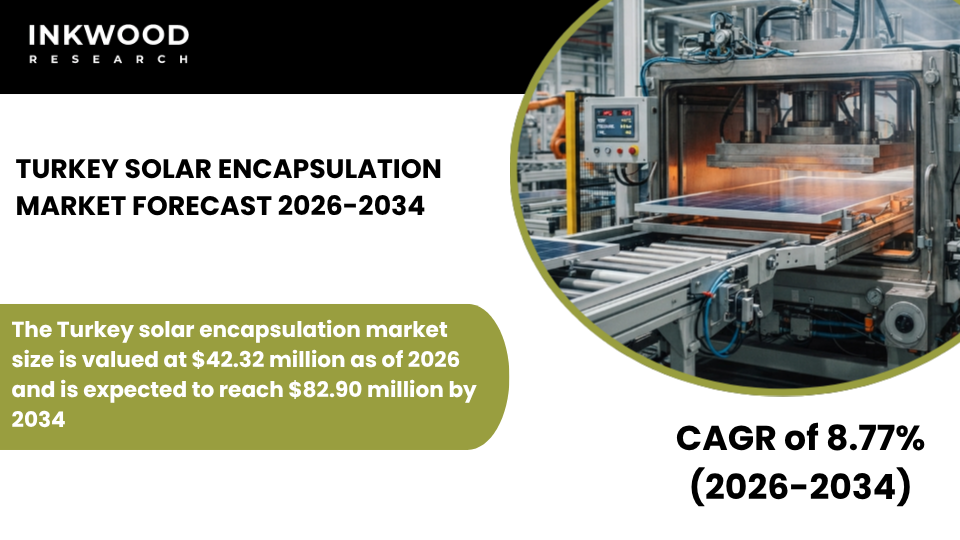
The Turkey solar encapsulation market size is valued at $42.32 million as of 2026 and is expected to reach $82.90 million by 2034, progressing with a CAGR of 8.77% during the forecast years, 2026-2034.
Turkey’s solar encapsulation market reflects the nation’s remarkable renewable energy transformation, driven by aggressive capacity expansion targets and favorable geographic positioning. The country’s solar installed capacity reached 19.6 gigawatts by late 2024, achieving its 2025 target approximately 18 months ahead of schedule and demonstrating extraordinary momentum in deployment velocity.
According to the Republic of Turkey Ministry of Energy and Natural Resources, solar energy contributed 8.7% of Turkey’s electricity generation in 2024, marking substantial progress from negligible levels just a decade earlier. This rapid expansion creates corresponding demand for encapsulation materials protecting photovoltaic cells throughout extended operational lifetimes.
Furthermore, Turkey’s strategic focus on energy security following historical dependence on imported natural gas drives continued solar investments, as renewable installations help reduce foreign currency exposure and enhance domestic energy resilience. The market benefits particularly from unlicensed solar installations, accounting for 90% of new capacity additions over recent years, primarily serving commercial and industrial self-consumption applications where project economics favor cost-effective encapsulant solutions.
Additionally, Turkey’s exceptional solar irradiation levels, especially across southeastern Anatolia and Mediterranean coastal regions, provide natural advantages encouraging large-scale deployments requiring reliable encapsulation materials withstanding intense ultraviolet exposure and temperature extremes. However, the market faces challenges from currency volatility affecting imported raw material costs and limited access to premium encapsulation technologies compared to more established European markets.
To Know More About This Report, Request a Free Sample Copy
The Turkey solar encapsulation market is segmented into material type, technology (module construction), and application. The technology (module construction) segment is further categorized into glass-backsheet, glass-glass (double glass), and building-integrated photovoltaics (BIPV).
Glass-backsheet configurations dominate Turkey’s solar encapsulation market due to cost advantages critical for price-sensitive project economics characterizing the nation’s rapidly expanding installations. Traditional glass-backsheet module designs utilize single front glass layers combined with polymer backsheets, requiring encapsulant materials to bond crystalline silicon solar cells while providing electrical insulation and environmental protection at competitive pricing.
Turkish solar developers, particularly those operating unlicensed systems for self-consumption, prioritize upfront cost minimization over premium durability features, making glass-backsheet architectures economically attractive for achieving acceptable payback periods. Consequently, ethylene-vinyl acetate encapsulants remain prevalent throughout Turkey’s module manufacturing ecosystem, offering proven performance characteristics at accessible price points suitable for market conditions.
The technology’s established supply chains and straightforward manufacturing processes further support adoption among Turkey’s growing domestic module production capabilities, seeking cost-efficient components. However, glass-backsheet modules face increasing scrutiny regarding long-term durability concerns, as backsheet degradation from prolonged ultraviolet exposure and moisture ingress can compromise module lifetimes, particularly relevant given Turkey’s high solar irradiation environments.
Despite these limitations, glass-backsheet configurations maintain market leadership throughout Turkey’s utility-scale and commercial segments, where initial capital expenditure constraints outweigh lifecycle performance considerations. Meanwhile, glass-glass alternatives incorporating encapsulants between dual glass layers are gradually gaining adoption among premium residential installations and export-oriented module manufacturers targeting quality-conscious European markets.
These bifacial-compatible architectures offer superior moisture resistance and mechanical durability, addressing potential-induced degradation risks increasingly important for high-efficiency module technologies entering Turkish production facilities.
Some of the top players operating in the Turkey solar encapsulation market include Coveme SpA, Arkema SA, DuPont de Nemours Inc, Dow Inc, etc.
Coveme SpA operates as an Italian specialty materials manufacturer with significant backsheet and encapsulant capabilities serving Turkey’s expanding photovoltaic sector. Headquartered in Bologna, Coveme produces multilayer polymer films and functional coatings for solar module applications, with particular expertise in backsheet technologies complementing encapsulant offerings.
The company’s DyMat backsheet product line delivers weather-resistant protection layers widely specified throughout Mediterranean climate installations similar to Turkey’s environmental conditions, where prolonged sunlight exposure and temperature cycling demand robust material performance. Coveme’s regional presence through distribution partnerships enables responsive technical support for Turkish module assemblers navigating quality requirements while managing cost pressures inherent to competitive market dynamics.
Moreover, the company supplies materials compatible with both traditional glass-backsheet configurations and emerging glass-glass architectures, providing flexibility as Turkish manufacturers diversify product portfolios targeting domestic and export markets. Coveme’s fluoropolymer-free backsheet alternatives address environmental concerns increasingly influencing procurement decisions among sustainability-focused developers and corporate solar installations.
The company also offers encapsulant films optimized for high-temperature lamination processes common throughout Turkish module manufacturing facilities equipped with standard production equipment. Recent developments include enhanced adhesion formulations improving long-term bonding reliability between encapsulants and backsheet layers, addressing delamination risks that can compromise module warranties.
REPORT SYNOPSIS
| REPORT SCOPE | DETAILS |
|---|---|
| Market Forecast Years | 2026-2034 |
| Base Year | 2025 |
| Market Historical Years | 2022-2024 |
| Forecast Units | Revenue ($ Million) |
| Segments Analyzed | Material Type, Technology (Module Construction), and Application |
| Country Analyzed | Turkey |
| Companies Analyzed | DuPont de Nemours Inc, Dow Inc, Coveme SpA, Arkema SA, Eastman Chemical Company |
TABLE OF CONTENTS
RESEARCH SCOPE & METHODOLOGY
- STUDY OBJECTIVES
- METHODOLOGY
- ASSUMPTIONS & LIMITATIONS
EXECUTIVE SUMMARY
- MARKET SIZE & FORECAST
- MARKET OVERVIEW
- SCOPE OF STUDY
- CRISIS SCENARIO ANALYSIS
- MAJOR MARKET FINDINGS
- TURKEY’S SOLAR ENCAPSULATION MARKET IS DRIVEN BY STRONG GROWTH IN DOMESTIC SOLAR INSTALLATIONS
- COST EFFECTIVE EVA ENCAPSULANTS DOMINATE DUE TO PRICE-SENSITIVE PROJECT ECONOMICS
- LOCAL MANUFACTURING CAPABILITIES ARE EXPANDING TO REDUCE IMPORT DEPENDENCE
- UTILITY SCALE AND C AND I SEGMENTS ACCOUNT FOR THE MAJORITY OF DEMAND
MARKET DYNAMICS
- KEY DRIVERS
- GOVERNMENT SUPPORT FOR RENEWABLE ENERGY IS BOOSTING SOLAR PROJECT DEVELOPMENT
- RISING ELECTRICITY DEMAND AND ENERGY SECURITY CONCERNS SUPPORT SOLAR INVESTMENTS
- FAVORABLE SOLAR IRRADIATION CONDITIONS ENCOURAGE LARGE-SCALE DEPLOYMENTS
- GROWING LOCAL MODULE MANUFACTURING BASE IS INCREASING ENCAPSULANT CONSUMPTION
- KEY RESTRAINTS
- LIMITED ACCESS TO ADVANCED ENCAPSULATION TECHNOLOGIES RESTRICTS PRODUCT DIVERSITY
- CURRENCY FLUCTUATIONS INCREASE COST UNCERTAINTY FOR IMPORTED RAW MATERIALS
- FINANCING CHALLENGES CAN DELAY PROJECT EXECUTION
- GRID INFRASTRUCTURE LIMITATIONS IN CERTAIN REGIONS CONSTRAIN INSTALLATION SPEED
- KEY DRIVERS
KEY ANALYTICS
- KEY MARKET TRENDS
- GRADUAL SHIFT TOWARD HIGHER QUALITY ENCAPSULANTS FOR EXPORT-ORIENTED MODULES
- INCREASING LOCALIZATION OF SOLAR COMPONENT SUPPLY CHAINS
- RISING INTEREST IN BIFACIAL AND HIGH-EFFICIENCY MODULE TECHNOLOGIES
- FOCUS ON COST OPTIMIZATION ACROSS THE MODULE VALUE CHAIN
- PORTER’S FIVE FORCES ANALYSIS
- BUYERS POWER
- SUPPLIERS POWER
- SUBSTITUTION
- NEW ENTRANTS
- INDUSTRY RIVALRY
- GROWTH PROSPECT MAPPING
- GROWTH PROSPECT MAPPING FOR TURKEY
- MARKET MATURITY ANALYSIS
- MARKET CONCENTRATION ANALYSIS
- VALUE CHAIN ANALYSIS
- RAW MATERIAL SUPPLIERS
- POLYMER COMPOUNDING
- ENCAPSULANT MANUFACTURING
- FILM EXTRUSION
- MODULE ASSEMBLY
- SOLAR PROJECT DEPLOYMENT
- KEY BUYING CRITERIA
- LONG-TERM DURABILITY
- CELL COMPATIBILITY
- COST EFFICIENCY
- SUPPLIER RELIABILITY
- REGULATORY FRAMEWORK
- KEY MARKET TRENDS
SOLAR ENCAPSULATION MARKET BY MATERIAL TYPE
- ETHYLENE VINYL ACETATE (EVA)
- POLYOLEFIN ELASTOMERS (POE)
- POLYVINYL BUTYRAL (PVB)
- SILICONE & IONOMER
- OTHER MATERIAL TYPES
SOLAR ENCAPSULATION MARKET BY TECHNOLOGY (MODULE CONSTRUCTION)
- GLASS-BACKSHEET
- GLASS-GLASS (DOUBLE GLASS)
- BUILDING-INTEGRATED PHOTOVOLTAICS (BIPV)
SOLAR ENCAPSULATION MARKET BY APPLICATION
- PHOTOVOLTAICS (PV)
- UTILITY-SCALE
- COMMERCIAL & INDUSTRIAL (C&I)
- RESIDENTIAL
- TRANSPORTATION & MOBILITY
- CONSUMER ELECTRONICS
- PHOTOVOLTAICS (PV)
COMPETITIVE LANDSCAPE
- KEY STRATEGIC DEVELOPMENTS
- MERGERS & ACQUISITIONS
- PRODUCT LAUNCHES & DEVELOPMENTS
- PARTNERSHIPS & AGREEMENTS
- BUSINESS EXPANSIONS & DIVESTITURES
- COMPANY PROFILES
- DUPONT DE NEMOURS INC
- COMPANY OVERVIEW
- PRODUCT LIST
- STRENGTHS & CHALLENGES
- DOW INC
- COMPANY OVERVIEW
- PRODUCT LIST
- STRENGTHS & CHALLENGES
- COVEME SPA
- COMPANY OVERVIEW
- PRODUCT LIST
- STRENGTHS & CHALLENGES
- ARKEMA SA
- COMPANY OVERVIEW
- PRODUCT LIST
- STRENGTHS & CHALLENGES
- EASTMAN CHEMICAL COMPANY
- COMPANY OVERVIEW
- PRODUCT LIST
- STRENGTHS & CHALLENGES
- DUPONT DE NEMOURS INC
- KEY STRATEGIC DEVELOPMENTS
LIST OF TABLES
TABLE 1: MARKET SNAPSHOT – SOLAR ENCAPSULATION
TABLE 2: SOLAR ENCAPSULATION MARKET REGULATORY FRAMEWORK
TABLE 3: MARKET BY MATERIAL TYPE, HISTORICAL YEARS, 2022-2024 (IN $ MILLION)
TABLE 4: MARKET BY MATERIAL TYPE, FORECAST YEARS, 2026-2034 (IN $ MILLION)
TABLE 5: MARKET BY TECHNOLOGY (MODULE CONSTRUCTION), HISTORICAL YEARS, 2022-2024 (IN $ MILLION)
TABLE 6: MARKET BY TECHNOLOGY (MODULE CONSTRUCTION), FORECAST YEARS, 2026-2034 (IN $ MILLION)
TABLE 7: MARKET BY APPLICATION, HISTORICAL YEARS, 2022-2024 (IN $ MILLION)
TABLE 8: MARKET BY APPLICATION, FORECAST YEARS, 2026-2034 (IN $ MILLION)
TABLE 9: MARKET BY PHOTOVOLTAICS (PV), HISTORICAL YEARS, 2022-2024 (IN $ MILLION)
TABLE 10: MARKET BY PHOTOVOLTAICS (PV), FORECAST YEARS, 2026-2034 (IN $ MILLION)
TABLE 11: KEY PLAYERS OPERATING IN THE TURKISH MARKET
TABLE 12: LIST OF MERGERS & ACQUISITIONS
TABLE 13: LIST OF PRODUCT LAUNCHES & DEVELOPMENTS
TABLE 14: LIST OF PARTNERSHIPS & AGREEMENTS
TABLE 15: LIST OF BUSINESS EXPANSIONS & DIVESTITURES
LIST OF FIGURES
FIGURE 1: KEY MARKET TRENDS
FIGURE 2: PORTER’S FIVE FORCES ANALYSIS
FIGURE 3: GROWTH PROSPECT MAPPING FOR TURKEY
FIGURE 4: MARKET MATURITY ANALYSIS
FIGURE 5: MARKET CONCENTRATION ANALYSIS
FIGURE 6: VALUE CHAIN ANALYSIS
FIGURE 7: KEY BUYING CRITERIA
FIGURE 8: SEGMENT GROWTH POTENTIAL, BY MATERIAL TYPE, IN 2025
FIGURE 9: ETHYLENE VINYL ACETATE (EVA) MARKET SIZE, 2026-2034 (IN $ MILLION)
FIGURE 10: POLYOLEFIN ELASTOMERS (POE) MARKET SIZE, 2026-2034 (IN $ MILLION)
FIGURE 11: POLYVINYL BUTYRAL (PVB) MARKET SIZE, 2026-2034 (IN $ MILLION)
FIGURE 12: SILICONE & IONOMER MARKET SIZE, 2026-2034 (IN $ MILLION)
FIGURE 13: OTHER MATERIAL TYPES MARKET SIZE, 2026-2034 (IN $ MILLION)
FIGURE 14: SEGMENT GROWTH POTENTIAL, BY TECHNOLOGY (MODULE CONSTRUCTION), IN 2025
FIGURE 15: GLASS-BACKSHEET MARKET SIZE, 2026-2034 (IN $ MILLION)
FIGURE 16: GLASS-GLASS (DOUBLE GLASS) MARKET SIZE, 2026-2034 (IN $ MILLION)
FIGURE 17: BUILDING-INTEGRATED PHOTOVOLTAICS (BIPV) MARKET SIZE, 2026-2034 (IN $ MILLION)
FIGURE 18: SEGMENT GROWTH POTENTIAL, BY APPLICATION, IN 2025
FIGURE 19: PHOTOVOLTAICS (PV) MARKET SIZE, 2026-2034 (IN $ MILLION)
FIGURE 20: SEGMENT GROWTH POTENTIAL, BY PHOTOVOLTAICS (PV), IN 2025
FIGURE 21: UTILITY-SCALE MARKET SIZE, 2026-2034 (IN $ MILLION)
FIGURE 22: COMMERCIAL & INDUSTRIAL (C&I) MARKET SIZE, 2026-2034 (IN $ MILLION)
FIGURE 23: RESIDENTIAL MARKET SIZE, 2026-2034 (IN $ MILLION)
FIGURE 24: TRANSPORTATION & MOBILITY MARKET SIZE, 2026-2034 (IN $ MILLION)
FIGURE 25: CONSUMER ELECTRONICS MARKET SIZE, 2026-2034 (IN $ MILLION)
FAQ’s
RELATED REPORTS
-

UNITED STATES AI-DRIVEN CLOUD MIGRATION SERVICES MARKET FORECAST 2026-2034
-

UNITED KINGDOM AI-DRIVEN CLOUD MIGRATION SERVICES MARKET FORECAST 2026-2034
-

UNITED ARAB EMIRATES AI-DRIVEN CLOUD MIGRATION SERVICES MARKET FORECAST 2026-2034
-

SOUTH KOREA AI-DRIVEN CLOUD MIGRATION SERVICES MARKET FORECAST 2026-2034
-

SINGAPORE AI-DRIVEN CLOUD MIGRATION SERVICES MARKET FORECAST 2026-2034
-

SAUDI ARABIA AI-DRIVEN CLOUD MIGRATION SERVICES MARKET FORECAST 2026-2034
-

AUSTRALIA AI-DRIVEN CLOUD MIGRATION SERVICES MARKET FORECAST 2026-2034
-

JAPAN AI-DRIVEN CLOUD MIGRATION SERVICES MARKET FORECAST 2026-2034
-

INDIA AI-DRIVEN CLOUD MIGRATION SERVICES MARKET FORECAST 2026-2034
-

CHINA AI-DRIVEN CLOUD MIGRATION SERVICES MARKET FORECAST 2026-2034