South Korea Liquefied Natural Gas (LNG) Market by LNG Infrastructure (LNG Liquefaction Plants, LNG Regasification Facilities, LNG Shipping & Transportation) Market by Application (Transportation, Industrial Feedstock, Power Generation, Other Applications) Market by Mode of Supply (Truck, Transshipment and Bunkering, Pipeline and Rail)
SOUTH KOREA LIQUEFIED NATURAL GAS (LNG) MARKET OVERVIEW
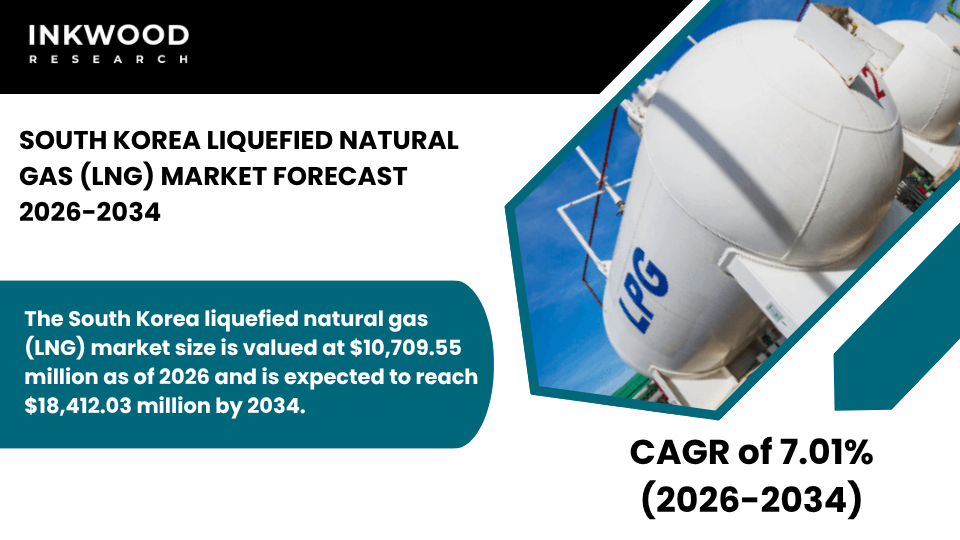
The South Korea liquefied natural gas (LNG) market size is valued at $10,709.55 million as of 2026 and is expected to reach $18,412.03 million by 2034, progressing with a CAGR of 7.01% during the forecast years, 2026-2034.
South Korea’s reliance on liquefied natural gas imports reflects the nation’s limited domestic energy resources and its strategic commitment to maintaining secure, diversified fuel supplies that support one of Asia’s most dynamic economies. The country has developed sophisticated procurement strategies that balance long-term contracts with spot market participation, thereby optimizing costs while ensuring reliable delivery throughout all seasons and market conditions.
According to the Ministry of Trade, Industry and Energy, the government actively supports infrastructure development and supply diversification as essential components of national energy security policy. Consequently, South Korea maintains extensive regasification capacity along its coastlines while continuously evaluating opportunities to enhance operational efficiency and expand import capabilities.
Power generation dominates South Korea’s liquefied natural gas consumption patterns as utilities depend heavily on combined-cycle gas turbine plants to meet baseload electricity demand across industrial, commercial, and residential sectors. These facilities deliver superior thermal efficiency compared to traditional coal-fired units while producing significantly lower emissions, aligning with the government’s environmental commitments and air quality improvement objectives.
Furthermore, gas-fired capacity provides the operational flexibility needed to balance intermittent renewable energy output from expanding solar and wind installations that increasingly contribute to the generation mix. The electricity sector’s sustained appetite for natural gas creates predictable demand patterns that underpin South Korea’s position among the world’s largest LNG importers, alongside Japan and China.
City gas distribution networks represent another critical application segment, delivering natural gas directly to millions of residential and commercial customers throughout urban areas nationwide. These systems connect regasification terminals to local distribution companies that manage the final delivery infrastructure serving households, restaurants, hospitals, and office buildings.
Residential consumers value natural gas for heating, cooking, and hot water applications that provide convenience, efficiency, and cleaner combustion compared to alternative fuels. Meanwhile, commercial establishments depend on reliable gas supplies to maintain business operations and customer services. This widespread adoption across the built environment creates stable, year-round demand that complements seasonal variations in power generation requirements.
To Know More About This Report, Request a Free Sample Copy
Industrial applications drive substantial liquefied natural gas consumption across South Korea’s manufacturing and petrochemical sectors, where companies utilize gas as both an energy source and essential feedstock for production processes. Chemical plants synthesize polymers, fertilizers, and specialty materials using natural gas derivatives, supporting export-oriented industries that compete globally.
Additionally, steel mills and automotive manufacturers increasingly adopt gas-based systems to reduce emissions while maintaining production efficiency and product quality standards. The food processing and electronics sectors similarly value natural gas for its clean combustion characteristics and precise temperature control capabilities that ensure consistent manufacturing outcomes.
South Korea’s procurement strategy emphasizes supply diversification across multiple producing regions to mitigate concentration risks and enhance negotiating leverage with suppliers. Major importers secure baseline volumes through multi-year agreements with established producers in Qatar, Australia, the United States, and Russia, ensuring predictable pricing frameworks and delivery schedules.
Additionally, companies increasingly participate in short-term markets to capitalize on favorable pricing opportunities when global supply exceeds demand or seasonal factors create temporary market imbalances. This balanced portfolio approach enables South Korean buyers to navigate volatile natural gas market conditions while maintaining the reliability that energy security requires.
Transportation fuel applications are gradually emerging as South Korea explores alternative solutions to reduce greenhouse gas emissions from its maritime shipping and heavy-duty vehicle sectors. Major ports develop LNG bunkering infrastructure to serve vessels transitioning away from heavy fuel oil in compliance with International Maritime Organization emission standards.
Furthermore, logistics companies evaluate natural gas as a viable alternative for long-haul trucking operations that currently depend heavily on diesel fuel. However, limited refueling infrastructure and vehicle conversion costs currently constrain broader adoption across these transportation segments. Nevertheless, government incentive programs and ongoing pilot projects suggest potential for incremental growth as the sector matures.
Regasification infrastructure forms the cornerstone of South Korea’s liquefied natural gas supply chain, with multiple large-scale terminals positioned strategically along the country’s extensive coastline to serve regional demand centers efficiently. These facilities transform cryogenic LNG back into gaseous form for injection into transmission pipelines that deliver gas to power plants, city gas networks, and industrial consumers nationwide.
Storage capacity at terminal sites provides operational flexibility that enables importers to manage cargo arrival schedules, accommodate seasonal demand variations, and maintain supply security during unexpected disruptions. Moreover, ongoing expansion projects and modernization initiatives ensure these critical assets continue meeting growing consumption requirements while incorporating advanced technologies that enhance safety and operational performance.
The South Korea liquefied natural gas (LNG) market is segmented into LNG infrastructure, application, and mode of supply. The application segment is further categorized into transportation, industrial feedstock, power generation, and other applications.
Industrial feedstock applications represent a vital consumption segment within South Korea’s highly developed manufacturing economy, where numerous sectors depend fundamentally on natural gas for both energy requirements and chemical production processes. Petrochemical complexes utilize gas as a primary feedstock for synthesizing ethylene, propylene, and various polymer products that serve domestic markets while supporting substantial export volumes.
The fertilizer industry similarly relies on natural gas for ammonia production through steam methane reforming processes that convert gas molecules into nitrogen-based compounds essential for agricultural productivity. Additionally, specialty chemical manufacturers produce advanced materials, pharmaceuticals, and electronic chemicals using natural gas derivatives in complex synthesis pathways. These industrial consumers typically secure long-term supply contracts directly with importers or through wholesale distributors to ensure consistent availability at predictable costs that support production planning and financial forecasting.
Moreover, manufacturing facilities often maintain backup fuel capabilities to protect against potential supply disruptions, though natural gas remains the preferred primary fuel due to its environmental advantages and operational efficiency benefits. Government policies increasingly mandate emission reductions from industrial sources, further reinforcing the attractiveness of cleaner energy solutions like natural gas compared to traditional coal or oil-based alternatives.
Some of the top players operating in the South Korea liquefied natural gas (LNG) market include KOGAS, SK E&S, POSCO Energy, and GS Energy, etc.
KOGAS (Korea Gas Corporation) operates as South Korea’s primary liquefied natural gas importer and wholesaler, headquartered in Daegu with operational responsibilities spanning procurement, regasification, transmission, and wholesale distribution. The state-owned company manages multiple coastal terminals, including facilities at Incheon, Pyeongtaek, Tongyeong, and Samcheok that collectively process the majority of South Korea’s LNG imports. KOGAS maintains diverse long-term supply relationships with international producers while actively participating in spot markets to optimize portfolio costs and ensure reliable delivery throughout all demand scenarios.
Furthermore, the company’s business model integrates terminal operations with extensive transmission pipeline networks that connect regasification facilities to city gas distributors, power generators, and industrial consumers nationwide. Additionally, KOGAS pursues international upstream investments and trading activities that enhance supply security while positioning the company as a global energy player beyond its domestic market role.
REPORT SYNOPSIS
| REPORT SCOPE | DETAILS |
|---|---|
| Market Forecast Years | 2026-2034 |
| Base Year | 2025 |
| Market Historical Years | 2022-2024 |
| Forecast Units | Revenue ($ Million) |
| Segments Analyzed | LNG Infrastructure, Application, and Mode of Supply |
| Country Analyzed | South Korea |
| Companies Analyzed | KOGAS, SK E&S, Korea Line LNG, POSCO Energy, GS Energy, Samsung C&T, Hyundai Heavy Industries |
TABLE OF CONTENTS
RESEARCH SCOPE & METHODOLOGY
- STUDY OBJECTIVES
- METHODOLOGY
- ASSUMPTIONS & LIMITATIONS
EXECUTIVE SUMMARY
- MARKET SIZE, SHARE & ESTIMATES
- MARKET OVERVIEW
- SCOPE OF STUDY
- CRISIS SCENARIO ANALYSIS
- MAJOR MARKET FINDINGS
- SOUTH KOREA MAINTAINS ITS POSITION AS A MAJOR LNG IMPORTER FOR POWER AND INDUSTRIAL USE
- LONG-TERM CONTRACTS ENSURE STABLE SUPPLY FROM DIVERSE GLOBAL SOURCES
- LNG REMAINS CENTRAL TO ENERGY SECURITY AND FUEL MIX STRATEGY
- INFRASTRUCTURE INVESTMENTS SUPPORT EFFICIENT IMPORT AND DISTRIBUTION
MARKET DYNAMICS
- KEY DRIVERS
- CONSISTENT DEMAND FROM POWER GENERATION AND CITY GAS SECTORS SUSTAINS IMPORTS
- GOVERNMENT POLICIES PRIORITIZE ENERGY DIVERSIFICATION AND SECURITY
- EXPANDED REGASIFICATION CAPACITY FACILITATES HIGHER VOLUMES
- ECONOMIC GROWTH SUPPORTS STEADY NATURAL GAS CONSUMPTION
- KEY RESTRAINTS
- ACCELERATED RENEWABLES DEPLOYMENT MAY MODERATE FUTURE LNG REQUIREMENTS
- GLOBAL MARKET COMPETITION AND PRICE VOLATILITY AFFECT PROCUREMENT
- HIGH IMPORT DEPENDENCE EXPOSES TO INTERNATIONAL MARKET RISKS
- TRANSITION TO LOW-CARBON ALTERNATIVES CREATES LONG-TERM UNCERTAINTY
- KEY DRIVERS
STRATEGIC MARKET ANALYTICS
- KEY MARKET TRENDS
- SOUTH KOREA PURSUES DIVERSIFIED AND FLEXIBLE SUPPLY PORTFOLIOS
- INCREASING INTEREST IN LOW-CARBON AND CERTIFIED LNG VOLUMES
- OPTIMIZATION OF CONTRACT STRUCTURES FOR COST MANAGEMENT
- INTEGRATION WITH ENERGY TRANSITION GOALS SUPPORTS SUSTAINABLE USE
- PORTER’S FIVE FORCES ANALYSIS
- BUYERS POWER
- SUPPLIERS POWER
- SUBSTITUTION
- NEW ENTRANTS
- INDUSTRY RIVALRY
- GROWTH PROSPECT MAPPING
- GROWTH PROSPECT MAPPING FOR SOUTH KOREA
- MARKET MATURITY ANALYSIS
- MARKET CONCENTRATION ANALYSIS
- VALUE CHAIN ANALYSIS
- EXPLORATION AND EXTRACTION
- LIQUEFACTION AND PROCESSING
- STORAGE AND TRANSPORTATION
- EXPORT AND DISTRIBUTION
- MARKETING AND SALES
- AFTER-SALES SERVICES
- KEY BUYING CRITERIA
- PRICE COMPETITIVENESS
- SUPPLY RELIABILITY
- QUALITY STANDARDS
- CONTRACT FLEXIBILITY
- FUTURE PROSPECTS OF LNG IN SOUTH KOREA
- TRADE
- EXPORTS
- IMPORTS
- LNG TERMINALS
- LIST OF LNG EXPORT TERMINALS
- REGULATORY FRAMEWORK AND COMPLIANCE BODIES
- KEY MARKET TRENDS
LIQUEFIED NATURAL GAS (LNG) MARKET BY LNG INFRASTRUCTURE
- LNG LIQUEFACTION PLANTS
- MARKET FORECAST FIGURE
- SEGMENT ANALYSIS
- LNG REGASIFICATION FACILITIES
- MARKET FORECAST FIGURE
- SEGMENT ANALYSIS
- LNG LIQUEFACTION PLANTS
LIQUEFIED NATURAL GAS (LNG) MARKET BY APPLICATION
- TRANSPORTATION
- MARKET FORECAST FIGURE
- SEGMENT ANALYSIS
- INDUSTRIAL FEEDSTOCK
- MARKET FORECAST FIGURE
- SEGMENT ANALYSIS
- POWER GENERATION
- MARKET FORECAST FIGURE
- SEGMENT ANALYSIS
- OTHER APPLICATIONS
- MARKET FORECAST FIGURE
- SEGMENT ANALYSIS
- TRANSPORTATION
LIQUEFIED NATURAL GAS (LNG) MARKET BY MODE OF SUPPLY
- TRUCK
- MARKET FORECAST FIGURE
- SEGMENT ANALYSIS
- TRANSSHIPMENT AND BUNKERING
- MARKET FORECAST FIGURE
- SEGMENT ANALYSIS
- PIPELINE AND RAIL
- MARKET FORECAST FIGURE
- SEGMENT ANALYSIS
- TRUCK
COMPETITIVE LANDSCAPE
- KEY STRATEGIC DEVELOPMENTS
- MERGERS & ACQUISITIONS
- PRODUCT LAUNCHES & DEVELOPMENTS
- PARTNERSHIPS & AGREEMENTS
- BUSINESS EXPANSIONS & DIVESTITURES
- COMPANY PROFILES
- KOGAS
- COMPANY OVERVIEW
- PRODUCT LIST
- STRENGTHS & CHALLENGES
- SK E&S
- COMPANY OVERVIEW
- PRODUCT LIST
- STRENGTHS & CHALLENGES
- KOREA LINE LNG
- COMPANY OVERVIEW
- PRODUCT LIST
- STRENGTHS & CHALLENGES
- POSCO ENERGY
- COMPANY OVERVIEW
- PRODUCT LIST
- STRENGTHS & CHALLENGES
- GS ENERGY
- COMPANY OVERVIEW
- PRODUCT LIST
- STRENGTHS & CHALLENGES
- SAMSUNG C&T
- COMPANY OVERVIEW
- PRODUCT LIST
- STRENGTHS & CHALLENGES
- HYUNDAI HEAVY INDUSTRIES
- COMPANY OVERVIEW
- PRODUCT LIST
- STRENGTHS & CHALLENGES
- KOGAS
- KEY STRATEGIC DEVELOPMENTS
LIST OF TABLES
TABLE 1: MARKET SNAPSHOT – LIQUEFIED NATURAL GAS (LNG)
TABLE 2: LIQUEFIED NATURAL GAS (LNG) MARKET REGULATORY FRAMEWORK
TABLE 3: SOUTH KOREA NATURAL GAS PRODUCTION, 2022-2024 (IN EXAJOULES)
TABLE 4: SOUTH KOREA NATURAL GAS CONSUMPTION, 2022-2024 (IN EXAJOULES)
TABLE 5: SOUTH KOREA LNG EXPORTS, 2022-2024 (IN BILLION CUBIC METERS)
TABLE 6: SOUTH KOREA LNG IMPORTS, 2022-2024 (IN BILLION CUBIC METERS)
TABLE 7: MARKET BY LNG INFRASTRUCTURE, HISTORICAL YEARS, 2022-2024 (IN $ MILLION)
TABLE 8: MARKET BY LNG INFRASTRUCTURE, FORECAST YEARS, 2026-2034 (IN $ MILLION)
TABLE 9: MARKET BY APPLICATION, HISTORICAL YEARS, 2022-2024 (IN $ MILLION)
TABLE 10: MARKET BY APPLICATION, FORECAST YEARS, 2026-2034 (IN $ MILLION)
TABLE 11: MARKET BY MODE OF SUPPLY, HISTORICAL YEARS, 2022-2024 (IN $ MILLION)
TABLE 12: MARKET BY MODE OF SUPPLY, FORECAST YEARS, 2026-2034 (IN $ MILLION)
TABLE 13: KEY PLAYERS OPERATING IN THE SOUTH KOREAN MARKET
TABLE 14: LIST OF MERGERS & ACQUISITIONS
TABLE 15: LIST OF PRODUCT LAUNCHES & DEVELOPMENTS
TABLE 16: LIST OF PARTNERSHIPS & AGREEMENTS
TABLE 17: LIST OF BUSINESS EXPANSIONS & DIVESTITURES
LIST OF FIGURES
FIGURE 1: KEY MARKET TRENDS
FIGURE 2: PORTER’S FIVE FORCES ANALYSIS
FIGURE 3: GROWTH PROSPECT MAPPING FOR SOUTH KOREA
FIGURE 4: MARKET MATURITY ANALYSIS
FIGURE 5: MARKET CONCENTRATION ANALYSIS
FIGURE 6: VALUE CHAIN ANALYSIS
FIGURE 7: KEY BUYING CRITERIA
FIGURE 8: SEGMENT GROWTH POTENTIAL, BY LNG INFRASTRUCTURE, IN 2025
FIGURE 9: LNG LIQUEFACTION PLANTS MARKET SIZE, 2026-2034 (IN $ MILLION)
FIGURE 10: LNG REGASIFICATION FACILITIES MARKET SIZE, 2026-2034 (IN $ MILLION)
FIGURE 11: SEGMENT GROWTH POTENTIAL, BY APPLICATION, IN 2025
FIGURE 12: TRANSPORTATION MARKET SIZE, 2026-2034 (IN $ MILLION)
FIGURE 13: INDUSTRIAL FEEDSTOCK MARKET SIZE, 2026-2034 (IN $ MILLION)
FIGURE 14: POWER GENERATION MARKET SIZE, 2026-2034 (IN $ MILLION)
FIGURE 15: OTHER APPLICATIONS MARKET SIZE, 2026-2034 (IN $ MILLION)
FIGURE 16: SEGMENT GROWTH POTENTIAL, BY MODE OF SUPPLY, IN 2025
FIGURE 17: TRUCK MARKET SIZE, 2026-2034 (IN $ MILLION)
FIGURE 18: TRANSSHIPMENT AND BUNKERING MARKET SIZE, 2026-2034 (IN $ MILLION)
FIGURE 19: PIPELINE AND RAIL MARKET SIZE, 2026-2034 (IN $ MILLION)
FAQ’s
RELATED REPORTS
-
UNITED STATES AI-DRIVEN CLOUD MIGRATION SERVICES MARKET FORECAST 2026-2034
-
UNITED KINGDOM AI-DRIVEN CLOUD MIGRATION SERVICES MARKET FORECAST 2026-2034
-
UNITED ARAB EMIRATES AI-DRIVEN CLOUD MIGRATION SERVICES MARKET FORECAST 2026-2034
-
SOUTH KOREA AI-DRIVEN CLOUD MIGRATION SERVICES MARKET FORECAST 2026-2034
-
SINGAPORE AI-DRIVEN CLOUD MIGRATION SERVICES MARKET FORECAST 2026-2034
-
SAUDI ARABIA AI-DRIVEN CLOUD MIGRATION SERVICES MARKET FORECAST 2026-2034
-
AUSTRALIA AI-DRIVEN CLOUD MIGRATION SERVICES MARKET FORECAST 2026-2034
-
JAPAN AI-DRIVEN CLOUD MIGRATION SERVICES MARKET FORECAST 2026-2034
-
INDIA AI-DRIVEN CLOUD MIGRATION SERVICES MARKET FORECAST 2026-2034
-
CHINA AI-DRIVEN CLOUD MIGRATION SERVICES MARKET FORECAST 2026-2034