
GLOBAL GAMIFIED CORPORATE TRAINING PLATFORMS MARKET FORECAST 2026-2034
SCOPE OF THE REPORT
Global Gamified Corporate Training Platforms Market by Deployment Model (Cloud-Based, On-Premises), Market by Application Area (Sales Training, Leadership Development, Compliance Training, Soft Skills Training, Onboarding), Market by Business Function (Human Resources, Learning and Development, Operations, Marketing, Sales), Market by Game Type (Simulation, Role-Playing, Puzzle-Solving, Strategy, Adventure), by Geography
GLOBAL GAMIFIED CORPORATE TRAINING PLATFORMS MARKET OVERVIEW
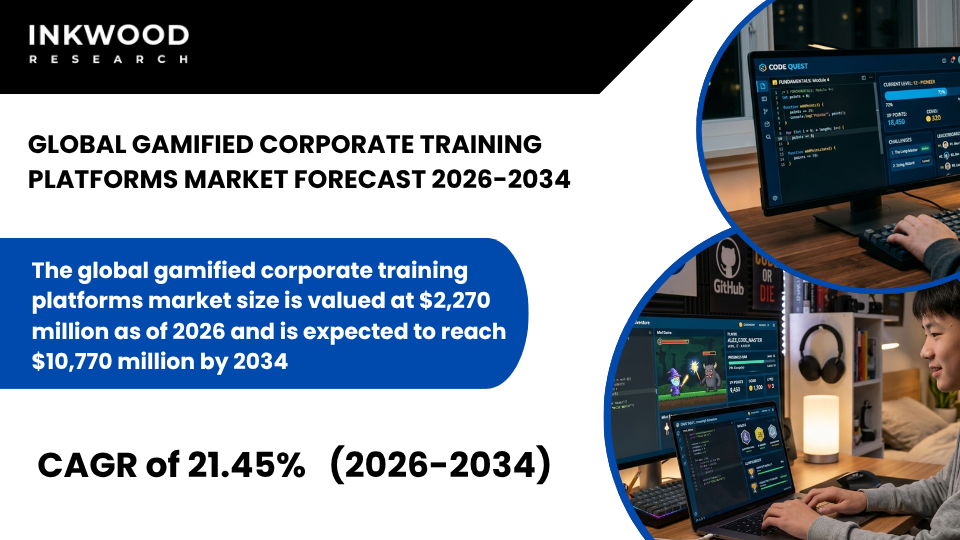
The global gamified corporate training platforms market size is valued at $2,270 million as of 2026 and is expected to reach $10,770 million by 2034, growing at a CAGR of 21.45% during the forecast period 2026–2034. The base year considered for the study is 2025, and the forecast period is between 2026 and 2034. The market study has also analyzed the crisis impact on the gamified corporate training platforms market qualitatively as well as quantitatively.
Gamified corporate training platforms are digital learning solutions that incorporate game design elements, such as points, badges, leaderboards, quests, progress bars, and rewards, into structured corporate training programs. Unlike conventional e-learning tools, these platforms are purpose-built to transform passive knowledge consumption into an active, engaging experience. They are deployed across a range of enterprise functions, from onboarding new hires to upskilling frontline staff and developing leadership capabilities.
Most modern gamified learning platforms for enterprises also integrate learning analytics dashboards, enabling HR and L&D teams to track individual and cohort-level performance in real time. As organizations increasingly shift toward blended and digital-first learning models, corporate learning gamification software has become a strategic priority for enterprises seeking to improve both training completion rates and measurable workforce outcomes.
The global gamified corporate training platforms market is expanding rapidly, driven by the convergence of digital workplace transformation, the rising cost of employee disengagement, and growing enterprise investment in workforce development technology. Organizations across industries are recognizing that traditional classroom-based or static e-learning approaches no longer meet the expectations of a modern, digitally native workforce. As a result, demand for gamification in corporate training is accelerating, with enterprises actively seeking platforms that combine instructional rigor with interactive, motivating mechanics that sustain learner attention and drive behavioral change.
To Know More About This Report, Request a Free Sample Copy
GROWTH ENABLERS
Key enablers of the global gamified corporate training platforms market growth:
- Rising demand for engaging and interactive learning methods is driving enterprises to implement gamification in corporate training programs
- The global shift toward digital workplaces and remote work environments is increasing the need for flexible online training solutions
- Organizations are investing in upskilling and reskilling initiatives to address rapid technological change and evolving job roles
- Advancements in learning analytics and AI-enabled personalization are improving training effectiveness and learner performance tracking
- According to the U.S. Bureau of Labor Statistics, employer spending on training and development has grown steadily over the past decade, reflecting broader strategic investment in human capital. Within this context, AI-enabled personalization has emerged as a critical differentiator among enterprise gamification platforms. By leveraging machine learning algorithms and real-time behavioral data, these platforms dynamically adjust content difficulty, learning paths, and reward structures to suit individual learner profiles.
- This adaptive approach not only improves knowledge retention but also reduces time-to-competency, a key metric for organizations managing rapid skill transitions. As AI capabilities mature, the integration of intelligent personalization into gamified e-learning platforms is expected to significantly improve return on training investment and expand adoption across large, geographically dispersed workforces.
Key growth restraining factors of the global gamified corporate training platforms market:
- High initial implementation costs and platform customization expenses can limit adoption among small and medium-sized enterprises
- Lack of internal expertise in game design and digital learning strategy can reduce the effectiveness of gamified training programs
- Data privacy and security concerns associated with cloud-based training platforms may restrict enterprise deployment in regulated industries
- Resistance to change from traditional training methods among certain organizational cultures can slow market adoption
- Cultural resistance to change remains one of the more persistent and often underestimated barriers to gamification adoption in workplace training. In many organizations, particularly those in legacy-heavy industries such as manufacturing, public administration, or traditional financial services, training is still closely associated with instructor-led classroom sessions or compliance-driven static modules. Introducing game mechanics into such environments can meet with skepticism from both management and employees who view game elements as trivial or inconsistent with professional development.
- This resistance can delay rollout timelines, reduce platform utilization rates, and ultimately diminish the ROI of gamified learning investments. Overcoming this restraint requires deliberate change management strategies, executive sponsorship, and clear internal communication about the measurable outcomes, such as improved completion rates and performance scores, that gamification in employee training can deliver.
KEY MARKET TRENDS
Global Gamified Corporate Training Platforms Industry | Top Trends
- AI-powered gamified learning platforms are reshaping how enterprises deliver personalized training at scale. By embedding machine learning into the learning engine, platforms can now analyze learner behavior in real time and dynamically modify content pathways, challenge levels, and reward structures. This shift from one-size-fits-all training to individualized learning journeys is proving particularly valuable in complex domains such as sales enablement, compliance training, and technical upskilling, where learner readiness and prior knowledge vary significantly across the workforce.
- Microlearning gamification platforms are gaining significant traction as enterprises seek to deliver bite-sized, high-impact training content that fits within the flow of work. By breaking down complex topics into short, focused modules and attaching game-based incentives, such as streaks, instant feedback, and level progression, these platforms dramatically improve daily engagement and long-term knowledge retention. This approach aligns with how modern employees actually consume information and is particularly effective for mobile gamified training platforms for employees in distributed or field-based roles.
- The rapid adoption of mobile-first enterprise strategies is accelerating demand for mobile gamified training platforms for employees, especially in industries with large, geographically dispersed workforces such as retail, logistics, and healthcare. Employees can now access training modules, participate in team challenges, and track progress from any device, at any time. This flexibility is not just a convenience feature; it is increasingly a business necessity, as organizations look to maintain training consistency and compliance across offices, warehouses, and remote work settings.
- Modern enterprise learning gamification solutions are increasingly incorporating social learning mechanics, including leaderboards, team-based missions, peer challenges, and collaborative problem-solving scenarios. These features tap into employees’ intrinsic motivation for recognition and belonging, turning individual training activities into shared, competitive, and community-driven experiences. Research from the Association for Talent Development (ATD) consistently highlights that social and collaborative learning environments produce stronger knowledge transfer and higher engagement than isolated, self-paced formats, making this trend a key differentiator for enterprise gamification platforms going forward.
MARKET SEGMENTATION
Market Segmentation – Deployment Model, Application Area, Business Function, and Game Type –
Market by Deployment Model:
- Cloud-Based
- Cloud-based deployment represents the dominant model within the gamified corporate training platforms market, and for good reason. These solutions are hosted on remote servers and delivered via the internet, enabling enterprises to deploy, scale, and update training content without significant on-site IT infrastructure. For large, multi-location organizations, this means that a single platform can simultaneously support thousands of learners across different geographies, business units, and time zones.
- Cloud-based gamified e-learning platforms typically offer subscription-based pricing, which lowers the barrier to entry and allows organizations to right-size their investment as workforce needs evolve. Additionally, their native compatibility with existing learning management systems, HRIS platforms, and productivity suites, via APIs and LTI standards, makes integration considerably more straightforward than on-premises alternatives.
- Demand for cloud-based gamified learning platforms for enterprises is further reinforced by the post-pandemic normalization of remote and hybrid work. As organizations shifted to distributed workforce models, the need for a centralized, always-accessible training infrastructure became urgent. Cloud deployment directly addresses this need, enabling real-time performance tracking, content updates, and learner communication from a single administrative console.
- Furthermore, the increasing sophistication of cloud security standards, including SOC 2 compliance, end-to-end encryption, and multi-factor authentication, is gradually easing concerns around data privacy, making cloud-based enterprise gamification platforms increasingly viable even in regulated sectors such as healthcare and financial services.
- On-Premises
Market by Application Area:
- Sales Training
- Leadership Development
- Compliance Training
- Soft Skills Training
- Onboarding
Market by Business Function:
- Human Resources
- Learning and Development
- Operations
- Marketing
- Sales
Market by Game Type:
- Simulation
- Role-Playing
- Puzzle-Solving
- Strategy
- Adventure
Geographical Study based on Four Major Regions:
- North America: The United States and Canada
- The North America gamified corporate training platforms market size is valued at $878.51 million as of 2026 and is expected to reach $3,851.13 million by 2034, growing at a CAGR of 20.29% during the forecast period 2026–2034.
- North America holds the largest share of the global gamified corporate training platforms market, driven by a combination of advanced digital infrastructure, high enterprise technology adoption rates, and a deeply established corporate learning culture.
- The United States, in particular, is home to a dense concentration of both platform providers and large enterprise buyers across sectors such as technology, financial services, healthcare, and professional services, all of which require frequent, high-quality employee training to maintain competitive advantage and regulatory compliance.
- According to the U.S. Department of Labor, workforce development remains a federal and corporate priority, further reinforcing demand. Canada, meanwhile, is seeing growing adoption of gamified e-learning platforms among mid-market enterprises seeking scalable alternatives to in-person training, a trend accelerated by the country’s increasingly distributed remote workforce.
- Europe: The United Kingdom, Germany, France, Italy, Spain, Poland, Belgium, and Rest of Europe
- The Europe gamified corporate training platforms market size is valued at $569.34 million as of 2026 and is expected to reach $2,570.94 million by 2034, growing at a CAGR of 20.74% during the forecast period 2026–2034.
- Europe represents a significant and fast-growing market for gamification in corporate training, with the United Kingdom and Germany leading regional adoption. In the UK, enterprises are investing heavily in digital learning transformation following workforce disruptions from Brexit and the pandemic, with gamified learning platforms emerging as a key enabler of continuous professional development.
- Germany’s manufacturing-intensive economy is increasingly turning to enterprise gamification platforms to upskill technical workforces amid the dual pressures of automation and skilled labor shortages, with the Federal Institute for Vocational Education and Training (BIBB) actively promoting digital learning adoption across the vocational and corporate sectors. Across the broader European region, GDPR compliance requirements are also shaping how platforms handle learner data, pushing providers to invest in privacy-by-design architectures.
- Asia-Pacific: China, India, Japan, Australia & New Zealand, South Korea, Thailand, Indonesia, Vietnam, Singapore, and Rest of Asia-Pacific
- The Asia-Pacific gamified corporate training platforms market size is valued at $586.86 million as of 2026 and is expected to reach $3,169.53 million by 2034, growing at a CAGR of 23.47% during the forecast period 2026–2034.
- Asia-Pacific is the fastest-growing regional market for gamified learning platforms for enterprises, fueled by rapid digital economy expansion, large and young workforces, and significant government-led investment in workforce development. China is witnessing accelerating enterprise adoption of gamified corporate learning software as large domestic corporations invest in talent development to support innovation-led growth strategies.
- Japan, meanwhile, is grappling with well-documented labor productivity challenges, and enterprises are increasingly turning to AI-powered gamified learning platforms and mobile-first solutions to improve workforce efficiency without expanding headcount. The country’s Ministry of Economy, Trade and Industry (METI) has specifically flagged digital human capital development as a national economic priority, creating a favorable policy environment for gamified e-learning platform adoption.
- Rest of World: Latin America, the Middle East & Africa
Our market research reports offer an in-depth analysis of individual country-level market size and growth statistics. We cover the segmentation analysis, key growth factors, and macro-economic trends within the gamified corporate training platforms market, providing detailed insights into:
- The United States Gamified Corporate Training Platforms Market
- Germany Gamified Corporate Training Platforms Market
- United Kingdom Gamified Corporate Training Platforms Market
- Japan Gamified Corporate Training Platforms Market
- India Gamified Corporate Training Platforms Market
- Australia Gamified Corporate Training Platforms Market
MAJOR PLAYERS
The major players in the global gamified corporate training platforms market are:
- Axonify Inc
- Centrical
- Docebo
- TalentLMS
- Kahoot!
Key strategies adopted by some of these companies:
- Axonify launched an enhanced version of its frontline employee training platform featuring expanded AI-driven personalization and microlearning gamification capabilities. This update strengthened Axonify’s position as one of the best gamified corporate training platforms for large-scale enterprise deployment, particularly in retail and logistics sectors where consistent, continuous training is operationally critical.
- Docebo expanded its integration partnership with Microsoft Teams, enabling seamless access to its gamified LMS platform directly within the Microsoft 365 environment. This collaboration significantly lowers the friction of daily platform access for enterprise learners, improving engagement rates by meeting employees within their existing digital workflows, a key competitive differentiator in the corporate gamification platform comparison landscape.
- Kahoot! announced the expansion of its enterprise business division into Southeast Asian markets, targeting the growing demand for interactive corporate training gamification tools in rapidly digitalizing economies such as Indonesia and Vietnam. This geographic expansion reflects the broader trend of leading enterprise gamification software market providers pursuing growth in Asia-Pacific, the market’s fastest-growing regional segment.
REPORT SYNOPSIS
| REPORT SCOPE | DETAILS |
|---|---|
| Market Forecast Years | 2026-2034 |
| Base Year | 2025 |
| Market Historical Years | 2022-2024 |
| Forecast Units | Revenue ($ Million) |
| Segments Analyzed | Deployment Mode, Application Area, Business Function, Game Type |
| Geographies Analyzed | North America, Europe, Asia-Pacific, Rest of World |
| Companies Analyzed | Axonify Inc, Centrical, Docebo, TalentLMS, Kahoot!, SC Training, Mambo.IO, 360Learning, Litmos, LearnUpon, Mindtickle Inc, Hoopla, isEazy Game, D2L Brightspace, Moodle Workplace |
TABLE OF CONTENTS
RESEARCH SCOPE & METHODOLOGY
- STUDY OBJECTIVES
- METHODOLOGY
- ASSUMPTIONS & LIMITATIONS
EXECUTIVE SUMMARY & KEY INSIGHTS
- MARKET SIZE, SHARE & ESTIMATES
- MARKET OVERVIEW
- SCOPE OF STUDY
- MAJOR MARKET FINDINGS
- THE GAMIFIED CORPORATE TRAINING PLATFORMS MARKET IS GROWING RAPIDLY AS ENTERPRISES INTEGRATE GAME-BASED LEARNING MECHANICS TO IMPROVE EMPLOYEE ENGAGEMENT AND KNOWLEDGE RETENTION
- LARGE ENTERPRISES ARE LEADING ADOPTION AS THEY INVEST IN DIGITAL LEARNING ECOSYSTEMS TO SUPPORT CONTINUOUS SKILL DEVELOPMENT AND WORKFORCE TRANSFORMATION
- CLOUD BASED TRAINING PLATFORMS ARE DOMINATING THE MARKET DUE TO THEIR SCALABILITY, REMOTE ACCESSIBILITY, AND EASE OF INTEGRATION WITH EXISTING LEARNING MANAGEMENT SYSTEMS
- TECHNOLOGY, FINANCIAL SERVICES, AND HEALTHCARE SECTORS REPRESENT MAJOR ADOPTERS AS THEY REQUIRE FREQUENT SKILL UPGRADES AND COMPLIANCE TRAINING
MARKET DYNAMICS
- KEY DRIVERS
- RISING DEMAND FOR ENGAGING AND INTERACTIVE LEARNING METHODS IS DRIVING ENTERPRISES TO IMPLEMENT GAMIFICATION IN CORPORATE TRAINING PROGRAMS
- THE GLOBAL SHIFT TOWARD DIGITAL WORKPLACES AND REMOTE WORK ENVIRONMENTS IS INCREASING THE NEED FOR FLEXIBLE ONLINE TRAINING SOLUTIONS
- ORGANIZATIONS ARE INVESTING IN UPSKILLING AND RESKILLING INITIATIVES TO ADDRESS RAPID TECHNOLOGICAL CHANGE AND EVOLVING JOB ROLES
- ADVANCEMENTS IN LEARNING ANALYTICS AND AI-ENABLED PERSONALIZATION ARE IMPROVING TRAINING EFFECTIVENESS AND LEARNER PERFORMANCE TRACKING
- KEY RESTRAINTS
- HIGH INITIAL IMPLEMENTATION COSTS AND PLATFORM CUSTOMIZATION EXPENSES CAN LIMIT ADOPTION AMONG SMALL AND MEDIUM SIZED ENTERPRISES
- LACK OF INTERNAL EXPERTISE IN GAME DESIGN AND DIGITAL LEARNING STRATEGY CAN REDUCE THE EFFECTIVENESS OF GAMIFIED TRAINING PROGRAMS
- DATA PRIVACY AND SECURITY CONCERNS ASSOCIATED WITH CLOUD BASED TRAINING PLATFORMS MAY RESTRICT ENTERPRISE DEPLOYMENT IN REGULATED INDUSTRIES
- RESISTANCE TO CHANGE FROM TRADITIONAL TRAINING METHODS AMONG CERTAIN ORGANIZATIONAL CULTURES CAN SLOW MARKET ADOPTION
- KEY DRIVERS
STRATEGIC MARKET ANALYTICS
- GROWTH METRICS
- TAM, SAM & SOM OPPORTUNITY ANALYSIS
- EMERGING MARKET TRENDS & PARADIGM SHIFTS
- INTEGRATION OF ARTIFICIAL INTELLIGENCE AND ADAPTIVE LEARNING TECHNOLOGIES IS ENABLING PERSONALIZED GAMIFIED TRAINING EXPERIENCES
- MICROLEARNING MODULES COMBINED WITH GAME-BASED REWARDS AND PROGRESSION SYSTEMS ARE GAINING POPULARITY IN CORPORATE LEARNING STRATEGIES
- ENTERPRISES ARE INCREASINGLY USING MOBILE FIRST GAMIFIED TRAINING PLATFORMS TO SUPPORT LEARNING ON THE GO FOR DISTRIBUTED WORKFORCES
- THE USE OF SOCIAL LEARNING FEATURES SUCH AS LEADERBOARDS, TEAM CHALLENGES, AND COLLABORATIVE MISSIONS IS ENHANCING EMPLOYEE PARTICIPATION
- PORTER’S FIVE FORCES ANALYSIS
- BUYERS POWER
- SUPPLIERS POWER
- SUBSTITUTION
- NEW ENTRANTS
- INDUSTRY RIVALRY
- PESTLE ANALYSIS
- POLITICAL
- ECONOMIC
- SOCIAL LANDSCAPE
- TECHNOLOGY
- LEGAL
- ENVIRONMENTAL
- GROWTH OPPORTUNITY MAPPING & HEATMAP
- GROWTH PROSPECT MAPPING FOR NORTH AMERICA
- GROWTH PROSPECT MAPPING FOR EUROPE
- GROWTH MAPPING PROSPECT FOR ASIA-PACIFIC
- GROWTH MAPPING PROSPECT FOR REST OF WORLD
- MARKET MATURITY & LIFECYCLE ANALYSIS
- MARKET CONCENTRATION ANALYSIS
- GROWTH METRICS
GAMIFIED CORPORATE TRAINING PLATFORMS VALUE CHAIN & DECISION FRAMEWORK
- VALUE CHAIN ANALYSIS
- CONTENT DEVELOPMENT
- GAME DESIGN
- PLATFORM DEVELOPMENT
- CLOUD INFRASTRUCTURE
- SYSTEM INTEGRATION
- CORPORATE DEPLOYMENT
- EMPLOYEE TRAINING
- PERFORMANCE ANALYTICS
- KEY BUYING CRITERIA
- USER ENGAGEMENT
- CONTENT CUSTOMIZATION
- PLATFORM SCALABILITY
- ANALYTICS CAPABILITIES
- PRICING MODELS, SUBSCRIPTION STRUCTURES & ENTERPRISE LICENSING STRATEGIES
- REGULATORY & POLICY LANDSCAPE ANALYSIS
- VALUE CHAIN ANALYSIS
GAMIFIED CORPORATE TRAINING PLATFORMS MARKET BY DEPLOYMENT MODEL
- CLOUD-BASED
- MARKET SIZE, FORECAST & SHARE (2022–2034)
- ON-PREMISES
- MARKET SIZE, FORECAST & SHARE (2022–2034)
- CLOUD-BASED
GAMIFIED CORPORATE TRAINING PLATFORMS MARKET BY APPLICATION AREA
- SALES TRAINING
- MARKET SIZE, FORECAST & SHARE (2022–2034)
- LEADERSHIP DEVELOPMENT
- MARKET SIZE, FORECAST & SHARE (2022–2034)
- COMPLIANCE TRAINING
- MARKET SIZE, FORECAST & SHARE (2022–2034)
- SOFT SKILLS TRAINING
- MARKET SIZE, FORECAST & SHARE (2022–2034)
- ONBOARDING
- MARKET SIZE, FORECAST & SHARE (2022–2034)
- SALES TRAINING
GAMIFIED CORPORATE TRAINING PLATFORMS MARKET BY BUSINESS FUNCTION
- HUMAN RESOURCES
- MARKET SIZE, FORECAST & SHARE (2022–2034)
- LEARNING AND DEVELOPMENT
- MARKET SIZE, FORECAST & SHARE (2022–2034)
- OPERATIONS
- MARKET SIZE, FORECAST & SHARE (2022–2034)
- MARKETING
- MARKET SIZE, FORECAST & SHARE (2022–2034)
- SALES
- MARKET SIZE, FORECAST & SHARE (2022–2034)
- HUMAN RESOURCES
GAMIFIED CORPORATE TRAINING PLATFORMS MARKET BY GAME TYPE
- SIMULATION
- MARKET SIZE, FORECAST & SHARE (2022–2034)
- ROLE-PLAYING
- MARKET SIZE, FORECAST & SHARE (2022–2034)
- PUZZLE-SOLVING
- MARKET SIZE, FORECAST & SHARE (2022–2034)
- STRATEGY
- MARKET SIZE, FORECAST & SHARE (2022–2034)
- ADVENTURE
- MARKET SIZE, FORECAST & SHARE (2022–2034)
- SIMULATION
GEOGRAPHICAL ANALYSIS
- NORTH AMERICA
- MARKET SIZE & ESTIMATES
- NORTH AMERICA GAMIFIED CORPORATE TRAINING PLATFORMS MARKET DRIVERS
- NORTH AMERICA GAMIFIED CORPORATE TRAINING PLATFORMS MARKET CHALLENGES
- KEY REGIONAL PLAYERS & ECOSYSTEM
- COUNTRY ANALYSIS
- UNITED STATES
- UNITED STATES GAMIFIED CORPORATE TRAINING PLATFORMS MARKET SIZE & OPPORTUNITIES
- CANADA
- CANADA GAMIFIED CORPORATE TRAINING PLATFORMS MARKET SIZE & OPPORTUNITIES
- UNITED STATES
- EUROPE
- MARKET SIZE & ESTIMATES
- EUROPE GAMIFIED CORPORATE TRAINING PLATFORMS MARKET DRIVERS
- EUROPE GAMIFIED CORPORATE TRAINING PLATFORMS MARKET CHALLENGES
- KEY REGIONAL PLAYERS & ECOSYSTEM
- COUNTRY ANALYSIS
- UNITED KINGDOM
- UNITED KINGDOM GAMIFIED CORPORATE TRAINING PLATFORMS MARKET SIZE & OPPORTUNITIES
- GERMANY
- GERMANY GAMIFIED CORPORATE TRAINING PLATFORMS MARKET SIZE & OPPORTUNITIES
- FRANCE
- FRANCE GAMIFIED CORPORATE TRAINING PLATFORMS MARKET SIZE & OPPORTUNITIES
- ITALY
- ITALY GAMIFIED CORPORATE TRAINING PLATFORMS MARKET SIZE & OPPORTUNITIES
- SPAIN
- SPAIN GAMIFIED CORPORATE TRAINING PLATFORMS MARKET SIZE & OPPORTUNITIES
- BELGIUM
- BELGIUM GAMIFIED CORPORATE TRAINING PLATFORMS MARKET SIZE & OPPORTUNITIES
- POLAND
- POLAND GAMIFIED CORPORATE TRAINING PLATFORMS MARKET SIZE & OPPORTUNITIES
- REST OF EUROPE
- REST OF EUROPE GAMIFIED CORPORATE TRAINING PLATFORMS MARKET SIZE & OPPORTUNITIES
- UNITED KINGDOM
- ASIA-PACIFIC
- MARKET ESTIMATES & SIZES
- ASIA-PACIFIC GAMIFIED CORPORATE TRAINING PLATFORMS MARKET DRIVERS
- ASIA-PACIFIC GAMIFIED CORPORATE TRAINING PLATFORMS MARKET CHALLENGES
- KEY REGIONAL PLAYERS & ECOSYSTEM
- COUNTRY ANALYSIS
- CHINA
- CHINA GAMIFIED CORPORATE TRAINING PLATFORMS MARKET SIZE & OPPORTUNITIES
- JAPAN
- JAPAN GAMIFIED CORPORATE TRAINING PLATFORMS MARKET SIZE & OPPORTUNITIES
- AUSTRALIA & NEW ZEALAND
- AUSTRALIA & NEW ZEALAND GAMIFIED CORPORATE TRAINING PLATFORMS MARKET SIZE & OPPORTUNITIES
- INDIA
- INDIA GAMIFIED CORPORATE TRAINING PLATFORMS MARKET SIZE & OPPORTUNITIES
- SOUTH KOREA
- SOUTH KOREA GAMIFIED CORPORATE TRAINING PLATFORMS MARKET SIZE & OPPORTUNITIES
- INDONESIA
- INDONESIA GAMIFIED CORPORATE TRAINING PLATFORMS MARKET SIZE & OPPORTUNITIES
- THAILAND
- THAILAND GAMIFIED CORPORATE TRAINING PLATFORMS MARKET SIZE & OPPORTUNITIES
- VIETNAM
- VIETNAM GAMIFIED CORPORATE TRAINING PLATFORMS MARKET SIZE & OPPORTUNITIES
- SINGAPORE
- SINGAPORE GAMIFIED CORPORATE TRAINING PLATFORMS MARKET SIZE & OPPORTUNITIES
- REST OF ASIA-PACIFIC
- REST OF ASIA-PACIFIC GAMIFIED CORPORATE TRAINING PLATFORMS MARKET SIZE & OPPORTUNITIES
- CHINA
- REST OF WORLD
- MARKET ESTIMATES & SIZES
- REST OF WORLD GAMIFIED CORPORATE TRAINING PLATFORMS MARKET DRIVERS
- REST OF WORLD GAMIFIED CORPORATE TRAINING PLATFORMS MARKET CHALLENGES
- KEY REGIONAL PLAYERS & ECOSYSTEM
- REGIONAL ANALYSIS
- LATIN AMERICA
- LATIN AMERICA GAMIFIED CORPORATE TRAINING PLATFORMS MARKET SIZE & OPPORTUNITIES
- MIDDLE EAST & AFRICA
- MIDDLE EAST & AFRICA GAMIFIED CORPORATE TRAINING PLATFORMS MARKET SIZE & OPPORTUNITIES
- LATIN AMERICA
- NORTH AMERICA
COMPETITIVE LANDSCAPE
- KEY STRATEGIC DEVELOPMENTS
- MERGERS & ACQUISITIONS
- PRODUCT LAUNCHES & DEVELOPMENTS
- PARTNERSHIPS & AGREEMENTS
- BUSINESS EXPANSIONS & DIVESTITURES
- COMPETITOR POSITIONING & DIFFERENTIATION MAP
- COMPANY PROFILES
- AXONIFY INC
- COMPANY OVERVIEW
- PRODUCT LIST
- STRENGTHS & CHALLENGES
- CENTRICAL
- COMPANY OVERVIEW
- PRODUCT LIST
- STRENGTHS & CHALLENGES
- DOCEBO
- COMPANY OVERVIEW
- PRODUCT LIST
- STRENGTHS & CHALLENGES
- TALENTLMS
- COMPANY OVERVIEW
- PRODUCT LIST
- STRENGTHS & CHALLENGES
- KAHOOT!
- COMPANY OVERVIEW
- PRODUCT LIST
- STRENGTHS & CHALLENGES
- SC TRAINING
- COMPANY OVERVIEW
- PRODUCT LIST
- STRENGTHS & CHALLENGES
- IO
- COMPANY OVERVIEW
- PRODUCT LIST
- STRENGTHS & CHALLENGES
- 360LEARNING
- COMPANY OVERVIEW
- PRODUCT LIST
- STRENGTHS & CHALLENGES
- LITMOS
- COMPANY OVERVIEW
- PRODUCT LIST
- STRENGTHS & CHALLENGES
- LEARNUPON
- COMPANY OVERVIEW
- PRODUCT LIST
- STRENGTHS & CHALLENGES
- MINDTICKLE INC
- COMPANY OVERVIEW
- PRODUCT LIST
- STRENGTHS & CHALLENGES
- HOOPLA
- COMPANY OVERVIEW
- PRODUCT LIST
- STRENGTHS & CHALLENGES
- ISEAZY GAME
- COMPANY OVERVIEW
- PRODUCT LIST
- STRENGTHS & CHALLENGES
- D2L BRIGHTSPACE
- COMPANY OVERVIEW
- PRODUCT LIST
- STRENGTHS & CHALLENGES
- MOODLE WORKPLACE
- COMPANY OVERVIEW
- PRODUCT LIST
- STRENGTHS & CHALLENGES
- AXONIFY INC
- KEY STRATEGIC DEVELOPMENTS
LIST OF TABLES
TABLE 1: MARKET SNAPSHOT – GAMIFIED CORPORATE TRAINING PLATFORMS
TABLE 2: PRICING MODELS, SUBSCRIPTION STRUCTURES & ENTERPRISE LICENSING STRATEGIES
TABLE 3: REGULATORY & POLICY LANDSCAPE ANALYSIS
TABLE 4: MARKET BY DEPLOYMENT MODEL, BY REGION, HISTORICAL YEARS, 2022-2024 (IN $ MILLION)
TABLE 5: MARKET BY DEPLOYMENT MODEL, BY REGION, FORECAST YEARS, 2026-2034 (IN $ MILLION)
TABLE 6: CLOUD-BASED MARKET, BY REGION, HISTORICAL YEARS, 2022-2024 (IN $ MILLION)
TABLE 7: CLOUD-BASED MARKET, BY REGION, FORECAST YEARS, 2026-2034 (IN $ MILLION)
TABLE 8: ON-PREMISES MARKET, BY REGION, HISTORICAL YEARS, 2022-2024 (IN $ MILLION)
TABLE 9: ON-PREMISES MARKET, BY REGION, FORECAST YEARS, 2026-2034 (IN $ MILLION)
TABLE 10: MARKET BY APPLICATION AREA, BY REGION, HISTORICAL YEARS, 2022-2024 (IN $ MILLION)
TABLE 11: MARKET BY APPLICATION AREA, BY REGION, FORECAST YEARS, 2026-2034 (IN $ MILLION)
TABLE 12: SALES TRAINING MARKET, BY REGION, HISTORICAL YEARS, 2022-2024 (IN $ MILLION)
TABLE 13: SALES TRAINING MARKET, BY REGION, FORECAST YEARS, 2026-2034 (IN $ MILLION)
TABLE 14: LEADERSHIP DEVELOPMENT MARKET, BY REGION, HISTORICAL YEARS, 2022-2024 (IN $ MILLION)
TABLE 15: LEADERSHIP DEVELOPMENT MARKET, BY REGION, FORECAST YEARS, 2026-2034 (IN $ MILLION)
TABLE 16: COMPLIANCE TRAINING MARKET, BY REGION, HISTORICAL YEARS, 2022-2024 (IN $ MILLION)
TABLE 17: COMPLIANCE TRAINING MARKET, BY REGION, FORECAST YEARS, 2026-2034 (IN $ MILLION)
TABLE 18: SOFT SKILLS TRAINING MARKET, BY REGION, HISTORICAL YEARS, 2022-2024 (IN $ MILLION)
TABLE 19: SOFT SKILLS TRAINING MARKET, BY REGION, FORECAST YEARS, 2026-2034 (IN $ MILLION)
TABLE 20: ONBOARDING MARKET, BY REGION, HISTORICAL YEARS, 2022-2024 (IN $ MILLION)
TABLE 21: ONBOARDING MARKET, BY REGION, FORECAST YEARS, 2026-2034 (IN $ MILLION)
TABLE 22: MARKET BY BUSINESS FUNCTION, BY REGION, HISTORICAL YEARS, 2022-2024 (IN $ MILLION)
TABLE 23: MARKET BY BUSINESS FUNCTION, BY REGION, FORECAST YEARS, 2026-2034 (IN $ MILLION)
TABLE 24: HUMAN RESOURCES MARKET, BY REGION, HISTORICAL YEARS, 2022-2024 (IN $ MILLION)
TABLE 25: HUMAN RESOURCES MARKET, BY REGION, FORECAST YEARS, 2026-2034 (IN $ MILLION)
TABLE 26: LEARNING AND DEVELOPMENT MARKET, BY REGION, HISTORICAL YEARS, 2022-2024 (IN $ MILLION)
TABLE 27: LEARNING AND DEVELOPMENT MARKET, BY REGION, FORECAST YEARS, 2026-2034 (IN $ MILLION)
TABLE 28: OPERATIONS MARKET, BY REGION, HISTORICAL YEARS, 2022-2024 (IN $ MILLION)
TABLE 29: OPERATIONS MARKET, BY REGION, FORECAST YEARS, 2026-2034 (IN $ MILLION)
TABLE 30: MARKETING MARKET, BY REGION, HISTORICAL YEARS, 2022-2024 (IN $ MILLION)
TABLE 31: MARKETING MARKET, BY REGION, FORECAST YEARS, 2026-2034 (IN $ MILLION)
TABLE 32: SALES MARKET, BY REGION, HISTORICAL YEARS, 2022-2024 (IN $ MILLION)
TABLE 33: SALES MARKET, BY REGION, FORECAST YEARS, 2026-2034 (IN $ MILLION)
TABLE 34: MARKET BY GAME TYPE, BY REGION, HISTORICAL YEARS, 2022-2024 (IN $ MILLION)
TABLE 35: MARKET BY GAME TYPE, BY REGION, FORECAST YEARS, 2026-2034 (IN $ MILLION)
TABLE 36: SIMULATION MARKET, BY REGION, HISTORICAL YEARS, 2022-2024 (IN $ MILLION)
TABLE 37: SIMULATION MARKET, BY REGION, FORECAST YEARS, 2026-2034 (IN $ MILLION)
TABLE 38: ROLE-PLAYING MARKET, BY REGION, HISTORICAL YEARS, 2022-2024 (IN $ MILLION)
TABLE 39: ROLE-PLAYING MARKET, BY REGION, FORECAST YEARS, 2026-2034 (IN $ MILLION)
TABLE 40: PUZZLE-SOLVING MARKET, BY REGION, HISTORICAL YEARS, 2022-2024 (IN $ MILLION)
TABLE 41: PUZZLE-SOLVING MARKET, BY REGION, FORECAST YEARS, 2026-2034 (IN $ MILLION)
TABLE 42: STRATEGY MARKET, BY REGION, HISTORICAL YEARS, 2022-2024 (IN $ MILLION)
TABLE 43: STRATEGY MARKET, BY REGION, FORECAST YEARS, 2026-2034 (IN $ MILLION)
TABLE 44: ADVENTURE MARKET, BY REGION, HISTORICAL YEARS, 2022-2024 (IN $ MILLION)
TABLE 45: ADVENTURE MARKET, BY REGION, FORECAST YEARS, 2026-2034 (IN $ MILLION)
TABLE 46: MARKET BY GEOGRAPHICAL ANALYSIS, HISTORICAL YEARS, 2022-2024 (IN $ MILLION)
TABLE 47: MARKET BY GEOGRAPHICAL ANALYSIS, FORECAST YEARS, 2026-2034 (IN $ MILLION)
TABLE 48: NORTH AMERICA MARKET, COUNTRY ANALYSIS, HISTORICAL YEARS, 2022-2024 (IN $ MILLION)
TABLE 49: NORTH AMERICA MARKET, COUNTRY ANALYSIS, FORECAST YEARS, 2026-2034 (IN $ MILLION)
TABLE 50: KEY PLAYERS OPERATING IN THE NORTH AMERICAN MARKET
TABLE 51: EUROPE MARKET, COUNTRY ANALYSIS, HISTORICAL YEARS, 2022-2024 (IN $ MILLION)
TABLE 52: EUROPE MARKET, COUNTRY ANALYSIS, FORECAST YEARS, 2026-2034 (IN $ MILLION)
TABLE 53: KEY PLAYERS OPERATING IN THE EUROPEAN MARKET
TABLE 54: ASIA-PACIFIC MARKET, COUNTRY ANALYSIS, HISTORICAL YEARS, 2022-2024 (IN $ MILLION)
TABLE 55: ASIA-PACIFIC MARKET, COUNTRY ANALYSIS, FORECAST YEARS, 2026-2034 (IN $ MILLION)
TABLE 56: KEY PLAYERS OPERATING IN THE ASIA-PACIFIC MARKET
TABLE 57: REST OF WORLD MARKET, REGIONAL ANALYSIS, HISTORICAL YEARS, 2022-2024 (IN $ MILLION)
TABLE 58: REST OF WORLD MARKET, REGIONAL ANALYSIS, FORECAST YEARS, 2026-2034 (IN $ MILLION)
TABLE 59: KEY PLAYERS OPERATING IN THE REST OF WORLD MARKET
TABLE 60: LIST OF MERGERS & ACQUISITIONS
TABLE 61: LIST OF PRODUCT LAUNCHES & DEVELOPMENTS
TABLE 62: LIST OF PARTNERSHIPS & AGREEMENTS
TABLE 63: LIST OF BUSINESS EXPANSIONS & DIVESTITURES
LIST OF FIGURES
FIGURE 1: MAJOR MARKET FINDINGS
FIGURE 2: MARKET DYNAMICS
FIGURE 3: KEY MARKET TRENDS
FIGURE 4: PORTER’S FIVE FORCES ANALYSIS
FIGURE 5: GROWTH PROSPECT MAPPING FOR NORTH AMERICA
FIGURE 6: GROWTH PROSPECT MAPPING FOR EUROPE
FIGURE 7: GROWTH PROSPECT MAPPING FOR ASIA-PACIFIC
FIGURE 8: GROWTH PROSPECT MAPPING FOR REST OF WORLD
FIGURE 9: MARKET MATURITY ANALYSIS
FIGURE 10: MARKET CONCENTRATION ANALYSIS
FIGURE 11: VALUE CHAIN ANALYSIS
FIGURE 12: KEY BUYING CRITERIA
FIGURE 13: SEGMENT GROWTH POTENTIAL, BY DEPLOYMENT MODEL, IN 2025
FIGURE 14: CLOUD-BASED MARKET SIZE, 2026-2034 (IN $ MILLION)
FIGURE 15: ON-PREMISES MARKET SIZE, 2026-2034 (IN $ MILLION)
FIGURE 16: SEGMENT GROWTH POTENTIAL, BY APPLICATION AREA, IN 2025
FIGURE 17: SALES TRAINING MARKET SIZE, 2026-2034 (IN $ MILLION)
FIGURE 18: LEADERSHIP DEVELOPMENT MARKET SIZE, 2026-2034 (IN $ MILLION)
FIGURE 19: COMPLIANCE TRAINING MARKET SIZE, 2026-2034 (IN $ MILLION)
FIGURE 20: SOFT SKILLS TRAINING MARKET SIZE, 2026-2034 (IN $ MILLION)
FIGURE 21: ONBOARDING MARKET SIZE, 2026-2034 (IN $ MILLION)
FIGURE 22: SEGMENT GROWTH POTENTIAL, BY BUSINESS FUNCTION, IN 2025
FIGURE 23: HUMAN RESOURCES MARKET SIZE, 2026-2034 (IN $ MILLION)
FIGURE 24: LEARNING AND DEVELOPMENT MARKET SIZE, 2026-2034 (IN $ MILLION)
FIGURE 25: OPERATIONS MARKET SIZE, 2026-2034 (IN $ MILLION)
FIGURE 26: MARKETING MARKET SIZE, 2026-2034 (IN $ MILLION)
FIGURE 27: SALES MARKET SIZE, 2026-2034 (IN $ MILLION)
FIGURE 28: SEGMENT GROWTH POTENTIAL, BY GAME TYPE, IN 2025
FIGURE 29: SIMULATION MARKET SIZE, 2026-2034 (IN $ MILLION)
FIGURE 30: ROLE-PLAYING MARKET SIZE, 2026-2034 (IN $ MILLION)
FIGURE 31: PUZZLE-SOLVING MARKET SIZE, 2026-2034 (IN $ MILLION)
FIGURE 32: STRATEGY MARKET SIZE, 2026-2034 (IN $ MILLION)
FIGURE 33: ADVENTURE MARKET SIZE, 2026-2034 (IN $ MILLION)
FIGURE 34: NORTH AMERICA GAMIFIED CORPORATE TRAINING PLATFORMS MARKET, COUNTRY OUTLOOK, 2025 & 2034 (IN %)
FIGURE 35: UNITED STATES MARKET SIZE, 2026-2034 (IN $ MILLION)
FIGURE 36: CANADA MARKET SIZE, 2026-2034 (IN $ MILLION)
FIGURE 37: EUROPE GAMIFIED CORPORATE TRAINING PLATFORMS MARKET, COUNTRY OUTLOOK, 2025 & 2034 (IN %)
FIGURE 38: GERMANY MARKET SIZE, 2026-2034 (IN $ MILLION)
FIGURE 39: UNITED KINGDOM MARKET SIZE, 2026-2034 (IN $ MILLION)
FIGURE 40: FRANCE MARKET SIZE, 2026-2034 (IN $ MILLION)
FIGURE 41: ITALY MARKET SIZE, 2026-2034 (IN $ MILLION)
FIGURE 42: SPAIN MARKET SIZE, 2026-2034 (IN $ MILLION)
FIGURE 43: BELGIUM MARKET SIZE, 2026-2034 (IN $ MILLION)
FIGURE 44: POLAND MARKET SIZE, 2026-2034 (IN $ MILLION)
FIGURE 45: REST OF EUROPE MARKET SIZE, 2026-2034 (IN $ MILLION)
FIGURE 46: ASIA-PACIFIC GAMIFIED CORPORATE TRAINING PLATFORMS MARKET, COUNTRY OUTLOOK, 2025 & 2034 (IN %)
FIGURE 47: CHINA MARKET SIZE, 2026-2034 (IN $ MILLION)
FIGURE 48: INDIA MARKET SIZE, 2026-2034 (IN $ MILLION)
FIGURE 49: JAPAN MARKET SIZE, 2026-2034 (IN $ MILLION)
FIGURE 50: AUSTRALIA & NEW ZEALAND MARKET SIZE, 2026-2034 (IN $ MILLION)
FIGURE 51: SOUTH KOREA MARKET SIZE, 2026-2034 (IN $ MILLION)
FIGURE 52: THAILAND MARKET SIZE, 2026-2034 (IN $ MILLION)
FIGURE 53: INDONESIA MARKET SIZE, 2026-2034 (IN $ MILLION)
FIGURE 54: VIETNAM MARKET SIZE, 2026-2034 (IN $ MILLION)
FIGURE 55: SINGAPORE MARKET SIZE, 2026-2034 (IN $ MILLION)
FIGURE 56: REST OF ASIA-PACIFIC MARKET SIZE, 2026-2034 (IN $ MILLION)
FIGURE 57: REST OF WORLD GAMIFIED CORPORATE TRAINING PLATFORMS MARKET, REGIONAL OUTLOOK, 2025 & 2034 (IN %)
FIGURE 58: LATIN AMERICA MARKET SIZE, 2026-2034 (IN $ MILLION)
FIGURE 59: MIDDLE EAST & AFRICA MARKET SIZE, 2026-2034 (IN $ MILLION)
FAQ’s
FAQs
Gamification in corporate training refers to the application of game mechanics, such as points, badges, leaderboards, and progress tracking, to structured employee learning programs. These elements are designed to increase engagement, motivation, and knowledge retention by making training more interactive and rewarding than conventional formats.
Gamified learning improves employee performance by reinforcing skills through repeated, engaging practice and providing immediate feedback on learner progress. Enterprise learning gamification solutions have been shown to increase training completion rates and accelerate time-to-competency, leading to measurable improvements in job performance.
The leading gamified corporate training platforms include Axonify, Centrical, Kahoot!, TalentLMS, and Docebo, among others. The best platform for a given organization depends on factors such as workforce size, training objectives, deployment model preferences, and integration requirements with existing HR systems.
Companies use gamification in employee training primarily to address persistent challenges with learner engagement and knowledge retention in traditional formats. Game-based mechanics create an intrinsically motivating learning environment, increasing voluntary participation and reducing training dropout rates across diverse workforce segments.
Gamification increases employee engagement in training by leveraging behavioral psychology principles, including reward-based motivation, social competition, and progress visualization. When employees can see their advancement, earn recognition, and compete or collaborate with peers, training transforms from an obligation into a goal-oriented activity that employees actively seek out.
Common examples of gamification in workplace training include simulation-based compliance modules where employees navigate regulatory scenarios, leaderboard-driven sales training programs that rank reps by skill assessment scores, and narrative adventure onboarding experiences that guide new hires through company culture and policy in an immersive, story-driven format.
RELATED REPORTS
-

UNITED STATES AI-DRIVEN CLOUD MIGRATION SERVICES MARKET FORECAST 2026-2034
-

UNITED KINGDOM AI-DRIVEN CLOUD MIGRATION SERVICES MARKET FORECAST 2026-2034
-

UNITED ARAB EMIRATES AI-DRIVEN CLOUD MIGRATION SERVICES MARKET FORECAST 2026-2034
-

SOUTH KOREA AI-DRIVEN CLOUD MIGRATION SERVICES MARKET FORECAST 2026-2034
-

SINGAPORE AI-DRIVEN CLOUD MIGRATION SERVICES MARKET FORECAST 2026-2034
-

SAUDI ARABIA AI-DRIVEN CLOUD MIGRATION SERVICES MARKET FORECAST 2026-2034
-

AUSTRALIA AI-DRIVEN CLOUD MIGRATION SERVICES MARKET FORECAST 2026-2034
-

JAPAN AI-DRIVEN CLOUD MIGRATION SERVICES MARKET FORECAST 2026-2034
-

INDIA AI-DRIVEN CLOUD MIGRATION SERVICES MARKET FORECAST 2026-2034
-

CHINA AI-DRIVEN CLOUD MIGRATION SERVICES MARKET FORECAST 2026-2034