Germany Wind Energy Market by Location / Installation Type (Onshore Wind, Offshore Wind (Fixed), Offshore Wind (Floating)), Market by Application (Utility-Scale Power Generation, Commercial & Industrial (C&I), Residential / Small Wind Turbines), Market by Turbine Capacity (Up to 1 MW, 1–3 MW, 3–10 MW, Above 10 MW), Market by End-User (Power Utilities, Independent Power Producers (IPP), Commercial Enterprises, Agricultural Users, Remote / Off-Grid Power Users), Market by Technology (Grid-Connected Systems, Off-Grid Systems), by Geography
GERMANY WIND ENERGY MARKET OVERVIEW
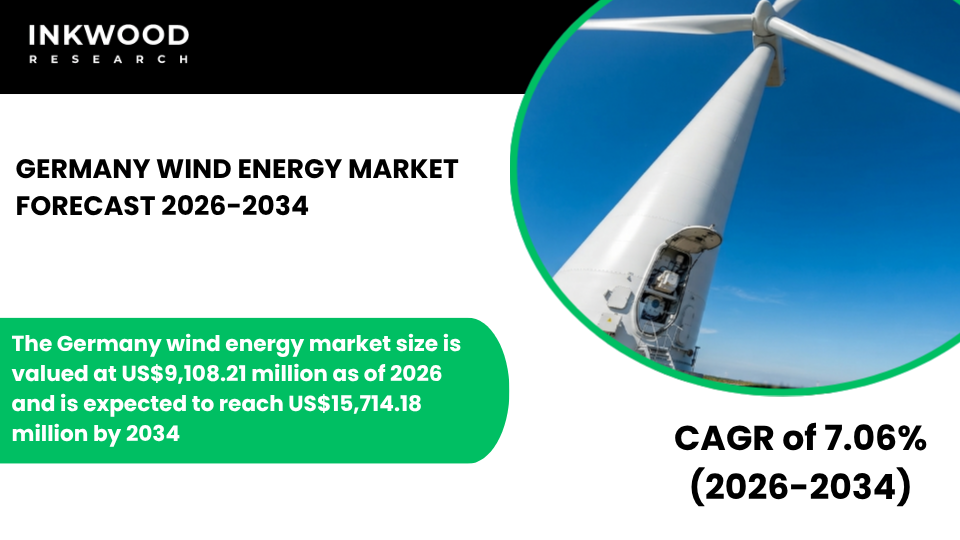
The Germany wind energy market size is valued at US$9,108.21 million as of 2026 and is expected to reach US$15,714.18 million by 2034, progressing with a CAGR of 7.06% during the forecast years, 2026-2034.
Germany’s wind energy market stands as a cornerstone of the nation’s ambitious Energiewende transition, driven by aggressive targets to phase out nuclear and coal-fired power generation while simultaneously expanding renewable energy capacity. As one of Europe’s leading wind power markets, Germany has built substantial onshore and offshore wind infrastructure that collectively contributes a significant portion of the country’s total electricity supply.
The government’s commitment to achieving climate neutrality by 2045 has intensified efforts to streamline permitting processes, address grid congestion challenges, and accelerate the deployment of new wind farms across multiple regions. Moreover, recent regulatory reforms aimed at reducing bureaucratic delays and simplifying approval procedures are expected to unlock a substantial pipeline of onshore wind projects that have faced prolonged development timelines.
In addition, Germany’s offshore wind sector continues to expand rapidly, supported by comprehensive grid connection plans and ambitious capacity targets set by federal energy authorities. The nation’s strategic focus on repowering aging wind turbines with modern, higher-capacity units presents significant opportunities for market growth while maximizing energy output from existing sites.
Furthermore, rising electricity prices across European markets have improved the economic viability of renewable energy projects, making wind power generation increasingly competitive without requiring extensive subsidy support. Consequently, independent power producers, power utilities, and commercial enterprises are actively investing in new wind energy installations to capitalize on favorable market conditions and meet corporate sustainability commitments.
Germany’s wind energy landscape is shaped by a complex interplay of policy support, technological innovation, and evolving market dynamics. The Energiewende framework establishes binding renewable energy targets that require substantial additions to wind power capacity throughout the forecast period, creating a stable investment environment for developers and financial institutions.
To Know More About This Report, Request a Free Sample Copy
However, challenges related to lengthy permitting processes, public opposition in certain regions, and strict setback regulations have historically constrained the pace of onshore wind development. To address these barriers, federal and state governments have introduced legislative measures designed to designate dedicated wind energy areas, streamline environmental assessments, and provide legal clarity on approval pathways.
These reforms are gradually removing bottlenecks that previously delayed project construction timelines and discouraged investment in new renewable energy projects. Additionally, Germany’s offshore wind sector benefits from well-established supply chains, experienced installation contractors, and proximity to major industrial load centers along the North Sea and Baltic Sea coastlines. The transition toward subsidy-free auction models for offshore wind farms demonstrates the sector’s maturity and cost competitiveness, attracting participation from both domestic and international developers.
Moreover, increasing emphasis on grid expansion initiatives and energy storage integration is addressing intermittency concerns associated with variable wind power generation, thereby enhancing overall system reliability and facilitating higher penetration rates of renewable energy sources. These factors, in turn, are set to propel the wind energy market expansion in Germany during the forecast period.
The Germany wind energy market is segmented into location/installation type, application, turbine capacity, end-user, and technology. The end-user segment is further categorized into power utilities, independent power producers (IPP), commercial enterprises, agricultural users, and remote/off-grid power users.
The independent power producers (IPP) segment plays a vital role in Germany’s wind energy ecosystem, accounting for a substantial share of new capacity additions and operational wind farms. Unlike traditional utility-owned projects, IPPs operate as specialized entities focused exclusively on developing, financing, and managing renewable energy assets with the primary objective of selling electricity to the grid or through long-term power purchase agreements.
These independent operators bring significant flexibility and innovation to the market, often pioneering new business models such as community ownership structures, corporate PPAs, and hybrid renewable energy projects that combine wind with solar or storage technologies. Moreover, IPPs have demonstrated strong capabilities in securing financing from international investors, green bonds, and institutional capital markets, thereby diversifying funding sources beyond conventional bank lending.
The segment’s growth is further supported by regulatory frameworks that enable fair grid access and transparent auction mechanisms, ensuring IPPs can compete effectively with established power utilities. In addition, many IPPs specialize in repowering projects, where older, less efficient wind turbines are replaced with modern units featuring higher capacity factors and lower maintenance requirements, thereby enhancing revenue potential from existing sites.
Furthermore, the increasing participation of IPPs in offshore wind auctions demonstrates their technical expertise and financial strength in executing large-scale, capital-intensive renewable energy projects. As Germany continues to liberalize its electricity markets and encourage private sector participation in the energy transition, independent power producers are expected to capture an expanding share of wind power generation capacity, supported by favorable investment conditions and growing demand for clean energy from commercial enterprises and industrial consumers.
Some of the top players operating in the Germany wind energy market include Enercon GmbH, Nordex SE, Vestas Wind Systems, and Siemens Gamesa Renewable Energy, etc.
Enercon GmbH is a prominent German wind turbine manufacturer headquartered in Aurich, Lower Saxony, renowned for its pioneering role in developing gearless direct-drive wind turbine technology. The company specializes in designing, manufacturing, and servicing onshore wind turbines ranging from medium to large capacity classes, with models optimized for various wind conditions and site requirements across Europe and international markets.
Enercon’s product portfolio features distinctive ringgenerator technology that eliminates the need for traditional gearboxes, resulting in reduced mechanical complexity, lower maintenance costs, and enhanced operational reliability over the turbine’s lifecycle. In addition to turbine manufacturing, Enercon provides comprehensive project development support, including site assessment, engineering services, installation supervision, and long-term maintenance programs tailored to meet the specific needs of wind farm developers and operators.
The company maintains a strong domestic presence in Germany, where it has installed thousands of wind turbines across diverse landscapes, from coastal regions to inland sites with moderate wind resources. Furthermore, Enercon actively participates in repowering initiatives, helping operators replace older turbine models with advanced units that deliver significantly higher energy yields while complying with updated environmental and technical standards.
REPORT SYNOPSIS
| REPORT SCOPE | DETAILS |
|---|---|
| Market Forecast Years | 2026-2034 |
| Base Year | 2025 |
| Market Historical Years | 2022-2024 |
| Forecast Units | Revenue ($ Million) |
| Segments Analyzed | Location / Installation Type, Application, Turbine Capacity, End-User, and Technology |
| Country Analyzed | Germany |
| Companies Analyzed | Enercon GmbH, Nordex SE, Vestas Wind Systems, Siemens Gamesa Renewable Energy, GE Vernova (GE Renewable Energy), EnBW Energie Baden-Württemberg AG, RWE AG |
TABLE OF CONTENTS
RESEARCH SCOPE & METHODOLOGY
- STUDY OBJECTIVES
- METHODOLOGY
- ASSUMPTIONS & LIMITATIONS
EXECUTIVE SUMMARY
- MARKET SIZE & FORECAST
- MARKET OVERVIEW
- SCOPE OF STUDY
- CRISIS SCENARIO ANALYSIS
- MAJOR MARKET FINDINGS
- GERMANY IS ONE OF THE LEADING WIND ENERGY MARKETS IN EUROPE WITH STRONG POLICY SUPPORT
- ONSHORE WIND REMAINS THE BACKBONE OF INSTALLED CAPACITY DESPITE SLOWER RECENT ADDITIONS
- OFFSHORE WIND CONTRIBUTES A HIGH SHARE OF ELECTRICITY GENERATION RELATIVE TO CAPACITY
- COMMUNITY OWNERSHIP MODELS HAVE HISTORICALLY PLAYED AN IMPORTANT ROLE
MARKET DYNAMICS
- KEY DRIVERS
- ENERGIEWENDE TARGETS AND PHASE OUT OF NUCLEAR AND COAL POWER DRIVE WIND EXPANSION
- STREAMLINED PERMITTING REFORMS ARE EXPECTED TO ACCELERATE ONSHORE PROJECT APPROVALS
- OFFSHORE WIND EXPANSION IS SUPPORTED BY STRONG GRID CONNECTION PLANS
- RISING ELECTRICITY PRICES IMPROVE THE ECONOMICS OF RENEWABLE GENERATION
- KEY RESTRAINTS
- LENGTHY PERMITTING AND LEGAL CHALLENGES HAVE SLOWED ONSHORE DEPLOYMENT
- PUBLIC OPPOSITION AND SETBACK RULES LIMIT SITE AVAILABILITY
- GRID CONGESTION BETWEEN NORTHERN GENERATION AND SOUTHERN DEMAND REGIONS PERSISTS
- SUPPLY CHAIN AND SKILLED LABOR SHORTAGES AFFECT PROJECT TIMELINES
- KEY DRIVERS
KEY ANALYTICS
- KEY MARKET TRENDS
- REPPOWERING OF OLD TURBINES WITH HIGHER CAPACITY UNITS IS A KEY MARKET DRIVER
- OFFSHORE WIND PROJECTS ARE MOVING TOWARD SUBSIDY-FREE AUCTION MODELS
- INCREASED FOCUS ON GRID EXPANSION AND STORAGE INTEGRATION IS EMERGING
- LOCAL CONTENT AND EUROPEAN SUPPLY CHAIN SECURITY ARE GAINING IMPORTANCE
- PORTER’S FIVE FORCES ANALYSIS
- BUYERS POWER
- SUPPLIERS POWER
- SUBSTITUTION
- NEW ENTRANTS
- INDUSTRY RIVALRY
- GROWTH PROSPECT MAPPING
- GROWTH PROSPECT MAPPING FOR GERMANY
- MARKET MATURITY ANALYSIS
- MARKET CONCENTRATION ANALYSIS
- VALUE CHAIN ANALYSIS
- RAW MATERIAL & MACHINERY SUPPLIERS
- DESIGN & DEVELOPMENT SERVICES
- COMPONENT SUPPLIERS
- WIND TURBINE COMPANIES
- CONSTRUCTION AND INSTALLATION SERVICES
- WIND FARM DEVELOPERS
- KEY BUYING CRITERIA
- GOVERNMENT POLICIES AND INCENTIVES
- TECHNOLOGICAL ADVANCEMENTS
- ENVIRONMENTAL AWARENESS AND SUSTAINABILITY
- ENVIRONMENTAL AND SOCIAL IMPACT ASSESSMENTS
- REGULATORY FRAMEWORK
- KEY MARKET TRENDS
WIND ENERGY MARKET BY LOCATION / INSTALLATION TYPE
- ONSHORE WIND
- MARKET FORECAST FIGURE
- SEGMENT ANALYSIS
- OFFSHORE WIND (FIXED)
- MARKET FORECAST FIGURE
- SEGMENT ANALYSIS
- OFFSHORE WIND (FLOATING)
- MARKET FORECAST FIGURE
- SEGMENT ANALYSIS
- ONSHORE WIND
WIND ENERGY MARKET BY APPLICATION
- UTILITY-SCALE POWER GENERATION
- MARKET FORECAST FIGURE
- SEGMENT ANALYSIS
- COMMERCIAL & INDUSTRIAL (C&I)
- MARKET FORECAST FIGURE
- SEGMENT ANALYSIS
- RESIDENTIAL / SMALL WIND TURBINES
- MARKET FORECAST FIGURE
- SEGMENT ANALYSIS
- UTILITY-SCALE POWER GENERATION
WIND ENERGY MARKET BY TURBINE CAPACITY
- UP TO 1 MW
- MARKET FORECAST FIGURE
- SEGMENT ANALYSIS
- 1–3 MW
- MARKET FORECAST FIGURE
- SEGMENT ANALYSIS
- 3–10 MW
- MARKET FORECAST FIGURE
- SEGMENT ANALYSIS
- ABOVE 10 MW
- MARKET FORECAST FIGURE
- SEGMENT ANALYSIS
- UP TO 1 MW
WIND ENERGY MARKET BY END-USER
- POWER UTILITIES
- MARKET FORECAST FIGURE
- SEGMENT ANALYSIS
- INDEPENDENT POWER PRODUCERS (IPP)
- MARKET FORECAST FIGURE
- SEGMENT ANALYSIS
- COMMERCIAL ENTERPRISES
- MARKET FORECAST FIGURE
- SEGMENT ANALYSIS
- AGRICULTURAL USERS
- MARKET FORECAST FIGURE
- SEGMENT ANALYSIS
- REMOTE / OFF-GRID POWER USERS
- MARKET FORECAST FIGURE
- SEGMENT ANALYSIS
- POWER UTILITIES
WIND ENERGY MARKET BY TECHNOLOGY
- GRID-CONNECTED SYSTEMS
- MARKET FORECAST FIGURE
- SEGMENT ANALYSIS
- OFF-GRID SYSTEMS
- MARKET FORECAST FIGURE
- SEGMENT ANALYSIS
- GRID-CONNECTED SYSTEMS
COMPETITIVE LANDSCAPE
- KEY STRATEGIC DEVELOPMENTS
- MERGERS & ACQUISITIONS
- PRODUCT LAUNCHES & DEVELOPMENTS
- PARTNERSHIPS & AGREEMENTS
- BUSINESS EXPANSIONS & DIVESTITURES
- COMPANY PROFILES
- ENERCON GMBH
- COMPANY OVERVIEW
- PRODUCTS / SERVICES LIST
- STRENGTHS & CHALLENGES
- NORDEX SE
- COMPANY OVERVIEW
- PRODUCTS / SERVICES LIST
- STRENGTHS & CHALLENGES
- VESTAS WIND SYSTEMS
- COMPANY OVERVIEW
- PRODUCTS / SERVICES LIST
- STRENGTHS & CHALLENGES
- SIEMENS GAMESA RENEWABLE ENERGY
- COMPANY OVERVIEW
- PRODUCTS / SERVICES LIST
- STRENGTHS & CHALLENGES
- GE VERNOVA (GE RENEWABLE ENERGY)
- COMPANY OVERVIEW
- PRODUCTS / SERVICES LIST
- STRENGTHS & CHALLENGES
- ENBW ENERGIE BADEN-WÜRTTEMBERG AG
- COMPANY OVERVIEW
- PRODUCTS / SERVICES LIST
- STRENGTHS & CHALLENGES
- RWE AG
- COMPANY OVERVIEW
- PRODUCTS / SERVICES LIST
- STRENGTHS & CHALLENGES
- ENERCON GMBH
- KEY STRATEGIC DEVELOPMENTS
LIST OF TABLES
TABLE 1: MARKET SNAPSHOT – WIND ENERGY
TABLE 2: WIND ENERGY MARKET REGULATORY FRAMEWORK
TABLE 3: MARKET BY LOCATION / INSTALLATION TYPE, HISTORICAL YEARS, 2022-2024 (IN $ MILLION)
TABLE 4: MARKET BY LOCATION / INSTALLATION TYPE, FORECAST YEARS, 2026-2034 (IN $ MILLION)
TABLE 5: MARKET BY APPLICATION, HISTORICAL YEARS, 2022-2024 (IN $ MILLION)
TABLE 6: MARKET BY APPLICATION, FORECAST YEARS, 2026-2034 (IN $ MILLION)
TABLE 7: MARKET BY TURBINE CAPACITY, HISTORICAL YEARS, 2022-2024 (IN $ MILLION)
TABLE 8: MARKET BY TURBINE CAPACITY, FORECAST YEARS, 2026-2034 (IN $ MILLION)
TABLE 9: MARKET BY END-USER, HISTORICAL YEARS, 2022-2024 (IN $ MILLION)
TABLE 10: MARKET BY END-USER, FORECAST YEARS, 2026-2034 (IN $ MILLION)
TABLE 11: MARKET BY TECHNOLOGY, HISTORICAL YEARS, 2022-2024 (IN $ MILLION)
TABLE 12: MARKET BY TECHNOLOGY, FORECAST YEARS, 2026-2034 (IN $ MILLION)
TABLE 13: KEY PLAYERS OPERATING IN THE GERMAN MARKET
TABLE 14: LIST OF MERGERS & ACQUISITIONS
TABLE 15: LIST OF PRODUCT LAUNCHES & DEVELOPMENTS
TABLE 16: LIST OF PARTNERSHIPS & AGREEMENTS
TABLE 17: LIST OF BUSINESS EXPANSIONS & DIVESTITURES
LIST OF FIGURES
FIGURE 1: MAJOR MARKET FINDINGS
FIGURE 2: MARKET DYNAMICS
FIGURE 3: KEY MARKET TRENDS
FIGURE 4: PORTER’S FIVE FORCES ANALYSIS
FIGURE 5: GROWTH PROSPECT MAPPING FOR GERMANY
FIGURE 6: MARKET MATURITY ANALYSIS
FIGURE 7: MARKET CONCENTRATION ANALYSIS
FIGURE 8: VALUE CHAIN ANALYSIS
FIGURE 9: KEY BUYING CRITERIA
FIGURE 10: SEGMENT GROWTH POTENTIAL, BY LOCATION / INSTALLATION TYPE, IN 2025
FIGURE 11: ONSHORE WIND MARKET SIZE, 2026-2034 (IN $ MILLION)
FIGURE 12: OFFSHORE WIND (FIXED) MARKET SIZE, 2026-2034 (IN $ MILLION)
FIGURE 13: OFFSHORE WIND (FLOATING) MARKET SIZE, 2026-2034 (IN $ MILLION)
FIGURE 14: SEGMENT GROWTH POTENTIAL, BY APPLICATION, IN 2025
FIGURE 15: UTILITY-SCALE POWER GENERATION MARKET SIZE, 2026-2034 (IN $ MILLION)
FIGURE 16: COMMERCIAL & INDUSTRIAL (C&I) MARKET SIZE, 2026-2034 (IN $ MILLION)
FIGURE 17: RESIDENTIAL / SMALL WIND TURBINES MARKET SIZE, 2026-2034 (IN $ MILLION)
FIGURE 18: SEGMENT GROWTH POTENTIAL, BY TURBINE CAPACITY, IN 2025
FIGURE 19: UP TO 1 MW MARKET SIZE, 2026-2034 (IN $ MILLION)
FIGURE 20: 1–3 MW MARKET SIZE, 2026-2034 (IN $ MILLION)
FIGURE 21: 3–10 MW MARKET SIZE, 2026-2034 (IN $ MILLION)
FIGURE 22: ABOVE 10 MW MARKET SIZE, 2026-2034 (IN $ MILLION)
FIGURE 23: SEGMENT GROWTH POTENTIAL, BY END-USER, IN 2025
FIGURE 24: POWER UTILITIES MARKET SIZE, 2026-2034 (IN $ MILLION)
FIGURE 25: INDEPENDENT POWER PRODUCERS (IPP) MARKET SIZE, 2026-2034 (IN $ MILLION)
FIGURE 26: COMMERCIAL ENTERPRISES MARKET SIZE, 2026-2034 (IN $ MILLION)
FIGURE 27: AGRICULTURAL USERS MARKET SIZE, 2026-2034 (IN $ MILLION)
FIGURE 28: REMOTE / OFF-GRID POWER USERS MARKET SIZE, 2026-2034 (IN $ MILLION)
FIGURE 29: SEGMENT GROWTH POTENTIAL, BY TECHNOLOGY, IN 2025
FIGURE 30: GRID-CONNECTED SYSTEMS MARKET SIZE, 2026-2034 (IN $ MILLION)
FIGURE 31: OFF-GRID SYSTEMS MARKET SIZE, 2026-2034 (IN $ MILLION)
FAQ’s
RELATED REPORTS
-

UNITED STATES AI-DRIVEN CLOUD MIGRATION SERVICES MARKET FORECAST 2026-2034
-

UNITED KINGDOM AI-DRIVEN CLOUD MIGRATION SERVICES MARKET FORECAST 2026-2034
-

UNITED ARAB EMIRATES AI-DRIVEN CLOUD MIGRATION SERVICES MARKET FORECAST 2026-2034
-

SOUTH KOREA AI-DRIVEN CLOUD MIGRATION SERVICES MARKET FORECAST 2026-2034
-

SINGAPORE AI-DRIVEN CLOUD MIGRATION SERVICES MARKET FORECAST 2026-2034
-

SAUDI ARABIA AI-DRIVEN CLOUD MIGRATION SERVICES MARKET FORECAST 2026-2034
-

AUSTRALIA AI-DRIVEN CLOUD MIGRATION SERVICES MARKET FORECAST 2026-2034
-

JAPAN AI-DRIVEN CLOUD MIGRATION SERVICES MARKET FORECAST 2026-2034
-

INDIA AI-DRIVEN CLOUD MIGRATION SERVICES MARKET FORECAST 2026-2034
-
CHINA AI-DRIVEN CLOUD MIGRATION SERVICES MARKET FORECAST 2026-2034