Germany Solar Microinverter Market by Product Type (Single-Phase Microinverters, Three-Phase Microinverters, Standalone Microinverters, Hybrid/Microinverter-Battery Integrated Units, IQ-Series), Market by Connection/System Type (Grid-Tied Microinverters, Off-Grid Microinverters, Hybrid Microinverters Grid-Interactive + Storage Compatible), Market by Power Rating (Below 250 W, 250–400 W, 400–700 W, Above 700 W), Market by Application (Residential Rooftop Solar, Utility-Scale Distributed PV, Off-Grid Systems/Remote Power Supply, Agricultural Solar, Commercial Solar), Market by Distribution Channel (Direct Sales Manufacturers to EPCs or Installers, Online Retail/E-Commerce, Distributors & Wholesalers, OEM Agreements), by Geography
GERMANY SOLAR MICROINVERTER MARKET OVERVIEW
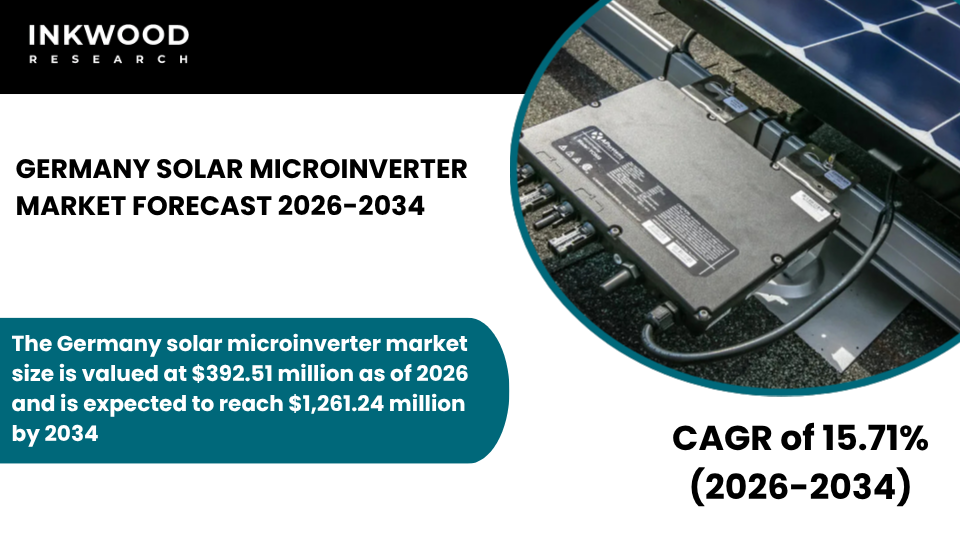
The Germany solar microinverter market size is valued at $392.51 million as of 2026 and is expected to reach $1,261.24 million by 2034, progressing with a CAGR of 15.71% during the forecast years, 2026-2034.
The Germany solar microinverter market represents one of Europe’s most mature and technically sophisticated landscapes for module-level power electronics, characterized by stringent quality expectations, high installer expertise, and consumers who demonstrate a strong willingness to pay premiums for performance transparency and long-term reliability. Germany’s ambitious Energiewende (energy transition) program continues to drive residential and commercial rooftop solar adoption, creating sustained demand for advanced inverter technologies that maximize energy yield in complex installation environments.
According to Germany’s Federal Network Agency, the country added 16.1 GW of new solar capacity in 2024, with approximately two-thirds concentrated in rooftop and building-mounted installations rather than ground-mounted utility-scale systems. This deployment pattern strongly favors solar microinverters, which excel in residential and small commercial applications where roof geometries, shading conditions, and multi-orientation arrays benefit from module-level optimization.
Furthermore, Germany’s renewable energy targets mandate that 80% of electricity generation must come from renewable sources by 2030, according to government policy frameworks, positioning solar photovoltaic systems as critical infrastructure requiring maximum performance efficiency. The market benefits from persistently high electricity prices that make self-consumption economically attractive, with residential rates remaining among Europe’s highest and incentivizing homeowners to maximize solar energy utilization through advanced monitoring and battery energy storage integration.
Additionally, the proliferation of balcony solar systems across Germany has expanded the addressable market beyond traditional homeowners to include apartment dwellers and renters, with 435,000 new balcony systems installed in 2024 alone. These plug-and-play configurations typically employ solar microinverters due to their simplified installation requirements, compliance with low-voltage safety regulations, and ability to operate individual panels independently without complex electrical work.
The regulatory environment also supports market growth through grid connection frameworks that prioritize distributed generation, net metering arrangements that provide fair compensation for surplus electricity exports, and building codes that increasingly require renewable energy components in new construction. However, challenges persist, including high labor and installation costs that increase total system expenditure compared to other European markets, intense competition from string inverters equipped with DC optimizers that offer some module-level benefits at lower costs, and stringent certification requirements that extend time-to-market for new products seeking VDE and other German quality approvals.
To Know More About This Report, Request a Free Sample Copy
Despite these headwinds, the Germany solar microinverter market is positioned for sustained expansion, driven by the country’s unwavering commitment to clean energy transition, sophisticated customer base that values quality and performance monitoring, ongoing technological innovations in hybrid microinverter-battery systems, and established distribution networks linking manufacturers with Germany’s extensive installer community.
The Germany solar microinverter market is segmented into product type, connection/system type, power rating, application, and distribution channel. The connection/system type segment is further categorized into grid-tied microinverters, off-grid microinverters, and hybrid microinverters (grid-interactive + storage compatible).
Hybrid microinverters, which combine grid-interactive capabilities with battery energy storage compatibility, are experiencing particularly robust growth within the Germany solar microinverter market, driven by increasing adoption of home storage systems and evolving energy management strategies among residential and commercial customers. These advanced power electronics devices enable bidirectional power flow, allowing excess solar generation to charge battery systems for later consumption during evening hours or grid outages, while also supporting grid export when batteries reach full capacity, and household demand is satisfied.
The segment benefits from Germany’s high electricity prices and unfavorable feed-in tariff economics for new installations, which make self-consumption through battery storage more financially attractive than selling surplus electricity to utilities at wholesale rates. According to market analysis, battery energy storage installations are accelerating across German residential markets as lithium-ion costs decline and consumers seek greater energy independence amid grid reliability concerns and volatile electricity pricing.
Hybrid solar microinverters address this opportunity by integrating seamlessly with popular battery brands, managing charge and discharge cycles intelligently based on real-time consumption patterns, electricity rate structures, and weather forecasts accessed through internet connectivity. Furthermore, these devices support advanced energy management scenarios, including time-of-use optimization, where batteries discharge during expensive peak rate periods and charge during cheaper overnight hours, maximizing economic returns from installed solar capacity.
The hybrid segment also aligns with Germany’s broader smart grid initiatives and virtual power plant developments, where distributed battery systems can provide grid services such as frequency regulation, demand response participation, and peak load reduction, creating additional revenue opportunities for system owners. Technological features distinguishing hybrid solar microinverters include sophisticated power management algorithms, integrated monitoring platforms that provide visibility into solar generation, battery state of charge, and household consumption patterns, and compatibility with vehicle-to-home (V2H) charging infrastructure that will enable electric vehicles to serve as mobile energy storage.
Additionally, hybrid configurations appeal to German customers’ preferences for comprehensive system warranties, as leading manufacturers offer extended coverage spanning both inverter components and battery integration functionality. The segment supports overall market growth by addressing the evolving needs of energy-conscious consumers seeking maximum self-sufficiency, benefiting from government programs that subsidize battery storage additions to existing solar installations, and providing manufacturers with opportunities to differentiate through advanced software capabilities, superior integration with home energy management systems, and proven interoperability across diverse battery chemistries and grid conditions prevalent throughout Germany’s decentralized electricity infrastructure.
Some of the top players operating in the Germany solar microinverter market include Enphase Energy Inc, Hoymiles Power Electronics Inc, SMA Solar Technology AG, APsystems (Altenergy Power System Inc), etc.
SMA Solar Technology AG is a leading German inverter manufacturer headquartered in Niestetal, specializing in solar and battery inverters, energy management systems, and monitoring solutions for residential, commercial, and utility-scale renewable energy applications. Established in 1981, SMA pioneered transformerless inverter technology and has delivered over 125 GW of installed inverter capacity globally.
The company offers comprehensive power electronics portfolios, including string inverters, central inverters, and increasingly, module-level solutions, addressing Germany’s sophisticated rooftop solar market through advanced product features, rigorous quality standards, and extensive local technical support infrastructure.
REPORT SYNOPSIS
| REPORT SCOPE | DETAILS |
|---|---|
| Market Forecast Years | 2026-2034 |
| Base Year | 2025 |
| Market Historical Years | 2022-2024 |
| Forecast Units | Revenue ($ Million) |
| Segments Analyzed | Product Type, Connection / System Type, Power Rating, Application, Distribution Channel |
| Country Analyzed | Germany |
| Companies Analyzed | Enphase Energy Inc, Hoymiles Power Electronics Inc, APsystems (Altenergy Power System Inc), Sungrow Power Supply Co Ltd, GoodWe, SMA Solar Technology AG |
TABLE OF CONTENTS
RESEARCH SCOPE & METHODOLOGY
- STUDY OBJECTIVES
- METHODOLOGY
- ASSUMPTIONS & LIMITATIONS
EXECUTIVE SUMMARY
- MARKET SIZE & FORECAST
- MARKET OVERVIEW
- SCOPE OF STUDY
- CRISIS SCENARIO ANALYSIS
- MAJOR MARKET FINDINGS
- GERMANY IS A MATURE AND TECHNICALLY SOPHISTICATED MICROINVERTER MARKET WITH STRONG QUALITY EXPECTATIONS
- RESIDENTIAL AND SMALL COMMERCIAL ROOFTOP SYSTEMS ACCOUNT FOR THE MAJORITY OF DEPLOYMENTS
- MICROINVERTERS BENEFIT FROM STRICT SAFETY AND GRID COMPLIANCE REQUIREMENTS
- CUSTOMERS SHOW HIGH WILLINGNESS TO PAY FOR PERFORMANCE TRANSPARENCY AND LONG-TERM RELIABILITY
MARKET DYNAMICS
- KEY DRIVERS
- CONTINUED EXPANSION OF RESIDENTIAL SOLAR DRIVEN BY HIGH ELECTRICITY PRICES
- STRONG POLICY SUPPORT FOR DECENTRALIZED ENERGY GENERATION AND SELF-CONSUMPTION
- HIGH PENETRATION OF COMPLEX ROOFTOP INSTALLATIONS WITH SHADING AND MULTI-ORIENTATION
- INCREASING ADOPTION OF HOME STORAGE SYSTEMS DRIVES HYBRID MICROINVERTER DEMAND
- KEY RESTRAINTS
- HIGH LABOR AND INSTALLATION COSTS INCREASE TOTAL SYSTEM EXPENDITURE
- STRING INVERTERS WITH OPTIMIZERS REMAIN A COMPETITIVE ALTERNATIVE
- CERTIFICATION AND COMPLIANCE REQUIREMENTS INCREASE TIME TO MARKET FOR NEW PRODUCTS
- SUPPLY CONSTRAINTS DURING PEAK DEMAND PERIODS AFFECT INSTALLATION TIMELINES
- KEY DRIVERS
KEY ANALYTICS
- KEY MARKET TRENDS
- INTEGRATION OF MICROINVERTERS WITH SMART GRID AND ENERGY MANAGEMENT SYSTEMS IS ACCELERATING
- FOCUS ON LONGER LIFECYCLE WARRANTIES AND SUSTAINABILITY CREDENTIALS IS INCREASING
- THREE-PHASE MICROINVERTERS ARE GAINING TRACTION IN COMMERCIAL ROOFTOP SYSTEMS
- LOCALIZED AFTER-SALES SERVICE IS BECOMING A KEY COMPETITIVE DIFFERENTIATOR
- PORTER’S FIVE FORCES ANALYSIS
- BUYERS POWER
- SUPPLIERS POWER
- SUBSTITUTION
- NEW ENTRANTS
- INDUSTRY RIVALRY
- GROWTH PROSPECT MAPPING
- GROWTH PROSPECT MAPPING FOR GERMANY
- MARKET MATURITY ANALYSIS
- MARKET CONCENTRATION ANALYSIS
- VALUE CHAIN ANALYSIS
- RAW MATERIAL SOURCING
- POWER ELECTRONICS DESIGN
- COMPONENT MANUFACTURING
- INVERTER ASSEMBLY
- QUALITY TESTING
- DISTRIBUTION CHANNELS
- INSTALLATION SERVICES
- AFTER SALES SUPPORT
- KEY BUYING CRITERIA
- CONVERSION EFFICIENCY
- SYSTEM RELIABILITY
- WARRANTY COVERAGE
- MONITORING FEATURES
- REGULATORY FRAMEWORK
- KEY MARKET TRENDS
SOLAR MICROINVERTER MARKET BY PRODUCT TYPE
- SINGLE-PHASE MICROINVERTERS
- THREE-PHASE MICROINVERTERS
- STANDALONE MICROINVERTERS
- HYBRID / MICROINVERTER-BATTERY INTEGRATED UNITS
- IQ-SERIES
SOLAR MICROINVERTER MARKET BY CONNECTION / SYSTEM TYPE
- GRID-TIED MICROINVERTERS
- OFF-GRID MICROINVERTERS
- HYBRID MICROINVERTERS (GRID-INTERACTIVE + STORAGE COMPATIBLE)
SOLAR MICROINVERTER MARKET BY POWER RATING
- BELOW 250 W
- 250–400 W
- 400–700 W
- ABOVE 700 W
SOLAR MICROINVERTER MARKET BY APPLICATION
- RESIDENTIAL ROOFTOP SOLAR
- UTILITY-SCALE DISTRIBUTED PV
- OFF-GRID SYSTEMS / REMOTE POWER SUPPLY
- AGRICULTURAL SOLAR
- COMMERCIAL SOLAR
- SMALL-SIZE
- MID-SIZE
SOLAR MICROINVERTER MARKET BY DISTRIBUTION CHANNEL
- DIRECT SALES (MANUFACTURERS TO EPCS OR INSTALLERS)
- ONLINE RETAIL / E-COMMERCE
- DISTRIBUTORS & WHOLESALERS
- OEM AGREEMENTS
COMPETITIVE LANDSCAPE
- KEY STRATEGIC DEVELOPMENTS
- MERGERS & ACQUISITIONS
- PRODUCT LAUNCHES & DEVELOPMENTS
- PARTNERSHIPS & AGREEMENTS
- BUSINESS EXPANSIONS & DIVESTITURES
- COMPANY PROFILES
- ENPHASE ENERGY INC
- COMPANY OVERVIEW
- PRODUCTS / SERVICES LIST
- STRENGTHS & CHALLENGES
- HOYMILES POWER ELECTRONICS INC
- COMPANY OVERVIEW
- PRODUCTS / SERVICES LIST
- STRENGTHS & CHALLENGES
- APSYSTEMS (ALTENERGY POWER SYSTEM INC)
- COMPANY OVERVIEW
- PRODUCTS / SERVICES LIST
- STRENGTHS & CHALLENGES
- SUNGROW POWER SUPPLY CO LTD
- COMPANY OVERVIEW
- PRODUCTS / SERVICES LIST
- STRENGTHS & CHALLENGES
- GOODWE
- COMPANY OVERVIEW
- PRODUCTS / SERVICES LIST
- STRENGTHS & CHALLENGES
- SMA SOLAR TECHNOLOGY AG
- COMPANY OVERVIEW
- PRODUCTS / SERVICES LIST
- STRENGTHS & CHALLENGES
- ENPHASE ENERGY INC
- KEY STRATEGIC DEVELOPMENTS
LIST OF TABLES
TABLE 1: MARKET SNAPSHOT – SOLAR MICROINVERTER
TABLE 2: SOLAR MICROINVERTER MARKET REGULATORY FRAMEWORK
TABLE 3: MARKET BY PRODUCT TYPE, HISTORICAL YEARS, 2022-2024 (IN $ MILLION)
TABLE 4: MARKET BY PRODUCT TYPE, FORECAST YEARS, 2026-2034 (IN $ MILLION)
TABLE 5: MARKET BY CONNECTION / SYSTEM TYPE, HISTORICAL YEARS, 2022-2024 (IN $ MILLION)
TABLE 6: MARKET BY CONNECTION / SYSTEM TYPE, FORECAST YEARS, 2026-2034 (IN $ MILLION)
TABLE 7: MARKET BY POWER RATING, HISTORICAL YEARS, 2022-2024 (IN $ MILLION)
TABLE 8: MARKET BY POWER RATING, FORECAST YEARS, 2026-2034 (IN $ MILLION)
TABLE 9: MARKET BY APPLICATION, HISTORICAL YEARS, 2022-2024 (IN $ MILLION)
TABLE 10: MARKET BY APPLICATION, FORECAST YEARS, 2026-2034 (IN $ MILLION)
TABLE 11: MARKET BY COMMERCIAL SOLAR, HISTORICAL YEARS, 2022-2024 (IN $ MILLION)
TABLE 12: MARKET BY COMMERCIAL SOLAR, FORECAST YEARS, 2026-2034 (IN $ MILLION)
TABLE 13: MARKET BY DISTRIBUTION CHANNEL, HISTORICAL YEARS, 2022-2024 (IN $ MILLION)
TABLE 14: MARKET BY DISTRIBUTION CHANNEL, FORECAST YEARS, 2026-2034 (IN $ MILLION)
TABLE 15: KEY PLAYERS OPERATING IN THE GERMAN MARKET
TABLE 16: LIST OF MERGERS & ACQUISITIONS
TABLE 17: LIST OF PRODUCT LAUNCHES & DEVELOPMENTS
TABLE 18: LIST OF PARTNERSHIPS & AGREEMENTS
TABLE 19: LIST OF BUSINESS EXPANSIONS & DIVESTITURES
LIST OF FIGURES
FIGURE 1: MAJOR MARKET FINDINGS
FIGURE 2: MARKET DYNAMICS
FIGURE 3: KEY MARKET TRENDS
FIGURE 4: PORTER’S FIVE FORCES ANALYSIS
FIGURE 5: GROWTH PROSPECT MAPPING FOR GERMANY
FIGURE 6: MARKET MATURITY ANALYSIS
FIGURE 7: MARKET CONCENTRATION ANALYSIS
FIGURE 8: VALUE CHAIN ANALYSIS
FIGURE 9: KEY BUYING CRITERIA
FIGURE 10: SEGMENT GROWTH POTENTIAL, BY PRODUCT TYPE, IN 2025
FIGURE 11: SINGLE-PHASE MICROINVERTERS MARKET SIZE, 2026-2034 (IN $ MILLION)
FIGURE 12: THREE-PHASE MICROINVERTERS MARKET SIZE, 2026-2034 (IN $ MILLION)
FIGURE 13: STANDALONE MICROINVERTERS MARKET SIZE, 2026-2034 (IN $ MILLION)
FIGURE 14: HYBRID / MICROINVERTER-BATTERY INTEGRATED UNITS MARKET SIZE, 2026-2034 (IN $ MILLION)
FIGURE 15: IQ-SERIES MARKET SIZE, 2026-2034 (IN $ MILLION)
FIGURE 16: SEGMENT GROWTH POTENTIAL, BY CONNECTION / SYSTEM TYPE, IN 2025
FIGURE 17: GRID-TIED MICROINVERTERS MARKET SIZE, 2026-2034 (IN $ MILLION)
FIGURE 18: OFF-GRID MICROINVERTERS MARKET SIZE, 2026-2034 (IN $ MILLION)
FIGURE 19: HYBRID MICROINVERTERS (GRID-INTERACTIVE + STORAGE COMPATIBLE) MARKET SIZE, 2026-2034 (IN $ MILLION)
FIGURE 20: SEGMENT GROWTH POTENTIAL, BY POWER RATING, IN 2025
FIGURE 21: BELOW 250 W MARKET SIZE, 2026-2034 (IN $ MILLION)
FIGURE 22: 250–400 W MARKET SIZE, 2026-2034 (IN $ MILLION)
FIGURE 23: 400–700 W MARKET SIZE, 2026-2034 (IN $ MILLION)
FIGURE 24: ABOVE 700 W MARKET SIZE, 2026-2034 (IN $ MILLION)
FIGURE 25: SEGMENT GROWTH POTENTIAL, BY APPLICATION, IN 2025
FIGURE 26: RESIDENTIAL ROOFTOP SOLAR MARKET SIZE, 2026-2034 (IN $ MILLION)
FIGURE 27: UTILITY-SCALE DISTRIBUTED PV MARKET SIZE, 2026-2034 (IN $ MILLION)
FIGURE 28: OFF-GRID SYSTEMS / REMOTE POWER SUPPLY MARKET SIZE, 2026-2034 (IN $ MILLION)
FIGURE 29: AGRICULTURAL SOLAR MARKET SIZE, 2026-2034 (IN $ MILLION)
FIGURE 30: COMMERCIAL SOLAR MARKET SIZE, 2026-2034 (IN $ MILLION)
FIGURE 31: SEGMENT GROWTH POTENTIAL, BY COMMERCIAL SOLAR, IN 2025
FIGURE 32: SMALL-SIZE COMMERCIAL SOLAR MARKET SIZE, 2026-2034 (IN $ MILLION)
FIGURE 33: MID-SIZE COMMERCIAL SOLAR MARKET SIZE, 2026-2034 (IN $ MILLION)
FIGURE 34: SEGMENT GROWTH POTENTIAL, BY DISTRIBUTION CHANNEL, IN 2025
FIGURE 35: DIRECT SALES MARKET SIZE, 2026-2034 (IN $ MILLION)
FIGURE 36: ONLINE RETAIL / E-COMMERCE MARKET SIZE, 2026-2034 (IN $ MILLION)
FIGURE 37: DISTRIBUTORS & WHOLESALERS MARKET SIZE, 2026-2034 (IN $ MILLION)
FIGURE 38: OEM AGREEMENTS MARKET SIZE, 2026-2034 (IN $ MILLION)
FAQ’s
RELATED REPORTS
-

UNITED STATES AI-DRIVEN CLOUD MIGRATION SERVICES MARKET FORECAST 2026-2034
-

UNITED KINGDOM AI-DRIVEN CLOUD MIGRATION SERVICES MARKET FORECAST 2026-2034
-

UNITED ARAB EMIRATES AI-DRIVEN CLOUD MIGRATION SERVICES MARKET FORECAST 2026-2034
-

SOUTH KOREA AI-DRIVEN CLOUD MIGRATION SERVICES MARKET FORECAST 2026-2034
-

SINGAPORE AI-DRIVEN CLOUD MIGRATION SERVICES MARKET FORECAST 2026-2034
-

SAUDI ARABIA AI-DRIVEN CLOUD MIGRATION SERVICES MARKET FORECAST 2026-2034
-

AUSTRALIA AI-DRIVEN CLOUD MIGRATION SERVICES MARKET FORECAST 2026-2034
-

JAPAN AI-DRIVEN CLOUD MIGRATION SERVICES MARKET FORECAST 2026-2034
-

INDIA AI-DRIVEN CLOUD MIGRATION SERVICES MARKET FORECAST 2026-2034
-

CHINA AI-DRIVEN CLOUD MIGRATION SERVICES MARKET FORECAST 2026-2034