China Solar Microinverter Market by Product Type (Single-Phase Microinverters, Three-Phase Microinverters, Standalone Microinverters, Hybrid/Microinverter-Battery Integrated Units, IQ-Series), Market by Connection/System Type (Grid-Tied Microinverters, Off-Grid Microinverters, Hybrid Microinverters Grid-Interactive + Storage Compatible), Market by Power Rating (Below 250 W, 250–400 W, 400–700 W, Above 700 W), Market by Application (Residential Rooftop Solar, Utility-Scale Distributed PV, Off-Grid Systems/Remote Power Supply, Agricultural Solar, Commercial Solar), Market by Distribution Channel (Direct Sales Manufacturers to EPCs or Installers, Online Retail/E-Commerce, Distributors & Wholesalers, OEM Agreements), by Geography
CHINA SOLAR MICROINVERTER MARKET OVERVIEW
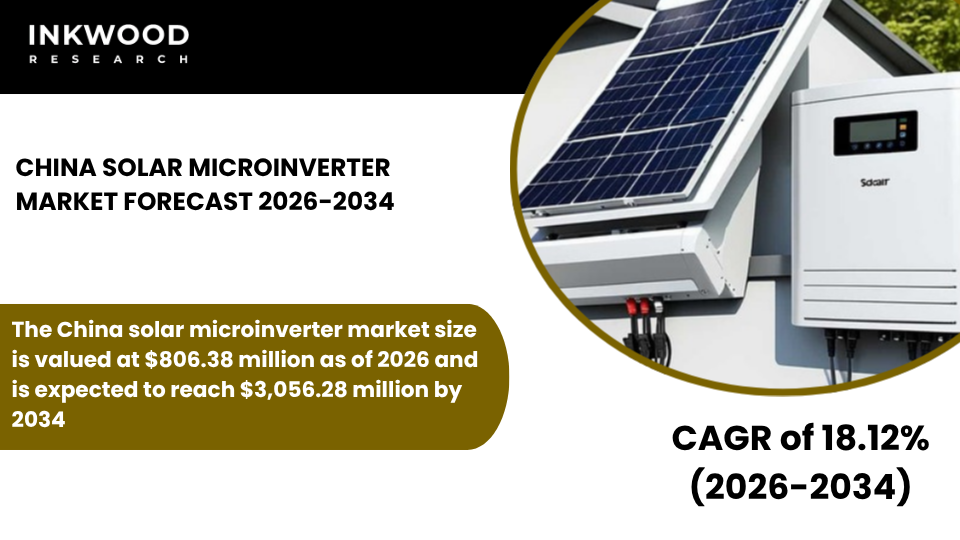
The China solar microinverter market size is valued at $806.38 million as of 2026 and is expected to reach $3,056.28 million by 2034, progressing with a CAGR of 18.12% during the forecast years, 2026-2034.
The China solar microinverter market is experiencing transformative growth, transitioning from a historically string-inverter-dominated landscape toward greater adoption of module-level power electronics across distributed solar applications. This evolution stems from comprehensive government policies promoting distributed photovoltaic systems in urban and industrial areas, combined with manufacturing cost advantages that are making solar microinverters increasingly competitive with traditional centralized inverter architectures.
China installed a record-breaking 60 GW of new solar capacity in the first quarter of 2025 alone, with rooftop installations accounting for 60% of total additions according to Rystad Energy analysis. This surge was largely driven by the National Energy Administration’s October 2024 guidelines, which took effect in May 2025 and fundamentally reshaped market dynamics by promoting self-consumption of distributed solar energy to alleviate grid congestion.
The regulatory framework aims to support China’s dual carbon goals of peaking emissions before 2030 and achieving carbon neutrality by 2060, creating sustained policy support for clean energy infrastructure. Furthermore, China’s “Whole County PV” program, initiated in June 2021 and covering 676 participating counties, targets adding solar photovoltaic panels to 20% of residential rooftops alongside commercial, industrial, and government buildings, establishing a coordinated deployment approach that benefits from economies of scale.
To Know More About This Report, Request a Free Sample Copy
Domestic manufacturers are rapidly scaling solar microinverter production capabilities, leveraging vertically integrated supply chains and advanced power electronics expertise to produce competitively priced products that meet both domestic and international certification standards. Additionally, rising safety and fire risk awareness in densely populated urban regions is driving interest in module-level power electronics, which offer superior shutdown capabilities compared to high-voltage string configurations.
The market also benefits from strong export demand, particularly from European and North American markets, where Chinese manufacturers have captured significant market share through competitive pricing, continuous technological innovation, and established distribution partnerships. However, challenges persist, including intense price competition from low-cost string inverters that remain dominant in utility-scale and large commercial installations, varying grid interconnection standards across provinces that create deployment complexity, and installer familiarity gaps with microinverter systems in smaller markets.
Despite these headwinds, the China solar microinverter market is positioned for sustained expansion, driven by government mandates for distributed solar deployment, ongoing manufacturing cost reductions, technological advancements in higher-power three-phase designs, and the strategic importance of clean energy technology in national industrial policy.
The China solar microinverter market is segmented into product type, connection/system type, power rating, application, and distribution channel. The power rating segment is further categorized into below 250 W, 250–400 W, 400–700 W, and above 700 W.
The 400–700 W power rating segment is experiencing particularly robust growth within the China solar microinverter market, driven by alignment with next-generation high-efficiency solar modules that increasingly exceed 500W output ratings. This power range represents an optimal balance between conversion efficiency, thermal management, and system economics for distributed commercial and industrial applications that constitute a significant portion of China’s rooftop solar deployment.
Modern solar photovoltaic panels have rapidly advanced in wattage capacity, with mainstream modules now achieving 450-550W output compared to 300-350W just a few years prior, necessitating solar microinverters capable of handling these higher power levels without oversizing or underutilizing capacity. The 400–700 W segment benefits from technological innovations in gallium nitride power electronics and advanced thermal design that enable compact form factors while maintaining conversion efficiencies exceeding 97%, ensuring minimal energy losses during DC to AC transformation.
Furthermore, this power rating aligns perfectly with commercial rooftop installations on warehouses, factories, and office buildings where larger roof areas support higher-capacity systems that benefit from module-level optimization. Chinese manufacturers have invested heavily in developing products within this range, responding to both domestic market needs and export demand from European and North American markets, transitioning to higher-wattage panels.
Additionally, the segment addresses key buying criteria, including system reliability and monitoring features, as higher power ratings reduce the total number of devices required per installation, thereby lowering complexity, improving system-level reliability, and reducing potential failure points. The 400–700 W power rating also offers economic advantages by optimizing the balance between hardware costs and installation labor, as fewer microinverters are needed compared to lower-power alternatives while still maintaining module-level performance optimization and safety benefits.
This segment supports overall market growth by addressing the evolving requirements of commercial solar deployments, benefiting from the transition to higher-efficiency photovoltaic technology, and providing manufacturers with opportunities to differentiate through advanced power electronics design, integrated battery energy storage compatibility, and smart monitoring capabilities that leverage wireless communication and cloud-based analytics platforms increasingly expected by commercial and industrial customers.
Some of the top players operating in the China solar microinverter market include Hoymiles Power Electronics Inc, APsystems (Altenergy Power System Inc), Sungrow Power Supply Co Ltd, GoodWe, etc.
APsystems (Altenergy Power System Inc) is a pioneering Chinese microinverter manufacturer, established by Silicon Valley veterans who combined extensive international industry experience with China’s manufacturing cost advantages to create a globally competitive product portfolio. Founded in 2010, APsystems has developed into one of the world’s leading solar microinverter suppliers, consistently ranked second globally for inverter bankability by Sinovoltaics for multiple consecutive quarters, reflecting strong financial stability and market confidence.
The company specializes in dual-module and quad-module microinverter configurations that optimize cost-effectiveness while maintaining individual maximum power point tracking (MPPT) benefits, offering products ranging from the DS3 series for residential applications to the QT2 series designed for higher-power commercial installations. APsystems recently extended its standard warranty to 25 years for DS3 and QT2 microinverters, demonstrating confidence in product durability and long-term performance while aligning with industry trends toward extended coverage that reduces total cost of ownership concerns.
As China’s solar microinverter market evolves from export-focused production toward greater domestic adoption, APsystems benefits from established manufacturing capabilities, proven product reliability demonstrated through millions of deployed units, and competitive pricing enabled by vertically integrated operations. Moreover, the company also gains from a strategic positioning to serve both the rapidly expanding domestic distributed solar market and sustained international demand from regions prioritizing module-level power electronics for residential and commercial renewable energy systems.
REPORT SYNOPSIS
| REPORT SCOPE | DETAILS |
|---|---|
| Market Forecast Years | 2026-2034 |
| Base Year | 2025 |
| Market Historical Years | 2022-2024 |
| Forecast Units | Revenue ($ Million) |
| Segments Analyzed | Product Type, Connection / System Type, Power Rating, Application, Distribution Channel |
| Country Analyzed | China |
| Companies Analyzed | Hoymiles Power Electronics Inc, APsystems (Altenergy Power System Inc), Darfon Electronics Corp, Sungrow Power Supply Co Ltd, ReneSola Ltd, GoodWe |
TABLE OF CONTENTS
RESEARCH SCOPE & METHODOLOGY
- STUDY OBJECTIVES
- METHODOLOGY
- ASSUMPTIONS & LIMITATIONS
EXECUTIVE SUMMARY
- MARKET SIZE & FORECAST
- MARKET OVERVIEW
- SCOPE OF STUDY
- CRISIS SCENARIO ANALYSIS
- MAJOR MARKET FINDINGS
- CHINA IS EMERGING AS A HIGH-GROWTH MICROINVERTER MARKET FROM A HISTORICALLY STRING INVERTER DOMINATED BASE
- DOMESTIC MANUFACTURERS ARE RAPIDLY SCALING MICROINVERTER PRODUCTION CAPABILITIES
- APPLICATION FOCUS IS SHIFTING TOWARD DISTRIBUTED COMMERCIAL AND URBAN ROOFTOP SOLAR
- EXPORT ORIENTED MICROINVERTER MANUFACTURING PLAYS A CRITICAL ROLE IN VOLUME GROWTH
MARKET DYNAMICS
- KEY DRIVERS
- STRONG GOVERNMENT SUPPORT FOR DISTRIBUTED SOLAR PROJECTS IN URBAN AND INDUSTRIAL AREAS
- RISING SAFETY AND FIRE RISK AWARENESS IN DENSELY POPULATED REGIONS SUPPORTS MODULE-LEVEL POWER ELECTRONICS
- COST REDUCTIONS FROM LOCALIZED MANUFACTURING IMPROVE MICROINVERTER COMPETITIVENESS
- INCREASING EXPORT DEMAND FROM EUROPE AND NORTH AMERICA INCENTIVIZES TECHNOLOGY INVESTMENT
- KEY RESTRAINTS
- PRICE COMPETITION FROM LOW-COST STRING INVERTERS LIMITS DOMESTIC MARKET PENETRATION
- LIMITED INSTALLER FAMILIARITY WITH MICROINVERTER SYSTEMS SLOWS ADOPTION IN SMALL PROJECTS
- GRID INTERCONNECTION STANDARDS VARY BY PROVINCE, CREATING DEPLOYMENT COMPLEXITY
- PERCEIVED RELIABILITY CONCERNS FOR NEWER DOMESTIC BRANDS IMPACT CUSTOMER CONFIDENCE
- KEY DRIVERS
KEY ANALYTICS
- KEY MARKET TRENDS
- RAPID TECHNOLOGY ITERATION TOWARD HIGHER POWER AND THREE-PHASE MICROINVERTERS IS UNDERWAY
- OEM SUPPLY AGREEMENTS WITH GLOBAL SOLAR BRANDS ARE INCREASING
- SMART MONITORING AND AI-ENABLED PERFORMANCE OPTIMIZATION FEATURES ARE BEING INTRODUCED
- EXPORT FOCUSED PRODUCT CERTIFICATIONS ARE BECOMING A STANDARD DEVELOPMENT PRIORITY
- PORTER’S FIVE FORCES ANALYSIS
- BUYERS POWER
- SUPPLIERS POWER
- SUBSTITUTION
- NEW ENTRANTS
- INDUSTRY RIVALRY
- GROWTH PROSPECT MAPPING
- GROWTH PROSPECT MAPPING FOR CHINA
- MARKET MATURITY ANALYSIS
- MARKET CONCENTRATION ANALYSIS
- VALUE CHAIN ANALYSIS
- RAW MATERIAL SOURCING
- POWER ELECTRONICS DESIGN
- COMPONENT MANUFACTURING
- INVERTER ASSEMBLY
- QUALITY TESTING
- DISTRIBUTION CHANNELS
- INSTALLATION SERVICES
- AFTER SALES SUPPORT
- KEY BUYING CRITERIA
- CONVERSION EFFICIENCY
- SYSTEM RELIABILITY
- WARRANTY COVERAGE
- MONITORING FEATURES
- REGULATORY FRAMEWORK
- KEY MARKET TRENDS
SOLAR MICROINVERTER MARKET BY PRODUCT TYPE
- SINGLE-PHASE MICROINVERTERS
- THREE-PHASE MICROINVERTERS
- STANDALONE MICROINVERTERS
- HYBRID / MICROINVERTER-BATTERY INTEGRATED UNITS
- IQ-SERIES
SOLAR MICROINVERTER MARKET BY CONNECTION / SYSTEM TYPE
- GRID-TIED MICROINVERTERS
- OFF-GRID MICROINVERTERS
- HYBRID MICROINVERTERS (GRID-INTERACTIVE + STORAGE COMPATIBLE)
SOLAR MICROINVERTER MARKET BY POWER RATING
- BELOW 250 W
- 250–400 W
- 400–700 W
- ABOVE 700 W
SOLAR MICROINVERTER MARKET BY APPLICATION
- RESIDENTIAL ROOFTOP SOLAR
- UTILITY-SCALE DISTRIBUTED PV
- OFF-GRID SYSTEMS / REMOTE POWER SUPPLY
- AGRICULTURAL SOLAR
- COMMERCIAL SOLAR
- SMALL-SIZE
- MID-SIZE
SOLAR MICROINVERTER MARKET BY DISTRIBUTION CHANNEL
- DIRECT SALES (MANUFACTURERS TO EPCS OR INSTALLERS)
- ONLINE RETAIL / E-COMMERCE
- DISTRIBUTORS & WHOLESALERS
- OEM AGREEMENTS
COMPETITIVE LANDSCAPE
- KEY STRATEGIC DEVELOPMENTS
- MERGERS & ACQUISITIONS
- PRODUCT LAUNCHES & DEVELOPMENTS
- PARTNERSHIPS & AGREEMENTS
- BUSINESS EXPANSIONS & DIVESTITURES
- COMPANY PROFILES
- HOYMILES POWER ELECTRONICS INC
- COMPANY OVERVIEW
- PRODUCTS / SERVICES LIST
- STRENGTHS & CHALLENGES
- APSYSTEMS (ALTENERGY POWER SYSTEM INC)
- COMPANY OVERVIEW
- PRODUCTS / SERVICES LIST
- STRENGTHS & CHALLENGES
- DARFON ELECTRONICS CORP
- COMPANY OVERVIEW
- PRODUCTS / SERVICES LIST
- STRENGTHS & CHALLENGES
- SUNGROW POWER SUPPLY CO LTD
- COMPANY OVERVIEW
- PRODUCTS / SERVICES LIST
- STRENGTHS & CHALLENGES
- RENESOLA LTD
- COMPANY OVERVIEW
- PRODUCTS / SERVICES LIST
- STRENGTHS & CHALLENGES
- GOODWE
- COMPANY OVERVIEW
- PRODUCTS / SERVICES LIST
- STRENGTHS & CHALLENGES
- HOYMILES POWER ELECTRONICS INC
- KEY STRATEGIC DEVELOPMENTS
LIST OF TABLES
TABLE 1: MARKET SNAPSHOT – SOLAR MICROINVERTER
TABLE 2: SOLAR MICROINVERTER MARKET REGULATORY FRAMEWORK
TABLE 3: MARKET BY PRODUCT TYPE, HISTORICAL YEARS, 2022-2024 (IN $ MILLION)
TABLE 4: MARKET BY PRODUCT TYPE, FORECAST YEARS, 2026-2034 (IN $ MILLION)
TABLE 5: MARKET BY CONNECTION / SYSTEM TYPE, HISTORICAL YEARS, 2022-2024 (IN $ MILLION)
TABLE 6: MARKET BY CONNECTION / SYSTEM TYPE, FORECAST YEARS, 2026-2034 (IN $ MILLION)
TABLE 7: MARKET BY POWER RATING, HISTORICAL YEARS, 2022-2024 (IN $ MILLION)
TABLE 8: MARKET BY POWER RATING, FORECAST YEARS, 2026-2034 (IN $ MILLION)
TABLE 9: MARKET BY APPLICATION, HISTORICAL YEARS, 2022-2024 (IN $ MILLION)
TABLE 10: MARKET BY APPLICATION, FORECAST YEARS, 2026-2034 (IN $ MILLION)
TABLE 11: MARKET BY COMMERCIAL SOLAR, HISTORICAL YEARS, 2022-2024 (IN $ MILLION)
TABLE 12: MARKET BY COMMERCIAL SOLAR, FORECAST YEARS, 2026-2034 (IN $ MILLION)
TABLE 13: MARKET BY DISTRIBUTION CHANNEL, HISTORICAL YEARS, 2022-2024 (IN $ MILLION)
TABLE 14: MARKET BY DISTRIBUTION CHANNEL, FORECAST YEARS, 2026-2034 (IN $ MILLION)
TABLE 15: KEY PLAYERS OPERATING IN THE CHINESE MARKET
TABLE 16: LIST OF MERGERS & ACQUISITIONS
TABLE 17: LIST OF PRODUCT LAUNCHES & DEVELOPMENTS
TABLE 18: LIST OF PARTNERSHIPS & AGREEMENTS
TABLE 19: LIST OF BUSINESS EXPANSIONS & DIVESTITURES
LIST OF FIGURES
FIGURE 1: MAJOR MARKET FINDINGS
FIGURE 2: MARKET DYNAMICS
FIGURE 3: KEY MARKET TRENDS
FIGURE 4: PORTER’S FIVE FORCES ANALYSIS
FIGURE 5: GROWTH PROSPECT MAPPING FOR CHINA
FIGURE 6: MARKET MATURITY ANALYSIS
FIGURE 7: MARKET CONCENTRATION ANALYSIS
FIGURE 8: VALUE CHAIN ANALYSIS
FIGURE 9: KEY BUYING CRITERIA
FIGURE 10: SEGMENT GROWTH POTENTIAL, BY PRODUCT TYPE, IN 2025
FIGURE 11: SINGLE-PHASE MICROINVERTERS MARKET SIZE, 2026-2034 (IN $ MILLION)
FIGURE 12: THREE-PHASE MICROINVERTERS MARKET SIZE, 2026-2034 (IN $ MILLION)
FIGURE 13: STANDALONE MICROINVERTERS MARKET SIZE, 2026-2034 (IN $ MILLION)
FIGURE 14: HYBRID / MICROINVERTER-BATTERY INTEGRATED UNITS MARKET SIZE, 2026-2034 (IN $ MILLION)
FIGURE 15: IQ-SERIES MARKET SIZE, 2026-2034 (IN $ MILLION)
FIGURE 16: SEGMENT GROWTH POTENTIAL, BY CONNECTION / SYSTEM TYPE, IN 2025
FIGURE 17: GRID-TIED MICROINVERTERS MARKET SIZE, 2026-2034 (IN $ MILLION)
FIGURE 18: OFF-GRID MICROINVERTERS MARKET SIZE, 2026-2034 (IN $ MILLION)
FIGURE 19: HYBRID MICROINVERTERS (GRID-INTERACTIVE + STORAGE COMPATIBLE) MARKET SIZE, 2026-2034 (IN $ MILLION)
FIGURE 20: SEGMENT GROWTH POTENTIAL, BY POWER RATING, IN 2025
FIGURE 21: BELOW 250 W MARKET SIZE, 2026-2034 (IN $ MILLION)
FIGURE 22: 250–400 W MARKET SIZE, 2026-2034 (IN $ MILLION)
FIGURE 23: 400–700 W MARKET SIZE, 2026-2034 (IN $ MILLION)
FIGURE 24: ABOVE 700 W MARKET SIZE, 2026-2034 (IN $ MILLION)
FIGURE 25: SEGMENT GROWTH POTENTIAL, BY APPLICATION, IN 2025
FIGURE 26: RESIDENTIAL ROOFTOP SOLAR MARKET SIZE, 2026-2034 (IN $ MILLION)
FIGURE 27: UTILITY-SCALE DISTRIBUTED PV MARKET SIZE, 2026-2034 (IN $ MILLION)
FIGURE 28: OFF-GRID SYSTEMS / REMOTE POWER SUPPLY MARKET SIZE, 2026-2034 (IN $ MILLION)
FIGURE 29: AGRICULTURAL SOLAR MARKET SIZE, 2026-2034 (IN $ MILLION)
FIGURE 30: COMMERCIAL SOLAR MARKET SIZE, 2026-2034 (IN $ MILLION)
FIGURE 31: SEGMENT GROWTH POTENTIAL, BY COMMERCIAL SOLAR, IN 2025
FIGURE 32: SMALL-SIZE COMMERCIAL SOLAR MARKET SIZE, 2026-2034 (IN $ MILLION)
FIGURE 33: MID-SIZE COMMERCIAL SOLAR MARKET SIZE, 2026-2034 (IN $ MILLION)
FIGURE 34: SEGMENT GROWTH POTENTIAL, BY DISTRIBUTION CHANNEL, IN 2025
FIGURE 35: DIRECT SALES MARKET SIZE, 2026-2034 (IN $ MILLION)
FIGURE 36: ONLINE RETAIL / E-COMMERCE MARKET SIZE, 2026-2034 (IN $ MILLION)
FIGURE 37: DISTRIBUTORS & WHOLESALERS MARKET SIZE, 2026-2034 (IN $ MILLION)
FIGURE 38: OEM AGREEMENTS MARKET SIZE, 2026-2034 (IN $ MILLION)
FAQ’s
RELATED REPORTS
-

UNITED STATES AI-DRIVEN CLOUD MIGRATION SERVICES MARKET FORECAST 2026-2034
-

UNITED KINGDOM AI-DRIVEN CLOUD MIGRATION SERVICES MARKET FORECAST 2026-2034
-

UNITED ARAB EMIRATES AI-DRIVEN CLOUD MIGRATION SERVICES MARKET FORECAST 2026-2034
-

SOUTH KOREA AI-DRIVEN CLOUD MIGRATION SERVICES MARKET FORECAST 2026-2034
-

SINGAPORE AI-DRIVEN CLOUD MIGRATION SERVICES MARKET FORECAST 2026-2034
-

SAUDI ARABIA AI-DRIVEN CLOUD MIGRATION SERVICES MARKET FORECAST 2026-2034
-

AUSTRALIA AI-DRIVEN CLOUD MIGRATION SERVICES MARKET FORECAST 2026-2034
-

JAPAN AI-DRIVEN CLOUD MIGRATION SERVICES MARKET FORECAST 2026-2034
-

INDIA AI-DRIVEN CLOUD MIGRATION SERVICES MARKET FORECAST 2026-2034
-

CHINA AI-DRIVEN CLOUD MIGRATION SERVICES MARKET FORECAST 2026-2034