
CHINA AUTONOMOUS ROBOTIC PROCESS AUTOMATION (RPA) BOTS MARKET FORECAST 2026-2034
SCOPE OF THE REPORT
China Autonomous Robotic Process Automation (RPA) Bots Market by Autonomy Level (Semi-Autonomous RPA Bots, Fully Autonomous RPA Bots) Market by Capability Type (Self-Healing Automation, Self-Learning Automation, Decision-Aware Automation, Adaptive Workflow Automation) Market by Deployment Model (Cloud-Based, On-Premise, Hybrid) Market by Enterprise Size (Large Enterprises, SMEs) Market by Industry Vertical (BFSI, Healthcare, Telecom, Retail & E-Commerce, Manufacturing, Government & Public Sector)
CHINA AUTONOMOUS ROBOTIC PROCESS AUTOMATION (RPA) BOTS MARKET OVERVIEW
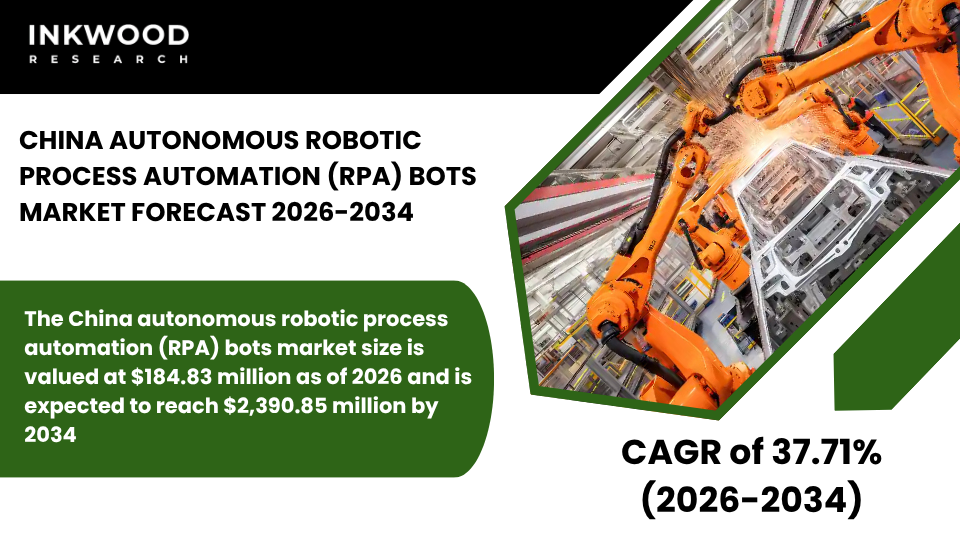
The China autonomous robotic process automation (RPA) bots market size is valued at $184.83 million as of 2026 and is expected to reach $2,390.85 million by 2034, progressing with a CAGR of 37.71% during the forecast years, 2026–2034.
MARKET INSIGHTS
China stands as one of the most strategically significant and fastest-expanding markets for autonomous robotic process automation (RPA) bots globally, underpinned by an unparalleled combination of state-level policy support, a vast digital economy, and rapidly maturing enterprise AI capabilities. The country’s commitment to intelligent automation is not incidental but deeply institutional.
China’s New Generation Artificial Intelligence Development Plan, issued by the State Council, outlines a comprehensive national roadmap for embedding AI across industries, including explicit goals for intelligent process automation in manufacturing, financial services, and public administration. This policy framework has created a uniquely conducive environment for the adoption of AI-powered RPA bots, as both state-owned enterprises and private sector conglomerates align their digital transformation agendas with national priorities.
Consequently, investment in autonomous RPA automation has accelerated significantly across China’s largest organizations, particularly those managing high-volume transactional workflows that demand speed, accuracy, and continuous operational availability. The regulatory landscape, while supportive of AI-driven automation in many respects, also introduces important compliance dimensions that shape how autonomous robotic process automation (RPA) bots are deployed across Chinese enterprises.
The Personal Information Protection Law (PIPL), enforced by the Cyberspace Administration of China, imposes strict requirements on how automated systems collect, process, and store personal data, pushing enterprises to deploy governed, auditable intelligent RPA bots that operate within clearly defined data handling boundaries. Similarly, the Data Security Law (DSL) categorizes data by security level and mandates that automated processing systems adhere to corresponding protection standards, directly influencing the architecture and governance frameworks of enterprise autonomous RPA solutions.
For vendors entering or expanding in the Chinese market, building compliance-ready, localized automation platforms that align with PIPL and DSL requirements is not optional but a foundational market entry requirement, and represents a meaningful competitive differentiator in enterprise procurement decisions. Beyond regulation, China’s extraordinary scale of digital economic activity is itself a structural engine of demand for autonomous RPA bots.
The country’s e-commerce ecosystem, manufacturing base, and financial services sector generate transaction volumes that far exceed the capacity of manual or semi-automated processes to manage efficiently. Leading technology companies, major banks, and large state-owned manufacturers are actively deploying next-generation RPA automation to orchestrate complex, multi-system workflows involving order management, supply chain reconciliation, regulatory reporting, and customer service operations.
Furthermore, the rapid expansion of cloud infrastructure from domestic providers such as Alibaba Cloud, Huawei Cloud, and Tencent Cloud is enabling scalable, low-latency deployment of cloud-based autonomous RPA solutions across enterprise environments nationwide. Together, these converging forces are set to sustain robust and accelerating growth in the China autonomous robotic process automation (RPA) bots market throughout the forecast period.
To Know More About This Report, Request a Free Sample Copy
SEGMENTATION ANALYSIS
The China autonomous robotic process automation (RPA) bots market is segmented by autonomy level, capability type, deployment model, enterprise size, and industry vertical. The industry vertical segment is further categorized into BFSI, healthcare, telecom, retail and e-commerce, manufacturing, and government and public sector.
The manufacturing vertical is one of the most strategically important and rapidly growing segments within the China autonomous robotic process automation (RPA) bots market, driven by the country’s scale as the world’s largest manufacturing economy and its aggressive push toward intelligent industrial digitalization. Chinese manufacturers are increasingly deploying autonomous RPA bots to automate procurement processing, supplier data reconciliation, production reporting, quality compliance documentation, and ERP data synchronization, all of which are high-frequency, data-intensive tasks that previously demanded significant manual labor.
The strategic alignment with China’s Made in China 2025 initiative, which prioritizes intelligent manufacturing and digital factory transformation, has further accelerated enterprise investment in adaptive workflow automation and self-learning automation bots across large industrial enterprises. Additionally, as global supply chains grow more complex and domestic manufacturers face rising labor costs, the financial and operational case for deploying intelligent RPA bots at scale has become increasingly compelling.
For vendors and investors, the manufacturing vertical in China represents a high-potential, high-volume opportunity. This is particularly for autonomous RPA solutions that integrate seamlessly with industrial ERP platforms such as SAP and offer industry-specific process libraries tailored to Chinese manufacturing workflows.
COMPETITIVE INSIGHTS
Some of the top players operating in the China autonomous robotic process automation (RPA) bots market include UiPath Inc, SAP SE, Microsoft Corporation, IBM Corporation, etc.
SAP SE is a Walldorf, Germany-headquartered enterprise software corporation and one of the most widely adopted technology providers among large Chinese enterprises and state-owned organizations. SAP offers intelligent automation capabilities through its SAP Intelligent RPA solution and the broader SAP Business Technology Platform, enabling Chinese enterprises to deploy AI-powered RPA bots that integrate natively with SAP ERP, S/4HANA, and other core business systems. With a long-established presence in China, a dedicated local partner ecosystem, and deep penetration across the manufacturing, BFSI, and government sectors, SAP is well-positioned to support enterprise-scale autonomous RPA deployments that require tight integration with complex, multi-module enterprise landscapes.
REPORT SYNOPSIS
| REPORT SCOPE | DETAILS |
|---|---|
| Market Forecast Years | 2026-2034 |
| Base Year | 2025 |
| Market Historical Years | 2022-2024 |
| Forecast Units | Revenue ($ Million) |
| Segments Analyzed | Autonomy Level, Capability Type, Deployment Model, Enterprise Size, Industry Vertical |
| Country Analyzed | China |
| Companies Analyzed | UiPath Inc, Automation Anywhere Inc, SS&C Blue Prism Limited, Microsoft Corporation, IBM Corporation, SAP SE, NICE Ltd, Tungsten Automation |
TABLE OF CONTENTS
RESEARCH SCOPE & METHODOLOGY
- STUDY OBJECTIVES
- METHODOLOGY
- ASSUMPTIONS & LIMITATIONS
EXECUTIVE SUMMARY
- MARKET SIZE, SHARE & ESTIMATES
- MARKET OVERVIEW
- SCOPE OF STUDY
- MAJOR MARKET FINDINGS
- CHINA IS EXPERIENCING RAPID ADOPTION OF AUTONOMOUS RPA BOTS AS ENTERPRISES ACCELERATE DIGITAL TRANSFORMATION ACROSS INDUSTRIES
- THE BFSI, E-COMMERCE, AND MANUFACTURING SECTORS ARE LEADING USERS OF AUTONOMOUS AUTOMATION FOR TRANSACTION PROCESSING AND OPERATIONS MANAGEMENT
- LOCAL TECHNOLOGY GIANTS AND ENTERPRISE SOFTWARE PROVIDERS ARE DEVELOPING ADVANCED INTELLIGENT AUTOMATION PLATFORMS FOR DOMESTIC ENTERPRISES
- AUTONOMOUS RPA DEPLOYMENTS ARE EXPANDING IN LARGE STATE-OWNED ENTERPRISES TO ENHANCE PRODUCTIVITY AND OPERATIONAL CONTROL
MARKET DYNAMICS
- KEY DRIVERS
- STRONG GOVERNMENT SUPPORT FOR AI AND INDUSTRIAL DIGITALIZATION IS DRIVING ENTERPRISE INVESTMENT IN AUTONOMOUS PROCESS AUTOMATION
- RAPID GROWTH OF DIGITAL ECONOMY AND E-COMMERCE ECOSYSTEMS IS INCREASING DEMAND FOR SCALABLE BUSINESS PROCESS AUTOMATION
- ENTERPRISE DEMAND FOR REAL-TIME DATA PROCESSING AND OPERATIONAL EFFICIENCY IS ACCELERATING ADOPTION OF AUTONOMOUS RPA BOTS
- EXPANSION OF CLOUD INFRASTRUCTURE AND ENTERPRISE AI PLATFORMS IS SUPPORTING INTELLIGENT AUTOMATION DEPLOYMENTS
- KEY RESTRAINTS
- STRICT DATA GOVERNANCE POLICIES AND REGULATORY COMPLIANCE REQUIREMENTS CREATE CHALLENGES FOR AUTOMATION IMPLEMENTATION
- COMPLEX ENTERPRISE SYSTEM LANDSCAPES AND LEGACY SOFTWARE INFRASTRUCTURE SLOW DOWN AUTONOMOUS RPA INTEGRATION
- HIGH IMPLEMENTATION COSTS AND LIMITED AUTOMATION SKILLS IN CERTAIN INDUSTRIES RESTRAIN MARKET PENETRATION
- SECURITY CONCERNS ASSOCIATED WITH AUTOMATED DATA PROCESSING LIMIT ENTERPRISE CONFIDENCE IN FULLY AUTONOMOUS SYSTEMS
- KEY DRIVERS
STRATEGIC MARKET ANALYTICS
- GROWTH METRICS
- TAM, SAM & SOM OPPORTUNITY ANALYSIS
- EMERGING MARKET TRENDS & PARADIGM SHIFTS
- RISING INTEGRATION OF RPA WITH ARTIFICIAL INTELLIGENCE, COMPUTER VISION, AND ADVANCED ANALYTICS FOR INTELLIGENT PROCESS AUTOMATION
- INCREASING DEPLOYMENT OF AUTONOMOUS RPA IN E-COMMERCE OPERATIONS, SUCH AS ORDER MANAGEMENT AND CUSTOMER SERVICE AUTOMATION
- CHINESE ENTERPRISES ARE ADOPTING HYPERAUTOMATION FRAMEWORKS TO ENABLE END-TO-END DIGITAL PROCESS TRANSFORMATION
- LOCAL SOFTWARE VENDORS ARE DEVELOPING INDUSTRY-SPECIFIC AUTONOMOUS RPA SOLUTIONS FOR MANUFACTURING AND FINANCIAL SERVICES
- PORTER’S FIVE FORCES ANALYSIS
- BUYERS POWER
- SUPPLIERS POWER
- SUBSTITUTION
- NEW ENTRANTS
- INDUSTRY RIVALRY
- PESTLE ANALYSIS
- POLITICAL
- ECONOMIC
- SOCIAL LANDSCAPE
- TECHNOLOGY
- LEGAL
- ENVIRONMENTAL
- GROWTH OPPORTUNITY MAPPING & HEATMAP
- GROWTH PROSPECT MAPPING FOR CHINA
- MARKET MATURITY & LIFECYCLE ANALYSIS
- MARKET CONCENTRATION ANALYSIS
- GROWTH METRICS
AUTONOMOUS ROBOTIC PROCESS AUTOMATION (RPA) BOTS VALUE CHAIN & DECISION FRAMEWORK
- VALUE CHAIN ANALYSIS
- AI MODEL DEVELOPMENT
- RPA PLATFORM DEVELOPMENT
- SYSTEM INTEGRATION SERVICES
- BOT DEPLOYMENT MANAGEMENT
- PROCESS MONITORING ANALYTICS
- ENTERPRISE SUPPORT SERVICES
- KEY BUYING CRITERIA
- AUTOMATION SCALABILITY
- AI INTEGRATION CAPABILITY
- DEPLOYMENT FLEXIBILITY
- ENTERPRISE SECURITY COMPLIANCE
- PRICING MODELS, LICENSING STRUCTURES & COST OPTIMIZATION STRATEGIES
- REGULATORY & POLICY LANDSCAPE ANALYSIS
- VALUE CHAIN ANALYSIS
AUTONOMOUS ROBOTIC PROCESS AUTOMATION (RPA) BOTS MARKET BY AUTONOMY LEVEL
- SEMI-AUTONOMOUS RPA BOTS
- MARKET SIZE, FORECAST & SHARE (2022–2034)
- FULLY AUTONOMOUS RPA BOTS
- MARKET SIZE, FORECAST & SHARE (2022–2034)
- SEMI-AUTONOMOUS RPA BOTS
AUTONOMOUS ROBOTIC PROCESS AUTOMATION (RPA) BOTS MARKET BY CAPABILITY TYPE
- SELF-HEALING AUTOMATION
- MARKET SIZE, FORECAST & SHARE (2022–2034)
- SELF-LEARNING AUTOMATION
- MARKET SIZE, FORECAST & SHARE (2022–2034)
- DECISION-AWARE AUTOMATION
- MARKET SIZE, FORECAST & SHARE (2022–2034)
- ADAPTIVE WORKFLOW AUTOMATION
- MARKET SIZE, FORECAST & SHARE (2022–2034)
- SELF-HEALING AUTOMATION
AUTONOMOUS ROBOTIC PROCESS AUTOMATION (RPA) BOTS MARKET BY DEPLOYMENT MODEL
- CLOUD-BASED
- MARKET SIZE, FORECAST & SHARE (2022–2034)
- ON-PREMISE
- MARKET SIZE, FORECAST & SHARE (2022–2034)
- HYBRID
- MARKET SIZE, FORECAST & SHARE (2022–2034)
- CLOUD-BASED
AUTONOMOUS ROBOTIC PROCESS AUTOMATION (RPA) BOTS MARKET BY ENTERPRISE SIZE
- LARGE ENTERPRISES
- MARKET SIZE, FORECAST & SHARE (2022–2034)
- SMES
- MARKET SIZE, FORECAST & SHARE (2022–2034)
- LARGE ENTERPRISES
AUTONOMOUS ROBOTIC PROCESS AUTOMATION (RPA) BOTS MARKET BY INDUSTRY VERTICAL
- BFSI
- MARKET SIZE, FORECAST & SHARE (2022–2034)
- HEALTHCARE
- MARKET SIZE, FORECAST & SHARE (2022–2034)
- TELECOM
- MARKET SIZE, FORECAST & SHARE (2022–2034)
- RETAIL & E-COMMERCE
- MARKET SIZE, FORECAST & SHARE (2022–2034)
- MANUFACTURING
- MARKET SIZE, FORECAST & SHARE (2022–2034)
- GOVERNMENT & PUBLIC SECTOR
- MARKET SIZE, FORECAST & SHARE (2022–2034)
- BFSI
COMPETITIVE LANDSCAPE
- KEY STRATEGIC DEVELOPMENTS
- MERGERS & ACQUISITIONS
- PRODUCT LAUNCHES & DEVELOPMENTS
- PARTNERSHIPS & AGREEMENTS
- BUSINESS EXPANSIONS & DIVESTITURES
- COMPETITOR POSITIONING & DIFFERENTIATION MAP
- COMPANY PROFILES
- UIPATH INC
- COMPANY OVERVIEW
- PRODUCT LIST
- STRENGTHS & CHALLENGES
- AUTOMATION ANYWHERE INC
- COMPANY OVERVIEW
- PRODUCT LIST
- STRENGTHS & CHALLENGES
- SS&C BLUE PRISM LIMITED
- COMPANY OVERVIEW
- PRODUCT LIST
- STRENGTHS & CHALLENGES
- MICROSOFT CORPORATION
- COMPANY OVERVIEW
- PRODUCT LIST
- STRENGTHS & CHALLENGES
- IBM CORPORATION
- COMPANY OVERVIEW
- PRODUCT LIST
- STRENGTHS & CHALLENGES
- SAP SE
- COMPANY OVERVIEW
- PRODUCT LIST
- STRENGTHS & CHALLENGES
- NICE LTD
- COMPANY OVERVIEW
- PRODUCT LIST
- STRENGTHS & CHALLENGES
- TUNGSTEN AUTOMATION
- COMPANY OVERVIEW
- PRODUCT LIST
- STRENGTHS & CHALLENGES
- UIPATH INC
- KEY STRATEGIC DEVELOPMENTS
LIST OF TABLES
TABLE 1: MARKET SNAPSHOT – AUTONOMOUS ROBOTIC PROCESS AUTOMATION (RPA) BOTS
TABLE 2: PRICING MODELS, LICENSING STRUCTURES & COST OPTIMIZATION STRATEGIES FOR AUTONOMOUS ROBOTIC PROCESS AUTOMATION (RPA) BOTS
TABLE 3: REGULATORY & POLICY LANDSCAPE ANALYSIS
TABLE 4: MARKET BY AUTONOMY LEVEL, HISTORICAL YEARS, 2022-2024 (IN $ MILLION)
TABLE 5: MARKET BY AUTONOMY LEVEL, FORECAST YEARS, 2026-2034 (IN $ MILLION)
TABLE 6: MARKET BY CAPABILITY TYPE, HISTORICAL YEARS, 2022-2024 (IN $ MILLION)
TABLE 7: MARKET BY CAPABILITY TYPE, FORECAST YEARS, 2026-2034 (IN $ MILLION)
TABLE 8: MARKET BY DEPLOYMENT MODEL, HISTORICAL YEARS, 2022-2024 (IN $ MILLION)
TABLE 9: MARKET BY DEPLOYMENT MODEL, FORECAST YEARS, 2026-2034 (IN $ MILLION)
TABLE 10: MARKET BY ENTERPRISE SIZE, HISTORICAL YEARS, 2022-2024 (IN $ MILLION)
TABLE 11: MARKET BY ENTERPRISE SIZE, FORECAST YEARS, 2026-2034 (IN $ MILLION)
TABLE 12: MARKET BY INDUSTRY VERTICAL, HISTORICAL YEARS, 2022-2024 (IN $ MILLION)
TABLE 13: MARKET BY INDUSTRY VERTICAL, FORECAST YEARS, 2026-2034 (IN $ MILLION)
TABLE 14: KEY PLAYERS OPERATING IN THE CHINESE MARKET
TABLE 15: LIST OF MERGERS & ACQUISITIONS
TABLE 16: LIST OF PRODUCT LAUNCHES & DEVELOPMENTS
TABLE 17: LIST OF PARTNERSHIPS & AGREEMENTS
TABLE 18: LIST OF BUSINESS EXPANSIONS & DIVESTITURES
LIST OF FIGURES
FIGURE 1: MAJOR MARKET FINDINGS
FIGURE 2: MARKET DYNAMICS
FIGURE 3: KEY MARKET TRENDS
FIGURE 4: PORTER’S FIVE FORCES ANALYSIS
FIGURE 5: GROWTH PROSPECT MAPPING FOR CHINA
FIGURE 6: MARKET MATURITY ANALYSIS
FIGURE 7: MARKET CONCENTRATION ANALYSIS
FIGURE 8: VALUE CHAIN ANALYSIS
FIGURE 9: KEY BUYING CRITERIA
FIGURE 10: SEGMENT GROWTH POTENTIAL, BY AUTONOMY LEVEL, IN 2025
FIGURE 11: SEMI-AUTONOMOUS RPA BOTS MARKET SIZE, 2026-2034 (IN $ MILLION)
FIGURE 12: FULLY AUTONOMOUS RPA BOTS MARKET SIZE, 2026-2034 (IN $ MILLION)
FIGURE 13: SEGMENT GROWTH POTENTIAL, BY CAPABILITY TYPE, IN 2025
FIGURE 14: SELF-HEALING AUTOMATION MARKET SIZE, 2026-2034 (IN $ MILLION)
FIGURE 15: SELF-LEARNING AUTOMATION MARKET SIZE, 2026-2034 (IN $ MILLION)
FIGURE 16: DECISION-AWARE AUTOMATION MARKET SIZE, 2026-2034 (IN $ MILLION)
FIGURE 17: ADAPTIVE WORKFLOW AUTOMATION MARKET SIZE, 2026-2034 (IN $ MILLION)
FIGURE 18: SEGMENT GROWTH POTENTIAL, BY DEPLOYMENT MODEL, IN 2025
FIGURE 19: CLOUD-BASED MARKET SIZE, 2026-2034 (IN $ MILLION)
FIGURE 20: ON-PREMISE MARKET SIZE, 2026-2034 (IN $ MILLION)
FIGURE 21: HYBRID MARKET SIZE, 2026-2034 (IN $ MILLION)
FIGURE 22: SEGMENT GROWTH POTENTIAL, BY ENTERPRISE SIZE, IN 2025
FIGURE 23: LARGE ENTERPRISES MARKET SIZE, 2026-2034 (IN $ MILLION)
FIGURE 24: SMES MARKET SIZE, 2026-2034 (IN $ MILLION)
FIGURE 25: SEGMENT GROWTH POTENTIAL, BY INDUSTRY VERTICAL, IN 2025
FIGURE 26: BFSI MARKET SIZE, 2026-2034 (IN $ MILLION)
FIGURE 27: HEALTHCARE MARKET SIZE, 2026-2034 (IN $ MILLION)
FIGURE 28: TELECOM MARKET SIZE, 2026-2034 (IN $ MILLION)
FIGURE 29: RETAIL & E-COMMERCE MARKET SIZE, 2026-2034 (IN $ MILLION)
FIGURE 30: MANUFACTURING MARKET SIZE, 2026-2034 (IN $ MILLION)
FIGURE 31: GOVERNMENT & PUBLIC SECTOR MARKET SIZE, 2026-2034 (IN $ MILLION)
FAQ’s
RELATED REPORTS
-
UNITED STATES AI-DRIVEN CLOUD MIGRATION SERVICES MARKET FORECAST 2026-2034
-
UNITED KINGDOM AI-DRIVEN CLOUD MIGRATION SERVICES MARKET FORECAST 2026-2034
-
UNITED ARAB EMIRATES AI-DRIVEN CLOUD MIGRATION SERVICES MARKET FORECAST 2026-2034
-
SOUTH KOREA AI-DRIVEN CLOUD MIGRATION SERVICES MARKET FORECAST 2026-2034
-

SINGAPORE AI-DRIVEN CLOUD MIGRATION SERVICES MARKET FORECAST 2026-2034
-
SAUDI ARABIA AI-DRIVEN CLOUD MIGRATION SERVICES MARKET FORECAST 2026-2034
-
AUSTRALIA AI-DRIVEN CLOUD MIGRATION SERVICES MARKET FORECAST 2026-2034
-
JAPAN AI-DRIVEN CLOUD MIGRATION SERVICES MARKET FORECAST 2026-2034
-
INDIA AI-DRIVEN CLOUD MIGRATION SERVICES MARKET FORECAST 2026-2034
-
CHINA AI-DRIVEN CLOUD MIGRATION SERVICES MARKET FORECAST 2026-2034