
ASIA-PACIFIC SOLAR MICROINVERTER MARKET FORECAST 2026-2034
SCOPE OF THE REPORT
Asia-Pacific Solar Microinverter Market by Product Type (Single-Phase Microinverters, Three-Phase Microinverters, Standalone Microinverters, Hybrid/Microinverter-Battery Integrated Units, IQ-Series), Market by Connection/System Type (Grid-Tied Microinverters, Off-Grid Microinverters, Hybrid Microinverters Grid-Interactive + Storage Compatible), Market by Power Rating (Below 250 W, 250–400 W, 400–700 W, Above 700 W), Market by Application (Residential Rooftop Solar, Utility-Scale Distributed PV, Off-Grid Systems/Remote Power Supply, Agricultural Solar, Commercial Solar), Market by Distribution Channel (Direct Sales Manufacturers to EPCs or Installers, Online Retail/E-Commerce, Distributors & Wholesalers, OEM Agreements), by Geography
REPORTS » ENERGY, POWER & UTILITIES » ASIA-PACIFIC SOLAR MICROINVERTER MARKET FORECAST 2026-2034
ASIA-PACIFIC SOLAR MICROINVERTER MARKET OVERVIEW
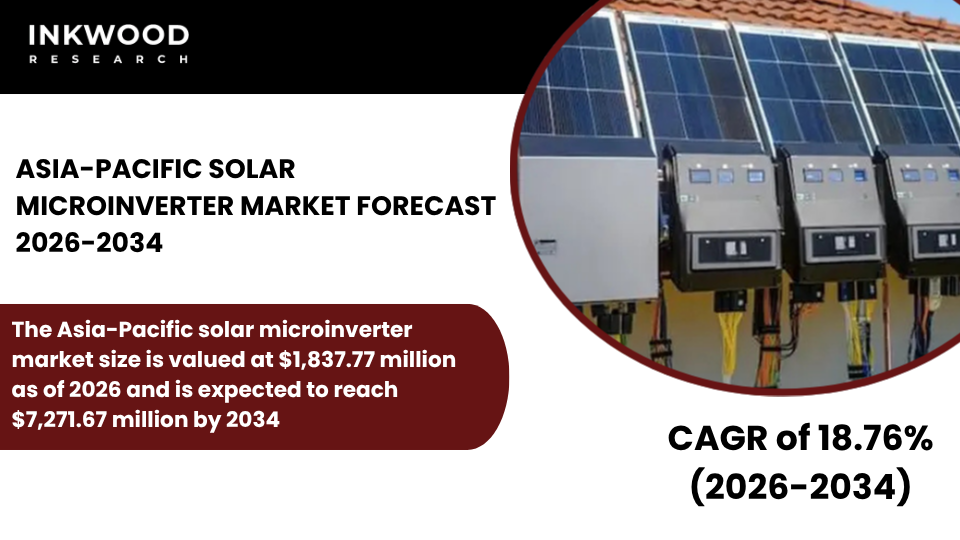
The Asia-Pacific solar microinverter market size is valued at $1,837.77 million as of 2026 and is expected to reach $7,271.67 million by 2034, progressing with a CAGR of 18.76% during the forecast years, 2026-2034.
The Asia-Pacific solar microinverter market is witnessing remarkable expansion, fueled by unprecedented solar capacity additions, aggressive renewable energy mandates, and rapidly declining system costs across key economies. China continues to dominate regional growth, installing a record-breaking 60 GW of new solar photovoltaic capacity in the first quarter of 2025 alone, with rooftop installations accounting for 60% of total additions.
This surge stems from new National Energy Administration guidelines implemented in May 2025 that promote self-consumption of distributed solar energy to alleviate grid congestion and enhance system reliability. Furthermore, China’s 14th Five-Year Plan drives provincial governments to accelerate clean energy deployment, creating substantial opportunities for module-level power electronics across commercial, industrial, and residential segments.
Japan represents another critical growth market, with the country’s draft Seventh Strategic Energy Plan positioning solar photovoltaic systems to supply 23-29% of electricity generation by 2040, requiring installed capacity to triple from current levels. The U.S. Energy Information Administration reports that Japan targets increasing solar capacity from 79 GW in 2022 to 108 GW by 2030, with initiatives including mandatory installations on 50% of government buildings and corporate facilities.
Additionally, Tokyo’s groundbreaking regulation requiring solar panels on new residential construction took effect in April 2025, establishing a precedent that other Japanese municipalities are expected to follow. Across the broader Asia-Pacific region, declining module prices combined with government subsidies and feed-in tariff programs are making distributed solar systems economically attractive for households and businesses.
The integration of battery energy storage with solar microinverters is gaining momentum, particularly in markets experiencing grid stability challenges, as storage enables greater energy independence and supports time-of-use optimization. Moreover, manufacturing cost advantages in China and Southeast Asia continue to put downward pressure on solar microinverter pricing, improving affordability while accelerating market penetration across price-sensitive segments..
To Know More About This Report, Request a Free Sample Copy
The Asia-Pacific solar microinverter market growth assessment includes the analysis of China, Japan, India, South Korea, Indonesia, Vietnam, Thailand, Australia & New Zealand, and Rest of Asia-Pacific.
China commands the dominant position within the Asia-Pacific solar microinverter market, supported by the world’s largest solar manufacturing ecosystem and comprehensive government policies targeting carbon neutrality by 2060. The country’s National Energy Administration implemented transformative regulations in October 2024, taking effect in May 2025, that fundamentally reshaped distributed solar deployment strategies.
According to industry analysis, China installed 198 GW of solar capacity between January and May 2025, demonstrating deployment rates equivalent to adding nearly 100 solar panels every second during peak installation months. These additions comprise both utility-scale projects and distributed rooftop systems, with the latter category experiencing particular acceleration due to self-consumption mandates designed to reduce grid congestion.
The Chinese government’s “Whole County PV” program, initiated in June 2021 and covering 676 participating counties, targets adding solar photovoltaic panels to 20% of residential rooftops alongside commercial, industrial, and government buildings. This coordinated approach eliminates administrative burdens that typically constrain individual installations while creating economies of scale that benefit solar microinverter suppliers.
However, the market faces challenges, including grid connection restrictions in certain provinces designated as “yellow” or “red” zones due to renewable energy intermittency concerns. Provincial governments in Shandong, Hebei, and Henan have implemented stricter requirements for rooftop solar projects, limiting grid access and reducing government incentive availability.
Additionally, new regulations require commercial and industrial projects exceeding 6 MW to prioritize self-consumption, with limitations on selling surplus electricity back to the grid. Despite these constraints, China’s solar photovoltaic industry benefits from vertically integrated supply chains, advanced manufacturing capabilities, and module prices that have declined to approximately CNY 0.75 per watt in 2024 from CNY 2.00 per watt in 2020.
Looking forward, projections indicate potential for 130 GW of distributed solar capacity additions in 2025, comprising 92 GW from commercial and industrial installations and 38 GW from residential projects, creating sustained demand for solar microinverters optimized for rooftop applications across diverse building types and electrical configurations.
Japan represents a strategically important and technologically sophisticated market for solar microinverters, characterized by premium quality standards, advanced grid integration requirements, and strong policy support for distributed renewable energy. The country’s draft Seventh Strategic Energy Plan, released in December 2024, establishes ambitious targets to increase solar’s share of electricity generation from 11.2% in 2023 to 23-29% by 2040, positioning photovoltaic systems as Japan’s largest power source.
According to the Organization for Cross-regional Coordination of Transmission Operators, nationwide solar installed capacity is forecast to grow from 76.70 GW in fiscal year 2024 to 104.94 GW by fiscal year 2034, requiring sustained annual additions. The Japanese government’s 6th Strategic Energy Plan, combined with initiatives under the GX (Green Transformation) Decarbonization framework, includes provisions for installing solar capacity on 50% of government buildings (contributing 6 GW), corporate buildings and parking garages (10 GW), and public land (4 GW) by 2030.
Furthermore, Tokyo’s pioneering regulation mandating solar installations on new residential construction became effective in April 2025, placing obligations on large homebuilders with projects exceeding 20,000 square meters annually. This requirement, administered by the Tokyo Metropolitan Government, establishes quotas based on building count and regional sunshine conditions, with similar regulations expected in other Japanese municipalities.
Interestingly, more than 60% of Japan’s solar generation in 2024 derived from rooftop installations rather than ground-mounted systems, reflecting land scarcity constraints and urbanization patterns that favor distributed deployment. The Japanese market particularly values solar microinverters for their ability to maximize energy yield in complex rooftop environments with varying orientations and partial shading conditions common in dense urban areas.
Additionally, Japan is pioneering next-generation perovskite solar cell technology, with government strategies targeting gigawatt-scale domestic production that will require compatible power electronics solutions. However, challenges persist, including relatively low adoption rates; only 6.6% of homes and 12% of detached houses had installed solar systems as of 2022, indicating substantial untapped residential potential.
The market also faces subsidy reduction pressures as feed-in tariff programs phase down, though rising electricity prices and energy security concerns following the 2011 Fukushima disaster continue to motivate solar investments. Battery energy storage integration remains limited by high costs, though government subsidies from the Ministry of Environment and Tokyo municipalities aim to accelerate adoption.
As Japan advances toward its carbon neutrality goal by 2050, rooftop solar photovoltaic systems combined with module-level power electronics represent critical infrastructure for achieving renewable energy targets while maintaining grid stability in one of Asia’s most technologically demanding markets.
The Asia-Pacific solar microinverter market is segmented into product type, connection/system type, power rating, application, and distribution channel. The Application segment is further categorized into residential rooftop solar, utility-scale distributed PV, off-grid systems/remote power supply, agricultural solar, and commercial solar.
Residential rooftop solar plays a vital role in the Asia-Pacific solar microinverter market, driven by strong government mandates, declining system costs, and growing energy independence concerns across major economies. This application segment encompasses solar photovoltaic installations on single-family homes, multi-family residential buildings, and apartment complexes, where solar microinverters provide critical advantages in complex rooftop environments.
The segment benefits particularly from regulatory tailwinds, including Tokyo’s mandatory solar requirements for new residential construction effective April 2025, China’s “Whole County PV” program targeting 20% rooftop coverage across 676 participating counties, and various provincial incentive schemes throughout the region. Residential installations favor solar microinverters due to their ability to optimize individual panel performance in scenarios involving varying roof orientations, partial shading from nearby structures or vegetation, and phased system expansion as household budgets allow.
Furthermore, module-level monitoring capabilities enable homeowners to track real-time energy production through mobile applications, identify underperforming panels quickly, and maximize self-consumption to reduce grid electricity purchases. The residential segment also benefits from safety advantages inherent in solar microinverter architecture, including automatic rapid shutdown functionality that meets evolving electrical codes and reduces fire risks during maintenance or emergency situations.
Economic factors driving residential adoption include feed-in tariff programs in Japan and parts of China that guarantee above-market prices for surplus electricity, net metering arrangements that provide credits for grid exports, and rising retail electricity rates that improve solar payback periods. Additionally, financing innovations such as zero-down leasing programs, utility-backed battery lease options, and government subsidy schemes reduce upfront cost barriers that historically constrained residential solar adoption.
As urbanization continues across Asia-Pacific markets, balcony solar systems and plug-in modules are expanding the addressable market beyond traditional homeowners to include apartment dwellers and renters seeking partial energy independence. This residential rooftop application supports overall solar microinverter market growth by representing the largest volume opportunity in distributed solar deployment, benefiting from favorable unit economics at small system sizes, established installer networks with module-level expertise, and consumer preferences for technology that maximizes energy harvest while providing granular performance visibility and long-term reliability backed by extended warranty coverage.
Some of the top players operating in the Asia-Pacific solar microinverter market include Hoymiles Power Electronics Inc, Enphase Energy Inc, APsystems (Altenergy Power System Inc), Sungrow Power Supply Co Ltd, etc.
Hoymiles Power Electronics Inc is a leading Chinese power electronics company, specializing in solar microinverters, hybrid inverters, battery energy storage systems, and module-level monitoring solutions for residential, commercial, and utility-scale applications. The company’s product portfolio spans single-phase and three-phase microinverters ranging from 350 to 2,000 VA peak output, designed to support both traditional rooftop installations and emerging balcony solar systems popular across European and Asian markets.
The company operates manufacturing facilities in China that benefit from vertically integrated supply chains and cost advantages, enabling competitive pricing while maintaining quality standards. Also, Hoymiles serves customers across more than 190 countries through established distribution networks, OEM partnerships, and direct relationships with solar installers.
Further, the company’s strategic focus on the Asia-Pacific region, combined with recent expansion into high-growth markets like India, where government programs including PM Surya Ghar and PM-KUSUM are accelerating solar adoption, positions Hoymiles as a key player addressing the massive distributed solar opportunity across residential, agricultural, and commercial segments throughout the region.
REPORT SYNOPSIS
| REPORT SCOPE | DETAILS |
|---|---|
| Market Forecast Years | 2026-2034 |
| Base Year | 2025 |
| Market Historical Years | 2022-2024 |
| Forecast Units | Revenue ($ Million) |
| Segments Analyzed | Product Type, Connection / System Type, Power Rating, Application, Distribution Channel |
| Countries Analyzed | China, India, Japan, Australia & New Zealand, South Korea, Thailand, Indonesia, Vietnam, and Rest of Asia-Pacific |
| Companies Analyzed | Enphase Energy Inc, SolarEdge Technologies Inc, Hoymiles Power Electronics Inc, SMA Solar Technology AG, APsystems (Altenergy Power System Inc), Darfon Electronics Corp, Sungrow Power Supply Co Ltd, Chilicon Power LLC, Sparq Systems Inc, Leading Edge Power, ReneSola Ltd, ABB Ltd, Delta Electronics Inc, GoodWe, Fronius International GmbH |
TABLE OF CONTENTS
RESEARCH SCOPE & METHODOLOGY
- STUDY OBJECTIVES
- METHODOLOGY
- ASSUMPTIONS & LIMITATIONS
EXECUTIVE SUMMARY
- MARKET SIZE & FORECAST
- MARKET OVERVIEW
- SCOPE OF STUDY
- CRISIS SCENARIO ANALYSIS
- MAJOR MARKET FINDINGS
- MICROINVERTERS ARE GAINING SHARE OVER STRING INVERTERS DUE TO SUPERIOR MODULE LEVEL OPTIMIZATION AND SAFETY PERFORMANCE
- RESIDENTIAL ROOFTOP INSTALLATIONS ACCOUNT FOR THE LARGEST DEMAND SHARE, DRIVEN BY DESIGN FLEXIBILITY AND SHADE TOLERANCE
- TECHNOLOGICAL DIFFERENTIATION IS CENTERED AROUND HIGHER POWER RATINGS AND INTEGRATED MONITORING CAPABILITIES
MARKET DYNAMICS
- KEY DRIVERS
- RISING RESIDENTIAL SOLAR ADOPTION IS ACCELERATING DEMAND FOR EASY TO INSTALL AND SCALABLE INVERTER SOLUTIONS
- INCREASING FOCUS ON SYSTEM SAFETY AND RAPID SHUTDOWN COMPLIANCE IS FAVORING MICROINVERTER DEPLOYMENT
- DECLINING MODULE COSTS ARE IMPROVING THE OVERALL ECONOMICS OF MICROINVERTER-BASED SYSTEMS
- GROWING CONSUMER AWARENESS OF ENERGY YIELD OPTIMIZATION IS DRIVING UPGRADE DEMAND FROM STRING INVERTERS
- KEY RESTRAINTS
- HIGHER UPFRONT SYSTEM COSTS CONTINUE TO LIMIT MICROINVERTER PENETRATION IN PRICE-SENSITIVE MARKETS
- COMPLEXITY IN AFTER-SALES SERVICE CAN INCREASE MAINTENANCE COSTS FOR LARGE-SCALE INSTALLATIONS
- DEPENDENCE ON IMPORTED ELECTRONIC COMPONENTS EXPOSES SUPPLY CHAINS TO PRICE AND AVAILABILITY RISKS
- LIMITED SUITABILITY FOR UTILITY SCALE PROJECTS CONSTRAINS THE ADDRESSABLE MARKET SIZE
- KEY DRIVERS
KEY ANALYTICS
- KEY MARKET TRENDS
- MANUFACTURERS ARE INTRODUCING HIGH-POWER MICROINVERTERS TO SUPPORT NEXT GENERATION SOLAR MODULES
- INTEGRATION OF ADVANCED MONITORING SOFTWARE IS BECOMING A STANDARD PRODUCT FEATURE
- STRATEGIC PARTNERSHIPS WITH INSTALLERS ARE EMERGING AS A KEY GO-TO MARKET STRATEGY
- INCREASING ADOPTION OF AC MODULES IS STRENGTHENING THE MICROINVERTER ECOSYSTEM
- PORTER’S FIVE FORCES ANALYSIS
- BUYERS POWER
- SUPPLIERS POWER
- SUBSTITUTION
- NEW ENTRANTS
- INDUSTRY RIVALRY
- GROWTH PROSPECT MAPPING
- GROWTH PROSPECT MAPPING FOR ASIA-PACIFIC
- MARKET MATURITY ANALYSIS
- MARKET CONCENTRATION ANALYSIS
- VALUE CHAIN ANALYSIS
- RAW MATERIAL SOURCING
- POWER ELECTRONICS DESIGN
- COMPONENT MANUFACTURING
- INVERTER ASSEMBLY
- QUALITY TESTING
- DISTRIBUTION CHANNELS
- INSTALLATION SERVICES
- KEY BUYING CRITERIA
- CONVERSION EFFICIENCY
- SYSTEM RELIABILITY
- WARRANTY COVERAGE
- MONITORING FEATURES
- REGULATORY FRAMEWORK
- KEY MARKET TRENDS
SOLAR MICROINVERTER MARKET BY PRODUCT TYPE
- SINGLE-PHASE MICROINVERTERS
- THREE-PHASE MICROINVERTERS
- STANDALONE MICROINVERTERS
- HYBRID / MICROINVERTER-BATTERY INTEGRATED UNITS
- IQ-SERIES
SOLAR MICROINVERTER MARKET BY CONNECTION / SYSTEM TYPE
- GRID-TIED MICROINVERTERS
- OFF-GRID MICROINVERTERS
- HYBRID MICROINVERTERS (GRID-INTERACTIVE + STORAGE COMPATIBLE)
SOLAR MICROINVERTER MARKET BY POWER RATING
- BELOW 250 W
- 250–400 W
- 400–700 W
- ABOVE 700 W
SOLAR MICROINVERTER MARKET BY APPLICATION
- RESIDENTIAL ROOFTOP SOLAR
- UTILITY-SCALE DISTRIBUTED PV
- OFF-GRID SYSTEMS / REMOTE POWER SUPPLY
- AGRICULTURAL SOLAR
- COMMERCIAL SOLAR
- SMALL-SIZE
- MID-SIZE
SOLAR MICROINVERTER MARKET BY DISTRIBUTION CHANNEL
- DIRECT SALES (MANUFACTURERS TO EPCS OR INSTALLERS)
- ONLINE RETAIL / E-COMMERCE
- DISTRIBUTORS & WHOLESALERS
- OEM AGREEMENTS
GEOGRAPHICAL ANALYSIS
- ASIA-PACIFIC
- MARKET SIZE & ESTIMATES
- ASIA-PACIFIC MARKET DRIVERS
- ASIA-PACIFIC MARKET CHALLENGES
- KEY PLAYERS IN ASIA-PACIFIC SOLAR MICROINVERTER MARKET
- COUNTRY ANALYSIS
- CHINA
- CHINA MARKET SIZE & OPPORTUNITIES
- INDIA
- INDIA MARKET SIZE & OPPORTUNITIES
- JAPAN
- JAPAN MARKET SIZE & OPPORTUNITIES
- AUSTRALIA & NEW ZEALAND
- AUSTRALIA & NEW ZEALAND MARKET SIZE & OPPORTUNITIES
- SOUTH KOREA
- SOUTH KOREA MARKET SIZE & OPPORTUNITIES
- THAILAND
- THAILAND MARKET SIZE & OPPORTUNITIES
- INDONESIA
- INDONESIA MARKET SIZE & OPPORTUNITIES
- VIETNAM
- VIETNAM MARKET SIZE & OPPORTUNITIES
- REST OF ASIA-PACIFIC
- REST OF ASIA-PACIFIC MARKET SIZE & OPPORTUNITIES
- CHINA
- ASIA-PACIFIC
COMPETITIVE LANDSCAPE
- KEY STRATEGIC DEVELOPMENTS
- MERGERS & ACQUISITIONS
- PRODUCT LAUNCHES & DEVELOPMENTS
- PARTNERSHIPS & AGREEMENTS
- BUSINESS EXPANSIONS & DIVESTITURES
- COMPANY PROFILES
- ENPHASE ENERGY INC
- COMPANY OVERVIEW
- PRODUCTS / SERVICES LIST
- STRENGTHS & CHALLENGES
- SOLAREDGE TECHNOLOGIES INC
- COMPANY OVERVIEW
- PRODUCTS / SERVICES LIST
- STRENGTHS & CHALLENGES
- HOYMILES POWER ELECTRONICS INC
- COMPANY OVERVIEW
- PRODUCTS / SERVICES LIST
- STRENGTHS & CHALLENGES
- SMA SOLAR TECHNOLOGY AG
- COMPANY OVERVIEW
- PRODUCTS / SERVICES LIST
- STRENGTHS & CHALLENGES
- APSISTEMS (ALTENERGY POWER SYSTEM INC)
- COMPANY OVERVIEW
- PRODUCTS / SERVICES LIST
- STRENGTHS & CHALLENGES
- DARFON ELECTRONICS CORP
- COMPANY OVERVIEW
- PRODUCTS / SERVICES LIST
- STRENGTHS & CHALLENGES
- SUNGROW POWER SUPPLY CO LTD
- COMPANY OVERVIEW
- PRODUCTS / SERVICES LIST
- STRENGTHS & CHALLENGES
- CHILICON POWER LLC
- COMPANY OVERVIEW
- PRODUCTS / SERVICES LIST
- STRENGTHS & CHALLENGES
- SPARQ SYSTEMS INC
- COMPANY OVERVIEW
- PRODUCTS / SERVICES LIST
- STRENGTHS & CHALLENGES
- LEADING EDGE POWER
- COMPANY OVERVIEW
- PRODUCTS / SERVICES LIST
- STRENGTHS & CHALLENGES
- RENESOLA LTD
- COMPANY OVERVIEW
- PRODUCTS / SERVICES LIST
- STRENGTHS & CHALLENGES
- ABB LTD
- COMPANY OVERVIEW
- PRODUCTS / SERVICES LIST
- STRENGTHS & CHALLENGES
- DELTA ELECTRONICS INC
- COMPANY OVERVIEW
- PRODUCTS / SERVICES LIST
- STRENGTHS & CHALLENGES
- GOODWE
- COMPANY OVERVIEW
- PRODUCTS / SERVICES LIST
- STRENGTHS & CHALLENGES
- FRONIUS INTERNATIONAL GMBH
- COMPANY OVERVIEW
- PRODUCTS / SERVICES LIST
- STRENGTHS & CHALLENGES
- ENPHASE ENERGY INC
- KEY STRATEGIC DEVELOPMENTS
LIST OF TABLES
TABLE 1: MARKET SNAPSHOT – SOLAR MICROINVERTER
TABLE 2: SOLAR MICROINVERTER MARKET REGULATORY FRAMEWORK
TABLE 3: MARKET BY PRODUCT TYPE, BY REGION, HISTORICAL YEARS, 2022-2024 (IN $ MILLION)
TABLE 4: MARKET BY PRODUCT TYPE, BY REGION, FORECAST YEARS, 2026-2034 (IN $ MILLION)
TABLE 5: MARKET BY CONNECTION / SYSTEM TYPE, BY REGION, HISTORICAL YEARS, 2022-2024 (IN $ MILLION)
TABLE 6: MARKET BY CONNECTION / SYSTEM TYPE, BY REGION, FORECAST YEARS, 2026-2034 (IN $ MILLION)
TABLE 7: MARKET BY POWER RATING, BY REGION, HISTORICAL YEARS, 2022-2024 (IN $ MILLION)
TABLE 8: MARKET BY POWER RATING, BY REGION, FORECAST YEARS, 2026-2034 (IN $ MILLION)
TABLE 9: MARKET BY APPLICATION, BY REGION, HISTORICAL YEARS, 2022-2024 (IN $ MILLION)
TABLE 10: MARKET BY APPLICATION, BY REGION, FORECAST YEARS, 2026-2034 (IN $ MILLION)
TABLE 11: MARKET BY COMMERCIAL SOLAR, BY REGION, HISTORICAL YEARS, 2022-2024 (IN $ MILLION)
TABLE 12: MARKET BY COMMERCIAL SOLAR, BY REGION, FORECAST YEARS, 2026-2034 (IN $ MILLION)
TABLE 13: MARKET BY DISTRIBUTION CHANNEL, BY REGION, HISTORICAL YEARS, 2022-2024 (IN $ MILLION)
TABLE 14: MARKET BY DISTRIBUTION CHANNEL, BY REGION, FORECAST YEARS, 2026-2034 (IN $ MILLION)
TABLE 15: ASIA-PACIFIC MARKET, COUNTRY ANALYSIS, HISTORICAL YEARS, 2022-2024 (IN $ MILLION)
TABLE 16: ASIA-PACIFIC MARKET, COUNTRY ANALYSIS, FORECAST YEARS, 2026-2034 (IN $ MILLION)
TABLE 17: KEY PLAYERS OPERATING IN THE ASIA-PACIFIC MARKET
TABLE 18: LIST OF MERGERS & ACQUISITIONS
TABLE 19: LIST OF PRODUCT LAUNCHES & DEVELOPMENTS
TABLE 20: LIST OF PARTNERSHIPS & AGREEMENTS
TABLE 21: LIST OF BUSINESS EXPANSIONS & DIVESTITURES
LIST OF FIGURES
FIGURE 1: MAJOR MARKET FINDINGS
FIGURE 2: MARKET DYNAMICS
FIGURE 3: KEY MARKET TRENDS
FIGURE 4: PORTER’S FIVE FORCES ANALYSIS
FIGURE 5: GROWTH PROSPECT MAPPING FOR ASIA-PACIFIC
FIGURE 6: MARKET MATURITY ANALYSIS
FIGURE 7: MARKET CONCENTRATION ANALYSIS
FIGURE 8: VALUE CHAIN ANALYSIS
FIGURE 9: KEY BUYING CRITERIA
FIGURE 10: SEGMENT GROWTH POTENTIAL, BY PRODUCT TYPE, IN 2025
FIGURE 11: SINGLE-PHASE MICROINVERTERS MARKET SIZE, 2026-2034 (IN $ MILLION)
FIGURE 12: THREE-PHASE MICROINVERTERS MARKET SIZE, 2026-2034 (IN $ MILLION)
FIGURE 13: STANDALONE MICROINVERTERS MARKET SIZE, 2026-2034 (IN $ MILLION)
FIGURE 14: HYBRID / MICROINVERTER-BATTERY INTEGRATED UNITS MARKET SIZE, 2026-2034 (IN $ MILLION)
FIGURE 15: IQ-SERIES MARKET SIZE, 2026-2034 (IN $ MILLION)
FIGURE 16: SEGMENT GROWTH POTENTIAL, BY CONNECTION / SYSTEM TYPE, IN 2025
FIGURE 17: GRID-TIED MICROINVERTERS MARKET SIZE, 2026-2034 (IN $ MILLION)
FIGURE 18: OFF-GRID MICROINVERTERS MARKET SIZE, 2026-2034 (IN $ MILLION)
FIGURE 19: HYBRID MICROINVERTERS (GRID-INTERACTIVE + STORAGE COMPATIBLE) MARKET SIZE, 2026-2034 (IN $ MILLION)
FIGURE 20: SEGMENT GROWTH POTENTIAL, BY POWER RATING, IN 2025
FIGURE 21: BELOW 250 W MARKET SIZE, 2026-2034 (IN $ MILLION)
FIGURE 22: 250–400 W MARKET SIZE, 2026-2034 (IN $ MILLION)
FIGURE 23: 400–700 W MARKET SIZE, 2026-2034 (IN $ MILLION)
FIGURE 24: ABOVE 700 W MARKET SIZE, 2026-2034 (IN $ MILLION)
FIGURE 25: SEGMENT GROWTH POTENTIAL, BY APPLICATION, IN 2025
FIGURE 26: RESIDENTIAL ROOFTOP SOLAR MARKET SIZE, 2026-2034 (IN $ MILLION)
FIGURE 27: UTILITY-SCALE DISTRIBUTED PV MARKET SIZE, 2026-2034 (IN $ MILLION)
FIGURE 28: OFF-GRID SYSTEMS / REMOTE POWER SUPPLY MARKET SIZE, 2026-2034 (IN $ MILLION)
FIGURE 29: AGRICULTURAL SOLAR MARKET SIZE, 2026-2034 (IN $ MILLION)
FIGURE 30: COMMERCIAL SOLAR MARKET SIZE, 2026-2034 (IN $ MILLION)
FIGURE 31: SEGMENT GROWTH POTENTIAL, BY COMMERCIAL SOLAR, IN 2025
FIGURE 32: SMALL-SIZE COMMERCIAL SOLAR MARKET SIZE, 2026-2034 (IN $ MILLION)
FIGURE 33: MID-SIZE COMMERCIAL SOLAR MARKET SIZE, 2026-2034 (IN $ MILLION)
FIGURE 34: SEGMENT GROWTH POTENTIAL, BY DISTRIBUTION CHANNEL, IN 2025
FIGURE 35: DIRECT SALES MARKET SIZE, 2026-2034 (IN $ MILLION)
FIGURE 36: ONLINE RETAIL / E-COMMERCE MARKET SIZE, 2026-2034 (IN $ MILLION)
FIGURE 37: DISTRIBUTORS & WHOLESALERS MARKET SIZE, 2026-2034 (IN $ MILLION)
FIGURE 38: OEM AGREEMENTS MARKET SIZE, 2026-2034 (IN $ MILLION)
FIGURE 39: ASIA-PACIFIC SOLAR MICROINVERTER MARKET, COUNTRY OUTLOOK, 2025 & 2034 (IN %)
FIGURE 40: CHINA MARKET SIZE, 2026-2034 (IN $ MILLION)
FIGURE 41: INDIA MARKET SIZE, 2026-2034 (IN $ MILLION)
FIGURE 42: JAPAN MARKET SIZE, 2026-2034 (IN $ MILLION)
FIGURE 43: AUSTRALIA & NEW ZEALAND MARKET SIZE, 2026-2034 (IN $ MILLION)
FIGURE 44: SOUTH KOREA MARKET SIZE, 2026-2034 (IN $ MILLION)
FIGURE 45: THAILAND MARKET SIZE, 2026-2034 (IN $ MILLION)
FIGURE 46: INDONESIA MARKET SIZE, 2026-2034 (IN $ MILLION)
FIGURE 47: VIETNAM MARKET SIZE, 2026-2034 (IN $ MILLION)
FIGURE 48: REST OF ASIA-PACIFIC MARKET SIZE, 2026-2034 (IN $ MILLION)
FAQ’s
RELATED REPORTS
-

ASIA PACIFIC PRECISION FARMING MARKET FORECAST 2026
-
TURKEY SOLAR ENCAPSULATION MARKET FORECAST 2026-2034
-
UNITED STATES SOLAR ENCAPSULATION MARKET FORECAST 2026-2034
-
JAPAN SOLAR ENCAPSULATION MARKET FORECAST 2026-2034
-
ASIA-PACIFIC SOLAR ENCAPSULATION MARKET FORECAST 2026-2034
-
EUROPE SOLAR ENCAPSULATION MARKET FORECAST 2026-2034
-
NORTH AMERICA SOLAR ENCAPSULATION MARKET FORECAST 2026-2034
-
GLOBAL SOLAR ENCAPSULATION MARKET FORECAST 2026-2034
-
UNITED STATES WIND ENERGY MARKET FORECAST 2026-2034
-
CANADA WIND ENERGY MARKET FORECAST 2026-2034