Asia-Pacific Battery Recycling Market by Chemistry (Lead-Acid, Nickel-Based, Lithium-Based, Others) Market by Application (Transportation, Consumer Electronics, Industrial, Other Applications) Market by Recycling Process (Hydrometallurgy, Pyrometallurgy, Lead Acid Battery Recycling Process, Lithium-Ion Battery Recycling Process) Market by Source (Automotive Batteries, Industrial Batteries, Consumer Electronics)
ASIA-PACIFIC BATTERY RECYCLING MARKET OVERVIEW
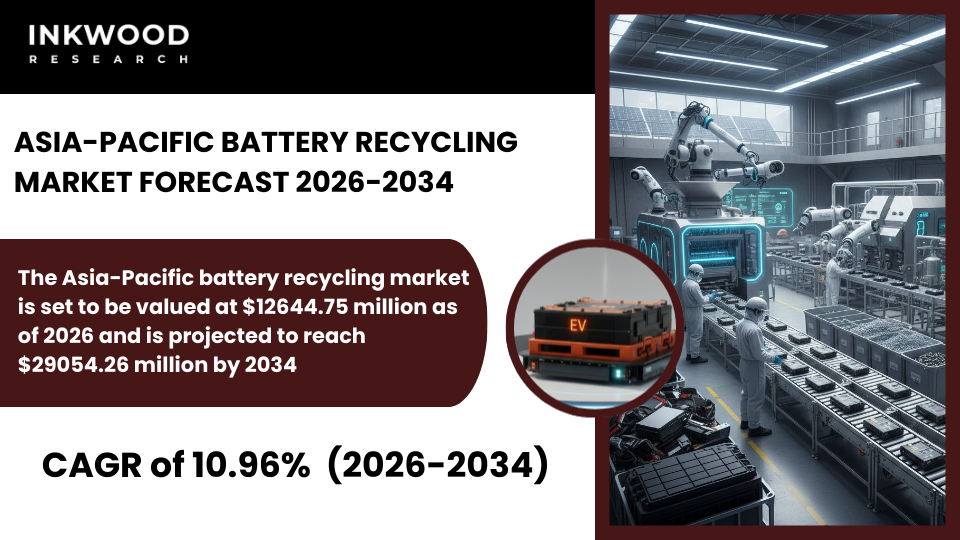
The Asia-Pacific battery recycling market is set to be valued at $12644.75 million as of 2026 and is projected to reach $29054.26 million by 2034, growing with a CAGR of 10.96% during the forecast years, 2026-2034.
The Asia-Pacific battery recycling market experiences exponential growth driven by the region’s dominance in global battery production and electric vehicle manufacturing. The region’s integrated supply chains, spanning raw material processing, cell manufacturing, and vehicle assembly, create comprehensive recycling ecosystems. China enforces stringent extended producer responsibility regulations requiring battery manufacturers to establish collection and recycling systems.
Government policies, such as China’s “New Energy Vehicle” (NEV) regulations, require battery manufacturers to be responsible for recycling, further supporting battery recycling market growth. These mandates create accountability throughout product lifecycles, ensuring systematic material recovery. Furthermore, Asia-Pacific countries implement ambitious electrification targets, accelerating EV adoption rates. In China, electric cars are projected to reach around 60% of total car sales in 2025. This massive deployment generates substantial future recycling volumes as batteries reach end-of-life stages.
Additionally, government subsidies and incentives support recycling infrastructure development across major economies. Japan and South Korea leverage advanced manufacturing expertise, applying precision engineering to battery recycling processes. India emerges as a rapidly growing market through domestic EV adoption and battery waste management regulations. Southeast Asian nations, including Thailand, Indonesia, and Vietnam, expand recycling capabilities aligned with burgeoning automotive industries. The region benefits from proximity to raw material sources and established metal refining industries. Consequently, recyclers achieve cost advantages compared to Western counterparts through integrated value chains.
To Know More About This Report, Request a Free Sample Copy
The Asia-Pacific battery recycling market growth assessment includes the analysis of China, Japan, India, South Korea, Indonesia, Vietnam, Thailand, Australia & New Zealand, and Rest of Asia-Pacific.
China maintained its lead with electric cars accounting for almost half of all car sales in 2024, with over 11 million electric cars sold in China last year. This massive EV fleet creates unprecedented recycling opportunities as early-generation vehicles approach retirement. The Chinese government introduced comprehensive battery lifecycle management regulations establishing traceability requirements from production through disposal.
China’s Ministry of Ecology and Environment proposed in March 2025 redefining the recyclable lithium-ion battery “black mass” as non-waste, allowing free imports as part of broader efforts under the China Resources Recycling Group. This policy shift facilitates material imports while promoting domestic processing capacity expansion. Moreover, upcoming national standards for recycled black mass establish quality benchmarks for imported materials.
Major battery manufacturers establish subsidiary recycling operations, creating vertically integrated circular systems. State-owned enterprises collaborate with private recyclers to develop comprehensive urban collection networks. Digital platforms track battery movements from manufacturing through collection points to recycling facilities. Furthermore, China’s Belt and Road initiatives extend recycling expertise to partner countries throughout Asia and Africa.
Japan develops sophisticated battery recycling infrastructure, leveraging decades of experience in precision manufacturing and materials science. The nation pioneered early lithium-ion battery commercialization, creating deep technical expertise in battery chemistry and processing. Japanese companies emphasize high-purity material recovery suitable for premium battery applications. Recycling operations integrate with established electronics recycling systems, providing efficient collection networks. Major battery manufacturers, including Panasonic and GS Yuasa, operate proprietary recycling facilities processing their own battery technologies. This vertical integration optimizes material recovery from familiar cell designs and chemistries.
Additionally, Japanese recyclers collaborate with automotive manufacturers, establishing closed-loop material flows. According to the Environmental Protection Agency, electric car production in Asia Pacific countries, excluding China, reached about 1 million, with most of the region’s electric car sales attributed to Japan’s Toyota and Korea’s Hyundai. Toyota implements comprehensive battery collection programs through dealership networks, capturing end-of-life hybrid and electric vehicle batteries systematically. The company also invests in research, developing direct recycling methods that preserve cathode material structures.
Furthermore, Japan’s regulatory framework emphasizes environmental protection with strict emissions controls and waste treatment requirements. Recycling facilities employ advanced pollution prevention technologies, ensuring zero harmful discharge. Resource circulation policies promote domestic material recovery, reducing import dependencies. Japanese recyclers export technical expertise to Southeast Asian countries, supporting regional capacity development. Partnerships with ASEAN nations transfer technology and establish joint ventures processing regional battery waste streams.
South Korea expands battery recycling capabilities aligned with its position as a major battery cell manufacturer and automotive exporter. Leading battery producers, including LG Energy Solution, Samsung SDI, and SK On, develop comprehensive recycling strategies. In January 2020, GS Engineering & Construction Corp., a South Korean civil engineering company, announced construction of a new facility for recycling lithium-ion batteries at an investment of around KRW 100 billion or USD 86 million by 2022, with a projected capacity of 4.5 kilotons. Government policies encourage manufacturers to establish domestic recycling operations before exporting cells globally.
The renewable energy industry regulations support battery reuse in energy storage systems before final recycling. Hyundai Glovis Co, an auto parts unit of Hyundai Motor Group, rents batteries to KST Mobility Co, an EV taxi operator, helping better manage and recycle used batteries. This cascade utilization extends battery lifecycles while creating eventual recycling feedstock. India implements battery waste management rules establishing extended producer responsibility for EV manufacturers and battery producers.
In addition, domestic recyclers, including Attero Recycling and Lohum scale operations rapidly growing. Attero plans to recycle 15,000 tons of lithium-ion batteries in FY 2024-25, aiming to reach 50,000 tons annually by 2027, with recovery rates exceeding 95% for critical metals such as lithium, cobalt, and nickel. Southeast Asian markets develop recycling infrastructure supporting growing EV adoption in Thailand, Indonesia, and Vietnam.
The Asia-Pacific battery recycling market is segmented into chemistry, application, recycling process, and source. The recycling process segment is further categorized into hydrometallurgy, pyrometallurgy, lead acid battery recycling process, and lithium-ion battery recycling process.
The hydrometallurgy recycling process segment captures a dominant market share across Asia-Pacific, driven by superior lithium recovery rates and environmental advantages. Based on process, the hydrometallurgical segment holds the dominating share in the global market. Asian recyclers favor chemical leaching methods because they effectively recover all valuable metals, including lithium, which pyrometallurgy loses to slag. The process operates at atmospheric or moderate pressures using aqueous acid solutions to dissolve cathode materials.
Sulfuric acid combined with hydrogen peroxide serves as the most common leaching combination across regional facilities. Subsequently, solution purification separates target metals through selective precipitation or solvent extraction techniques. This approach achieves recovery rates exceeding ~95% for cobalt, nickel, manganese, and lithium simultaneously. Moreover, hydrometallurgical facilities adapt readily to mixed battery feedstocks without extensive pre-sorting requirements. Asian markets receive diverse battery chemistries from consumer electronics, electric vehicles, and industrial applications. Therefore, flexible processing capabilities provide significant operational advantages.
Energy consumption remains substantially lower compared to pyrometallurgical methods since operating temperatures stay below 100°C. This efficiency aligns with regional sustainability goals and reduces operational costs. Furthermore, hydrometallurgical processes produce battery-grade materials meeting stringent purity specifications for cathode manufacturing. Asian battery producers require high-quality recycled materials that match virgin material performance characteristics.
Consequently, recyclers invest heavily in advanced purification technologies, ensuring product quality. The segment benefits from established chemical processing expertise throughout Asia-Pacific’s industrial base. Companies leverage existing hydrometallurgical knowledge from mining and metal refining industries, applying proven techniques to battery recycling applications.
Some of the top players operating in the Asia-Pacific battery recycling market include Contemporary Amperex Technology Co., Limited (CATL), GEM Co Ltd, Guangdong Brunp Recycling Technology, Huayou Cobalt, etc.
Contemporary Amperex Technology Co Limited (CATL) operates as the world’s largest electric vehicle battery manufacturer, headquartered in Ningde, China, with comprehensive battery lifecycle management capabilities. The company produces lithium-ion batteries for passenger vehicles, commercial applications, and energy storage systems globally. CATL conducts battery recycling operations through its subsidiary Guangdong Brunp Recycling Technology Co Ltd, creating fully integrated circular supply chains.
The company’s waste battery disposal capacity is approximately 120,000 tons per annum, with a recovery rate exceeding 99%. Their recycling network extends across China with additional operations in Japan, Korea, Taiwan, and the Americas. CATL employs advanced hydrometallurgical processes to recover lithium, cobalt, nickel, and manganese at industry-leading purity levels. The recovered materials feed directly into CATL’s cathode production lines, enabling closed-loop manufacturing. This vertical integration reduces dependence on mined materials while lowering supply chain costs.
The company invests in research and developing next-generation recycling technologies applicable to emerging battery chemistries, including sodium-ion and solid-state batteries. CATL partners with automotive manufacturers, establishing collection systems that capture batteries at end-of-life stages. Their business model emphasizes resource efficiency and environmental sustainability throughout product lifecycles. The company’s dominant market position in battery manufacturing creates substantial competitive advantages in recycling operations through scale economies and technical expertise.
REPORT SYNOPSIS
| REPORT SCOPE | DETAILS |
|---|---|
| Market Forecast Years | 2026-2034 |
| Base Year | 2025 |
| Market Historical Years | 2022-2024 |
| Forecast Units | Revenue ($ Million) |
| Segments Analyzed | Chemistry, Application, Recycling Process, and Source |
| Countries Analyzed | China, Japan, India, South Korea, Indonesia, Vietnam, Thailand, Australia & New Zealand, and Rest of Asia-Pacific |
| Companies Analyzed | ACCUREC Recycling GmbH, Aqua Metals Inc, Battery Recycling Made Easy LLC, Battery Solutions Inc, Call2Recycle Inc, ECO-BAT Technologies Ltd, Exide Technologies, Neometals Ltd, Raw Materials Company, Recupyl SAS, Recylex SA, The Doe Run Resources Corporation, Umicore SA, GS Yuasa Corporation, Retriev Technologies Inc |
TABLE OF CONTENTS
RESEARCH SCOPE & METHODOLOGY
- STUDY OBJECTIVES
- METHODOLOGY
- ASSUMPTIONS & LIMITATIONS
EXECUTIVE SUMMARY
- MARKET SIZE & FORECAST
- MARKET OVERVIEW
- SCOPE OF STUDY
- CRISIS SCENARIO ANALYSIS
- MAJOR MARKET FINDINGS
- GLOBAL DEMAND FOR CRITICAL MINERALS IS DRIVING RAPID SCALE-UP OF LITHIUM-ION BATTERY RECYCLING CAPACITIES
- EV ADOPTION IS ACCELERATING THE FLOW OF END-OF-LIFE BATTERIES ENTERING COMMERCIAL RECYCLING STREAMS
- ADVANCED HYDROMETALLURGICAL PROCESSES ARE EMERGING AS THE MOST EFFICIENT ROUTE FOR LITHIUM AND COBALT RECOVERY
MARKET DYNAMICS
- KEY DRIVERS
- RISING EV SALES ARE INCREASING THE VOLUME OF SPENT LITHIUM-ION BATTERIES REQUIRING SUSTAINABLE RECYCLING
- GLOBAL CRITICAL MINERAL SHORTAGES ARE BOOSTING DEMAND FOR HIGH-PURITY RECOVERED MATERIALS
- REGULATORY PRESSURE FOR EXTENDED PRODUCER RESPONSIBILITY IS EXPANDING FORMAL RECYCLING NETWORKS
- TECHNOLOGICAL ADVANCEMENTS ARE REDUCING PROCESSING COSTS AND IMPROVING MATERIAL RECOVERY RATES
- KEY RESTRAINTS
- LIMITED COLLECTION INFRASTRUCTURE REDUCES THE EFFECTIVENESS OF NATIONAL RECYCLING PROGRAMS
- HIGH CAPITAL COSTS FOR ADVANCED RECYCLING FACILITIES DELAY NEW PROJECT DEVELOPMENT
- LACK OF STANDARDIZED BATTERY DESIGN MAKES DISASSEMBLY AND MATERIAL RECOVERY LABOR INTENSIVE
- LOW COMMODITY PRICES CAN REDUCE THE ECONOMIC VIABILITY OF RECYCLING OPERATIONS
- KEY DRIVERS
KEY ANALYTICS
- KEY MARKET TRENDS
- HYDROMETALLURGY AND DIRECT RECYCLING ARE EMERGING AS THE FASTEST-GROWING PROCESS TECHNOLOGIES
- GLOBAL OEMS ARE FORMING CLOSED-LOOP PARTNERSHIPS WITH SPECIALIZED RECYCLERS TO SECURE MATERIAL SUPPLY
- SECOND-LIFE APPLICATIONS ARE DELAYING RECYCLING FLOWS BY EXTENDING BATTERY USAGE IN ENERGY STORAGE
- DIGITAL TRACKING SYSTEMS ARE BEING INTRODUCED TO IMPROVE TRACEABILITY OF BATTERIES THROUGH THE RECYCLING CHAIN
- PORTER’S FIVE FORCES ANALYSIS
- BUYERS POWER
- SUPPLIERS POWER
- SUBSTITUTION
- NEW ENTRANTS
- INDUSTRY RIVALRY
- GROWTH PROSPECT MAPPING
- GROWTH PROSPECT MAPPING FOR ASIA-PACIFIC
- MARKET MATURITY ANALYSIS
- MARKET CONCENTRATION ANALYSIS
- VALUE CHAIN ANALYSIS
- BATTERY COLLECTION
- LOGISTICS HANDLING
- DISASSEMBLY OPERATIONS
- CHEMICAL PROCESSING
- MATERIAL SEPARATION
- REFINED OUTPUTS
- OEM REINTEGRATION
- KEY BUYING CRITERIA
- RECOVERY EFFICIENCY
- PROCESS COSTS
- REGULATORY COMPLIANCE
- MATERIAL PURITY
- REGULATORY FRAMEWORK
- KEY MARKET TRENDS
BATTERY RECYCLING MARKET BY CHEMISTRY
- LEAD-ACID
- MARKET FORECAST FIGURE
- SEGMENT ANALYSIS
- NICKEL-BASED
- MARKET FORECAST FIGURE
- SEGMENT ANALYSIS
- LITHIUM-BASED
- MARKET FORECAST FIGURE
- SEGMENT ANALYSIS
- OTHERS
- MARKET FORECAST FIGURE
- SEGMENT ANALYSIS
- LEAD-ACID
BATTERY RECYCLING MARKET BY APPLICATION
- TRANSPORTATION
- MARKET FORECAST FIGURE
- SEGMENT ANALYSIS
- CONSUMER ELECTRONICS
- MARKET FORECAST FIGURE
- SEGMENT ANALYSIS
- INDUSTRIAL
- MARKET FORECAST FIGURE
- SEGMENT ANALYSIS
- OTHER APPLICATIONS
- MARKET FORECAST FIGURE
- SEGMENT ANALYSIS
- TRANSPORTATION
BATTERY RECYCLING MARKET BY RECYCLING PROCESS
- HYDROMETALLURGY
- MARKET FORECAST FIGURE
- SEGMENT ANALYSIS
- PYROMETALLURGY
- MARKET FORECAST FIGURE
- SEGMENT ANALYSIS
- LEAD ACID BATTERY RECYCLING PROCESS
- MARKET FORECAST FIGURE
- SEGMENT ANALYSIS
- LITHIUM-ION BATTERY RECYCLING PROCESS
- MARKET FORECAST FIGURE
- SEGMENT ANALYSIS
- HYDROMETALLURGY
BATTERY RECYCLING MARKET BY SOURCE
- AUTOMOTIVE BATTERIES
- MARKET FORECAST FIGURE
- SEGMENT ANALYSIS
- INDUSTRIAL BATTERIES
- MARKET FORECAST FIGURE
- SEGMENT ANALYSIS
- CONSUMER ELECTRONICS
- MARKET FORECAST FIGURE
- SEGMENT ANALYSIS
- AUTOMOTIVE BATTERIES
GEOGRAPHICAL ANALYSIS
- ASIA-PACIFIC
- MARKET SIZE & ESTIMATES
- ASIA-PACIFIC MARKET DRIVERS
- ASIA-PACIFIC MARKET CHALLENGES
- KEY PLAYERS IN ASIA-PACIFIC BATTERY RECYCLING MARKET
- COUNTRY ANALYSIS
- CHINA
- CHINA MARKET SIZE & OPPORTUNITIES
- INDIA
- INDIA MARKET SIZE & OPPORTUNITIES
- JAPAN
- JAPAN MARKET SIZE & OPPORTUNITIES
- AUSTRALIA & NEW ZEALAND
- AUSTRALIA & NEW ZEALAND MARKET SIZE & OPPORTUNITIES
- SOUTH KOREA
- SOUTH KOREA MARKET SIZE & OPPORTUNITIES
- THAILAND
- THAILAND MARKET SIZE & OPPORTUNITIES
- INDONESIA
- INDONESIA MARKET SIZE & OPPORTUNITIES
- VIETNAM
- VIETNAM MARKET SIZE & OPPORTUNITIES
- REST OF ASIA-PACIFIC
- REST OF ASIA-PACIFIC MARKET SIZE & OPPORTUNITIES
- CHINA
- ASIA-PACIFIC
COMPETITIVE LANDSCAPE
- KEY STRATEGIC DEVELOPMENTS
- MERGERS & ACQUISITIONS
- PRODUCT LAUNCHES & DEVELOPMENTS
- PARTNERSHIPS & AGREEMENTS
- BUSINESS EXPANSIONS & DIVESTITURES
- COMPANY PROFILES
- ACCUREC RECYCLING GMBH
- COMPANY OVERVIEW
- PRODUCTS
- STRENGTHS & CHALLENGES
- AQUA METALS INC
- COMPANY OVERVIEW
- PRODUCTS
- STRENGTHS & CHALLENGES
- BATTERY RECYCLING MADE EASY LLC
- COMPANY OVERVIEW
- PRODUCTS
- STRENGTHS & CHALLENGES
- BATTERY SOLUTIONS INC
- COMPANY OVERVIEW
- PRODUCTS
- STRENGTHS & CHALLENGES
- CALL2RECYCLE INC
- COMPANY OVERVIEW
- PRODUCTS
- STRENGTHS & CHALLENGES
- ECO-BAT TECHNOLOGIES LTD
- COMPANY OVERVIEW
- PRODUCTS
- STRENGTHS & CHALLENGES
- EXIDE TECHNOLOGIES
- COMPANY OVERVIEW
- PRODUCTS
- STRENGTHS & CHALLENGES
- NEOMETALS LTD
- COMPANY OVERVIEW
- PRODUCTS
- STRENGTHS & CHALLENGES
- RAW MATERIALS COMPANY
- COMPANY OVERVIEW
- PRODUCTS
- STRENGTHS & CHALLENGES
- RECUPYL SAS
- COMPANY OVERVIEW
- PRODUCTS
- STRENGTHS & CHALLENGES
- RECYLEX SA
- COMPANY OVERVIEW
- PRODUCTS
- STRENGTHS & CHALLENGES
- THE DOE RUN RESOURCES CORPORATION
- COMPANY OVERVIEW
- PRODUCTS
- STRENGTHS & CHALLENGES
- UMICORE SA
- COMPANY OVERVIEW
- PRODUCTS
- STRENGTHS & CHALLENGES
- GS YUASA CORPORATION
- COMPANY OVERVIEW
- PRODUCTS
- STRENGTHS & CHALLENGES
- RETRIEV TECHNOLOGIES INC
- COMPANY OVERVIEW
- PRODUCTS
- STRENGTHS & CHALLENGES
- ACCUREC RECYCLING GMBH
- KEY STRATEGIC DEVELOPMENTS
LIST OF TABLES
TABLE 1: MARKET SNAPSHOT – BATTERY RECYCLING
TABLE 2: MARKET BY CHEMISTRY, BY REGION, HISTORICAL YEARS, 2022-2024 (IN $ MILLION)
TABLE 3: MARKET BY CHEMISTRY, BY REGION, FORECAST YEARS, 2026-2034 (IN $ MILLION)
TABLE 4: MARKET BY APPLICATION, BY REGION, HISTORICAL YEARS, 2022-2024 (IN $ MILLION)
TABLE 5: MARKET BY APPLICATION, BY REGION, FORECAST YEARS, 2026-2034 (IN $ MILLION)
TABLE 6: MARKET BY RECYCLING PROCESS, BY REGION, HISTORICAL YEARS, 2022-2024 (IN $ MILLION)
TABLE 7: MARKET BY RECYCLING PROCESS, BY REGION, FORECAST YEARS, 2026-2034 (IN $ MILLION)
TABLE 8: MARKET BY SOURCE, BY REGION, HISTORICAL YEARS, 2022-2024 (IN $ MILLION)
TABLE 9: MARKET BY SOURCE, BY REGION, FORECAST YEARS, 2026-2034 (IN $ MILLION)
TABLE 10: ASIA-PACIFIC MARKET, COUNTRY ANALYSIS, HISTORICAL YEARS, 2022-2024 (IN $ MILLION)
TABLE 11: ASIA-PACIFIC MARKET, COUNTRY ANALYSIS, FORECAST YEARS, 2026-2034 (IN $ MILLION)
TABLE 12: KEY PLAYERS OPERATING IN THE ASIA-PACIFIC MARKET
TABLE 13: LIST OF MERGERS & ACQUISITIONS
TABLE 14: LIST OF PRODUCT LAUNCHES & DEVELOPMENTS
TABLE 15: LIST OF PARTNERSHIPS & AGREEMENTS
TABLE 16: LIST OF BUSINESS EXPANSIONS & DIVESTITURES
LIST OF FIGURES
FIGURE 1: KEY MARKET TRENDS
FIGURE 2: PORTER’S FIVE FORCES ANALYSIS
FIGURE 3: GROWTH PROSPECT MAPPING FOR ASIA-PACIFIC
FIGURE 4: MARKET MATURITY ANALYSIS
FIGURE 5: MARKET CONCENTRATION ANALYSIS
FIGURE 6: VALUE CHAIN ANALYSIS
FIGURE 7: KEY BUYING CRITERIA
FIGURE 8: SEGMENT GROWTH POTENTIAL, BY CHEMISTRY, IN 2025
FIGURE 9: LEAD-ACID MARKET SIZE, 2026-2034 (IN $ MILLION)
FIGURE 10: NICKEL-BASED MARKET SIZE, 2026-2034 (IN $ MILLION)
FIGURE 11: LITHIUM-BASED MARKET SIZE, 2026-2034 (IN $ MILLION)
FIGURE 12: OTHERS CHEMISTRY MARKET SIZE, 2026-2034 (IN $ MILLION)
FIGURE 13: SEGMENT GROWTH POTENTIAL, BY APPLICATION, IN 2025
FIGURE 14: TRANSPORTATION MARKET SIZE, 2026-2034 (IN $ MILLION)
FIGURE 15: CONSUMER ELECTRONICS MARKET SIZE, 2026-2034 (IN $ MILLION)
FIGURE 16: INDUSTRIAL MARKET SIZE, 2026-2034 (IN $ MILLION)
FIGURE 17: OTHER APPLICATIONS MARKET SIZE, 2026-2034 (IN $ MILLION)
FIGURE 18: SEGMENT GROWTH POTENTIAL, BY RECYCLING PROCESS, IN 2025
FIGURE 19: HYDROMETALLURGY MARKET SIZE, 2026-2034 (IN $ MILLION)
FIGURE 20: PYROMETALLURGY MARKET SIZE, 2026-2034 (IN $ MILLION)
FIGURE 21: LEAD-ACID BATTERY RECYCLING PROCESS MARKET SIZE, 2026-2034 (IN $ MILLION)
FIGURE 22: LITHIUM-ION BATTERY RECYCLING PROCESS MARKET SIZE, 2026-2034 (IN $ MILLION)
FIGURE 23: SEGMENT GROWTH POTENTIAL, BY SOURCE, IN 2025
FIGURE 24: AUTOMOTIVE BATTERIES MARKET SIZE, 2026-2034 (IN $ MILLION)
FIGURE 25: INDUSTRIAL BATTERIES MARKET SIZE, 2026-2034 (IN $ MILLION)
FIGURE 26: CONSUMER ELECTRONICS MARKET SIZE, 2026-2034 (IN $ MILLION)
FIGURE 27: ASIA-PACIFIC BATTERY RECYCLING MARKET, COUNTRY OUTLOOK, 2025 & 2034 (IN %)
FIGURE 28: CHINA MARKET SIZE, 2026-2034 (IN $ MILLION)
FIGURE 29: INDIA MARKET SIZE, 2026-2034 (IN $ MILLION)
FIGURE 30: JAPAN MARKET SIZE, 2026-2034 (IN $ MILLION)
FIGURE 31: AUSTRALIA & NEW ZEALAND MARKET SIZE, 2026-2034 (IN $ MILLION)
FIGURE 32: SOUTH KOREA MARKET SIZE, 2026-2034 (IN $ MILLION)
FIGURE 33: THAILAND MARKET SIZE, 2026-2034 (IN $ MILLION)
FIGURE 34: INDONESIA MARKET SIZE, 2026-2034 (IN $ MILLION)
FIGURE 35: VIETNAM MARKET SIZE, 2026-2034 (IN $ MILLION)
FIGURE 36: REST OF ASIA-PACIFIC MARKET SIZE, 2026-2034 (IN $ MILLION)
FAQ’s
RELATED REPORTS
-
TURKEY SOLAR ENCAPSULATION MARKET FORECAST 2026-2034
-
UNITED STATES SOLAR ENCAPSULATION MARKET FORECAST 2026-2034
-
JAPAN SOLAR ENCAPSULATION MARKET FORECAST 2026-2034
-
ASIA-PACIFIC SOLAR ENCAPSULATION MARKET FORECAST 2026-2034
-
EUROPE SOLAR ENCAPSULATION MARKET FORECAST 2026-2034
-
NORTH AMERICA SOLAR ENCAPSULATION MARKET FORECAST 2026-2034
-
GLOBAL SOLAR ENCAPSULATION MARKET FORECAST 2026-2034
-
UNITED STATES WIND ENERGY MARKET FORECAST 2026-2034
-
CANADA WIND ENERGY MARKET FORECAST 2026-2034
-
GERMANY WIND ENERGY MARKET FORECAST 2026-2034