United States Solar Microinverter Market by Product Type (Single-Phase Microinverters, Three-Phase Microinverters, Standalone Microinverters, Hybrid/Microinverter-Battery Integrated Units, IQ-Series), Market by Connection/System Type (Grid-Tied Microinverters, Off-Grid Microinverters, Hybrid Microinverters Grid-Interactive + Storage Compatible), Market by Power Rating (Below 250 W, 250–400 W, 400–700 W, Above 700 W), Market by Application (Residential Rooftop Solar, Utility-Scale Distributed PV, Off-Grid Systems/Remote Power Supply, Agricultural Solar, Commercial Solar), Market by Distribution Channel (Direct Sales Manufacturers to EPCs or Installers, Online Retail/E-Commerce, Distributors & Wholesalers, OEM Agreements), by Geography
UNITED STATES SOLAR MICROINVERTER MARKET OVERVIEW
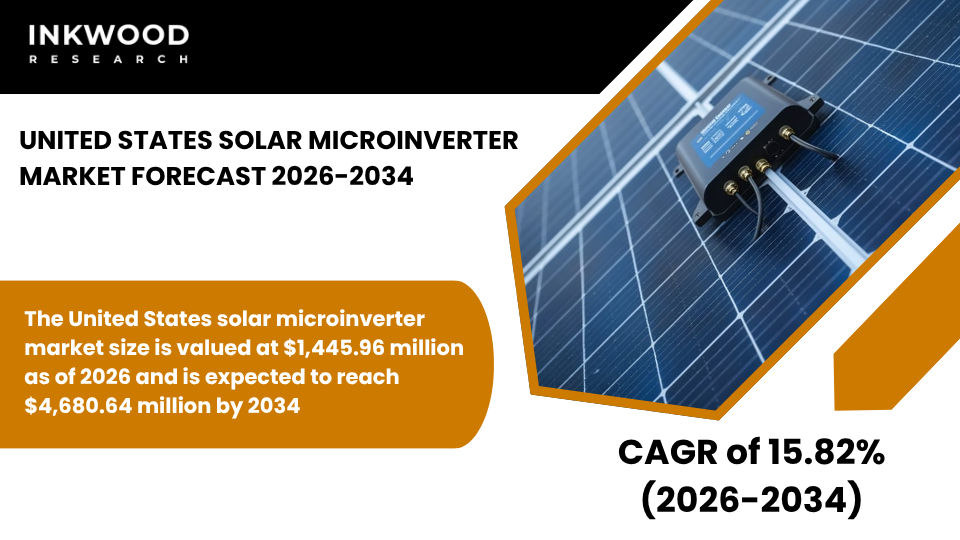
The United States solar microinverter market size is valued at $1,445.96 million as of 2026 and is expected to reach $4,680.64 million by 2034, progressing with a CAGR of 15.82% during the forecast years, 2026-2034.
The United States solar microinverter market represents the world’s largest and most mature landscape for module-level power electronics, characterized by high residential rooftop penetration, sophisticated installer networks, and consumers who demonstrate willingness to pay premium pricing in exchange for reliability, comprehensive warranties, and advanced monitoring capabilities.
The market benefits fundamentally from National Electrical Code requirements, particularly NEC 2017 and NEC 2020 Article 690.12, which mandate rapid shutdown functionality at the module level, creating inherent regulatory advantages for solar microinverter architectures over traditional string configurations. According to industry analysis, approximately 4.2 million homes in the United States had solar panels installed by 2024, with each system typically featuring 25 to 30 panels, bringing total residential rooftop installations to an estimated 105 to 126 million solar panels nationwide.
This extensive installed base creates sustained replacement demand as early-generation systems age, while new installations benefit from declining module prices that improve overall economics despite higher inverter costs. Furthermore, federal incentives, including the Investment Tax Credit (ITC), have significantly reduced upfront system expenses, with the Inflation Reduction Act extending and enhancing these benefits through domestic content bonus credits that favor U.S.-manufactured components.
The U.S. Environmental Protection Agency announced that approximately 900,000 households and disadvantaged communities will benefit under the Solar for All program, expanding access to clean energy across diverse socioeconomic segments. Additionally, over 6.5 GW of residential solar capacity was installed in the U.S. during 2023, with nearly 38% of those systems utilizing microinverter technology according to market analysis, demonstrating strong installer and homeowner preference for module-level solutions.
To Know More About This Report, Request a Free Sample Copy
The market also benefits from rising adoption of solar-plus-storage systems, with battery energy storage expected to surpass 30 GWh globally by 2026, driving demand for hybrid and grid-interactive solar microinverters that support bidirectional energy flow and advanced grid functions. State-level policies, including California’s time-of-use rates, make energy management essential, while grid modernization initiatives such as the U.S. Department of Energy’s $3 billion allocation for grid infrastructure create opportunities for intelligent microinverter deployment supporting real-time grid balancing.
However, challenges persist including higher upfront costs compared to string inverters that remain barriers in price-sensitive segments, supply chain dependence on imported electronic components creating cost and lead time volatility, utility-scale projects’ continued preference for central inverters limiting large-project adoption, and installer training requirements that can slow new brand penetration in a market dominated by established players with strong distribution networks and installer mindshare.
The United States solar microinverter market is segmented into product type, connection/system type, power rating, application, and distribution channel. The product type segment is further categorized into single-phase microinverters, three-phase microinverters, standalone microinverters, hybrid/microinverter-battery integrated units, and IQ-series.
Hybrid microinverter-battery integrated units are experiencing exceptional growth within the United States solar microinverter market, driven by accelerating residential energy storage adoption, evolving utility rate structures favoring self-consumption, and homeowners’ desire for backup power capabilities during grid outages.
These advanced systems seamlessly integrate solar generation with battery energy storage, enabling homeowners to maximize self-consumption during expensive peak rate periods, store excess daytime production for evening use, and maintain critical loads during blackouts without requiring separate battery inverters.
The segment benefits from federal incentives that now extend Investment Tax Credit benefits to standalone battery systems when paired with solar installations, improving project economics and reducing payback periods for integrated configurations. Furthermore, California’s NEM 3.0 policy, which significantly reduced compensation for solar exports to the grid, has fundamentally shifted economics toward self-consumption models that maximize value retention through battery storage rather than grid export.
Hybrid solar microinverters address this opportunity by managing complex power flows between solar panels, battery systems, household loads, and grid connections through sophisticated algorithms that optimize energy dispatch based on time-of-use rates, weather forecasts, and historical consumption patterns.
Additionally, these devices support emerging vehicle-to-home (V2H) capabilities that will enable electric vehicles to serve as mobile energy storage, with Enphase Energy announcing its IQ Bidirectional EV Charger targeting volume production in Q4 2026 to enable EVs to power homes during outages or send electricity to the grid during peak demand periods.
The hybrid segment also aligns with utility virtual power plant (VPP) programs, where aggregated residential battery systems provide grid services including frequency regulation, demand response participation, and capacity reserves, creating additional revenue opportunities for homeowners while supporting grid stability.
Technological features distinguishing hybrid microinverter-battery units include advanced monitoring platforms providing real-time visibility into solar generation, battery state of charge, household consumption, and grid interaction, integrated safety features including automatic islanding during grid failures, and interoperability with major battery brands, ensuring customer choice and system flexibility.
This product type supports overall market growth by addressing the evolving needs of energy-conscious homeowners seeking independence from volatile utility rates, benefiting from state and federal programs subsidizing battery storage additions, and providing manufacturers with opportunities to differentiate through superior software integration and proven grid compliance across diverse U.S. jurisdictions. Further, it also establishes recurring revenue models through energy management services and VPP participation that extend value propositions beyond hardware sales into ongoing platform-based relationships with customers seeking comprehensive home energy solutions.
Some of the top players operating in the United States solar microinverter market include Enphase Energy Inc, APsystems (Altenergy Power System Inc), Hoymiles Power Electronics Inc, Chilicon Power LLC, etc.
Chilicon Power LLC is a California-based solar microinverter manufacturer specializing in high-efficiency module-level power electronics designed specifically for North American residential and commercial markets. Founded in 2010, Chilicon has established itself as an innovative player offering competitively priced alternatives to market leaders while maintaining rigorous quality standards and UL 1741 certification compliance.
The company’s product portfolio includes single-phase and three-phase microinverters optimized for seamless integration with industry-standard solar panels, featuring wireless monitoring capabilities, rapid shutdown compliance meeting NEC 2017/2020 requirements, and conversion efficiencies approaching 96%.
Chilicon differentiates itself through direct-to-installer sales models that strengthen customer relationships, competitive pricing strategies targeting cost-conscious installers and residential customers, and a comprehensive technical support infrastructure, including installer training programs and responsive warranty service that builds installer confidence in deploying microinverter systems across diverse project types and sizes throughout the United States market.
REPORT SYNOPSIS
| REPORT SCOPE | DETAILS |
|---|---|
| Market Forecast Years | 2026-2034 |
| Base Year | 2025 |
| Market Historical Years | 2022-2024 |
| Forecast Units | Revenue ($ Million) |
| Segments Analyzed | Product Type, Connection / System Type, Power Rating, Application, Distribution Channel |
| Country Analyzed | The United States |
| Companies Analyzed | Enphase Energy Inc, Hoymiles Power Electronics Inc, APsystems (Altenergy Power System Inc), Darfon Electronics Corp, Sungrow Power Supply Co Ltd, Chilicon Power LLC, Sparq Systems Inc, ReneSola Ltd, GoodWe |
TABLE OF CONTENTS
RESEARCH SCOPE & METHODOLOGY
- STUDY OBJECTIVES
- METHODOLOGY
- ASSUMPTIONS & LIMITATIONS
EXECUTIVE SUMMARY
- MARKET SIZE & FORECAST
- MARKET OVERVIEW
- SCOPE OF STUDY
- CRISIS SCENARIO ANALYSIS
- MAJOR MARKET FINDINGS
- THE UNITED STATES REPRESENTS THE LARGEST AND MOST MATURE SOLAR MICROINVERTER MARKET DRIVEN BY HIGH RESIDENTIAL ROOFTOP PENETRATION
- MICROINVERTERS COMMAND A STRONG SHARE IN RESIDENTIAL SEGMENTS DUE TO SAFETY CODES AND MODULE LEVEL MONITORING REQUIREMENTS
- PREMIUM PRICING IS ACCEPTED BY INSTALLERS AND HOMEOWNERS IN EXCHANGE FOR RELIABILITY AND LONGER WARRANTIES
- MARKET CONSOLIDATION IS HIGH WITH A FEW BRANDS DOMINATING DISTRIBUTION AND INSTALLER MINDSHARE
MARKET DYNAMICS
- KEY DRIVERS
- NATIONAL ELECTRICAL CODE REQUIREMENTS FOR RAPID SHUTDOWN STRONGLY FAVOR MICROINVERTER DEPLOYMENT
- CONTINUED GROWTH IN RESIDENTIAL AND SMALL COMMERCIAL SOLAR INSTALLATIONS SUPPORTS UNIT VOLUME EXPANSION
- RISING ADOPTION OF SOLAR PLUS STORAGE SYSTEMS DRIVES DEMAND FOR HYBRID AND GRID INTERACTIVE MICROINVERTERS
- FALLING MODULE PRICES IMPROVE OVERALL SYSTEM ECONOMICS, ENABLING HIGHER MICROINVERTER ATTACH RATES
- KEY RESTRAINTS
- HIGHER UPFRONT COST COMPARED TO STRING INVERTERS REMAINS A BARRIER IN PRICE-SENSITIVE PROJECTS
- SUPPLY CHAIN DEPENDENCE ON IMPORTED ELECTRONIC COMPONENTS CREATES COST AND LEAD TIME VOLATILITY
- UTILITY SCALE PROJECTS CONTINUE TO FAVOR CENTRAL AND STRING INVERTERS, LIMITING LARGE PROJECT ADOPTION
- INSTALLER TRAINING AND CERTIFICATION REQUIREMENTS CAN SLOW NEW BRAND PENETRATION
- KEY DRIVERS
KEY ANALYTICS
- KEY MARKET TRENDS
- INCREASING INTEGRATION OF MICROINVERTERS WITH HOME ENERGY MANAGEMENT PLATFORMS IS GAINING TRACTION
- LONGER WARRANTY PERIODS ARE BEING USED AS A KEY DIFFERENTIATION STRATEGY BY LEADING PLAYERS
- DESIGN OPTIMIZATION FOR HIGH POWER MODULES ABOVE 600 W IS ACCELERATING PRODUCT DEVELOPMENT
- DIRECT TO INSTALLER SALES MODELS ARE STRENGTHENING MANUFACTURER CUSTOMER CONTROL
- PORTER’S FIVE FORCES ANALYSIS
- BUYERS POWER
- SUPPLIERS POWER
- SUBSTITUTION
- NEW ENTRANTS
- INDUSTRY RIVALRY
- GROWTH PROSPECT MAPPING
- GROWTH PROSPECT MAPPING FOR THE UNITED STATES
- MARKET MATURITY ANALYSIS
- MARKET CONCENTRATION ANALYSIS
- VALUE CHAIN ANALYSIS
- RAW MATERIAL SOURCING
- POWER ELECTRONICS DESIGN
- COMPONENT MANUFACTURING
- INVERTER ASSEMBLY
- QUALITY TESTING
- DISTRIBUTION CHANNELS
- INSTALLATION SERVICES
- AFTER SALES SUPPORT
- KEY BUYING CRITERIA
- CONVERSION EFFICIENCY
- SYSTEM RELIABILITY
- WARRANTY COVERAGE
- MONITORING FEATURES
- REGULATORY FRAMEWORK
- KEY MARKET TRENDS
SOLAR MICROINVERTER MARKET BY PRODUCT TYPE
- SINGLE-PHASE MICROINVERTERS
- THREE-PHASE MICROINVERTERS
- STANDALONE MICROINVERTERS
- HYBRID / MICROINVERTER-BATTERY INTEGRATED UNITS
- IQ-SERIES
SOLAR MICROINVERTER MARKET BY CONNECTION / SYSTEM TYPE
- GRID-TIED MICROINVERTERS
- OFF-GRID MICROINVERTERS
- HYBRID MICROINVERTERS (GRID-INTERACTIVE + STORAGE COMPATIBLE)
SOLAR MICROINVERTER MARKET BY POWER RATING
- BELOW 250 W
- 250–400 W
- 400–700 W
- ABOVE 700 W
SOLAR MICROINVERTER MARKET BY APPLICATION
- RESIDENTIAL ROOFTOP SOLAR
- UTILITY-SCALE DISTRIBUTED PV
- OFF-GRID SYSTEMS / REMOTE POWER SUPPLY
- AGRICULTURAL SOLAR
- COMMERCIAL SOLAR
- SMALL-SIZE
- MID-SIZE
SOLAR MICROINVERTER MARKET BY DISTRIBUTION CHANNEL
- DIRECT SALES (MANUFACTURERS TO EPCS OR INSTALLERS)
- ONLINE RETAIL / E-COMMERCE
- DISTRIBUTORS & WHOLESALERS
- OEM AGREEMENTS
COMPETITIVE LANDSCAPE
- KEY STRATEGIC DEVELOPMENTS
- MERGERS & ACQUISITIONS
- PRODUCT LAUNCHES & DEVELOPMENTS
- PARTNERSHIPS & AGREEMENTS
- BUSINESS EXPANSIONS & DIVESTITURES
- COMPANY PROFILES
- ENPHASE ENERGY INC
- COMPANY OVERVIEW
- PRODUCTS / SERVICES LIST
- STRENGTHS & CHALLENGES
- HOYMILES POWER ELECTRONICS INC
- COMPANY OVERVIEW
- PRODUCTS / SERVICES LIST
- STRENGTHS & CHALLENGES
- APSYSTEMS (ALTENERGY POWER SYSTEM INC)
- COMPANY OVERVIEW
- PRODUCTS / SERVICES LIST
- STRENGTHS & CHALLENGES
- DARFON ELECTRONICS CORP
- COMPANY OVERVIEW
- PRODUCTS / SERVICES LIST
- STRENGTHS & CHALLENGES
- SUNGROW POWER SUPPLY CO LTD
- COMPANY OVERVIEW
- PRODUCTS / SERVICES LIST
- STRENGTHS & CHALLENGES
- CHILICON POWER LLC
- COMPANY OVERVIEW
- PRODUCTS / SERVICES LIST
- STRENGTHS & CHALLENGES
- SPARQ SYSTEMS INC
- COMPANY OVERVIEW
- PRODUCTS / SERVICES LIST
- STRENGTHS & CHALLENGES
- RENESOLA LTD
- COMPANY OVERVIEW
- PRODUCTS / SERVICES LIST
- STRENGTHS & CHALLENGES
- GOODWE
- COMPANY OVERVIEW
- PRODUCTS / SERVICES LIST
- STRENGTHS & CHALLENGES
- ENPHASE ENERGY INC
- KEY STRATEGIC DEVELOPMENTS
LIST OF TABLES
TABLE 1: MARKET SNAPSHOT – SOLAR MICROINVERTER
TABLE 2: SOLAR MICROINVERTER MARKET REGULATORY FRAMEWORK
TABLE 3: MARKET BY PRODUCT TYPE, HISTORICAL YEARS, 2022-2024 (IN $ MILLION)
TABLE 4: MARKET BY PRODUCT TYPE, FORECAST YEARS, 2026-2034 (IN $ MILLION)
TABLE 5: MARKET BY CONNECTION / SYSTEM TYPE, HISTORICAL YEARS, 2022-2024 (IN $ MILLION)
TABLE 6: MARKET BY CONNECTION / SYSTEM TYPE, FORECAST YEARS, 2026-2034 (IN $ MILLION)
TABLE 7: MARKET BY POWER RATING, HISTORICAL YEARS, 2022-2024 (IN $ MILLION)
TABLE 8: MARKET BY POWER RATING, FORECAST YEARS, 2026-2034 (IN $ MILLION)
TABLE 9: MARKET BY APPLICATION, HISTORICAL YEARS, 2022-2024 (IN $ MILLION)
TABLE 10: MARKET BY APPLICATION, FORECAST YEARS, 2026-2034 (IN $ MILLION)
TABLE 11: MARKET BY COMMERCIAL SOLAR, HISTORICAL YEARS, 2022-2024 (IN $ MILLION)
TABLE 12: MARKET BY COMMERCIAL SOLAR, FORECAST YEARS, 2026-2034 (IN $ MILLION)
TABLE 13: MARKET BY DISTRIBUTION CHANNEL, HISTORICAL YEARS, 2022-2024 (IN $ MILLION)
TABLE 14: MARKET BY DISTRIBUTION CHANNEL, FORECAST YEARS, 2026-2034 (IN $ MILLION)
TABLE 15: KEY PLAYERS OPERATING IN THE UNITED STATES MARKET
TABLE 16: LIST OF MERGERS & ACQUISITIONS
TABLE 17: LIST OF PRODUCT LAUNCHES & DEVELOPMENTS
TABLE 18: LIST OF PARTNERSHIPS & AGREEMENTS
TABLE 19: LIST OF BUSINESS EXPANSIONS & DIVESTITURES
LIST OF FIGURES
FIGURE 1: MAJOR MARKET FINDINGS
FIGURE 2: MARKET DYNAMICS
FIGURE 3: KEY MARKET TRENDS
FIGURE 4: PORTER’S FIVE FORCES ANALYSIS
FIGURE 5: GROWTH PROSPECT MAPPING FOR THE UNITED STATES
FIGURE 6: MARKET MATURITY ANALYSIS
FIGURE 7: MARKET CONCENTRATION ANALYSIS
FIGURE 8: VALUE CHAIN ANALYSIS
FIGURE 9: KEY BUYING CRITERIA
FIGURE 10: SEGMENT GROWTH POTENTIAL, BY PRODUCT TYPE, IN 2025
FIGURE 11: SINGLE-PHASE MICROINVERTERS MARKET SIZE, 2026-2034 (IN $ MILLION)
FIGURE 12: THREE-PHASE MICROINVERTERS MARKET SIZE, 2026-2034 (IN $ MILLION)
FIGURE 13: STANDALONE MICROINVERTERS MARKET SIZE, 2026-2034 (IN $ MILLION)
FIGURE 14: HYBRID / MICROINVERTER-BATTERY INTEGRATED UNITS MARKET SIZE, 2026-2034 (IN $ MILLION)
FIGURE 15: IQ-SERIES MARKET SIZE, 2026-2034 (IN $ MILLION)
FIGURE 16: SEGMENT GROWTH POTENTIAL, BY CONNECTION / SYSTEM TYPE, IN 2025
FIGURE 17: GRID-TIED MICROINVERTERS MARKET SIZE, 2026-2034 (IN $ MILLION)
FIGURE 18: OFF-GRID MICROINVERTERS MARKET SIZE, 2026-2034 (IN $ MILLION)
FIGURE 19: HYBRID MICROINVERTERS (GRID-INTERACTIVE + STORAGE COMPATIBLE) MARKET SIZE, 2026-2034 (IN $ MILLION)
FIGURE 20: SEGMENT GROWTH POTENTIAL, BY POWER RATING, IN 2025
FIGURE 21: BELOW 250 W MARKET SIZE, 2026-2034 (IN $ MILLION)
FIGURE 22: 250–400 W MARKET SIZE, 2026-2034 (IN $ MILLION)
FIGURE 23: 400–700 W MARKET SIZE, 2026-2034 (IN $ MILLION)
FIGURE 24: ABOVE 700 W MARKET SIZE, 2026-2034 (IN $ MILLION)
FIGURE 25: SEGMENT GROWTH POTENTIAL, BY APPLICATION, IN 2025
FIGURE 26: RESIDENTIAL ROOFTOP SOLAR MARKET SIZE, 2026-2034 (IN $ MILLION)
FIGURE 27: UTILITY-SCALE DISTRIBUTED PV MARKET SIZE, 2026-2034 (IN $ MILLION)
FIGURE 28: OFF-GRID SYSTEMS / REMOTE POWER SUPPLY MARKET SIZE, 2026-2034 (IN $ MILLION)
FIGURE 29: AGRICULTURAL SOLAR MARKET SIZE, 2026-2034 (IN $ MILLION)
FIGURE 30: COMMERCIAL SOLAR MARKET SIZE, 2026-2034 (IN $ MILLION)
FIGURE 31: SEGMENT GROWTH POTENTIAL, BY COMMERCIAL SOLAR, IN 2025
FIGURE 32: SMALL-SIZE COMMERCIAL SOLAR MARKET SIZE, 2026-2034 (IN $ MILLION)
FIGURE 33: MID-SIZE COMMERCIAL SOLAR MARKET SIZE, 2026-2034 (IN $ MILLION)
FIGURE 34: SEGMENT GROWTH POTENTIAL, BY DISTRIBUTION CHANNEL, IN 2025
FIGURE 35: DIRECT SALES MARKET SIZE, 2026-2034 (IN $ MILLION)
FIGURE 36: ONLINE RETAIL / E-COMMERCE MARKET SIZE, 2026-2034 (IN $ MILLION)
FIGURE 37: DISTRIBUTORS & WHOLESALERS MARKET SIZE, 2026-2034 (IN $ MILLION)
FIGURE 38: OEM AGREEMENTS MARKET SIZE, 2026-2034 (IN $ MILLION)
FAQ’s
RELATED REPORTS
-

UNITED STATES AI-DRIVEN CLOUD MIGRATION SERVICES MARKET FORECAST 2026-2034
-

UNITED KINGDOM AI-DRIVEN CLOUD MIGRATION SERVICES MARKET FORECAST 2026-2034
-

UNITED ARAB EMIRATES AI-DRIVEN CLOUD MIGRATION SERVICES MARKET FORECAST 2026-2034
-

SOUTH KOREA AI-DRIVEN CLOUD MIGRATION SERVICES MARKET FORECAST 2026-2034
-

SINGAPORE AI-DRIVEN CLOUD MIGRATION SERVICES MARKET FORECAST 2026-2034
-

SAUDI ARABIA AI-DRIVEN CLOUD MIGRATION SERVICES MARKET FORECAST 2026-2034
-

AUSTRALIA AI-DRIVEN CLOUD MIGRATION SERVICES MARKET FORECAST 2026-2034
-

JAPAN AI-DRIVEN CLOUD MIGRATION SERVICES MARKET FORECAST 2026-2034
-

INDIA AI-DRIVEN CLOUD MIGRATION SERVICES MARKET FORECAST 2026-2034
-

CHINA AI-DRIVEN CLOUD MIGRATION SERVICES MARKET FORECAST 2026-2034