The United Kingdom Food Delivery Platform Fee Structures Market by Delivery Mode (Platform-To-Consumer Delivery, Restaurant-To-Consumer Delivery), Market by Payment Method (Online Payment, Cash On Delivery (COD)), Market by Revenue Model (Commission-Based Revenue, Delivery Fee-Based Revenue, Advertising & Promotion Revenue, Subscription-Based Revenue), Market by Product Type (Meal Delivery, Grocery Delivery, Meal Kit Delivery, Alcohol Delivery, Other Product Types), by Geography
UNITED KINGDOM FOOD DELIVERY PLATFORM FEE STRUCTURES MARKET OVERVIEW
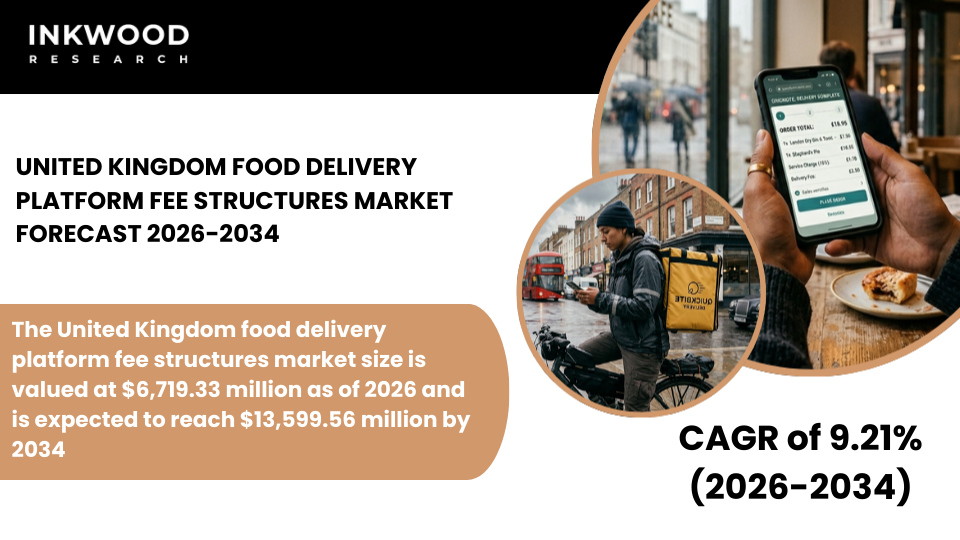
The United Kingdom food delivery platform fee structures market size is valued at $6,719.33 million as of 2026 and is expected to reach $13,599.56 million by 2034, progressing with a CAGR of 9.21% during the forecast years, 2026-2034.
MARKET INSIGHTS
The United Kingdom is one of Europe’s most mature and competitively intense markets for food delivery platform fee structures, with a well-established consumer base accustomed to on-demand food ordering and a dense urban network that supports efficient last-mile delivery operations. The UK’s online food delivery platform ecosystem is anchored by three dominant players, Just Eat, Deliveroo, and Uber Eats, each operating distinct food delivery platform pricing models that span commission-based revenue, delivery fee income, advertising products, and subscription memberships.
According to the Office for National Statistics (ONS), internet sales as a proportion of total retail spending in the UK have remained consistently elevated since the pandemic, reflecting a structural and lasting shift in how British consumers access goods and services, including food. This digital spending behaviour continues to fuel growth in online food ordering platform fee revenues across the country.
Regulatory oversight is a defining feature of the UK food delivery marketplace. The Competition and Markets Authority (CMA) has actively scrutinised food delivery platform practices, particularly around food delivery commission rates, consumer pricing transparency, and the treatment of restaurant partners. The CMA’s broader digital markets agenda, reinforced through the Digital Markets, Competition and Consumers Act, signals a long-term commitment to ensuring that food delivery platform fee structures remain fair and contestable.
For platforms, this regulatory environment creates both a compliance burden and a strategic imperative to design food delivery platform pricing models that can withstand public and regulatory scrutiny. In parallel, the UK Supreme Court’s ruling on gig worker status has increased labor cost pressures for platforms employing delivery couriers, contributing to upward adjustments in food delivery service charges as platforms seek to protect margins.
Beyond regulation, the UK market offers substantial growth opportunities, particularly in the subscription-based revenue and advertising and promotion segments of the food delivery platform business model. Platforms are increasingly investing in data analytics capabilities to refine their food delivery platform take rate strategies, targeting high-frequency consumers with subscription memberships. These include Deliveroo Plus and Just Eat’s subscription tier, in addition to simultaneously offering restaurants performance-driven advertising tools that generate income independent of per-order restaurant delivery commissions.
For investors and vendors, the UK’s combination of high digital penetration, evolving food delivery commission rate dynamics, and a regulatory environment pushing toward greater fee transparency makes it a strategically attractive, if challenging, market to operate in. These factors, together, are set to boost the food delivery platform fee structures market growth in the United Kingdom during the forecast period.
To Know More About This Report, Request a Free Sample Copy
SEGMENTATION ANALYSIS
The United Kingdom food delivery platform fee structures market is segmented by delivery mode, payment method, revenue model, and product type. The delivery mode segment is further categorized into platform-to-consumer delivery and restaurant-to-consumer delivery.
Platform-to-consumer delivery is the dominant sub-segment within the delivery mode segment of the UK food delivery platform fee structures market. Under this model, the food delivery platform assumes full responsibility for last-mile logistics, deploying its own network of independent couriers to fulfill orders on behalf of restaurant partners. This arrangement allows platforms to charge a higher overall food delivery commission rate to restaurants, since the fee bundle covers both marketplace access and physical delivery infrastructure.
In the UK, all three major platforms, Just Eat, Deliveroo, and Uber Eats, operate platform-to-consumer delivery services in major cities, though their approaches to food delivery platform pricing differ meaningfully. Deliveroo, for instance, built its entire business model around the platform-to-consumer model, using proprietary logistics technology to optimize routing and reduce per-order delivery costs.
As consumer expectations for speed and reliability continue to rise, platform-to-consumer delivery is expected to remain the primary growth engine of the UK food delivery marketplace’s fee structure landscape, particularly in dense urban markets where logistics efficiency translates directly into stronger take rates and improved platform profitability.
COMPETITIVE INSIGHTS
Some of the top players operating in the United Kingdom food delivery platform fee structures market include Just Eat, Deliveroo, Uber Eats, Foodhub, etc.
Deliveroo is a London-headquartered online food delivery platform, founded in 2013 and listed on the London Stock Exchange, making it one of the few major food delivery platforms with a primary public market presence in the UK. Deliveroo operates a platform-to-consumer delivery model, connecting consumers with restaurant partners and grocery retailers across the UK and select international markets.
The company charges restaurant delivery commissions in exchange for marketplace access and logistics services. Its proprietary delivery algorithm, Frank, optimises courier routing in real time, and its Deliveroo Plus subscription service provides consumers with unlimited free delivery for a monthly fee, adding a recurring subscription-based revenue stream alongside its core food delivery commission income.
REPORT SYNOPSIS
| REPORT SCOPE | DETAILS |
|---|---|
| Market Forecast Years | 2026-2034 |
| Base Year | 2025 |
| Market Historical Years | 2022-2024 |
| Forecast Units | Revenue ($ Million) |
| Segments Analyzed | Delivery Mode, Payment Method, Revenue Model, Product Type |
| Country Analyzed | The United Kingdom |
| Companies Analyzed | Just Eat, Deliveroo, Uber Eats, Foodhub, Bolt Food, Tesco Groceries, Hungry Panda |
TABLE OF CONTENTS
RESEARCH SCOPE & METHODOLOGY
- STUDY OBJECTIVES
- METHODOLOGY
- ASSUMPTIONS & LIMITATIONS
EXECUTIVE SUMMARY
- MARKET SIZE, SHARE & ESTIMATES
- MARKET OVERVIEW
- SCOPE OF STUDY
- MAJOR MARKET FINDINGS
- THE UNITED KINGDOM FOOD DELIVERY PLATFORM FEE STRUCTURES MARKET FEATURES A MIX OF COMMISSION-BASED REVENUE, DELIVERY FEES, AND ADVERTISING-DRIVEN MONETIZATION
- PLATFORM-TO-CONSUMER DELIVERY SERVICES DOMINATE THE MARKET WITH MAJOR APPS PROVIDING LOGISTICS INFRASTRUCTURE FOR RESTAURANTS
- THE MARKET IS HIGHLY COMPETITIVE WITH MULTIPLE PLATFORMS OFFERING DIFFERENT COMMISSION TIERS AND MARKETING PACKAGES
- SUBSCRIPTION SERVICES PROVIDING DISCOUNTED DELIVERY FEES ARE INCREASINGLY POPULAR AMONG FREQUENT USERS
MARKET DYNAMICS
- KEY DRIVERS
- THE STRONG CULTURE OF ONLINE FOOD ORDERING AND HIGH SMARTPHONE PENETRATION ARE DRIVING MARKET EXPANSION
- RAPID URBAN DELIVERY NETWORK DEVELOPMENT IS ENABLING FASTER ORDER FULFILLMENT AND HIGHER PLATFORM ADOPTION
- INCREASED DIGITAL MARKETING SPENDING BY RESTAURANTS IS SUPPORTING ADVERTISING REVENUE FOR DELIVERY PLATFORMS
- THE GROWING DEMAND FOR GROCERY AND CONVENIENCE ITEM DELIVERY IS EXPANDING PLATFORM REVENUE STREAMS
- KEY RESTRAINTS
- RESTAURANT INDUSTRY CONCERNS ABOUT HIGH PLATFORM COMMISSIONS ARE LIMITING LONG-TERM PARTNERSHIP STABILITY
- REGULATORY SCRUTINY REGARDING GIG ECONOMY LABOR PRACTICES IS INCREASING OPERATING COSTS FOR DELIVERY SERVICES
- MARKET SATURATION IN MAJOR URBAN CENTERS IS LEADING TO INTENSE PRICE COMPETITION BETWEEN PLATFORMS
- HIGH PROMOTIONAL DISCOUNTS AND INCENTIVES ARE REDUCING PROFIT MARGINS FOR DELIVERY APPS
- KEY DRIVERS
STRATEGIC MARKET ANALYTICS
- GROWTH METRICS
- TAM, SAM & SOM OPPORTUNITY ANALYSIS
- EMERGING MARKET TRENDS & PARADIGM SHIFTS
- PLATFORMS ARE INTRODUCING FLEXIBLE COMMISSION TIERS THAT OFFER DIFFERENT LEVELS OF RESTAURANT VISIBILITY
- THE INTEGRATION OF GROCERY DELIVERY AND QUICK COMMERCE SERVICES IS BECOMING A KEY REVENUE DRIVER
- SUBSCRIPTION DELIVERY SERVICES ARE BEING EXPANDED WITH ADDITIONAL BENEFITS, SUCH AS EXCLUSIVE DEALS
- AI AND DATA ANALYTICS ARE BEING USED TO OPTIMIZE PRICING AND DELIVERY ROUTING
- PORTER’S FIVE FORCES ANALYSIS
- BUYERS POWER
- SUPPLIERS POWER
- SUBSTITUTION
- NEW ENTRANTS
- INDUSTRY RIVALRY
- PESTLE ANALYSIS
- POLITICAL
- ECONOMIC
- SOCIAL LANDSCAPE
- TECHNOLOGY
- LEGAL
- ENVIRONMENTAL
- GROWTH OPPORTUNITY MAPPING & HEATMAP
- GROWTH PROSPECT MAPPING FOR THE UNITED KINGDOM
- MARKET MATURITY & LIFECYCLE ANALYSIS
- MARKET CONCENTRATION ANALYSIS
- GROWTH METRICS
FOOD DELIVERY PLATFORM FEE STRUCTURES VALUE CHAIN & DECISION FRAMEWORK
- VALUE CHAIN ANALYSIS
- MERCHANT ONBOARDING & FEE CONTRACTING
- PLATFORM TECHNOLOGY & FEE ENGINE
- FEE STRUCTURE DESIGN & MONETIZATION
- LOGISTICS & DELIVERY COST MANAGEMENT
- MARKETING, VISIBILITY & DEMAND GENERATION
- SETTLEMENT, ANALYTICS & REGULATORY COMPLIANCE
- KEY BUYING CRITERIA
- COMMISSION LEVELS & FEE TRANSPARENCY
- IMPACT ON MERCHANT PROFITABILITY
- FLEXIBILITY OF FEE MODELS
- DEMAND REACH & ORDER POTENTIAL
- PROMOTION EFFECTIVENESS & VISIBILITY ROI
- SETTLEMENT RELIABILITY & PLATFORM CREDIBILITY
- PRICING MODELS, FEE STRUCTURES & TAKE RATE OPTIMIZATION STRATEGIES
- REGULATORY & POLICY LANDSCAPE ANALYSIS
- VALUE CHAIN ANALYSIS
FOOD DELIVERY PLATFORM FEE STRUCTURES MARKET BY DELIVERY MODE
- PLATFORM-TO-CONSUMER DELIVERY
- MARKET SIZE, FORECAST & SHARE (2022–2034)
- RESTAURANT-TO-CONSUMER DELIVERY
- MARKET SIZE, FORECAST & SHARE (2022–2034)
- PLATFORM-TO-CONSUMER DELIVERY
FOOD DELIVERY PLATFORM FEE STRUCTURES MARKET BY PAYMENT METHOD
- ONLINE PAYMENT
- MARKET SIZE, FORECAST & SHARE (2022–2034)
- CASH ON DELIVERY (COD)
- MARKET SIZE, FORECAST & SHARE (2022–2034)
- ONLINE PAYMENT
FOOD DELIVERY PLATFORM FEE STRUCTURES MARKET BY REVENUE MODEL
- COMMISSION-BASED REVENUE
- MARKET SIZE, FORECAST & SHARE (2022–2034)
- DELIVERY FEE-BASED REVENUE
- MARKET SIZE, FORECAST & SHARE (2022–2034)
- ADVERTISING & PROMOTION REVENUE
- MARKET SIZE, FORECAST & SHARE (2022–2034)
- SUBSCRIPTION-BASED REVENUE
- MARKET SIZE, FORECAST & SHARE (2022–2034)
- COMMISSION-BASED REVENUE
FOOD DELIVERY PLATFORM FEE STRUCTURES MARKET BY PRODUCT TYPE
- MEAL DELIVERY
- MARKET SIZE, FORECAST & SHARE (2022–2034)
- GROCERY DELIVERY
- MARKET SIZE, FORECAST & SHARE (2022–2034)
- MEAL KIT DELIVERY
- MARKET SIZE, FORECAST & SHARE (2022–2034)
- ALCOHOL DELIVERY
- MARKET SIZE, FORECAST & SHARE (2022–2034)
- OTHER PRODUCT TYPES
- MARKET SIZE, FORECAST & SHARE (2022–2034)
- MEAL DELIVERY
COMPETITIVE LANDSCAPE
- KEY STRATEGIC DEVELOPMENTS
- MERGERS & ACQUISITIONS
- PRODUCT LAUNCHES & DEVELOPMENTS
- PARTNERSHIPS & AGREEMENTS
- BUSINESS EXPANSIONS & DIVESTITURES
- COMPETITOR POSITIONING & DIFFERENTIATION MAP
- COMPANY PROFILES
- JUST EAT
- COMPANY OVERVIEW
- PRODUCT LIST
- STRENGTHS & CHALLENGES
- DELIVEROO
- COMPANY OVERVIEW
- PRODUCT LIST
- STRENGTHS & CHALLENGES
- UBER EATS
- COMPANY OVERVIEW
- PRODUCT LIST
- STRENGTHS & CHALLENGES
- FOODHUB
- COMPANY OVERVIEW
- PRODUCT LIST
- STRENGTHS & CHALLENGES
- BOLT FOOD
- COMPANY OVERVIEW
- PRODUCT LIST
- STRENGTHS & CHALLENGES
- TESCO GROCERIES
- COMPANY OVERVIEW
- PRODUCT LIST
- STRENGTHS & CHALLENGES
- HUNGRY PANDA
- COMPANY OVERVIEW
- PRODUCT LIST
- STRENGTHS & CHALLENGES
- JUST EAT
- KEY STRATEGIC DEVELOPMENTS
LIST OF TABLES
TABLE 1: MARKET SNAPSHOT – FOOD DELIVERY PLATFORM FEE STRUCTURES
TABLE 2: PRICING MODELS, FEE STRUCTURES & TAKE RATE OPTIMIZATION STRATEGIES
TABLE 3: REGULATORY & POLICY LANDSCAPE ANALYSIS
TABLE 4: MARKET BY DELIVERY MODE, HISTORICAL YEARS, 2022-2024 (IN $ MILLION)
TABLE 5: MARKET BY DELIVERY MODE, FORECAST YEARS, 2026-2034 (IN $ MILLION)
TABLE 6: MARKET BY PAYMENT METHOD, HISTORICAL YEARS, 2022-2024 (IN $ MILLION)
TABLE 7: MARKET BY PAYMENT METHOD, FORECAST YEARS, 2026-2034 (IN $ MILLION)
TABLE 8: MARKET BY REVENUE MODEL, HISTORICAL YEARS, 2022-2024 (IN $ MILLION)
TABLE 9: MARKET BY REVENUE MODEL, FORECAST YEARS, 2026-2034 (IN $ MILLION)
TABLE 10: MARKET BY PRODUCT TYPE, HISTORICAL YEARS, 2022-2024 (IN $ MILLION)
TABLE 11: MARKET BY PRODUCT TYPE, FORECAST YEARS, 2026-2034 (IN $ MILLION)
TABLE 12: KEY PLAYERS OPERATING IN THE UNITED KINGDOM MARKET
TABLE 13: LIST OF MERGERS & ACQUISITIONS
TABLE 14: LIST OF PRODUCT LAUNCHES & DEVELOPMENTS
TABLE 15: LIST OF PARTNERSHIPS & AGREEMENTS
TABLE 16: LIST OF BUSINESS EXPANSIONS & DIVESTITURES
LIST OF FIGURES
FIGURE 1: MAJOR MARKET FINDINGS
FIGURE 2: MARKET DYNAMICS
FIGURE 3: KEY MARKET TRENDS
FIGURE 4: PORTER’S FIVE FORCES ANALYSIS
FIGURE 5: GROWTH PROSPECT MAPPING FOR THE UNITED KINGDOM
FIGURE 6: MARKET MATURITY ANALYSIS
FIGURE 7: MARKET CONCENTRATION ANALYSIS
FIGURE 8: VALUE CHAIN ANALYSIS
FIGURE 9: KEY BUYING CRITERIA
FIGURE 10: SEGMENT GROWTH POTENTIAL, BY DELIVERY MODE, IN 2025
FIGURE 11: PLATFORM-TO-CONSUMER DELIVERY MARKET SIZE, 2026-2034 (IN $ MILLION)
FIGURE 12: RESTAURANT-TO-CONSUMER DELIVERY MARKET SIZE, 2026-2034 (IN $ MILLION)
FIGURE 13: SEGMENT GROWTH POTENTIAL, BY PAYMENT METHOD, IN 2025
FIGURE 14: ONLINE PAYMENT MARKET SIZE, 2026-2034 (IN $ MILLION)
FIGURE 15: CASH ON DELIVERY (COD) MARKET SIZE, 2026-2034 (IN $ MILLION)
FIGURE 16: SEGMENT GROWTH POTENTIAL, BY REVENUE MODEL, IN 2025
FIGURE 17: COMMISSION-BASED REVENUE MARKET SIZE, 2026-2034 (IN $ MILLION)
FIGURE 18: DELIVERY FEE-BASED REVENUE MARKET SIZE, 2026-2034 (IN $ MILLION)
FIGURE 19: ADVERTISING & PROMOTION REVENUE MARKET SIZE, 2026-2034 (IN $ MILLION)
FIGURE 20: SUBSCRIPTION-BASED REVENUE MARKET SIZE, 2026-2034 (IN $ MILLION)
FIGURE 21: SEGMENT GROWTH POTENTIAL, BY PRODUCT TYPE, IN 2025
FIGURE 22: MEAL DELIVERY MARKET SIZE, 2026-2034 (IN $ MILLION)
FIGURE 23: GROCERY DELIVERY MARKET SIZE, 2026-2034 (IN $ MILLION)
FIGURE 24: MEAL KIT DELIVERY MARKET SIZE, 2026-2034 (IN $ MILLION)
FIGURE 25: ALCOHOL DELIVERY MARKET SIZE, 2026-2034 (IN $ MILLION)
FIGURE 26: OTHER PRODUCT TYPES MARKET SIZE, 2026-2034 (IN $ MILLION)
FAQ’s
RELATED REPORTS
-

LATIN AMERICA FACIAL RECOGNITION MARKET FORECAST 2019-2028
-

UNITED STATES AI-DRIVEN CLOUD MIGRATION SERVICES MARKET FORECAST 2026-2034
-

UNITED KINGDOM AI-DRIVEN CLOUD MIGRATION SERVICES MARKET FORECAST 2026-2034
-

UNITED ARAB EMIRATES AI-DRIVEN CLOUD MIGRATION SERVICES MARKET FORECAST 2026-2034
-

SOUTH KOREA AI-DRIVEN CLOUD MIGRATION SERVICES MARKET FORECAST 2026-2034
-

SINGAPORE AI-DRIVEN CLOUD MIGRATION SERVICES MARKET FORECAST 2026-2034
-

SAUDI ARABIA AI-DRIVEN CLOUD MIGRATION SERVICES MARKET FORECAST 2026-2034
-

AUSTRALIA AI-DRIVEN CLOUD MIGRATION SERVICES MARKET FORECAST 2026-2034
-

JAPAN AI-DRIVEN CLOUD MIGRATION SERVICES MARKET FORECAST 2026-2034
-

INDIA AI-DRIVEN CLOUD MIGRATION SERVICES MARKET FORECAST 2026-2034