
JAPAN SOLAR PANEL RECYCLING MARKET FORECAST 2026-2034
SCOPE OF THE REPORT
Japan Solar Panel Recycling Market by Process (Thermal, Mechanical, Chemical, Laser) Market by Type (Silicon-Based C-Si, Thin-Film, Other Types) Market by Shelf Life (Early Loss, Normal Loss) Market by Material/Recoverable Components (Glass, Aluminum, Copper, Plastic, Silver, PV Silicon, Other Materials/Recoverable Components), by Geography
JAPAN SOLAR PANEL RECYCLING MARKET OVERVIEW
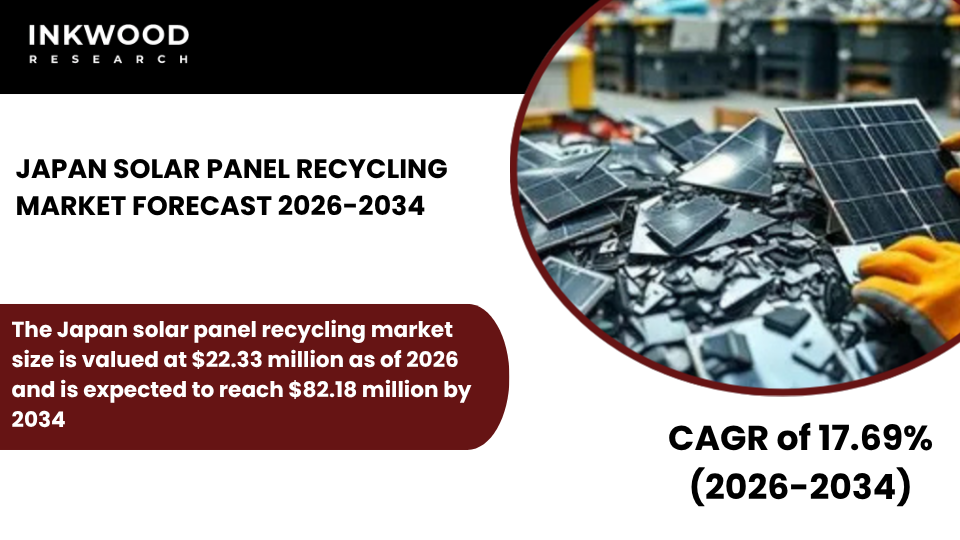
The Japan solar panel recycling market size is valued at $22.33 million as of 2026 and is expected to reach $82.18 million by 2034, progressing with a CAGR of 17.69% during the forecast years, 2026-2034.
Japan’s solar panel recycling market is entering a high-growth phase characterized by sophisticated technological capabilities and comprehensive regulatory frameworks that reflect the nation’s commitment to environmental stewardship and resource efficiency. The market’s acceleration stems primarily from aging feed-in-tariff projects launched following the Fukushima disaster in 2011, which created a substantial wave of solar installations now approaching their operational shelf life and requiring systematic decommissioning and material recovery.
Expiration of feed-in-tariff contracts is accelerating panel retirement decisions, as facilities operating under original generous subsidy programs face economic challenges competing with current lower electricity prices, making replacement more attractive than continued operation with degraded panels. Consequently, Japan faces mounting volumes of end-of-life photovoltaic modules requiring proper disposal through certified recycling channels rather than general waste streams.
Strict environmental and waste management laws support formal recycling operations by establishing clear compliance requirements and traceability obligations throughout the disposal chain. According to Japan’s Ministry of Environment, the country has developed comprehensive guidelines specifically addressing solar panel waste classification, collection procedures, and processing standards that recyclers must meet to maintain operating licenses.
These regulatory frameworks create market certainty by defining operational requirements while ensuring environmental protection throughout material recovery processes. Furthermore, high material quality expectations drive demand for advanced recycling solutions capable of producing recovered materials meeting stringent specifications for industrial reuse applications.
To Know More About This Report, Request a Free Sample Copy
Japanese manufacturers and consumers prioritize quality over cost considerations, creating market opportunities for premium recycling services that achieve superior recovery rates and material purity compared to basic mechanical separation approaches. Corporate compliance and ESG commitments encourage proper disposal practices among utilities, commercial operators, and industrial facilities seeking to maintain environmental credentials and stakeholder trust.
Japanese business culture emphasizes corporate responsibility and regulatory adherence, creating a strong demand for certified recycling services even when less expensive alternatives exist. However, significant challenges constrain market development, particularly the high-cost structure for collection and recycling operations driven by expensive labor, strict safety standards, and premium facility requirements.
Limited landfill space increases pressure for recycling adoption while simultaneously raising disposal costs that make improper handling increasingly uneconomical, creating both opportunities and challenges for formal recyclers. Small-scale rooftop systems create collection complexities, as residential installations contain insufficient panel volumes to justify dedicated collection services, requiring aggregation mechanisms that increase logistical costs substantially.
Technology deployment costs limit the rapid scaling of advanced processing capabilities, as sophisticated chemical and thermal systems require substantial capital investments that must be justified through processing volumes and recovered material revenues. Nevertheless, the market demonstrates strong fundamentals supporting long-term growth, with utility-scale solar projects representing the largest source of future waste volumes due to concentrated installations that enable efficient collection and processing logistics.
Investment in high-recovery and low-emission recycling processes reflects Japan’s emphasis on environmental excellence and technological leadership within the solar energy sector. Companies are deploying cutting-edge mechanical thermal laser technologies that maximize material recovery while minimizing environmental impacts throughout operations.
Development of national guidelines specific to solar panel waste provides clarity for industry participants while establishing standards that facilitate consistent practices across regional jurisdictions. Increasing automation in dismantling and sorting operations addresses labor cost challenges by reducing manual handling requirements while improving processing speed and material separation accuracy.
Integration of solar panel recycling into Japan’s broader circular economy strategy positions the sector as a critical component of national resource security objectives, particularly for valuable materials like silicon and precious metals, where import dependence creates strategic vulnerabilities. The Ministry of Economy, Trade and Industry (METI) has designated solar panel recycling as a priority area for circular economy development, encouraging research collaborations between universities, manufacturers, and recycling companies to advance technical capabilities.
These initiatives focus on developing efficient processes for recovering high-purity silicon suitable for semiconductor applications, creating premium product categories that justify additional processing investments. Meanwhile, prefectural governments are establishing regional collection networks that aggregate panels from dispersed installations, improving logistics efficiency while ensuring proper handling throughout the retrieval process.
Major solar manufacturers, including Sharp Corporation and Panasonic, are establishing take-back programs that accept panels regardless of age or manufacturer, demonstrating industry leadership while creating comprehensive collection infrastructure. Japan’s advanced manufacturing sector provides strong domestic demand for recovered materials, particularly high-purity silicon, silver, and copper used in electronics production and industrial applications. This demand creates reliable revenue streams for recyclers while supporting circular economy objectives that reduce virgin material imports and associated environmental impacts.
Furthermore, Japanese engineering expertise enables continuous innovation in processing technologies, with companies developing proprietary methods that achieve recovery rates exceeding international benchmarks. Space constraints in densely populated regions have driven innovations in compact, high-efficiency recycling equipment suitable for urban facilities, creating technologies potentially applicable to other space-constrained markets throughout Asia and Europe.
The Japan solar panel recycling market is segmented into process, type, shelf life, and material/recoverable components. The material/recoverable components segment is further categorized into glass, aluminum, copper, plastic, silver, PV silicon, and other materials/recoverable components.
Silver represents a particularly valuable segment within Japan’s solar panel recycling market, offering exceptional economic returns due to the material’s high industrial value and relatively significant concentration within modern photovoltaic cell designs. This precious metal serves critical functions in solar panels as the primary conductor for electrical current collection, applied as thin layers on cell surfaces through screen printing or plating techniques.
Consequently, each panel contains small but economically meaningful quantities of silver that justify sophisticated recovery processes despite processing complexities. Japanese recyclers employ advanced chemical and electrochemical techniques to extract silver from photovoltaic cells, achieving recovery rates exceeding 95% through multi-stage purification processes that produce material meeting industrial purity specifications.
The recovered silver finds ready markets in Japan’s electronics manufacturing sector, jewelry industry, and precious metal trading channels, creating liquid markets with transparent pricing that enable reliable revenue forecasting for recycling operations. Furthermore, silver’s role in sustainable energy systems aligns with broader environmental objectives, as recycled material reduces mining impacts while supporting circular economy principles throughout the solar energy value chain.
Economic modeling demonstrates that silver recovery alone can offset substantial portions of overall recycling costs, making it a critical component of viable business models. Japanese companies have developed proprietary techniques for silver extraction that minimize chemical consumption and waste generation while maximizing recovery efficiency, creating competitive advantages in processing economics and environmental performance.
Market dynamics favor this segment as silver content in panels has increased over time to improve electrical performance, meaning newer panels approaching end-of-life contain higher concentrations that enhance recovery economics. Additionally, silver prices demonstrate long-term appreciation trends driven by industrial demand and investment demand, creating favorable conditions for recycling investments with extended payback periods.
This segment supports overall market expansion by providing high-value revenue streams that subsidize the recovery of lower-value materials like glass and plastics, enabling comprehensive recycling systems that address environmental objectives while maintaining economic sustainability throughout Japan’s solar panel waste management value chain.
Some of the top players operating in the Japan solar panel recycling market include NPC Incorporated, Rexia Corporation, Eiki Shoji Co Ltd, J&T Recycling Corporation, Sharp Corporation, etc.
NPC Incorporated operates as a specialized environmental services company, headquartered in Tokyo, focusing on comprehensive waste management solutions, including photovoltaic panel recycling through advanced mechanical and chemical processing technologies. The company has established dedicated solar panel recycling facilities equipped with automated dismantling systems and multi-stage separation processes that achieve exceptional recovery rates for valuable materials, including silicon, silver, aluminum, and glass.
NPC Incorporated emphasizes traceability and environmental compliance throughout operations, maintaining detailed records of material flows and processing outcomes that satisfy Japan’s stringent regulatory requirements for industrial waste management. The company serves utility operators, commercial facilities, residential installers, and solar manufacturers seeking certified recycling services that meet quality standards while minimizing environmental impacts.
Additionally, NPC Incorporated collaborates with research institutions to advance recycling technologies and develop innovative processing methods that improve material recovery efficiency and reduce operational costs. This comprehensive approach positions the company as a market leader in Japan’s solar panel recycling sector, combining technical capabilities with regulatory expertise and customer service excellence that supports the country’s transition toward comprehensive circular economy systems within the renewable energy industry.
REPORT SYNOPSIS
| REPORT SCOPE | DETAILS |
|---|---|
| Market Forecast Years | 2026-2034 |
| Base Year | 2025 |
| Market Historical Years | 2022-2024 |
| Forecast Units | Revenue ($ Million) |
| Segments Analyzed | Process, Type, Shelf Life, and Material / Recoverable Components |
| Country Analyzed | Japan |
| Companies Analyzed | NPC Incorporated, Rexia Corporation, EIKI SHOJI Co Ltd, J&T Recycling Corporation, Sharp Corporation |
TABLE OF CONTENTS
RESEARCH SCOPE & METHODOLOGY
- STUDY OBJECTIVES
- METHODOLOGY
- ASSUMPTIONS & LIMITATIONS
EXECUTIVE SUMMARY
- MARKET SIZE & FORECAST
- MARKET OVERVIEW
- SCOPE OF STUDY
- CRISIS SCENARIO ANALYSIS
- MAJOR MARKET FINDINGS
- JAPAN IS ENTERING A HIGH-GROWTH PHASE FOR SOLAR PANEL RECYCLING DUE TO AGING FEED-IN-TARIFF PROJECTS
- THE MARKET IS CHARACTERIZED BY STRONG REGULATORY OVERSIGHT AND TRACEABILITY REQUIREMENTS
- DOMESTIC RECYCLING TECHNOLOGIES FOCUS ON HIGH-PURITY MATERIAL RECOVERY
- UTILITY-SCALE SOLAR PROJECTS REPRESENT THE LARGEST SOURCE OF FUTURE WASTE
MARKET DYNAMICS
- KEY DRIVERS
- EXPIRATION OF FEED-IN-TARIFF CONTRACTS IS ACCELERATING PANEL DECOMMISSIONING
- STRICT ENVIRONMENTAL AND WASTE MANAGEMENT LAWS SUPPORT FORMAL RECYCLING
- HIGH MATERIAL QUALITY EXPECTATIONS DRIVE ADVANCED RECYCLING SOLUTIONS
- CORPORATE COMPLIANCE AND ESG COMMITMENTS ENCOURAGE PROPER DISPOSAL
- KEY RESTRAINTS
- HIGH-COST STRUCTURE FOR COLLECTION AND RECYCLING OPERATIONS
- LIMITED LANDFILL SPACE INCREASES PRESSURE BUT ALSO RAISES COSTS
- SMALL-SCALE ROOFTOP SYSTEMS CREATE COLLECTION COMPLEXITIES
- TECHNOLOGY DEPLOYMENT COSTS LIMIT RAPID SCALING
- KEY DRIVERS
KEY ANALYTICS
- KEY MARKET TRENDS
- INVESTMENT IN HIGH-RECOVERY AND LOW-EMISSION RECYCLING PROCESSES
- DEVELOPMENT OF NATIONAL GUIDELINES SPECIFIC TO SOLAR PANEL WASTE
- INCREASING AUTOMATION IN DISMANTLING AND SORTING OPERATIONS
- INTEGRATION OF SOLAR PANEL RECYCLING INTO JAPAN’S CIRCULAR ECONOMY STRATEGY
- PORTER’S FIVE FORCES ANALYSIS
- BUYERS POWER
- SUPPLIERS POWER
- SUBSTITUTION
- NEW ENTRANTS
- INDUSTRY RIVALRY
- GROWTH PROSPECT MAPPING
- GROWTH PROSPECT MAPPING FOR JAPAN
- MARKET MATURITY ANALYSIS
- MARKET CONCENTRATION ANALYSIS
- VALUE CHAIN ANALYSIS
- RAW MATERIAL SUPPLY
- COLLECTION AND LOGISTICS
- DISMANTLING AND SHREDDING
- MATERIAL SORTING
- CHEMICAL PROCESSING
- RECOVERED MATERIAL SUPPLY
- KEY BUYING CRITERIA
- RECYCLING EFFICIENCY
- COST COMPETITIVENESS
- ENVIRONMENTAL COMPLIANCE
- TECHNOLOGICAL ADVANCEMENT
- REGULATORY FRAMEWORK
- KEY MARKET TRENDS
SOLAR PANEL RECYCLING MARKET BY PROCESS
- THERMAL
- MARKET FORECAST FIGURE
- SEGMENT ANALYSIS
- MECHANICAL
- MARKET FORECAST FIGURE
- SEGMENT ANALYSIS
- CHEMICAL
- MARKET FORECAST FIGURE
- SEGMENT ANALYSIS
- LASER
- MARKET FORECAST FIGURE
- SEGMENT ANALYSIS
- THERMAL
SOLAR PANEL RECYCLING MARKET BY TYPE
- SILICON-BASED (C-SI)
- MARKET FORECAST FIGURE
- SEGMENT ANALYSIS
- THIN-FILM
- MARKET FORECAST FIGURE
- SEGMENT ANALYSIS
- OTHER TYPES
- MARKET FORECAST FIGURE
- SEGMENT ANALYSIS
- SILICON-BASED (C-SI)
SOLAR PANEL RECYCLING MARKET BY SHELF LIFE
- EARLY LOSS
- MARKET FORECAST FIGURE
- SEGMENT ANALYSIS
- NORMAL LOSS
- MARKET FORECAST FIGURE
- SEGMENT ANALYSIS
- EARLY LOSS
SOLAR PANEL RECYCLING MARKET BY MATERIAL / RECOVERABLE COMPONENTS
- GLASS
- MARKET FORECAST FIGURE
- SEGMENT ANALYSIS
- ALUMINUM
- MARKET FORECAST FIGURE
- SEGMENT ANALYSIS
- COPPER
- MARKET FORECAST FIGURE
- SEGMENT ANALYSIS
- PLASTIC
- MARKET FORECAST FIGURE
- SEGMENT ANALYSIS
- SILVER
- MARKET FORECAST FIGURE
- SEGMENT ANALYSIS
- PV SILICON
- MARKET FORECAST FIGURE
- SEGMENT ANALYSIS
- OTHER MATERIALS / RECOVERABLE COMPONENTS
- MARKET FORECAST FIGURE
- SEGMENT ANALYSIS
- GLASS
COMPETITIVE LANDSCAPE
- KEY STRATEGIC DEVELOPMENTS
- MERGERS & ACQUISITIONS
- PRODUCT LAUNCHES & DEVELOPMENTS
- PARTNERSHIPS & AGREEMENTS
- BUSINESS EXPANSIONS & DIVESTITURES
- COMPANY PROFILES
- NPC INCORPORATED
- COMPANY OVERVIEW
- PRODUCTS / SERVICES LIST
- STRENGTHS & CHALLENGES
- REXIA CORPORATION
- COMPANY OVERVIEW
- PRODUCTS / SERVICES LIST
- STRENGTHS & CHALLENGES
- EIKI SHOJI CO LTD
- COMPANY OVERVIEW
- PRODUCTS / SERVICES LIST
- STRENGTHS & CHALLENGES
- J&T RECYCLING CORPORATION
- COMPANY OVERVIEW
- PRODUCTS / SERVICES LIST
- STRENGTHS & CHALLENGES
- SHARP CORPORATION
- COMPANY OVERVIEW
- PRODUCTS / SERVICES LIST
- STRENGTHS & CHALLENGES
- NPC INCORPORATED
- KEY STRATEGIC DEVELOPMENTS
LIST OF TABLES
TABLE 1: MARKET SNAPSHOT – SOLAR PANEL RECYCLING
TABLE 2: SOLAR PANEL RECYCLING MARKET REGULATORY FRAMEWORK
TABLE 3: MARKET BY PROCESS, HISTORICAL YEARS, 2022-2024 (IN $ MILLION)
TABLE 4: MARKET BY PROCESS, FORECAST YEARS, 2026-2034 (IN $ MILLION)
TABLE 5: MARKET BY TYPE, HISTORICAL YEARS, 2022-2024 (IN $ MILLION)
TABLE 6: MARKET BY TYPE, FORECAST YEARS, 2026-2034 (IN $ MILLION)
TABLE 7: MARKET BY SHELF LIFE, HISTORICAL YEARS, 2022-2024 (IN $ MILLION)
TABLE 8: MARKET BY SHELF LIFE, FORECAST YEARS, 2026-2034 (IN $ MILLION)
TABLE 9: MARKET BY MATERIAL / RECOVERABLE COMPONENTS, HISTORICAL YEARS, 2022-2024 (IN $ MILLION)
TABLE 10: MARKET BY MATERIAL / RECOVERABLE COMPONENTS, FORECAST YEARS, 2026-2034 (IN $ MILLION)
TABLE 11: KEY PLAYERS OPERATING IN THE JAPANESE MARKET
TABLE 12: LIST OF MERGERS & ACQUISITIONS
TABLE 13: LIST OF PRODUCT LAUNCHES & DEVELOPMENTS
TABLE 14: LIST OF PARTNERSHIPS & AGREEMENTS
TABLE 15: LIST OF BUSINESS EXPANSIONS & DIVESTITURES
LIST OF FIGURES
FIGURE 1: KEY MARKET TRENDS
FIGURE 2: PORTER’S FIVE FORCES ANALYSIS
FIGURE 3: GROWTH PROSPECT MAPPING FOR JAPAN
FIGURE 4: MARKET MATURITY ANALYSIS
FIGURE 5: MARKET CONCENTRATION ANALYSIS
FIGURE 6: VALUE CHAIN ANALYSIS
FIGURE 7: KEY BUYING CRITERIA
FIGURE 8: SEGMENT GROWTH POTENTIAL, BY PROCESS, IN 2025
FIGURE 9: THERMAL MARKET SIZE, 2026-2034 (IN $ MILLION)
FIGURE 10: MECHANICAL MARKET SIZE, 2026-2034 (IN $ MILLION)
FIGURE 11: CHEMICAL MARKET SIZE, 2026-2034 (IN $ MILLION)
FIGURE 12: LASER MARKET SIZE, 2026-2034 (IN $ MILLION)
FIGURE 13: SEGMENT GROWTH POTENTIAL, BY TYPE, IN 2025
FIGURE 14: SILICON-BASED (C-SI) MARKET SIZE, 2026-2034 (IN $ MILLION)
FIGURE 15: THIN-FILM MARKET SIZE, 2026-2034 (IN $ MILLION)
FIGURE 16: OTHER TYPES MARKET SIZE, 2026-2034 (IN $ MILLION)
FIGURE 17: SEGMENT GROWTH POTENTIAL, BY SHELF LIFE, IN 2025
FIGURE 18: EARLY LOSS MARKET SIZE, 2026-2034 (IN $ MILLION)
FIGURE 19: NORMAL LOSS MARKET SIZE, 2026-2034 (IN $ MILLION)
FIGURE 20: SEGMENT GROWTH POTENTIAL, BY MATERIAL / RECOVERABLE COMPONENTS, IN 2025
FIGURE 21: GLASS MARKET SIZE, 2026-2034 (IN $ MILLION)
FIGURE 22: ALUMINUM MARKET SIZE, 2026-2034 (IN $ MILLION)
FIGURE 23: COPPER MARKET SIZE, 2026-2034 (IN $ MILLION)
FIGURE 24: PLASTIC MARKET SIZE, 2026-2034 (IN $ MILLION)
FIGURE 25: SILVER MARKET SIZE, 2026-2034 (IN $ MILLION)
FIGURE 26: PV SILICON MARKET SIZE, 2026-2034 (IN $ MILLION)
FIGURE 27: OTHER MATERIALS / RECOVERABLE COMPONENTS MARKET SIZE, 2026-2034 (IN $ MILLION)
FAQ’s
RELATED REPORTS
-

UNITED STATES AI-DRIVEN CLOUD MIGRATION SERVICES MARKET FORECAST 2026-2034
-

UNITED KINGDOM AI-DRIVEN CLOUD MIGRATION SERVICES MARKET FORECAST 2026-2034
-

UNITED ARAB EMIRATES AI-DRIVEN CLOUD MIGRATION SERVICES MARKET FORECAST 2026-2034
-

SOUTH KOREA AI-DRIVEN CLOUD MIGRATION SERVICES MARKET FORECAST 2026-2034
-

SINGAPORE AI-DRIVEN CLOUD MIGRATION SERVICES MARKET FORECAST 2026-2034
-

SAUDI ARABIA AI-DRIVEN CLOUD MIGRATION SERVICES MARKET FORECAST 2026-2034
-

AUSTRALIA AI-DRIVEN CLOUD MIGRATION SERVICES MARKET FORECAST 2026-2034
-

JAPAN AI-DRIVEN CLOUD MIGRATION SERVICES MARKET FORECAST 2026-2034
-

INDIA AI-DRIVEN CLOUD MIGRATION SERVICES MARKET FORECAST 2026-2034
-

CHINA AI-DRIVEN CLOUD MIGRATION SERVICES MARKET FORECAST 2026-2034