
INDIA SOLAR PANEL RECYCLING MARKET FORECAST 2026-2034
SCOPE OF THE REPORT
India Solar Panel Recycling Market by Process (Thermal, Mechanical, Chemical, Laser) Market by Type (Silicon-Based C-Si, Thin-Film, Other Types) Market by Shelf Life (Early Loss, Normal Loss) Market by Material/Recoverable Components (Glass, Aluminum, Copper, Plastic, Silver, PV Silicon, Other Materials/Recoverable Components), by Geography
INDIA SOLAR PANEL RECYCLING MARKET OVERVIEW
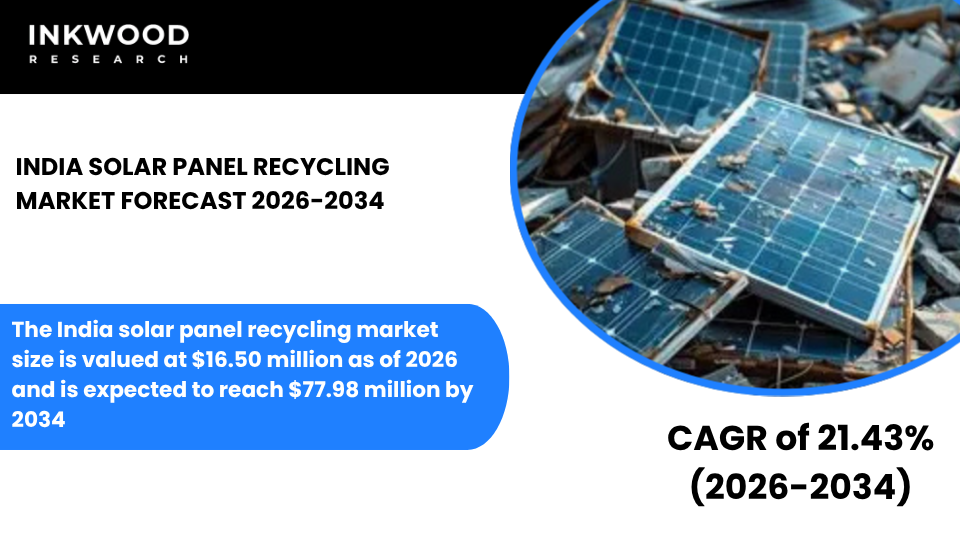
The India solar panel recycling market size is valued at $16.50 million as of 2026 and is expected to reach $77.98 million by 2034, progressing with a CAGR of 21.43% during the forecast years, 2026-2034.
India’s solar panel recycling market represents an emerging opportunity characterized by nascent infrastructure development and significant long-term potential driven by the country’s ambitious renewable energy expansion targets and rapidly growing photovoltaic installations. The market currently operates at a formative stage with limited commercial-scale operations, as most end-of-life panels are either stored at installation sites, handled through informal waste channels, or processed by general electronics recyclers lacking specialized solar panel expertise.
However, this underdeveloped landscape is poised for transformation as regulatory guidelines for solar waste management advance through development stages and industry stakeholders recognize the strategic importance of establishing proper material recovery systems before decommissioning volumes surge substantially.
Strong government push for solar energy expansion under national renewable energy missions creates substantial future recycling demand, with India targeting massive capacity additions that will eventually generate significant panel retirement volumes requiring systematic waste management solutions. According to India’s Ministry of New and Renewable Energy, the country continues expanding solar installations across utility-scale projects, rooftop systems, and rural electrification programs, creating a diverse installed base that will reach end-of-life phases beginning in the 2030s and accelerating thereafter.
Rising concerns over electronic and hazardous waste management are prompting government agencies and environmental organizations to address solar panel disposal proactively rather than waiting until waste volumes become overwhelming and environmentally problematic. Furthermore, policy discussions around extended producer responsibility frameworks suggest forthcoming regulations that could mandate manufacturer involvement in end-of-life panel management, similar to existing requirements for other electronic products covered under India’s e-waste management rules.
Low-cost labor provides India with potential competitive advantages for recycling operations, particularly for labor-intensive manual disassembly and sorting processes that represent significant cost components in more developed markets with higher wage structures. This economic factor could enable profitable operations even with relatively modest recovered material values, creating viable business models that attract entrepreneurial investment and technology development.
To Know More About This Report, Request a Free Sample Copy
Nevertheless, substantial challenges constrain current market development, with the absence of dedicated solar panel recycling regulations creating regulatory uncertainty that deters large-scale infrastructure investments by formal recycling companies. The lack of technical expertise and commercial-scale facilities means India currently possesses limited domestic capacity for sophisticated material recovery, particularly for high-value components like silicon wafers and precious metals requiring specialized processing technologies.
Low awareness among project developers regarding end-of-life management responsibilities results in inadequate planning for eventual panel disposal, with many installations lacking provisions for decommissioning logistics or recycling service procurement. Economic viability remains challenging due to low recovered material values relative to collection and processing costs, especially given India’s geographic dispersion of solar installations that increases transportation expenses substantially.
Additionally, informal recycling channels that dominate current end-of-life panel handling often employ environmentally harmful practices focused solely on extracting easily accessible aluminum and copper while improperly disposing of remaining components containing potentially hazardous materials. Market trends indicate emerging activity that could catalyze broader sector development, with pilot projects and startups focused specifically on solar waste demonstrating technical feasibility and generating practical experience with Indian market conditions.
Companies like Attero Recycling and RE Sustainability Limited are establishing initial processing capabilities while collaborating with solar developers to create collection networks and service offerings. Increasing policy alignment with existing e-waste management frameworks suggests regulatory evolution that could extend established electronics recycling requirements to photovoltaic systems, creating compliance drivers and operational frameworks that accelerate market formalization.
Rising interest from international recycling technology providers reflects recognition of India’s long-term market potential, with European and Asian companies exploring partnerships and technology transfer arrangements that could accelerate capability development. These collaborations bring proven processing technologies and operational expertise that can be adapted for Indian applications, potentially shortening the timeline for establishing commercial-scale operations.
States with major solar installations, particularly Rajasthan, Gujarat, Karnataka, and Tamil Nadu, are beginning to consider localized waste management requirements that could create regional regulatory drivers even absent comprehensive national frameworks. Meanwhile, environmental advocacy groups are raising awareness about proper solar panel disposal, creating stakeholder pressure that encourages proactive industry action and government policy development.
The informal sector’s current dominance presents both challenges and opportunities, as existing waste management networks could potentially be formalized and upgraded rather than completely replaced, creating pathways for inclusive industry development that leverages established collection capabilities while improving processing standards and environmental compliance.
However, transitioning from informal to formal operations requires substantial investments in facility upgrades, worker training, and regulatory compliance systems that may prove challenging without targeted government support or financing mechanisms. Banking sector interest in sustainable finance could potentially provide capital for recycling infrastructure development if clear regulatory frameworks and revenue models emerge that reduce investment risk perceptions.
The India solar panel recycling market is segmented into process, type, shelf life, and material/recoverable components. The process segment is further categorized into thermal, mechanical, chemical, and laser.
Mechanical recycling processes play a pivotal role in India’s emerging solar panel recycling sector, offering accessible entry points for new operators through relatively modest capital requirements and straightforward operational procedures suitable for the country’s developing infrastructure landscape. This approach employs physical separation techniques, including manual disassembly, mechanical shredding, crushing, and screening, to isolate different material components from photovoltaic modules without requiring sophisticated chemical processing or specialized thermal equipment.
The process typically begins with labor-intensive frame removal and junction box extraction, leveraging India’s competitive labor costs to minimize operational expenses while creating employment opportunities in waste management sectors. Subsequently, automated or semi-automated crushing systems break down remaining panel assemblies, separating glass, plastics, and metal components through density-based sorting methods that require minimal technical expertise.
Mechanical techniques prove particularly suitable for India’s current market conditions, as they enable operations at various scales from small regional facilities to larger centralized plants, providing flexibility that accommodates uncertain waste volumes during the market’s developmental phase. Furthermore, mechanical processing generates relatively minimal environmental concerns compared to chemical methods, simplifying regulatory compliance and reducing operational complexity for companies navigating India’s evolving waste management frameworks.
Recovery rates for aluminum frames and glass typically exceed 85% using mechanical approaches, creating viable revenue streams from these high-volume material categories despite relatively modest per-unit values. However, mechanical methods achieve lower recovery rates for high-value components like silicon and precious metals, limiting profitability potential compared to advanced chemical or thermal techniques employed in more developed markets.
Nevertheless, mechanical recycling establishes foundational capabilities and operational experience that can subsequently be enhanced through technological upgrades as market maturity increases and waste volumes justify investments in more sophisticated processing systems. The approach aligns with India’s established electronics recycling sector, enabling knowledge transfer and infrastructure sharing that reduces barriers to entry while accelerating capability development.
This segment supports overall market expansion by providing economically accessible pathways for entrepreneurial entry and pilot project development. In turn, it helps create initial industry structures that can evolve toward more comprehensive material recovery systems as regulatory frameworks solidify and recovered material markets develop throughout India’s solar energy value chain.
Some of the top players operating in the India solar panel recycling market include Attero Recycling, RE Sustainability Limited, Eco Recycling Ltd (EcoReco), Veracity Recycler Private Limited, etc.
Attero Recycling operates as India’s leading electronics waste management company, headquartered in Noida, Uttar Pradesh, specializing in comprehensive recycling solutions for diverse electronic products, including lithium-ion batteries, mobile phones, IT equipment, and increasingly, photovoltaic panels. The company employs advanced mechanical and hydrometallurgical processing technologies at its state-of-the-art facilities, achieving high recovery rates for valuable materials, including precious metals, base metals, and various components suitable for remanufacturing applications.
Attero Recycling has strategically positioned itself within India’s emerging solar panel recycling sector by leveraging its extensive experience with electronic waste processing and applying established capabilities to photovoltaic module recycling challenges. The company maintains collection networks across major metropolitan areas and industrial zones, providing logistics infrastructure that facilitates efficient panel retrieval from commercial and utility installations throughout key solar markets.
Additionally, Attero Recycling emphasizes environmental compliance and worker safety throughout operations, maintaining certifications that demonstrate adherence to Indian environmental regulations and international best practices for hazardous material handling. This comprehensive approach positions the company as a pioneering force in India’s solar panel recycling sector, establishing operational templates and demonstrating commercial viability that could catalyze broader industry development as regulatory frameworks mature and waste management requirements become increasingly stringent across the renewable energy sector.
REPORT SYNOPSIS
| REPORT SCOPE | DETAILS |
|---|---|
| Market Forecast Years | 2026-2034 |
| Base Year | 2025 |
| Market Historical Years | 2022-2024 |
| Forecast Units | Revenue ($ Million) |
| Segments Analyzed | Process, Type, Shelf Life, and Material / Recoverable Components |
| Country Analyzed | India |
| Companies Analyzed | First Solar Inc, Re Sustainability Limited, Attero Recycling, Eco Recycling Ltd (Ecoreco), Veracity Recycler Private Limited |
TABLE OF CONTENTS
RESEARCH SCOPE & METHODOLOGY
- STUDY OBJECTIVES
- METHODOLOGY
- ASSUMPTIONS & LIMITATIONS
EXECUTIVE SUMMARY
- MARKET SIZE & FORECAST
- MARKET OVERVIEW
- SCOPE OF STUDY
- CRISIS SCENARIO ANALYSIS
- MAJOR MARKET FINDINGS
- INDIA’S SOLAR PANEL RECYCLING MARKET IS AT A NASCENT STAGE WITH LIMITED COMMERCIAL OPERATIONS
- MOST END-OF-LIFE PANELS ARE CURRENTLY STORED OR DISPOSED OF THROUGH INFORMAL CHANNELS
- REGULATORY GUIDELINES FOR SOLAR WASTE MANAGEMENT ARE STILL UNDER DEVELOPMENT
- LONG-TERM RECYCLING POTENTIAL IS SIGNIFICANT DUE TO RAPID SOLAR CAPACITY ADDITIONS
MARKET DYNAMICS
- KEY DRIVERS
- STRONG GOVERNMENT PUSH FOR SOLAR ENERGY EXPANSION CREATES FUTURE RECYCLING DEMAND
- RISING CONCERNS OVER ELECTRONIC AND HAZARDOUS WASTE MANAGEMENT
- POLICY DISCUSSIONS AROUND EXTENDED PRODUCER RESPONSIBILITY SUPPORT MARKET FORMATION
- LOW-COST LABOR PROVIDES A POTENTIAL COST ADVANTAGE FOR RECYCLING OPERATIONS
- KEY RESTRAINTS
- ABSENCE OF DEDICATED SOLAR PANEL RECYCLING REGULATIONS
- LACK OF TECHNICAL EXPERTISE AND COMMERCIAL-SCALE FACILITIES
- LOW AWARENESS AMONG PROJECT DEVELOPERS REGARDING END-OF-LIFE MANAGEMENT
- ECONOMIC VIABILITY REMAINS CHALLENGING DUE TO LOW MATERIAL RECOVERY VALUE
- KEY DRIVERS
KEY ANALYTICS
- KEY MARKET TRENDS
- EMERGING PILOT PROJECTS AND STARTUPS FOCUSED ON SOLAR WASTE
- INCREASING POLICY ALIGNMENT WITH E-WASTE MANAGEMENT FRAMEWORKS
- COLLABORATION BETWEEN RESEARCH INSTITUTES AND INDUSTRY PLAYERS
- RISING INTEREST FROM INTERNATIONAL RECYCLING TECHNOLOGY PROVIDERS
- PORTER’S FIVE FORCES ANALYSIS
- BUYERS POWER
- SUPPLIERS POWER
- SUBSTITUTION
- NEW ENTRANTS
- INDUSTRY RIVALRY
- GROWTH PROSPECT MAPPING
- GROWTH PROSPECT MAPPING FOR INDIA
- MARKET MATURITY ANALYSIS
- MARKET CONCENTRATION ANALYSIS
- VALUE CHAIN ANALYSIS
- RAW MATERIAL SUPPLY
- COLLECTION AND LOGISTICS
- DISMANTLING AND SHREDDING
- MATERIAL SORTING
- CHEMICAL PROCESSING
- RECOVERED MATERIAL SUPPLY
- KEY BUYING CRITERIA
- RECYCLING EFFICIENCY
- COST COMPETITIVENESS
- ENVIRONMENTAL COMPLIANCE
- TECHNOLOGICAL ADVANCEMENT
- REGULATORY FRAMEWORK
- KEY MARKET TRENDS
SOLAR PANEL RECYCLING MARKET BY PROCESS
- THERMAL
- MARKET FORECAST FIGURE
- SEGMENT ANALYSIS
- MECHANICAL
- MARKET FORECAST FIGURE
- SEGMENT ANALYSIS
- CHEMICAL
- MARKET FORECAST FIGURE
- SEGMENT ANALYSIS
- LASER
- MARKET FORECAST FIGURE
- SEGMENT ANALYSIS
- THERMAL
SOLAR PANEL RECYCLING MARKET BY TYPE
- SILICON-BASED (C-SI)
- MARKET FORECAST FIGURE
- SEGMENT ANALYSIS
- THIN-FILM
- MARKET FORECAST FIGURE
- SEGMENT ANALYSIS
- OTHER TYPES
- MARKET FORECAST FIGURE
- SEGMENT ANALYSIS
- SILICON-BASED (C-SI)
SOLAR PANEL RECYCLING MARKET BY SHELF LIFE
- EARLY LOSS
- MARKET FORECAST FIGURE
- SEGMENT ANALYSIS
- NORMAL LOSS
- MARKET FORECAST FIGURE
- SEGMENT ANALYSIS
- EARLY LOSS
SOLAR PANEL RECYCLING MARKET BY MATERIAL / RECOVERABLE COMPONENTS
- GLASS
- MARKET FORECAST FIGURE
- SEGMENT ANALYSIS
- ALUMINUM
- MARKET FORECAST FIGURE
- SEGMENT ANALYSIS
- COPPER
- MARKET FORECAST FIGURE
- SEGMENT ANALYSIS
- PLASTIC
- MARKET FORECAST FIGURE
- SEGMENT ANALYSIS
- SILVER
- MARKET FORECAST FIGURE
- SEGMENT ANALYSIS
- PV SILICON
- MARKET FORECAST FIGURE
- SEGMENT ANALYSIS
- OTHER MATERIALS / RECOVERABLE COMPONENTS
- MARKET FORECAST FIGURE
- SEGMENT ANALYSIS
- GLASS
COMPETITIVE LANDSCAPE
- KEY STRATEGIC DEVELOPMENTS
- MERGERS & ACQUISITIONS
- PRODUCT LAUNCHES & DEVELOPMENTS
- PARTNERSHIPS & AGREEMENTS
- BUSINESS EXPANSIONS & DIVESTITURES
- COMPANY PROFILES
- FIRST SOLAR INC
- COMPANY OVERVIEW
- PRODUCTS / SERVICES LIST
- STRENGTHS & CHALLENGES
- RE SUSTAINABILITY LIMITED
- COMPANY OVERVIEW
- PRODUCTS / SERVICES LIST
- STRENGTHS & CHALLENGES
- ATTERO RECYCLING
- COMPANY OVERVIEW
- PRODUCTS / SERVICES LIST
- STRENGTHS & CHALLENGES
- ECO RECYCLING LTD (ECORECO)
- COMPANY OVERVIEW
- PRODUCTS / SERVICES LIST
- STRENGTHS & CHALLENGES
- VERACITY RECYCLER PRIVATE LIMITED
- COMPANY OVERVIEW
- PRODUCTS / SERVICES LIST
- STRENGTHS & CHALLENGES
- FIRST SOLAR INC
- KEY STRATEGIC DEVELOPMENTS
LIST OF TABLES
TABLE 1: MARKET SNAPSHOT – SOLAR PANEL RECYCLING
TABLE 2: SOLAR PANEL RECYCLING MARKET REGULATORY FRAMEWORK
TABLE 3: MARKET BY PROCESS, HISTORICAL YEARS, 2022-2024 (IN $ MILLION)
TABLE 4: MARKET BY PROCESS, FORECAST YEARS, 2026-2034 (IN $ MILLION)
TABLE 5: MARKET BY TYPE, HISTORICAL YEARS, 2022-2024 (IN $ MILLION)
TABLE 6: MARKET BY TYPE, FORECAST YEARS, 2026-2034 (IN $ MILLION)
TABLE 7: MARKET BY SHELF LIFE, HISTORICAL YEARS, 2022-2024 (IN $ MILLION)
TABLE 8: MARKET BY SHELF LIFE, FORECAST YEARS, 2026-2034 (IN $ MILLION)
TABLE 9: MARKET BY MATERIAL / RECOVERABLE COMPONENTS, HISTORICAL YEARS, 2022-2024 (IN $ MILLION)
TABLE 10: MARKET BY MATERIAL / RECOVERABLE COMPONENTS, FORECAST YEARS, 2026-2034 (IN $ MILLION)
TABLE 11: KEY PLAYERS OPERATING IN THE INDIAN MARKET
TABLE 12: LIST OF MERGERS & ACQUISITIONS
TABLE 13: LIST OF PRODUCT LAUNCHES & DEVELOPMENTS
TABLE 14: LIST OF PARTNERSHIPS & AGREEMENTS
TABLE 15: LIST OF BUSINESS EXPANSIONS & DIVESTITURES
LIST OF FIGURES
FIGURE 1: KEY MARKET TRENDS
FIGURE 2: PORTER’S FIVE FORCES ANALYSIS
FIGURE 3: GROWTH PROSPECT MAPPING FOR INDIA
FIGURE 4: MARKET MATURITY ANALYSIS
FIGURE 5: MARKET CONCENTRATION ANALYSIS
FIGURE 6: VALUE CHAIN ANALYSIS
FIGURE 7: KEY BUYING CRITERIA
FIGURE 8: SEGMENT GROWTH POTENTIAL, BY PROCESS, IN 2025
FIGURE 9: THERMAL MARKET SIZE, 2026-2034 (IN $ MILLION)
FIGURE 10: MECHANICAL MARKET SIZE, 2026-2034 (IN $ MILLION)
FIGURE 11: CHEMICAL MARKET SIZE, 2026-2034 (IN $ MILLION)
FIGURE 12: LASER MARKET SIZE, 2026-2034 (IN $ MILLION)
FIGURE 13: SEGMENT GROWTH POTENTIAL, BY TYPE, IN 2025
FIGURE 14: SILICON-BASED (C-SI) MARKET SIZE, 2026-2034 (IN $ MILLION)
FIGURE 15: THIN-FILM MARKET SIZE, 2026-2034 (IN $ MILLION)
FIGURE 16: OTHER TYPES MARKET SIZE, 2026-2034 (IN $ MILLION)
FIGURE 17: SEGMENT GROWTH POTENTIAL, BY SHELF LIFE, IN 2025
FIGURE 18: EARLY LOSS MARKET SIZE, 2026-2034 (IN $ MILLION)
FIGURE 19: NORMAL LOSS MARKET SIZE, 2026-2034 (IN $ MILLION)
FIGURE 20: SEGMENT GROWTH POTENTIAL, BY MATERIAL / RECOVERABLE COMPONENTS, IN 2025
FIGURE 21: GLASS MARKET SIZE, 2026-2034 (IN $ MILLION)
FIGURE 22: ALUMINUM MARKET SIZE, 2026-2034 (IN $ MILLION)
FIGURE 23: COPPER MARKET SIZE, 2026-2034 (IN $ MILLION)
FIGURE 24: PLASTIC MARKET SIZE, 2026-2034 (IN $ MILLION)
FIGURE 25: SILVER MARKET SIZE, 2026-2034 (IN $ MILLION)
FIGURE 26: PV SILICON MARKET SIZE, 2026-2034 (IN $ MILLION)
FIGURE 27: OTHER MATERIALS / RECOVERABLE COMPONENTS MARKET SIZE, 2026-2034 (IN $ MILLION)
FAQ’s
RELATED REPORTS
-

UNITED STATES AI-DRIVEN CLOUD MIGRATION SERVICES MARKET FORECAST 2026-2034
-

UNITED KINGDOM AI-DRIVEN CLOUD MIGRATION SERVICES MARKET FORECAST 2026-2034
-

UNITED ARAB EMIRATES AI-DRIVEN CLOUD MIGRATION SERVICES MARKET FORECAST 2026-2034
-

SOUTH KOREA AI-DRIVEN CLOUD MIGRATION SERVICES MARKET FORECAST 2026-2034
-

SINGAPORE AI-DRIVEN CLOUD MIGRATION SERVICES MARKET FORECAST 2026-2034
-

SAUDI ARABIA AI-DRIVEN CLOUD MIGRATION SERVICES MARKET FORECAST 2026-2034
-

AUSTRALIA AI-DRIVEN CLOUD MIGRATION SERVICES MARKET FORECAST 2026-2034
-

JAPAN AI-DRIVEN CLOUD MIGRATION SERVICES MARKET FORECAST 2026-2034
-

INDIA AI-DRIVEN CLOUD MIGRATION SERVICES MARKET FORECAST 2026-2034
-

CHINA AI-DRIVEN CLOUD MIGRATION SERVICES MARKET FORECAST 2026-2034