Germany Food Delivery Platform Fee Structures Market by Delivery Mode (Platform-To-Consumer Delivery, Restaurant-To-Consumer Delivery), Market by Payment Method (Online Payment, Cash On Delivery (COD)), Market by Revenue Model (Commission-Based Revenue, Delivery Fee-Based Revenue, Advertising & Promotion Revenue, Subscription-Based Revenue), Market by Product Type (Meal Delivery, Grocery Delivery, Meal Kit Delivery, Alcohol Delivery, Other Product Types), by Geography
GERMANY FOOD DELIVERY PLATFORM FEE STRUCTURES MARKET OVERVIEW
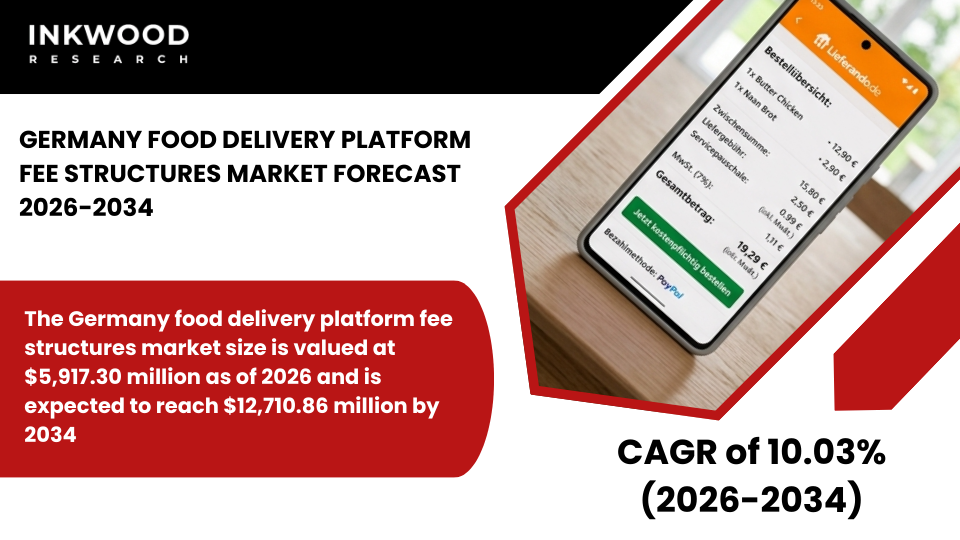
The Germany food delivery platform fee structures market size is valued at $5,917.30 million as of 2026 and is expected to reach $12,710.86 million by 2034, progressing with a CAGR of 10.03% during the forecast years, 2026-2034.
MARKET INSIGHTS
Germany is one of Europe’s most significant and strategically important markets for food delivery platform fee structures, driven by a large urban population, strong digital infrastructure, and growing consumer appetite for on-demand food services. The country’s online food delivery platform landscape is shaped by a mix of internationally backed players and locally embedded brands, each competing on food delivery commission rates, service quality, and merchant value proposition.
According to Destatis, the Federal Statistical Office of Germany, e-commerce spending in Germany has expanded steadily, with food and beverage categories emerging as one of the fastest-growing segments within digital retail. This broader shift toward online commerce has laid a strong foundation for food delivery platform pricing growth, as more restaurants, particularly independent operators in Berlin, Munich, Hamburg, and Frankfurt, turn to digital marketplaces to reach consumers efficiently.
Germany’s regulatory environment has a meaningful influence on how food delivery platforms structure and price their services. The country’s strict labor laws, particularly those governing worker classification under the Federal Ministry of Labour and Social Affairs (BMAS), have increased operational costs for platforms that rely on gig-economy couriers. These higher labor costs, in turn, create upward pressure on food delivery service charges and delivery fee-based revenue components, as platforms seek to offset compliance expenses without eroding restaurant delivery commission margins.
Additionally, Germany’s robust data privacy framework under the General Data Protection Regulation (GDPR), enforced domestically by the Federal Commissioner for Data Protection and Freedom of Information (BfDI), adds a layer of operational complexity for platforms that use consumer behavioral data to power dynamic food delivery platform pricing models and targeted advertising products. Navigating these regulatory requirements is increasingly a competitive differentiator for platforms with strong compliance infrastructure.
Despite these regulatory pressures, Germany’s food delivery marketplace presents compelling growth opportunities, especially in grocery delivery, meal kit services, and subscription-based food delivery revenue models. The integration of quick commerce platforms such as Flink into the broader online food ordering ecosystem is actively diversifying food delivery platform fee structures beyond traditional restaurant commissions.
Platforms that can offer merchants a transparent, flexible, and multi-tiered food delivery platform pricing model, backed by strong logistics coverage and data analytics tools, are well positioned to capture merchant share in this competitive market. For investors and vendors alike, Germany’s combination of scale, digital maturity, and evolving food delivery commission rate dynamics makes it a high-priority market within the European landscape. These factors, together, are set to boost the food delivery platform fee structures market growth in Germany during the forecast period.
To Know More About This Report, Request a Free Sample Copy
SEGMENTATION ANALYSIS
The Germany food delivery platform fee structures market is segmented by delivery mode, payment method, revenue model, and product type. The product type segment is categorized into meal delivery, grocery delivery, meal kit delivery, alcohol delivery, and other product types.
Grocery delivery is one of the most rapidly expanding sub-segments within the product type segment of the Germany food delivery platform fee structures market. Unlike traditional restaurant meal delivery, grocery delivery operates on a distinct food delivery platform fee structure, with platforms typically generating revenue through a combination of delivery fees, service charges, and retail markup margins rather than pure restaurant delivery commissions.
In Germany, the growth of quick commerce players operating dark store networks across major urban centers has accelerated consumer familiarity with on-demand grocery ordering, creating new monetization opportunities for platforms that can embed grocery delivery into their broader online food ordering ecosystems. For food delivery platforms, grocery delivery expands the addressable revenue base without necessarily depending on food delivery commission rates tied to restaurant partners.
In turn, this provides a meaningful diversification of the overall food delivery platform business model. As consumer expectations around delivery speed and product range continue to rise, grocery delivery is expected to remain a key growth lever within Germany’s food delivery marketplace fee structure landscape throughout the forecast period.
COMPETITIVE INSIGHTS
Some of the top players operating in the Germany food delivery platform fee structures market include Lieferando (Just Eat Takeaway.com), Wolt (DoorDash Inc), Uber Eats, Flink, etc.
Lieferando is Germany’s dominant online food ordering platform, operating as the local brand of Just Eat Takeaway.com, one of Europe’s largest food delivery marketplace groups. Headquartered in Amsterdam and operating extensively across Germany, Lieferando offers restaurants access to its platform through a commission-based food delivery fee structure, with restaurant delivery commission rates applied per order.
The platform covers thousands of cities and towns across Germany, serving both independent restaurants and national food chains, and has progressively expanded into advertising and promotional products that allow merchants to boost visibility within the app, further diversifying its food delivery platform revenue model.
REPORT SYNOPSIS
| REPORT SCOPE | DETAILS |
|---|---|
| Market Forecast Years | 2026-2034 |
| Base Year | 2025 |
| Market Historical Years | 2022-2024 |
| Forecast Units | Revenue ($ Million) |
| Segments Analyzed | Delivery Mode, Payment Method, Revenue Model, Product Type |
| Country Analyzed | Germany |
| Companies Analyzed | Lieferando (Just Eat Takeaway.com / Delivery Hero), Wolt (DoorDash Inc), Uber Eats, Foodora (Delivery Hero SE), Flink, Picnic, Too Good To Go |
TABLE OF CONTENTS
RESEARCH SCOPE & METHODOLOGY
- STUDY OBJECTIVES
- METHODOLOGY
- ASSUMPTIONS & LIMITATIONS
EXECUTIVE SUMMARY
- MARKET SIZE, SHARE & ESTIMATES
- MARKET OVERVIEW
- SCOPE OF STUDY
- MAJOR MARKET FINDINGS
- THE GERMANY FOOD DELIVERY PLATFORM FEE STRUCTURES MARKET IS DOMINATED BY MAJOR INTERNATIONAL PLATFORMS THAT UTILIZE COMMISSION-BASED AND DELIVERY FEE-BASED REVENUE MODELS
- RESTAURANT-TO-CONSUMER DELIVERY MODELS CONTINUE TO EXIST ALONGSIDE PLATFORM-TO-CONSUMER LOGISTICS SERVICES IN MANY URBAN AREAS
- DIGITAL PAYMENT ADOPTION AND MOBILE ORDERING ARE ENABLING MORE FLEXIBLE PLATFORM FEE STRUCTURES AND ORDER MANAGEMENT SYSTEMS
- PLATFORMS ARE INCREASINGLY GENERATING REVENUE THROUGH IN-APP PROMOTIONAL LISTINGS AND RESTAURANT ADVERTISING SERVICES
MARKET DYNAMICS
- KEY DRIVERS
- HIGH URBANIZATION AND STRONG DEMAND FOR QUICK SERVICE FOOD DELIVERY ARE SUPPORTING THE EXPANSION OF DIGITAL DELIVERY PLATFORMS
- THE INCREASING NUMBER OF SMALL AND INDEPENDENT RESTAURANTS JOINING ONLINE MARKETPLACES IS DRIVING PLATFORM COMMISSION REVENUE
- ADVANCES IN LAST-MILE DELIVERY TECHNOLOGIES ARE IMPROVING DELIVERY EFFICIENCY AND SUPPORTING PLATFORM FEE OPTIMIZATION
- THE GROWING POPULARITY OF SUBSCRIPTION DELIVERY SERVICES IS PROVIDING ADDITIONAL REVENUE STREAMS FOR PLATFORMS
- KEY RESTRAINTS
- STRICT LABOR REGULATIONS AND EMPLOYEE CLASSIFICATION RULES ARE INCREASING COSTS FOR DELIVERY OPERATIONS
- RESTAURANT CONCERNS ABOUT HIGH COMMISSION RATES ARE CREATING NEGOTIATION PRESSURES ON PLATFORM PRICING MODELS
- INTENSE MARKET COMPETITION IS LEADING TO FREQUENT DISCOUNTS AND PROMOTIONS THAT IMPACT PLATFORM PROFITABILITY
- DATA PRIVACY AND DIGITAL REGULATION FRAMEWORKS ARE ADDING COMPLEXITY TO PLATFORM OPERATIONS
- KEY DRIVERS
STRATEGIC MARKET ANALYTICS
- GROWTH METRICS
- TAM, SAM & SOM OPPORTUNITY ANALYSIS
- EMERGING MARKET TRENDS & PARADIGM SHIFTS
- PLATFORMS ARE EXPANDING VALUE-ADDED SERVICES SUCH AS DATA ANALYTICS AND RESTAURANT PERFORMANCE INSIGHTS
- THE INTEGRATION OF QUICK COMMERCE AND GROCERY DELIVERY IS DIVERSIFYING PLATFORM FEE STRUCTURES
- SUBSCRIPTION-BASED DELIVERY PROGRAMS ARE GAINING TRACTION AMONG FREQUENT USERS IN URBAN MARKETS
- AI-DRIVEN ROUTE OPTIMIZATION AND DELIVERY MANAGEMENT SYSTEMS ARE IMPROVING COST EFFICIENCY
- PORTER’S FIVE FORCES ANALYSIS
- BUYERS POWER
- SUPPLIERS POWER
- SUBSTITUTION
- NEW ENTRANTS
- INDUSTRY RIVALRY
- PESTLE ANALYSIS
- POLITICAL
- ECONOMIC
- SOCIAL LANDSCAPE
- TECHNOLOGY
- LEGAL
- ENVIRONMENTAL
- GROWTH OPPORTUNITY MAPPING & HEATMAP
- GROWTH PROSPECT MAPPING FOR GERMANY
- MARKET MATURITY & LIFECYCLE ANALYSIS
- MARKET CONCENTRATION ANALYSIS
- GROWTH METRICS
FOOD DELIVERY PLATFORM FEE STRUCTURES VALUE CHAIN & DECISION FRAMEWORK
- VALUE CHAIN ANALYSIS
- MERCHANT ONBOARDING & FEE CONTRACTING
- PLATFORM TECHNOLOGY & FEE ENGINE
- FEE STRUCTURE DESIGN & MONETIZATION
- LOGISTICS & DELIVERY COST MANAGEMENT
- MARKETING, VISIBILITY & DEMAND GENERATION
- SETTLEMENT, ANALYTICS & REGULATORY COMPLIANCE
- KEY BUYING CRITERIA
- COMMISSION LEVELS & FEE TRANSPARENCY
- IMPACT ON MERCHANT PROFITABILITY
- FLEXIBILITY OF FEE MODELS
- DEMAND REACH & ORDER POTENTIAL
- PROMOTION EFFECTIVENESS & VISIBILITY ROI
- SETTLEMENT RELIABILITY & PLATFORM CREDIBILITY
- PRICING MODELS, FEE STRUCTURES & TAKE RATE OPTIMIZATION STRATEGIES
- REGULATORY & POLICY LANDSCAPE ANALYSIS
- VALUE CHAIN ANALYSIS
FOOD DELIVERY PLATFORM FEE STRUCTURES MARKET BY DELIVERY MODE
- PLATFORM-TO-CONSUMER DELIVERY
- MARKET SIZE, FORECAST & SHARE (2022–2034)
- RESTAURANT-TO-CONSUMER DELIVERY
- MARKET SIZE, FORECAST & SHARE (2022–2034)
- PLATFORM-TO-CONSUMER DELIVERY
FOOD DELIVERY PLATFORM FEE STRUCTURES MARKET BY PAYMENT METHOD
- ONLINE PAYMENT
- MARKET SIZE, FORECAST & SHARE (2022–2034)
- CASH ON DELIVERY (COD)
- MARKET SIZE, FORECAST & SHARE (2022–2034)
- ONLINE PAYMENT
FOOD DELIVERY PLATFORM FEE STRUCTURES MARKET BY REVENUE MODEL
- COMMISSION-BASED REVENUE
- MARKET SIZE, FORECAST & SHARE (2022–2034)
- DELIVERY FEE-BASED REVENUE
- MARKET SIZE, FORECAST & SHARE (2022–2034)
- ADVERTISING & PROMOTION REVENUE
- MARKET SIZE, FORECAST & SHARE (2022–2034)
- SUBSCRIPTION-BASED REVENUE
- MARKET SIZE, FORECAST & SHARE (2022–2034)
- COMMISSION-BASED REVENUE
FOOD DELIVERY PLATFORM FEE STRUCTURES MARKET BY PRODUCT TYPE
- MEAL DELIVERY
- MARKET SIZE, FORECAST & SHARE (2022–2034)
- GROCERY DELIVERY
- MARKET SIZE, FORECAST & SHARE (2022–2034)
- MEAL KIT DELIVERY
- MARKET SIZE, FORECAST & SHARE (2022–2034)
- ALCOHOL DELIVERY
- MARKET SIZE, FORECAST & SHARE (2022–2034)
- OTHER PRODUCT TYPES
- MARKET SIZE, FORECAST & SHARE (2022–2034)
- MEAL DELIVERY
COMPETITIVE LANDSCAPE
- KEY STRATEGIC DEVELOPMENTS
- MERGERS & ACQUISITIONS
- PRODUCT LAUNCHES & DEVELOPMENTS
- PARTNERSHIPS & AGREEMENTS
- BUSINESS EXPANSIONS & DIVESTITURES
- COMPETITOR POSITIONING & DIFFERENTIATION MAP
- COMPANY PROFILES
- LIEFERANDO (JUST EAT TAKEAWAY.COM / DELIVERY HERO)
- COMPANY OVERVIEW
- PRODUCT LIST
- STRENGTHS & CHALLENGES
- WOLT (DOORDASH INC)
- COMPANY OVERVIEW
- PRODUCT LIST
- STRENGTHS & CHALLENGES
- UBER EATS
- COMPANY OVERVIEW
- PRODUCT LIST
- STRENGTHS & CHALLENGES
- FOODORA (DELIVERY HERO SE)
- COMPANY OVERVIEW
- PRODUCT LIST
- STRENGTHS & CHALLENGES
- FLINK
- COMPANY OVERVIEW
- PRODUCT LIST
- STRENGTHS & CHALLENGES
- PICNIC
- COMPANY OVERVIEW
- PRODUCT LIST
- STRENGTHS & CHALLENGES
- TOO GOOD TO GO
- COMPANY OVERVIEW
- PRODUCT LIST
- STRENGTHS & CHALLENGES
- LIEFERANDO (JUST EAT TAKEAWAY.COM / DELIVERY HERO)
- KEY STRATEGIC DEVELOPMENTS
LIST OF TABLES
TABLE 1: MARKET SNAPSHOT – FOOD DELIVERY PLATFORM FEE STRUCTURES
TABLE 2: PRICING MODELS, FEE STRUCTURES & TAKE RATE OPTIMIZATION STRATEGIES
TABLE 3: REGULATORY & POLICY LANDSCAPE ANALYSIS
TABLE 4: MARKET BY DELIVERY MODE, HISTORICAL YEARS, 2022-2024 (IN $ MILLION)
TABLE 5: MARKET BY DELIVERY MODE, FORECAST YEARS, 2026-2034 (IN $ MILLION)
TABLE 6: MARKET BY PAYMENT METHOD, HISTORICAL YEARS, 2022-2024 (IN $ MILLION)
TABLE 7: MARKET BY PAYMENT METHOD, FORECAST YEARS, 2026-2034 (IN $ MILLION)
TABLE 8: MARKET BY REVENUE MODEL, HISTORICAL YEARS, 2022-2024 (IN $ MILLION)
TABLE 9: MARKET BY REVENUE MODEL, FORECAST YEARS, 2026-2034 (IN $ MILLION)
TABLE 10: MARKET BY PRODUCT TYPE, HISTORICAL YEARS, 2022-2024 (IN $ MILLION)
TABLE 11: MARKET BY PRODUCT TYPE, FORECAST YEARS, 2026-2034 (IN $ MILLION)
TABLE 12: KEY PLAYERS OPERATING IN THE GERMAN MARKET
TABLE 13: LIST OF MERGERS & ACQUISITIONS
TABLE 14: LIST OF PRODUCT LAUNCHES & DEVELOPMENTS
TABLE 15: LIST OF PARTNERSHIPS & AGREEMENTS
TABLE 16: LIST OF BUSINESS EXPANSIONS & DIVESTITURES
LIST OF FIGURES
FIGURE 1: MAJOR MARKET FINDINGS
FIGURE 2: MARKET DYNAMICS
FIGURE 3: KEY MARKET TRENDS
FIGURE 4: PORTER’S FIVE FORCES ANALYSIS
FIGURE 5: GROWTH PROSPECT MAPPING FOR GERMANY
FIGURE 6: MARKET MATURITY ANALYSIS
FIGURE 7: MARKET CONCENTRATION ANALYSIS
FIGURE 8: VALUE CHAIN ANALYSIS
FIGURE 9: KEY BUYING CRITERIA
FIGURE 10: SEGMENT GROWTH POTENTIAL, BY DELIVERY MODE, IN 2025
FIGURE 11: PLATFORM-TO-CONSUMER DELIVERY MARKET SIZE, 2026-2034 (IN $ MILLION)
FIGURE 12: RESTAURANT-TO-CONSUMER DELIVERY MARKET SIZE, 2026-2034 (IN $ MILLION)
FIGURE 13: SEGMENT GROWTH POTENTIAL, BY PAYMENT METHOD, IN 2025
FIGURE 14: ONLINE PAYMENT MARKET SIZE, 2026-2034 (IN $ MILLION)
FIGURE 15: CASH ON DELIVERY (COD) MARKET SIZE, 2026-2034 (IN $ MILLION)
FIGURE 16: SEGMENT GROWTH POTENTIAL, BY REVENUE MODEL, IN 2025
FIGURE 17: COMMISSION-BASED REVENUE MARKET SIZE, 2026-2034 (IN $ MILLION)
FIGURE 18: DELIVERY FEE-BASED REVENUE MARKET SIZE, 2026-2034 (IN $ MILLION)
FIGURE 19: ADVERTISING & PROMOTION REVENUE MARKET SIZE, 2026-2034 (IN $ MILLION)
FIGURE 20: SUBSCRIPTION-BASED REVENUE MARKET SIZE, 2026-2034 (IN $ MILLION)
FIGURE 21: SEGMENT GROWTH POTENTIAL, BY PRODUCT TYPE, IN 2025
FIGURE 22: MEAL DELIVERY MARKET SIZE, 2026-2034 (IN $ MILLION)
FIGURE 23: GROCERY DELIVERY MARKET SIZE, 2026-2034 (IN $ MILLION)
FIGURE 24: MEAL KIT DELIVERY MARKET SIZE, 2026-2034 (IN $ MILLION)
FIGURE 25: ALCOHOL DELIVERY MARKET SIZE, 2026-2034 (IN $ MILLION)
FIGURE 26: OTHER PRODUCT TYPES MARKET SIZE, 2026-2034 (IN $ MILLION)
FAQ’s
RELATED REPORTS
-

LATIN AMERICA FACIAL RECOGNITION MARKET FORECAST 2019-2028
-

UNITED STATES AI-DRIVEN CLOUD MIGRATION SERVICES MARKET FORECAST 2026-2034
-

UNITED KINGDOM AI-DRIVEN CLOUD MIGRATION SERVICES MARKET FORECAST 2026-2034
-

UNITED ARAB EMIRATES AI-DRIVEN CLOUD MIGRATION SERVICES MARKET FORECAST 2026-2034
-

SOUTH KOREA AI-DRIVEN CLOUD MIGRATION SERVICES MARKET FORECAST 2026-2034
-

SINGAPORE AI-DRIVEN CLOUD MIGRATION SERVICES MARKET FORECAST 2026-2034
-

SAUDI ARABIA AI-DRIVEN CLOUD MIGRATION SERVICES MARKET FORECAST 2026-2034
-

AUSTRALIA AI-DRIVEN CLOUD MIGRATION SERVICES MARKET FORECAST 2026-2034
-

JAPAN AI-DRIVEN CLOUD MIGRATION SERVICES MARKET FORECAST 2026-2034
-

INDIA AI-DRIVEN CLOUD MIGRATION SERVICES MARKET FORECAST 2026-2034