Europe Solar Encapsulation Market by Material Type (Ethylene Vinyl Acetate (EVA), Polyolefin Elastomers (POE), Polyvinyl Butyral (PVB), Silicone & Ionomer, Other Material Types) Market by Technology (Module Construction) (Glass-Backsheet, Glass-Glass (Double Glass), Building-Integrated Photovoltaics (BIPV)) Market by Application (Photovoltaics (PV) (Utility-Scale, Commercial & Industrial (C&I), Residential), Transportation & Mobility, Consumer Electronics)
EUROPE SOLAR ENCAPSULATION MARKET OVERVIEW
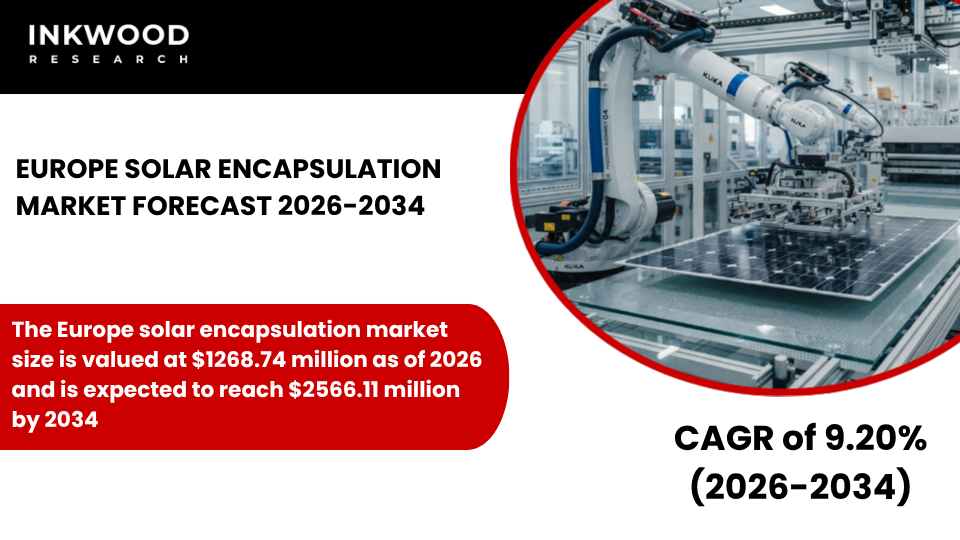
The Europe solar encapsulation market size is valued at $1268.74 million as of 2026 and is expected to reach $2566.11 million by 2034, progressing with a CAGR of 9.20% during the forecast years, 2026-2034.
Europe’s solar encapsulation market benefits from ambitious renewable energy targets and comprehensive policy frameworks driving photovoltaic deployment across the continent. The European Union’s REPowerEU plan aims to achieve 750 gigawatts of solar capacity by 2030, creating substantial demand for advanced encapsulation materials.
According to SolarPower Europe, the region installed 65.5 gigawatts of new solar capacity in 2024, bringing cumulative installations to approximately 338 gigawatts. This expansion directly translates to increased consumption of ethylene-vinyl acetate, polyolefin elastomers, and specialty encapsulants across utility-scale and distributed generation segments.
Moreover, Europe’s emphasis on domestic solar manufacturing through initiatives like the European Solar Charter is reshaping supply chain dynamics for encapsulation materials. Module producers increasingly prioritize sustainability criteria and resilience standards in procurement decisions, favoring encapsulants with superior recyclability and extended durability profiles.
The shift toward bifacial modules and building-integrated photovoltaic systems further drives demand for premium encapsulation solutions. Additionally, rooftop solar installations continue expanding despite recent market moderation, supported by feed-in tariffs and net metering programs across multiple member states.
To Know More About This Report, Request a Free Sample Copy
The Europe solar encapsulation market growth assessment includes the analysis of the United Kingdom, Germany, France, Italy, Spain, Belgium, Poland, and Rest of Europe.
Germany dominates European encapsulant demand through sustained solar deployment momentum and ambitious capacity expansion targets. Reports indicate that Germany installed 16.2 gigawatts of solar capacity during 2024, bringing total installed capacity to 99.3 gigawatts by year-end. This achievement represents Germany’s continued leadership in European solar markets, with two-thirds of new installations occurring on residential and commercial rooftops.
Bavaria led regional growth with 4.0 gigawatts of new capacity, while utility-scale projects like the 162-megawatt installation in Saxony demonstrate the scale of ground-mounted deployments requiring robust encapsulation solutions. Furthermore, Germany’s renewable energy legislation mandates 215 gigawatts of solar capacity by 2030, necessitating sustained annual installations exceeding current levels.
The proliferation of balcony-mounted plug-in solar systems adds another dimension to encapsulant demand, with 435,000 units installed in 2024 alone. Module manufacturers serving the German market increasingly specify advanced cross-linked EVA formulations and polyolefin alternatives to meet stringent performance warranties extending 25-30 years.
The United Kingdom’s solar encapsulation market is accelerating following policy reforms and increased project approvals under the current government. The Department for Energy Security and Net Zero recorded 1.2 gigawatts of new solar capacity in 2024, bringing total installations to 17.6 gigawatts. However, industry analysts view official figures as conservative estimates of actual deployment levels.
Ground-mounted utility-scale projects account for 49% of UK solar capacity despite representing a small fraction of total installation numbers, creating concentrated encapsulant demand in large-volume procurement channels. The Labour government’s clean power targets for 2030, combined with development consent approvals for projects like the 500-megawatt Heckington Fen Solar Park, signal accelerating market growth.
Additionally, residential installations gained momentum through VAT exemptions introduced in 2022 and the Smart Export Guarantee program, enabling homeowners to monetize excess generation. The UK’s transition from subsidy-dependent growth to market-driven expansion positions encapsulant suppliers for sustained demand increases across both residential and commercial segments.
The Europe solar encapsulation market is segmented into material type, technology (module construction), and application. The technology (module construction) segment is further categorized into glass-backsheet, glass-glass (double glass), and building-integrated photovoltaics (BIPV).
Glass-glass module construction is gaining significant traction in European markets due to superior durability characteristics and compatibility with bifacial cell technologies. This double-glass architecture eliminates traditional backsheet materials, instead sandwiching encapsulant layers between two protective glass panels.
Consequently, glass-glass designs demand specialized encapsulant formulations with enhanced moisture barrier properties and exceptional UV stability. The configuration enables light capture from both module surfaces, increasing energy yields by 10-30% depending on installation conditions and ground albedo effects.
European solar developers particularly value glass-glass modules for floating photovoltaic installations and challenging environmental conditions where traditional backsheet designs face accelerated degradation. Moreover, the technology’s extended operational lifetimes exceeding 30 years align with utility-scale project economics and institutional investor requirements for long-term asset performance.
Leading thin-film solar and crystalline silicon manufacturers across Europe are transitioning production lines to accommodate glass-glass specifications, directly impacting encapsulant procurement patterns. The segment’s growth also reflects Europe’s emphasis on circular economy principles, as glass-glass modules facilitate end-of-life component separation and recycling compared to backsheet alternatives. This architectural shift requires encapsulants maintaining adhesion strength and optical clarity throughout multi-decade exposures while withstanding thermal cycling between -40°C and +85°C test conditions.
Some of the top players operating in the Europe solar encapsulation market include DuPont de Nemours Inc, Dow Inc, Arkema SA, Coveme SpA, etc.
Arkema SA operates as a specialty chemicals company with established expertise in advanced polymer materials for photovoltaic encapsulation applications. Headquartered in La Défense, France, Arkema manufactures polyolefin elastomer-based encapsulants and specialty additives that enhance module durability and optical performance. The company’s product portfolio serves European solar manufacturers requiring materials compliant with stringent EU sustainability standards and recyclability requirements.
Arkema supplies encapsulation solutions for both crystalline silicon solar modules and thin-film technologies, with particular strength in formulations suited for building-integrated photovoltaic facades and architectural applications. The company operates production facilities across multiple European countries, enabling responsive supply chain support for regional module manufacturers. Recent innovations from Arkema include bio-based encapsulant precursors that reduce carbon footprints while maintaining technical performance specifications demanded by tier-one solar producers.
Additionally, Arkema’s research collaboration with European solar equipment manufacturers focuses on developing next-generation encapsulants compatible with heterojunction and tandem cell architectures entering commercial production. This technical partnership approach positions Arkema as a strategic materials supplier addressing Europe’s renewable energy transition while supporting domestic solar manufacturing competitiveness against Asian imports.
REPORT SYNOPSIS
| REPORT SCOPE | DETAILS |
|---|---|
| Market Forecast Years | 2026-2034 |
| Base Year | 2025 |
| Market Historical Years | 2022-2024 |
| Forecast Units | Revenue ($ Million) |
| Segments Analyzed | Material Type, Technology (Module Construction), and Application |
| Countries Analyzed | The United Kingdom, Germany, France, Italy, Spain, Poland, Belgium, and Rest of Europe |
| Companies Analyzed | DuPont de Nemours Inc, 3M Company, Dow Inc, STR Holdings Inc, Mitsui Chemicals Inc, Bridgestone Corporation, Coveme SpA, Arkema SA, RenewSys India Pvt Ltd, Hangzhou First Applied Material Co Ltd, Kuraray Co Ltd, Eastman Chemical Company |
TABLE OF CONTENTS
RESEARCH SCOPE & METHODOLOGY
- STUDY OBJECTIVES
- METHODOLOGY
- ASSUMPTIONS & LIMITATIONS
EXECUTIVE SUMMARY
- MARKET SIZE & FORECAST
- MARKET OVERVIEW
- SCOPE OF STUDY
- CRISIS SCENARIO ANALYSIS
- MAJOR MARKET FINDINGS
- HIGH ADOPTION OF EVA AND POE ENCAPSULANTS IS DRIVEN BY COST EFFICIENCY AND RELIABLE MODULE PERFORMANCE ACROSS GLOBAL SOLAR INSTALLATIONS
- UTILITY SCALE SOLAR PROJECTS ACCOUNT FOR A SIGNIFICANT SHARE OF ENCAPSULANT DEMAND DUE TO LARGE MODULE VOLUMES AND LONG-TERM DEPLOYMENTS
- TECHNOLOGICAL DIFFERENTIATION AMONG ENCAPSULANT SUPPLIERS IS INCREASING AS MODULE MAKERS DEMAND HIGHER DURABILITY AND LOWER DEGRADATION
MARKET DYNAMICS
- KEY DRIVERS
- RAPID EXPANSION OF SOLAR PV INSTALLATIONS IS DIRECTLY INCREASING DEMAND FOR ENCAPSULATION MATERIALS
- DECLINING SOLAR MODULE PRICES ARE ACCELERATING PROJECT ECONOMICS AND BOOSTING MODULE PRODUCTION VOLUMES
- GOVERNMENT POLICIES AND INCENTIVES PROMOTING RENEWABLE ENERGY ARE SUPPORTING LONG-TERM MARKET GROWTH
- RISING FOCUS ON MODULE LIFETIME AND EFFICIENCY IS DRIVING USE OF ADVANCED ENCAPSULANT FORMULATIONS
- KEY RESTRAINTS
- VOLATILITY IN RAW MATERIAL PRICES SUCH AS POLYMERS, IMPACTS ENCAPSULANT MANUFACTURING COST STRUCTURES
- TECHNICAL COMPATIBILITY ISSUES WITH NEW CELL TECHNOLOGIES CAN LIMIT RAPID ADOPTION OF CERTAIN ENCAPSULANTS
- INTENSE PRICE COMPETITION AMONG SUPPLIERS COMPRESSES MARGINS ACROSS THE VALUE CHAIN
- HIGH-PERFORMANCE MATERIALS OFTEN FACE SLOW QUALIFICATION CYCLES WITH CONSERVATIVE MODULE MANUFACTURERS
- KEY DRIVERS
KEY ANALYTICS
- KEY MARKET TRENDS
- SHIFT TOWARD POE ENCAPSULANTS IS GAINING MOMENTUM DUE TO SUPERIOR MOISTURE AND PID RESISTANCE
- DEMAND FOR ENCAPSULANTS SUITABLE FOR BIFACIAL AND HIGH EFFICIENCY MODULES IS INCREASING
- MANUFACTURERS ARE INVESTING IN THINNER AND LIGHTWEIGHT ENCAPSULATION SOLUTIONS TO REDUCE MODULE COSTS
- SUSTAINABILITY AND RECYCLABILITY CONSIDERATIONS ARE INFLUENCING MATERIAL SELECTION AND PRODUCT DEVELOPMENT
- PORTER’S FIVE FORCES ANALYSIS
- BUYERS POWER
- SUPPLIERS POWER
- SUBSTITUTION
- NEW ENTRANTS
- INDUSTRY RIVALRY
- GROWTH PROSPECT MAPPING
- GROWTH PROSPECT MAPPING FOR EUROPE
- MARKET MATURITY ANALYSIS
- MARKET CONCENTRATION ANALYSIS
- VALUE CHAIN ANALYSIS
- RAW MATERIAL SUPPLIERS
- POLYMER COMPOUNDING
- ENCAPSULANT MANUFACTURING
- FILM EXTRUSION
- MODULE ASSEMBLY
- SOLAR PROJECT DEPLOYMENT
- KEY BUYING CRITERIA
- LONG-TERM DURABILITY
- CELL COMPATIBILITY
- COST EFFICIENCY
- SUPPLIER RELIABILITY
- REGULATORY FRAMEWORK
- KEY MARKET TRENDS
SOLAR ENCAPSULATION MARKET BY MATERIAL TYPE
- ETHYLENE VINYL ACETATE (EVA)
- POLYOLEFIN ELASTOMERS (POE)
- POLYVINYL BUTYRAL (PVB)
- SILICONE & IONOMER
- OTHER MATERIAL TYPES
SOLAR ENCAPSULATION MARKET BY TECHNOLOGY (MODULE CONSTRUCTION)
- GLASS-BACKSHEET
- GLASS-GLASS (DOUBLE GLASS)
- BUILDING-INTEGRATED PHOTOVOLTAICS (BIPV)
SOLAR ENCAPSULATION MARKET BY APPLICATION
- PHOTOVOLTAICS (PV)
- UTILITY-SCALE
- COMMERCIAL & INDUSTRIAL (C&I)
- RESIDENTIAL
- TRANSPORTATION & MOBILITY
- CONSUMER ELECTRONICS
- PHOTOVOLTAICS (PV)
GEOGRAPHICAL ANALYSIS
- EUROPE
- MARKET SIZE & ESTIMATES
- EUROPE MARKET DRIVERS
- EUROPE MARKET CHALLENGES
- KEY PLAYERS IN EUROPE SOLAR ENCAPSULATION MARKET
- COUNTRY ANALYSIS
- GERMANY
- GERMANY MARKET SIZE & OPPORTUNITIES
- UNITED KINGDOM
- UNITED KINGDOM MARKET SIZE & OPPORTUNITIES
- FRANCE
- FRANCE MARKET SIZE & OPPORTUNITIES
- ITALY
- ITALY MARKET SIZE & OPPORTUNITIES
- SPAIN
- SPAIN MARKET SIZE & OPPORTUNITIES
- BELGIUM
- BELGIUM MARKET SIZE & OPPORTUNITIES
- POLAND
- POLAND MARKET SIZE & OPPORTUNITIES
- REST OF EUROPE
- REST OF EUROPE MARKET SIZE & OPPORTUNITIES
- GERMANY
- EUROPE
COMPETITIVE LANDSCAPE
- KEY STRATEGIC DEVELOPMENTS
- MERGERS & ACQUISITIONS
- PRODUCT LAUNCHES & DEVELOPMENTS
- PARTNERSHIPS & AGREEMENTS
- BUSINESS EXPANSIONS & DIVESTITURES
- COMPANY PROFILES
- DUPONT DE NEMOURS INC
- COMPANY OVERVIEW
- PRODUCT LIST
- STRENGTHS & CHALLENGES
- 3M COMPANY
- COMPANY OVERVIEW
- PRODUCT LIST
- STRENGTHS & CHALLENGES
- DOW INC
- COMPANY OVERVIEW
- PRODUCT LIST
- STRENGTHS & CHALLENGES
- STR HOLDINGS INC
- COMPANY OVERVIEW
- PRODUCT LIST
- STRENGTHS & CHALLENGES
- MITSUI CHEMICALS INC
- COMPANY OVERVIEW
- PRODUCT LIST
- STRENGTHS & CHALLENGES
- BRIDGESTONE CORPORATION
- COMPANY OVERVIEW
- PRODUCT LIST
- STRENGTHS & CHALLENGES
- COVEME SPA
- COMPANY OVERVIEW
- PRODUCT LIST
- STRENGTHS & CHALLENGES
- ARKEMA SA
- COMPANY OVERVIEW
- PRODUCT LIST
- STRENGTHS & CHALLENGES
- RENEWSYS INDIA PVT LTD
- COMPANY OVERVIEW
- PRODUCT LIST
- STRENGTHS & CHALLENGES
- HANGZHOU FIRST APPLIED MATERIAL CO LTD
- COMPANY OVERVIEW
- PRODUCT LIST
- STRENGTHS & CHALLENGES
- KURARAY CO LTD
- COMPANY OVERVIEW
- PRODUCT LIST
- STRENGTHS & CHALLENGES
- EASTMAN CHEMICAL COMPANY
- COMPANY OVERVIEW
- PRODUCT LIST
- STRENGTHS & CHALLENGES
- DUPONT DE NEMOURS INC
- KEY STRATEGIC DEVELOPMENTS
LIST OF TABLES
TABLE 1: MARKET SNAPSHOT – SOLAR ENCAPSULATION
TABLE 2: SOLAR ENCAPSULATION MARKET REGULATORY FRAMEWORK
TABLE 3: MARKET BY MATERIAL TYPE, BY REGION, HISTORICAL YEARS, 2022-2024 (IN $ MILLION)
TABLE 4: MARKET BY MATERIAL TYPE, BY REGION, FORECAST YEARS, 2026-2034 (IN $ MILLION)
TABLE 5: MARKET BY TECHNOLOGY (MODULE CONSTRUCTION), BY REGION, HISTORICAL YEARS, 2022-2024 (IN $ MILLION)
TABLE 6: MARKET BY TECHNOLOGY (MODULE CONSTRUCTION), BY REGION, FORECAST YEARS, 2026-2034 (IN $ MILLION)
TABLE 7: MARKET BY APPLICATION, BY REGION, HISTORICAL YEARS, 2022-2024 (IN $ MILLION)
TABLE 8: MARKET BY APPLICATION, BY REGION, FORECAST YEARS, 2026-2034 (IN $ MILLION)
TABLE 9: MARKET BY PHOTOVOLTAICS (PV), BY REGION, HISTORICAL YEARS, 2022-2024 (IN $ MILLION)
TABLE 10: MARKET BY PHOTOVOLTAICS (PV), BY REGION, FORECAST YEARS, 2026-2034 (IN $ MILLION)
TABLE 11: EUROPE MARKET, COUNTRY ANALYSIS, HISTORICAL YEARS, 2022-2024 (IN $ MILLION)
TABLE 12: EUROPE MARKET, COUNTRY ANALYSIS, FORECAST YEARS, 2026-2034 (IN $ MILLION)
TABLE 13: KEY PLAYERS OPERATING IN THE EUROPEAN MARKET
TABLE 14: LIST OF MERGERS & ACQUISITIONS
TABLE 15: LIST OF PRODUCT LAUNCHES & DEVELOPMENTS
TABLE 16: LIST OF PARTNERSHIPS & AGREEMENTS
TABLE 17: LIST OF BUSINESS EXPANSIONS & DIVESTITURES
LIST OF FIGURES
FIGURE 1: KEY MARKET TRENDS
FIGURE 2: PORTER’S FIVE FORCES ANALYSIS
FIGURE 3: GROWTH PROSPECT MAPPING FOR EUROPE
FIGURE 4: MARKET MATURITY ANALYSIS
FIGURE 5: MARKET CONCENTRATION ANALYSIS
FIGURE 6: VALUE CHAIN ANALYSIS
FIGURE 7: KEY BUYING CRITERIA
FIGURE 8: SEGMENT GROWTH POTENTIAL, BY MATERIAL TYPE, IN 2025
FIGURE 9: ETHYLENE VINYL ACETATE (EVA) MARKET SIZE, 2026-2034 (IN $ MILLION)
FIGURE 10: POLYOLEFIN ELASTOMERS (POE) MARKET SIZE, 2026-2034 (IN $ MILLION)
FIGURE 11: POLYVINYL BUTYRAL (PVB) MARKET SIZE, 2026-2034 (IN $ MILLION)
FIGURE 12: SILICONE & IONOMER MARKET SIZE, 2026-2034 (IN $ MILLION)
FIGURE 13: OTHER MATERIAL TYPES MARKET SIZE, 2026-2034 (IN $ MILLION)
FIGURE 14: SEGMENT GROWTH POTENTIAL, BY TECHNOLOGY (MODULE CONSTRUCTION), IN 2025
FIGURE 15: GLASS-BACKSHEET MARKET SIZE, 2026-2034 (IN $ MILLION)
FIGURE 16: GLASS-GLASS (DOUBLE GLASS) MARKET SIZE, 2026-2034 (IN $ MILLION)
FIGURE 17: BUILDING-INTEGRATED PHOTOVOLTAICS (BIPV) MARKET SIZE, 2026-2034 (IN $ MILLION)
FIGURE 18: SEGMENT GROWTH POTENTIAL, BY APPLICATION, IN 2025
FIGURE 19: PHOTOVOLTAICS (PV) MARKET SIZE, 2026-2034 (IN $ MILLION)
FIGURE 20: SEGMENT GROWTH POTENTIAL, BY PHOTOVOLTAICS (PV), IN 2025
FIGURE 21: UTILITY-SCALE MARKET SIZE, 2026-2034 (IN $ MILLION)
FIGURE 22: COMMERCIAL & INDUSTRIAL (C&I) MARKET SIZE, 2026-2034 (IN $ MILLION)
FIGURE 23: RESIDENTIAL MARKET SIZE, 2026-2034 (IN $ MILLION)
FIGURE 24: TRANSPORTATION & MOBILITY MARKET SIZE, 2026-2034 (IN $ MILLION)
FIGURE 25: CONSUMER ELECTRONICS MARKET SIZE, 2026-2034 (IN $ MILLION)
FIGURE 26: EUROPE SOLAR ENCAPSULATION MARKET, COUNTRY OUTLOOK, 2025 & 2034 (IN %)
FIGURE 27: GERMANY MARKET SIZE, 2026-2034 (IN $ MILLION)
FIGURE 28: UNITED KINGDOM MARKET SIZE, 2026-2034 (IN $ MILLION)
FIGURE 29: FRANCE MARKET SIZE, 2026-2034 (IN $ MILLION)
FIGURE 30: ITALY MARKET SIZE, 2026-2034 (IN $ MILLION)
FIGURE 31: SPAIN MARKET SIZE, 2026-2034 (IN $ MILLION)
FIGURE 32: BELGIUM MARKET SIZE, 2026-2034 (IN $ MILLION)
FIGURE 33: POLAND MARKET SIZE, 2026-2034 (IN $ MILLION)
FIGURE 34: REST OF EUROPE MARKET SIZE, 2026-2034 (IN $ MILLION)
FAQ’s
RELATED REPORTS
-
NORTH AMERICA 3D CELL CULTURE MARKET FORECAST 2026
-
TURKEY SOLAR ENCAPSULATION MARKET FORECAST 2026-2034
-
UNITED STATES SOLAR ENCAPSULATION MARKET FORECAST 2026-2034
-
JAPAN SOLAR ENCAPSULATION MARKET FORECAST 2026-2034
-
ASIA-PACIFIC SOLAR ENCAPSULATION MARKET FORECAST 2026-2034
-
NORTH AMERICA SOLAR ENCAPSULATION MARKET FORECAST 2026-2034
-
GLOBAL SOLAR ENCAPSULATION MARKET FORECAST 2026-2034
-
UNITED STATES WIND ENERGY MARKET FORECAST 2026-2034
-
CANADA WIND ENERGY MARKET FORECAST 2026-2034
-
GERMANY WIND ENERGY MARKET FORECAST 2026-2034