Asia-Pacific Solar Encapsulation Market by Material Type (Ethylene Vinyl Acetate (EVA), Polyolefin Elastomers (POE), Polyvinyl Butyral (PVB), Silicone & Ionomer, Other Material Types) Market by Technology (Module Construction) (Glass-Backsheet, Glass-Glass (Double Glass), Building-Integrated Photovoltaics (BIPV)) Market by Application (Photovoltaics (PV) (Utility-Scale, Commercial & Industrial (C&I), Residential), Transportation & Mobility, Consumer Electronics)
ASIA-PACIFIC SOLAR ENCAPSULATION MARKET OVERVIEW
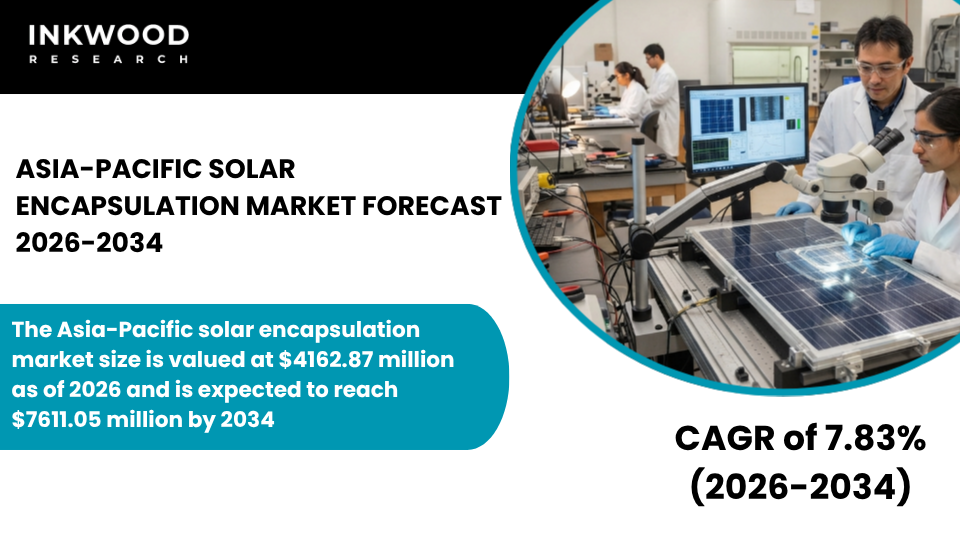
The Asia-Pacific solar encapsulation market size is valued at $4162.87 million as of 2026 and is expected to reach $7611.05 million by 2034, progressing with a CAGR of 7.83% during the forecast years, 2026-2034.
Asia-Pacific dominates global solar encapsulation demand through massive photovoltaic deployments and vertically integrated manufacturing ecosystems spanning the entire renewable energy value chain. The region’s solar capacity additions dwarf other markets, creating unprecedented consumption of ethylene-vinyl acetate, polyolefin elastomers, and advanced encapsulation materials.
Government mandates supporting carbon neutrality goals and energy security objectives are accelerating solar adoption across utility-scale, commercial, and residential segments. Furthermore, Asia-Pacific nations collectively account for over 60% of global solar module manufacturing, establishing the region as both the primary producer and consumer of encapsulation materials.
This dual role enables rapid feedback loops between encapsulant suppliers and module makers, driving continuous material innovations suited for tropical climates and challenging environmental conditions. The proliferation of floating photovoltaic installations across water bodies and aggressive rooftop solar programs in dense urban areas creates diverse application requirements for encapsulation technologies.
Additionally, declining module costs throughout the region make solar increasingly competitive with coal-fired generation, thereby sustaining robust installation growth despite periodic policy adjustments.
To Know More About This Report, Request a Free Sample Copy
The Asia-Pacific solar encapsulation market growth assessment includes the analysis of China, Japan, India, South Korea, Indonesia, Vietnam, Thailand, Australia & New Zealand, and Rest of Asia-Pacific.
China overwhelmingly dominates Asia-Pacific encapsulant consumption through record-breaking solar installations that far exceed any other nation globally. The National Energy Administration reports that China installed 277.17 gigawatts of new solar capacity during 2024, representing a 45.48% year-over-year increase.
This single-year addition surpasses the entire cumulative solar capacity of most developed nations, bringing China’s total installed photovoltaic capacity to 886.66 gigawatts by year-end. The deployment surge exceeded industry forecasts, with December 2024 alone witnessing 68.33 gigawatts of new installations as state-owned energy enterprises rushed to meet annual assessment targets.
Moreover, China’s vertically integrated solar manufacturing ecosystem produces over 80% of global module supply, creating massive domestic demand for encapsulation materials. Leading Chinese encapsulant manufacturers like Hangzhou First Applied Material Co Ltd supply both domestic module producers and export markets worldwide.
The country’s renewable energy targets mandate reaching 1,200 gigawatts of combined wind and solar capacity by 2030, a milestone achieved six years ahead of schedule in August 2024. This policy environment ensures sustained encapsulant demand growth as China develops mega-solar installations across Inner Mongolia’s Kubuqi Desert and other provinces.
Technological advances in crystalline silicon solar cell efficiencies and n-type TOPCon architectures require corresponding encapsulant innovations, positioning Chinese material suppliers as global technology leaders. Japan’s solar encapsulation market exhibits maturity characteristics with emphasis on rooftop installations and distributed generation systems serving energy security objectives.
This deployment pattern reflects Japan’s land scarcity challenges and strategic preference for distributed energy resources following the 2011 Fukushima nuclear accident. According to the Renewable Energy Institute, Japan’s cumulative solar capacity reached approximately 87 gigawatts by 2023, making it the third-largest global market behind China and the United States.
However, installation growth has moderated compared to earlier boom periods when feed-in tariff programs drove rapid capacity additions, with recent reports from 2025 indicating that India has surpassed Japan to become the world’s third-largest solar market/generator.
The transition from guaranteed feed-in tariffs to feed-in premium mechanisms introduces market price exposure, encouraging module manufacturers to prioritize high-efficiency cells and premium encapsulants that maximize energy yields. Japanese encapsulant demand increasingly emphasizes materials compatible with building-integrated photovoltaic facades and agrivoltaic installations combining agriculture with solar generation.
Additionally, Tokyo and Kawasaki implementing mandatory solar requirements for new residential construction creates baseline demand supporting encapsulant suppliers. Floating photovoltaic installations across Japan’s numerous water bodies require specialized encapsulation solutions that withstand high humidity and thermal cycling unique to aquatic environments.
The Asia-Pacific solar encapsulation market is segmented into material type, technology (module construction), and application. The application segment is further categorized into photovoltaics (PV) (utility-scale, commercial & industrial (C&I), residential), transportation & mobility, and consumer electronics.
Utility-scale photovoltaic projects dominate encapsulant consumption throughout the Asia-Pacific due to gigawatt-scale installations driving massive material volumes. These large ground-mounted solar farms, typically exceeding 50 megawatt capacity, account for the majority of regional module production and, consequently, encapsulation material procurement.
Utility-scale developers prioritize cost efficiency alongside proven durability, making ethylene-vinyl acetate the predominant encapsulant choice despite growing adoption of polyolefin alternatives. The segment benefits from economies of scale in both module manufacturing and project development, enabling aggressive pricing structures that accelerate solar’s competitiveness against fossil fuels.
Furthermore, utility-scale installations concentrate in regions with abundant land availability and high solar irradiation, particularly across China’s desert provinces, India’s solar parks, and Australia’s outback territories. These projects typically secure 20-25-year power purchase agreements with utilities or corporate offtakers, necessitating encapsulants maintaining performance throughout multi-decade operational periods.
Module manufacturers serving utility-scale markets increasingly specify advanced cross-linked EVA formulations offering improved moisture resistance compared to conventional materials. The segment also drives innovation in thin-film solar encapsulation as cadmium telluride and CIGS technologies compete for utility-scale market share.
Additionally, utility-scale projects enable testing of emerging encapsulant technologies at meaningful commercial scales before broader market adoption. Bifacial module configurations gaining popularity in utility installations require specialized encapsulation approaches supporting dual-sided light capture while maintaining structural integrity.
Some of the top players operating in the Asia-Pacific solar encapsulation market include DuPont de Nemours Inc, Mitsui Chemicals Inc, Bridgestone Corporation, Hangzhou First Applied Material Co Ltd, etc.
Hangzhou First Applied Material Co Ltd operates as China’s leading encapsulant manufacturer with a dominant market share across Asia-Pacific solar supply chains. Headquartered in Hangzhou, Zhejiang Province, the company specializes in producing ethylene-vinyl acetate and polyolefin elastomer films for crystalline silicon solar modules and thin-film photovoltaic applications.
Hangzhou First has established comprehensive in-house production capabilities spanning polymer compounding, film extrusion, and quality control testing that enable rapid response to module manufacturer specifications. The company supplies China’s largest solar producers, including LONGi Green Energy, JinkoSolar, and Trina Solar, benefiting from proximity to concentrated manufacturing clusters.
Moreover, Hangzhou First invests heavily in developing high-transparency EVA formulations offering superior UV resistance and reduced yellowing characteristics essential for modern high-efficiency modules. The company’s production scale enables competitive pricing that supports China’s position as the global low-cost solar module supplier.
Additionally, Hangzhou First exports encapsulation films to Southeast Asian module assembly operations and serves international markets through technical partnerships with downstream manufacturers. Recent product innovations include ultra-thin encapsulant layers, reducing material consumption while maintaining protective performance, addressing industry cost optimization priorities.
REPORT SYNOPSIS
| REPORT SCOPE | DETAILS |
|---|---|
| Market Forecast Years | 2026-2034 |
| Base Year | 2025 |
| Market Historical Years | 2022-2024 |
| Forecast Units | Revenue ($ Million) |
| Segments Analyzed | Material Type, Technology (Module Construction), and Application |
| Countries Analyzed | China, India, Japan, Australia & New Zealand, South Korea, Thailand, Indonesia, Vietnam, and Rest of Asia-Pacific |
| Companies Analyzed | DuPont de Nemours Inc, 3M Company, Dow Inc, STR Holdings Inc, Mitsui Chemicals Inc, Bridgestone Corporation, Coveme SpA, Arkema SA, RenewSys India Pvt Ltd, Hangzhou First Applied Material Co Ltd, Kuraray Co Ltd, Eastman Chemical Company |
TABLE OF CONTENTS
RESEARCH SCOPE & METHODOLOGY
- STUDY OBJECTIVES
- METHODOLOGY
- ASSUMPTIONS & LIMITATIONS
EXECUTIVE SUMMARY
- MARKET SIZE & FORECAST
- MARKET OVERVIEW
- SCOPE OF STUDY
- CRISIS SCENARIO ANALYSIS
- MAJOR MARKET FINDINGS
- HIGH ADOPTION OF EVA AND POE ENCAPSULANTS IS DRIVEN BY COST EFFICIENCY AND RELIABLE MODULE PERFORMANCE ACROSS GLOBAL SOLAR INSTALLATIONS
- UTILITY SCALE SOLAR PROJECTS ACCOUNT FOR A SIGNIFICANT SHARE OF ENCAPSULANT DEMAND DUE TO LARGE MODULE VOLUMES AND LONG-TERM DEPLOYMENTS
- ASIA-PACIFIC DOMINATES THE MARKET SUPPORTED BY STRONG SOLAR MANUFACTURING BASES AND AGGRESSIVE RENEWABLE ENERGY TARGETS
- TECHNOLOGICAL DIFFERENTIATION AMONG ENCAPSULANT SUPPLIERS IS INCREASING AS MODULE MAKERS DEMAND HIGHER DURABILITY AND LOWER DEGRADATION
MARKET DYNAMICS
- KEY DRIVERS
- RAPID EXPANSION OF SOLAR PV INSTALLATIONS IS DIRECTLY INCREASING DEMAND FOR ENCAPSULATION MATERIALS
- DECLINING SOLAR MODULE PRICES ARE ACCELERATING PROJECT ECONOMICS AND BOOSTING MODULE PRODUCTION VOLUMES
- GOVERNMENT POLICIES AND INCENTIVES PROMOTING RENEWABLE ENERGY ARE SUPPORTING LONG-TERM MARKET GROWTH
- RISING FOCUS ON MODULE LIFETIME AND EFFICIENCY IS DRIVING USE OF ADVANCED ENCAPSULANT FORMULATIONS
- KEY RESTRAINTS
- VOLATILITY IN RAW MATERIAL PRICES SUCH AS POLYMERS, IMPACTS ENCAPSULANT MANUFACTURING COST STRUCTURES
- TECHNICAL COMPATIBILITY ISSUES WITH NEW CELL TECHNOLOGIES CAN LIMIT RAPID ADOPTION OF CERTAIN ENCAPSULANTS
- INTENSE PRICE COMPETITION AMONG SUPPLIERS COMPRESSES MARGINS ACROSS THE VALUE CHAIN
- HIGH-PERFORMANCE MATERIALS OFTEN FACE SLOW QUALIFICATION CYCLES WITH CONSERVATIVE MODULE MANUFACTURERS
- KEY DRIVERS
KEY ANALYTICS
- KEY MARKET TRENDS
- SHIFT TOWARD POE ENCAPSULANTS IS GAINING MOMENTUM DUE TO SUPERIOR MOISTURE AND PID RESISTANCE
- DEMAND FOR ENCAPSULANTS SUITABLE FOR BIFACIAL AND HIGH EFFICIENCY MODULES IS INCREASING
- MANUFACTURERS ARE INVESTING IN THINNER AND LIGHTWEIGHT ENCAPSULATION SOLUTIONS TO REDUCE MODULE COSTS
- SUSTAINABILITY AND RECYCLABILITY CONSIDERATIONS ARE INFLUENCING MATERIAL SELECTION AND PRODUCT DEVELOPMENT
- PORTER’S FIVE FORCES ANALYSIS
- BUYERS POWER
- SUPPLIERS POWER
- SUBSTITUTION
- NEW ENTRANTS
- INDUSTRY RIVALRY
- GROWTH PROSPECT MAPPING
- GROWTH PROSPECT MAPPING FOR ASIA-PACIFIC
- MARKET MATURITY ANALYSIS
- MARKET CONCENTRATION ANALYSIS
- VALUE CHAIN ANALYSIS
- RAW MATERIAL SUPPLIERS
- POLYMER COMPOUNDING
- ENCAPSULANT MANUFACTURING
- FILM EXTRUSION
- MODULE ASSEMBLY
- SOLAR PROJECT DEPLOYMENT
- KEY BUYING CRITERIA
- LONG-TERM DURABILITY
- CELL COMPATIBILITY
- COST EFFICIENCY
- SUPPLIER RELIABILITY
- REGULATORY FRAMEWORK
- KEY MARKET TRENDS
SOLAR ENCAPSULATION MARKET BY MATERIAL TYPE
- ETHYLENE VINYL ACETATE (EVA)
- POLYOLEFIN ELASTOMERS (POE)
- POLYVINYL BUTYRAL (PVB)
- SILICONE & IONOMER
- OTHER MATERIAL TYPES
SOLAR ENCAPSULATION MARKET BY TECHNOLOGY (MODULE CONSTRUCTION)
- GLASS-BACKSHEET
- GLASS-GLASS (DOUBLE GLASS)
- BUILDING-INTEGRATED PHOTOVOLTAICS (BIPV)
SOLAR ENCAPSULATION MARKET BY APPLICATION
- PHOTOVOLTAICS (PV)
- UTILITY-SCALE
- COMMERCIAL & INDUSTRIAL (C&I)
- RESIDENTIAL
- TRANSPORTATION & MOBILITY
- CONSUMER ELECTRONICS
- PHOTOVOLTAICS (PV)
GEOGRAPHICAL ANALYSIS
- ASIA-PACIFIC
- MARKET SIZE & ESTIMATES
- ASIA-PACIFIC MARKET DRIVERS
- ASIA-PACIFIC MARKET CHALLENGES
- KEY PLAYERS IN ASIA-PACIFIC SOLAR ENCAPSULATION MARKET
- COUNTRY ANALYSIS
- CHINA
- CHINA MARKET SIZE & OPPORTUNITIES
- INDIA
- INDIA MARKET SIZE & OPPORTUNITIES
- JAPAN
- JAPAN MARKET SIZE & OPPORTUNITIES
- AUSTRALIA & NEW ZEALAND
- AUSTRALIA & NEW ZEALAND MARKET SIZE & OPPORTUNITIES
- SOUTH KOREA
- SOUTH KOREA MARKET SIZE & OPPORTUNITIES
- THAILAND
- THAILAND MARKET SIZE & OPPORTUNITIES
- INDONESIA
- INDONESIA MARKET SIZE & OPPORTUNITIES
- VIETNAM
- VIETNAM MARKET SIZE & OPPORTUNITIES
- REST OF ASIA-PACIFIC
- REST OF ASIA-PACIFIC MARKET SIZE & OPPORTUNITIES
- CHINA
- ASIA-PACIFIC
COMPETITIVE LANDSCAPE
- KEY STRATEGIC DEVELOPMENTS
- MERGERS & ACQUISITIONS
- PRODUCT LAUNCHES & DEVELOPMENTS
- PARTNERSHIPS & AGREEMENTS
- BUSINESS EXPANSIONS & DIVESTITURES
- COMPANY PROFILES
- DUPONT DE NEMOURS INC
- COMPANY OVERVIEW
- PRODUCT LIST
- STRENGTHS & CHALLENGES
- 3M COMPANY
- COMPANY OVERVIEW
- PRODUCT LIST
- STRENGTHS & CHALLENGES
- DOW INC
- COMPANY OVERVIEW
- PRODUCT LIST
- STRENGTHS & CHALLENGES
- STR HOLDINGS INC
- COMPANY OVERVIEW
- PRODUCT LIST
- STRENGTHS & CHALLENGES
- MITSUI CHEMICALS INC
- COMPANY OVERVIEW
- PRODUCT LIST
- STRENGTHS & CHALLENGES
- BRIDGESTONE CORPORATION
- COMPANY OVERVIEW
- PRODUCT LIST
- STRENGTHS & CHALLENGES
- COVEME SPA
- COMPANY OVERVIEW
- PRODUCT LIST
- STRENGTHS & CHALLENGES
- ARKEMA SA
- COMPANY OVERVIEW
- PRODUCT LIST
- STRENGTHS & CHALLENGES
- RENEWSYS INDIA PVT LTD
- COMPANY OVERVIEW
- PRODUCT LIST
- STRENGTHS & CHALLENGES
- HANGZHOU FIRST APPLIED MATERIAL CO LTD
- COMPANY OVERVIEW
- PRODUCT LIST
- STRENGTHS & CHALLENGES
- KURARAY CO LTD
- COMPANY OVERVIEW
- PRODUCT LIST
- STRENGTHS & CHALLENGES
- EASTMAN CHEMICAL COMPANY
- COMPANY OVERVIEW
- PRODUCT LIST
- STRENGTHS & CHALLENGES
- DUPONT DE NEMOURS INC
- KEY STRATEGIC DEVELOPMENTS
LIST OF TABLES
TABLE 1: MARKET SNAPSHOT – SOLAR ENCAPSULATION
TABLE 2: SOLAR ENCAPSULATION MARKET REGULATORY FRAMEWORK
TABLE 3: MARKET BY MATERIAL TYPE, BY REGION, HISTORICAL YEARS, 2022-2024 (IN $ MILLION)
TABLE 4: MARKET BY MATERIAL TYPE, BY REGION, FORECAST YEARS, 2026-2034 (IN $ MILLION)
TABLE 5: MARKET BY TECHNOLOGY (MODULE CONSTRUCTION), BY REGION, HISTORICAL YEARS, 2022-2024 (IN $ MILLION)
TABLE 6: MARKET BY TECHNOLOGY (MODULE CONSTRUCTION), BY REGION, FORECAST YEARS, 2026-2034 (IN $ MILLION)
TABLE 7: MARKET BY APPLICATION, BY REGION, HISTORICAL YEARS, 2022-2024 (IN $ MILLION)
TABLE 8: MARKET BY APPLICATION, BY REGION, FORECAST YEARS, 2026-2034 (IN $ MILLION)
TABLE 9: MARKET BY PHOTOVOLTAICS (PV), BY REGION, HISTORICAL YEARS, 2022-2024 (IN $ MILLION)
TABLE 10: MARKET BY PHOTOVOLTAICS (PV), BY REGION, FORECAST YEARS, 2026-2034 (IN $ MILLION)
TABLE 11: ASIA-PACIFIC MARKET, COUNTRY ANALYSIS, HISTORICAL YEARS, 2022-2024 (IN $ MILLION)
TABLE 12: ASIA-PACIFIC MARKET, COUNTRY ANALYSIS, FORECAST YEARS, 2026-2034 (IN $ MILLION)
TABLE 13: KEY PLAYERS OPERATING IN THE ASIA-PACIFIC MARKET
TABLE 14: LIST OF MERGERS & ACQUISITIONS
TABLE 15: LIST OF PRODUCT LAUNCHES & DEVELOPMENTS
TABLE 16: LIST OF PARTNERSHIPS & AGREEMENTS
TABLE 17: LIST OF BUSINESS EXPANSIONS & DIVESTITURES
LIST OF FIGURES
FIGURE 1: KEY MARKET TRENDS
FIGURE 2: PORTER’S FIVE FORCES ANALYSIS
FIGURE 3: GROWTH PROSPECT MAPPING FOR ASIA-PACIFIC
FIGURE 4: MARKET MATURITY ANALYSIS
FIGURE 5: MARKET CONCENTRATION ANALYSIS
FIGURE 6: VALUE CHAIN ANALYSIS
FIGURE 7: KEY BUYING CRITERIA
FIGURE 8: SEGMENT GROWTH POTENTIAL, BY MATERIAL TYPE, IN 2025
FIGURE 9: ETHYLENE VINYL ACETATE (EVA) MARKET SIZE, 2026-2034 (IN $ MILLION)
FIGURE 10: POLYOLEFIN ELASTOMERS (POE) MARKET SIZE, 2026-2034 (IN $ MILLION)
FIGURE 11: POLYVINYL BUTYRAL (PVB) MARKET SIZE, 2026-2034 (IN $ MILLION)
FIGURE 12: SILICONE & IONOMER MARKET SIZE, 2026-2034 (IN $ MILLION)
FIGURE 13: OTHER MATERIAL TYPES MARKET SIZE, 2026-2034 (IN $ MILLION)
FIGURE 14: SEGMENT GROWTH POTENTIAL, BY TECHNOLOGY (MODULE CONSTRUCTION), IN 2025
FIGURE 15: GLASS-BACKSHEET MARKET SIZE, 2026-2034 (IN $ MILLION)
FIGURE 16: GLASS-GLASS (DOUBLE GLASS) MARKET SIZE, 2026-2034 (IN $ MILLION)
FIGURE 17: BUILDING-INTEGRATED PHOTOVOLTAICS (BIPV) MARKET SIZE, 2026-2034 (IN $ MILLION)
FIGURE 18: SEGMENT GROWTH POTENTIAL, BY APPLICATION, IN 2025
FIGURE 19: PHOTOVOLTAICS (PV) MARKET SIZE, 2026-2034 (IN $ MILLION)
FIGURE 20: SEGMENT GROWTH POTENTIAL, BY PHOTOVOLTAICS (PV), IN 2025
FIGURE 21: UTILITY-SCALE MARKET SIZE, 2026-2034 (IN $ MILLION)
FIGURE 22: COMMERCIAL & INDUSTRIAL (C&I) MARKET SIZE, 2026-2034 (IN $ MILLION)
FIGURE 23: RESIDENTIAL MARKET SIZE, 2026-2034 (IN $ MILLION)
FIGURE 24: TRANSPORTATION & MOBILITY MARKET SIZE, 2026-2034 (IN $ MILLION)
FIGURE 25: CONSUMER ELECTRONICS MARKET SIZE, 2026-2034 (IN $ MILLION)
FIGURE 26: ASIA-PACIFIC SOLAR ENCAPSULATION MARKET, COUNTRY OUTLOOK, 2025 & 2034 (IN %)
FIGURE 27: CHINA MARKET SIZE, 2026-2034 (IN $ MILLION)
FIGURE 28: INDIA MARKET SIZE, 2026-2034 (IN $ MILLION)
FIGURE 29: JAPAN MARKET SIZE, 2026-2034 (IN $ MILLION)
FIGURE 30: AUSTRALIA & NEW ZEALAND MARKET SIZE, 2026-2034 (IN $ MILLION)
FIGURE 31: SOUTH KOREA MARKET SIZE, 2026-2034 (IN $ MILLION)
FIGURE 32: THAILAND MARKET SIZE, 2026-2034 (IN $ MILLION)
FIGURE 33: INDONESIA MARKET SIZE, 2026-2034 (IN $ MILLION)
FIGURE 34: VIETNAM MARKET SIZE, 2026-2034 (IN $ MILLION)
FIGURE 35: REST OF ASIA-PACIFIC MARKET SIZE, 2026-2034 (IN $ MILLION)
FAQ’s
RELATED REPORTS
-

ASIA PACIFIC PRECISION FARMING MARKET FORECAST 2026
-
TURKEY SOLAR ENCAPSULATION MARKET FORECAST 2026-2034
-
UNITED STATES SOLAR ENCAPSULATION MARKET FORECAST 2026-2034
-
JAPAN SOLAR ENCAPSULATION MARKET FORECAST 2026-2034
-
EUROPE SOLAR ENCAPSULATION MARKET FORECAST 2026-2034
-
NORTH AMERICA SOLAR ENCAPSULATION MARKET FORECAST 2026-2034
-
GLOBAL SOLAR ENCAPSULATION MARKET FORECAST 2026-2034
-
UNITED STATES WIND ENERGY MARKET FORECAST 2026-2034
-
CANADA WIND ENERGY MARKET FORECAST 2026-2034
-
GERMANY WIND ENERGY MARKET FORECAST 2026-2034