United Arab Emirates Liquefied Natural Gas (LNG) Market by LNG Infrastructure (LNG Liquefaction Plants, LNG Regasification Facilities, LNG Shipping & Transportation) Market by Application (Transportation, Industrial Feedstock, Power Generation, Other Applications) Market by Mode of Supply (Truck, Transshipment and Bunkering, Pipeline and Rail)
UNITED ARAB EMIRATES LIQUEFIED NATURAL GAS (LNG) MARKET OVERVIEW
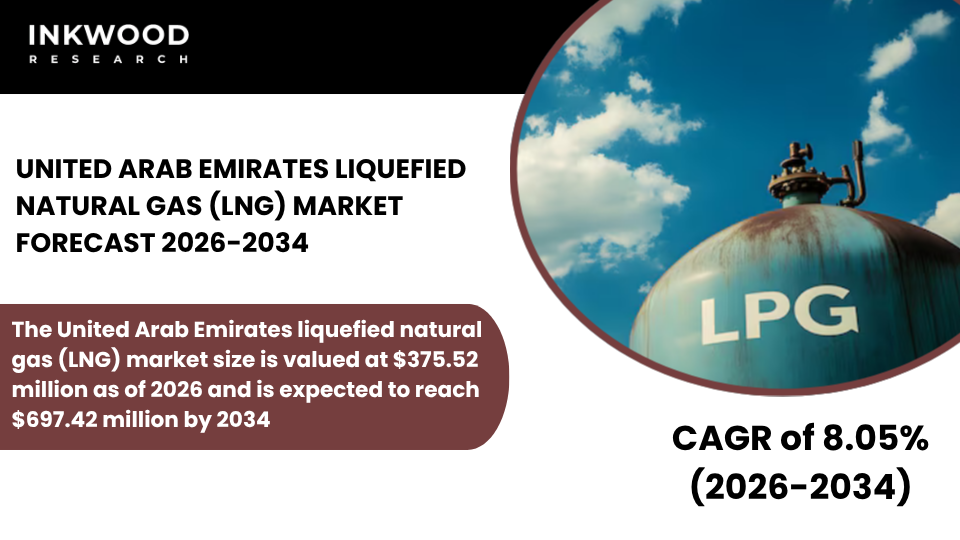
The United Arab Emirates liquefied natural gas (LNG) market size is valued at $375.52 million as of 2026 and is expected to reach $697.42 million by 2034, progressing with a CAGR of 8.05% during the forecast years, 2026-2034.
The United Arab Emirates is strategically positioning itself as an emerging liquefied natural gas player through ambitious infrastructure investments and international partnerships that leverage the country’s substantial natural gas reserves. While historically the UAE imported LNG to meet domestic demand that exceeded local production capacity, recent years have witnessed a fundamental shift toward gas self-sufficiency and export-oriented development.
According to ADNOC, the national oil company spearheads initiatives to expand production from offshore fields while simultaneously developing liquefaction capabilities that will enable cargo shipments to international buyers. This transformation reflects the UAE’s broader economic diversification strategy and its commitment to participating actively in the global energy transition as a supplier of cleaner energy alternatives.
Domestic consumption patterns underscore the critical role that natural gas plays within the UAE’s energy infrastructure, particularly for power generation applications that meet electricity demand across residential, commercial, and industrial sectors. Gas-fired plants deliver reliable baseload capacity while supporting the integration of expanding renewable energy installations, especially large-scale solar projects in Abu Dhabi and Dubai.
Furthermore, seawater desalination facilities depend heavily on gas supplies for the energy-intensive processes that produce potable water essential for the UAE’s arid climate. These dual requirements for electricity and water create sustained demand that historically necessitated LNG imports during periods when domestic production fell short of consumption needs.
The UAE’s strategic geographic location along critical maritime routes connecting the Middle East with Asian and European markets creates natural advantages for liquefied natural gas trade activities. Proximity to major consumption centers in South Asia reduces shipping costs and delivery times compared to more distant suppliers, enhancing competitiveness in price-sensitive markets.
To Know More About This Report, Request a Free Sample Copy
Additionally, the country’s advanced port infrastructure and logistics capabilities facilitate efficient cargo handling operations that minimize turnaround times for LNG carriers. These factors collectively position the UAE as a potential regional hub for natural gas market activities, including both export operations and potential reexport or transshipment services.
Industrial applications drive substantial natural gas consumption across the UAE’s manufacturing and petrochemical sectors, where companies utilize gas as both fuel power and essential feedstock for production processes. The aluminum smelting industry, particularly concentrated in Abu Dhabi, requires enormous energy inputs that natural gas supplies efficiently and economically.
Meanwhile, petrochemical complexes convert gas into polymers, fertilizers, and specialty chemicals that serve domestic markets while generating export revenues. These energy-intensive industries benefit from the UAE’s commitment to maintaining competitive gas pricing and reliable supply availability that support industrial competitiveness.
ADNOC’s initiatives to develop low-carbon liquefied natural gas production capabilities align with growing international buyer preferences for certified, emission-reduced cargoes that support their own decarbonization objectives. The company invests in carbon capture and storage technologies, methane emission reduction programs, and operational efficiency improvements that minimize the carbon intensity of LNG production.
Furthermore, ADNOC pursues partnerships with international energy companies that bring technical expertise and market access while sharing development risks and capital requirements. These collaborations accelerate project timelines while positioning UAE LNG exports competitively in increasingly sustainability-conscious markets.
The UAE’s natural gas reserves provide the foundation for sustained production growth that can support both domestic consumption requirements and future export ambitions simultaneously. Offshore fields contain substantial resources that advanced extraction technologies and enhanced recovery techniques can access economically.
Consequently, the government prioritizes upstream development projects that expand production capacity while maintaining cost competitiveness. These investments create the supply surplus necessary to justify liquefaction plant construction and long-term export contract negotiations with international buyers seeking reliable suppliers.
Transportation fuel applications remain relatively modest within the UAE’s liquefied natural gas consumption landscape, though maritime bunkering opportunities are gradually emerging at major port facilities serving international shipping lanes.
The country’s strategic position along critical trade routes creates natural opportunities to provide refueling services for vessels transitioning toward cleaner fuels. Additionally, some logistics companies evaluate natural gas for heavy-duty trucking operations, though widespread adoption remains constrained by infrastructure availability and vehicle technology considerations.
The United Arab Emirates liquefied natural gas (LNG) market is segmented into LNG infrastructure, application, and mode of supply. The LNG infrastructure segment is further categorized into LNG liquefaction plants and LNG regasification facilities.
Liquefaction plants represent the strategic priority within the UAE’s evolving liquefied natural gas infrastructure landscape as the country transitions from import dependence toward export capacity development. ADNOC’s projects focus on constructing state-of-the-art facilities that incorporate the latest process technologies, maximizing thermal efficiency while minimizing environmental footprint through integrated carbon capture capabilities.
These installations will process natural gas from offshore production platforms, removing impurities and cooling the gas to cryogenic temperatures where it condenses into liquid form suitable for international shipping. The liquefaction plant developments require substantial capital investment and technical expertise, necessitating partnerships with experienced international operators who contribute both financial resources and operational knowledge.
Furthermore, these facilities incorporate modular construction approaches that accelerate installation schedules while maintaining rigorous quality and safety standards essential for decades of reliable operations. The infrastructure creates significant employment opportunities during construction phases while establishing permanent operational positions that support skills development within the UAE’s energy sector workforce. Additionally, plant designs emphasize operational flexibility to accommodate varying production volumes and gas compositions from different offshore fields as development progresses over time.
Some of the top players operating in the United Arab Emirates liquefied natural gas (LNG) market include ADNOC, Excelerate Energy, Al Fanar Gas Group, and Dragon Oil, etc.
ADNOC (Abu Dhabi National Oil Company) operates as the UAE’s integrated national energy company, headquartered in Abu Dhabi with comprehensive operations spanning upstream exploration and production, midstream processing and transportation, and downstream refining and distribution. The company leads the UAE’s strategic shift toward liquefied natural gas export capabilities through major infrastructure projects that will transform the country’s role in global energy markets.
ADNOC’s business model combines state ownership with commercial efficiency, leveraging international partnerships that bring technical capabilities and market access while maintaining strategic control over resource development decisions. The company actively pursues sustainability initiatives, including carbon intensity reduction, methane emission minimization, and renewable energy integration that position its future LNG exports as premium products in environmentally conscious markets.
REPORT SYNOPSIS
| REPORT SCOPE | DETAILS |
|---|---|
| Market Forecast Years | 2026-2034 |
| Base Year | 2025 |
| Market Historical Years | 2022-2024 |
| Forecast Units | Revenue ($ Million) |
| Segments Analyzed | LNG Infrastructure, Application, and Mode of Supply |
| Country Analyzed | The United Arab Emirates |
| Companies Analyzed | ADNOC, Excelerate Energy, Al Fanar Gas Group, Dragon Oil, Abu Dhabi National Oil Company |
TABLE OF CONTENTS
RESEARCH SCOPE & METHODOLOGY
- STUDY OBJECTIVES
- METHODOLOGY
- ASSUMPTIONS & LIMITATIONS
EXECUTIVE SUMMARY
- MARKET SIZE, SHARE & ESTIMATES
- MARKET OVERVIEW
- SCOPE OF STUDY
- CRISIS SCENARIO ANALYSIS
- MAJOR MARKET FINDINGS
- THE UAE POSITIONS ITSELF AS AN EMERGING PLAYER IN GLOBAL LNG THROUGH STRATEGIC EXPORT AGREEMENTS AND INFRASTRUCTURE INVESTMENTS
- ADNOC DRIVES GROWTH BY FOCUSING ON LOW-CARBON LNG INITIATIVES AND INTERNATIONAL PARTNERSHIPS
- THE COUNTRY LEVERAGES ITS STRATEGIC LOCATION TO FACILITATE LNG TRADE WITH KEY MARKETS IN ASIA AND EUROPE
- UAE ADVANCES TOWARD GAS SELF-SUFFICIENCY WHILE BUILDING SURPLUS CAPACITY FOR FUTURE EXPORTS
MARKET DYNAMICS
- KEY DRIVERS
- RISING GLOBAL DEMAND FOR CLEANER ENERGY SOURCES SUPPORTS EXPANDED UAE LNG EXPORT ACTIVITIES
- VAST NATURAL GAS RESERVES ENABLE SUSTAINED PRODUCTION AND EXPORT DEVELOPMENT
- EXTENSIVE INFRASTRUCTURE INVESTMENTS ENHANCE LNG SHIPPING AND STORAGE CAPABILITIES
- STRATEGIC INTERNATIONAL CONTRACTS STRENGTHEN MARKET POSITION AND ENSURE LONG-TERM DEMAND
- KEY RESTRAINTS
- HIGH CAPITAL REQUIREMENTS FOR LIQUEFACTION AND EXPORT FACILITIES LIMIT RAPID EXPANSION
- INCREASING COMPETITION FROM ESTABLISHED LNG SUPPLIERS PRESSURES MARKET SHARE
- ENVIRONMENTAL REGULATIONS AND SUSTAINABILITY PRESSURES CREATE ADDITIONAL INVESTMENT CHALLENGES
- POTENTIAL DELAYS IN INFRASTRUCTURE PROJECTS DUE TO GLOBAL SUPPLY CHAIN ISSUES HINDER PROGRESS
- KEY DRIVERS
STRATEGIC MARKET ANALYTICS
- KEY MARKET TRENDS
- UAE EMPHASIZES LOW-CARBON AND SUSTAINABLE LNG PRODUCTION TO ALIGN WITH GLOBAL ENERGY TRANSITION GOALS
- EXPANSION OF LNG CARRIER FLEET AND MANUFACTURING CAPABILITIES DIVERSIFIES REVENUE STREAMS
- GROWING INTERNATIONAL PARTNERSHIPS FACILITATE TECHNOLOGY TRANSFER AND MARKET ACCESS
- FOCUS ON DOMESTIC GAS DEVELOPMENT REDUCES FUTURE RELIANCE ON LNG IMPORTS
- PORTER’S FIVE FORCES ANALYSIS
- BUYERS POWER
- SUPPLIERS POWER
- SUBSTITUTION
- NEW ENTRANTS
- INDUSTRY RIVALRY
- GROWTH PROSPECT MAPPING
- GROWTH PROSPECT MAPPING FOR UNITED ARAB EMIRATES
- MARKET MATURITY ANALYSIS
- MARKET CONCENTRATION ANALYSIS
- VALUE CHAIN ANALYSIS
- EXPLORATION AND EXTRACTION
- LIQUEFACTION AND PROCESSING
- STORAGE AND TRANSPORTATION
- EXPORT AND DISTRIBUTION
- MARKETING AND SALES
- AFTER-SALES SERVICES
- KEY BUYING CRITERIA
- PRICE COMPETITIVENESS
- SUPPLY RELIABILITY
- QUALITY STANDARDS
- CONTRACT FLEXIBILITY
- FUTURE PROSPECTS OF LNG IN UNITED ARAB EMIRATES
- TRADE
- EXPORTS
- IMPORTS
- LNG TERMINALS
- LIST OF LNG EXPORT TERMINALS
- REGULATORY FRAMEWORK AND COMPLIANCE BODIES
- KEY MARKET TRENDS
LIQUEFIED NATURAL GAS (LNG) MARKET BY LNG INFRASTRUCTURE
- LNG LIQUEFACTION PLANTS
- MARKET FORECAST FIGURE
- SEGMENT ANALYSIS
- LNG REGASIFICATION FACILITIES
- MARKET FORECAST FIGURE
- SEGMENT ANALYSIS
- LNG LIQUEFACTION PLANTS
LIQUEFIED NATURAL GAS (LNG) MARKET BY APPLICATION
- TRANSPORTATION
- MARKET FORECAST FIGURE
- SEGMENT ANALYSIS
- INDUSTRIAL FEEDSTOCK
- MARKET FORECAST FIGURE
- SEGMENT ANALYSIS
- POWER GENERATION
- MARKET FORECAST FIGURE
- SEGMENT ANALYSIS
- OTHER APPLICATIONS
- MARKET FORECAST FIGURE
- SEGMENT ANALYSIS
- TRANSPORTATION
LIQUEFIED NATURAL GAS (LNG) MARKET BY MODE OF SUPPLY
- TRUCK
- MARKET FORECAST FIGURE
- SEGMENT ANALYSIS
- TRANSSHIPMENT AND BUNKERING
- MARKET FORECAST FIGURE
- SEGMENT ANALYSIS
- PIPELINE AND RAIL
- MARKET FORECAST FIGURE
- SEGMENT ANALYSIS
- TRUCK
COMPETITIVE LANDSCAPE
- KEY STRATEGIC DEVELOPMENTS
- MERGERS & ACQUISITIONS
- PRODUCT LAUNCHES & DEVELOPMENTS
- PARTNERSHIPS & AGREEMENTS
- BUSINESS EXPANSIONS & DIVESTITURES
- COMPANY PROFILES
- ADNOC
- COMPANY OVERVIEW
- PRODUCT LIST
- STRENGTHS & CHALLENGES
- EXCELERATE ENERGY
- COMPANY OVERVIEW
- PRODUCT LIST
- STRENGTHS & CHALLENGES
- AL FANAR GAS GROUP
- COMPANY OVERVIEW
- PRODUCT LIST
- STRENGTHS & CHALLENGES
- DRAGON OIL
- COMPANY OVERVIEW
- PRODUCT LIST
- STRENGTHS & CHALLENGES
- ABU DHABI NATIONAL OIL COMPANY
- COMPANY OVERVIEW
- PRODUCT LIST
- STRENGTHS & CHALLENGES
- ADNOC
- KEY STRATEGIC DEVELOPMENTS
LIST OF TABLES
TABLE 1: MARKET SNAPSHOT – LIQUEFIED NATURAL GAS (LNG)
TABLE 2: LIQUEFIED NATURAL GAS (LNG) MARKET REGULATORY FRAMEWORK
TABLE 3: UNITED ARAB EMIRATES NATURAL GAS PRODUCTION, 2022-2024 (IN EXAJOULES)
TABLE 4: UNITED ARAB EMIRATES NATURAL GAS CONSUMPTION, 2022-2024 (IN EXAJOULES)
TABLE 5: UNITED ARAB EMIRATES LNG EXPORTS, 2022-2024 (IN BILLION CUBIC METERS)
TABLE 6: UNITED ARAB EMIRATES LNG IMPORTS, 2022-2024 (IN BILLION CUBIC METERS)
TABLE 7: MARKET BY LNG INFRASTRUCTURE, HISTORICAL YEARS, 2022-2024 (IN $ MILLION)
TABLE 8: MARKET BY LNG INFRASTRUCTURE, FORECAST YEARS, 2026-2034 (IN $ MILLION)
TABLE 9: MARKET BY APPLICATION, HISTORICAL YEARS, 2022-2024 (IN $ MILLION)
TABLE 10: MARKET BY APPLICATION, FORECAST YEARS, 2026-2034 (IN $ MILLION)
TABLE 11: MARKET BY MODE OF SUPPLY, HISTORICAL YEARS, 2022-2024 (IN $ MILLION)
TABLE 12: MARKET BY MODE OF SUPPLY, FORECAST YEARS, 2026-2034 (IN $ MILLION)
TABLE 13: KEY PLAYERS OPERATING IN THE UNITED ARAB EMIRATES MARKET
TABLE 14: LIST OF MERGERS & ACQUISITIONS
TABLE 15: LIST OF PRODUCT LAUNCHES & DEVELOPMENTS
TABLE 16: LIST OF PARTNERSHIPS & AGREEMENTS
TABLE 17: LIST OF BUSINESS EXPANSIONS & DIVESTITURES
LIST OF FIGURES
FIGURE 1: KEY MARKET TRENDS
FIGURE 2: PORTER’S FIVE FORCES ANALYSIS
FIGURE 3: GROWTH PROSPECT MAPPING FOR UNITED ARAB EMIRATES
FIGURE 4: MARKET MATURITY ANALYSIS
FIGURE 5: MARKET CONCENTRATION ANALYSIS
FIGURE 6: VALUE CHAIN ANALYSIS
FIGURE 7: KEY BUYING CRITERIA
FIGURE 8: SEGMENT GROWTH POTENTIAL, BY LNG INFRASTRUCTURE, IN 2025
FIGURE 9: LNG LIQUEFACTION PLANTS MARKET SIZE, 2026-2034 (IN $ MILLION)
FIGURE 10: LNG REGASIFICATION FACILITIES MARKET SIZE, 2026-2034 (IN $ MILLION)
FIGURE 11: SEGMENT GROWTH POTENTIAL, BY APPLICATION, IN 2025
FIGURE 12: TRANSPORTATION MARKET SIZE, 2026-2034 (IN $ MILLION)
FIGURE 13: INDUSTRIAL FEEDSTOCK MARKET SIZE, 2026-2034 (IN $ MILLION)
FIGURE 14: POWER GENERATION MARKET SIZE, 2026-2034 (IN $ MILLION)
FIGURE 15: OTHER APPLICATIONS MARKET SIZE, 2026-2034 (IN $ MILLION)
FIGURE 16: SEGMENT GROWTH POTENTIAL, BY MODE OF SUPPLY, IN 2025
FIGURE 17: TRUCK MARKET SIZE, 2026-2034 (IN $ MILLION)
FIGURE 18: TRANSSHIPMENT AND BUNKERING MARKET SIZE, 2026-2034 (IN $ MILLION)
FIGURE 19: PIPELINE AND RAIL MARKET SIZE, 2026-2034 (IN $ MILLION)
FAQ’s
RELATED REPORTS
-
UNITED STATES AI-DRIVEN CLOUD MIGRATION SERVICES MARKET FORECAST 2026-2034
-
UNITED KINGDOM AI-DRIVEN CLOUD MIGRATION SERVICES MARKET FORECAST 2026-2034
-
UNITED ARAB EMIRATES AI-DRIVEN CLOUD MIGRATION SERVICES MARKET FORECAST 2026-2034
-
SOUTH KOREA AI-DRIVEN CLOUD MIGRATION SERVICES MARKET FORECAST 2026-2034
-

SINGAPORE AI-DRIVEN CLOUD MIGRATION SERVICES MARKET FORECAST 2026-2034
-

SAUDI ARABIA AI-DRIVEN CLOUD MIGRATION SERVICES MARKET FORECAST 2026-2034
-

AUSTRALIA AI-DRIVEN CLOUD MIGRATION SERVICES MARKET FORECAST 2026-2034
-
JAPAN AI-DRIVEN CLOUD MIGRATION SERVICES MARKET FORECAST 2026-2034
-
INDIA AI-DRIVEN CLOUD MIGRATION SERVICES MARKET FORECAST 2026-2034
-
CHINA AI-DRIVEN CLOUD MIGRATION SERVICES MARKET FORECAST 2026-2034