Table of Contents
This analysis is brought to you by Inkwood Research, a leading market intelligence firm specializing in India’s digital public infrastructure, electric mobility ecosystems, and energy technology platforms. Our research team draws on deep expertise in EV charging market dynamics, open protocol architectures, and smart grid integration across South and Southeast Asia. Through strategic partnerships with energy technology developers, mobility platforms, and policy advisory bodies, we deliver actionable intelligence for decision-makers navigating India’s unified energy interface EV charging market.
TLDR
India is developing a Unified Energy Interface, a digital public infrastructure layer modeled on UPI’s success in payments, but designed for EV charging discovery, access, and settlement. The UEI EV charging ecosystem addresses fragmentation across charging networks and enables true interoperability. As global EV charging markets in China, Germany, the UK, and Australia expand at double-digit CAGRs, India’s UEI-based EV charging infrastructure positions the country as a pioneer in open, protocol-driven energy mobility.
This blog is essential reading for EV infrastructure developers, energy technology investors, and mobility platform strategists tracking the India unified energy interface EV charging market. Additionally, policymakers shaping digital public infrastructure frameworks, fleet operators evaluating smart EV charging solutions India, and automotive executives planning India market entry will find targeted intelligence here on UEI integration, digital energy platforms, and the EV charging interoperability ecosystem taking shape across the country.
What Is India’s Unified Energy Interface for EV Charging?
India’s approach to solving EV charging fragmentation is distinctly its own. Rather than waiting for a single dominant platform to consolidate the market, India is building the India unified energy interface EV charging market around an open, interoperable protocol, much the way UPI transformed digital payments a decade ago.
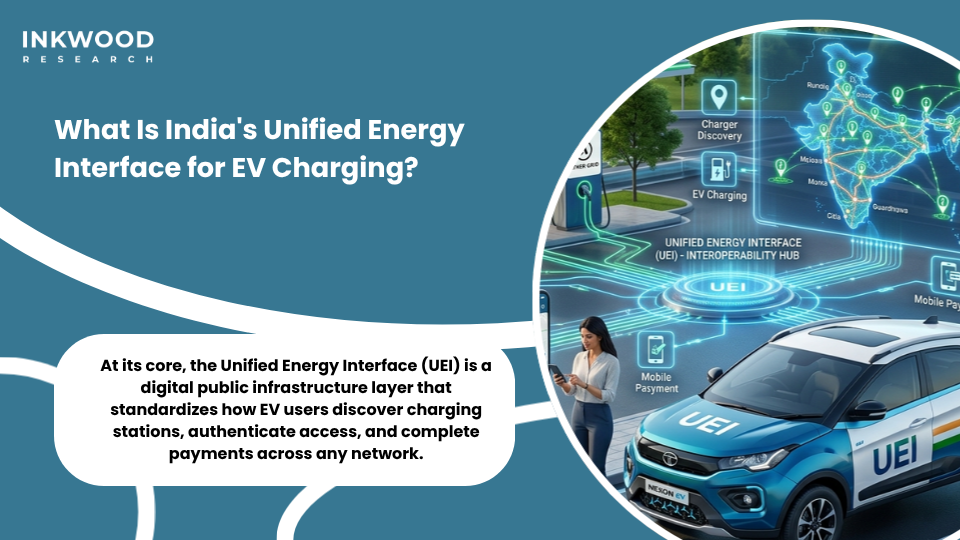
At its core, the Unified Energy Interface (UEI) is a digital public infrastructure layer that standardizes how EV users discover charging stations, authenticate access, and complete payments across any network. Consequently, a driver using one app can access chargers operated by an entirely different network, without switching platforms or juggling multiple accounts. The Bureau of Energy Efficiency (BEE) under India’s Ministry of Power has been central to establishing the policy and technical framework supporting this vision. Launched in April 2024, the initiative, managed by the UEI Alliance, aims to eliminate fragmentation in the EV charging market by enabling interoperability across different Charge Point Operators (CPOs).
The Problem UEI Solves
Today, the UEI EV charging market in India faces a familiar challenge, network lock-in. Competing platforms operate independent charging networks, each requiring separate apps, memberships, and payment methods. This fragmentation discourages adoption, particularly among new EV users who find the experience unnecessarily complex.
- Multiple apps for different charging networks, creating friction at every touchpoint
- No universal EV charging payment and discovery platform in India across operators
- Inconsistent pricing transparency makes cost comparison difficult for users
- Poor rural and highway coverage due to siloed infrastructure deployment
The unified energy interface EV charging ecosystem addresses each of these pain points by creating a shared digital layer that any operator, platform, or user can connect to, freely and openly.
How Does UEI Mirror UPI’s Transformational Model?
Understanding UEI starts with understanding what UPI achieved. The Unified Payments Interface, managed by NPCI, created a protocol-level standard that allowed banks, fintechs, and consumers to transact across platforms seamlessly. No single player owned the rails. Furthermore, because the infrastructure was open, innovation accelerated, thousands of apps built on top of UPI, each competing on experience while sharing the same underlying network.
UEI applies this exact logic to energy and mobility. The unified energy interface EV charging ecosystem provides an open protocol layer that enables:
- Any charging network to list its stations, availability, and real-time pricing
- Any consumer app to discover, book, and pay for charging seamlessly
- Any operator to receive payments through a standardized settlement mechanism
- Real-time data sharing across the India EV charging infrastructure market, improving utilization and user experience
Additionally, UEI’s architecture supports peer-to-peer energy transactions and distributed energy systems, opening doors to vehicle-to-grid capabilities as India’s grid evolves. This positions the India digital energy platform EV charging not merely as a coordination tool, but as foundational infrastructure for India’s broader smart mobility vision.
Digital Public Infrastructure as a Competitive Advantage
India’s DPI approach, which gave the world Aadhaar, UPI, and ONDC, has now turned toward the UEI-based EV charging infrastructure India needs at scale. The design philosophy is consistent: build open rails, let private players innovate on top, and use government policy to drive adoption.
This model is particularly powerful in a country where EV charging infrastructure must reach not just metros but tier-2 cities, highways, and rural corridors. Moreover, an open protocol ensures that smaller regional operators can participate without building proprietary ecosystems from scratch, lowering the capital barrier and accelerating the EV charging network India growth that the market urgently needs.
Why Does India’s EV Charging Market Need an Open Protocol?
India’s electric vehicle adoption is accelerating meaningfully across segments. According to the Ministry of Road Transport and Highways’ Vahan portal, EV registrations have grown year on year, with two-wheelers and three-wheelers consistently leading volumes. Moreover, the government’s PM E-DRIVE initiative has directed substantial public investment toward EV charging infrastructure expansion, reinforcing the urgency of a unified, interoperable backbone.
Yet investment alone does not solve interoperability. As the EV charging interoperability platform India debate has shown, charging growth without a unified discovery and settlement layer leads to stranded assets and uneven utilization. Operators in well-served urban corridors see strong throughput, while stations in underserved areas sit idle, because users simply cannot find or access them reliably.
Smart Charging, Grid Integration, and the Role of UEI
Beyond interoperability, the unified energy interface mobility market also addresses smart grid integration, one of the more consequential long-term opportunities. UEI-enabled charging stations can receive signals from grid operators to shift load, charging EVs during off-peak hours when renewable energy is most abundant. Conversely, stations can pause or reduce output during peak demand periods, directly supporting grid stability.
This capability is essential for India, where the Ministry of Power has set ambitious parallel targets for both EV penetration and renewable energy integration. Furthermore, the architecture’s support for distributed energy systems and peer-to-peer energy transactions opens a future path toward vehicle-to-grid, fundamentally reshaping the economics of EV ownership in India over the next decade.
Which Companies Are Building the UEI-Enabled EV Charging Ecosystem?
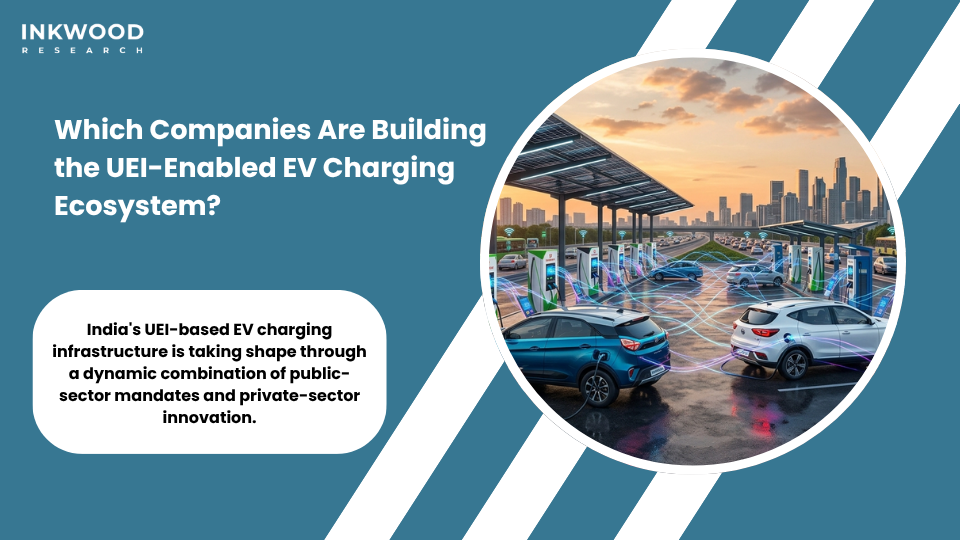
India’s UEI-based EV charging infrastructure is taking shape through a dynamic combination of public-sector mandates and private-sector innovation. Several companies are defining what the open-protocol charging ecosystem looks like in practice:
Public Sector: CESL as the Anchor Operator
Convergence Energy Services Limited (CESL), a public sector entity under the Ministry of Power, has emerged as the anchor operator for government-backed charging infrastructure. CESL’s tender-driven rollout model deploys charging stations across highways, government buildings, and public transport corridors. Importantly, CESL’s procurement approach explicitly supports interoperability, setting a clear benchmark for the India digital energy platform EV charging ecosystem to follow.
Private Players Shaping the Ecosystem
- Tata Power EV Charging has built one of India’s largest charging networks, with a presence across retail locations, residential societies, and fleet hubs. The platform is evolving toward open-protocol compatibility, reflecting the broader market direction.
- ChargeZone and Statiq have positioned themselves as technology-forward operators, emphasizing real-time availability, dynamic pricing, and multi-network access, capabilities that align naturally with UEI’s design principles.
- Ather Grid, operated by Ather Energy, has become a reference point for fast-charging quality and reliability in India’s two-wheeler segment, a critical proof point for open-protocol viability. Also, it is now boasting over 5,000 active, reliable charging points nationwide.
- Reliance BP Mobility is entering the fast-charging space at petrol station forecourts, bringing significant capital and distribution scale to the India EV charging infrastructure market.
Together, these players illustrate the competitive depth of the unified energy interface EV charging ecosystem. Consequently, the UEI protocol does not threaten private operators, it provides the infrastructure rails on which each can build differentiated services, exactly as UPI did for fintech.
What Are the Latest Developments Shaping UEI Adoption?
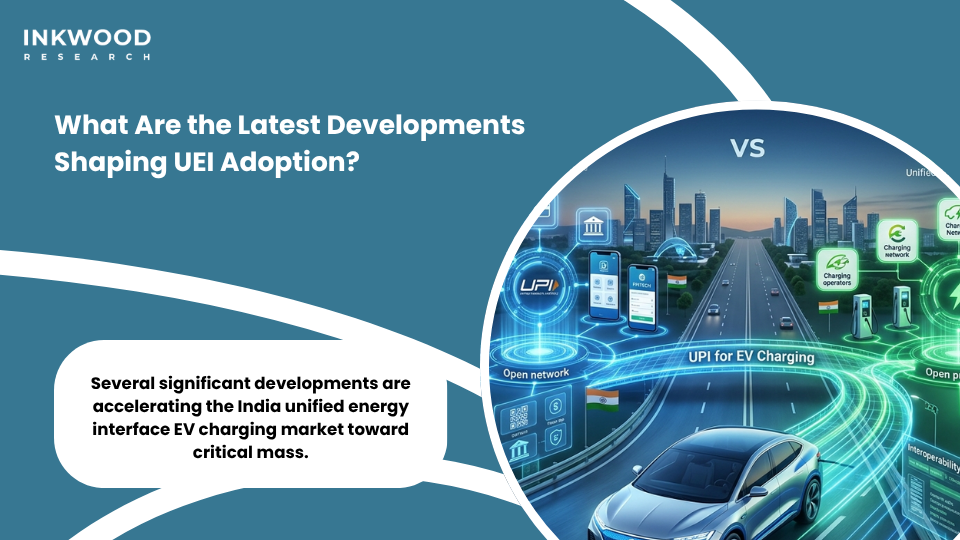
Several significant developments are accelerating the India unified energy interface EV charging market toward critical mass. These advances span policy, technical standards, and ecosystem participation:
- PM E-DRIVE Scheme (2024): The Government of India approved the PM Electric Drive Revolution in Innovative Vehicle Enhancement scheme with an outlay of ₹10,900 crore, covering EV subsidies and public charging infrastructure. This expands the earlier FAME II programme with an explicit focus on EV charging digital platforms India and public access.
- BEE Charging Standards: The Bureau of Energy Efficiency has been progressively standardizing EV charging connectors and communication protocols, a technical prerequisite for UEI’s interoperability layer to function at scale across operators.
- ONDC for Energy Parallel: India’s Open Network for Digital Commerce (ONDC) framework is being studied as a structural parallel for the digital public infrastructure for EV charging India UEI vision, reinforcing the government’s commitment to open-protocol approaches across sectors.
- Smart Grid Pilots: The Ministry of Power has initiated smart grid pilots in multiple states, testing demand-response integration with EV charging infrastructure, a direct precursor to grid-aware, UEI-enabled operation at scale.
Furthermore, international interest in India’s model is growing. Several countries exploring EV charging digital platforms and API-based energy platforms frameworks have engaged with India’s DPI architects to study the UEI approach. This signals that the India unified energy interface EV charging market may have global resonance, positioning India as both a domestic leader and an emerging exporter of digital infrastructure models.
Key Takeaways
- The India unified energy interface EV charging market is built on the same open-protocol philosophy that made UPI the world’s most successful digital payments network: open rails, private innovation on top.
- UEI addresses the core fragmentation challenge in India’s EV charging landscape, creating a unified discovery, access, and settlement layer across all operators and networks.
- CESL, Tata Power EV, ChargeZone, Statiq, Ather Grid, and Reliance BP Mobility are the primary players shaping the UEI EV charging ecosystem, each contributing to interoperability from different angles.
- The PM E-DRIVE scheme (₹10,900 crore) and BEE charging standards provide the policy and technical foundation for UEI’s national rollout.
- Smart grid integration and vehicle-to-grid capabilities represent UEI’s next frontier, moving it from a charging coordination protocol to a full energy interoperability platform for India’s mobility future.
Conclusion
India’s unified energy interface EV charging ecosystem is one of the most thoughtfully designed infrastructure initiatives in the global EV transition. By applying the DPI model to energy, India is not merely building more charging stations, it is building the connective tissue that makes those stations discoverable, accessible, and economically viable at scale.
As the UEI EV charging market India matures, the open-protocol architecture will lower barriers for operators, reduce friction for users, and accelerate investment from both domestic and international players. For businesses, investors, and policymakers navigating this space, understanding the UEI architecture and its implications is essential.
Inkwood Research provides the market intelligence and strategic analysis needed to act with confidence in the India unified energy interface EV charging market.
Connect with our team to explore how our insights can support your strategy in India’s evolving electric mobility ecosystem.
Frequently Asked Questions (FAQs)
UEI is an open digital protocol enabling seamless discovery, access, and payment across all EV charging networks in India.
Unlike proprietary apps, UEI is an open layer allowing any platform and any charging network to interconnect without exclusive bilateral agreements.
The Bureau of Energy Efficiency, under India’s Ministry of Power, leads the technical standards and policy framework supporting UEI.
CESL anchors public-sector charging deployment, setting interoperability benchmarks for India’s digital energy platform EV charging infrastructure.
UEI-enabled chargers can receive grid signals to shift load, supporting demand response and renewable energy integration at scale.
PM E-DRIVE is India’s ₹10,900 crore EV initiative covering subsidies and public charging, accelerating UEI-compatible infrastructure deployment nationwide.