Table of Contents
This analysis is brought to you by Inkwood Research, a leading market intelligence firm specializing in Asia-Pacific energy transitions, liquefied natural gas infrastructure developments, and regional power sector transformations. Our research team combines extensive experience analyzing natural gas markets, renewable energy integration patterns, and energy security frameworks across China, India, Japan, Southeast Asia, and Australia. Based on our proprietary research methodologies and strategic partnerships with regional energy authorities, LNG terminal operators, and government energy agencies, we deliver actionable insights that empower strategic decision-making for global enterprises navigating Asia-Pacific’s energy transformation.
TLDR
Asia-Pacific’s liquefied natural gas market experiences an unprecedented transformation driven by energy security concerns and decarbonization goals. China’s massive infrastructure investments, India’s ambitious import expansion, and Japan’s strategic LNG partnerships reshape global gas trade dynamics. Indonesia balances domestic energy needs with export commitments while South Korea diversifies away from monopolistic supply structures. Meanwhile, Australia anchors regional supply security through expanding export capacity. These shifting patterns reflect broader transitions toward cleaner energy sources across the world’s fastest-growing economic region.
Energy sector executives, infrastructure investors, natural gas traders, policy analysts, renewable energy developers, LNG shipping operators, power utility strategists, industrial gas consumers, climate finance professionals, and regional economic planners will gain valuable insights into Asia-Pacific’s evolving energy landscape, market dynamics, supply-demand patterns, regulatory frameworks, and strategic opportunities shaping the region’s liquefied natural gas future.
Asia-Pacific LNG Market Outlook
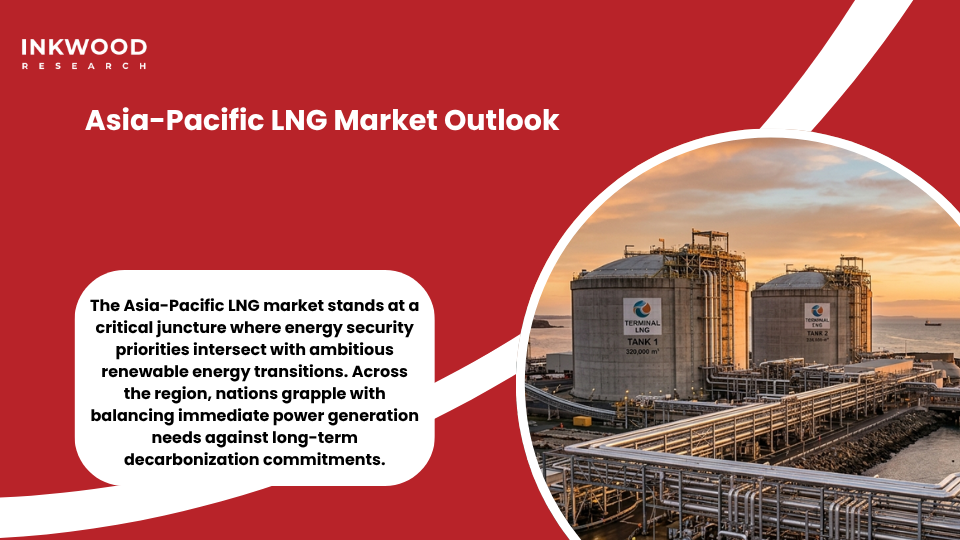
The Asia-Pacific LNG market stands at a critical juncture where energy security priorities intersect with ambitious renewable energy transitions. Across the region, nations grapple with balancing immediate power generation needs against long-term decarbonization commitments. Liquefied natural gas emerges as the bridge fuel enabling this delicate equilibrium.
Countries like China and India accelerate LNG infrastructure development while Japan and South Korea recalibrate established import frameworks. Meanwhile, Australia positions itself as the region’s supply anchor. This complex interplay reshapes global LNG market dynamics in profound ways. Our analysis reveals how these energy transitions create both challenges and opportunities for stakeholders navigating Asia-Pacific’s evolving energy landscape. Understanding regional nuances becomes essential for strategic planning.
China’s Infrastructure Push Transforms Regional LNG Dynamics
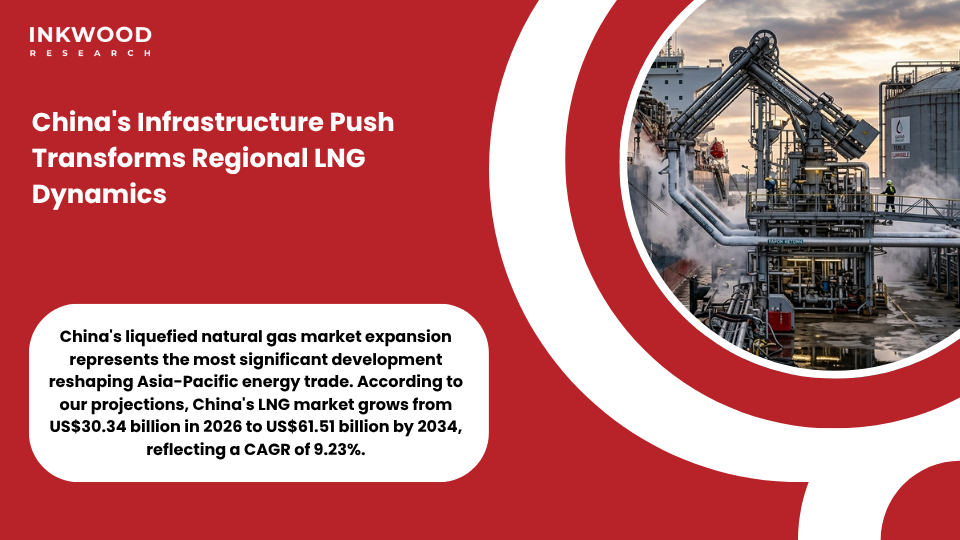
China’s liquefied natural gas market expansion represents the most significant development reshaping Asia-Pacific energy trade. Consequently, the country’s appetite for cleaner-burning fuels drives unprecedented infrastructure investment across coastal provinces. According to our projections based on current trajectory analysis, China’s LNG market grows from US$30.34 billion in 2026 to US$61.51 billion by 2034, reflecting a CAGR of 9.23%.
This remarkable expansion stems from Beijing’s dual objectives of reducing air pollution while maintaining energy security amid geopolitical uncertainties. Furthermore, the National Energy Administration continues prioritizing natural gas in the country’s energy transition strategy. Coastal cities develop receiving terminals at an accelerated pace while pipeline networks extend into interior regions.
These developments transform traditional coal-dependent provinces into diversified energy markets. Consequently, Chinese demand patterns influence global LNG pricing mechanisms and supply allocation decisions. Major suppliers from Qatar to Australia adjust production planning around Chinese market dynamics.
Regional Hub Ambitions and Trade Flow Impacts
Meanwhile, China positions itself as a potential regional liquefied natural gas trading hub through strategic infrastructure placement. Shanghai’s energy exchange develops LNG futures contracts targeting price discovery for Asian markets. Additionally, bonded tank storage facilities enable re-export capabilities previously concentrated in Singapore.
These initiatives reflect Beijing’s broader ambitions to influence regional energy market structures beyond mere consumption growth. However, infrastructure development faces coordination challenges across multiple government agencies and state-owned enterprises. Project approval timelines extend while environmental assessments become more stringent. Nevertheless, the overall trajectory remains upward as national priorities align with provincial development goals.
Our research indicates accelerated build-out through 2030 despite occasional regulatory adjustments affecting project timelines. Moreover, private sector participation increases as the government recognizes that infrastructure financing requirements exceed public resources alone.
India’s Ambitious Import Expansion Reshapes Energy Mix
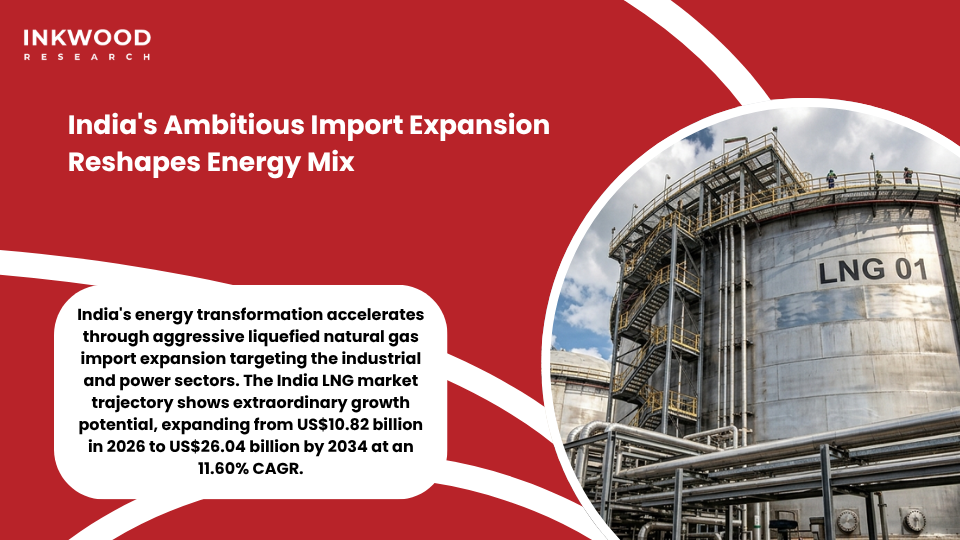
India’s energy transformation accelerates through aggressive liquefied natural gas import expansion targeting the industrial and power sectors. The India LNG market trajectory shows extraordinary growth potential, expanding from US$10.82 billion in 2026 to US$26.04 billion by 2034 at an 11.60% CAGR. This represents the highest regional growth rate, underscoring India’s urgent need for cleaner energy sources amid rapid economic development and urbanization pressures. Subsequently, multiple terminals under construction are expected to reach operational status within the next five years.
Moreover, India’s Petroleum and Natural Gas Regulatory Board streamlines approval processes for import terminal development along both western and eastern coastlines. Private sector participation increases as government frameworks encourage competition in gas infrastructure. This expansion enables greater penetration of natural gas into India’s energy mix, currently dominated by coal for power generation. Additionally, city gas distribution networks expand across urban centers, creating consistent baseload demand for LNG imports.
City Gas Distribution Networks Drive Demand Growth
Simultaneously, city gas distribution networks expand across urban centers, creating consistent baseload demand for LNG imports. The Indian government’s ambitious target of increasing natural gas share to 15% of primary energy consumption by 2030 requires substantial infrastructure development. Urban air quality concerns accelerate conversion from traditional fuels to compressed natural gas in transportation sectors. These parallel developments create multiple demand drivers supporting India’s robust market growth projections.
Nevertheless, challenges persist around pipeline connectivity between coastal terminals and inland consumption centers. Infrastructure gaps limit immediate demand response capabilities despite growing import capacity. Our analysis suggests a gradual resolution through public-private partnerships targeting connecting infrastructure.
Furthermore, according to the Ministry of Petroleum and Natural Gas data, pipeline expansion remains a national priority for maximizing LNG utilization efficiency across diverse end-use sectors, including fertilizer production and industrial manufacturing. Consequently, integrated infrastructure planning becomes critical for realizing India’s energy transition objectives.
Japan Maintains Strategic Position Despite Market Maturity
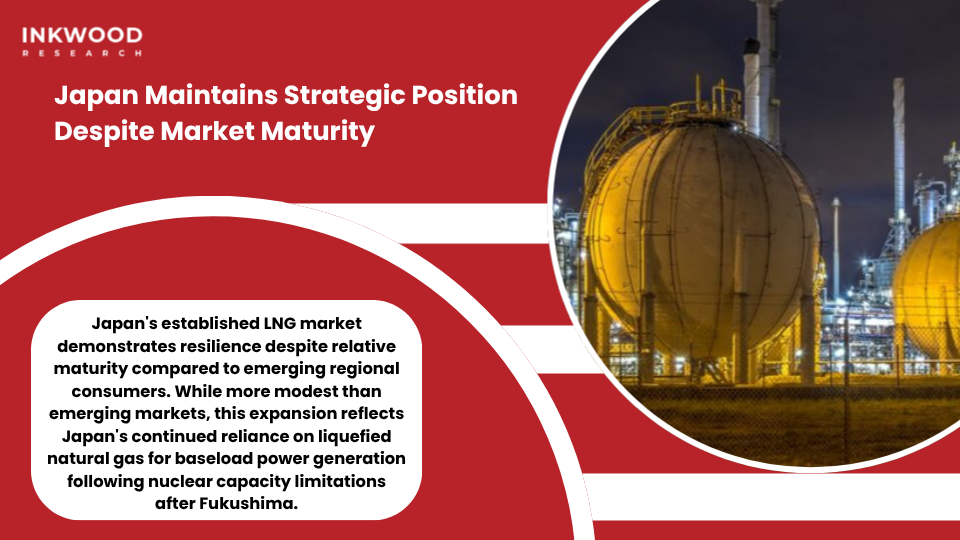
Japan’s established LNG market demonstrates resilience despite relative maturity compared to emerging regional consumers. Market projections indicate growth from US$25.04 billion in 2026 to US$40.68 billion by 2034, representing a 6.25% CAGR. While more modest than emerging markets, this expansion reflects Japan’s continued reliance on liquefied natural gas for baseload power generation following nuclear capacity limitations after Fukushima. Consequently, Japanese utilities maintain sophisticated long-term supply contracts with producers across Australia, Qatar, and increasingly the United States.
Furthermore, Japanese utilities maintain sophisticated long-term supply contracts with producers across Australia, Qatar, and increasingly the United States. These relationships provide price stability and volume certainty crucial for power generation planning. Tokyo Electric Power Company and other major utilities periodically renegotiate terms reflecting evolving market conditions. Additionally, Japan’s trading houses facilitate spot market transactions, capitalizing on price arbitrage opportunities across the Pacific and Atlantic basins. These activities contribute to regional market liquidity and price discovery mechanisms.
Energy Security Through Supply Diversification
Meanwhile, Japan pursues supply diversification beyond traditional Middle Eastern sources. The Ministry of Economy, Trade, and Industry encourages partnerships with North American LNG projects through equity participation and offtake agreements. This strategy reduces concentration risk while supporting friendly nations’ energy export development.
Consequently, Japan’s import portfolio becomes increasingly balanced across multiple geographic sources, providing enhanced supply security. Moreover, Japanese companies invest in LNG shipping and terminal infrastructure globally, securing strategic positions across the value chain.
However, Japan faces long-term demand uncertainty as renewable energy capacity expands and energy efficiency improvements reduce overall power consumption. According to Japan’s Agency for Natural Resources and Energy, natural gas will remain significant through 2030 despite growing renewable penetration. Our research suggests Japanese LNG demand plateaus post-2030 as offshore wind and solar installations offset traditional thermal generation requirements. Nevertheless, natural gas maintains importance for grid stability and backup generation, supporting intermittent renewable sources.
Indonesia Balances Domestic Needs with Export Ambitions
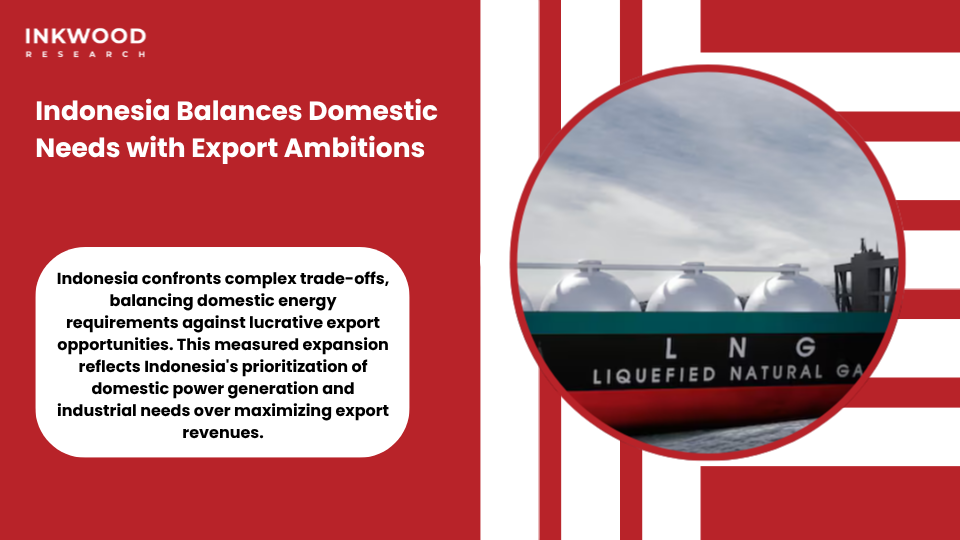
Indonesia confronts complex trade-offs, balancing domestic energy requirements against lucrative export opportunities. The Indonesia LNG market evolves from US$2.62 billion in 2026 to US$4.62 billion by 2034, growing at 7.33% annually. This measured expansion reflects Indonesia’s prioritization of domestic power generation and industrial needs over maximizing export revenues.
Consequently, government regulations increasingly direct natural gas production toward local consumption rather than international markets. Nevertheless, Indonesia maintains its position as a significant regional LNG exporter serving Asian markets. Moreover, Indonesia’s Ministry of Energy and Mineral Resources implements domestic market obligation policies requiring producers allocate specific volumes for local consumption.
These regulations aim to ensure sufficient gas availability for power plants and fertilizer manufacturers at controlled prices. Subsequently, export volumes face constraints as domestic priorities take precedence. However, Indonesia continues to develop new production capacity, potentially expanding both domestic supply and export availability. Offshore gas fields under development target production increases, supporting dual objectives.
Domestic Energy Security Prioritization
Furthermore, Indonesia’s electrification goals drive natural gas demand across Java, Sumatra, and emerging industrial zones. State-owned utility PLN expands gas-fired generation capacity, reducing reliance on coal and diesel. These infrastructure investments absorb growing domestic production even as total output increases.
Consequently, export availability depends on production growth outpacing domestic consumption expansion. Our analysis suggests Indonesia’s export role stabilizes rather than expands significantly through 2030. Nevertheless, Indonesia maintains strategic importance as a regional supplier, particularly for neighboring Southeast Asian markets. Singapore, Thailand, and Malaysia import Indonesian LNG, supporting their energy security strategies.
Additionally, Indonesia explores potential as an LNG bunkering hub serving the maritime industry’s transition toward cleaner marine fuels. These emerging opportunities could diversify Indonesia’s role beyond traditional bulk LNG exports. Moreover, investments in small-scale LNG infrastructure enable supply to remote domestic markets while creating export optionality.
South Korea’s Monopoly Evolution and Private Sector Entry
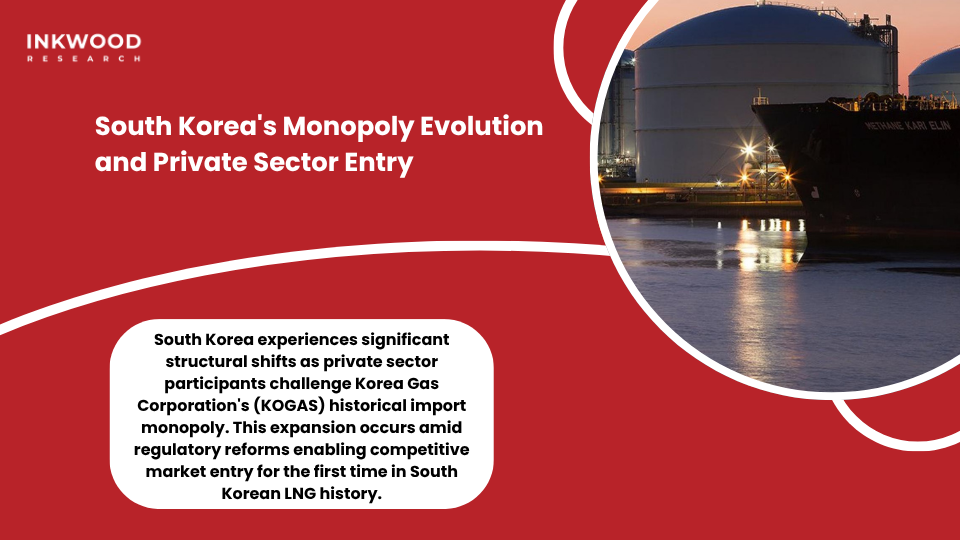
South Korea experiences significant structural shifts as private sector participants challenge Korea Gas Corporation’s (KOGAS) historical import monopoly. The South Korea LNG market expands from US$10.71 billion in 2026 to US$18.41 billion by 2034, achieving 7.01% annual growth.
This expansion occurs amid regulatory reforms enabling competitive market entry for the first time in South Korean LNG history. Consequently, major industrial consumers and independent power producers develop direct import capabilities, reducing dependency on KOGAS infrastructure and pricing. Furthermore, South Korea’s Ministry of Trade, Industry, and Energy promotes a competitive market structure, enhancing consumer choice and potentially reducing energy costs.
Private terminal developments in Samcheok and other locations provide import access independent from KOGAS facilities. These regulatory changes reflect broader economic liberalization efforts across the South Korean energy sector. Additionally, industrial consumers seek long-term supply contracts directly with international producers, bypassing traditional KOGAS intermediation. Such arrangements provide price certainty and volume security for manufacturing operations.
Private Terminal Development and Market Competition
Meanwhile, private sector investments in regasification terminals transform the South Korean LNG landscape fundamentally. SK E&S, POSCO, and other industrial groups construct dedicated import facilities serving their specific requirements. These terminals process contracted volumes more cost-effectively than relying on KOGAS infrastructure access. Consequently, South Korea develops a more competitive, efficient gas market benefiting both industrial and residential consumers through improved pricing dynamics.
Moreover, multiple import channels enhance supply security through redundancy and diversification. However, the transition from monopoly to a competitive market presents regulatory challenges around third-party access, pricing transparency, and coordination during supply emergencies. Government authorities develop frameworks balancing competition benefits against maintaining system reliability and emergency response capabilities.
Our research indicates gradual market evolution rather than abrupt transition, allowing stakeholders to adapt operational models and commercial strategies. Nevertheless, competitive pressures drive efficiency improvements across the entire value chain from import terminals through distribution networks.
Australia and New Zealand Anchor Regional Supply Security
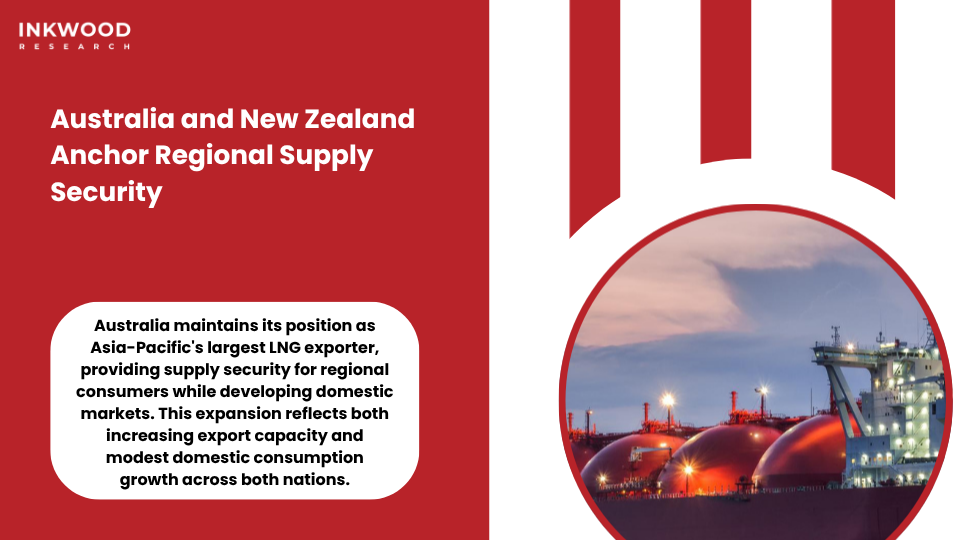
Australia maintains its position as Asia-Pacific’s largest LNG exporter, providing supply security for regional consumers while developing domestic markets. The combined Australia & New Zealand LNG market grows from US$3.09 billion in 2026 to US$6.58 billion by 2034, representing 9.90% annual growth. This expansion reflects both increasing export capacity and modest domestic consumption growth across both nations.
Consequently, Australian LNG projects underpin regional energy security through long-term supply contracts with Japan, China, South Korea, and emerging Asian markets. Furthermore, Australia’s western coast hosts multiple world-scale LNG export facilities processing natural gas from offshore fields. Projects like Gorgon, Wheatstone, and Ichthys represent multi-billion dollar investments establishing Australia as a reliable supplier for decades.
These facilities operate under long-term contracts providing volume certainty for Asian buyers while generating substantial export revenues for the Australian economy. Additionally, eastern coast projects supply both export markets and growing domestic natural gas demand, particularly across Queensland and New South Wales.
Export Growth Supporting Regional Energy Security
Meanwhile, Australian producers continue developing resources supporting additional export capacity targeting Asian market growth. Browse, Scarborough, and other proposed projects advance through regulatory approvals and commercial negotiations. These developments ensure Australia maintains supply leadership even as global LNG capacity expands through North American and African projects.
Australian reliability and proximity advantages sustain a competitive position despite emerging supply alternatives for Asian consumers. However, domestic gas reservation policies in Western Australia ensure adequate supply for the local industry even as exports expand. These regulations balance export revenue generation against maintaining affordable energy for domestic manufacturers and power generators.
Our analysis suggests Australia navigates these competing objectives successfully through careful resource management and strategic project timing. Moreover, according to the Australian Department of Climate Change, Energy, the Environment, and Water, natural gas remains important for grid stability, supporting renewable energy integration across Australian electricity markets.
Malaysia's Petronas Drives Southeast Asian Gas Integration
Malaysia’s national oil company, Petronas, plays a pivotal role in integrating Southeast Asian natural gas markets through production, trading, and infrastructure development. The Malaysia LNG market advances from US$1.39 billion in 2026 to US$2.20 billion by 2034, growing at 5.88% annually. This measured expansion reflects Malaysia’s dual position as both an LNG exporter and a growing domestic consumer.
Petronas balances export commitments with ensuring adequate supply for Malaysia’s manufacturing sector and power generation requirements. Nevertheless, Malaysia maintains strategic importance as a regional LNG supplier and trading hub. Furthermore, Petronas operates the Malaysia LNG complex in Sarawak, one of the world’s longest-running LNG export facilities with multiple expansion phases over four decades.
These facilities export to Asian markets under long-term contracts while Petronas develops additional production capacity supporting both domestic and export growth. Additionally, Petronas’ global trading operations provide market intelligence and price discovery mechanisms, benefiting regional gas commerce. The company’s international LNG activities span production, shipping, regasification, and marketing across multiple continents.
Regional Trading Hub Development
Malaysia positions itself as a Southeast Asian natural gas trading and pricing hub through infrastructure investments and regulatory frameworks. Proposed LNG trading platform aims to establish benchmark pricing for regional transactions currently referenced to distant market indices.
This initiative could enhance price discovery and market efficiency for Southeast Asian gas commerce. Consequently, Malaysia’s strategic geography and Petronas capabilities support regional integration objectives beyond purely national interests. However, Malaysia faces declining domestic production from mature offshore fields requiring investment in new resources. Deep-water developments and enhanced recovery from existing fields target maintaining production, supporting both exports and domestic consumption.
Our research indicates Malaysia successfully balances these objectives through strategic investment prioritization and partnerships with international energy companies. Moreover, small-scale LNG developments enable monetization of stranded gas resources while serving domestic markets lacking pipeline infrastructure.
Key Takeaways
- The Asia-Pacific LNG market undergoes a fundamental transformation driven by divergent national energy security strategies and decarbonization timelines. China and India lead regional demand growth through massive infrastructure investments targeting cleaner fuel transitions.
- Meanwhile, mature markets like Japan and South Korea optimize existing import frameworks while managing long-term renewable energy integration challenges. These varying approaches create complex regional dynamics requiring sophisticated market navigation.
- Moreover, supply dynamics shift as Australia expands export capacity while Indonesia balances domestic consumption priorities against revenue generation from LNG exports. These competing pressures create complex trade-off decisions for regional governments and energy companies.
- Consequently, market participants must navigate increasingly sophisticated regulatory environments and evolving pricing mechanisms across diverse national frameworks. Understanding these nuances becomes essential for successful commercial strategies.
- Furthermore, private sector participation increases across traditionally state-controlled markets as governments recognize that infrastructure financing requirements exceed public resources. This privatization trend introduces competitive dynamics, potentially improving operational efficiency while raising questions around energy security governance.
- Stakeholders monitoring these developments identify strategic opportunities amid structural market evolution. Additionally, regional integration initiatives through trading platforms and infrastructure connectivity enhance overall market efficiency and resilience.
Conclusion
Asia-Pacific’s liquefied natural gas landscape reflects the region’s broader energy transformation journey, balancing economic growth imperatives with environmental sustainability commitments. The substantial market expansion projected through 2034 demonstrates the continued relevance of natural gas as a transitional fuel despite accelerating renewable energy deployment. Regional demand patterns diverge significantly, requiring tailored strategies accounting for unique national circumstances around energy security, infrastructure readiness, and regulatory frameworks.
Based on our analysis, successful navigation of Asia-Pacific LNG markets demands a sophisticated understanding of government policy directions, infrastructure development timelines, and competitive dynamics across multiple national contexts.
Organizations positioning themselves to serve this growing market must demonstrate flexibility, adapting to rapid regulatory changes while maintaining long-term strategic vision. The region’s energy future depends on collaborative approaches balancing commercial interests with public policy objectives around clean energy transitions and reliable power supply.
For organizations seeking deeper insights into Asia-Pacific LNG market opportunities or regional energy strategy development, Inkwood Research offers comprehensive market intelligence and consulting services. Contact our team to explore how these evolving dynamics align with your strategic objectives and operational planning requirements.
Frequently Asked Questions (FAQs)
Rapid renewable capacity additions in solar and wind do not eliminate LNG demand in Asia-Pacific, as natural gas remains critical for backup power, grid stability, and peak electricity supply in countries such as China and India where electricity demand growth continues to outpace renewable expansion
Long-term LNG supply contracts provide price certainty, supply security, and investment stability for power utilities and import terminals, while flexible contract structures allow buyers to combine long-term supply security with spot market optimization
China’s dominant LNG purchasing power can tighten regional spot supply and increase prices during peak demand periods, occasionally disadvantaging smaller importers that rely more heavily on the spot market
LNG is widely viewed as a transition fuel in Asia-Pacific because it produces lower carbon emissions than coal and oil while supporting energy security and reliable power generation during the shift toward renewable energy systems
Rapid industrialization, urbanization, and population growth across Asia-Pacific are increasing electricity demand, prompting governments and utilities to invest in LNG import terminals, regasification facilities, and gas-fired power plants
LNG-fired power plants provide flexible and dispatchable generation that can quickly ramp up when solar and wind output fluctuates, helping maintain grid stability and ensuring consistent electricity supply across rapidly growing energy systems