
Table of Contents
This analysis is brought to you by Inkwood Research, a leading market intelligence firm specializing in Asia-Pacific cloud infrastructure, enterprise AI adoption, and digital transformation ecosystems. Our research team combines deep expertise in government ICT modernization, data sovereignty frameworks, and intelligent cloud migration solutions across Australia, South Korea, and Singapore. Through strategic partnerships with regional technology providers and government advisory bodies, we deliver actionable intelligence for decision-makers navigating the Asia-Pacific AI-driven cloud migration services market.
TLDR
Asia-Pacific is at the heart of a global cloud transformation wave, and three markets are setting the pace. The Australia AI-driven cloud migration services market is projected to grow from US$57.51 million in 2026 to US$577.00 million by 2034, at a 33.41% CAGR. Meanwhile, South Korea and Singapore are posting equally strong growth trajectories, driven by government modernization mandates, evolving data residency policies, and landmark infrastructure investments that are fundamentally reshaping how enterprises approach intelligent cloud migration across the region.
This blog is essential reading for enterprise IT leaders, government technology officers, and cloud migration consultants operating across Asia-Pacific. Additionally, investment analysts, policy strategists evaluating data sovereignty frameworks, and technology vendors assessing regional cloud adoption trends in Australia, South Korea, and Singapore will find rigorous, analyst-grade insights here.
Why Is Asia-Pacific Leading the Next Cloud Migration Revolution?
The global race to modernize enterprise IT is accelerating, and Asia-Pacific is emerging as one of the most dynamic battlegrounds. The benefits of AI in cloud migration services are no longer theoretical; across government agencies, financial institutions, and manufacturing firms, intelligent automation is actively reducing migration risk, cutting costs, and compressing timelines that once stretched across years.
Furthermore, the economic stakes are significant.
The Australia AI-driven cloud migration services market is forecast to reach US$577.00 million by 2034, growing at a 33.41% CAGR from US$57.51 million in 2026.
Meanwhile, the South Korea AI-driven cloud migration services market is projected to climb from US$65.63 million in 2026 to US$666.46 million by 2034, at a 33.61% CAGR.
The Singapore AI-driven cloud migration services market follows a similarly steep trajectory, expanding from US$40.49 million in 2026 to US$464.28 million by 2034, at a 35.65% CAGR, the fastest growth rate among all three markets.
These figures reflect something deeper than simple market expansion. They signal a structural shift in how organizations think about cloud modernization, and AI is at the center of that shift.
Several converging forces are driving this regional surge:
- Rising demand for AI-based workload assessment tools that reduce human error during complex migrations
- Growing adoption of hybrid cloud migration using AI to manage multi-environment complexity
- Expanding regulatory pressure forcing legacy system exits across government and financial services
- Significant public and private sector infrastructure investments are creating new migration demand
- Rapid enterprise uptake of cloud modernization using artificial intelligence as a competitive imperative
Australia: Can AI Finally Kill the Legacy ICT Beast?
Australia’s public sector is grappling with one of the most persistent challenges in enterprise technology: the sheer cost and complexity of ageing ICT environments. The Australian Public Service (APS) manages thousands of legacy applications, many built on outdated architectures, that continue to consume resources, create security vulnerabilities, and limit the government’s ability to deliver modern digital services.
Consequently, the push to exit these environments has become a national priority.
What Is the APS Doing to Modernize Ageing Systems?
The Australian Digital Transformation Agency (DTA) has been a central driver of the government’s ICT modernization agenda, establishing frameworks that guide whole-of-government cloud adoption. The DTA’s Digital Sourcing Policy and cloud-first guidance are actively pushing agencies toward scalable, modern infrastructure.
However, the challenge of safely exiting legacy environments remains formidable, particularly given the complexity of systems that have accumulated over decades of patchwork updates.
Legacy systems across APS agencies typically share several characteristics that make migration particularly difficult, and understanding them is key to designing effective exit strategies:
- Deep integration with downstream processes and databases accumulated over decades
- Minimal documentation and high institutional knowledge dependencies
- Significant risk of service disruption during any transition window
- Security vulnerabilities that grow more serious as systems age beyond vendor support
Consequently, many agencies have historically delayed migration, not from lack of intent, but from a genuine absence of tools capable of managing the transition safely and affordably.
How Does AI Accelerate Legacy Exit Strategies?
This is precisely where automated cloud migration using AI changes the calculus entirely. AI-powered dependency mapping tools analyze legacy application architectures automatically, surfacing interdependencies that manual audits routinely miss.
Meanwhile, predictive analytics for cloud migration helps teams model risk scenarios before a single workload is moved, enabling more confident decision-making at the executive level and significantly reducing the likelihood of post-migration outages.
Moreover, AI-driven application dependency mapping eliminates much of the guesswork that has traditionally made legacy exit projects so expensive. Agencies can now sequence migrations based on actual risk profiles rather than estimates.
Compliance with the Australian Government Information Security Manual (ISM) can also be monitored continuously throughout the migration process.
Practical advantages include:
- Reduced discovery timelines from months to weeks through AI-based workload assessment tools
- More accurate migration cost forecasting through AI cloud migration ROI analysis
- Automated testing frameworks that validate application performance post-migration
- Continuous compliance monitoring aligned with national cybersecurity requirements
The APS modernization story is not simply about moving to the cloud. It is, fundamentally, about using intelligent cloud migration services to exit legacy environments strategically, and Australia’s rapidly growing market reflects exactly that momentum building at scale.
South Korea: The Data Residency Dilemma
South Korea presents a fascinating paradox for anyone tracking the AI cloud migration solutions landscape. On one hand, the country is home to some of the world’s most technologically sophisticated enterprises, massive conglomerates, and a thriving IT services sector that has long embraced digital innovation.
On the other hand, South Korea’s evolving data residency and sovereignty frameworks are creating both headwinds and genuine opportunities for intelligent cloud migration services providers operating in the market.
What Are South Korea’s Data Localization Requirements?
South Korea’s Personal Information Protection Act (PIPA), administered by the Personal Information Protection Commission (PIPC), is among the most comprehensive data protection frameworks in Asia.
Recent amendments have strengthened requirements around cross-border data transfers, mandating that organizations establish explicit legal bases and protective measures before transferring personal data outside the country.
Additionally, certain regulated industries face sector-specific requirements that further restrict data movement. The Financial Services Commission (FSC) maintains rules that effectively require significant financial data to remain within domestic systems, directly shaping how enterprises must architect their cloud migration strategies. Key compliance considerations include:
- Cross-border data transfers must meet one of several approved legal mechanisms under PIPA
- Data processors must conduct adequacy assessments before engaging foreign cloud providers
- Financial and healthcare data often requires domestic hosting or sovereign cloud arrangements
- Organizations face significant penalties for non-compliant data transfers across borders
Will Data Sovereignty Help or Hinder AI Cloud Adoption?
Here is where the localization paradox becomes genuinely interesting. In the short term, strict data residency requirements add complexity and cost to cloud migration projects, particularly for multinational enterprises seeking to consolidate workloads on global platforms.
However, these same requirements are simultaneously driving significant investment in domestic cloud infrastructure and sovereign cloud offerings that could ultimately expand the South Korea AI-driven cloud migration services market considerably.
Moreover, the compliance imperative is pushing demand for sophisticated AI cloud migration consulting services that can navigate regulatory requirements intelligently. Rather than treating data residency as a barrier, forward-looking organizations are using compliance as a catalyst to rethink their entire cloud architecture.
The result is a market where enterprise AI cloud migration solutions providers with deep regulatory expertise are becoming essential strategic partners, not merely technology vendors.
This dynamic explains, in large part, why the South Korea market is on track to grow from US$65.63 million to US$666.46 million by 2034, at a 33.61% CAGR. Regulatory complexity, far from suppressing demand, is refining and elevating it.
Singapore: What Does Microsoft's AI Commitment Mean for the Region?
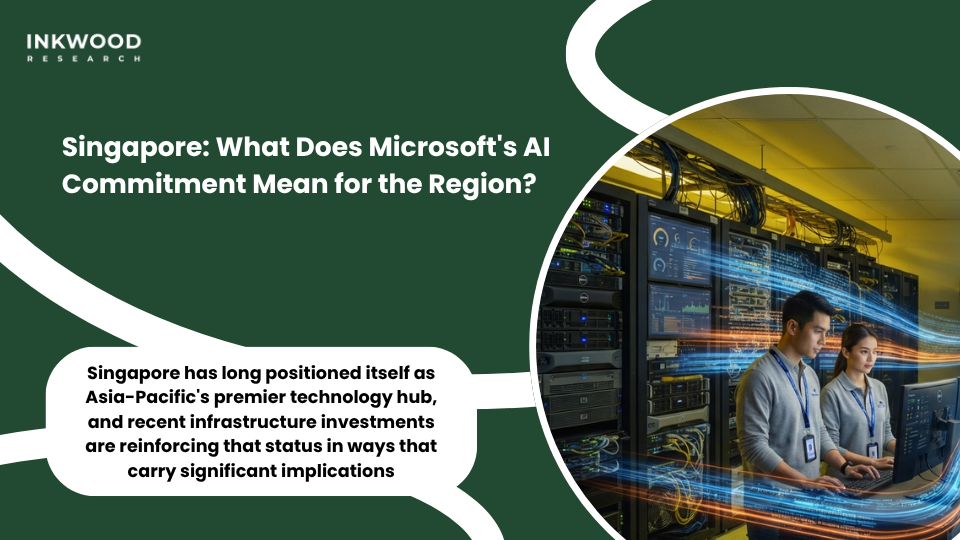
Singapore has long positioned itself as Asia-Pacific’s premier technology hub, and recent infrastructure investments are reinforcing that status in ways that carry significant implications for the regional AI-powered cloud transformation landscape.
Microsoft’s announced commitment of US$5.5 billion to expand AI infrastructure in Singapore represents one of the largest single technology investments the city-state has attracted, signaling long-term hyperscaler confidence in Singapore as a platform for enterprise AI and cloud services.
Why Is Singapore a Strategic Hub for AI Infrastructure?
Singapore’s appeal to major technology investors is rooted in several compounding advantages. The country’s Personal Data Protection Act (PDPA), administered by the Personal Data Protection Commission, provides a mature and internationally respected data governance framework.
Furthermore, Singapore’s National AI Strategy 2.0, launched in 2023, establishes a clear government commitment to AI adoption across both public and private sectors, creating the policy stability that infrastructure investors require.
Several structural factors make Singapore the natural anchor for regional AI infrastructure. Taken together, they create an environment that multinational enterprises actively seek out when designing their Asia-Pacific cloud architectures:
- Highly stable regulatory and legal environment with internationally recognized data governance standards
- World-class physical infrastructure and connectivity across Southeast Asian and broader Asia-Pacific markets
- Deep concentration of cloud, AI, and digital talent supporting complex migration programs
- Government-backed AI acceleration programs that create strong public sector demand
How Does Major Infrastructure Investment Change Cloud Migration Economics?
Infrastructure investments of this scale fundamentally change the economics and risk profile of cloud migration for regional enterprises. When hyperscaler infrastructure is physically present and expanding within a jurisdiction, organizations benefit from lower latency for data-intensive workloads, making hybrid cloud migration using AI significantly more viable for applications that previously required on-premises hosting.
Additionally, greater data sovereignty assurance is particularly important for regulated industries navigating both local and regional compliance requirements.
Expanded availability of managed cloud services simplifies the operational side of intelligent workload migration using AI, reducing the specialist expertise burden on enterprise IT teams.
Furthermore, Microsoft’s commitment signals that Singapore will become an increasingly capable platform for generative AI in cloud transformation workloads, which require significantly more compute density than traditional enterprise applications.
For organizations mapping their migration roadmaps today, this trajectory is a compelling reason to accelerate planning.
The competitive dynamics of the AI-driven cloud migration services market across Australia, South Korea, and Singapore reflect the broader global landscape, but with distinct regional characteristics that reward deep local expertise. Several major players have established meaningful market positions:
- Microsoft Azure is particularly well-positioned in all three markets. Deep government relationships in Australia, growing South Korea enterprise presence, and the strategic Singapore infrastructure investment anchor Microsoft’s Asia-Pacific ambitions. Azure Migrate and Azure AI Services deliver integrated automated cloud migration tools using AI.
- Amazon Web Services (AWS) maintains strong enterprise and government market positions across the region. AWS migration acceleration programs and local infrastructure zones support AI-based workload migration to cloud platforms at scale, with cloud migration managed services with AI available through an extensive partner network.
- Google Cloud has expanded across Asia-Pacific with a focus on multi-cloud migration AI solutions, and AI/ML workload capabilities, making it a strong competitor for enterprises pursuing cloud modernization using artificial intelligence across complex, multi-environment architectures.
- IBM brings deep expertise in legacy system modernization, making it highly relevant to Australia’s APS modernization challenge. IBM’s AI-driven digital transformation services portfolio positions it particularly well for complex government migrations involving decades-old systems.
- Accenture and Deloitte, as leading AI cloud transformation consulting companies, both firms provide the advisory layer above technology platforms, helping enterprises design compliant and cost-effective migration architectures that optimize AI cloud migration ROI across all three markets.
Additionally, regional system integrators and hyperscaler-aligned partners are capturing significant share by combining cloud migration managed services with AI and deep local regulatory knowledge, a combination that global vendors alone often cannot replicate effectively.
Key Takeaways
- Australia, South Korea, and Singapore AI-driven cloud migration services markets are all growing above 33% CAGR, reflecting structural digital transformation demand that will sustain through 2034
- Australia’s APS modernization is creating significant public sector demand for AI-powered legacy exit tools, particularly around AI-driven application dependency mapping and predictive migration planning
- South Korea’s PIPA framework adds complexity but also drives demand for specialized AI cloud migration consulting services, turning regulatory compliance into a market growth engine
- Microsoft’s US$5.5 billion Singapore investment signals hyperscaler confidence in the region and will materially improve the economics of intelligent cloud migration services for regional enterprises
- Cloud migration cost optimization using AI, compliance-aware architecture, and deep regional expertise are no longer differentiators, they are foundational requirements for success in these markets
- Leading competitors, Microsoft Azure, AWS, Google Cloud, IBM, and major consulting firms, are each competing across technology, advisory, and managed services dimensions simultaneously
Conclusion:
The Asia-Pacific AI cloud migration market is not simply growing; it is maturing, and the three markets examined here illustrate that maturity through entirely different lenses. Australia is confronting the legacy problem head-on, using AI to make exits from ageing government systems finally viable at scale.
South Korea is navigating the tension between data sovereignty and cloud efficiency, and in doing so, is generating a sophisticated and rapidly expanding demand for specialized migration expertise. Singapore, meanwhile, is attracting the infrastructure investments that will define what AI-powered cloud transformation looks like for the entire region over the next decade.
For enterprises and technology providers operating across these markets, the implication is clear. Intelligent cloud migration services, compliance-aware architecture, and deep regional expertise are table stakes.
Inkwood Research provides the market intelligence and strategic analysis needed to act with confidence in this rapidly evolving landscape.
Connect with our team to explore how our insights can support your positioning in the Asia-Pacific AI-driven cloud migration services market.
Frequently Asked Questions
How does AI improve cloud migration efficiency for Australian government agencies?
AI automates dependency mapping, workload assessment, and risk modeling, compressing migration timelines and reducing manual discovery costs significantly.
What are the main data residency requirements affecting cloud migration in South Korea?
PIPA mandates legal bases for cross-border data transfers, with additional sector-specific rules for financial and healthcare data requiring domestic or sovereign cloud arrangements.
Why is Microsoft's Singapore investment significant for Asia-Pacific cloud migration?
It expands regional AI compute capacity, improves migration economics, and supports data sovereignty for enterprises across Southeast Asia and broader Asia-Pacific.
What are the biggest barriers to AI cloud migration for Australian government agencies?
Legacy system complexity, limited documentation, and security compliance requirements under the ISM remain the primary obstacles slowing APS cloud transition programs.
How does AI-based workload assessment reduce cloud migration costs for enterprises?
It automates discovery and dependency mapping, eliminating costly manual audits and reducing the risk of post-migration failures that drive unexpected remediation spending.
Which industries in Singapore are adopting intelligent cloud migration services fastest?
Financial services, government, and professional services lead adoption, supported by PDPA clarity, the National AI Strategy 2.0, and expanding hyperscaler infrastructure availability.