Table of Contents
This analysis is brought to you by Inkwood Research, a leading market intelligence firm specializing in North American renewable energy sectors, photovoltaic supply chain dynamics, and domestic manufacturing strategies. Our research team combines extensive experience analyzing U.S. energy policy implications, polysilicon production economics, thin-film solar technologies, and solar encapsulation material innovations. Based on our proprietary research methodologies and strategic partnerships with American manufacturers, Department of Energy initiatives, and renewable energy associations, we deliver actionable insights that empower strategic decision-making for enterprises navigating the United States solar industry’s supply chain transformation and manufacturing renaissance.
TLDR
United States solar encapsulation markets experience transformative supply chain restructuring as domestic manufacturing initiatives reduce Chinese import dependence while supporting clean energy goals. Polysilicon facilities reactivate as upstream demand materializes, while Ohio’s thin-film solar technologies offer independent supply pathways. Federal incentives offset higher American production costs as the Biden Administration targets require solar expansion from 4% to 40% of electricity generation. Economic security concerns drive reshoring investments, with material innovation supporting diversified manufacturing capabilities and workforce development accompanying industrial expansion through 2034.
Solar manufacturers, supply chain strategists, policy analysts, renewable energy investors, material suppliers, trade compliance officers, economic development agencies, workforce planners, and clean energy advocates will gain valuable insights into U.S. market dynamics, reshoring strategies, manufacturing incentives, technology pathways, regulatory frameworks, and opportunities in America’s solar encapsulation sector transformation.
Executive Order 14017 Catalyzing Supply Chain Independence
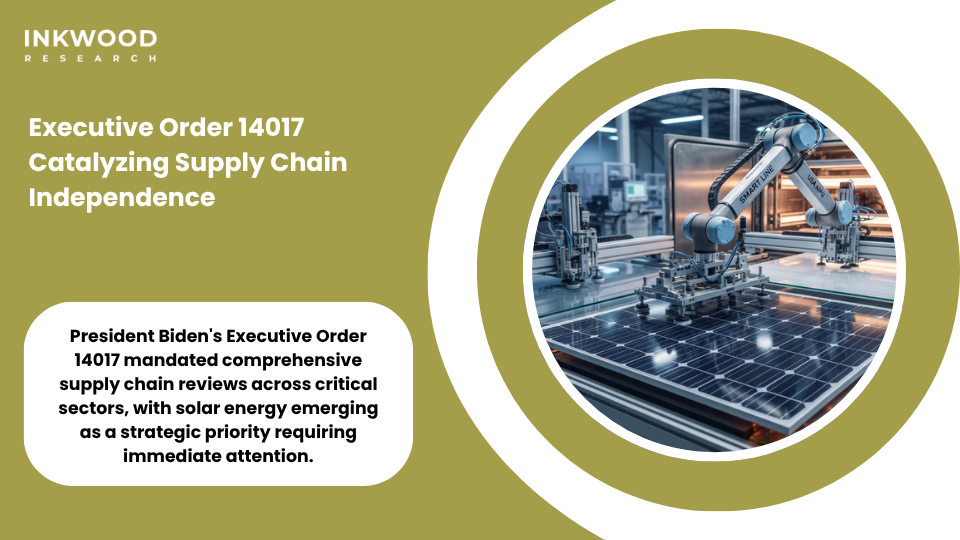
President Biden’s Executive Order 14017 mandated comprehensive supply chain reviews across critical sectors, with solar energy emerging as a strategic priority requiring immediate attention. According to the Department of Energy assessment, this initiative aims to build more secure and diverse energy supply chains through federal coordination that accelerates domestic production. Moreover, the strategy addresses economic security concerns alongside environmental objectives, creating a framework for reducing foreign dependencies while advancing renewable energy goals.
Strategic Framework for Solar Supply Chain Resilience
Further, the Executive Order established clear priorities that facilitate greater domestic production as the primary objective while accelerating clean energy deployment to support climate goals. Adequate supply diversity prevents single-source dependencies, while built-in redundancies protect against disruption scenarios. Also, safe digital networks secure intellectual property and operations, creating a comprehensive approach to supply chain security.
Department of Energy collaboration with the National Renewable Energy Laboratory provides technical expertise that identifies critical bottlenecks throughout the value chain. Moreover, their joint analysis developed roadmaps addressing manufacturing gaps systematically, with implementation timelines prioritizing components with the highest strategic importance. In this regard, solar encapsulation materials receive attention alongside upstream silicon production, ensuring comprehensive coverage of the entire manufacturing ecosystem.
Policy Mechanisms Enabling Manufacturing Transformation
Federal initiatives combine regulatory support with financial incentives, where tax credits reduce capital investment barriers for new facilities while loan guarantees lower financing costs for manufacturers. Aligning with this, procurement preferences favor domestically-produced components, while research funding accelerates technology development and process optimization. These complementary mechanisms create favorable conditions for industrial expansion across the solar value chain.
On the other hand, workforce development programs prepare skilled labor for manufacturing roles through educational partnerships that train technicians and engineers in photovoltaic production. Community colleges develop specialized curricula addressing industry needs, while veteran transition programs target solar manufacturing opportunities. In all, this comprehensive approach ensures workforce availability supports facility growth, with human capital constraints diminishing as programs mature.
Chinese Dominance and Strategic Vulnerability Assessment
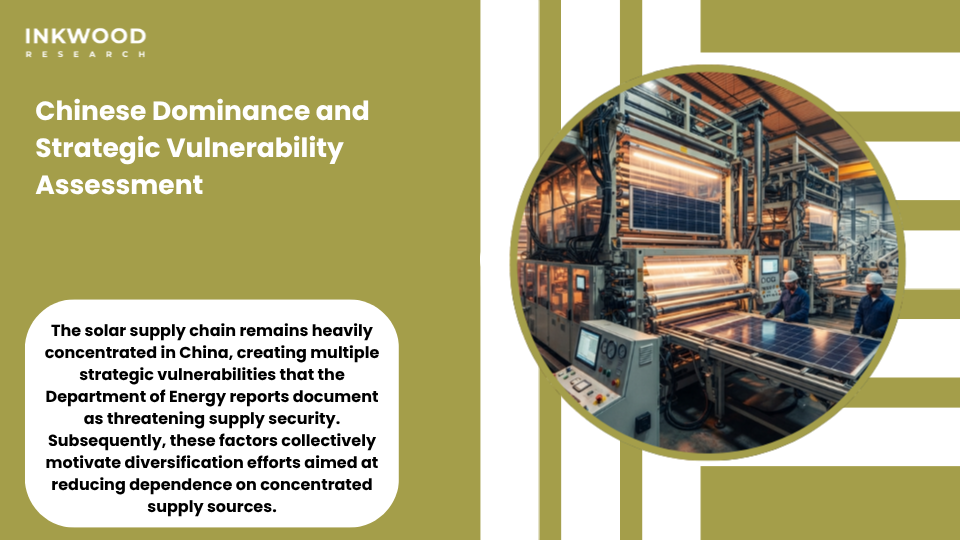
The solar supply chain remains heavily concentrated in China, creating multiple strategic vulnerabilities that the Department of Energy reports document as threatening supply security. Documented human rights violations complicate procurement decisions, while trade relationship unpredictability introduces business uncertainty. Subsequently, these factors collectively motivate diversification efforts aimed at reducing dependence on concentrated supply sources.
Quantifying Import Dependence Across the Value Chain
Chinese manufacturers dominate polysilicon production despite American technological leadership, with wafer manufacturing occurring almost exclusively in Asia. Accordingly, cell production similarly concentrates in Chinese facilities, while module assembly represents the only segment with significant U.S. capacity. Even domestic assemblers source components internationally, exposing multiple vulnerability points throughout this value chain structure.
Solar encapsulation materials face similar concentration risks as ethylene-vinyl acetate suppliers maintain strong Chinese market positions. Polyolefin elastomer production occurs primarily in Asia, while specialized additives and processing equipment come from limited sources. Plus, material supply disruptions could constrain U.S. manufacturing regardless of assembly capacity, making comprehensive reshoring necessary to address encapsulation materials specifically.
Geopolitical Risk Factors Influencing Supply Security
Trade tensions periodically disrupt material flows between nations, with tariff implementations creating cost uncertainty for importers. Also, export restrictions could theoretically constrain critical material availability, while shipping logistics face periodic disruptions from various causes. These vulnerabilities became apparent during recent supply chain disruptions, driving economic security concerns that motivate reshoring momentum.
Human rights considerations influence procurement decisions for conscientious buyers, as documented violations in supply regions create compliance challenges. Moreover, corporate responsibility commitments require supply chain transparency, leading some organizations to actively seek alternatives to problematic sources. This ethical dimension reinforces economic rationales for domestic manufacturing, where material suppliers demonstrating clean supply chains gain competitive advantages.
Polysilicon Production Resurgence Supporting Domestic Growth
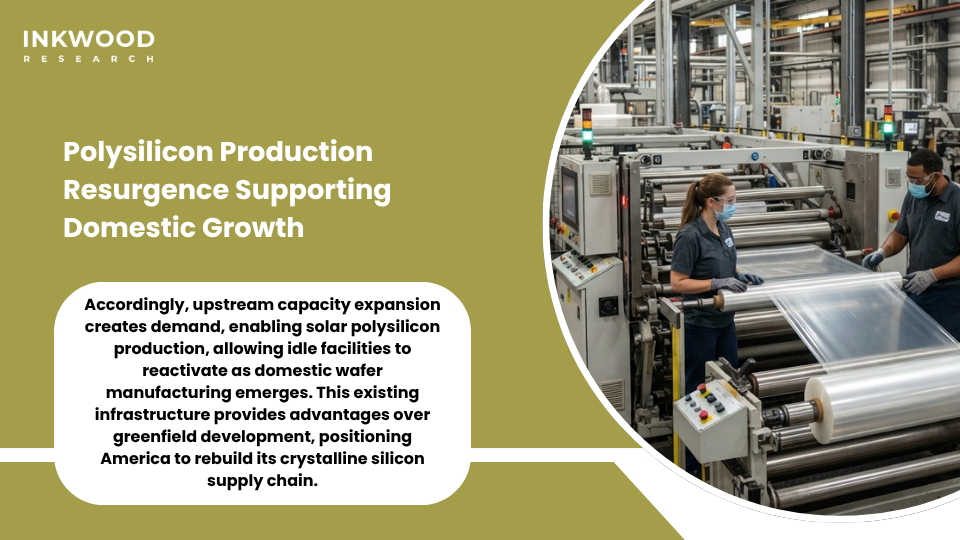
Existing American polysilicon facilities currently operate below capacity, with NREL analysis showing these plants supply other industries rather than photovoltaic manufacturers. Accordingly, upstream capacity expansion creates demand, enabling solar polysilicon production, allowing idle facilities to reactivate as domestic wafer manufacturing emerges. This existing infrastructure provides advantages over greenfield development, positioning America to rebuild its crystalline silicon supply chain.
American Polysilicon Technology and Cost Competitiveness
U.S. producers pioneered modern polysilicon manufacturing technologies that achieve high purity levels meeting stringent photovoltaic requirements. Aligning with this, energy-efficient Siemens and fluidized bed reactor processes minimize production costs, though Chinese producers undercut pricing through various competitive advantages. Federal support mechanisms aim to offset cost differentials, enabling American producers to compete effectively in global markets.
Environmental standards differ significantly between jurisdictions, with American facilities meeting strict emission controls and workplace safety requirements that increase regulatory compliance costs. Further, quality consistency and supply reliability provide value beyond pricing, as customers increasingly recognize the total cost of ownership rather than purchase price alone. These non-price factors help justify premium positioning for American polysilicon in conscientious market segments.
Upstream Integration Enabling Complete Domestic Supply Chains
Ingot and wafer production announcements signal growing domestic capacity, with several manufacturers committing to new facilities supporting crystalline silicon supply chains. These investments create demand for American polysilicon at meaningful volumes, making solar-grade production economically viable for existing facilities. Additionally, vertical integration strengthens overall supply chain resilience while reducing dependence on international suppliers.
Material quality traceability provides advantages in regulated markets where documented supply chains satisfy compliance requirements for government procurement. Accordingly, corporate sustainability commitments favor transparent sourcing, with American polysilicon offering verifiable production practices and labor standards. These non-price attributes support premium positioning that helps offset higher manufacturing costs in domestic operations.
Ohio’s Thin-Film Leadership Offering Alternative Pathways

Thin-film solar technologies provide alternatives to crystalline silicon supply chains, with Ohio hosting concentrated manufacturing capabilities in cadmium telluride modules. These facilities operate independently from Chinese component suppliers, offering strategic diversification according to Department of Energy assessments. Technology differences enable distinct material sourcing strategies that reduce overall supply chain vulnerability.
Cadmium Telluride Technology Advantages and Market Position
First Solar leads American thin-film manufacturing with substantial Ohio operations, where its cadmium telluride technology achieves competitive efficiency levels. Manufacturing costs reach parity with crystalline silicon through process optimization, while material requirements differ fundamentally from silicon-based approaches. Also, this technology independence reduces Chinese supply chain dependencies, creating a parallel pathway for American solar manufacturing.
Solar encapsulation requirements differ between thin-film and crystalline technologies, as cadmium telluride modules employ specialized barrier layers and edge sealing. Material suppliers developed formulations specifically for thin-film applications, creating separate supply chains that serve these distinct technology segments. Plus, Ohio’s concentration enables localized supply ecosystems supporting manufacturing operations through regional supplier networks.
Regional Industrial Clusters Supporting Manufacturing Excellence
Ohio’s manufacturing heritage provides a skilled workforce and supporting infrastructure, with glass suppliers, chemical companies, and equipment manufacturers clustering regionally. This industrial ecosystem reduces logistics costs and accelerates problem-solving, while universities contribute research expertise and graduate talent. Regional economic development agencies support expansion initiatives through various programs that attract and retain solar manufacturing operations.
Thin-film capacity expansion continues as demand grows, with recent announcements including additional production lines and facility enlargements. Federal incentives improve project economics, encouraging investment decisions, while long-term power purchase agreements provide revenue certainty. Subsequently, these factors combine to support Ohio’s position as America’s thin-film manufacturing center for the foreseeable future.
Federal Incentives Offsetting Manufacturing Cost Differentials
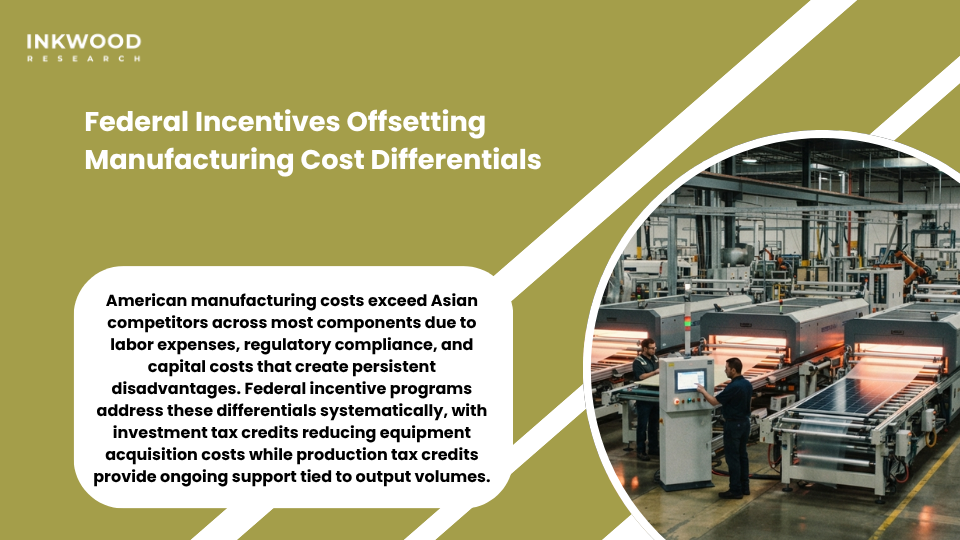
American manufacturing costs exceed Asian competitors across most components due to labor expenses, regulatory compliance, and capital costs that create persistent disadvantages. Federal incentive programs address these differentials systematically, with investment tax credits reducing equipment acquisition costs while production tax credits provide ongoing support tied to output volumes. Moreover, these mechanisms improve project economics significantly for domestic manufacturers.
Inflation Reduction Act Provisions Supporting Solar Manufacturing
Legislation includes specific provisions favoring domestic component manufacturing, with module producers receiving higher incentives when using American-made materials. This tiered structure creates demand pull for upstream suppliers, allowing solar encapsulation manufacturers to benefit when serving domestic module assembly. Additionally, material production becomes economically viable within the United States’ borders through this comprehensive incentive framework.
Advanced manufacturing production credits reward facility development across various components, including polysilicon, wafers, cells, and modules. Encapsulation materials receive recognition as critical enabling components, with investment criteria considering supply chain security alongside production volume. Plus, this comprehensive approach addresses bottlenecks systematically throughout the value chain rather than focusing narrowly on final module assembly.
Economic Development Incentives Complementing Federal Programs
State and local governments compete in attracting solar manufacturing facilities through tax abatements that reduce operational costs during the initial years. Infrastructure investments improve site accessibility and utility services, while workforce training programs prepare local talent for specialized roles. In all, these complementary incentives strengthen overall value propositions for manufacturers evaluating location decisions.
Site selection processes evaluate comprehensive cost structures beyond direct incentives, with proximity to customers reducing logistics expenses while energy costs influence competitiveness for energy-intensive processes. In addition, regulatory environments affect permitting timelines and ongoing compliance, meaning successful locations offer multiple advantages beyond financial subsidies alone.
Clean Energy Targets Driving Massive Capacity Expansion
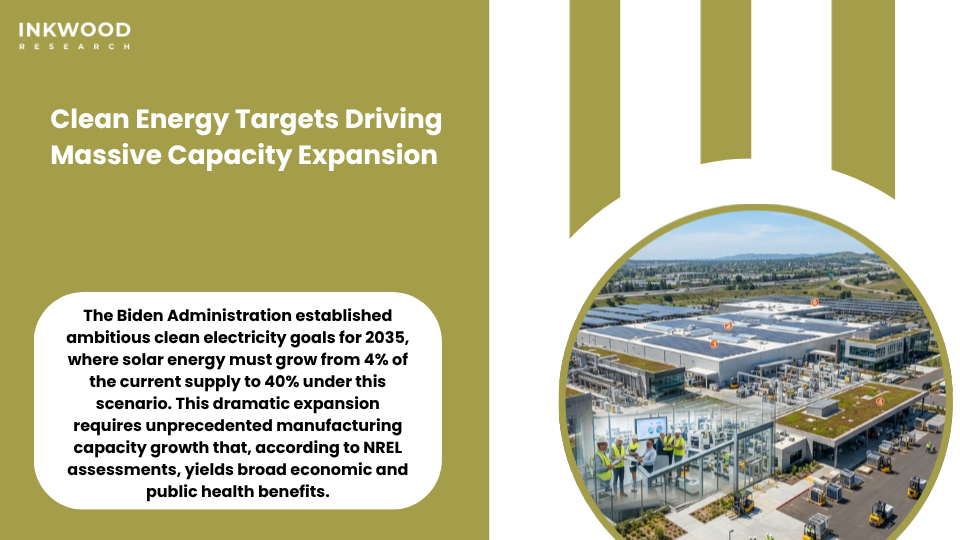
The Biden Administration established ambitious clean electricity goals for 2035, where solar energy must grow from 4% of the current supply to 40% under this scenario. This dramatic expansion requires unprecedented manufacturing capacity growth that, according to NREL assessments, yields broad economic and public health benefits. Furthermore, module demand increases correspondingly, driving component requirements, including solar encapsulation materials.
Installation Volume Requirements and Manufacturing Implications
Current annual installations must multiply several times to reach target deployment rates, with utility-scale projects dominating capacity additions, though distributed generation contributes meaningfully. Commercial and industrial installations provide stable demand independent of utility procurement, while residential solar continues to grow, supported by declining costs and financing availability. Consequently, all segments require reliable component supplies, including encapsulation materials, to sustain growth trajectories.
Supply chain capacity must scale proportionally with installation growth as module assembly facilities require corresponding upstream material availability. Solar encapsulation demand grows directly with module production volumes, meaning material suppliers face expansion imperatives matching customer requirements. Further, investment timing becomes critical in ensuring capacity availability when needed to avoid constraining overall industry growth.
Economic Activity and Workforce Development Benefits
Rapid solar expansion generates employment across construction and manufacturing sectors as installation jobs multiply with accelerating deployment. Manufacturing facilities create skilled positions with competitive compensation, while supply chain development supports additional indirect employment. Also, these economic benefits extend beyond environmental improvements to create tangible opportunities for American workers.
Public health improvements result from reduced fossil fuel combustion, with air quality benefits concentrating near retired coal facilities. Healthcare cost savings accrue from decreased respiratory illness, strengthening rationales for aggressive clean energy transitions. Furthermore, energy independence reduces geopolitical vulnerabilities associated with fuel imports, creating national security benefits alongside environmental and economic advantages.
Market Projections and Investment Landscape Analysis
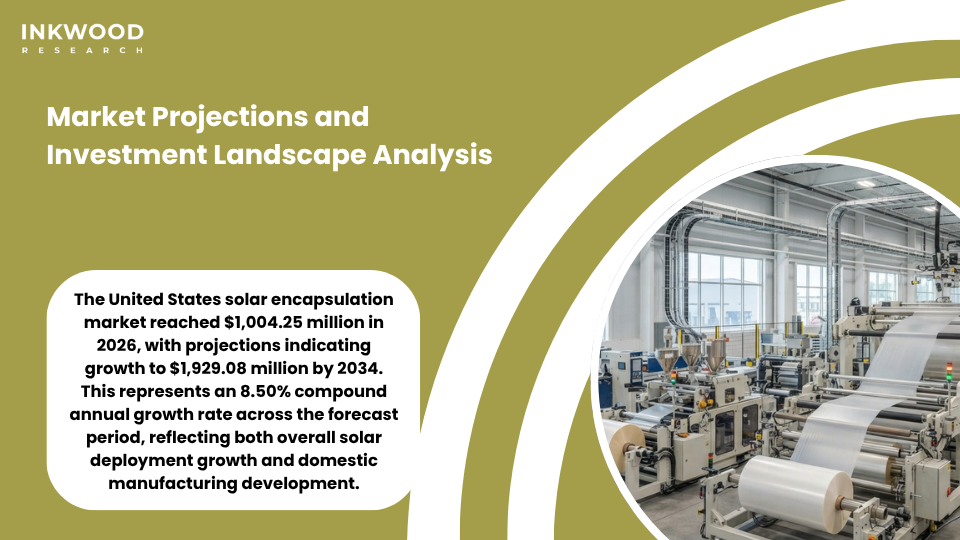
The United States solar encapsulation market reached $1,004.25 million in 2026, with projections indicating growth to $1,929.08 million by 2034. This represents an 8.50% compound annual growth rate across the forecast period, reflecting both overall solar deployment growth and domestic manufacturing development. Accordingly, material suppliers position strategically to capture this opportunity through facility investments and customer relationships.
Competitive Dynamics in Reshored Manufacturing Environment
Established international suppliers evaluate American production investments where proximity to customers provides logistics advantages and relationship benefits. Greenfield facilities require substantial capital commitments, leading some companies to pursue partnerships with existing chemical producers as alternative entry strategies. Additionally, joint ventures combine solar expertise with manufacturing capabilities, reducing investment requirements while accelerating market entry.
Domestic material suppliers expand offerings into solar encapsulation markets where their existing infrastructure reduces investment requirements compared to international competitors. Customer relationships and distribution networks provide market access, while technology licensing or development partnerships accelerate product commercialization. As a result, this domestic supplier engagement strengthens overall supply chain resilience by diversifying the supplier base.
Technology Development Priorities for Market Leadership
Advanced encapsulation materials offering superior performance command premium pricing as polyolefin elastomer adoption grows despite higher costs. Specialized formulations addressing specific failure mechanisms differentiate suppliers, while recycling capabilities become increasingly important as sustainability concerns mount. Plus, material innovation continues driving competitive advantage in an evolving market landscape.
Manufacturing process optimization reduces costs, improving competitiveness against imports through automation that minimizes labor differentials between regions. Energy efficiency lowers operational expenses in energy-intensive processes, while quality control systems reduce waste and rework. Hence, these continuous improvements gradually close cost gaps with offshore production, making domestic manufacturing increasingly viable.
Key Takeaways
- Executive Order 14017 catalyzed comprehensive solar supply chain transformation initiatives addressing Chinese dominance that creates strategic vulnerabilities. Polysilicon facilities can reactivate as upstream demand materializes from ingot and wafer capacity, while Ohio’s thin-film cluster provides alternative technology pathways independent from crystalline silicon supply chains.
- Federal incentives offset higher American manufacturing costs, enabling competitive operations as clean energy targets requiring 40% solar electricity by 2035 drive massive capacity expansion.
- The United States solar encapsulation market projects nearly doubling through 2034, with workforce development and economic activity accompanying manufacturing growth throughout the value chain.
- Material innovation continues advancing performance and sustainability as supply chain resilience benefits from diversified sourcing and domestic production. Investment opportunities span established suppliers and new market entrants, with strategic positioning requiring an understanding of policy incentives, technology trends, and competitive dynamics.
Conclusion
The United States solar encapsulation market undergoes a fundamental transformation driven by strategic imperatives, where supply chain security concerns motivate comprehensive reshoring initiatives. Federal policy provides financial mechanisms offsetting cost disadvantages, while clean energy targets create massive demand growth supporting manufacturing investments across the photovoltaic value chain.
Polysilicon production resurgence enables complete domestic crystalline silicon supply chains as Ohio’s thin-film leadership demonstrates alternative technology pathways. Multiple routes toward supply independence emerge simultaneously, with material suppliers capturing these opportunities positioned advantageously for long-term market leadership in renewable energy manufacturing.
Economic and workforce development benefits extend beyond environmental improvements as the manufacturing renaissance creates skilled employment and industrial capability. Public health improvements result from reduced fossil fuel dependence, while, based on our analysis, American solar encapsulation manufacturing enters a transformative growth phase, benefiting multiple stakeholder groups.
For organizations seeking deeper insights into U.S. solar manufacturing or supply chain strategies, Inkwood Research offers comprehensive market intelligence and consulting services. Contact our team to explore how these transformations align with your strategic objectives.
Frequently Asked Questions (FAQs)
Heavy reliance on Chinese solar supply chains raises concerns about potential supply disruptions, geopolitical risks, and strategic dependence on a single dominant manufacturing source.
Federal incentives such as investment tax credits and production tax credits reduce capital costs and support domestic manufacturing output under policies like the Inflation Reduction Act.
Ohio provides a skilled manufacturing workforce, strong industrial infrastructure, regional suppliers for materials, and research support from universities that strengthen thin-film solar production.
Thin-film solar manufacturing relies on different materials and supply chains than crystalline silicon, helping diversify production and reduce dependence on overseas suppliers.
State tax incentives, workforce development programs, and infrastructure support complement federal policies to attract solar manufacturing facilities.
Diversified supply chains reduce geopolitical risks, improve resilience against disruptions, and support long-term stability in renewable energy markets.