Table of Contents
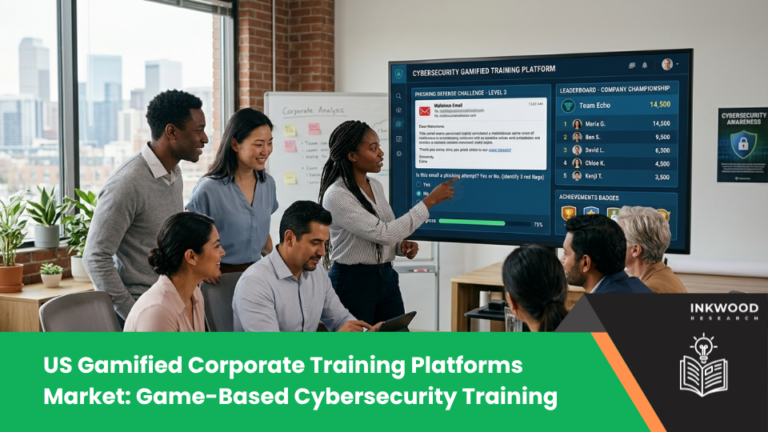
This analysis is brought to you by Inkwood Research, a leading market intelligence firm specializing in North American enterprise learning technology, cybersecurity workforce development, and gamified training platform ecosystems. Our research team combines deep expertise in U.S. corporate security awareness programs, gamified LMS deployment patterns, and the intersection of enterprise gamification and information security compliance. Through strategic partnerships with U.S. corporate training leaders, cybersecurity vendors, and HR technology analysts, we deliver actionable intelligence for enterprises navigating the United States gamified corporate training platforms market.
TLDR
Cybersecurity training in the U.S. has a well-documented engagement problem, and American companies are solving it with games. The United States gamified corporate training platforms market is seeing its fastest-growing segment in cybersecurity, where phishing simulations, security scenario challenges, and leaderboard-driven awareness modules are replacing annual compliance click-throughs. As breach costs rise and regulatory pressure intensifies, U.S. enterprises are discovering that making security training genuinely fun is not just a nice-to-have; it is a measurable risk reduction strategy.
This blog is directly relevant for Chief Information Security Officers, corporate security awareness program managers, and HR technology leaders in U.S. enterprises. Additionally, cybersecurity platform vendors, enterprise gamification market investors tracking the United States gamified corporate training platforms market, compliance officers, and enterprise buyers evaluating gamified learning platforms for businesses for security training will find targeted, evidence-grounded intelligence here.
Can Employees Actually Learn Cybersecurity Through Games?
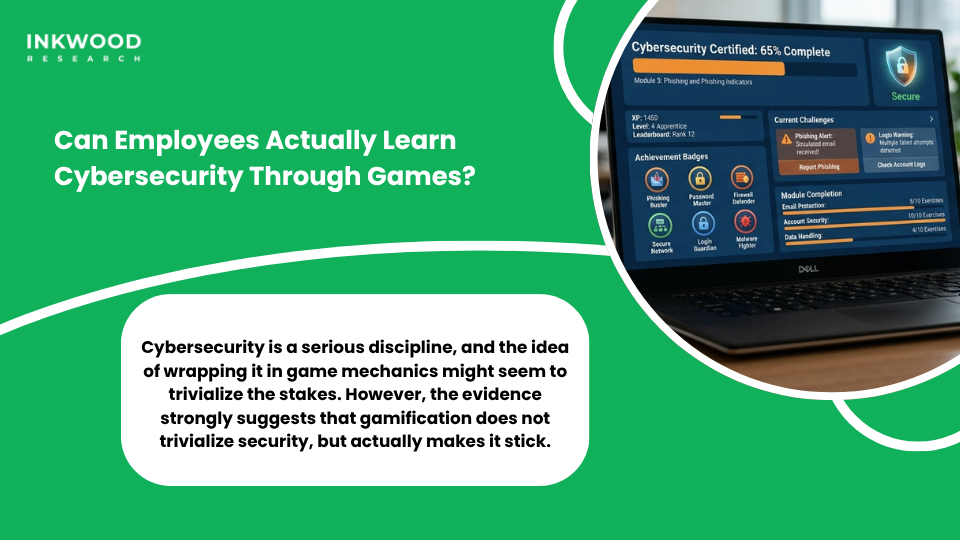
The skepticism is understandable. Cybersecurity is a serious discipline, and the idea of wrapping it in game mechanics might seem to trivialize the stakes. However, the evidence strongly suggests that gamification does not trivialize security, but actually makes it stick. The fundamental challenge with traditional cybersecurity training is not that employees are incapable; it is that passive, compliance-oriented formats fail to create the behavioral change that genuine security awareness requires.
Gamified approaches change this dynamic by shifting employees from passive receivers of information to active participants in security challenges. When an employee successfully identifies and reports a simulated phishing email and earns recognition on a company leaderboard, the behavioral reinforcement that follows is qualitatively different from having completed a click-through compliance module. Furthermore, the iterative nature of game-based learning, repeated challenges, adaptive difficulty, and immediate feedback mirrors exactly the kind of consistent behavioral reinforcement that security experts say is necessary to change employee habits over time.
The Science Behind Gamified Security Learning
The behavioral science underpinning gamified e-learning market applications in security training draws on well-established principles of operant conditioning and intrinsic motivation. Points, badges, and leaderboards activate reward systems that make employees more likely to engage voluntarily and return to training content repeatedly. Moreover, scenario-based gamified simulations, placing employees in realistic security decision contexts and scoring their choices, build the kind of experiential judgment that purely informational training cannot replicate.
According to the U.S. Cybersecurity and Infrastructure Security Agency (CISA), human error remains a leading factor in cybersecurity incidents, underscoring the critical importance of effective employee security training as a frontline defense strategy. This institutional perspective strengthens the case for investing in advanced gamified approaches that demonstrably change employee behavior beyond temporary compliance awareness.
Why Is the U.S. Cybersecurity Training Market Turning to Gamification?
Several structural forces are converging to make gamified cybersecurity training a strategic priority within the broader United States gamified corporate training platforms market. Understanding these drivers matters for both vendors positioning their solutions and enterprises evaluating their training investment.
First, the regulatory landscape has intensified significantly. Frameworks such as the NIST Cybersecurity Framework emphasize continuous employee awareness as a core element of organizational security posture. Demonstrating consistent, verifiable training completion across the workforce has become a compliance requirement in regulated industries, including finance, healthcare, and federal contracting. Consequently, enterprises need training approaches that achieve high engagement and completion rates reliably, and gamified platforms have demonstrated superior performance on both metrics compared to traditional alternatives.
The Cost of Human Error in U.S. Cybersecurity
The financial stakes make a compelling case for investing in more effective security training. The FBI’s Internet Crime Complaint Center (IC3) reported that U.S. businesses and individuals lost over $12.5 billion to cybercrime in 2023, with phishing and social engineering attacks among the most prevalent vectors. Because these attacks succeed primarily by exploiting human judgment failures rather than technical vulnerabilities, the quality of employee security training has a direct impact on an organization’s breach risk profile.
This reality has elevated security awareness from an HR compliance checkbox to a board-level risk management priority. As a result, U.S. enterprises are scrutinizing training effectiveness far more rigorously than they did even three years ago. The move toward gamification in corporate training market solutions for cybersecurity reflects this scrutiny; organizations want training that can demonstrate measurable behavior change, not just completion certificates.
How Are U.S. Companies Building Gamified Security Awareness Programs?
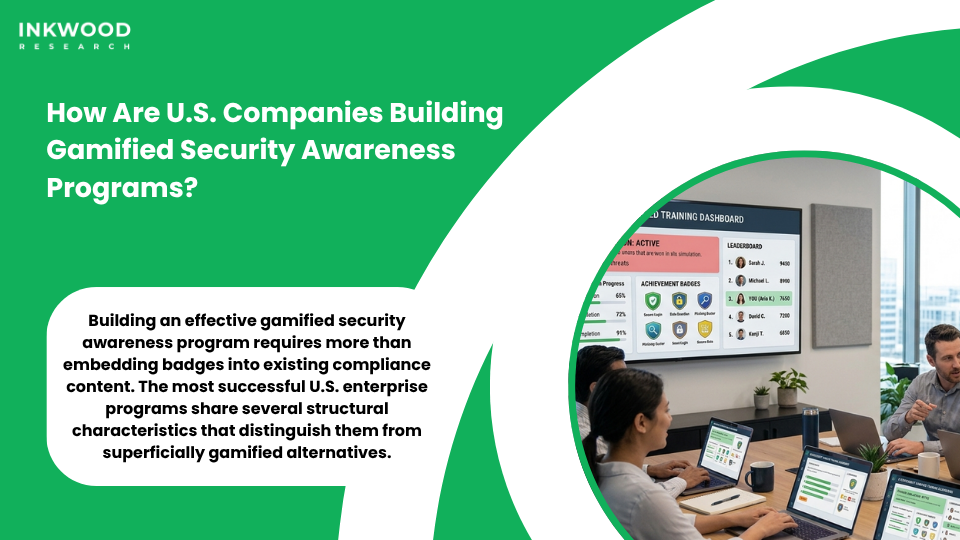
Building an effective gamified security awareness program requires more than embedding badges into existing compliance content. The most successful U.S. enterprise programs share several structural characteristics that distinguish them from superficially gamified alternatives.
A. Phishing Simulation as the Engagement Anchor
Simulated phishing campaigns remain the most widely deployed gamified security training mechanism in U.S. enterprises, and for good reason. When employees encounter a simulated phishing email, click on it, and are immediately redirected to a brief, engaging learning module that explains what they missed, the learning moment is immediate and contextually relevant. Moreover, tracking employee susceptibility rates over time and communicating improvement through internal communications gamifies the organizational security posture itself, making progress visible and motivating at both individual and team levels.
Advanced programs layer additional game mechanics on top of phishing simulations. Employees earn security reputation scores that accumulate across multiple training interactions. Teams compete in monthly security challenge tournaments. Department leaderboards create healthy competitive dynamics that drive voluntary engagement beyond mandatory participation minimums. These mechanics transform interactive learning systems from compliance tools into genuinely engaging workforce development programs.
B. Scenario-Based Security Challenges
Beyond phishing simulations, leading U.S. enterprises are deploying broader scenario-based gamified learning platforms for businesses that challenge employees to navigate realistic security decision points. These scenarios might include responding to a suspicious colleague request for account credentials, identifying unsafe shadow IT practices, or managing a mobile device in an unsecured environment. Each choice earns or deducts points, and explanations appear immediately after each decision, creating a continuous learning loop.
The corporate gamification software market has responded to this demand with increasingly sophisticated scenario engines that allow enterprise security teams to customize scenarios based on their specific threat landscape and compliance requirements. This customization capability is particularly valuable for regulated industries where security scenarios must reflect industry-specific risk contexts.
What Role Does the United States Gamified Corporate Training Platforms Market Play?

The United States gamified corporate training platforms market occupies a unique position globally, simultaneously representing the world’s largest enterprise gamification buyer and its most demanding. U.S. enterprises set the innovation agenda for the global market, driving platform vendors to continuously raise their capabilities in personalization, analytics, and content sophistication.
Several factors make the U.S. market particularly significant. The country’s large enterprise sector, deep corporate training investment culture, and stringent regulatory environment in industries like finance, healthcare, and defense collectively create a high-volume, high-complexity demand profile that shapes global platform development. Additionally, U.S. enterprises’ willingness to adopt emerging technologies early, AI personalization, immersive VR training, and conversational AI coaching, makes the market a proving ground for innovations that subsequently spread globally.
Integration with Broader Workforce Training Technology
Within the U.S. enterprise context, gamified cybersecurity training is increasingly integrated into broader workforce training technology architectures. Rather than existing as standalone security awareness tools, leading platforms are connecting with enterprise SIEM systems, HR platforms, and learning management systems to create unified employee risk and development profiles. This integration enables security teams to correlate training performance data with actual security incident patterns, creating evidence-based feedback loops that continuously improve program design.
Furthermore, the emergence of digital learning platforms that unify security training with technical skills development and compliance training is streamlining the enterprise training landscape. Employees benefit from cohesive learning experiences rather than fragmented point solutions, while L&D and security teams gain consolidated analytics that demonstrate program-wide impact. The enterprise gamification market in the U.S. is consequently evolving from a collection of specialized tools into an integrated ecosystem.
Which Companies Are Leading Gamified Cybersecurity Training in the U.S.?
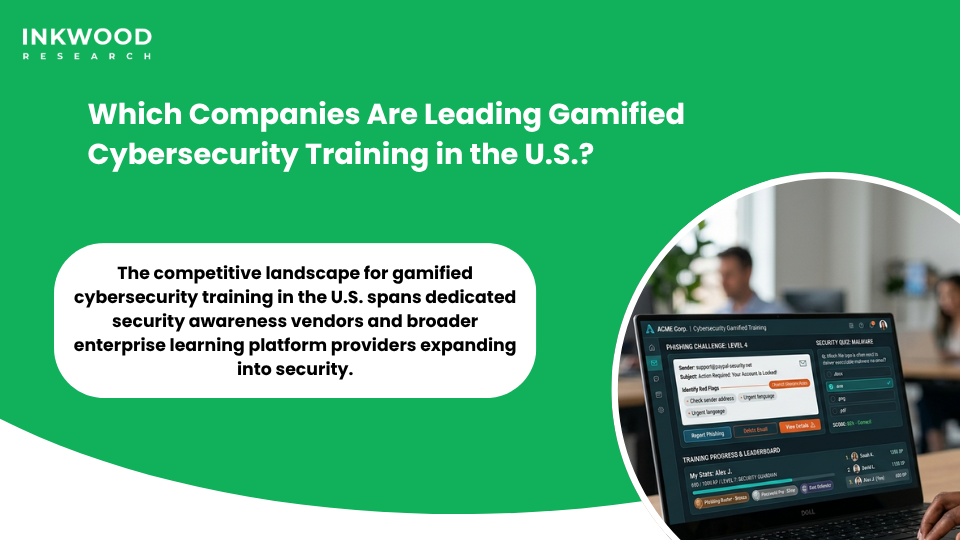
The competitive landscape for gamified cybersecurity training in the U.S. spans dedicated security awareness vendors and broader enterprise learning platform providers expanding into security. Each brings distinct capabilities to the gamified corporate training market.
KnowBe4
KnowBe4 is the dominant force in the U.S. security awareness training market, with a platform that deeply integrates phishing simulation, gamified training modules, and advanced behavioral analytics. The company’s launch of its AIDA (Artificial Intelligence Driven Agent) capability introduced AI-powered adaptive phishing campaigns that adjust in real time to individual employee behavior profiles, making its gamified training significantly more personalized. Furthermore, KnowBe4’s extensive gamified content library, spanning compliance, security awareness, and role-specific training, gives it the broadest addressable use case coverage among gamified employee training platforms focused on security.
Proofpoint Security Awareness Training
Proofpoint brings its threat intelligence capabilities to bear on security awareness, enabling gamified training that reflects real-world threat patterns relevant to each organization. The platform’s recent updates expanded its gamified content format options, including interactive video scenarios and challenge-based assessments, improving engagement across different learning style preferences. Moreover, Proofpoint’s integration with its broader email security platform creates a closed loop between detected threats and training triggers, automatically targeting employees who exhibit risky behaviors with relevant gamified training content.
Immersive Labs
Immersive Labs has carved out a distinctive position in the United States gamified corporate training platforms market by focusing on technical security team development alongside broader employee awareness. Its hands-on, lab-based gamified challenges for security professionals are particularly valued by U.S. enterprises seeking to develop internal cyber defense capabilities. The platform’s crisis simulation exercises, in which security teams work through gamified incident response scenarios, address a capability gap that traditional training formats struggle to fill.
Terranova Security
Terranova Security, which operates within the corporate gamification software market through its partnership with Microsoft, has leveraged its integration with Microsoft 365 security features to deliver contextually relevant gamified training within the tools employees already use daily. This native integration approach reduces friction for both employees and administrators, making gamified security training feel like a natural part of the work environment rather than an interruption to it.
What Are the Latest Innovations in Gamified Security Training Platforms?

The past year has brought a significant wave of platform innovation that is raising the ceiling for what gamified cybersecurity training can achieve in U.S. enterprises. Generative AI is transforming content creation for gamified security training. Platforms are now enabling security teams to generate custom phishing simulation templates, scenario scripts, and training narratives using AI tools.
Moreover, this dramatically reduces the time and expertise required to maintain fresh, relevant training content. This development is particularly impactful because training effectiveness decays when employees see repetitive content, and AI-generated variation keeps the gamified experience novel and challenging.
Immersive VR Security Simulations
- VR-based security training is moving from pilot programs into mainstream enterprise deployment among leading U.S. organizations.
- Immersive simulations that place employees inside a realistic virtual office environment, where they must identify and respond to social engineering attempts, physical security threats, and digital manipulation scenarios, are showing notably stronger retention outcomes than screen-based alternatives.
- Moreover, the gamified scoring and replay mechanics native to VR security simulations create high engagement levels, with employees voluntarily returning to improve their scores.
Behavioral Risk Scoring and Predictive Analytics
- Perhaps the most consequential recent development is the emergence of continuous behavioral risk scoring within gamified security platforms.
- Rather than measuring training completion, advanced enterprise LMS platforms now track employee security behavior across training and actual work contexts, generating dynamic risk scores that identify individuals or teams most likely to represent security vulnerabilities.
- This predictive capability transforms gamified training from a periodic event into a continuous, adaptive risk management system, directly strengthening organizational security posture across the gamification in corporate training industry outlook.
Key Takeaways
- The United States gamified corporate training platforms market is experiencing its fastest growth in cybersecurity, driven by regulatory pressure, rising breach costs, and the demonstrated behavioral effectiveness of gamified security training.
- The FBI IC3 reported over $12.5 billion in U.S. cybercrime losses in 2023, with human error as a primary vector, directly strengthening the investment case for advanced gamified security awareness programs.
- Phishing simulations, scenario-based security challenges, and behavioral risk scoring are the three most effective gamified mechanics currently deployed across U.S. enterprise security training programs.
- KnowBe4, Proofpoint, Immersive Labs, and Terranova Security are leading the competitive landscape with AI personalization, threat intelligence integration, and immersive VR capabilities.
- CISA’s emphasis on human-centered security resilience reinforces institutional support for gamified approaches to employee cybersecurity training as a frontline defense strategy.
- Generative AI, continuous behavioral risk scoring, and VR simulation are the most transformative emerging technologies reshaping the United States gamified corporate training platforms market for security applications.
Conclusion
The United States gamified corporate training platforms market is proving that turning security lessons into engaging games is not a compromise on rigor; it is an upgrade. As cyber threats grow more sophisticated and human judgment remains the most exploitable vulnerability, the quality of security awareness training has become a genuine strategic differentiator. Organizations that invest in advanced gamified cybersecurity platforms will build more resilient workforces, reduce breach risk, and satisfy increasingly demanding regulatory requirements.
Inkwood Research delivers the intelligence and strategic analysis needed to navigate the enterprise gamification market with confidence.
Connect with our team to explore how our perspective can support your security training investment decisions.
Frequently Asked Questions (FAQs)
Gamified cybersecurity training consistently outperforms traditional formats on engagement, completion rates, and measurable behavior change, particularly for phishing resistance.
The U.S. market’s size, regulatory complexity, and early technology adoption culture make it the global innovation leader in enterprise gamification for security training.
Gamified programs change employee security behaviors through repeated, reward-based reinforcement, directly reducing susceptibility to phishing and social engineering attacks.
Financial services, healthcare, government contracting, and technology sectors lead U.S. enterprise adoption of gamified cybersecurity training platforms.
Behavioral risk scoring continuously measures employee security behaviors across training and work contexts, identifying high-risk individuals for targeted gamified interventions.
Generative AI enables rapid creation of customized phishing simulations and security scenarios, keeping gamified training content fresh and continuously relevant to evolving threats.