Table of Contents
This analysis is brought to you by Inkwood Research, a leading market intelligence firm specializing in renewable energy transformation, clean hydrogen technologies, and sustainable power infrastructure. Our research team combines extensive experience analyzing electrolyzer manufacturing, green hydrogen production pathways, and renewable energy integration across global markets. Based on our proprietary research methodologies and strategic partnerships with energy producers, technology developers, and government agencies, we deliver actionable insights that empower strategic decision-making for enterprises navigating the global green hydrogen revolution.
TLDR
The global green hydrogen market reaches US$11.80 billion in 2026, expanding to US$227.45 billion by 2034 at 44.75% CAGR. Major projects leverage renewable energy integration through advanced PEM electrolysis and alkaline electrolysis technologies. Air Liquide and Siemens Energy pioneer industrial green hydrogen production combining solar and wind power with innovative electrolyzer systems. Meanwhile, wind energy, green hydrogen initiatives, and grid injection capabilities enable large-scale renewable source deployment, transforming how industries approach decarbonization through hydrogen energy solutions worldwide.
Energy investors evaluating hydrogen market opportunities, renewable energy executives planning integration strategies, technology providers developing electrolysis systems, government officials designing clean energy policies, industrial manufacturers seeking decarbonization pathways, infrastructure developers building hydrogen networks, and financial analysts tracking renewable energy investments will gain comprehensive insights into transformative projects reshaping global energy landscapes through strategic green hydrogen deployment and innovative renewable source technologies.
Global Green Hydrogen Market Analysis
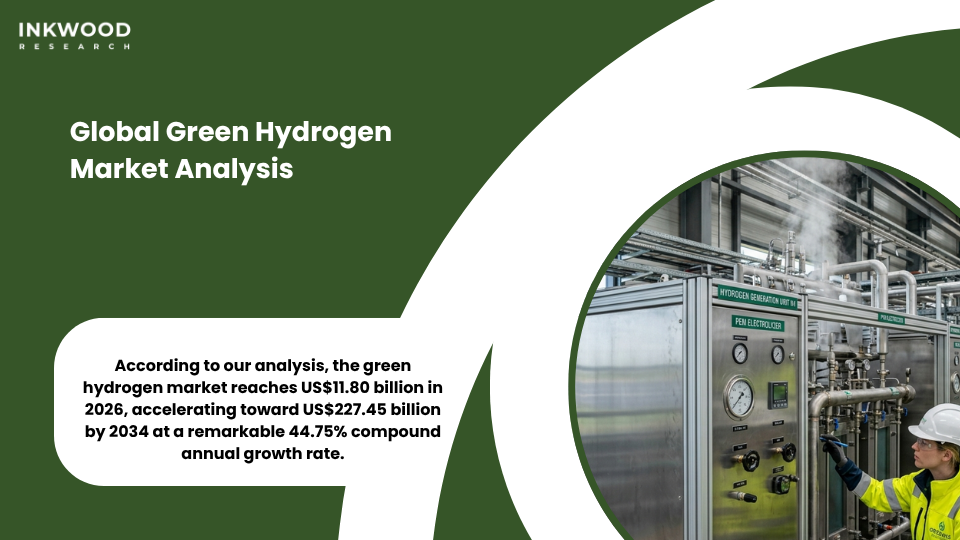
The global green hydrogen market transforms energy landscapes as unprecedented investments flow into innovative projects worldwide. According to our analysis, the green hydrogen market reaches US$11.80 billion in 2026, accelerating toward US$227.45 billion by 2034 at a remarkable 44.75% compound annual growth rate. These developments reflect how renewable energy integration drives transformation across industrial sectors. Moreover, companies like Air Liquide and Siemens Energy pioneer advanced PEM electrolysis and alkaline electrolysis technologies that enable large-scale hydrogen energy production from renewable source power generation systems.
Investors increasingly recognize how green hydrogen projects offer compelling returns while advancing decarbonization objectives. Subsequently, capital allocation strategies shift toward ventures combining proven technologies with scalable infrastructure. These initiatives leverage solar and wind power resources to produce clean hydrogen through efficient electrolysis processes. Furthermore, grid injection capabilities allow surplus renewable energy storage, addressing intermittency challenges that have long plagued sustainable power generation.
Ten flagship projects capture global attention through their ambitious scale and innovative approaches. Each initiative demonstrates unique technological solutions tailored to regional resource availability and market demands. Consequently, these developments create blueprints for future hydrogen economy expansion across diverse geographical and industrial contexts.
Understanding the Global Green Hydrogen Market Momentum
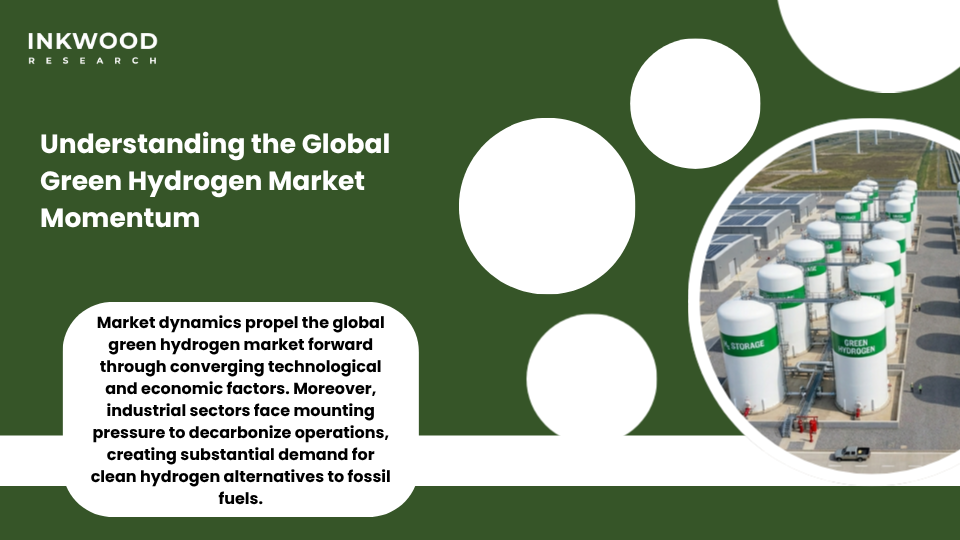
Market dynamics propel the global green hydrogen market forward through converging technological and economic factors. Production costs decline as electrolyzer manufacturing scales and renewable electricity prices drop. Additionally, policy frameworks worldwide establish supportive regulatory environments encouraging private investment. Moreover, industrial sectors face mounting pressure to decarbonize operations, creating substantial demand for clean hydrogen alternatives to fossil fuels.
Technology Advancements Driving Market Growth
Electrolyzer technologies evolve rapidly, improving efficiency while reducing capital requirements. PEM electrolysis systems demonstrate particular advantages for renewable energy integration due to their operational flexibility. These systems respond quickly to variable power inputs from solar and wind installations. Meanwhile, alkaline electrolysis offers proven reliability at scale with lower equipment costs for steady-state operations.
Manufacturing innovations enable gigawatt-scale production facilities that dramatically reduce per-unit costs. Aligning with this, Air Liquide and Siemens Energy established a joint venture producing electrolyzer components at unprecedented volumes. Their Berlin facility ramps toward three gigawatts of annual capacity, transforming hydrogen production economics. Consequently, project developers access cost-effective equipment supporting larger installations than previously feasible.
Investment Patterns Reshaping Energy Portfolios
Financial institutions recognize green hydrogen as essential for achieving net-zero emissions targets across portfolios. Institutional investors allocate billions toward projects demonstrating clear pathways to profitability. Furthermore, government funding programs reduce early-stage risks, encouraging private capital deployment at commercial scales. This blended finance approach accelerates project development timelines significantly.
Based on our research, strategic partnerships between technology providers and industrial consumers create stable revenue streams. Long-term offtake agreements provide certainty that attracts debt financing for capital-intensive infrastructure. Similarly, vertically integrated projects combining production, storage, and end-use applications optimize returns while minimizing market exposure risks.
NEOM: The World’s Largest Renewable Energy Hydrogen Facility
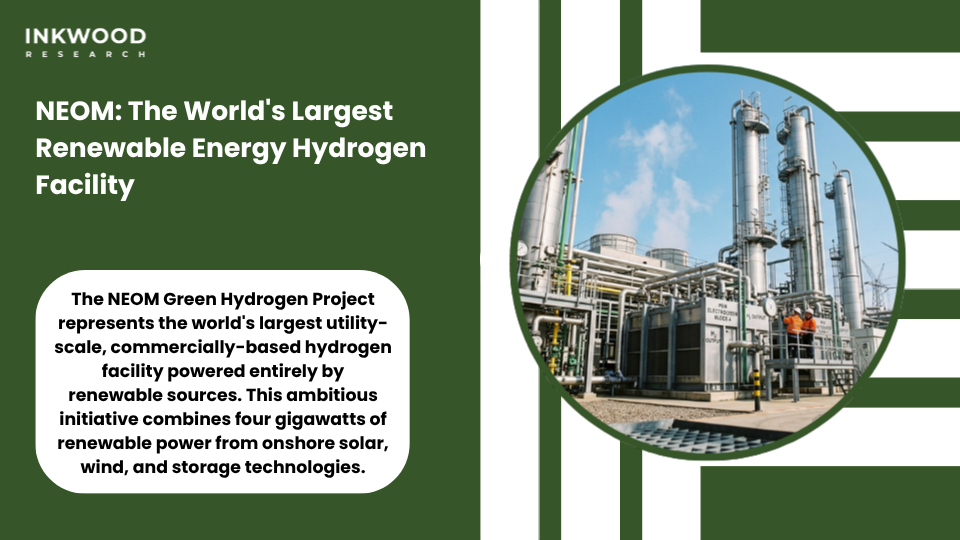
The NEOM Green Hydrogen Project represents the world’s largest utility-scale, commercially-based hydrogen facility powered entirely by renewable sources. This ambitious initiative combines four gigawatts of renewable power from onshore solar, wind, and storage technologies. When commissioned in 2027, the facility will produce 600 tonnes daily of clean hydrogen through advanced electrolysis systems utilizing ThyssenKrupp technology.
An equal joint venture between NEOM, Air Products, and ACWA Power brings together world-class expertise across energy production and industrial gases. The project integrates proven technologies while pioneering new approaches to large-scale hydrogen manufacturing. Additionally, nitrogen production through air separation supports downstream ammonia synthesis processes.
Environmental Impact and Carbon Mitigation
Upon completion, NEOM will produce up to 1.2 million tonnes annually of green ammonia for global export markets. This output mitigates the impact of 5 million metric tonnes of carbon emissions yearly. Such a scale demonstrates how industrial green hydrogen applications can meaningfully contribute toward climate objectives while building economically viable businesses.
The facility’s renewable energy integration strategy addresses intermittency through sophisticated storage systems. Battery installations smooth power delivery to electrolyzers, maintaining steady production rates despite variable solar and wind generation. Consequently, the project achieves high capacity utilization factors that improve overall economics and return on investment metrics.
Air Liquide and Siemens Energy: Revolutionizing PEM Electrolysis
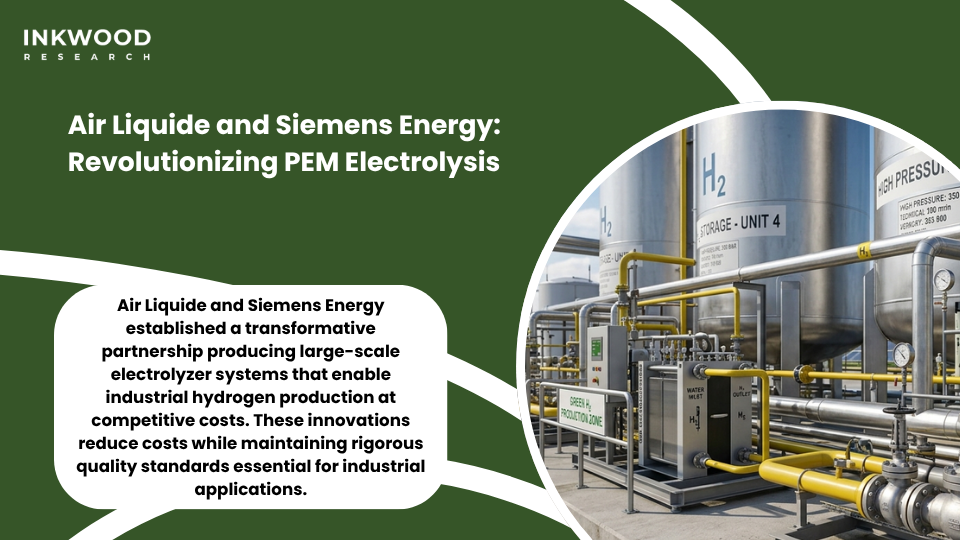
Air Liquide and Siemens Energy established a transformative partnership producing large-scale electrolyzer systems that enable industrial hydrogen production at competitive costs. Their Berlin gigafactory represents a crucial milestone in scaling clean energy technologies. The initial capacity of one gigawatt annually expands toward three gigawatts by 2025, supporting projects worldwide.
This strategic collaboration combines Air Liquide’s hydrogen value chain expertise with Siemens Energy’s electrolyzer technology leadership. The partners developed automated manufacturing processes using robotics for PEM stack production. These innovations reduce costs while maintaining rigorous quality standards essential for industrial applications.
Normand’Hy Project Demonstrates Commercial Viability
The Normand’Hy facility in Port-Jérôme, France, showcases partnership capabilities through a 200-megawatt electrolyzer installation. Operations beginning in 2026 will produce 28,000 tonnes annually of renewable hydrogen for industry and mobility sectors. This project avoids 250,000 tonnes of carbon dioxide emissions yearly while serving diverse market segments.
Approximately one-quarter of production supplies transport refueling stations along the Seine Axis, powering up to 500 hydrogen trucks. Meanwhile, industrial customers receive reliable supplies for manufacturing processes requiring high-purity hydrogen. This dual-market approach enhances project economics through diversified revenue streams and reduced concentration risks.
Western Green Energy Hub and Australia’s Hydrogen Vision
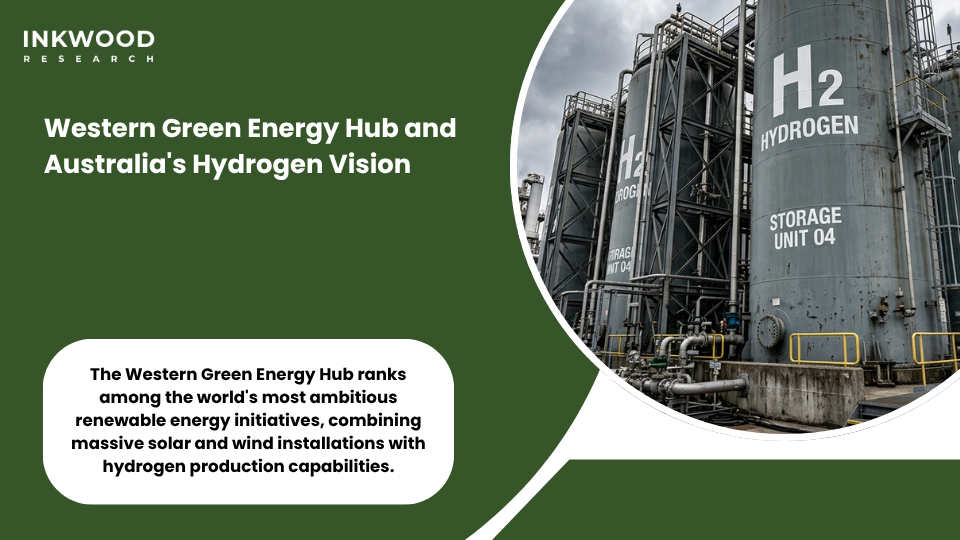
The Western Green Energy Hub ranks among the world’s most ambitious renewable energy initiatives, combining massive solar and wind installations with hydrogen production capabilities. Located in Western Australia, the project capitalizes on exceptional renewable resources across vast land areas. This geography provides ideal conditions for large-scale clean energy generation and hydrogen export operations.
Developers plan the integration of wind energy green hydrogen systems producing millions of tonnes annually for domestic use and international markets. The initiative addresses growing demand from Asian economies seeking clean fuel alternatives. Furthermore, Australia’s strategic location enables cost-effective shipping to key consumption centers across the Indo-Pacific region.
Additional Major Projects Advancing the Global Green Hydrogen Market
Several other initiatives demonstrate the breadth of global green hydrogen market development.
- CWPG AMAN in Mauritania combines solar and wind power for hydrogen and ammonia production.
- The AREH project in Australia focuses on renewable energy integration, supporting domestic and export markets.
- BrintØ Island in Denmark pioneers offshore wind-to-hydrogen concepts.
- Aqua Ventus off Maine’s coast explores floating wind technology paired with electrolysis systems.
- India’s Pudimadaka Hub leverages coastal locations for hydrogen production and maritime transport.
- Project Nour in Egypt combines abundant solar resources with strategic Suez Canal access.
- China’s Ningxia Baofeng and Xinjiang projects utilize renewable power for industrial applications at massive scales.
Wind Energy Green Hydrogen Projects Across Continents
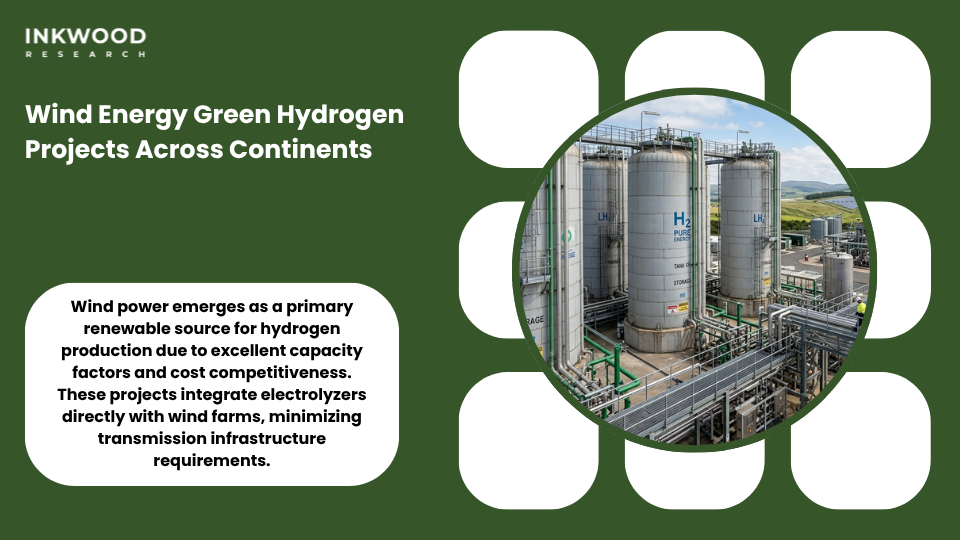
Wind power emerges as a primary renewable source for hydrogen production due to excellent capacity factors and cost competitiveness. Offshore wind installations particularly suit hydrogen applications through their steady generation profiles and proximity to coastal industrial clusters. These projects integrate electrolyzers directly with wind farms, minimizing transmission infrastructure requirements.
Furthermore, Denmark leads wind energy and green hydrogen development through innovative project designs. BrintØ Island proposes an artificial energy hub in the North Sea combining multiple gigawatts of offshore wind with electrolysis facilities. This concept enables large-scale hydrogen production while avoiding land-use conflicts that challenge onshore developments.
Floating Wind Technology Opens New Possibilities
Floating wind turbines access deeper waters with superior wind resources unavailable to fixed-bottom installations. Aqua Ventus demonstrates this technology offshore Maine, combining floating platforms with hydrogen production systems. The project addresses unique engineering challenges while proving commercial viability for similar initiatives worldwide.
These developments unlock vast ocean areas previously unsuitable for energy generation. Consequently, hydrogen production potential expands dramatically beyond traditional offshore wind zones. This technological progress supports ambitious national and regional hydrogen strategies requiring massive clean fuel supplies.
Industrial Green Hydrogen Applications in Manufacturing
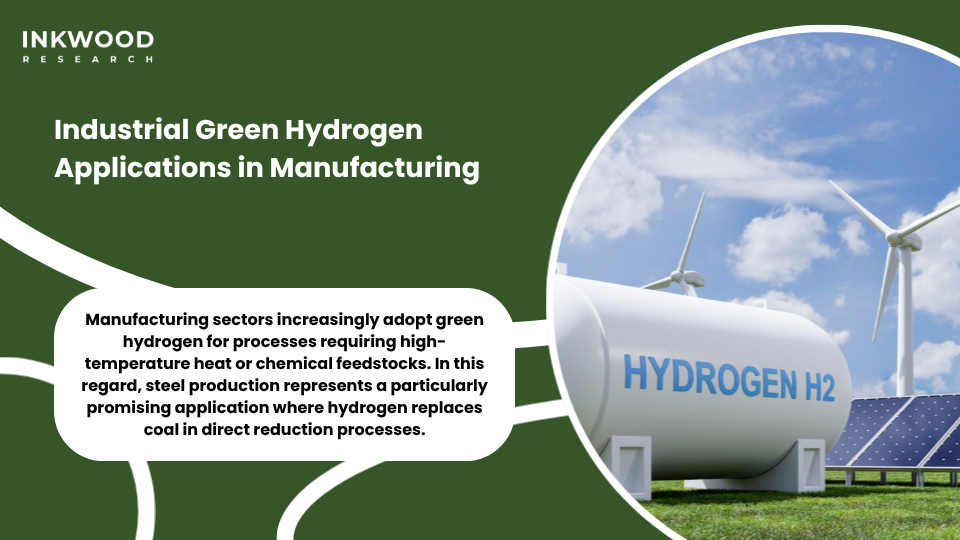
Manufacturing sectors increasingly adopt green hydrogen for processes requiring high-temperature heat or chemical feedstocks. In this regard, steel production represents a particularly promising application where hydrogen replaces coal in direct reduction processes. This substitution eliminates massive carbon dioxide emissions while maintaining product quality and production rates.
Chemical industries utilize hydrogen as a fundamental building block for numerous products, including ammonia, methanol, and synthetic fuels. Currently, most hydrogen comes from natural gas reforming with significant emissions. Transitioning to green hydrogen produced through renewable-powered electrolysis eliminates these carbon footprints while creating identical molecules.
Refining and Petrochemical Sector Transformation
Petroleum refineries consume enormous hydrogen volumes for upgrading crude oil into transportation fuels. These facilities represent major near-term markets for green hydrogen as companies face pressure to reduce operational emissions. Moreover, existing infrastructure enables relatively straightforward transitions from grey to green hydrogen supplies.
Based on our findings, several refineries already implement green hydrogen blending strategies. Initial projects demonstrate technical feasibility while establishing supply chains and commercial relationships. These early adoptions pave the way for broader industrial sector transformation as production scales and costs decline further.
Grid Injection Technologies Enabling Renewable Energy Integration
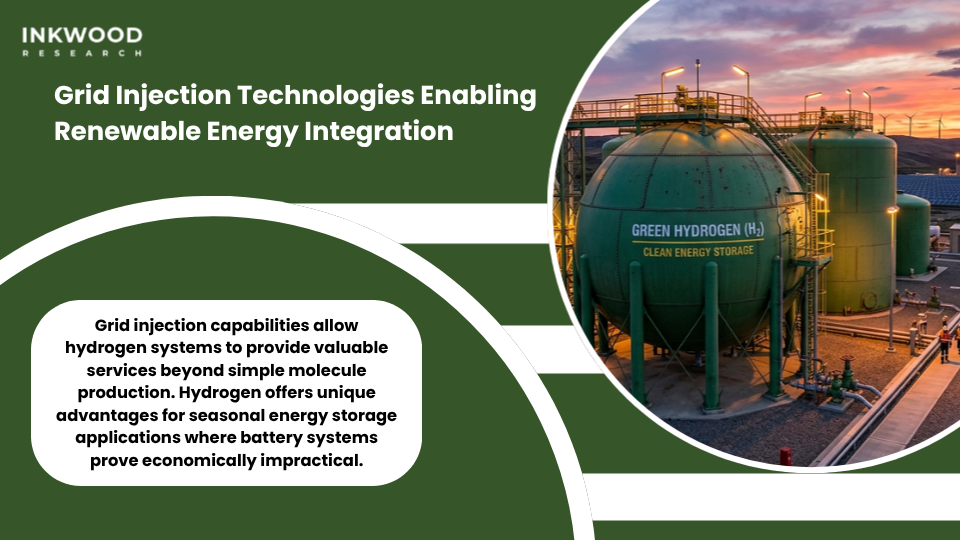
Grid injection capabilities allow hydrogen systems to provide valuable services beyond simple molecule production. Electrolyzers can absorb excess renewable generation during periods of high solar and wind output. This flexibility helps balance power systems while avoiding curtailment of clean electricity.
Conversely, stored hydrogen enables power generation during periods when renewable output drops below demand. Fuel cells or hydrogen turbines convert stored energy back to electricity, providing dispatchable capacity that complements variable renewable sources. This bidirectional capability enhances overall grid reliability while maximizing renewable energy utilization.
Seasonal Storage Addressing Long-Duration Needs
Hydrogen offers unique advantages for seasonal energy storage applications where battery systems prove economically impractical. Large underground storage facilities can hold massive energy quantities over months, addressing seasonal mismatches between renewable generation and demand patterns. Furthermore, these capabilities become increasingly important as grids transition toward predominantly renewable power sources.
Salt caverns provide particularly cost-effective storage solutions due to their enormous volumes and proven safety records. Several projects develop these formations specifically for hydrogen storage, supporting renewable energy integration strategies. Consequently, regions with suitable geology gain strategic advantages in deploying high-renewable power systems.
Key Takeaways
- The global green hydrogen market expands at 44.75% annually, reaching US$227.45 billion by 2034 as investments accelerate across major projects worldwide.
- NEOM’s facility will produce 600 tonnes daily when operational in 2027, mitigating 5 million metric tonnes of annual carbon emissions. Air Liquide and Siemens Energy’s Berlin gigafactory scales toward three gigawatts of annual electrolyzer production capacity by 2025.
- Ten flagship projects demonstrate diverse approaches combining solar and wind power with advanced electrolysis technologies. Western Green Energy Hub and Australia’s initiatives leverage exceptional renewable resources for domestic and export markets.
- Wind energy green hydrogen projects across continents prove technical viability while establishing commercial pathways.
- Industrial applications in steel, chemicals, and refining create substantial near-term demand for green hydrogen.
- Grid injection capabilities enhance renewable energy integration through flexible electrolyzer operations and hydrogen storage. These developments establish foundations for comprehensive hydrogen economies supporting decarbonization objectives across multiple sectors simultaneously.
Conclusion
According to our analysis, the global green hydrogen market transformation accelerates as major projects move from planning to operational phases. Technologies mature while costs decline, creating increasingly favorable economics for clean hydrogen production. Strategic partnerships between energy companies and technology providers enable rapid scaling of manufacturing capabilities.
These ten projects establish blueprints for future hydrogen economy development across diverse contexts. Each initiative demonstrates unique solutions addressing regional resources, market demands, and infrastructure constraints. Moreover, lessons learned through these implementations inform subsequent projects, accelerating overall sector maturation.
Furthermore, the coming years will prove critical as these facilities commence operations and validate technical and commercial assumptions. Success will catalyze additional investments while failures provide valuable learning opportunities. Ultimately, this pioneering generation of projects determines hydrogen’s role in global energy transformation toward sustainable, low-carbon systems.
Frequently Asked Questions (FAQs)
Green hydrogen is produced through water electrolysis powered by renewable energy such as solar and wind, generating zero direct carbon emissions unlike grey hydrogen from natural gas or blue hydrogen with carbon capture
PEM electrolysis enables flexible operation with variable renewable energy integration and fast response times, while alkaline electrolysis offers lower capital costs and proven performance for large scale steady state hydrogen production
Green hydrogen investments benefit from clean energy demand growth, government incentives, falling electrolyzer costs, carbon pricing mechanisms, and long term offtake agreements supporting stable and sustainable returns
Green hydrogen is used in ammonia production, green steel manufacturing, refinery decarbonization, heavy transport fuel, energy storage, and power grid balancing to support industrial and mobility sector decarbonization
Green hydrogen can be stored as compressed gas, liquefied hydrogen, or converted into ammonia or synthetic fuels, enabling pipeline transport, shipping, and long distance energy trade
Key challenges include high electrolyzer capital costs, renewable electricity availability, infrastructure gaps, hydrogen storage limitations, regulatory uncertainty, and the need for supportive policy frameworks