Table of Contents
This analysis is brought to you by Inkwood Research, a leading market intelligence firm specialising in Southeast Asian healthcare markets, oncology diagnostic imaging, and ultrasound technology ecosystems. Our research team combines extensive knowledge of Thai hospital infrastructure, liver cancer epidemiology, and contrast agent adoption patterns across Thailand’s public and private healthcare sectors. Through partnerships with Southeast Asian radiologists, oncology networks, and health technology providers, we deliver actionable intelligence for businesses and clinicians navigating the Thailand contrast ultrasound market.
TLDR
Thailand occupies a fascinating position in the Southeast Asian imaging landscape, a country with one of the region’s heaviest liver cancer burdens but also one of its most ambitious healthcare modernisation programmes. The Thailand contrast ultrasound market is projected to grow from US$28.14 million in 2026 to US$55.51 million by 2034, reflecting a healthy 8.86% CAGR. This growth is anchored by rising liver cancer incidence, expanding contrast ultrasound adoption across oncology and cardiology, and the strategic entry of portable imaging technologies into community hospitals and specialty clinics nationwide.
This blog serves oncologists, hepatologists, and radiologists working across Thailand’s public and private hospital systems. Furthermore, medical device distributors, contrast enhanced ultrasound agent manufacturers, health technology investors, and Southeast Asia market entry strategists will gain targeted intelligence on clinical adoption patterns, competitive dynamics, and technology trends reshaping Thailand’s enhanced ultrasound industry.
What Makes Thailand a High-Growth Market for Contrast Ultrasound?
Thailand’s healthcare system is anchored by the Universal Coverage Scheme (UCS), often referred to as the “30-baht scheme” or “Gold Card.” It provides comprehensive, tax-financed healthcare to approximately 47 million citizens (roughly 75% of the population). This system ensures that the majority of the population, particularly those in rural areas, has access to essential medical services, including basic imaging.
Moreover, this foundation, combined with a robust private hospital sector that actively competes on imaging quality, creates a two-speed market for contrast ultrasound: public institutions driving volume, and private hospitals pushing the frontiers of advanced imaging technologies.
Southeast Asia’s Imaging Infrastructure Gap
Across Southeast Asia, demand for radiation-free, cost-effective diagnostic alternatives is accelerating as healthcare systems grapple with aging populations and rising chronic disease burdens. Thailand stands out within this regional picture because of its relatively mature hospital infrastructure in Bangkok and major provincial cities.
Additionally, Thailand’s status as a medical tourism destination, attracting patients from Myanmar, Cambodia, Laos, and beyond, creates disproportionately high demand for premium diagnostic imaging capabilities in its top-tier private hospitals. Furthermore, this medical tourism economy directly incentivises private facilities to invest in the enhanced ultrasound industry as a differentiating offering.
How Does Thailand’s Liver Cancer Burden Drive CEUS Demand?
Liver cancer is Thailand’s most lethal malignancy, and the GLOBOCAN 2022 data from the International Agency for Research on Cancer (IARC) documents this starkly for the Thai population. Cholangiocarcinoma (bile duct cancer) and hepatocellular carcinoma (HCC) together represent the dominant cancer mortality drivers in the country, largely linked to liver fluke infection and hepatitis B/C prevalence. For clinicians managing this burden, accurate, early-stage characterisation of liver lesions is not a clinical preference; it is a survival imperative.
Why CT and MRI Fall Short in High-Volume Thai Settings
Both CT and MRI provide high-quality liver imaging, but each carries practical limitations that become acutely apparent in Thailand’s high-volume oncology environment. CT exposes patients to ionising radiation, a concern for the frequent repeat imaging that liver cancer surveillance requires.
MRI presents significant capacity constraints, long booking queues, and elevated costs. Moreover, iodinated CT contrast agents and gadolinium-based MRI agents carry nephrotoxic risks that limit their use in patients with impaired renal function, an increasingly relevant concern in a population with rising diabetes prevalence.
By contrast, contrast enhanced ultrasonography uses microbubbles metabolised harmlessly through the lungs, carries no renal toxicity, and can be performed at the bedside or in ambulatory surgical centers within minutes. Consequently, Thai oncology departments are progressively incorporating contrast ultrasound as a first-line and problem-solving tool alongside CT and MRI surveillance pathways.
What Role Does Oncology Cardiology Play in Thai CEUS Adoption?
While liver cancer is the headline driver, oncology and cardiology together represent the two pillars of Thailand’s contrast ultrasound growth story. In cardiology, echocardiography with ultrasound contrast agents enables detailed visualisation of left ventricular structure and function, critical for managing heart failure and ischaemic heart disease. Plus, these carry a significant mortality burden in Thailand’s aging population.
CEUS in Thai Cardiovascular Practice
Thai cardiologists practising in major hospitals have adopted contrast-enhanced echocardiography protocols aligned with international guidelines from the American Society of Echocardiography and the European Association of Cardiovascular Imaging. These standards support the use of ultrasound contrast agents to delineate endocardial borders, assess wall motion, and characterise intracardiac masses, all without ionising radiation. Furthermore, point-of-care diagnostic applications in cardiology in Thai emergency departments are expanding as portable platforms integrate contrast-specific imaging modes, enabling rapid bedside cardiac assessment in acute presentations.
For oncology, beyond hepatic applications, contrast ultrasound is increasingly used to guide ablation procedures, monitor treatment response in liver tumours, and assess the perfusion of solid organ metastases. The 2024 LI-RADS CEUS algorithm update provides Thai hepatologists with a standardised international framework for assessing HCC viability post-treatment, directly supporting adoption in oncology departments.
How Are Thai Hospitals Integrating Enhanced Ultrasound Protocols?
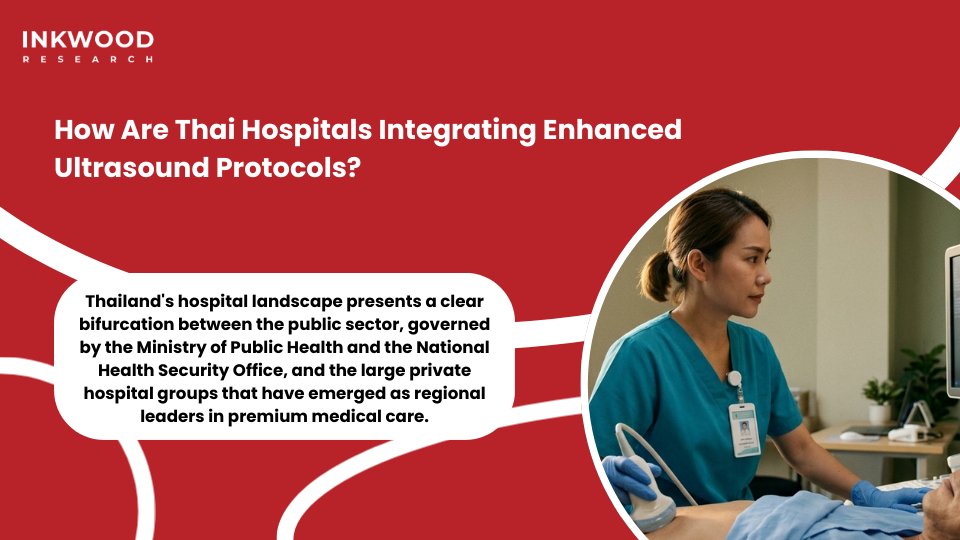
Thailand’s hospital landscape presents a clear bifurcation between the public sector, governed by the Ministry of Public Health and the National Health Security Office, and the large private hospital groups that have emerged as regional leaders in premium medical care. Both sectors are engaging with enhanced ultrasound, but through distinct pathways and at different speeds.
Public Sector Integration
Within Thailand’s public university hospitals, institutions like Siriraj Hospital, Ramathibodi Hospital, and Chulalongkorn Hospital, CEUS protocols have been established within hepatology and gastroenterology departments for liver lesion characterisation and HCC surveillance. These academic centres also serve as training hubs, educating the next generation of Thai radiologists in contrast ultrasound technique and protocol interpretation. Their structured training programmes are essential in building the operator base that will sustain the Thailand contrast ultrasound market‘s growth across provincial facilities.
Private Hospital Investment in CEUS
Private hospital groups, particularly Bumrungrad International, Bangkok Hospital Group, and Samitivej, are actively investing in advanced imaging technologies as a competitive differentiator. For these institutions, contrast enhanced ultrasonography sits at the intersection of clinical quality and operational efficiency: it delivers premium diagnostic outcomes without the capital cost of additional MRI or CT capacity. Moreover, software application diagnostic therapeutic platforms that integrate CEUS quantification tools into reporting workflows are enabling more standardised, reproducible diagnosis across these high-volume facilities.
What Are the Diagnostic Applications Driving Growth in Thailand?
Liver Lesion Characterisation
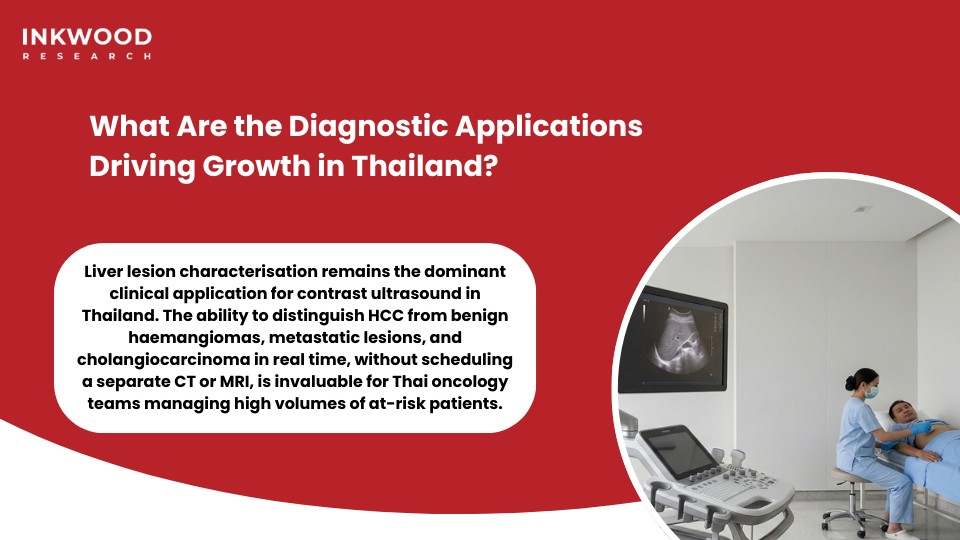
Liver lesion characterisation remains the dominant clinical application for contrast ultrasound in Thailand. The ability to distinguish HCC from benign haemangiomas, metastatic lesions, and cholangiocarcinoma in real time, without scheduling a separate CT or MRI, is invaluable for Thai oncology teams managing high volumes of at-risk patients. Furthermore, the portability and immediate availability of portable ultrasound devices with contrast modes means this capability is reaching regional hospitals and not just Bangkok’s major centres.
Ablation Guidance and Interventional Applications
Beyond characterisation, contrast enhanced ultrasound radiology is playing a growing role in guiding and monitoring percutaneous ablation procedures for liver tumours. Real-time CEUS guidance allows operators to confirm adequate tumour coverage during radiofrequency or microwave ablation, immediately identify residual viable tissue, and adjust treatment accordingly, a capability that significantly improves procedural outcomes. These therapeutic applications of CEUS are gradually entering mainstream practice at Thailand’s leading oncology centres.
- Renal and Vascular Imaging Expansion
Renal lesion characterisation and vascular imaging represent growing secondary applications in the Thai context. As awareness of CEUS’s nephrotoxicity-free profile spreads among Thai nephrologists and urologists, referral patterns are shifting. Additionally, molecule-targeted microbubbles and nanoparticle molecule-targeted research are beginning to influence academic oncology practice in Thailand, with preliminary interest in sonoporation-based drug delivery for hepatic and renal malignancies.
What Are the Newest Developments Shaping Thai Imaging Practice?
AI Integration in CEUS Quantification
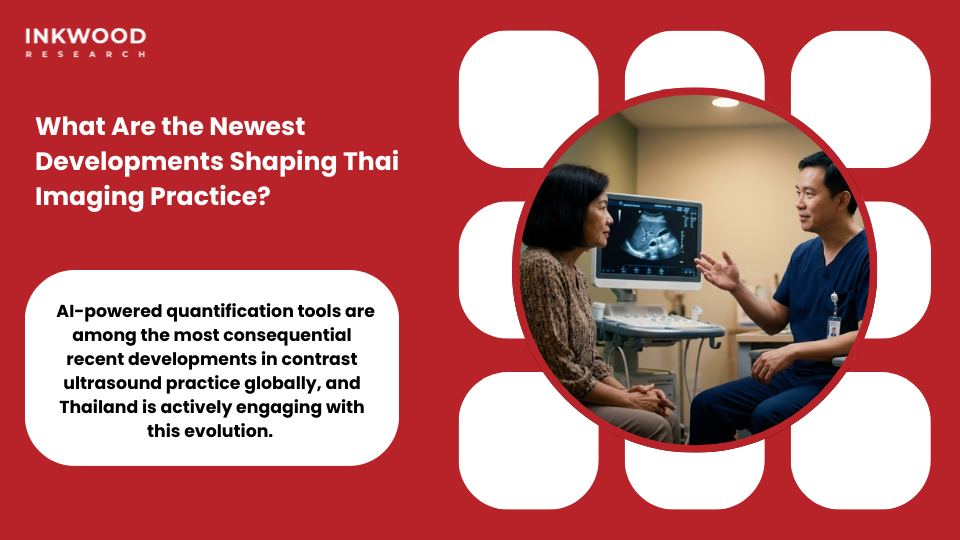
- AI-powered quantification tools are among the most consequential recent developments in contrast ultrasound practice globally, and Thailand is actively engaging with this evolution.
- Time-intensity curve analysis software, deep learning models for lesion classification, and perfusion quantification platforms are reducing operator dependency, a critical capability in a country where CEUS expertise remains concentrated in academic urban centres.
- As these software application diagnostic therapeutic tools become standard on commercial platforms, CEUS’s scalability across provincial Thai hospitals will increase substantially.
Wearable Ultrasound and Point-of-Care Advances
- The broader ultrasound technology landscape is also evolving in ways that will benefit Thai practice. Wearable ultrasound patches capable of continuous organ monitoring signal a future where perfusion assessment moves beyond scheduled imaging sessions.
- Furthermore, cloud-connected tele-ultrasound platforms, enabling scans acquired in rural Thai clinics to be interpreted remotely by Bangkok specialists, are beginning to bridge the access gap for patients outside major cities.
- This infrastructure, when combined with contrast-capable portable ultrasound devices, could fundamentally reshape the reach of Thailand contrast ultrasound market across the country’s 77 provinces.
Key Takeaways
- The Thailand contrast ultrasound market is projected to grow from US$28.14 million in 2026 to US$55.51 million by 2034 at an 8.86% CAGR, significantly outpacing global CEUS market growth averages.
- Liver cancer, highlighted by GLOBOCAN 2022 data from IARC, is the primary demand driver, making hepatic CEUS adoption a clinical and commercial imperative for Thai oncology departments.
- The oncology cardiology axis drives dual-market demand: liver lesion characterisation and echocardiography together represent the highest-volume CEUS applications across Thai public and private hospitals.
- Thailand’s medical tourism economy creates disproportionately high demand for advanced imaging technologies at private hospitals competing for regional patients, directly accelerating contrast ultrasound investment.
- AI integration, molecule-targeted microbubble research, and portable ultrasound innovation are collectively expanding both the depth and reach of CEUS across Thailand’s imaging ecosystem.
- Key competitors, including Bracco, Philips, GE Healthcare, Siemens Healthineers, and Mindray, are competing across equipment, contrast agents, and AI-driven software in the Thailand contrast ultrasound market.
Conclusion:
Thailand’s contrast ultrasound market is evolving rapidly, shaped by a convergence of severe liver cancer burden, ambitious hospital modernisation, and growing clinical confidence in CEUS across oncology and cardiology.
For businesses seeking to enter or expand within this space, the strategic window is open, but understanding Thailand’s dual public-private structure, its oncology priorities, and its appetite for AI-enhanced advanced imaging technologies is essential.
Inkwood Research delivers the market intelligence required to make confident, well-informed decisions in the Thailand contrast ultrasound market.
Connect with our team to explore how our analysis can support your strategy.
Frequently Asked Questions
What is the size of the Thailand contrast ultrasound market?
The market stands at US$28.14 million in 2026, projected to reach US$55.51 million by 2034 at an 8.86% CAGR, driven by liver cancer and cardiovascular imaging demand.
What is the biggest clinical driver of CEUS adoption in Thailand?
Liver cancer, specifically hepatocellular carcinoma and cholangiocarcinoma, is Thailand’s primary driver, as CEUS enables real-time, radiation-free characterisation without nephrotoxic contrast agents.
How is contrast ultrasound used in Thai cardiology?
Thai cardiologists use CEUS echocardiography to delineate endocardial borders, assess wall motion, and characterise cardiac masses safely in patients with renal impairment.
Which private hospitals in Thailand are adopting CEUS?
Bumrungrad International, Bangkok Hospital Group, and Samitivej are leading private hospital investors in contrast ultrasound and advanced imaging technologies in Thailand.
Are portable ultrasound devices available for CEUS in Thai provincial hospitals?
Yes. Mindray and GE Healthcare portable platforms with contrast-specific imaging modes are reaching provincial Thai hospitals, expanding CEUS beyond Bangkok’s major centres.
What are the therapeutic applications of CEUS in Thailand?
Ablation guidance, treatment response monitoring for HCC, and early-stage research into molecule-targeted microbubble drug delivery represent Thailand’s emerging CEUS therapeutic applications.