Table of Contents
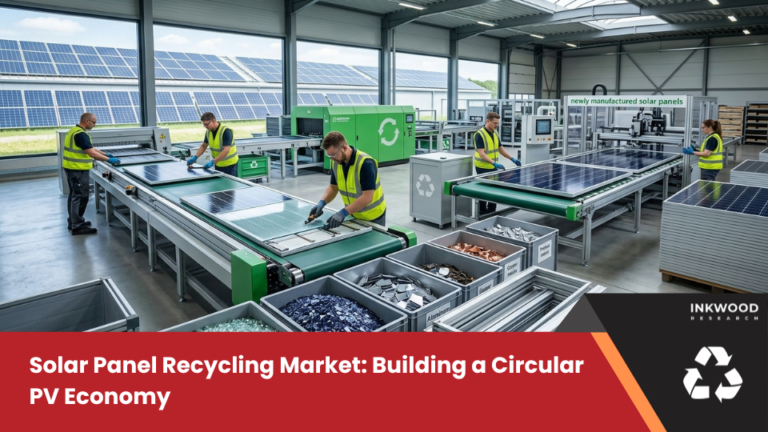
This analysis is brought to you by Inkwood Research, a leading market intelligence firm specializing in renewable energy technologies, circular economy strategies, and sustainable waste management systems. Our research team combines extensive experience analyzing photovoltaic technologies, material recovery innovations, and environmental compliance frameworks across global markets. Based on our proprietary research methodologies and strategic partnerships with recycling facilities, solar manufacturers, government environmental agencies, and technology providers, we deliver actionable insights that empower strategic decision-making for enterprises navigating the solar panel recycling revolution and circular economy transformation.
TLDR
The global solar panel recycling market stands at a pivotal juncture as mounting photovoltaic waste demands innovative solutions. North America leads technological advancement through recycled materials, challenging traditional manufacturing dominance. Meanwhile, Europe pioneers digital traceability systems through groundbreaking initiatives, and Asia-Pacific develops interim storage strategies while building recycling infrastructure. This transformation promises environmental benefits, economic opportunities, and circular economy advancement across regions.
Solar manufacturers seeking sustainable end-of-life solutions, renewable energy developers planning long-term waste management strategies, environmental policy makers crafting recycling regulations, investment analysts evaluating circular economy opportunities, and waste management companies exploring emerging markets will find comprehensive insights into regional approaches, technological innovations, and strategic frameworks shaping the photovoltaic recycling landscape.
Introduction: The Journey Toward a Circular PV Economy
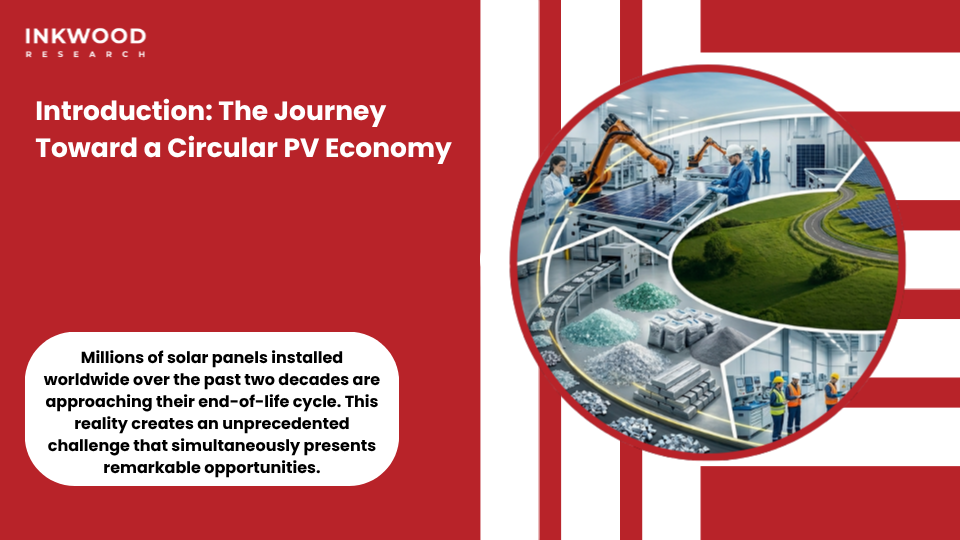
Millions of solar panels installed worldwide over the past two decades are approaching their end-of-life cycle. This reality creates an unprecedented challenge that simultaneously presents remarkable opportunities. Photovoltaic waste management has evolved from a distant concern into an immediate priority across continents. Moreover, the circular economy concept now drives strategic planning for manufacturers, developers, and policymakers alike.
Traditional disposal methods prove inadequate for managing the complex materials found in modern solar panels. These panels contain valuable resources, including silicon, silver, and aluminum, that merit recovery rather than landfill burial. Consequently, innovative recycling approaches are reshaping how industries approach end-of-life photovoltaic systems. Different regions have developed distinct strategies reflecting their unique economic priorities, regulatory frameworks, and technological capabilities.
The journey toward a circular PV economy reveals fascinating regional variations. North America pursues advanced recycling technologies to reclaim manufacturing relevance. Europe implements comprehensive digital solutions ensuring material traceability throughout product lifecycles. Meanwhile, Asia-Pacific balances rapid solar deployment with measured infrastructure development. Each approach offers valuable lessons for stakeholders navigating this emerging landscape.
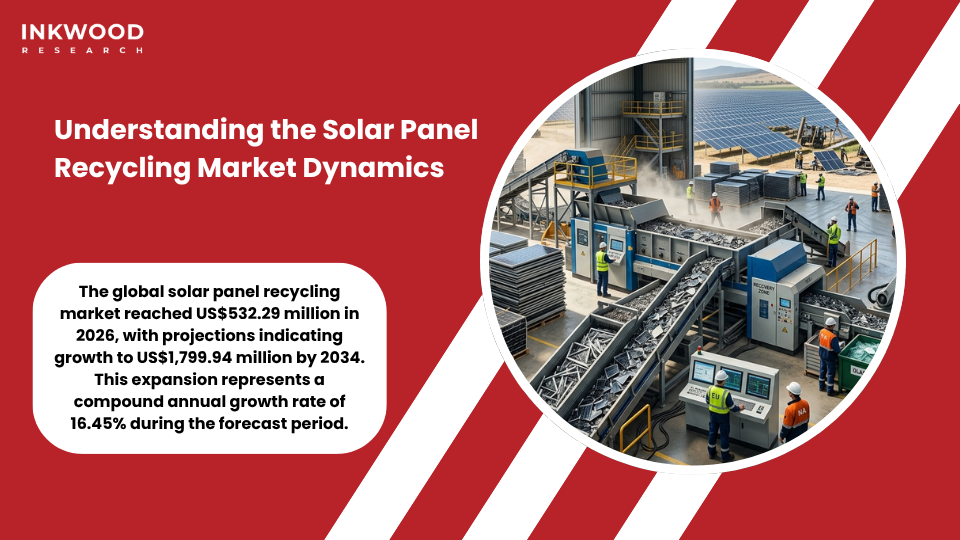
The global solar panel recycling market reached US$532.29 million in 2026, with projections indicating growth to US$1,799.94 million by 2034. This expansion represents a compound annual growth rate of 16.45% during the forecast period. Several interconnected factors drive this remarkable trajectory across international markets.
Photovoltaic panels typically maintain operational efficiency for 25-30 years before requiring replacement. The first wave of large-scale solar installations from the early 2000s now approaches retirement. Therefore, the volume of decommissioned panels continues to accelerate annually. This surge creates both challenges and opportunities for specialized recycling facilities worldwide.
Environmental regulations increasingly mandate responsible disposal practices for electronic waste, including solar panels. Governments recognize that improper handling of photovoltaic waste poses environmental and health risks. Furthermore, recovered materials reduce dependence on virgin resource extraction. These policy developments significantly influence market dynamics across different jurisdictions.
Regional Market Variations Shape Growth Patterns
Regional differences significantly impact how solar panel recycling markets develop and mature. Economic priorities, regulatory frameworks, and technological capabilities create distinct approaches across continents. North America emphasizes advanced material recovery to support domestic manufacturing. Europe focuses on comprehensive circular economy integration with digital tracking systems.
Asia-Pacific presents unique characteristics due to massive solar deployment scales combined with developing recycling infrastructure. Countries in this region implement interim storage solutions while building long-term processing capabilities. Each regional strategy reflects local circumstances, resources, and strategic objectives that influence global market evolution.
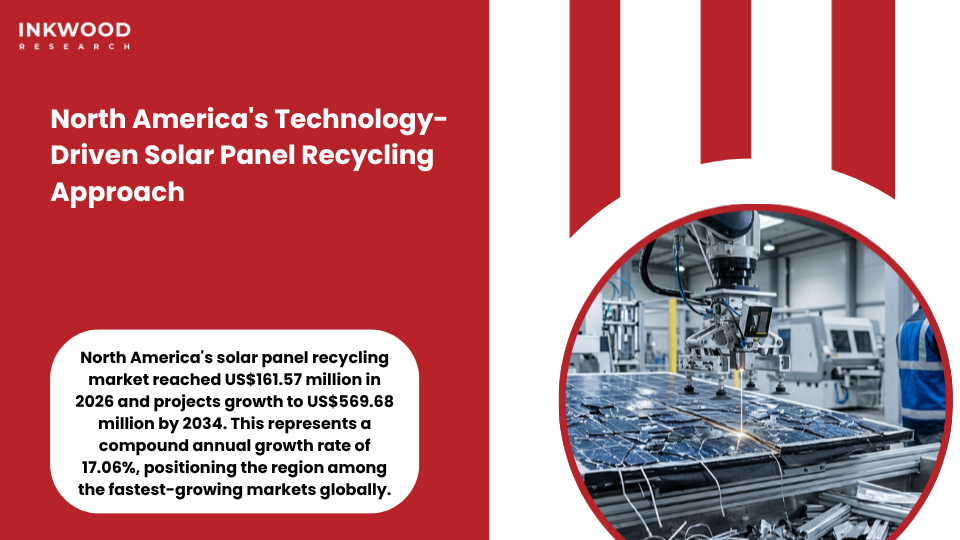
North America’s solar panel recycling market reached US$161.57 million in 2026 and projects growth to US$569.68 million by 2034. This represents a compound annual growth rate of 17.06%, positioning the region among the fastest-growing markets globally. Strategic investments in advanced recycling technologies distinguish North America’s approach.
SOLARCYCLE leads North American innovation through groundbreaking facilities and partnerships. In late 2024, the company announced plans to establish a 5 GW recycling facility in Georgia, destined to become the largest in the United States. This facility will process up to 10 million solar panels annually.
The company’s achievements demonstrate the potential of advanced recycling methods. Throughout 2024, SOLARCYCLE recycled 480,406 panels and saved 13.8 million kg of CO2 equivalent emissions. Additionally, the company doubled its processing capacity at the Odessa, Texas, facility. These expansions reflect growing demand for domestic recycling solutions that reduce environmental impact.
Manufacturer Partnerships Drive Circular Supply Chains
Industry collaboration accelerates circular economy development across North America. In February 2024, Qcells partnered with SOLARCYCLE in the first-of-its-kind agreement between a major solar manufacturer and an advanced recycler in the United States.
This partnership enables Qcells to recycle decommissioned panels while supporting domestic supply chain development. Recovered materials, including aluminum, silver, copper, silicon, and low-iron glass, return to manufacturing processes. Such collaborations reduce dependence on imported raw materials subject to supply chain disruptions.
Additional partnerships expanded throughout 2024 and 2025. Canadian Solar became one of the first crystalline silicon module manufacturers offering full recycling processes to United States customers. HELIENE is committed to multi-year purchases of domestic glass derived from recycled photovoltaic modules. These agreements demonstrate industry commitment to circular economy principles.
Advanced Technologies Challenge Manufacturing Dominance
North American recycling facilities employ cutting-edge technologies that maximize material recovery rates. SOLARCYCLE’s proprietary methods extract over 95% of value from solar modules, significantly exceeding industry standards. This technological advantage positions North America competitively against traditional manufacturing regions.
Mechanical, thermal, and laser-based processes work in combination to efficiently separate panel components. Robotic systems enable precise disassembly while minimizing material degradation. Furthermore, research and development centers continually refine these processes. The state-of-the-art facility in Mesa, Arizona, employs metallurgists, chemists, and engineers advancing recycling science.
These technological capabilities serve strategic objectives beyond environmental compliance. Recovered high-purity materials challenge China’s manufacturing dominance by providing domestic alternatives to imported components. Consequently, recycling infrastructure becomes integral to national energy security and economic competitiveness.
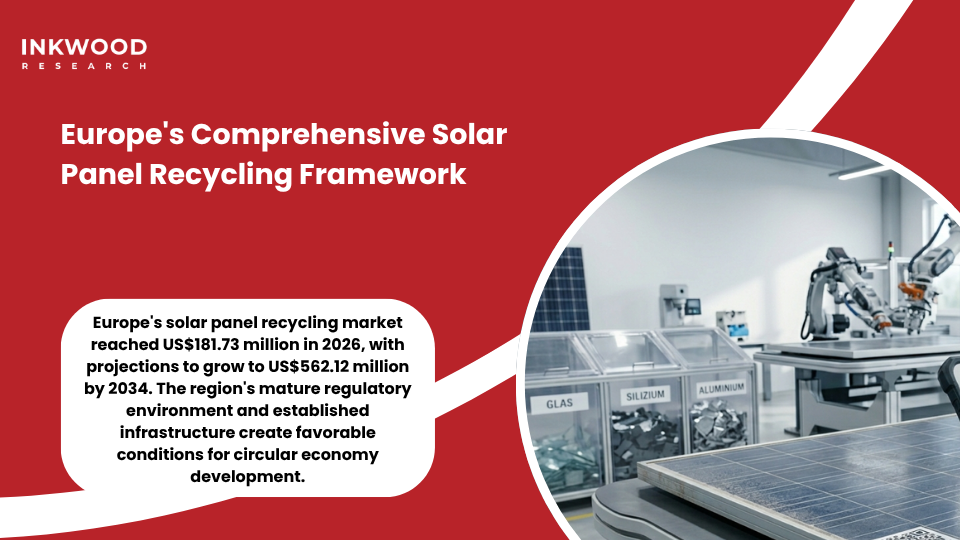
Europe’s solar panel recycling market reached US$181.73 million in 2026, with projections to grow to US$562.12 million by 2034. This represents a compound annual growth rate of 15.16%. The region’s mature regulatory environment and established infrastructure create favorable conditions for circular economy development.
The European Union’s Waste Electrical and Electronic Equipment Directive mandates the collection and recycling of solar panels, ensuring the recovery of critical raw materials. This comprehensive policy framework establishes minimum standards while encouraging innovation.
Germany, France, and Italy lead European recycling efforts through advanced protocols and processing facilities. These countries combine extensive solar adoption with robust waste management systems. Their experiences provide valuable models for other nations developing recycling capabilities.
SOPHIA Project Pioneers Digital Traceability Solutions
The SOPHIA project represents Europe’s commitment to advanced circular economy solutions for photovoltaic panels. This EU-funded Horizon Europe initiative began in June 2025 and runs for 36 months. Coordinated by AIMPLAS, the project involves 15 partners across nine European countries.
SOPHIA implements advanced digital solutions throughout the solar panel value chain. The project develops prototypes for rapid state-of-health assessments, evaluating panel efficiency and damage. Panels retaining over 80% efficiency undergo robot-assisted repairs using high-performance dielectric varnishes. Meanwhile, non-repairable panels proceed through innovative recycling technologies, maximizing material separation.
Digital Product Passports form the cornerstone of SOPHIA’s traceability system. These digital records track panels from manufacturing through end-of-life processing. The information enables more efficient repair and recycling decisions while improving secondary material quality. Further, repaired panels and recovered materials become available through dedicated marketplaces supporting circular economy transactions.
Circular Economy Integration Drives European Innovation
Europe’s circular economy approach extends beyond individual projects to systemic transformation. The PHOTORAMA project, which won the 2024 European Sustainable Energy Award, demonstrates high-value recycling potential. Moreover, initial estimates suggest that recycling 1,200 tonnes of panels saves over 3,800 tonnes of CO2 equivalent.
European initiatives emphasize eco-design principles that facilitate future disassembly. Smart adhesives that deactivate on demand simplify maintenance and recycling processes. These innovations reduce costs while improving material recovery rates. Furthermore, they demonstrate how design decisions influence entire product lifecycles.
Regional collaboration accelerates knowledge sharing and best practice adoption. Research centers, manufacturers, waste managers, and European organizations work collectively toward common objectives. As a result, this integrated approach positions Europe as a global leader in sustainable solar panel recycling practices.
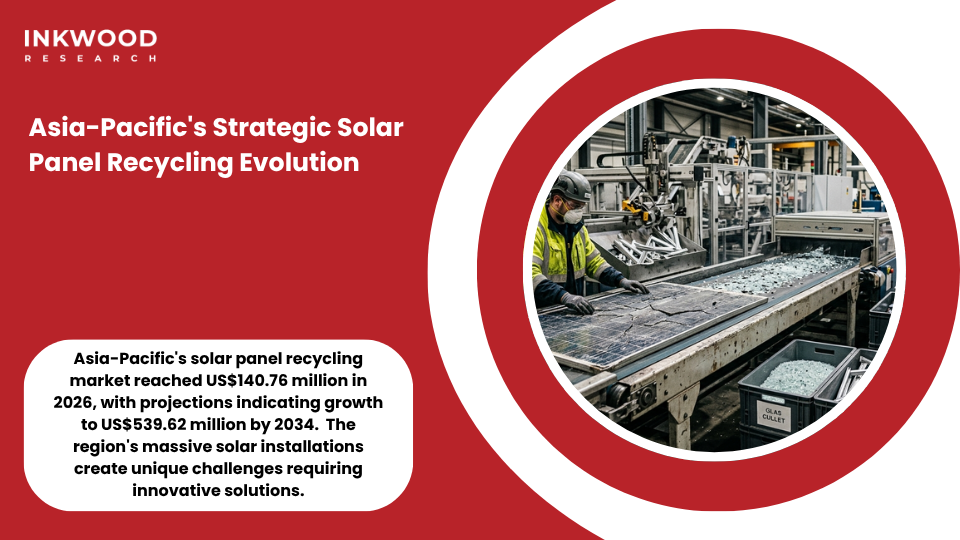
Asia-Pacific’s solar panel recycling market reached US$140.76 million in 2026, with projections indicating growth to US$539.62 million by 2034. This represents the highest compound annual growth rate at 18.29%. The region’s massive solar installations create unique challenges requiring innovative solutions.
China, Japan, and India account for substantial portions of global solar capacity. These countries face mounting pressure to address photovoltaic waste as installations continue expanding. However, recycling infrastructure development lags behind deployment rates in many areas. This gap necessitates interim strategies while long-term capabilities develop.
Different maturity levels characterize recycling approaches across the region. Japan and South Korea operate established facilities with proven technologies. Meanwhile, China, India, and Southeast Asian nations implement varied strategies reflecting their specific circumstances. Each approach contributes to regional capacity building over time.
India’s Interim Storage Strategy Addresses Infrastructure Development
India’s E-Waste Management Rules 2022 mandate that solar PV module and cell producers store waste until 2034-2035. This requirement acknowledges the time needed to establish a comprehensive recycling infrastructure throughout the country.
Furthermore, guidelines from the Central Pollution Control Board govern storage practices during this interim period. Manufacturers must maintain data inventories and file annual returns through the e-waste management portal. These requirements ensure accountability while the infrastructure develops. Storage obligations provide time for facility construction and technology deployment.
India’s installed solar capacity generated approximately 100 kilotonnes of waste by 2024. Projections indicate this volume could reach 600 kilotonnes by 2030 and 19,000 kilotonnes by 2050. Five states, namely, Rajasthan, Gujarat, Karnataka, Tamil Nadu, and Andhra Pradesh, account for 67% of the projected waste. These regions host major solar parks and continue to expand capacity significantly.
Emerging Markets Create Economic Opportunities
Asia-Pacific’s recycling market offers substantial economic potential alongside environmental benefits. Recovered materials reduce dependence on virgin resource extraction and imported components. Silicon, copper, cadmium, and tellurium represent critical minerals for domestic manufacturing. Recycling provides secure supply sources supporting industrial development.
Employment opportunities emerge across collection, transportation, and processing operations. Informal sectors currently handle significant volumes, though professional facilities are increasingly entering the market. Companies recognize potential returns from recovered materials. Government policies encouraging recycling investment accelerate market development.
Regional collaboration enhances capabilities through knowledge exchange and resource sharing. Countries learn from each other’s experiences while adapting approaches to local contexts. This cooperative environment supports the sustainable growth of recycling infrastructure throughout the Asia-Pacific.
Advanced Recycling Methods Transform Material Recovery
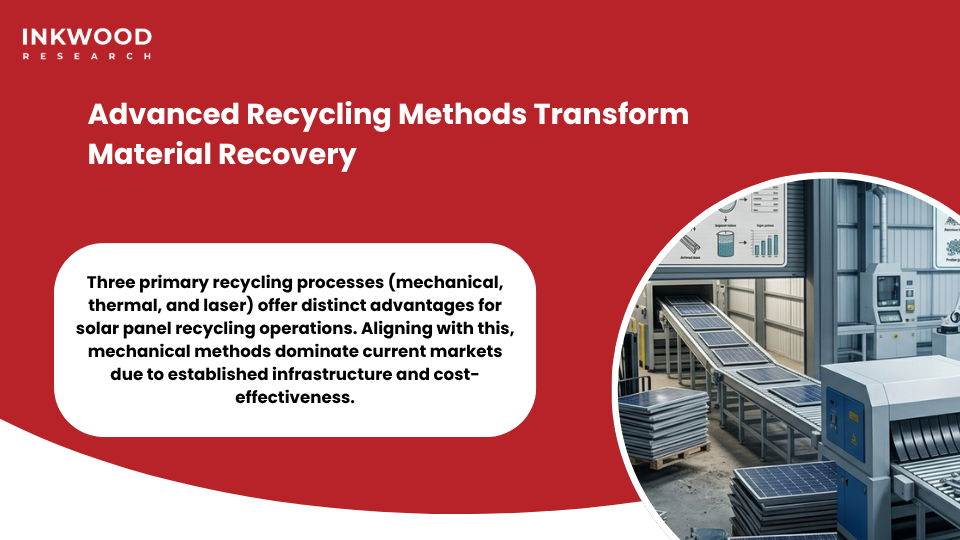
Three primary recycling processes (mechanical, thermal, and laser) offer distinct advantages for solar panel recycling operations. Aligning with this, mechanical methods dominate current markets due to established infrastructure and cost-effectiveness. However, thermal and laser technologies gain traction through superior material purity and recovery rates.
Mechanical recycling physically breaks panels into constituent materials through shredding, crushing, and grinding. This approach effectively recovers glass, aluminum, and silicon for reuse in various applications. The method’s simplicity and scalability enable high-volume processing. Consequently, mechanical systems handle the majority of current recycling volumes globally.
Thermal processes use high temperatures to recover valuable materials by burning off plastic components. Moreover, this method efficiently extracts metals, including silicon, silver, and aluminum. Thermal recycling proves particularly effective for large panel volumes. Additionally, it achieves high-purity material recovery, supporting demanding manufacturing applications.
Laser Technology Offers Precision Material Separation
Laser-based recycling represents the fastest-growing technology segment within the market. This method offers precision, minimal material loss, and targeted component extraction. Laser systems selectively remove specific materials without damaging surrounding elements. These capabilities prove valuable for recovering high-purity materials.
Demand for advanced recycling methods drives laser technology adoption. Manufacturers require high-purity silicon for new panel production. Traditional methods sometimes introduce contaminants, reducing material value. Laser processing addresses these concerns through precise separation capabilities. Consequently, recovered materials command premium prices, supporting investment in laser facilities.
Material Recovery Rates Determine Economic Viability
The economic success of recycling operations depends significantly on material recovery rates and purity levels. Glass and aluminum account for approximately 85% of panel weight. These materials recover relatively easily through mechanical processes. However, valuable elements like silicon and silver comprise smaller portions requiring more sophisticated extraction methods.
Advanced facilities achieve recovery rates exceeding 95% for silicon and 85% for silver. These performance levels transform recycling economics by maximizing recovered material value. High-purity materials compete effectively with virgin resources in manufacturing applications. Therefore, technology investments that improve recovery rates generate substantial returns.
Continuous research enhances recovery capabilities across all process types. Innovations in chemical treatments, mechanical separation, and thermal processing expand possibilities. Facilities incorporating multiple methods achieve superior results compared to single-process operations. This integrated approach represents the industry’s future direction.
Major Companies Shape the Solar Panel Recycling Industry
Leading solar panel recycling companies establish standards and drive industry evolution through technological innovation and operational excellence. These organizations range from specialized recyclers to integrated solar manufacturers offering comprehensive lifecycle solutions. Their strategies reflect different approaches to capturing value from the circular economy.
First Solar demonstrates how vertical integration creates competitive advantages in solar panel recycling. The company manufactures thin-film modules while operating dedicated recycling facilities. This integrated model enables closed-loop material flows from production through end-of-life processing.
Decades of operational experience provide First Solar with proven recycling expertise. The company’s processes recover valuable materials efficiently while managing thin-film-specific challenges. Furthermore, vertical integration ensures consistent panel streams for recycling operations. This reliability supports facility planning and capacity utilization.
SOLARCYCLE represents the new generation of specialized recycling companies employing cutting-edge technologies. Founded in 2022, the company rapidly expanded through strategic partnerships and capacity investments. Its Georgia facility, under construction, is set to process 10 million panels annually upon completion.
Proprietary technology enables SOLARCYCLE to extract over 95% of panel value, significantly exceeding industry averages. This performance attracts partnerships with major manufacturers, including Q-Cells, Canadian Solar, and HELIENE. The company aims to recycle nearly 1 million panels by the end of 2025, doubling that volume in 2026.
Reiling GmbH Anchors European Recycling Infrastructure
Reiling GmbH & Co. KG operates as a major European recycler with extensive experience across electronic waste categories. The company’s facilities in Germany process substantial volumes of solar panels alongside other materials. This diversification provides operational stability and knowledge transfer across product categories.
European regulatory compliance expertise positions Reiling advantageously as directives evolve. The company navigates complex requirements while maintaining cost-effective operations. Additionally, established relationships with collectors and manufacturers ensure consistent material streams. These factors combine to support market leadership within Europe.
Numerous companies enter the solar panel recycling market across different regions:
- ROSI SAS develops advanced processes in Europe
- Reclaim PV Recycling Pty Ltd serves the Australian market
- Yingli Energy Co. Ltd. leverages manufacturing expertise in China
- Solar Panel Recycling operates in North Carolina with circular economy principles
- Echo Environmental provides comprehensive recycling services across North America, while Veolia expands offerings through its environmental services portfolio
Each company contributes unique capabilities, strengthening overall industry infrastructure. Plus, competition drives efficiency improvements and technology advancement, benefiting all stakeholders.
Regulatory Frameworks Drive Solar Panel Recycling Adoption
Government policies significantly influence solar panel recycling market development through mandates, incentives, and standards. Regulatory approaches vary substantially across regions, reflecting different priorities and capabilities. However, common themes emerge around producer responsibility and environmental protection objectives.
Europe’s regulatory environment provides the most comprehensive framework globally. The WEEE Directive mandates high recycling rates while establishing producer responsibility throughout product lifecycles. Member states implement these requirements through national legislation, creating consistent standards.
United States regulations are developed primarily at the state level. California and Washington enacted specific mandates for photovoltaic waste management. Other states implement varying requirements, including decommissioning plans and recycling considerations. This fragmented approach creates complexity for multi-state operations while encouraging innovation.
Extended Producer Responsibility Programs Shape Industry
Extended Producer Responsibility programs assign manufacturers accountability for end-of-life product management. These frameworks incentivize design improvements, facilitating recycling while ensuring funding for collection and processing. Europe’s mature EPR systems provide models for other regions developing similar programs.
EPR requirements often include collection targets, recycling quotas, and material-specific recovery rates. Producers meet obligations through direct operations or purchasing recycling certificates. This flexibility accommodates different business models while achieving environmental objectives. Consequently, EPR programs effectively drive recycling infrastructure investments.
Emerging Regulations Address Growing Waste Volumes
Policymakers worldwide recognize the need for comprehensive photovoltaic waste management frameworks. China implements policies supporting recycling as solar capacity expands dramatically. India’s storage mandate provides interim solutions while long-term infrastructure develops. Japan’s established regulations continue evolving to address changing circumstances.
Future regulations likely emphasize material recovery rates over simple recycling percentages. This approach ensures valuable materials return to productive use rather than downcycling into lower-value applications. Additionally, digital tracking requirements may expand, following Europe’s Digital Product Passport initiatives. These developments will reshape industry practices globally.
Key Takeaways
- The global solar panel recycling market demonstrates robust growth driven by mounting photovoltaic waste volumes and strengthening environmental regulations.
- Regional approaches reflect distinct priorities, with North America emphasizing technological advancement, Europe pioneering comprehensive systems, and Asia-Pacific balancing deployment with infrastructure development.
- Advanced recycling technologies transform material recovery economics through improved efficiency and purity. Mechanical methods currently dominate, while thermal and laser processes gain market share.
- Companies like SOLARCYCLE and First Solar lead innovation through proprietary processes, achieving recovery rates exceeding 95%.
- Strategic partnerships between manufacturers and recyclers create closed-loop supply chains, reducing import dependence.
- Digital traceability systems pioneered through Europe’s SOPHIA project enhance material management throughout product lifecycles. Meanwhile, regulatory frameworks continue evolving to address growing waste volumes and circular economy objectives.
- Asia-Pacific’s interim storage strategies acknowledge infrastructure development timelines while ensuring accountability.
- Research initiatives across the region advance capabilities through innovative processes adapted to local conditions. Economic opportunities emerge alongside environmental benefits as recovered materials support domestic manufacturing.
Conclusion
Solar panel recycling transforms from a distant concern into an immediate priority, shaping renewable energy’s future. The circular economy vision drives strategic planning across manufacturing, deployment, and end-of-life management. Regional variations in approach create valuable lessons applicable globally.
Technological advancement enables economic viability while delivering environmental benefits. Companies investing in advanced processes position themselves advantageously as waste volumes accelerate. Partnerships between stakeholders strengthen value chains supporting sustainable practices.
Regulatory frameworks will continue evolving to address emerging challenges and opportunities. Policymakers balance environmental protection with economic development objectives. Industry collaboration ensures practical implementation of increasingly sophisticated requirements.
The journey toward a circular PV economy requires sustained commitment from all stakeholders. Manufacturers, recyclers, policymakers, and consumers all play critical roles. Together, they shape an industry where solar energy delivers both clean power generation and responsible resource management.
Ready to explore how solar panel recycling strategies can benefit your organization?
Inkwood Research offers comprehensive market intelligence and strategic guidance tailored to your specific needs. Contact our expert team today to discover actionable insights driving circular economy success.
Frequently Asked Questions (FAQs)
Solar panels contain valuable materials such as silicon, silver, aluminum, copper, and glass, and advanced solar panel recycling technologies can recover these components at purity levels suitable for manufacturing new photovoltaic modules.
Photovoltaic solar panels typically maintain operational efficiency for 25–30 years, although early panel waste can occur due to installation damage, transportation issues, or manufacturing defects before reaching their full lifespan.
Europe leads the solar panel recycling market due to strong regulatory frameworks and established recycling infrastructure, while North America is expanding through technological innovation and Asia-Pacific shows the fastest growth driven by large-scale solar installations.
Solar panel recycling is becoming essential as aging photovoltaic installations increase waste volumes and valuable materials can be recovered for reuse in new solar manufacturing.
Key challenges include high recycling costs, limited specialized facilities, and complex panel structures that make material separation difficult.
Solar panel recycling supports the circular economy by recovering critical materials such as glass, silicon, and metals for reuse in new renewable energy technologies.