Table of Contents

This analysis is brought to you by Inkwood Research, a leading market intelligence firm specializing in renewable energy technologies, power electronics innovations, and global solar market dynamics. Our research team combines extensive experience analyzing module-level power electronics, photovoltaic systems optimization, and clean energy adoption patterns across North America, Europe, and the Asia-Pacific. Based on our proprietary research methodologies and strategic partnerships with solar technology providers, energy storage developers, and industry associations, we deliver actionable insights that empower strategic decision-making for enterprises navigating the solar microinverter market expansion.
TLDR
Solar microinverters represent a transformative shift in renewable energy optimization. These module-level power electronics convert direct current to alternating current at each panel, eliminating energy losses from shading and mismatch. The global solar microinverter market reached US$5.37 billion in 2026 and projects growth to US$19.02 billion by 2034 at a 17.13% CAGR. Advanced gallium nitride technology now delivers 97.5% efficiency while enabling safer all-AC rooftop architectures. Battery energy storage integration and rapid shutdown compliance drive adoption across residential and commercial photovoltaic systems.
Solar installers seeking to differentiate their offerings will gain practical insights into microinverter ROI advantages. Energy executives evaluating clean energy infrastructure investments can leverage our competitive analysis of leading manufacturers. Commercial property developers planning photovoltaic installations will understand how module-level optimization impacts system design. Renewable energy consultants advising clients on low-carbon-intensive technologies will appreciate the detailed examination of battery energy storage integration and grid compliance requirements.
Understanding Solar Microinverter Technology Evolution

Picture a rooftop covered in solar panels. Traditional systems connect these panels in series, creating vulnerability to a single weak point. Enter solar microinverters—revolutionary devices that attach directly to individual solar panels, transforming direct current into alternating current right at the source.
This fundamental shift in power electronics architecture eliminates the cascading failures that plague string inverter configurations. The U.S. Department of Energy research demonstrates that photovoltaic systems using module-level power electronics maintain production even when individual panels encounter shading or soiling. Each solar microinverter operates independently, optimizing energy harvest panel by panel.
Why Module-Level Optimization Matters for Solar Microinverter Performance
Module-level power electronics deliver tangible advantages over centralized string inverters. Consider a residential installation where one panel receives morning shade from a nearby tree. With traditional string configurations, that single shaded panel reduces output across the entire string.
Solar microinverters isolate this performance impact. Aligning with this, NREL research findings, microinverter-based systems achieve more than 12% improved performance under heavy shading conditions. The unshaded panels continue generating maximum power while the affected unit operates at reduced capacity.
Further, this granular control extends beyond shading mitigation. Manufacturing variations mean no two solar panels produce identical output. Power electronics at the module level extract peak performance from each unit regardless of these natural inconsistencies.
How Module-Level Power Electronics Transform System Performance

The architectural elegance of solar microinverter systems reveals itself in practical application. Every photovoltaic panel becomes an independent power station. Accordingly, traditional string inverters create high-voltage DC runs across rooftops, representing configurations that demand specialized safety equipment and trained personnel.
Microinverter architectures convert power at the panel, establishing all-AC systems on the roof. This design inherently complies with NEC 690.12 rapid shutdown requirements without additional hardware. Moreover, installers appreciate the simplified wiring, while building owners benefit from enhanced safety profiles.
Real-Time Monitoring Capabilities of Solar Microinverter Systems
Data visibility transforms maintenance from reactive to predictive. In this regard, solar microinverter platforms provide panel-level production analytics accessible through cloud-based interfaces. System operators identify underperforming modules immediately, pinpointing issues before they escalate.
Consider a commercial installation with 200 panels. String inverter systems offer aggregate output metrics, masking individual panel degradation. Meanwhile, microinverter monitoring highlights the specific panel experiencing reduced output, enabling targeted intervention.
This granular insight extends system longevity. Operators detect anomalies early, addressing minor issues before they compromise surrounding components. The result? Photovoltaic installations that maintain optimal performance throughout their operational life.
Scalability Advantages of Solar Microinverter Architectures
System expansion becomes remarkably straightforward with module-level power electronics. Moreover, adding capacity to string inverter installations often requires replacing the central inverter or installing a second unit. Microinverter systems, in this regard, simply accommodate additional panels with corresponding units.
This flexibility proves valuable for growing businesses. For example, a company installing 50 kilowatts today can seamlessly expand to 100 kilowatts tomorrow. No system redesign, no equipment replacement; just additional panels paired with compatible solar microinverters.
Financial Returns That Matter: Real-World Solar Microinverter ROI

Investment decisions require concrete financial justification. Solar microinverter systems command higher upfront costs compared to string inverter alternatives. However, lifetime value calculations reveal compelling economics.
The global solar microinverter market demonstrates this value proposition through sustained growth. Our analysis shows the sector reached US$5.37 billion in 2026, projecting expansion to US$19.02 billion by 2034. This 17.13% compound annual growth rate reflects widespread recognition of microinverter benefits.
Calculating Long-Term Value for Solar Microinverter Investments
Enhanced energy harvest directly impacts ROI. Panel-level optimization recovers production losses from shading, soiling, and manufacturing variations. Subsequently, these incremental gains compound over system lifetimes spanning 25 years.
Reliability factors weigh heavily in the total cost of ownership. Leading manufacturers report failure rates below 0.05%—one unit per 2,000 deployed. Furthermore, a distributed architecture means single component failures affect only one panel rather than the entire string.
Warranty coverage reinforces long-term value. Premium solar microinverter products carry 25-year warranties matching photovoltaic panel lifespans. This comprehensive coverage minimizes replacement expenses throughout the system’s operational period.
Operational Cost Reductions Through Advanced Power Electronics
Maintenance efficiency translates to bottom-line savings. In this regard, panel-level monitoring enables precise diagnostics, reducing technician time spent troubleshooting. Meanwhile, the all-AC rooftop architecture simplifies compliance with electrical codes.
Installation labor represents another cost consideration. While microinverter systems require attaching units to each panel, simplified wiring offsets this time investment. Contractors report comparable or reduced total installation hours compared to string inverter projects.
Competitive Landscape: Leading Global Solar Microinverter Manufacturers
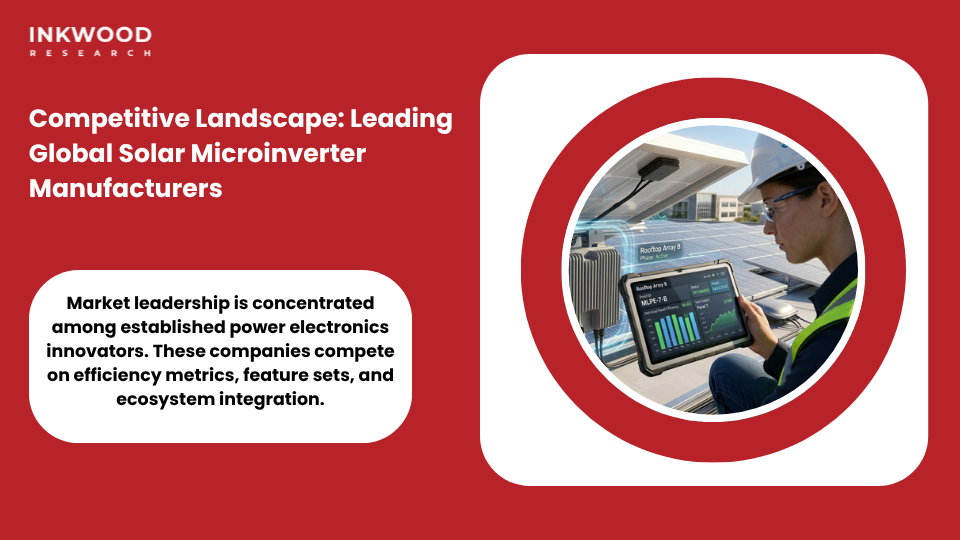
Market leadership is concentrated among established power electronics innovators. These companies compete on efficiency metrics, feature sets, and ecosystem integration. Accordingly, understanding their distinct approaches helps buyers make informed technology selections.
Enphase Energy: Pioneer in Solar Microinverter Innovation
Enphase Energy has continued to play a pivotal role in commercial microinverter deployment. Founded in 2006, this California-based manufacturer established the category through persistent technology refinement. Their IQ Series represents the latest evolution, incorporating advanced power electronics and grid-forming capabilities.
The company’s ecosystem approach extends beyond solar microinverters. Enphase integrates battery energy storage, electric vehicle charging, and comprehensive monitoring through its Enlighten platform. This unified architecture appeals to customers seeking complete energy management solutions.
Recent product launches demonstrate continued innovation. Their IQ9 generation leverages gallium nitride semiconductors, achieving 97.5% conversion efficiency. Manufacturing in the United States supports domestic content requirements for federal infrastructure projects.
APsystems: Competitive Alternatives in Solar Microinverter Markets
APsystems brings competitive pricing to microinverter adoption. This manufacturer targets cost-conscious segments while maintaining credible performance specifications. Their three-phase products address commercial installations requiring higher voltage configurations.
Market positioning emphasizes accessibility. APsystems enables smaller contractors to offer microinverter benefits without premium price points. This strategy expands module-level power electronics adoption across broader customer bases.
SolarEdge: Hybrid Approach to Power Electronics Optimization
SolarEdge employs an alternative architecture combining power optimizers with centralized inverters. While not true solar microinverters, their DC optimizers provide panel-level maximum power point tracking. This hybrid configuration offers cost advantages while retaining some module-level benefits.
The company competes through different value propositions. Lower upfront costs appeal to budget-constrained projects. However, centralized inverter architectures introduce single points of failure absent from distributed microinverter systems.
Emerging Players: Hoymiles and Market Expansion
New entrants challenge established manufacturers through aggressive pricing. Moreover, Hoymiles captures budget segments in Europe and emerging markets and their entry pressures premium brands while expanding total addressable markets.
Quality concerns temper enthusiasm for the lowest-cost options. Aligning with this, installers report mixed experiences with newer manufacturers lacking established track records. Also, warranty terms often reflect this positioning, with 10-year coverage versus 25-year protection from premium providers.
Latest Product Innovations Reshaping the Market
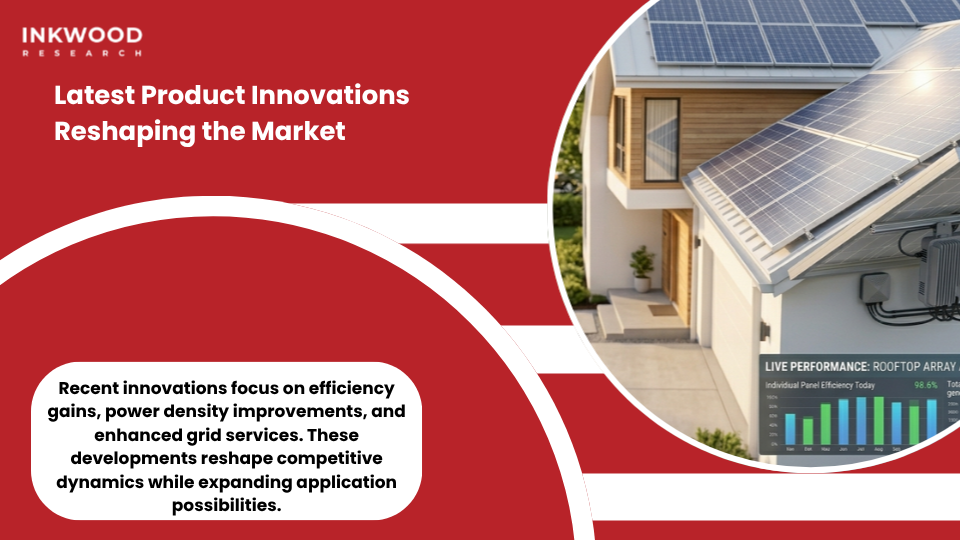
Technology advancement accelerates across the solar microinverter sector. Recent innovations focus on efficiency gains, power density improvements, and enhanced grid services. These developments reshape competitive dynamics while expanding application possibilities.
Gallium Nitride Revolution in Solar Microinverter Design
Gallium nitride semiconductors represent a fundamental materials breakthrough. These wide-bandgap components enable smaller, cooler-running power electronics. Moreover, efficiency improvements reaching 97.5% translate directly to increased energy production from identical panel arrays.
Thermal management benefits prove equally significant. Reduced heat generation extends component longevity while enabling more compact form factors. Aligning with this, installers appreciate lighter units that simplify mounting procedures.
Commercial adoption accelerates as manufacturers scale production. Enphase commenced volume shipments of gallium nitride-based microinverters in late 2025. Plus, industry analysts expect competing manufacturers to introduce similar products throughout 2026.
Grid-Forming Capabilities and Virtual Power Plant Integration
Advanced solar microinverters now provide grid-forming functions traditionally reserved for utility-scale generators. These capabilities enable systems to operate during power outages, supplying electricity from real-time solar production. The feature creates localized microgrids without requiring battery energy storage.
Virtual power plant aggregation extends this functionality. Utilities coordinate thousands of distributed photovoltaic systems, managing them as unified generation assets. Microinverter communication protocols enable this sophisticated coordination, providing grid services while compensating system owners.
Three-Phase Commercial Solar Microinverter Products
Commercial markets demand different specifications than residential applications. Three-phase 480-volt configurations dominate commercial buildings and industrial facilities. Historically, these requirements have limited microinverter adoption in commercial segments.
Recent product launches address this gap. Enphase introduced its IQ9N-3P commercial microinverter in January 2026. Moreover, the device handles 480Y/277-volt three-phase grids without external transformers, supporting panels up to 600 watts.
This expansion opens substantial market opportunities. Commercial rooftops present complex shading scenarios from HVAC equipment, skylights, and multi-tenant configurations. Module-level optimization proves particularly valuable in these challenging environments.
Integration with Battery Energy Storage Systems
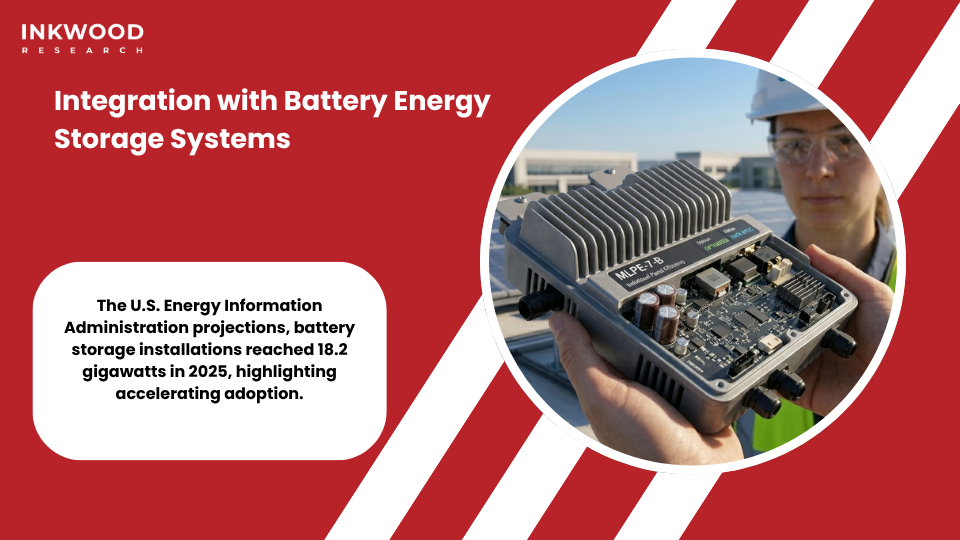
Solar microinverter architectures integrate seamlessly with battery energy storage. This pairing addresses the intermittency challenge inherent to renewable energy generation. The U.S. Energy Information Administration projections, battery storage installations reached 18.2 gigawatts in 2025, highlighting accelerating adoption.
AC-Coupled Battery Energy Storage Advantages
Microinverter systems naturally accommodate AC-coupled battery configurations. Solar panels generate DC power, converted to AC at each module. Battery systems then convert this AC back to DC for storage, later inverting again for household use.
This architecture offers retrofit advantages. Existing photovoltaic installations easily add battery energy storage without system modifications. Conversely, DC-coupled batteries require matching inverter brands, limiting consumer choice.
Economic Drivers for Combined Solar Microinverter and Storage
Net metering policy changes accelerate battery adoption. California’s NEM 3.0 reduced export credits by 75%, transforming economics. Self-consumption becomes financially superior to grid export under these rate structures.
Battery energy storage enables time-shifting strategies. Systems capture midday solar production, discharging during expensive evening hours. This optimization maximizes financial returns while supporting grid stability during peak demand periods.
Key Takeaways
- Solar microinverters fundamentally transform photovoltaic system architecture through module-level power electronics.
- These devices convert DC to AC at individual panels, eliminating cascading failures and optimizing energy harvest.
- The global market reached US$5.37 billion in 2026, projecting growth to US$19.02 billion by 2034.
- Competitive dynamics concentrate among established manufacturers like Enphase Energy alongside emerging players such as APsystems and Hoymiles.
- Recent innovations emphasize gallium nitride technology delivering 97.5% efficiency and grid-forming capabilities enabling microgrid operation.
- Three-phase commercial products expand addressable markets beyond residential applications.
- Integration with battery energy storage addresses renewable energy intermittency while enabling sophisticated time-shifting strategies.
- AC-coupled configurations offer retrofit flexibility and manufacturer independence.
- ROI calculations must account for enhanced energy harvest, reduced maintenance costs, and comprehensive warranty coverage spanning 25 years.
Frequently Asked Questions (FAQs)
A solar microinverter is a device that converts DC power from an individual photovoltaic panel into AC electricity, enabling module-level power conversion and optimization.
Solar microinverters optimize energy production by allowing each panel to operate independently, preventing shading or performance issues in one module from affecting the entire system.
Solar microinverters often provide strong long-term returns through higher energy output, lower maintenance requirements, and extended warranties of up to 25 years.
Solar microinverters operate at the panel level while string inverters connect multiple panels in a single circuit, which can reduce overall performance if one panel underperforms.
Microinverters provide better performance monitoring, improved energy harvest, flexible system design, and enhanced safety in residential solar installations.
Yes, microinverters increase reliability because the failure of one unit affects only a single panel rather than the entire solar array.