Table of Contents

This analysis is brought to you by Inkwood Research, a leading market intelligence firm specializing in renewable energy transitions, photovoltaic technology innovations, and global solar power ecosystems. Our research team combines extensive experience analyzing concentrated solar systems, monocrystalline and polycrystalline technologies, and clean energy adoption patterns across North America, Europe, and Asia-Pacific. Based on our proprietary research methodologies and strategic partnerships with solar module manufacturers, we deliver actionable insights that empower decision-making for enterprises navigating the global solar energy market expansion.
TLDR
The global solar energy market witnessed unprecedented expansion in 2025, installing 380 GW of new capacity within just six months. This represents a 64% surge compared to 2024’s pace, signaling a fundamental shift in how nations approach electricity generation. Renewable energy technologies, particularly photovoltaic systems and concentrated solar installations, are transforming traditional power infrastructure. Investment patterns reveal growing confidence in solar module innovations, while emerging markets accelerate the adoption of monocrystalline and polycrystalline technologies for sustainable transportation and lighting applications.
Energy executives, renewable power strategists, and infrastructure investors seeking comprehensive insights into evolving solar panel recycling opportunities will benefit from this analysis. Policy makers evaluating green energy transitions, solar module manufacturers exploring market expansion, and sustainability officers implementing clean energy programs gain valuable perspectives. Additionally, financial analysts tracking photovoltaic market dynamics and technology developers advancing cadmium telluride or amorphous silicon innovations discover actionable intelligence for strategic planning.
Global Solar Energy Market Trends

The solar energy revolution reached a pivotal moment in 2025. Traditional electricity generation faced unprecedented competition as photovoltaic systems demonstrated remarkable cost efficiency. Within the first half of the year, global installations surged past expectations, fundamentally altering how energy executives view renewable power infrastructure. Moreover, this transformation extends beyond simple capacity additions; it represents a comprehensive reimagining of how societies produce, distribute, and consume power.
The global solar energy market dynamics shifted dramatically when installation figures exceeded 380 GW in just six months, according to International Energy Agency data. Previously, achieving such capacity expansion required entire calendar years. Consequently, renewable energy technologies now command serious attention from conservative utility operators and fossil fuel advocates alike. Additionally, the acceleration signals more than incremental progress; it demonstrates fundamental changes in manufacturing capabilities, financing structures, and regulatory frameworks supporting clean energy adoption.
What makes this expansion particularly significant? Solar module manufacturing evolved substantially, incorporating advanced monocrystalline and polycrystalline architectures alongside innovative cadmium telluride and amorphous silicon alternatives. Plus, these technological improvements reduced production costs while simultaneously enhancing conversion efficiency.
Moreover, concentrated solar installations utilizing power tower and Fresnel configurations gained traction in regions with abundant direct sunlight. Together, these developments create compelling economics that challenge conventional power generation assumptions across diverse geographic markets and regulatory environments.
Breaking Records: The Global Solar Energy Market Acceleration

Historical performance provides essential context for current achievements. Throughout 2024, the global solar energy sector required nine months to surpass 350 GW of installations. However, 2025 demonstrated vastly different momentum. Installations reached this milestone by June, revealing acceleration that caught even optimistic analysts by surprise. This 64% year-over-year increase reflects converging factors rather than isolated improvements in solar module technology or manufacturing capacity alone.
Several catalysts drove this remarkable expansion. Initially, supply chain constraints that plagued renewable energy markets during 2022-2023 were finally resolved. Manufacturers scaled production facilities for monocrystalline and polycrystalline panels substantially. Subsequently, improved availability reduced delivery timelines and project development cycles.
Additionally, policy support mechanisms expanded across multiple jurisdictions, creating favorable regulatory environments for clean energy investments. These combined forces generated unprecedented installation velocity that reshaped competitive dynamics within electricity generation markets globally.
Renewable Energy Integration and Grid Modernization
Grid operators confronted significant challenges in managing increased photovoltaic capacity. Traditional electricity generation systems were designed around predictable, dispatchable baseload power sources. Conversely, solar energy introduces variable output dependent on weather patterns and daylight availability.
Consequently, utilities invested heavily in energy storage solutions, smart grid technologies, and demand response programs to maintain system reliability while accommodating higher renewable penetration levels. Plus, advanced forecasting capabilities emerged as critical infrastructure components. Meanwhile, battery storage deployments accelerated alongside solar installations, creating integrated solutions that address intermittency concerns.
Furthermore, transmission infrastructure upgrades enabled power transfer from regions with optimal solar resources to demand centers. These complementary investments demonstrate how sustainable transportation and lighting applications increasingly depend on coordinated renewable energy ecosystem development rather than isolated technology deployments.
Technology Evolution: From Monocrystalline to Cadmium Telluride Innovations

Technological advancement fundamentally altered the economics of solar energy deployment. Efficiency improvements in monocrystalline solar modules reached commercial viability at levels previously confined to laboratory settings. Manufacturers achieved conversion rates exceeding 24% in mass-production environments, substantially improving land-use efficiency for utility-scale projects.
This progress matters tremendously for regions facing space constraints or seeking to maximize output from limited suitable terrain. Alternative materials gained meaningful market share during this period. Meanwhile, cadmium telluride thin-film technologies demonstrated remarkable cost advantages for specific applications.
Similarly, amorphous silicon solutions found niches in building-integrated photovoltaic systems where flexibility and aesthetics matter more than absolute efficiency metrics. Moreover, perovskite tandem architectures progressed from research curiosity to early commercial pilots. These diverse technology pathways ensure the global solar energy market maintains innovation momentum rather than stagnating around a single dominant approach.
Concentrated Solar Power Innovation Beyond Photovoltaic Systems
Concentrated solar technology pursued parallel advancement trajectories. Power tower configurations incorporating molten salt thermal storage achieved remarkable capacity factors by enabling electricity generation long after sunset. Fresnel collector systems optimized land utilization while maintaining competitive costs.
These approaches address intermittency challenges through integrated thermal storage rather than relying solely on battery solutions, offering distinct advantages for certain geographic and regulatory contexts. Further, hybrid configurations combining photovoltaic and concentrated solar elements emerged as particularly promising innovations.
Such systems leverage complementary strengths: photovoltaic panels generate electricity efficiently during peak solar hours, while thermal components provide dispatchable capacity when needed most. Consequently, project developers gained flexibility in designing renewable energy installations tailored to specific grid requirements and market conditions. As a result, this technological diversity strengthens the overall value proposition for clean energy transitions globally.
Investment Dynamics: Financing the Renewable Energy Transition

Financial markets demonstrated unprecedented appetite for solar energy investments throughout 2025. Institutional investors allocated substantial capital toward renewable energy infrastructure, recognizing both environmental imperatives and attractive risk-adjusted returns. Green bonds specifically designated for photovoltaic projects reached record issuance volumes.
Meanwhile, private equity firms established dedicated clean energy funds targeting solar module manufacturing expansion and project development opportunities across emerging markets. Risk profiles evolved considerably as solar technologies matured. Developers secured financing on increasingly favorable terms reflecting growing lender confidence in long-term revenue stability.
On the other hand, power purchase agreements with creditworthy offtakers provided cash flow certainty that attracted conservative institutional capital previously focused on conventional electricity generation assets. Furthermore, refinancing opportunities for operating projects delivered attractive returns to early-stage investors while recycling capital into new development pipelines. These financial innovations accelerated deployment substantially beyond what government subsidies alone could achieve.
Policy Frameworks Enabling Green Energy Investment
Regulatory certainty proved essential for sustained capital deployment. Jurisdictions maintaining consistent renewable energy policies attracted disproportionate investment shares. Tax incentives, renewable portfolio standards, and carbon pricing mechanisms created favorable economics, encouraging private sector participation.
Conversely, markets with frequently changing regulations struggled to attract long-term commitments despite potentially attractive solar resources. International cooperation mechanisms facilitated cross-border investment flows. Development finance institutions provided risk mitigation instruments that encouraged private capital deployment in emerging markets.
Additionally, bilateral agreements streamlined equipment exports and technology transfers, accelerating global solar energy market integration. These policy tools demonstrate how coordinated government action multiplies private investment effectiveness, enabling transitions toward sustainable transportation and comprehensive clean energy infrastructure faster than market forces alone would deliver.
Regional Leadership: How Markets Drive Global Solar Energy Growth
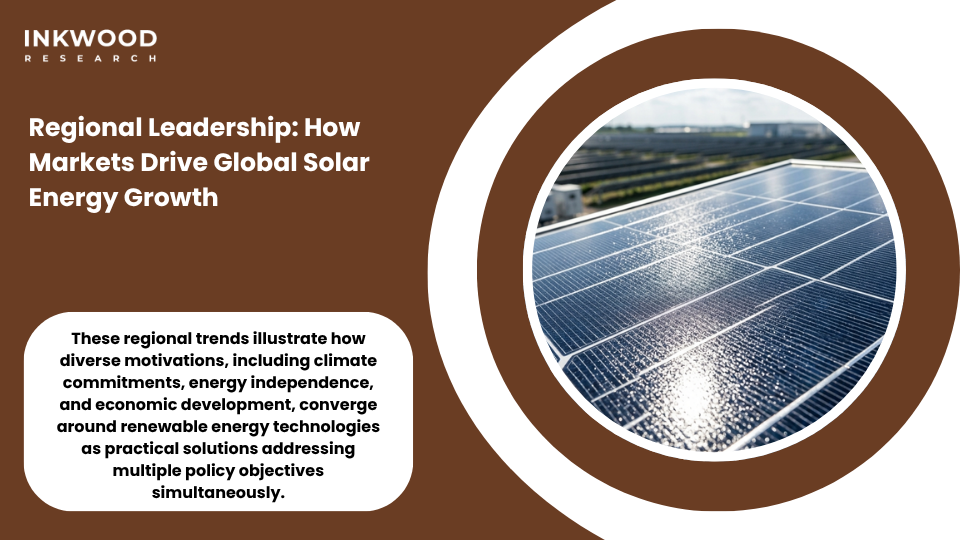
Asia-Pacific Dominance in Solar Module Manufacturing
Asia-Pacific nations maintained commanding positions in photovoltaic manufacturing throughout 2025. China continued expanding polysilicon production capacity while simultaneously advancing downstream solar module assembly capabilities. Meanwhile, Southeast Asian countries attracted manufacturing investments seeking geographic diversification beyond single-country dependencies.
Aligning with this, Vietnam, Thailand, and Malaysia developed substantial production footprints serving regional and global markets. This manufacturing concentration creates strategic implications for renewable energy supply chains. Companies balance cost advantages from established Asian production hubs against supply security concerns, motivating domestic manufacturing in consuming markets.
Consequently, policymakers implemented various incentive structures encouraging local production of monocrystalline and polycrystalline panels. These trade-offs between efficiency and resilience are increasingly shaping competitive dynamics across the global solar energy sector.
North American and European Market Developments
North American markets experienced remarkable expansion driven by federal incentive programs and state-level mandates. Utility-scale projects dominated capacity additions, though distributed generation through residential and commercial installations maintained steady growth. Notably, Texas emerged as a leading deployment region despite limited renewable portfolio requirements, demonstrating how favorable wind and solar resources combined with competitive wholesale electricity markets drive clean energy adoption.
European nations pursued aggressive renewable targets amid energy security concerns following geopolitical disruptions. Germany accelerated solar installations substantially while Spain leveraged exceptional solar resources for large-scale photovoltaic development. Furthermore, Eastern European markets previously reliant on conventional generation rapidly deployed solar capacity. These regional trends illustrate how diverse motivations, including climate commitments, energy independence, and economic development, converge around renewable energy technologies as practical solutions addressing multiple policy objectives simultaneously.
Competitive Landscape: Major Players Reshaping Photovoltaic Systems
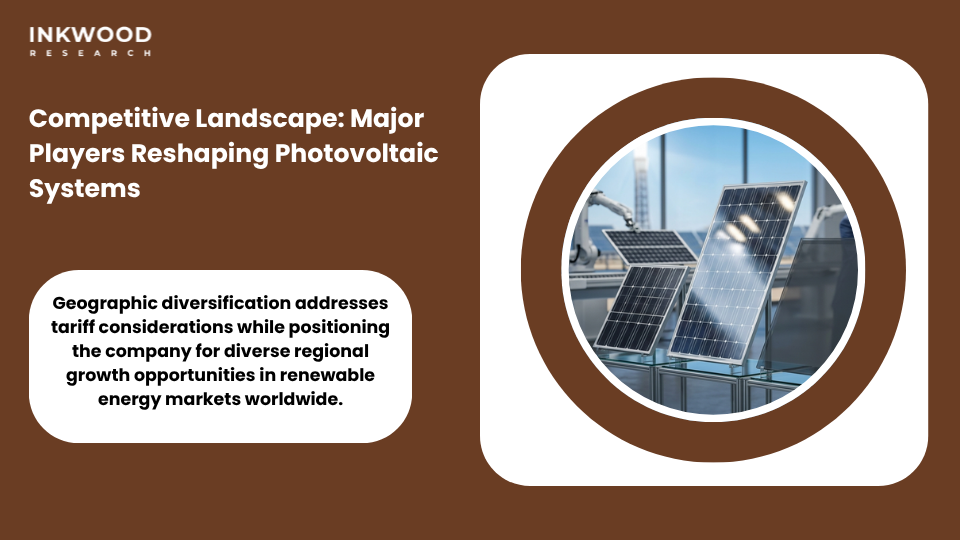
JinkoSolar maintains its position as the world’s largest solar module manufacturer, shipping record volumes throughout 2025. The company’s vertical integration strategy (controlling polysilicon through finished panel production) delivers cost advantages that competitors struggle to match.
Recently, JinkoSolar announced expansions into energy storage solutions, recognizing that integrated offerings provide differentiation as photovoltaic markets commoditize. This strategic evolution demonstrates how leading manufacturers adapt business models beyond pure hardware supply toward comprehensive energy solutions.
On the other hand, Trina Solar distinguished itself through technological innovation, particularly in bifacial panel architectures and large-format wafer implementations. These advances improve energy yield per installation, creating value for utility-scale developers prioritizing land-use efficiency.
Meanwhile, Canadian Solar expanded its global manufacturing footprint strategically, establishing facilities across Asia, the Americas, and planned European locations. Geographic diversification addresses tariff considerations while positioning the company for diverse regional growth opportunities in renewable energy markets worldwide.
Emerging Competitors and Concentrated Solar Specialists
First Solar carved a distinctive market position through cadmium telluride thin-film technology rather than conventional crystalline silicon approaches. This differentiation proved valuable for customers seeking supply chain diversity and technology risk mitigation. Moreover, the company’s American manufacturing base attracted significant demand from domestic customers valuing local content.
First Solar’s recent announcements regarding next-generation tandem cell development signal continued innovation ambitions beyond current product lines. Plus, concentrated solar specialists pursued distinct competitive strategies. Abengoa developed sophisticated power tower configurations integrating thermal storage capabilities that enable dispatchable renewable generation.
Similarly, companies like BrightSource Energy advanced Fresnel collector technologies optimized for industrial process heat applications beyond electricity generation alone. These specialized players demonstrate how clean energy transitions encompass diverse technology pathways rather than singular photovoltaic dominance, creating opportunities for differentiated market positioning across various customer segments and application requirements.
Inverter and Balance-of-System Component Leaders
System integration extends beyond solar modules themselves. SMA Solar Technology and Huawei compete intensely within the inverter market, where software capabilities increasingly differentiate offerings beyond pure hardware specifications. Moreover, advanced grid management features, remote monitoring capabilities, and predictive maintenance algorithms create value that project developers recognize and willingly pay premiums to obtain.
Consequently, component suppliers evolved from commodity vendors into strategic technology partners. Balance-of-system innovations accelerated alongside panel efficiency improvements. Mounting hardware manufacturers introduced robotic installation systems, reducing labor costs substantially. Tracker suppliers developed sophisticated algorithms optimizing panel orientation throughout the day, improving energy capture meaningfully.
Hence, these complementary innovations demonstrate how global solar energy market competitiveness depends on coordinated advancement across entire value chains rather than isolated component improvements alone. Successful renewable energy transitions require ecosystem thinking that traditional electricity generation sectors rarely demanded previously.
Key Takeaways
- The global solar energy market’s 2025 performance reveals fundamental shifts reshaping electricity generation worldwide. Installation velocity demonstrates that renewable energy technologies now compete effectively against conventional power sources without requiring unsustainable subsidy support.
- Financial markets recognize these competitive dynamics, allocating capital at scales previously reserved for traditional infrastructure. Consequently, energy executives must recalibrate strategic planning assumptions regarding future generation portfolios and investment priorities.
- Technology diversity strengthens rather than weakens the solar energy proposition. Monocrystalline efficiency improvements, cadmium telluride cost advantages, concentrated solar dispatchability, and amorphous silicon flexibility create tailored solutions for varied applications.
- This technological breadth ensures continued innovation rather than market stagnation around a single dominant approach. Moreover, manufacturing globalization combined with emerging regional capabilities creates supply chain resilience that earlier photovoltaic systems generations lacked entirely.
- Looking forward, sustained growth depends on continued policy support, grid infrastructure investment, and storage technology advancement. Nevertheless, the momentum established during 2025 demonstrates that clean energy transitions gained irreversible commercial viability.
- Businesses across industries must incorporate renewable energy planning into core strategies rather than treating sustainability as peripheral corporate responsibility exercises. The question facing decision-makers shifts from whether solar adoption makes sense to how quickly organizations can capture advantages from this fundamental power sector transformation.
Conclusion: Navigating the Renewable Energy Future
The solar energy revolution accelerated beyond most projections during 2025, establishing new benchmarks for deployment velocity and technological advancement. Photovoltaic systems now represent mainstream electricity generation solutions rather than experimental alternatives requiring extraordinary support.
Furthermore, financial markets validated this transition through unprecedented capital allocation toward renewable energy infrastructure. Meanwhile, competitive dynamics intensified as manufacturers pursued differentiation through efficiency improvements, geographic diversification, and integrated solution offerings.
Organizations navigating this transformation require a sophisticated understanding of technology options, regional market dynamics, policy frameworks, and supply chain considerations. Success demands moving beyond simplistic renewable versus conventional debates toward nuanced strategies leveraging solar energy’s diverse capabilities appropriately. Those who master these complexities will capture competitive advantages as global energy systems undergo their most significant restructuring in generations.
Inkwood Research provides comprehensive market intelligence supporting strategic decision-making throughout renewable energy transitions. Our analysts deliver actionable insights based on proprietary research methodologies and extensive industry partnerships.
Contact us to explore how our expertise can inform your organization’s clean energy strategy and investment planning.
Frequently Asked Questions (FAQs)
Key solar energy trends in 2026 include record installation growth, technology diversification, integration of battery storage systems, expanding global manufacturing capacity, and improved project financing conditions.
Solar photovoltaic systems are becoming cost-competitive with conventional power sources and increasingly contribute to large-scale electricity generation when combined with energy storage solutions.
Solar energy expansion may face challenges such as transmission infrastructure limitations, supply chain disruptions, policy uncertainty, and grid integration complexities.
Battery energy storage systems help store excess solar electricity and supply power during low sunlight periods, improving grid reliability and renewable energy utilization.
Solar module costs continue to decline due to technological improvements, large-scale manufacturing, supply chain efficiencies, and competitive global solar markets.
Government incentives, renewable energy targets, and supportive regulatory frameworks significantly accelerate solar energy deployment and investment worldwide.