Table of Contents

This analysis is brought to you by Inkwood Research, a leading market intelligence firm specializing in South Asian renewable energy transitions, solar power manufacturing ecosystems, and clean energy policy frameworks. Our research team combines extensive experience analyzing India solar energy market dynamics, photovoltaic manufacturing expansion, and sustainable development programs across emerging economies. Based on our proprietary research methodologies and strategic partnerships with Indian renewable energy agencies and solar technology providers, we deliver actionable insights empowering decision-making for global enterprises navigating India’s remarkable clean power transformation.
TLDR
India’s solar energy journey represents one of the most remarkable transformations in global renewable power history. The nation generated 108,494 GWh of solar electricity, surpassing Japan to claim third position worldwide. Manufacturing capacity doubled from 38 GW to 74 GW during fiscal year 2024-25, demonstrating unprecedented industrial expansion. Renewables now constitute 50.07% of India’s total installed capacity, achieving COP26 commitments five years ahead of schedule. This rapid ascent reflects strategic policy frameworks, ambitious national targets, and coordinated efforts across government agencies, private enterprises, and international partners, driving India’s clean energy revolution.
Renewable energy investors evaluating emerging market opportunities, solar module manufacturers exploring production expansion locations, and infrastructure developers pursuing utility-scale projects gain critical insights from this analysis. Policy makers designing clean energy frameworks, sustainability executives implementing corporate renewable programs, and technology providers targeting rapidly growing markets discover actionable intelligence. Additionally, climate finance professionals, supply chain strategists, and international development organizations focused on South Asia’s energy transition benefit from comprehensive coverage of India solar power growth trajectories and manufacturing ecosystem developments.
Introduction: India Solar Energy Market
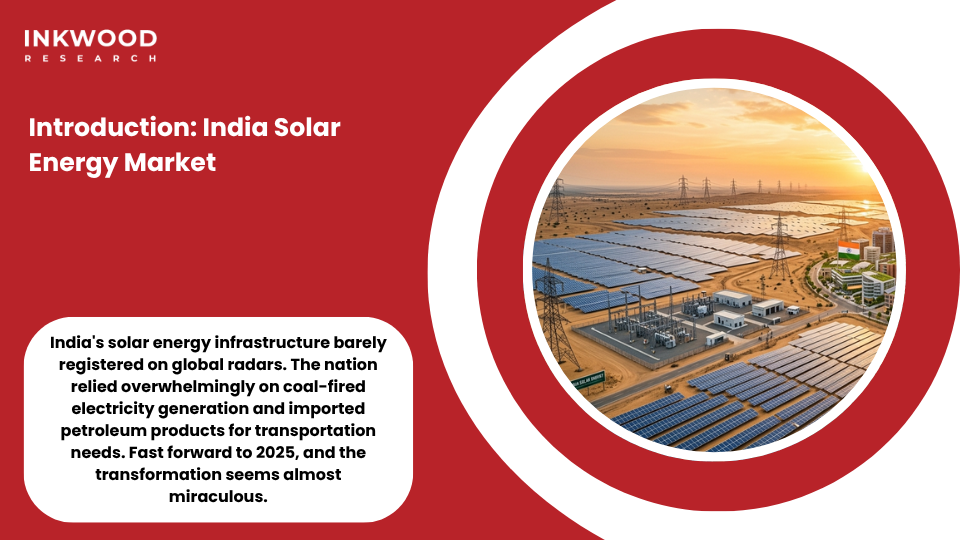
Two decades ago, India’s solar energy infrastructure barely registered on global radars. The nation relied overwhelmingly on coal-fired electricity generation and imported petroleum products for transportation needs. Fast forward to 2025, and the transformation seems almost miraculous. India now stands as the world’s third-largest solar power producer, surpassing technologically advanced nations like Japan.
The numbers tell a compelling story. According to IRENA Renewable Energy Statistics 2025, India ranks fourth globally in renewable energy installed capacity, fourth in wind power, and third in solar power capacity. During fiscal year 2024-25, solar module manufacturing capacity jumped from 38 GW to 74 GW—nearly doubling production capabilities within twelve months.
Meanwhile, total renewable energy installations crossed the critical threshold, representing 50.07% of India’s 484.82 GW total installed power capacity. These achievements arrived five years ahead of the nation’s COP26 commitments, demonstrating accelerated progress beyond initial projections.
What enabled such a rapid transformation? Multiple factors converged simultaneously in the India solar energy market. Government policies provided consistent long-term signals encouraging private investment. Technological costs declined substantially, making renewable energy economically competitive without requiring permanent subsidies. While international partnerships facilitated technology transfers and manufacturing know-how, domestic entrepreneurship flourished as Indian companies recognized opportunities within growing markets.
From Modest Beginnings: India’s Solar Energy Market Transformation

India’s renewable energy journey began modestly compared to its current achievements. Early installations faced significant obstacles, including limited domestic manufacturing capabilities, expensive imported equipment, and underdeveloped supply chains. Financial institutions lacked familiarity with solar project economics, making capital access challenging.
Furthermore, grid infrastructure required substantial upgrades to accommodate variable renewable generation patterns. These barriers initially constrained deployment velocity despite abundant solar resources across much of the subcontinent. Policy uncertainty complicated long-term planning during the early phases. Regulatory frameworks evolved frequently as governments experimented with different support mechanisms.
Additionally, developers struggled to navigate complex approval processes spanning multiple agencies and jurisdictions. Plus, land acquisition challenges slowed project development timelines substantially. These growing pains typified emerging markets confronting energy sector transitions without established precedents or institutional frameworks supporting renewable deployment at meaningful scales.
Breakthrough Moments Accelerating India Solar Energy Growth
Several pivotal developments catalyzed India’s solar acceleration. The National Solar Mission, launched in 2010, established ambitious targets that initially seemed unrealistic. However, these aspirational goals focused industry attention and mobilized resources toward achieving seemingly impossible benchmarks. Subsequently, competitive reverse auctions for power purchase agreements drove prices downward dramatically.
Indian developers achieved some of the world’s lowest solar tariffs, demonstrating remarkable cost competitiveness against conventional generation alternatives. On the other hand, international partnerships proved transformative for technology access and manufacturing capabilities. Collaboration agreements with leading photovoltaic producers facilitated knowledge transfers, accelerating domestic production readiness.
Moreover, Make in India initiatives encouraged foreign manufacturers to establish local facilities, creating employment while building indigenous industrial capabilities. These strategic moves positioned India solar capacity expansion on sustainable trajectories less dependent on imported equipment and foreign expertise over time.
Manufacturing Revolution: Doubling India Solar Capacity Infrastructure
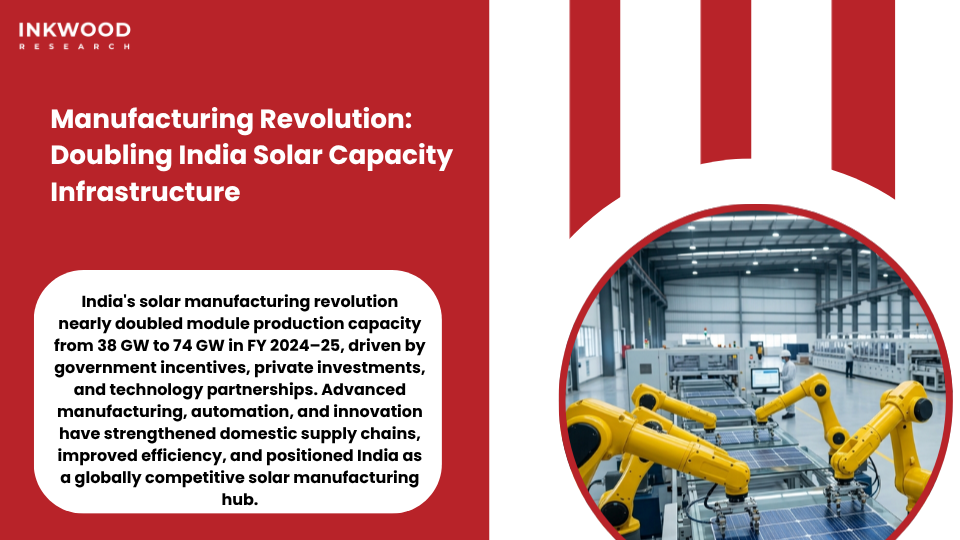
Manufacturing capabilities underwent an extraordinary transformation during fiscal year 2024-25. Solar module production capacity surged from 38 GW to 74 GW, representing nearly 95% expansion within twelve months. This rapid scaling reflects coordinated efforts across government incentive programs, private sector investments, and technology partnerships, enabling quick capacity additions.
Additionally, major industrial states attracted significant manufacturing investments, creating integrated supply chains spanning polysilicon production through finished panel assembly. Vertical integration strategies gained prominence among leading Indian manufacturers. Companies invested simultaneously in upstream materials production and downstream module assembly, capturing value throughout supply chains while reducing import dependencies.
Consequently, domestic content percentages increased substantially across new installations. This manufacturing depth provides strategic advantages, including cost control, quality assurance, and reduced exposure to international trade disruptions that previously constrained project development timelines and economics significantly.
Technology Adoption and India Solar Power Innovation
Indian manufacturers rapidly adopted advanced photovoltaic technologies, matching global efficiency standards. Investment in research and development capabilities enabled indigenous innovation rather than simple technology replication. Several domestic companies developed proprietary improvements in cell architectures, manufacturing processes, and quality control systems.
These advances demonstrate that India’s solar energy market participants compete on innovation rather than competing solely through low-cost labor arbitrage strategies. Further, automation and Industry 4.0 practices transformed production facilities beyond traditional labor-intensive approaches. Advanced manufacturing execution systems optimized production flows while minimizing defect rates and material waste.
On the other hand, robotics integration improved consistency across large-scale operations. Furthermore, data analytics enhanced predictive maintenance capabilities, reducing downtime and improving overall equipment effectiveness. These technological investments positioned Indian solar module production as globally competitive on quality and efficiency metrics, not just pricing considerations alone.
Policy Frameworks Driving India Solar Power Growth
Ambitious national targets provided clear directional signals guiding industry investments and development priorities. The government established specific capacity goals for renewable energy deployment, creating measurable benchmarks against which progress could be tracked. Plus, these commitments gained credibility through consistent policy support rather than shifting priorities with electoral cycles.
Consequently, developers and investors gained confidence in making long-term capital allocations toward solar energy in India’s infrastructure, knowing regulatory frameworks would remain supportive. Implementation mechanisms evolved substantially based on practical experience and market feedback. Early support systems relied heavily on feed-in tariffs guaranteeing prices for renewable power.
However, later programs shifted toward competitive auctions, driving cost reductions through market mechanisms. Additionally, viability gap funding addressed economic challenges in regions with weaker power demand or transmission constraints. These flexible policy instruments demonstrated a sophisticated understanding of market dynamics and a willingness to adapt approaches based on evolving circumstances.
Financial Incentives Supporting India Solar Energy Market Expansion
Production-linked incentive schemes transformed manufacturing economics by providing financial support tied to domestic value addition. Plus, these programs rewarded companies for establishing integrated supply chains within India rather than simply assembling imported components. Tax benefits, including accelerated depreciation and investment allowances, improved project returns substantially.
Furthermore, concessional financing through dedicated green energy funds reduced capital costs for both manufacturing facilities and power generation projects across the India solar power sector. Grid connectivity improvements received substantial government investment, addressing critical infrastructure gaps. Additionally, transmission capacity expansions enabled power evacuation from renewable energy zones to consumption centers. Smart grid technologies facilitated better management of variable solar generation patterns.
Moreover, storage integration programs encouraged battery deployments alongside photovoltaic installations, creating dispatchable renewable capacity. These complementary infrastructure investments proved essential, enabling solar energy penetration beyond what generation capacity alone could achieve within existing grid constraints.
Global Rankings: India’s Position Among Solar Energy Leaders
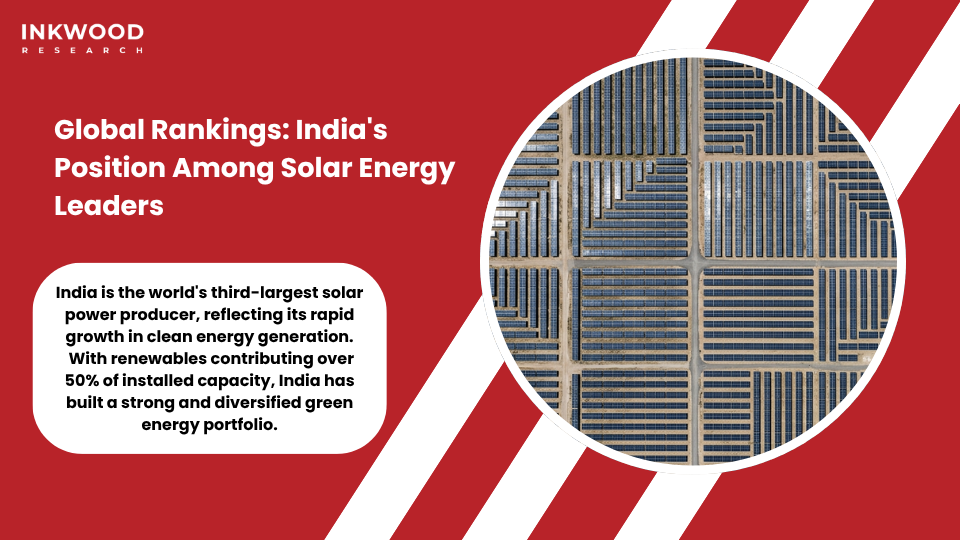
India’s achievement of producing 108,494 GWh of solar electricity during the measurement period represents remarkable progress. This output surpassed Japan’s 96,459 GWh generation, establishing India as the world’s third-largest solar energy producer behind only China and the United States.
Furthermore, the ranking reflects not just installed capacity but actual generation performance, demonstrating effective capacity utilization and grid integration capabilities beyond theoretical nameplate ratings. Comparative analysis reveals interesting dynamics among leading solar nations. China maintains dominant manufacturing and deployment positions globally. The United States leverages diverse state-level policies and favorable solar resources.
Meanwhile, India combines competitive manufacturing costs with rapidly growing domestic demand, creating unique market characteristics. European nations demonstrate mature markets with sophisticated grid integration practices. These different national contexts highlight multiple pathways toward clean energy transitions rather than singular optimal approaches.
Renewable Energy Portfolio Balance in India Solar Capacity Mix
Achieving 50.07% renewable share within total installed capacity represents a historic milestone for India’s power sector. This balanced portfolio spans solar, wind, hydroelectric, and emerging technologies, including energy storage systems. Also, the diversity provides system resilience against variable generation patterns from individual renewable sources.
Furthermore, geographic distribution across multiple states reduces correlated weather risks that could impact single-technology deployments concentrated in limited regions. Portfolio evolution continues beyond current achievements. On the other hand, offshore wind development gained momentum as technology matured and coastal states identified suitable locations. Hybrid renewable projects combining solar with wind or storage optimize land utilization and grid value.
Additionally, distributed generation through rooftop photovoltaic systems expanded significantly, particularly within commercial and industrial sectors seeking energy cost management. These complementary approaches create comprehensive renewable energy ecosystems rather than relying solely on utility-scale solar power generation India projects.
Regional Development: State-Level Solar Energy India Initiatives
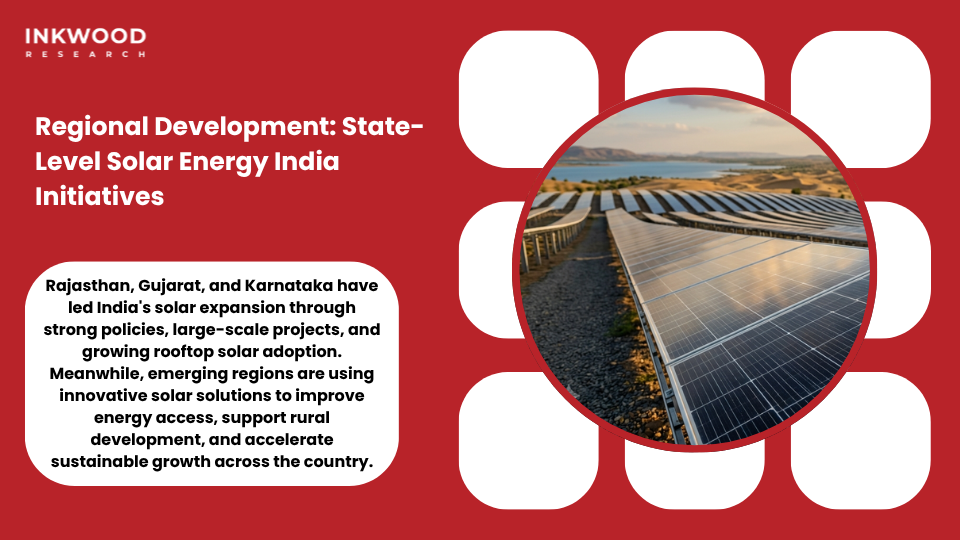
Rajasthan emerged as India’s solar powerhouse, leveraging abundant land availability and exceptional solar irradiation levels. The state attracted massive utility-scale projects through streamlined approval processes and dedicated renewable energy zones. Additionally, Gujarat maintained strong positions through early adoption and consistent policy support spanning multiple government administrations.
Meanwhile, Karnataka balanced large installations with thriving rooftop sectors serving Bangalore’s technology industry energy demands. Madhya Pradesh and Maharashtra pursued aggressive renewable targets, complementing their existing industrial bases. Tamil Nadu leveraged strong wind resources alongside growing solar deployments, creating diversified renewable portfolios.
Additionally, Andhra Pradesh and Telangana attracted significant project investments through competitive policies and improved transmission infrastructure. These state-level competitions for renewable investments accelerated overall India solar power growth beyond what centralized planning alone might achieve through distributed innovation and policy experimentation.
Emerging Opportunities in Previously Underdeveloped Regions
Northern states, including Uttar Pradesh and Punjab, recognized solar energy potential, addressing power deficit challenges. Urban areas within these states implemented ambitious rooftop programs, reducing grid dependence. Meanwhile, rural electrification through off-grid photovoltaic systems improved energy access in remote villages lacking transmission connectivity.
These applications demonstrated clean energy technologies addressing diverse development priorities beyond simple generation capacity additions. Himalayan states explored innovative approaches to match mountainous terrain constraints. Floating solar installations on reservoirs maximized water body utilization while avoiding land acquisition complications. Small-scale hydroelectric facilities paired with solar arrays created hybrid renewable systems leveraging complementary seasonal generation patterns.
Furthermore, tourism sectors adopted sustainable transportation solutions powered by renewable energy, demonstrating broad economic applications beyond traditional power sector boundaries. These creative implementations showcase India solar energy market versatility, addressing unique regional circumstances effectively.
Key Takeaways
- India’s solar energy transformation demonstrates how emerging economies can rapidly scale renewable technologies through coordinated policy frameworks, manufacturing investments, and sustained implementation commitment.
- The nation’s progression from negligible solar capacity to the third-largest global producer within compressed timeframes provides valuable lessons for other developing countries pursuing clean energy transitions.
- Success required simultaneous advancement across multiple dimensions—technology, manufacturing, policy, finance, and infrastructure—rather than sequential development.
- Manufacturing capacity doubling within fiscal year 2024-25 underscores India’s industrial capabilities when policy signals align with market opportunities.
- Domestic production expansion reduces import dependencies while creating employment and building exportable capabilities. This manufacturing depth provides strategic advantages extending beyond immediate cost benefits toward long-term technological self-reliance and supply chain resilience.
- Companies evaluating production locations should recognize that India’s solar capacity infrastructure now matches global quality standards while offering competitive economics.
- Looking forward, sustained growth requires continued infrastructure investment, grid modernization, and energy storage deployment.
- However, achieving COP26 commitments five years ahead of schedule demonstrates that aggressive targets, when backed by credible implementation, can exceed expectations.
- Organizations planning renewable energy strategies must recognize India solar power market as globally significant, with ongoing expansion trajectories creating sustained opportunities for equipment suppliers, project developers, and technology providers across the clean energy value chain.
Conclusion: India's Renewable Energy Leadership Journey
India’s ascent to third position among global solar energy producers represents more than a statistical achievement. It demonstrates how developing nations can leapfrog traditional energy infrastructure development pathways, embracing clean technologies at scales matching or exceeding those of industrialized countries.
Additionally, the 108,494 GWh generation figure and manufacturing capacity expansion to 74 GW reflect successful integration of policy vision, industrial capability development, and market-driven innovation, creating self-sustaining growth momentum.
Challenges remain, including grid infrastructure limitations, financing accessibility for smaller developers, and continued technology advancement requirements. Nevertheless, progress achieved within recent years establishes strong foundations for continued expansion.
India’s solar energy market evolution provides a blueprint for other nations pursuing rapid renewable transitions while addressing development priorities, including energy access, economic growth, and climate commitments simultaneously.
Inkwood Research delivers comprehensive intelligence supporting strategic decision-making throughout renewable energy transitions. Our analysts provide actionable insights based on proprietary research methodologies and extensive industry partnerships across South Asia and global markets.
Contact us to explore how our expertise can inform your organization’s clean energy strategy and India market entry planning.
Frequently Asked Questions
How much solar power does India produce?
India generated 108,494 GWh of solar electricity, surpassing Japan to become the world’s third-largest producer. This achievement reflects rapid capacity expansion and effective grid integration supporting renewable energy growth.
What is India's solar energy ranking in the world?
India ranks third globally in solar power generation and capacity. The nation also holds fourth position in overall renewable energy installed capacity and wind power, according to IRENA statistics.
How did India become the third-largest solar energy producer?
Coordinated policy frameworks, manufacturing capacity expansion, competitive auctions driving cost reductions, and sustained government support enabled rapid growth. Manufacturing capacity doubled to 74 GW within fiscal year 2024-25 alone.
What factors are driving solar power growth in India?
Rapid solar expansion in India is driven by government renewable energy targets, falling solar module costs, large utility-scale projects, and increasing electricity demand.
What is India’s target for solar energy capacity in the coming years?
India aims to significantly expand solar capacity as part of its broader renewable energy goal of reaching 500 GW of non-fossil fuel power capacity by 2030.
Why is solar energy important for India’s energy transition?
Solar energy helps reduce dependence on fossil fuels, improve energy security, and support India’s long-term climate and sustainability commitments.