Table of Contents
This analysis is brought to you by Inkwood Research, a leading market intelligence firm specializing in Asia-Pacific renewable energy technologies, perovskite solar cell development, and building-integrated photovoltaic systems. Our research team combines extensive experience analyzing Japanese innovation ecosystems, flexible thin-film manufacturing, and architectural solar integration strategies. Based on our proprietary research methodologies and strategic partnerships with Japanese research institutions, construction industry leaders, and photovoltaic technology developers, we deliver actionable insights that empower strategic decision-making for enterprises navigating Japan’s building-integrated solar revolution and flexible photovoltaic markets.
TLDR
Japan pioneers building-integrated photovoltaic solutions through flexible perovskite solar films. These lightweight materials enable architectural applications previously impossible with rigid crystalline silicon. Roll-to-roll manufacturing reduces production costs significantly. Demonstration projects validate performance across diverse installations. Furthermore, tandem cell architectures combining perovskite and silicon technologies achieve record efficiencies. Specialized solar encapsulation protects flexible modules from environmental degradation. Government funding accelerates commercialization timelines. Japan’s innovation addresses space constraints through seamless building integration. The technology transforms underutilized surfaces into productive energy generators.
Architectural firms, construction companies, renewable energy developers, building material manufacturers, perovskite researchers, urban planners, property developers, sustainability consultants, and photovoltaic system integrators will gain valuable insights into Japan’s flexible solar innovations, building-integrated photovoltaic deployment strategies, manufacturing advances, performance validation, and market opportunities in architectural renewable energy integration.
Japan’s Urban Density Challenge Driving BIPV Innovation

Japan faces unique renewable energy constraints stemming from limited available land. Urban density leaves minimal space for conventional ground-mounted solar installations. Consequently, building surfaces represent untapped potential for distributed generation. Traditional crystalline silicon modules struggle with architectural integration due to weight and rigidity. These limitations drive Japan’s focus on flexible, lightweight photovoltaic solutions.
Spatial Constraints Necessitating Architectural Solar Integration
Japan’s mountainous terrain restricts usable land to approximately 12% of the total area. Furthermore, dense urban development occupies much of this limited space. Rooftop and facade surfaces offer the primary opportunity for solar deployment expansion. However, structural limitations prevent widespread adoption of heavy traditional modules. Building codes strictly regulate additional roof loading capacity.
Aging infrastructure compounds integration challenges across Japanese cities. Many existing buildings cannot support significant additional weight. Meanwhile, aesthetic considerations influence architectural solar adoption rates. Property owners resist installations that compromise building appearance. Therefore, seamless integration becomes essential for market expansion. Building-integrated photovoltaic solutions address these multifaceted requirements simultaneously.
Government Policy Supporting Renewable Energy Development
Japan’s energy security concerns intensified following the 2011 Fukushima disaster. Nuclear power’s reduced role created demand for alternative generation sources. Consequently, government initiatives prioritize renewable energy technology development. NEDO’s Green Innovation Fund specifically targets next-generation photovoltaic commercialization. This strategic funding accelerates technologies addressing Japan’s specific deployment challenges.
The Japan solar encapsulation market reached $331.78 million in 2026. Projections indicate growth to $582.25 million by 2034, representing a 7.28% compound annual growth rate. This expansion reflects both conventional module deployment and emerging flexible technology adoption. Material innovation supports increasingly diverse installation environments and architectural requirements.
Film-Type Perovskite Technology Breaking Architectural Barriers
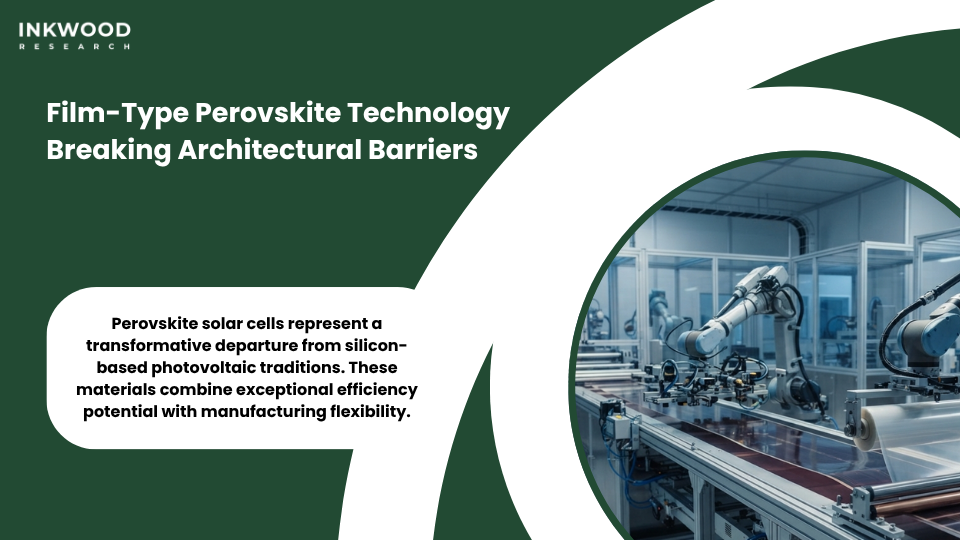
Perovskite solar cells represent a transformative departure from silicon-based photovoltaic traditions. These materials combine exceptional efficiency potential with manufacturing flexibility. Film-type configurations enable applications impossible with rigid crystalline silicon. Moreover, solution-based processing allows deposition on diverse substrates. This versatility unlocks architectural integration opportunities previously unattainable.
Perovskite Material Properties Enabling Flexible Applications
Perovskite absorber layers achieve high efficiency despite minimal material thickness. This characteristic reduces weight dramatically compared to silicon solar technologies. Additionally, flexible substrates replace rigid glass supports used in conventional modules. Lightweight construction enables installation on structures unable to support traditional photovoltaic systems. Furthermore, conformable modules integrate seamlessly with curved architectural elements.
Processing temperatures remain significantly lower than silicon manufacturing requirements. Consequently, energy consumption during production decreases substantially. Solution-based deposition methods enable large-area coating through established techniques. These manufacturing advantages translate to potential cost reductions at the commercial scale. However, stability challenges require continued development before widespread deployment.
Japanese Innovation Leadership in Perovskite Development
Japanese research institutions pioneered many fundamental perovskite photovoltaic advances. Academic-industry collaboration accelerates technology transfer from laboratory to commercial application. Companies like SEKISUI CHEMICAL invested heavily in manufacturing capability development. Meanwhile, government funding through NEDO supports demonstration projects validating real-world performance. This ecosystem approach coordinates research, development, and deployment effectively.
Intellectual property strategies position Japanese companies advantageously in emerging markets. Patent portfolios cover critical manufacturing processes and material formulations. Furthermore, vertical integration enables control over supply chains and quality standards. This strategic positioning supports Japan’s competitiveness as perovskite technologies are commercialized. Nevertheless, international competition intensifies as global interest grows.
Expo 2025 Demonstration: World’s Largest Perovskite Installation
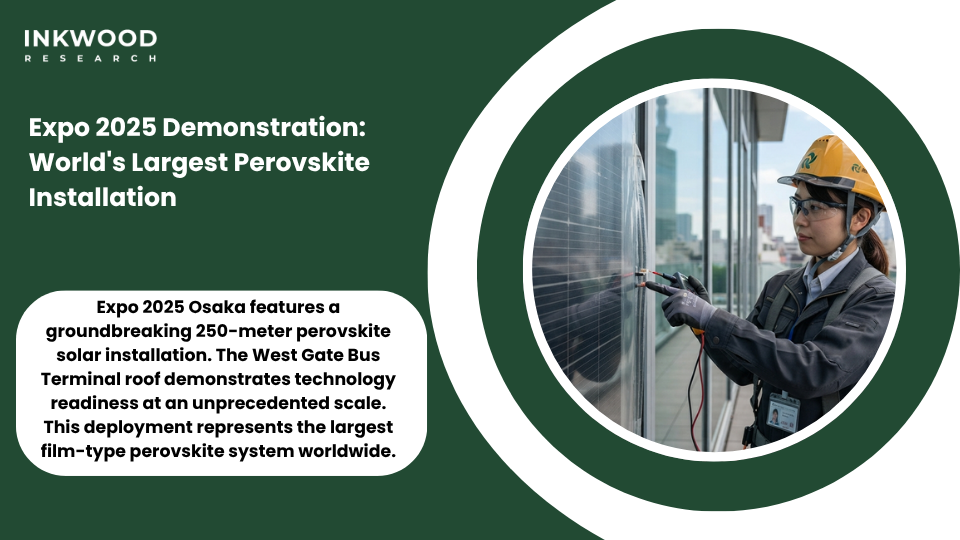
Expo 2025 Osaka features a groundbreaking 250-meter perovskite solar installation. The West Gate Bus Terminal roof demonstrates technology readiness at an unprecedented scale. This deployment represents the largest film-type perovskite system worldwide. SEKISUI CHEMICAL developed and manufactured the specialized solar films. According to project announcements, this installation validates commercial viability.
Technical Specifications and Performance Monitoring
The installation utilizes roll-to-roll manufactured perovskite films optimized for outdoor durability. Encapsulation strategies protect sensitive materials from moisture and oxygen exposure. Integrated monitoring systems track performance across diverse weather conditions. Data collection enables continuous refinement of manufacturing processes and material formulations. Real-world performance validation builds confidence for future commercial deployments.
Building-integrated photovoltaic design requires balancing energy generation with architectural aesthetics. The terminal roof application demonstrates seamless visual integration. Lightweight construction avoided structural reinforcement requirements. Moreover, installation proceeded rapidly compared to conventional module systems. These practical advantages support broader building-integrated photovoltaic adoption across Japan’s built environment.
Expanding Demonstration Portfolio Across Japan
SEKISUI CHEMICAL conducts parallel demonstrations at multiple locations nationwide, with company headquarters installations providing controlled testing environments. While Tokyo International Cruise Terminal deployment validates marine environment durability, Uchisaiwaicho South Tower integration represents future urban building applications. This diverse testing portfolio addresses varied deployment scenarios and environmental exposures.
Each demonstration site generates performance data informing commercialization strategies. Climate variations across locations test material resilience comprehensively. Additionally, different installation configurations validate manufacturing flexibility. Field trials identify reliability issues before large-scale production begins. This methodical approach minimizes risks associated with emerging technology deployment.
Roll-to-Roll Manufacturing Revolutionizing Production Economics

Roll-to-roll processing represents a fundamental manufacturing paradigm shift for photovoltaic production. This continuous process dramatically improves throughput compared to batch fabrication. Material utilization efficiency increases while waste decreases substantially. Furthermore, automation reduces labor requirements and improves consistency. These advantages position flexible thin-film solar technologies competitively against established crystalline silicon manufacturing.
Process Advantages Enabling Cost Reduction
Continuous web coating eliminates substrate handling inefficiencies inherent in batch processing. Multiple functional layers are deposited sequentially without intermediate handling steps. Consequently, production speed increases significantly compared to traditional module assembly. Quality control systems monitor continuously, catching defects immediately, while rework costs decline as process control improves through real-time feedback.
Capital equipment costs scale more favorably than batch manufacturing alternatives. Single production lines generate higher output with smaller physical footprints. Energy consumption per unit decreases through process integration and waste heat recovery. Meanwhile, material suppliers adapt packaging and delivery systems for continuous processing requirements. This ecosystem development further enhances economic competitiveness.
Technical Challenges in Continuous Perovskite Deposition
Maintaining uniform perovskite layer quality across continuous webs demands precise process control. Solution chemistry must remain stable throughout extended production runs. Temperature and humidity management become critical for consistent crystallization. Additionally, substrate cleaning and surface preparation require robust inline systems. These technical hurdles necessitate significant engineering development before commercial-scale production.
Solar encapsulation integration adds complexity to roll-to-roll manufacturing sequences. Protective layers must deposit without compromising underlying perovskite materials. Furthermore, adhesion between functional layers requires optimization for mechanical durability. Inline testing validates performance without interrupting continuous production. Process development continues refining these manufacturing sequences toward commercial readiness.
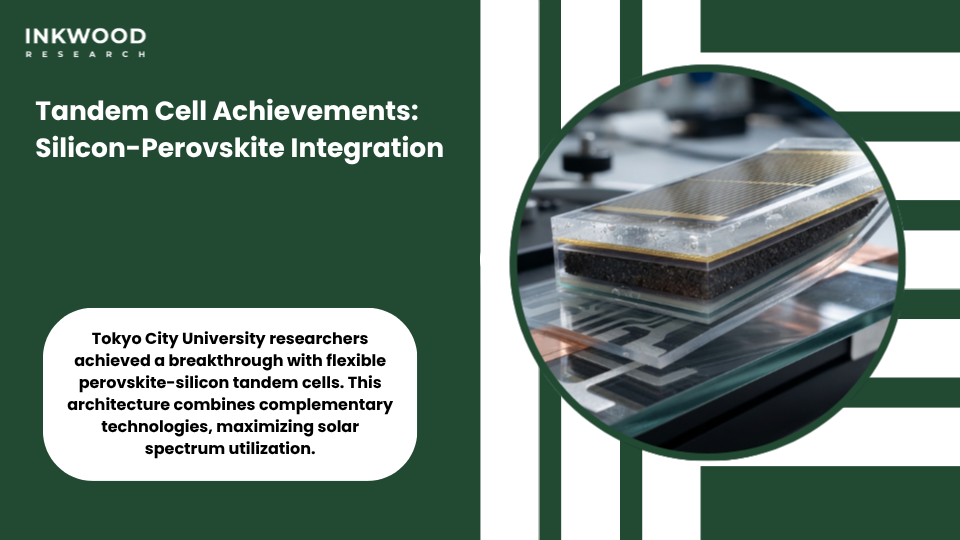
Tokyo City University researchers achieved a breakthrough with flexible perovskite-silicon tandem cells. This architecture combines complementary technologies, maximizing solar spectrum utilization. According to research publications, the team demonstrated 26.5% efficiency, representing the highest recorded performance for flexible perovskite-silicon tandems. Moreover, bendable form factors enable applications impossible with rigid alternatives.
Tandem Architecture Optimizing Light Absorption
Top perovskite layers absorb high-energy photons efficiently while transmitting longer wavelengths. Bottom silicon solar cells capture remaining light, completing spectrum utilization. This complementary absorption eliminates thermalization losses, limiting single-junction efficiency. Consequently, theoretical efficiency limits exceed conventional silicon technologies substantially. Practical implementations increasingly approach these theoretical boundaries.
Material selection requires careful optimization, balancing multiple performance factors. Perovskite bandgap tuning affects top cell current generation and optical transmission. Silicon heterojunction technology provides excellent bottom cell performance through surface passivation. Meanwhile, intermediate layers facilitate electrical connection without optical losses. Each component demands precise engineering for optimal system performance.
Thinning Silicon for Mechanical Flexibility
Researchers employed potassium hydroxide etching to create flexible silicon substrates. This chemical process selectively thins wafers while maintaining crystalline quality. Protective silicon nitride layers prevent unwanted etching during processing. Consequently, bottom cells achieve flexibility without sacrificing silicon solar efficiency. The 21.1% bottom cell performance demonstrates technology viability.
On the other hand, mechanical durability concerns require addressing for commercial flexible module deployment. Repeated bending cycles must not degrade electrical performance or structural integrity. Solar encapsulation becomes critical for protecting both silicon and perovskite layers. Furthermore, interconnection strategies must accommodate mechanical stresses without failure. Ongoing research optimizes materials and designs for long-term reliability.
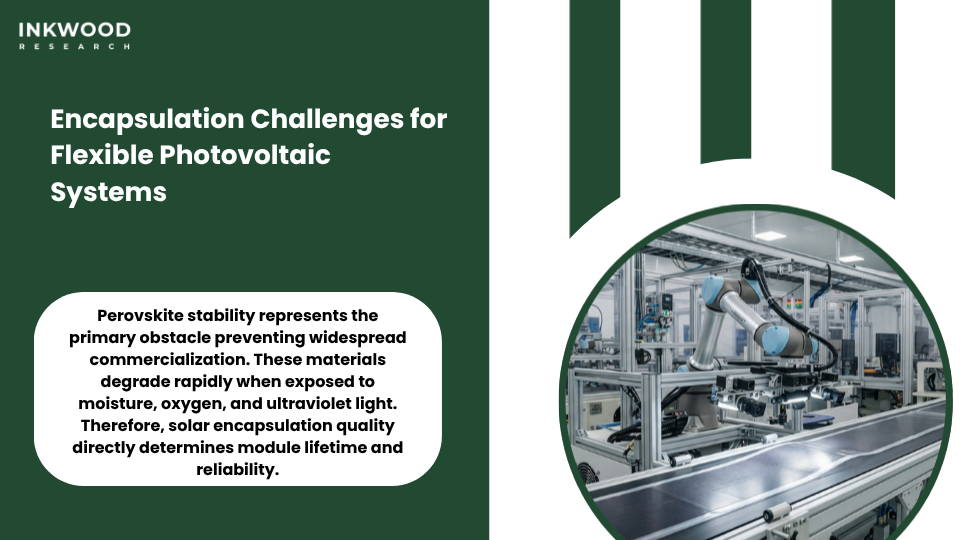
Perovskite stability represents the primary obstacle preventing widespread commercialization. These materials degrade rapidly when exposed to moisture, oxygen, and ultraviolet light. Therefore, solar encapsulation quality directly determines module lifetime and reliability. Flexible substrates complicate encapsulation strategies compared to rigid glass configurations. Edge sealing becomes particularly critical in preventing environmental ingress pathways.
Material Requirements for Perovskite Protection
Moisture barrier performance must exceed conventional crystalline silicon requirements substantially. Water vapor transmission rates approaching zero become necessary for perovskite longevity. Additionally, oxygen permeability requires minimization through specialized barrier layers. Traditional ethylene-vinyl acetate proves insufficient for perovskite applications. Advanced polymers with superior barrier properties become essential.
Optical transmission requirements remain stringent despite enhanced barrier needs. Encapsulation materials cannot compromise light reaching active layers. Furthermore, mechanical flexibility demands materials that maintain performance during bending. Adhesion between layers must withstand mechanical stresses without delamination. These competing requirements challenge material scientists developing next-generation encapsulation solutions.
Emerging Encapsulation Strategies for Flexible Modules
Multilayer barrier films combine inorganic and organic materials, optimizing multiple properties. Atomic layer deposition enables ultra-thin inorganic barriers with minimal optical impact. Polymer layers provide mechanical protection and stress relief. Meanwhile, edge sealing technologies prevent perimeter ingress routes. This multilayered approach addresses diverse degradation pathways simultaneously.
Testing protocols must validate encapsulation effectiveness under accelerated aging conditions. Standard tests developed for crystalline silicon may not adequately predict perovskite durability. Consequently, new qualification procedures specific to emerging technologies require development. International standardization efforts aim to establish reliability testing frameworks. These standards will facilitate market acceptance as technologies mature.

Japan’s building-integrated photovoltaic market demonstrates substantial growth potential driven by multiple factors. Urban density necessitates maximizing building surface utilization for renewable energy generation. Furthermore, government incentives support clean energy adoption across commercial and residential sectors. While technological maturation of flexible perovskite systems expands addressable market opportunities, material innovation in solar encapsulation enables longer-lasting installations, justifying investment.
Architectural Market Segments for Flexible Solar Integration
Commercial building retrofits represent significant near-term opportunities for lightweight photovoltaic deployment. Existing structures, unable to support traditional modules, become viable through film-type technologies. Additionally, new construction increasingly incorporates renewable generation from design phases. Aesthetic preferences favor seamless integration over visible panel installations. These market dynamics support premium pricing for building-integrated photovoltaic solutions.
Transportation infrastructure offers unique deployment opportunities for flexible solar technologies. Bus terminal installations like Expo 2025 demonstrate practical applications. Similarly, train stations, airport terminals, and parking structures provide extensive surface areas. Curved architectural elements particularly benefit from conformable module characteristics. Infrastructure operators increasingly recognize energy generation potential from underutilized surfaces.
Competitive Landscape and Market Entry Strategies
Established building material manufacturers possess distribution advantages for architectural solar products. However, photovoltaic expertise requires either internal development or strategic partnerships. Consequently, collaboration between the construction and renewable energy sectors accelerates market development. SEKISUI CHEMICAL exemplifies the successful integration of chemical engineering and solar technology capabilities.
International competitors increasingly target Japanese markets, recognizing growth opportunities. Nevertheless, local expertise in seismic design and building codes creates entry barriers. Furthermore, aesthetic preferences specific to Japanese architecture require product customization. Companies demonstrating long-term commitment through local manufacturing and research investments gain competitive advantages. The Japan solar encapsulation market expansion supports growing domestic and international participation.
Key Takeaways
- Japan addresses renewable energy challenges through innovative building-integrated photovoltaic solutions. Film-type perovskite technologies enable architectural integration impossible with rigid crystalline silicon.
- Expo 2025 Osaka showcases the world’s largest perovskite installation, validating commercial readiness. Roll-to-roll manufacturing promises significant cost reductions, supporting market competitiveness.
- Tandem cell architectures combining perovskite and silicon technologies achieve record efficiencies. Tokyo City University demonstrated 26.5% performance in flexible configurations.
- However, solar encapsulation remains critical for perovskite stability and long-term reliability. Advanced barrier materials protect sensitive layers from moisture and oxygen degradation.
- The Japan solar encapsulation market projects substantial growth, supporting diverse photovoltaic deployments. Building-integrated applications particularly benefit from flexible technology innovations.
- Government support accelerates commercialization timelines through strategic funding programs. Market opportunities span commercial retrofits, new construction, and transportation infrastructure integration.
Conclusion:
Japanese innovation leadership positions the nation advantageously in emerging flexible photovoltaic markets. Building-integrated applications address space constraints while advancing renewable energy adoption. Film-type perovskite cells represent transformative technology enabling architectural integration. Moreover, tandem configurations maximize efficiency through complementary material properties.
Manufacturing advances through roll-to-roll processing promise economic competitiveness at a commercial scale. Nevertheless, encapsulation development remains critical, ensuring long-term reliability. Material science innovations protect sensitive perovskite layers from environmental degradation. Plus, field demonstrations validate performance, building confidence for broader deployment.
Market growth reflects converging technology maturation and policy support. Japan’s experience offers valuable lessons for global building-integrated photovoltaic development. Urban environments worldwide face similar space constraints, driving architectural solar integration. Based on our analysis, flexible technologies will increasingly complement traditional ground-mounted installations, expanding renewable energy generation capacity.
For organizations seeking deeper insights into Japanese solar innovations or building-integrated photovoltaic strategies, Inkwood Research offers comprehensive market intelligence and consulting services. Contact our team to explore how these emerging technologies align with your strategic objectives.
Frequently Asked Questions
What advantages do perovskite films offer for building-integrated photovoltaics?
Perovskite solar films provide lightweight, flexible, and aesthetically adaptable solutions that enable installation on curved or load-sensitive building structures.
How does roll-to-roll manufacturing reduce perovskite solar cell production costs?
Roll-to-roll processing enables continuous large-scale production, improving throughput, reducing material waste, and lowering labor and energy costs compared to traditional batch manufacturing.
Why is encapsulation critical for perovskite solar cells?
Perovskite materials are highly sensitive to moisture, oxygen, and ultraviolet exposure, making advanced encapsulation essential for protecting the cells and extending operational lifetimes.
How do perovskite solar cells support building-integrated photovoltaic applications?
Perovskite technologies allow semi-transparent and lightweight solar films that can be integrated into windows, facades, and architectural surfaces for distributed energy generation.
What challenges affect commercial deployment of perovskite solar technology?
Key challenges include long-term material stability, large-scale manufacturing consistency, and the need for advanced encapsulation solutions to protect sensitive layers.
Why are perovskite solar cells considered promising for next-generation photovoltaics?
Perovskite cells offer high efficiency potential, lower manufacturing costs, and flexible application possibilities that support future photovoltaic innovation.