Table of Contents
Inkwood Research specializes in comprehensive market analysis and business intelligence across emerging technology sectors, including digital entertainment and educational gaming markets. Our research team combines decades of industry expertise with data-driven insights to deliver authoritative market perspectives.
TLDR
Religious digital games represent an emerging niche within the broader gaming market. Developers create faith-based titles for Islam, Christianity, Hinduism, Judaism, and other traditions. These games balance educational content with engaging gameplay. Market growth stems from demand for authentic cultural representation. Parental monitoring remains essential despite educational focus. Successful titles emphasize teaching over preaching. Realistic gameplay mechanics enhance learning outcomes. Challenges include cultural sensitivity and avoiding stereotypes. Major platforms now host diverse religious gaming content.
Educational technology investors, game developers, religious organizations, parents seeking faith-based content, cultural diversity advocates, mobile gaming publishers, curriculum developers, digital media executives, faith community leaders, and gaming platform operators will gain valuable insights into this specialized market segment’s growth potential, development challenges, and opportunities for authentic cultural representation in interactive entertainment.
The Emerging Religious Gaming Landscape
The global gaming market was valued at $230.96 billion in 2024 and is expected to reach $349.89 billion by 2032, growing at a CAGR of 5.39%, according to our research. Within this massive sector, religious-themed games represent a specialized niche experiencing steady growth. Moreover, faith-based gaming titles now span multiple religions and platforms, with mobile devices accounting for more than 50% of total gaming hours logged worldwide.
Understanding the Religious Gaming Segment
Religious digital games aim to educate players about faith traditions while maintaining entertainment value. Unlike mainstream gaming content, these titles prioritize cultural authenticity and educational outcomes. Plus, developers face unique challenges balancing engagement with religious accuracy. Meanwhile, parents increasingly seek alternatives to conventional gaming content for their children.
Organizations like Bigitec Studio pioneered immersive faith-based experiences with titles like Muslim 3D. Similarly, Christian game developers created platforms through initiatives like the Christian Game Developers Conference. Additionally, Hindu-focused games like Shloka address environmental themes through religious frameworks, while Jewish educational games from companies like Davka Corp have served niche audiences since the 1980s.
Market Size and Scope Considerations
Precise market sizing for religious games remains challenging due to limited specialized tracking. However, the broader educational gaming segment shows promising indicators. More than 3.3 billion people worldwide played games on smartphones in 2024. Moreover, educational content represents a growing proportion of mobile gaming downloads, while parents demonstrate increasing interest in faith-aligned digital content for children.
What’s Driving Faith-Based Game Development
Several factors fuel the expansion of religious gaming content. While cultural representation gaps in mainstream gaming create opportunities for specialized developers, communities seek positive portrayals of their faith traditions in interactive media. Moreover, educational institutions increasingly incorporate digital games into religious studies curricula.
Addressing Representation Deficits
For years, mainstream gaming has struggled with how it portrays religious characters. Muslim characters often appeared as antagonists in action titles, while Christian themes received superficial treatment in commercial games. Hindu deities faced misrepresentation or cultural insensitivity, and Jewish cultural elements remained largely absent from popular franchises. This lack of authentic representation created a noticeable gap in the gaming landscape.
Consequently, faith communities decided to take matters into their own hands. These grassroots efforts prioritized authentic representation over commercial appeal, bringing developers with personal connections to religious traditions into game design. Moreover, crowdfunding platforms opened new doors, enabling niche projects to secure initial financing without needing traditional publisher support.
Educational Value Proposition
Beyond representation, faith-based games offer compelling pedagogical advantages over traditional religious education methods. Interactive experiences naturally enhance information retention compared to passive learning approaches. When players engage with religious concepts through problem-solving and exploration mechanics, they absorb lessons more effectively. According to research on digital game-based learning, immediate feedback systems significantly improve educational outcomes.
Consider D’Youville University in Buffalo, New York, which incorporated Muslim 3D into its Gaming and Religion course curriculum. This academic validation demonstrates growing acceptance of religious games as legitimate educational tools. Furthermore, game-based learning frameworks allow students to experience religious practices in immersive virtual environments, creating connections that traditional classroom methods simply can’t replicate.
Diverse Religious Gaming Experiences Across Traditions
Religious gaming content now spans major world religions and denominations, with each faith tradition presenting unique development considerations and cultural requirements. Successful titles reflect a deep understanding of religious practices and community values, creating experiences that resonate authentically with their audiences.
Islamic Gaming Developments
Muslim 3D emerged as a pioneering title in Islamic gaming, marking a significant shift in faith-based digital content. Bigitec Studio created an immersive role-playing experience inspired by popular games like Skyrim and Assassin’s Creed. Additionally, players can explore virtual reproductions of holy Islamic sites, including the Grand Mosque of Mecca, while performing virtual Hajj pilgrimages and participating in Islamic rituals.
Bilal Chbib, managing director of Bigitec Studio, shared his development motivation with media outlets. He aimed to counter the negative Muslim stereotypes prevalent in mainstream gaming. Additionally, the studio expanded its portfolio with companion titles like Muslim Tales and Muslims Game Islam: Eid Mubarak, which educate players about Ramadan practices and Islamic family life.
Meanwhile, Islamic Relief UK partnered with Ultimatum Games to develop Virtue Reality, a mobile game that teaches humanitarian aid through Islamic charitable principles. Players accumulate “DeedCoins” by building shelters, wells, and schools in virtual environments. The game beautifully reflects the Islamic concept of good deeds as a religious obligation.
Christian Gaming Evolution
Christian gaming has evolved significantly from its early educational roots. Wisdom Tree pioneered faith-based games in the 1990s with titles like Super 3D Noah’s Ark. Today, modern Christian developers focus on production quality that matches mainstream standards, with games like The Great Commission offering strategic card-based gameplay woven into biblical narratives.
Further, the Christian Game Developers Conference plays a crucial role, connecting industry professionals through annual events and ongoing community support. This organization facilitates collaboration between developers who share faith-based design goals. Meanwhile, companies like Digital Praise have created successful titles, including Dance Praise, cleverly adapting popular gaming formats to Christian content.
Hindu and Jewish Gaming Initiatives
Hindu-focused gaming addresses unique cultural and environmental themes that resonate with contemporary concerns. Shloka, developed through UC Santa Cruz research, explores climate change through Hindu religious frameworks. Additionally, the game features seven levels addressing pollution at sacred sites, and its development included ethnographic research at religious locations throughout India.
Jewish educational games, on the other hand, date back several decades in the digital space. Davka Corp positioned itself as a leader in Judaic software since 1985, building a lasting legacy in the field. On the other hand, titles like Kosherland and Search for Your Israeli Cousin have successfully combined entertainment with cultural education. These games teach geography, religious practices, and Jewish history through interactive gameplay that engages learners of all ages.
Balancing Engagement with Educational Integrity
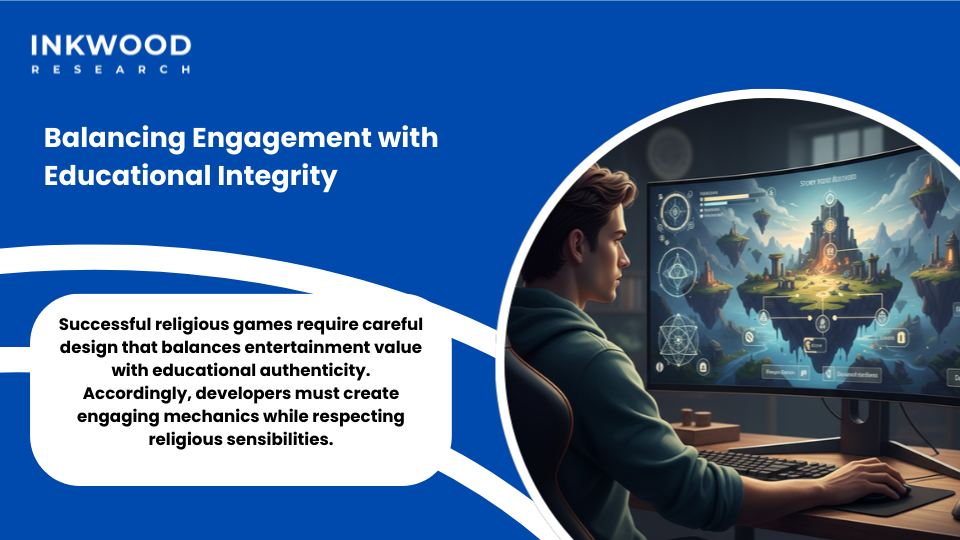
Successful religious games require careful design that balances entertainment value with educational authenticity. Accordingly, developers must create engaging mechanics while respecting religious sensibilities. This delicate balance often determines whether titles succeed in reaching their target audiences.
Teach Not Preach Philosophy
Effective faith-based games avoid heavy-handed moralizing or didactic approaches that can turn players away. Instead, players respond better to experiential learning than explicit preaching. Moreover, game mechanics should naturally encourage reflection on religious principles without forcing lessons down players’ throats. According to digital game-based learning research, constructivist approaches consistently yield better educational outcomes than directive teaching methods.
Muslim 3D exemplifies this philosophy beautifully through open exploration mechanics. Players discover Islamic history organically rather than through forced tutorials, creating a more authentic learning experience. Similarly, Shloka incorporates Hindu environmental ethics without explicit moral lectures. The gameplay naturally leads players toward ecological awareness aligned with religious values, making the message resonate more deeply.
Realistic and Challenging Gameplay
Beyond philosophy, religious games must offer genuine challenges to maintain player engagement. Trivial or simplistic mechanics simply fail to capture sustained attention. Plus, research indicates that appropriately challenging tasks promote deeper learning and skill development, which is why game difficulty should scaffold progressively as players advance.
The Great Commission demonstrates this principle well by incorporating strategic decision-making that matches the complexity of mainstream card games. Players manage resources, build communities, and navigate historical challenges with real consequences. This depth prevents the game from feeling like a superficial religious wrapper on basic mechanics, ensuring players stay engaged throughout.
Cultural Authenticity Requirements
Authentic representation requires deep cultural expertise that goes far beyond surface-level research. Developers benefit enormously from consulting religious scholars and community leaders throughout the design process. For example, Shloka’s development team conducted extensive ethnographic fieldwork at Hindu religious sites, interviewing priests and community stakeholders to ensure cultural accuracy.
This consultation process helps avoid inadvertent stereotyping or cultural insensitivity that could undermine the game’s impact. For instance, Shloka removed all combat mechanics after receiving feedback that violence contradicted Hindu principles of nonviolence. Accordingly, such adjustments demonstrate a genuine commitment to authentic cultural representation over generic gaming conventions, ultimately creating games that faith communities can truly embrace.
Content Oversight and Quality Standards
Despite educational intentions, parental monitoring remains essential for religious gaming content. Quality varies significantly across titles and developers, and as a result, parents must evaluate games based on multiple criteria beyond religious alignment.
Why Monitoring Matters for Faith-Based Games
Not all religious games maintain consistent quality or appropriate content standards, which is why parental oversight remains crucial. Some titles may inadvertently include insensitive cultural portrayals, while others might present theological interpretations parents disagree with regarding their faith tradition. Additionally, online multiplayer features can introduce potential exposure to inappropriate user interactions that parents need to watch for.
The Entertainment Software Rating Board (ESRB) provides helpful rating systems for parents evaluating game appropriateness. According to ESRB data, 84% of parents with gaming children check ratings before purchases. However, religious content nuances may not appear in standard rating categories, which means parents should review actual gameplay beyond just checking age ratings.
Evaluating Game Content Quality
Parents should assess religious games across several dimensions before allowing children access. First, verify whether developers consulted with religious authorities during development. Second, examine whether games accurately represent faith traditions without resorting to stereotyping. Third, evaluate the educational content quality against established curriculum standards.
Parental control systems can be invaluable tools for monitoring gaming time and content access. According to 2024 research, more than 67% of parents feel more comfortable with games certified through privacy protection programs. These tools allow parents to set time limits, block specific content ratings, and manage in-game purchases, providing peace of mind while children explore faith-based content.
Community and Expert Recommendations
Faith community leaders can provide valuable guidance on appropriate religious gaming content that goes beyond what rating systems offer. Many religious organizations now evaluate digital media specifically for congregation members, creating trusted recommendations. Educational institutions are increasingly incorporating vetted religious games into formal curricula as well. D’Youville University’s inclusion of Muslim 3D, for instance, demonstrates academic validation of quality faith-based gaming.
Parents should also consider developer track records and community feedback when making decisions. Games with positive reviews from religious education professionals typically maintain higher quality standards and greater sensitivity to faith traditions. Moreover, titles developed in consultation with faith communities consistently show greater cultural authenticity than commercial productions that simply add religious themes as an afterthought.
Major Developers and Platform Distribution
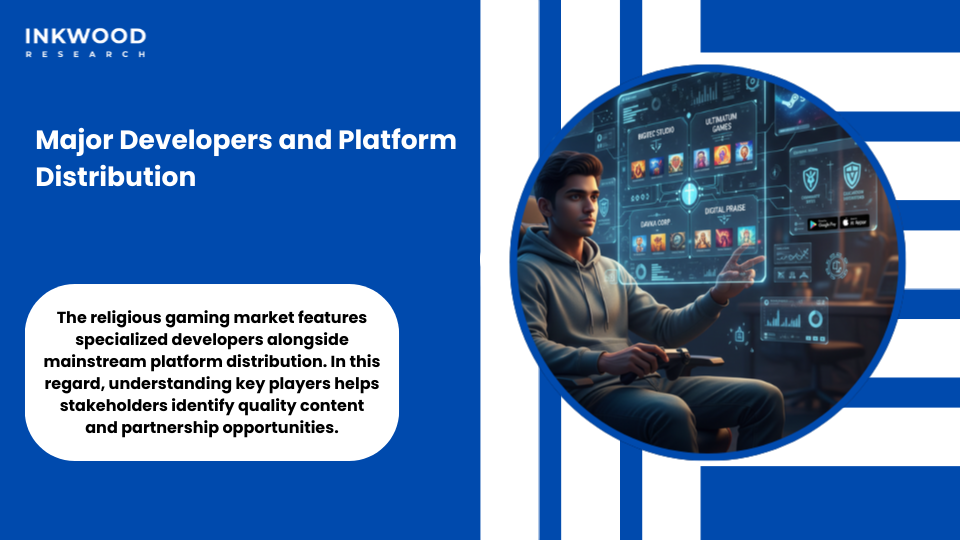
The religious gaming market features specialized developers alongside mainstream platform distribution. In this regard, understanding key players helps stakeholders identify quality content and partnership opportunities.
Leading Faith-Based Game Developers
- Bigitec Studio leads Islamic gaming development with multiple successful titles that have set industry standards. The Germany-based company pioneered immersive religious experiences through Muslim 3D, and their portfolio demonstrates a genuine commitment to authentic representation and educational value. The studio continues expanding its content with new features and chronicle episodes, showing dedication to long-term development.
- Ultimatum Games took a different approach by partnering with Islamic Relief UK on Virtue Reality. CEO Shahid Kamal Ahmad brought personal experience with Islamophobia to the development process, and this perspective directly informed the game’s focus on positive Muslim representation. The partnership model demonstrates how faith organizations can effectively collaborate with gaming professionals to create meaningful content.
- Davka Corp established itself as a pioneer in Jewish educational software, maintaining its position since 1985. The company has consistently focused on Judaic content across multiple product categories, and its extensive catalog serves Jewish education needs from elementary through adult learning. This longevity demonstrates that sustainable business models exist for niche religious gaming when developers stay committed to their communities.
- Christian gaming, meanwhile, sees more fragmented development across multiple smaller studios. The Christian Game Developers Conference facilitates community building among faith-based developers, creating networks of support and collaboration. Digital Praise created successful titles like Dance Praise by adapting popular game formats, while newer developers are focusing on higher production values that match mainstream gaming standards.
Platform Distribution Dynamics
Religious games now appear across major digital distribution platforms, expanding their reach significantly. Steam hosts multiple faith-based titles, including Muslim 3D and Christian adventure games. Mobile app stores feature hundreds of religious educational games for iOS and Android devices. However, discoverability remains challenging given algorithm prioritization of mainstream content, which tends to push niche titles to the margins.
Specialized distribution channels have emerged to serve specific religious communities more effectively. JewishSoftware.com and IslamicBookstore.com provide curated content for their respective audiences, offering community vetting beyond generic app store review processes. Christian gaming distributors similarly maintain faith-aligned content standards, ensuring quality and appropriateness for their user base.
Educational institutions represent another important distribution channel for religious games. Universities incorporating titles into curricula validate games for wider educational adoption, lending academic credibility to the medium. D’Youville University’s use of Muslim 3D, for example, creates pathways for broader academic distribution. K-12 religious schools are similarly adopting vetted educational gaming content, integrating it into their teaching approaches.
Mobile gaming dominates the religious gaming segment due to its accessibility and lower development costs. Free-to-play models with optional purchases enable wider audience reach, removing financial barriers for users. Educational institutions often prefer one-time purchase pricing for classroom deployments, providing predictable budgeting. Subscription models, on the other hand, remain relatively uncommon for faith-based gaming content.
Cultural Sensitivity and Development Hurdles
Religious game development faces unique challenges beyond typical gaming industry obstacles. Meanwhile, cultural authenticity requirements increase development complexity. Since market fragmentation limits economies of scale, funding constraints affect production quality for niche developers.
Avoiding Stereotypes and Insensitivity
Cultural stereotyping represents the most significant risk in religious gaming development, and the stakes are high. Mainstream games have historically portrayed religious characters through narrow, often negative archetypes. Muslim characters frequently appeared as terrorists or backward antagonists, while Hindu deities faced trivialization or inappropriate depictions. Moreover, Christian themes received superficial treatment, reducing complex theology to simplistic morality tales.
Developers must invest significant effort in researching faith traditions authentically, as surface-level understanding inevitably leads to inadvertent cultural insensitivity. According to research on digital game-based learning for religious education, inadequate cultural consultation can produce content that disrespects religious traditions unintentionally. One study documented how a school’s game inadvertently included stereotypical portrayals, despite good intentions.
Consultation with religious scholars and community leaders throughout development helps mitigate these risks considerably. Shloka’s development team, for example, conducted extensive ethnographic research at Hindu religious sites in India. Additionally, they interviewed priests and stakeholders to ensure accurate, respectful representation. This investment increased development time but ultimately yielded culturally authentic content that communities could embrace.
Balancing Entertainment and Religious Authority
Religious games must navigate an inherent tension between entertainment value and theological accuracy. Communities may disagree about appropriate religious representations in gaming contexts, creating challenges for developers. Further, some religious authorities question whether interactive entertainment trivializes sacred concepts, while others embrace digital media as valuable educational tools.
Muslim 3D faced criticism from some community members regarding specific gameplay elements. Critics objected to non-player characters walking near virtual representations of the Kaaba during prayer, raising concerns about respect for sacred spaces. These concerns highlight the careful balance developers must maintain. However, other Muslim commenters praised the game for its educational accessibility, showing that opinions within communities can vary widely.
The Legend of Zelda: Ocarina of Time offers another cautionary tale. The game originally included Islamic prayer chants in its background music. Nintendo removed this content after becoming aware of potential offense to Muslim players. This incident demonstrates how even unintentional religious references require careful consideration, regardless of developer intent.
Funding and Production Quality Constraints
Niche religious gaming markets limit revenue potential compared to mainstream titles, creating real financial challenges. This constrains the development budgets available for faith-based games significantly. Lower budgets typically result in reduced production quality compared to blockbuster mainstream releases, and players accustomed to high-quality graphics and mechanics may dismiss religious games as inferior products.
Crowdfunding platforms have emerged as alternative financing sources for specialized religious projects. The Great Commission was successfully funded through Kickstarter in September 2024, demonstrating the viability of this approach. This model allows developers to validate market demand before committing full production resources. However, crowdfunding success requires existing community awareness and strong marketing capabilities, which smaller developers may struggle to build.
Traditional game publishers rarely invest in religious gaming due to perceived market limitations, leaving faith-based developers on their own. Consequently, these developers typically operate independently with limited resources. This structural disadvantage perpetuates the production quality gap between religious and mainstream gaming content, creating a cycle that’s difficult to break.
Market Trajectory and Emerging Opportunities
Religious gaming markets show significant potential for continued expansion despite their current niche status. Several trends suggest growing opportunities for faith-based interactive entertainment, driven by technology advances that enable more immersive religious experiences and cultural diversity initiatives, creating demand for authentic representation.
Technology-Enabled Immersion
Virtual reality and augmented reality technologies are opening exciting new possibilities for religious gaming. VR could enable deeply immersive experiences of religious rituals and sacred spaces that were previously impossible to recreate. Muslim 3D’s virtual Hajj pilgrimage already demonstrates this potential with current technology, and next-generation VR headsets would enhance presence and educational impact even more significantly.
Augmented reality could take things a step further by overlaying religious educational content onto real-world locations. Imagine AR applications teaching Islamic architectural history at actual mosques, bringing historical context to life as visitors explore. Similarly, AR could provide interactive Torah study experiences within synagogues, enriching traditional learning environments. Hindu temple visits might incorporate AR elements explaining deity symbolism and ritual practices, helping visitors understand what they’re experiencing in real-time.
Further, cloud gaming platforms are democratizing access to religious games regardless of hardware capabilities. Players can stream high-quality faith-based content to any device, which removes significant barriers that previously prevented access to graphically sophisticated religious games. Consequently, developers can target broader audiences without compromising production quality to accommodate mobile limitations.
Educational Institution Adoption
Universities are increasingly recognizing religious games as legitimate educational tools, lending academic credibility to the medium. This institutional adoption provides stable distribution channels for quality faith-based games that might otherwise struggle to find audiences.
Educational licensing models could emerge as significant revenue sources for developers in the coming years. Schools typically prefer one-time institutional licenses over per-student purchases, simplifying budgeting and administration. Bulk educational distribution creates economies of scale that help offset development costs, making projects more financially viable. Moreover, institutional validation enhances game credibility with parent communities who trust educational endorsements.
Research initiatives like UC Santa Cruz’s Shloka project demonstrate genuine academic interest in religious gaming beyond simple adoption. Universities contribute development expertise and validation to faith-based projects, bringing resources and credibility to the field. These partnerships could accelerate innovation in religious game design significantly. Academic research also generates valuable evidence supporting the educational efficacy of faith-based gaming, building the case for broader adoption.
Global Market Expansion Potential
Religious gaming markets extend globally across diverse faith communities, offering substantial growth opportunities. India’s nearly 900 million internet users in 2024-2025 represent a massive potential audience for Hindu-focused games. Similarly, Muslim populations across Southeast Asia, the Middle East, and Africa offer substantial markets waiting to be tapped. Global Christian communities span both developed and emerging economies, creating diverse market segments.
Localization efforts can adapt successful titles across linguistic and cultural contexts effectively. Muslim 3D’s framework, for instance, could extend to Arabic, Urdu, Indonesian, and other languages with relative ease. Further, Christian games might localize for Catholic, Protestant, and Orthodox traditions separately, addressing theological differences. Jewish educational games could serve diaspora communities worldwide, maintaining cultural connections across borders.
Mobile-first development strategies align particularly well with global internet access patterns. Smartphone penetration continues growing rapidly in emerging markets where religious education remains culturally important and highly valued. Moreover, free-to-play models with optional purchases enable access regardless of economic circumstances, removing financial barriers to entry. This approach maximizes reach while maintaining revenue potential through engaged users who choose to support games they value.
Key Takeaways
- The religious gaming market represents a specialized but growing segment of digital entertainment.
- Faith-based games span major world religions, including Islam, Christianity, Hinduism, and Judaism. Successful titles balance educational authenticity with engaging gameplay mechanics.
- Developers must navigate cultural sensitivity requirements while maintaining entertainment value. Market drivers include demand for positive religious representation in gaming.
- Communities seek alternatives to mainstream titles stereotyping faith traditions. Educational institutions increasingly adopt religious games as legitimate learning tools.
- Technology advances enable more immersive and accessible faith-based experiences. Parental monitoring remains essential despite educational intentions of religious games.
- Quality varies significantly across developers and titles. Content evaluation should assess cultural authenticity, theological accuracy, and age-appropriateness.
- Platform distribution spans app stores, specialized religious retailers, and educational institutions.
- Challenges include avoiding cultural stereotypes, securing adequate funding, and balancing entertainment with religious authority.
- However, opportunities exist through VR/AR technologies, educational partnerships, and global market expansion. The sector demonstrates potential for continued growth, serving diverse faith communities worldwide.
Conclusion
Religious digital games occupy a unique space that bridges entertainment, education, and cultural identity in ways few other media can. These titles serve communities seeking authentic representation of their faith traditions in interactive media, filling a gap that mainstream gaming has largely overlooked. Successful developers are demonstrating that games can teach without preaching through thoughtful design and genuine community engagement.
The market trajectory suggests continued expansion as technology evolves and institutional adoption increases across educational sectors. Virtual reality, augmented reality, and cloud gaming will enable more immersive religious experiences that weren’t possible just a few years ago. Educational validation through university curricula enhances both credibility and distribution channels, creating sustainable pathways for growth. Global audiences present substantial opportunities for localized faith-based content that respects cultural and linguistic diversity.
Based on our analysis, the religious gaming market will continue evolving beyond its current niche status in the coming years. Faith communities are increasingly recognizing interactive media’s potential for cultural transmission and education across generations. Developers who prioritize authenticity, engagement, and community collaboration will be best positioned to capture this growing demand. The intersection of technology, faith, and gaming offers promising opportunities for meaningful innovation that serves both entertainment and educational purposes.
For organizations seeking deeper insights into religious gaming markets or faith-based digital content strategies, Inkwood Research offers comprehensive market intelligence and consulting services. Contact our team to explore how these emerging opportunities align with your strategic objectives and how you can participate in this evolving landscape.
Frequently Asked Questions (FAQs)
Religious games vary widely in complexity and content appropriateness. Many titles target children with simplified educational mechanics and age-appropriate themes. Others offer sophisticated gameplay for adults exploring religious history and philosophy. Parents should review ESRB ratings and content descriptions before allowing children access to faith-based games.
Dedicated religious games prioritize authentic cultural representation and educational accuracy. Developers typically consult religious scholars and community leaders throughout the design process. Mainstream games may include religious elements as narrative devices without commitment to theological accuracy. Faith-based games serve educational and cultural transmission purposes beyond entertainment alone.
Religious games appear on major platforms, including Steam, iOS App Store, and Google Play Store. Specialized distributors like JewishSoftware.com and IslamicBookstore.com curate faith-specific content. Educational institutions increasingly adopt vetted titles for curriculum use. Community recommendations from religious organizations help identify quality games aligned with specific faith traditions.