Table of Contents
This analysis is brought to you by Inkwood Research, a leading market intelligence firm specializing in medical technology innovations, diagnostic imaging systems, and healthcare transformation initiatives. Our research team combines extensive experience analyzing optical coherence tomography developments, clinical optical imaging solutions, and healthcare optical imaging equipment adoption patterns across global markets. Based on our proprietary research methodologies and strategic partnerships with medical device manufacturers and healthcare institutions, we deliver actionable insights that empower strategic decision-making.
TLDR
Optical imaging systems are transforming medical diagnostics through non-invasive visualization techniques that enhance disease detection and surgical precision. The global optical imaging devices market is experiencing unprecedented growth as healthcare providers adopt advanced technologies like confocal optical imaging systems, multiphoton optical imaging, and hyperspectral optical imaging devices. According to our analysis, the market is projected to reach US$7,537.42 million by 2034 from US$3,121.42 million in 2026, growing at a CAGR of 11.65%. Moreover, innovations in portable optical imaging systems and wearable optical imaging technologies are expanding clinical applications beyond traditional settings.
Healthcare executives, medical device manufacturers, and clinical specialists exploring the optical imaging systems market forecast opportunities will benefit from this comprehensive analysis. Additionally, investment analysts evaluating optical imaging technology market growth, hospital procurement managers assessing advanced optical imaging systems, and regulatory professionals navigating medical imaging approvals will find actionable insights. Furthermore, researchers studying optical imaging systems industry trends and entrepreneurs developing point-of-care optical imaging solutions can leverage these strategic perspectives for informed decision-making.
Understanding the Optical Imaging Revolution
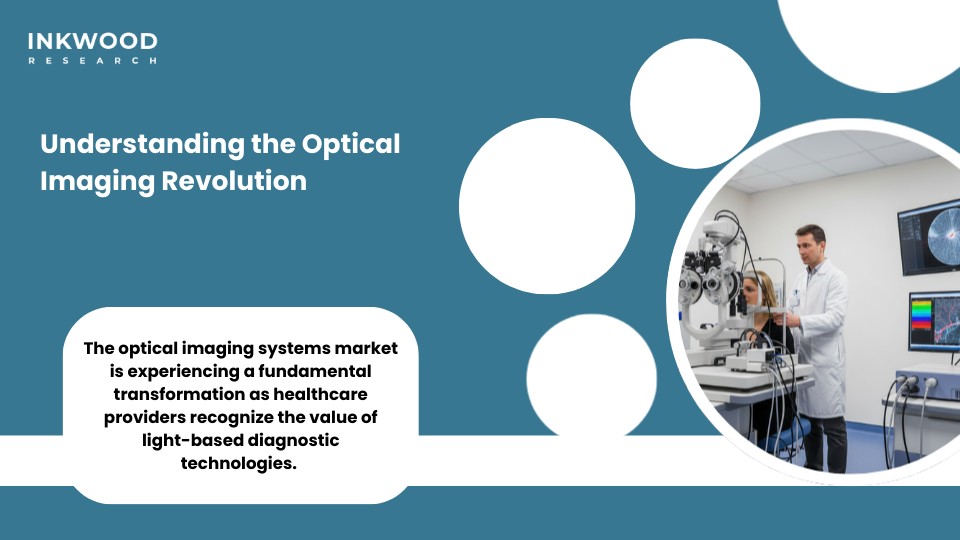
The optical imaging systems market is experiencing a fundamental transformation as healthcare providers recognize the value of light-based diagnostic technologies. Unlike traditional imaging modalities that rely on radiation or magnetic fields, optical imaging devices use photons to create detailed tissue visualizations. Consequently, these systems offer safer, faster, and more cost-effective diagnostic alternatives for numerous clinical scenarios.
Why Optical Imaging Matters Now
Medical facilities worldwide face mounting pressure to improve diagnostic accuracy while reducing patient risk. Therefore, clinical diagnostic optical imaging devices provide compelling solutions through non-ionizing radiation approaches. Furthermore, the ability to perform real-time imaging during surgical procedures has revolutionized intraoperative decision-making capabilities.
The FDA’s Division of Imaging, Diagnostics, and Software Reliability actively develops evaluation methods for emerging imaging systems. Additionally, regulatory frameworks continue evolving to support innovation while maintaining rigorous safety standards. Meanwhile, healthcare systems prioritize technologies that enhance patient outcomes without compromising accessibility.
Key Technologies Driving Market Expansion

Several breakthrough technologies are propelling the optical imaging systems industry trends forward through enhanced capabilities and broader applications.
Optical Coherence Tomography Dominance
- Optical coherence tomography (OCT) devices represent perhaps the most commercially successful optical imaging technology to date. These systems generate high-resolution cross-sectional images using low-coherence interferometry principles. Subsequently, ophthalmologists worldwide rely on OCT for diagnosing retinal diseases, glaucoma, and macular degeneration with unprecedented precision.
- Recent FDA approvals demonstrate continued innovation momentum in this space. For instance, AI Optics received FDA clearance for its Sentinel Camera, a portable handheld retinal imaging system addressing specialist shortages. Similarly, advances in superluminescent diode technology deliver brighter, higher-quality imaging even with media opacities like cataracts.
Fluorescence and Confocal Systems
- Fluorescence optical imaging systems enable molecular-level visualization through fluorescent contrast agents. Accordingly, surgeons can identify tumor margins, assess tissue perfusion, and guide resection procedures with remarkable accuracy.
- Meanwhile, confocal optical imaging systems provide cellular-resolution images without requiring tissue removal, revolutionizing dermatology and gastroenterology practices.
Multiphoton and Hyperspectral Innovations
- Multiphoton optical imaging systems penetrate deeper into tissues while minimizing photodamage through nonlinear excitation processes. Therefore, researchers studying thick tissue samples benefit from three-dimensional imaging capabilities.
- Additionally, hyperspectral optical imaging devices capture spectral information across multiple wavelengths, enabling tissue characterization based on biochemical composition rather than just structural features.
Clinical Applications Transforming Patient Care

The versatility of optical imaging systems enables transformative applications across multiple medical specialties. These include ophthalmology, oncology and surgical guidance, cardiovascular diagnostics, and preclinical research advances.
Ophthalmology Applications
Optical imaging systems for ophthalmology have become indispensable diagnostic tools in modern eye care. Notably, OCT technology allows non-invasive visualization of retinal layers, optic nerve head structures, and anterior segment anatomy. Furthermore, practices worldwide use these systems for monitoring disease progression, guiding treatment decisions, and documenting therapeutic responses.
Oncology and Surgical Guidance
Optical imaging devices for oncology address critical challenges in cancer detection and treatment. Importantly, intraoperative fluorescence imaging helps surgeons distinguish healthy tissue from malignant cells during tumor resection. According to FDA guidance on optical imaging drugs, these technologies serve as intraoperative aids for detecting pathology and delineating normal anatomical structures. Consequently, surgical outcomes improve through enhanced visualization capabilities.
Cardiovascular Diagnostics
Optical imaging systems for cardiology provide detailed coronary artery assessment during interventional procedures. For example, the FDA recently cleared SpectraWAVE’s HyperVue Imaging System for coronary artery imaging in patients undergoing transluminal interventional procedures. Meanwhile, intravascular OCT helps cardiologists optimize stent placement and assess plaque characteristics.
Preclinical Research Advances
Preclinical optical imaging systems accelerate drug development through non-invasive longitudinal monitoring of disease models. Consequently, researchers can track tumor growth, evaluate therapeutic responses, and study biological processes in living organisms. Additionally, these capabilities reduce animal research requirements while providing more comprehensive data.
Regional Market Dynamics and Growth Patterns

Geographic variations in healthcare infrastructure, regulatory environments, and disease prevalence create diverse optical imaging equipment market overview landscapes across regions.
North American Market Leadership
North America maintains a dominant market position through robust healthcare spending, advanced research infrastructure, and favorable reimbursement policies. Moreover, the presence of leading medical device manufacturers and academic institutions drives continuous innovation. The FDA’s regulatory framework for medical imaging devices provides clear pathways for bringing new technologies to market while ensuring patient safety.
European Market Sophistication
European markets demonstrate strong adoption of advanced diagnostic technologies supported by comprehensive healthcare systems. Additionally, regulatory harmonization through the Medical Device Regulation (MDR) facilitates market access across member states. Countries like Germany lead in both technology development and clinical implementation.
Asia-Pacific Growth Acceleration
Asia-Pacific regions exhibit the fastest growth rates driven by expanding healthcare infrastructure and rising chronic disease prevalence. Particularly, countries like South Korea have streamlined regulatory processes to encourage medical device innovation. The MFDS acceptance of Real-World Evidence since 2023 has significantly accelerated approval timelines for digital medical devices and AI-based imaging systems.
Competitive Landscape and Industry Leaders
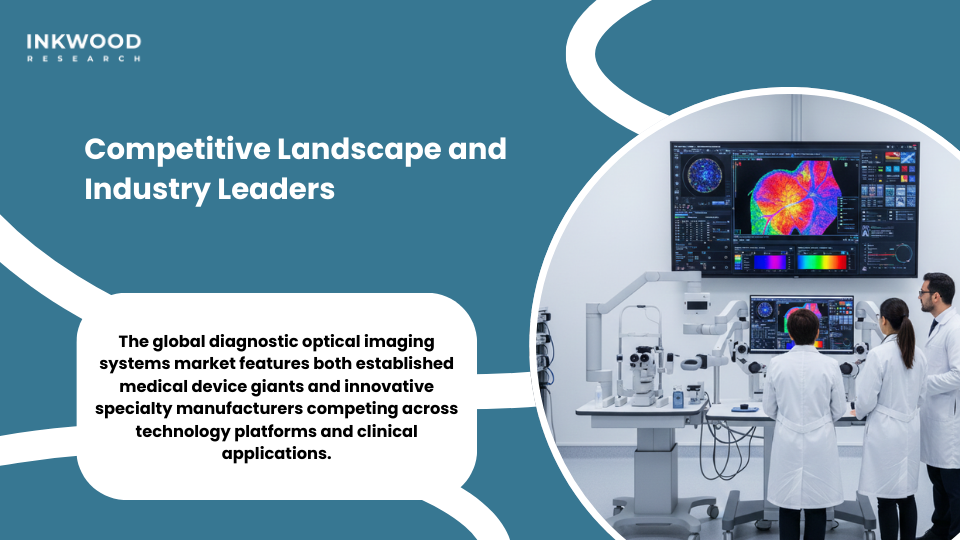
The global diagnostic optical imaging systems market features both established medical device giants and innovative specialty manufacturers competing across technology platforms and clinical applications.
- Carl Zeiss Meditec
Carl Zeiss Meditec stands as a dominant force in ophthalmic optical imaging through its comprehensive OCT product portfolio. The company continuously enhances imaging resolution, scan speeds, and analytical software capabilities. Recently, they expanded into surgical microscopy systems, integrating optical imaging technologies for enhanced visualization during delicate procedures.
- Topcon Corporation
Topcon Corporation delivers integrated diagnostic solutions combining optical imaging with electronic health record connectivity. Their multimodal imaging platforms enable comprehensive eye examinations through a single device. Moreover, Topcon invests heavily in artificial intelligence development to automate image analysis and improve diagnostic efficiency.
- Heidelberg Engineering
Heidelberg Engineering pioneered confocal scanning laser ophthalmoscopy and maintains technological leadership through continuous innovation. Their Spectralis platform combines multiple imaging modalities for comprehensive retinal assessment. Additionally, the company focuses on developing diagnostic algorithms that extract clinically relevant parameters from imaging data.
- Nikon Healthcare
Nikon Healthcare leverages optical expertise to develop advanced confocal microscopy and cell imaging systems for research applications. Furthermore, they’re expanding into clinical diagnostics through strategic partnerships and technology licensing agreements. Their investments in digital pathology position them well for emerging whole-slide imaging markets.
- PerkinElmer
PerkinElmer focuses on preclinical optical imaging systems serving pharmaceutical research and academic laboratories. Their in vivo imaging platforms enable longitudinal disease monitoring in small animal models. Consequently, drug developers can assess therapeutic efficacy earlier in development pipelines, potentially reducing overall development costs and timelines.
Recent Product Innovations and Breakthroughs
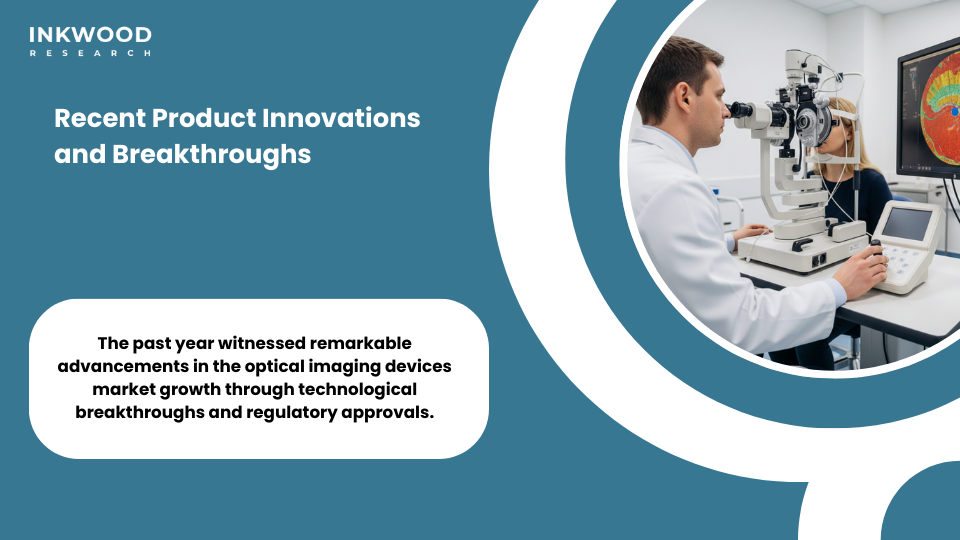
The past year witnessed remarkable advancements in the optical imaging devices market growth through technological breakthroughs and regulatory approvals.
FDA Breakthrough Device Designations
Several innovative optical imaging technologies received FDA Breakthrough Device designations, expediting development and review processes. Notably, EyeYon Medical’s EndoArt received FDA IDE approval for clinical trials of a synthetic endothelial layer treating chronic corneal edema. Meanwhile, BVI Medical secured FDA 510(k) clearance for its Leos Laser Endoscopy Ophthalmic System, introducing novel laser ECP procedures with superior anatomical visualization.
Portable and Point-of-Care Solutions
Point-of-care optical imaging solutions emerged as a critical market segment addressing healthcare accessibility challenges. For example, AI Optics’ portable Sentinel Camera enables retinal disease screening in primary care settings without requiring specialist expertise. Similarly, handheld OCT devices bring advanced imaging capabilities to bedside consultations and remote healthcare facilities.
Intraoperative Imaging Advances
Intraoperative optical imaging devices continue evolving to provide surgeons with real-time guidance during complex procedures. According to FDA guidance documents, these combination products integrate imaging devices with optical contrast agents to enhance tissue visualization. Furthermore, manufacturers are developing device-agnostic contrast agents compatible with multiple imaging platforms, potentially accelerating clinical adoption.
Artificial Intelligence Integration
AI-powered image analysis transforms optical imaging workflows by automating measurements, detecting abnormalities, and predicting disease progression. Consequently, clinicians can focus on treatment planning rather than manual image interpretation. Moreover, machine learning algorithms trained on diverse patient populations improve diagnostic accuracy across demographic groups.
Future Outlook and Strategic Opportunities
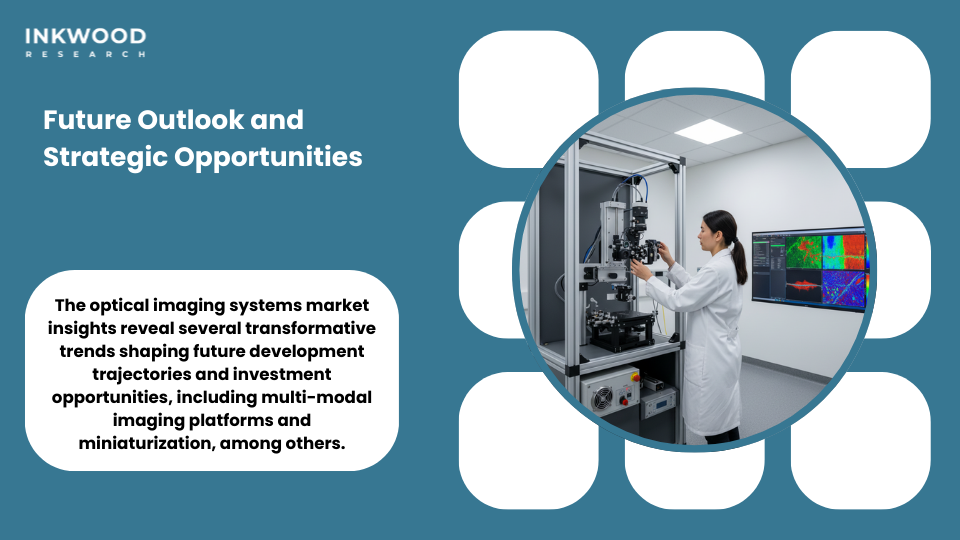
The optical imaging systems market insights reveal several transformative trends shaping future development trajectories and investment opportunities, including multi-modal imaging platforms and miniaturization, among others.
Miniaturization and Integration
Ongoing miniaturization efforts will enable wearable optical imaging systems for continuous health monitoring applications. For instance, researchers are developing compact devices capable of tracking tissue oxygenation, blood flow, and metabolic activity throughout daily activities. Additionally, integration with smartphones and consumer electronics will democratize access to basic imaging capabilities.
Multi-Modal Imaging Platforms
Healthcare providers increasingly demand comprehensive diagnostic solutions combining multiple imaging modalities within unified platforms. Therefore, manufacturers are developing systems integrating optical imaging with ultrasound, photoacoustic imaging, and other complementary technologies. Subsequently, clinicians can leverage synergistic information from different modalities without requiring separate equipment or examinations.
Molecular Imaging Expansion
Multispectral optical imaging systems will enable more sophisticated molecular imaging applications through targeted fluorescent probes. Accordingly, future systems may detect early biochemical changes preceding structural tissue alterations. Furthermore, pharmaceutical companies will use molecular imaging to monitor drug distribution, target engagement, and therapeutic responses with unprecedented precision.
Regulatory Evolution
Regulatory agencies worldwide continue refining approval pathways for innovative optical imaging technologies. The FDA’s guidance on developing optical imaging drugs clarifies requirements for combination products, potentially accelerating market entry for novel contrast agents. Similarly, international regulatory harmonization initiatives will streamline global commercialization strategies.
Key Takeaways
Several critical insights emerge from our comprehensive analysis of the optical imaging systems market forecast:
- Market Growth Trajectory: The global market will expand from US$3,121.42 million in 2026 to US$7,537.42 million by 2034, representing a robust 11.65% CAGR driven by technological innovation and expanding clinical applications.
- Technology Diversification: Multiple optical imaging modalities, including OCT devices, fluorescence imaging, confocal systems, and multiphoton platforms, serve distinct clinical needs, creating diverse market opportunities rather than winner-take-all competition.
- Clinical Integration: Successful adoption requires seamless workflow integration, compelling clinical evidence, and favorable reimbursement policies rather than technological superiority alone.
- Regulatory Dynamics: Evolving regulatory frameworks, particularly around combination products and AI-enabled imaging, create both opportunities and challenges requiring proactive engagement with authorities.
Geographic Variation: Regional markets exhibit distinct characteristics necessitating tailored commercialization strategies reflecting local healthcare systems, reimbursement landscapes, and regulatory requirements.
Conclusion
The optical imaging systems market stands at an inflection point where technological capabilities, clinical needs, and economic incentives converge to drive unprecedented growth. Healthcare providers increasingly recognize optical imaging as essential diagnostic infrastructure rather than optional advanced technology. Meanwhile, ongoing innovations in miniaturization, AI integration, and molecular imaging expand addressable applications far beyond current use cases.
Organizations positioned at the intersection of technological innovation and clinical validation will capture disproportionate value as markets mature. However, success requires understanding that superior technology alone proves insufficient without compelling clinical evidence, favorable economics, and seamless workflow integration.
Ready to navigate the optical imaging market landscape?
Inkwood Research provides customized market intelligence, competitive analysis, and strategic guidance, helping organizations identify opportunities, assess threats, and optimize market entry strategies. Contact our consulting team to discuss how our insights can inform your strategic planning and investment decisions.
Frequently Asked Questions (FAQs)
Multiple factors accelerate adoption, including non-invasive imaging advantages, improved diagnostic accuracy, real-time surgical guidance capabilities, and expanding clinical applications. Additionally, regulatory support and favorable reimbursement policies in developed markets facilitate faster commercialization.
Asia-Pacific demonstrates a 6.86% CAGR compared to North America’s 5.32% due to healthcare infrastructure expansion, population health challenges, and government modernization initiatives. Additionally, emerging markets experience simultaneous facility construction and technology adoption, while mature markets focus primarily on replacement cycles.
Ophthalmology represents the most mature market through widespread OCT adoption. However, oncology, cardiology, dermatology, and gastroenterology show rapid growth through fluorescence guidance, intraoperative imaging, and minimally invasive diagnostic procedures.