Table of Contents
This analysis is brought to you by Inkwood Research, a leading market intelligence firm specializing in European battery circular economy practices, second-life battery applications, renewable energy storage technologies, and EV battery repurposing methodologies. Our research team combines extensive experience analyzing Dutch energy infrastructure, battery management systems, stationary energy storage markets, and grid modernization programs across Western Europe. Based on our proprietary research methodologies and strategic partnerships with European battery repurposers, energy storage operators, automotive manufacturers, and sustainable technology providers, we deliver actionable insights that empower strategic decision-making for global enterprises navigating second-life battery opportunities and circular energy storage solutions.
TLDR
Netherlands emerges as Europe’s strategic hub for second-life battery applications, leveraging proximity to EV manufacturers and advanced energy storage infrastructure. Retired electric vehicle batteries retaining 70-80% capacity find new purpose in renewable energy storage, grid stabilization, and off-grid systems. Companies like EcarACCU and Time Shift pioneer innovative remanufacturing processes, achieving 98% material reuse rates. The Netherlands battery recycling market reached US$243.44 million in 2026, projected to grow to US$586.21 million by 2034 at an 11.61% CAGR.
Energy storage system developers implementing second-life battery solutions, renewable energy operators seeking cost-effective storage options, circular economy strategists evaluating battery reuse business models, EV fleet managers exploring end-of-life battery monetization, grid operators requiring flexible backup power systems, and sustainability consultants advising on battery lifecycle extension will discover practical applications here. Furthermore, Dutch policymakers and European Union regulators shaping battery circularity frameworks will gain valuable market insights.
Netherlands: Strategic Location for Battery Repurposing in Europe
The Netherlands battery recycling market occupies a unique position within Europe’s burgeoning battery circular economy. Geographic proximity to major EV manufacturers, combined with advanced energy infrastructure, creates ideal conditions for second-life battery development. Research indicates the Netherlands represents the best location for installing battery repurposing plants because of its closeness to EV manufacturers and potential European EV markets.
A strong relationship exists between EV market share and income per capita across European nations. The Netherlands demonstrates both metrics favorably, with high EV adoption rates and robust purchasing power. Consequently, the country generates significant volumes of retired EV batteries suitable for repurposing. Moreover, excellent logistics infrastructure facilitates efficient battery collection and distribution throughout Europe.
Market Valuation and Growth Trajectory
The Netherlands battery recycling market was valued at US$243.44 million in 2026. Projections indicate substantial growth to US$586.21 million by 2034, representing a remarkable 11.61% CAGR. This growth rate significantly exceeds global averages, reflecting the Netherlands’ strategic focus on sustainable battery recycling and circular economy practices.
Europe boasts one of the fastest-growing electric vehicle markets globally, with the Netherlands leading adoption alongside Germany and Norway. This rapid EV uptake fuels policy incentives, environmental awareness, and robust charging infrastructure development. Furthermore, increasing EV numbers means more batteries reach end-of-first-lifecycle status, presenting opportunities for repurposing.
The Second-Life Opportunity
Second-life batteries are retired electric vehicle batteries that still have considerable capacity left and can be repurposed for various energy storage applications. Many end-of-life batteries retain 60-80% usable capacity despite no longer meeting vehicle performance requirements. This retained capacity proves perfectly adequate for less demanding stationary storage applications.
The second-life battery market currently operates in early stages but anticipates exponential growth ahead. A new “stationary storage systems” sector emerges, with second-life batteries providing local and grid-scale energy storage capabilities. Additionally, compatibility with renewable energy infrastructure, combined with lower costs compared to new storage technologies, makes them especially appealing.
Understanding Second-Life Battery Economics
The economics of battery reuse and recovery present compelling value propositions for multiple stakeholders. Used EV batteries still maintain 70-80% of their capacity, enough to power on-site commercial battery storage systems. Repurposing EV batteries in battery energy storage systems provides value through reduced costs and more efficient EV charging operations.
Cost Advantages Over New Battery Systems
Fleet owners occupy unique positions to reduce energy and BESS costs by repurposing their own battery inventory. Sparkion’s proprietary SparkSwitch technology allows bypassing weak cells to generate more energy per cycle. This innovation reduces BESS cost-per-kWh by as much as 60% while cutting CapEx costs to half of competitive solutions.
In conventional EV battery storage units, the weakest cell drags down the usable capacity of entire battery packs, decreasing economic efficiency. Advanced cell-level management systems overcome this limitation. Subsequently, organizations achieve better returns on battery investments through extended utilization periods.
Environmental and Resource Benefits
By extending EV battery life, the need for new battery production diminishes, minimizing environmental impact from mining and manufacturing raw materials. Furthermore, battery repurposing helps reduce electronic waste ending up in landfills. This dual benefit supports both economic and environmental sustainability objectives.
Mitigating environmental impact through battery reuse represents a critical strategy as global battery demand accelerates. Rather than using more new batteries, second-life solutions repurpose retired EV batteries into BESS applications. This battery circular economy approach reduces waste and prevents additional Earth mineral depletion.
Market Accessibility and Supply Dynamics
The availability and quality of retired batteries can vary, making a reliable supply challenging to ensure. Nevertheless, the Netherlands’ concentrated EV market provides consistent feedstock for repurposing operations. Additionally, partnerships with automotive manufacturers secure predictable battery flows from lease returns and fleet replacements.
Economic viability challenges arise from several factors, including battery health problems due to degradation, safety concerns, inconsistent quality and availability, compatibility issues, and overall cost-effectiveness considerations. However, technological advances in battery diagnostics and management systems steadily address these obstacles.
Dutch Pioneers: Companies Leading Battery Reuse Innovation
Several innovative Dutch companies drive electric vehicle battery recycling and repurposing technologies forward. These organizations develop comprehensive solutions spanning collection, testing, remanufacturing, and deployment of second-life battery systems. Their pioneering work establishes the Netherlands as a European center of excellence for battery circularity.
EcarACCU: Comprehensive Remanufacturing Solutions
EcarACCU breathes new life into lithium batteries through innovative remanufacturing processes. The company receives various battery packs from plug-in hybrid and electric vehicles, then dismantles, reuses, and recycles them, achieving up to 98% material recovery. Individual cells form the basis for new products using updated management systems.
The company’s mission extends beyond mere recycling to reducing environmental harm and resource extraction. They advocate for sustainable economic practices with batteries at the core. Moreover, EcarACCU provides zero-emission solutions in energy storage, transportation, and smart grid applications.
Short feedback loops characterize their client partnerships, enabling co-creation in product and software development. Tailored solutions address specific customer requirements while maintaining standardized quality protocols. This flexible approach supports diverse end-of-life battery management applications across residential, commercial, and industrial sectors.
Time Shift: Smart Grid Integration
The Arnhem-based company Time Shift specializes in reusing discarded EV batteries for energy storage applications. Through the Gelderland Energy Agreement, an initiative involving Alliander and environmental federations, discarded EV batteries receive new life cycles. Specifically, Time Shift uses batteries to provide energy storage to the Smart Trolley Grid.
This smart electricity network consists of charging points on trolley masts where trolleybuses offload braking energy. Subsequently, electric vehicles “refuel” with recovered electricity at these locations. The system demonstrates practical battery materials recovery integration within existing urban transportation infrastructure.
Applications extend to providing backup for existing energy networks during consumption peaks and delivering self-sufficiency to households or entire islands. These diverse use cases showcase the versatility of repurposed battery systems. Furthermore, they validate business models supporting circular economy objectives.
Alliander: Infrastructure-Scale Deployment
Alliander Power Company takes responsibility for batteries on Pampus, the fort island in IJmeer. Power generated by solar panels is stored in repurposed batteries for later use. Pampus targets 100% sustainability and self-sufficiency by 2022 through integrated renewable energy and storage systems.
According to Alliander, a series of batteries in a half an ocean container can power an entire neighborhood off-grid for one day. This scalability demonstrates potential for second-life batteries addressing energy access challenges. Additionally, it proves the technical feasibility of distributed energy storage networks.
Renewable Energy Integration Through Repurposed Batteries
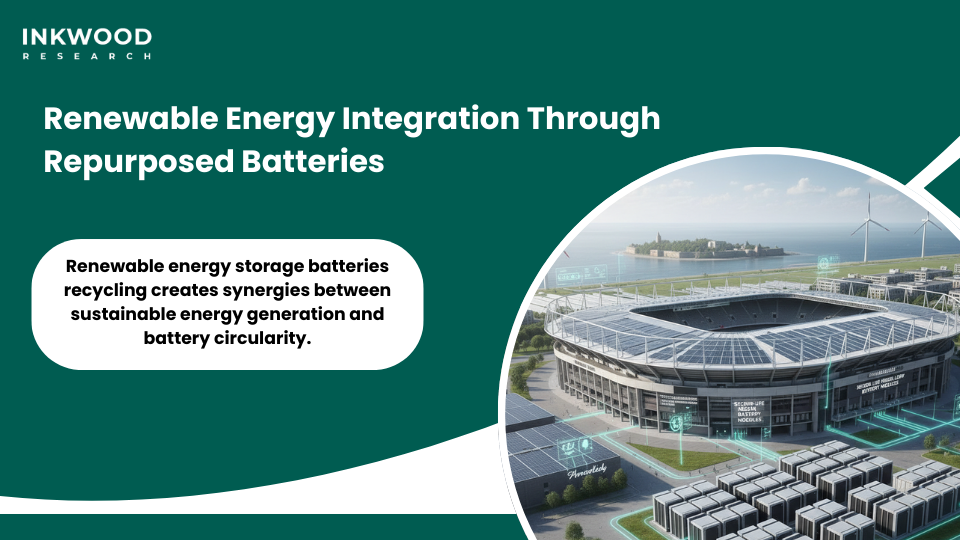
Renewable energy storage batteries recycling creates synergies between sustainable energy generation and battery circularity. Second-life EV batteries combine into large-scale energy storage systems, similar to Tesla Powerpack, storing excess renewable energy generated by wind and solar farms. Stored energy is released into grids during peak hours, helping stabilize systems and reduce fossil fuel plant dependence.
Amsterdam Arena: Showcase Implementation
Amsterdam Arena provides an excellent example of using second-life Nissan LEAF batteries to store energy from solar panels on the stadium roof. The second-life batteries also provide backup power options during grid outage events. This high-profile installation demonstrates the reliability and scalability of repurposed battery systems.
The stadium’s implementation attracted international attention, showcasing Dutch innovation in sustainable battery recycling. Moreover, it proved that second-life batteries meet demanding performance requirements for critical infrastructure applications. Subsequently, similar projects emerged across Europe following this successful model.
Off-Grid and Remote Applications
Islands and remote locations particularly benefit from second-life battery deployments. Pampus and other islands use repurposed batteries as part of their energy supply systems. These applications avoid expensive grid extension costs while providing reliable electricity access.
Used EV batteries serve as energy storage and delivery media for at least seven to ten years, according to industry analyses. This extended operational period provides substantial value in stationary applications. Consequently, total battery lifecycle economics improve dramatically through second-life utilization.
Grid Stabilization and Peak Demand Management
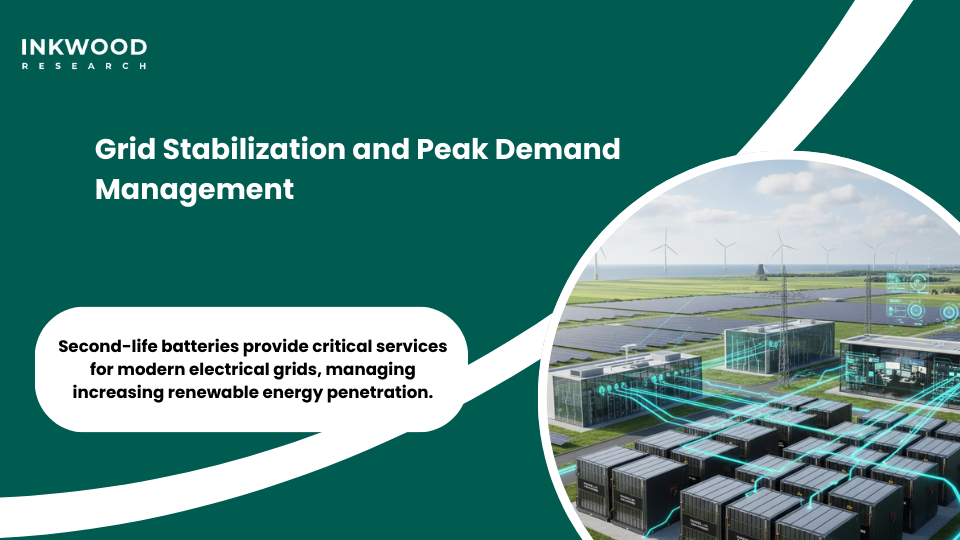
Second-life batteries provide critical services for modern electrical grids, managing increasing renewable energy penetration. Grid operators face challenges balancing supply and demand as variable renewable sources displace dispatchable fossil fuel generation. In this regard, repurposed battery systems offer flexible, cost-effective solutions for grid stability services.
Demand Response and Load Shifting
Battery energy storage systems enable demand response programs where consumption shifts to off-peak periods. Second-life batteries charge during low-demand hours when renewable generation exceeds consumption. Subsequently, stored energy discharges during peak demand periods, reducing strain on the generation infrastructure.
This load-shifting capability provides economic value to grid operators and end users alike. Utilities avoid expensive peaker plant operations during high-demand periods. Meanwhile, commercial and industrial customers reduce electricity costs through strategic consumption timing. Therefore, second-life batteries create win-win scenarios across stakeholder groups.
Frequency Regulation Services
Maintaining grid frequency within narrow tolerances requires rapid response capabilities. Second-life battery systems provide fast-responding reserve capacity for frequency regulation services. Their quick discharge and recharge capabilities make them ideal for this application.
Grid operators increasingly contract with battery storage operators for ancillary services, including frequency regulation, voltage support, and reactive power provision. Second-life batteries compete effectively with new battery systems for these applications. Consequently, repurposed batteries generate revenue streams supporting circular business models.
Backup Power and Resilience
Retired EV batteries could be used in data centers for backup power, replacing diesel generators used by the vast majority of facilities. This transition improves sustainability profiles while reducing operational costs. Moreover, battery systems provide quieter, cleaner backup power compared to diesel alternatives.
Critical infrastructure operators value reliable backup systems ensuring continuous operations during grid disturbances. Second-life batteries meet these requirements at lower costs than new battery installations. Additionally, modular battery systems scale easily to match specific backup power requirements.
Technical Challenges in Battery Health Assessment
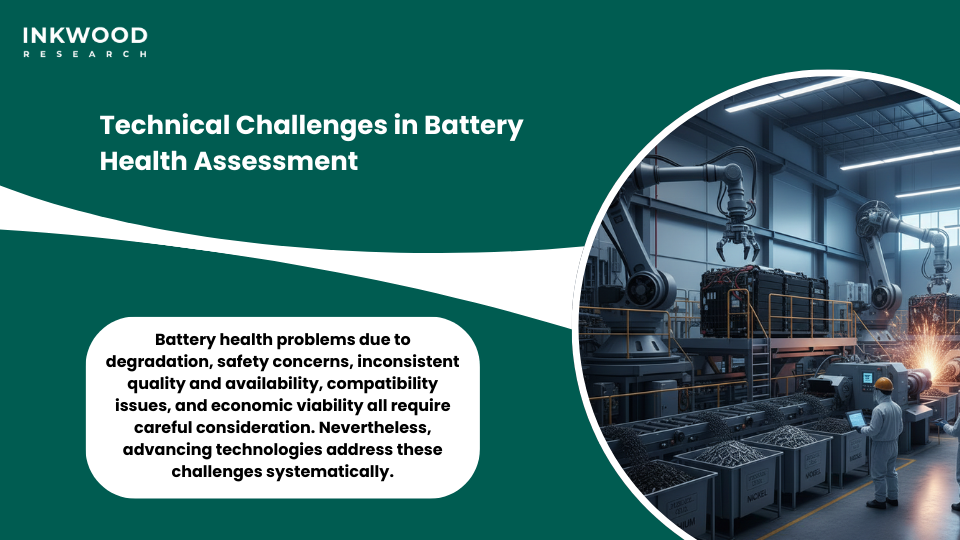
Using retired EV batteries in second-life applications faces several technical hurdles. Battery health problems due to degradation, safety concerns, inconsistent quality and availability, compatibility issues, and economic viability all require careful consideration. Nevertheless, advancing technologies address these challenges systematically.
State of Health Diagnostics
Accurately assessing battery State of Health (SOH) accurately determines viability for second-life applications. Diagnostic systems must evaluate capacity retention, internal resistance, and cycle life expectations. The Fraunhofer Institute developed methods combining quantum technology and AI to assess the viability of second-life applications for lithium-ion batteries non-destructively.
This technique enables faster evaluation of battery health, facilitating efficient battery recycling and repurposing decisions. Moreover, it reduces costs associated with detailed battery testing protocols. Consequently, more batteries qualify for second-life applications through improved assessment methodologies.
Safety and Thermal Management
Retired EV batteries may contain hazardous materials requiring careful handling protocols. Additionally, degraded batteries present increased thermal runaway risks if improperly managed. Advanced battery management systems monitor temperature, voltage, and current parameters continuously.
Proper thermal management systems ensure safe operations throughout second-life deployments. Cooling infrastructure maintains optimal operating temperatures, preventing degradation acceleration. Furthermore, protective enclosures meet safety standards for commercial and industrial installations.
Compatibility and Standardization
The significant variation in EV battery designs differs between manufacturers and car models, complicating automated recycling and repurposing. Lack of standardization increases costs and technical complexity. However, AI and machine learning enable systems to adapt to diverse battery formats.
Sparkion’s AI-driven solution enables turning retired second-life EV batteries into viable energy storage regardless of manufacturer, chemistry, or state of health. Their SparkCore energy management system uses proprietary algorithms to meet site goals with proactive, real-time monitoring. Thus, technology overcomes standardization challenges through intelligent adaptation.
Regulatory Framework Supporting Circular Battery Economy
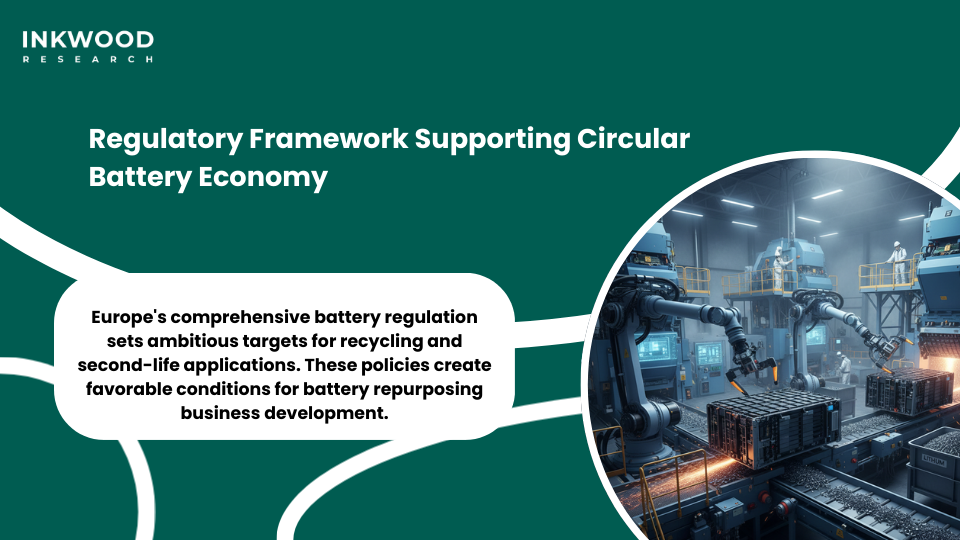
The Netherlands operates within the European Union regulatory frameworks, promoting battery circular economy development. Europe’s comprehensive battery regulation sets ambitious targets for recycling and second-life applications. These policies create favorable conditions for battery repurposing business development.
EU Battery Regulation Requirements
The European Union introduced stringent targets for minimum recycled content in batteries, requiring companies to include at least 6% lithium and 16% cobalt from recycled sources by the decade’s end. These rules also set performance benchmarks for recycling plants, demanding at least 65 percent of battery weight recovery by 2025.
Digital product passports will store relevant battery data throughout the entire lifecycle, containing detailed information about battery production, testing, and recycling. This traceability supports second-life market development by providing reliable battery history information. Consequently, repurposers make informed decisions about battery suitability for specific applications.
Extended Producer Responsibility
Extended Producer Responsibility (EPR) programs make manufacturers responsible for end-of-life battery management. This framework incentivizes design-for-recycling and second-life compatibility. Moreover, EPR funding supports collection and processing infrastructure development.
The Netherlands implements EPR principles through national legislation aligned with EU directives. Manufacturers finance collection systems, processing facilities, and consumer education programs. These investments strengthen circular economy infrastructure supporting second-life battery markets.
Safety and Performance Standards
Standards classify batteries based on performance potential and classify storage applications based on performance needs. Widely accepted standards and regulatory regimes setting broad guidelines are essential for the widespread adoption of recycled batteries. Subsequently, clear standards reduce market uncertainty and accelerate deployment.
ISO publishes standards proposing frameworks for battery safety, recycling, and performance evaluation. These international standards facilitate cross-border trade and technology transfer. Furthermore, harmonized regulations reduce compliance costs for companies operating across multiple markets.
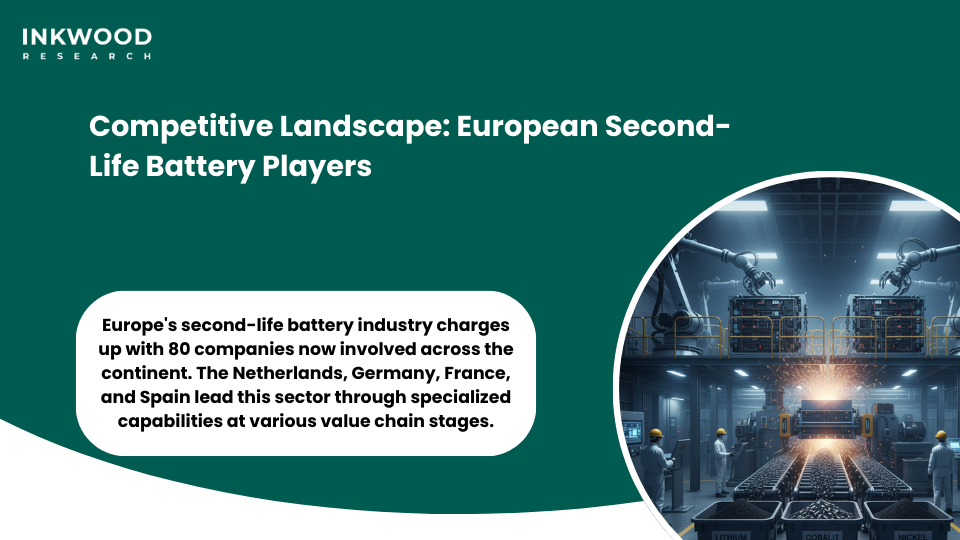
Europe’s second-life battery industry charges up with 80 companies now involved across the continent. The Netherlands, Germany, France, and Spain lead this sector through specialized capabilities at various value chain stages. Competition intensifies as more players recognize commercial opportunities in battery repurposing.
Germany: Manufacturing and Integration
Germany dominates as the biggest player with several companies involved in various process stages. The country’s leadership in automotive manufacturing and central European location make it a natural hub for battery recycling and repurposing. Companies like Audi and Mercedes-Benz invest heavily in second-life battery programs.
Mercedes-Benz + Primobius launched an integrated plant at Kuppenheim, achieving recovery rates above 96%. This vertical integration demonstrates automakers taking direct supply chain control. Similarly, other German manufacturers develop in-house battery repurposing capabilities.
UK: Grid Storage Specialists
The United Kingdom makes significant strides with companies like Zenobe and Honda focusing on using second-life batteries for grid storage applications. These firms specialize in aggregating retired EV batteries into utility-scale storage systems. Subsequently, they provide grid services, generating revenue from previously “waste” assets.
Connected Energy Ltd. develops modular second-life battery systems for commercial and industrial applications. Their technology enables scalable deployments matching specific customer requirements. Moreover, standardized designs reduce project development timelines and costs.
France and Spain: Renewable Integration Leaders
Renault Group in France specializes in second-life battery integration for home energy storage and large-scale renewable energy projects. The company leverages its automotive expertise to develop comprehensive battery lifecycle solutions. Additionally, Renault partners with energy utilities, deploying repurposed batteries supporting renewable integration.
In Spain, BeePlanet Factory and Altabat work on integrating second-life batteries into energy storage systems for homes and businesses. These installations help Spain reduce fossil fuel reliance while advancing renewable energy goals. Furthermore, they demonstrate the economic viability of battery circular economy business models.
Market Consolidation Trends
Despite the promise, the second-life battery industry faces challenges from a lack of standardized testing procedures across Europe. No universal standard exists for assessing used battery conditions, leading to inconsistencies and delays. However, growing EV demand means more batteries will become available for second-life applications coming years.
The growing demand ensures consistent feedstock supplies supporting industry expansion. Moreover, technology improvements reduce testing costs and improve reliability predictions. Consequently, market conditions favor continued growth and consolidation around leading players.
Latest Innovations in Battery Repurposing Technologies
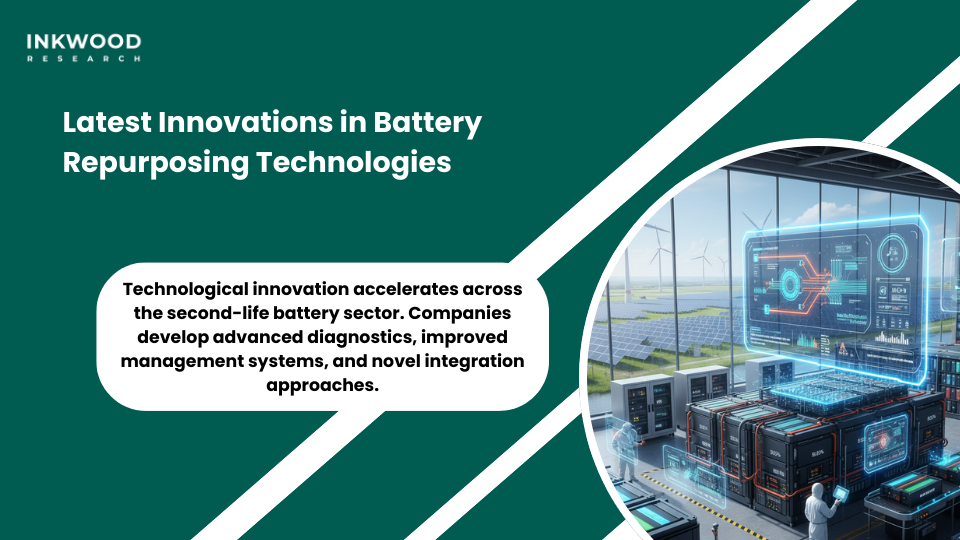
Technological innovation accelerates across the second-life battery sector. Companies develop advanced diagnostics, improved management systems, and novel integration approaches. These innovations enhance the performance, safety, and economic viability of repurposed battery deployments.
AI-Driven Battery Management
- Sparkion’s SparkSwitch technology represents a breakthrough in cell-level battery management. By bypassing weak cells, the system generates more energy per cycle than conventional approaches. This innovation reduces BESS cost-per-kWh by up to 60% while cutting capital expenditures dramatically.
- AI algorithms optimize stored energy deployment across EV charging stations and other applications. Real-time monitoring enables proactive maintenance, preventing system failures. Furthermore, machine learning improves performance predictions, supporting better project planning.
Modular System Architectures
- Redwood Energy division pioneered turning partially degraded packs into stationary energy storage through modular designs. Diagnostics determine whether batteries retain usable capacity, typically 50-80% of their original ratings. Qualified packs reconfigure into modular storage units with proprietary control systems.
- These second-life systems already operate successfully. One project includes a 12 MW / 63 MWh solar-powered microgrid in Nevada supporting an AI data center. This installation represents the largest second-life battery deployment globally. Consequently, it validates technical and commercial feasibility at scale.
Direct Reuse Processes
Three different remanufacture or repurposing processes handle second-life batteries: direct reuse, module dismantle, and cell dismantle. The fastest and cheapest approach involves direct reuse. Specifically, taking EV batteries as received, checking SOH and functional characteristics, then adding minimum adaptations for second-life applications.
This strategy follows paths taken by car manufacturers in demonstrative projects. It minimizes processing costs while maximizing battery value retention. Moreover, it accelerates deployment timelines compared to complete remanufacturing approaches.
Digital Twin Technologies
Digital twins and virtual twin experiences optimize recycling and repurposing workflows. These technologies simulate battery performance under various operating conditions. Subsequently, operators identify optimal applications matching specific battery characteristics.
Virtual testing reduces physical prototyping costs while accelerating development cycles. Additionally, digital twins support ongoing performance monitoring throughout operational lifetimes. This comprehensive approach maximizes value extraction from repurposed battery systems.
Key Takeaways
- The Netherlands battery recycling market demonstrates exceptional growth potential, projected to reach US$586.21 million by 2034 at an 11.61% CAGR. Strategic location near EV manufacturers, combined with advanced energy infrastructure, positions the Netherlands as a European second-life battery hub. Companies like EcarACCU achieve 98% material reuse rates through innovative remanufacturing processes.
- Second-life batteries retaining 70-80% original capacity provide cost-effective solutions for renewable energy storage, grid stabilization, and backup power applications. Economic benefits include 60% reductions in BESS cost-per-kWh compared to new battery systems. Moreover, sustainable battery recycling through second-life applications reduces environmental impacts from mining and manufacturing.
- Technical challenges, including battery health assessment, safety management, and standardization issues, receive solutions through AI-driven diagnostics and advanced management systems. EU regulatory frameworks support battery circular economy development through extended producer responsibility, recycled content requirements, and digital product passports.
- Europe’s second-life battery industry involves 80 companies spanning collection, testing, integration, and deployment activities. Netherlands companies Time Shift, EcarACCU, and Alliander pioneer innovative applications from smart grid integration to off-grid island power systems. These successes validate commercial viability while establishing best practices for global replication.
Conclusion:
Second-life battery applications represent a critical bridge between linear disposal and circular economy systems. The Netherlands demonstrates how strategic geographic positioning, supportive regulatory frameworks, and innovative companies create thriving battery repurposing ecosystems. The sector’s 11.61% CAGR significantly exceeds global averages, reflecting strong fundamentals.
As EV adoption accelerates across Europe, volumes of retired batteries available for repurposing will increase exponentially. This growth creates opportunities for entrepreneurs, established companies, and investors alike. However, success requires addressing technical, regulatory, and commercial challenges through continued innovation.
At Inkwood Research, we help organizations navigate second-life battery opportunities through comprehensive market intelligence and strategic advisory services. Our experts analyze technology trends, regulatory developments, and competitive dynamics shaping European battery circular economy markets. Contact our team to explore how repurposed EV batteries can enhance your energy storage strategies while supporting sustainability objectives and generating attractive financial returns.
Frequently Asked Questions
What percentage of original capacity do second-life batteries typically retain?
Retired EV batteries usually maintain 70-80% of their original capacity when they reach end-of-automotive-life. This retained capacity proves perfectly adequate for stationary energy storage applications, including renewable energy integration, grid services, and backup power systems.
How does the Netherlands compare to other European countries for second-life battery development?
The Netherlands battery recycling market grows at 11.61% CAGR, exceeding European averages due to strategic location near EV manufacturers, advanced energy infrastructure, and pioneering companies. However, Germany leads in absolute company numbers with various firms involved across the value chain.
What are the main cost advantages of using second-life batteries versus new systems?
Second-life batteries reduce BESS cost-per-kWh by up to 60% compared to new systems while cutting capital expenditures in half of competitive solutions. Additionally, they avoid disposal costs and generate value from otherwise waste assets.