Table of Contents
This analysis is brought to you by Inkwood Research, a leading market intelligence firm specializing in North American environmental technology markets, IoT sensor ecosystems, and air quality regulatory frameworks. Our research team combines deep expertise in US startup innovation, Canadian digital health infrastructure, and emission compliance monitoring across industrial and urban settings. Through strategic partnerships with technology developers, regulatory consultants, and health technology companies, we deliver actionable intelligence for stakeholders navigating the United States and Canada air quality IoT sensors markets.
TLDR
The United States and Canada are redefining how industries and cities approach air quality compliance. In the US, a new generation of IoT air sensor startups is disrupting legacy monitoring infrastructure with low-cost, AI-driven platforms. Meanwhile, Canada’s evolving digital air strategy is creating a structured market for health technology companies targeting emission compliance. Our analysis values the United States air quality IoT sensors market at US$743.64 million in 2026, while the Canada air quality IoT sensors market stands at US$130.01 million, both growing at a meaningful pace through 2034.
This blog is directly relevant for environmental health technology investors, industrial compliance officers, and IoT platform developers operating across North American markets. Additionally, Canadian health technology companies navigating the digital air strategy framework, US startup founders seeking market context, and policy analysts tracking 2026 emission compliance timelines will find targeted, evidence-grounded intelligence here.
How Are US Startups Disrupting the IoT Air Sensor Market?
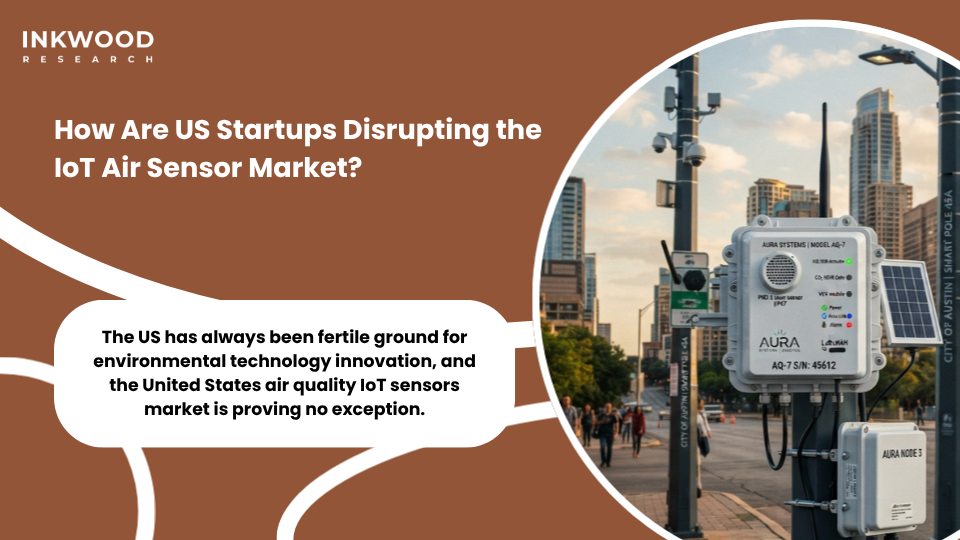
The US has always been fertile ground for environmental technology innovation, and the United States air quality IoT sensors market is proving no exception. A cohort of well-funded startups is challenging legacy monitoring infrastructure with platforms that combine low-cost IoT air quality monitoring market sensors, machine learning, and cloud analytics, often in ways that established instrument manufacturers have been slow to replicate.
What makes these companies strategically interesting is not just the technology itself, it is the business model underneath it. Rather than selling hardware as a one-time transaction, many are offering platform subscriptions that turn smart air quality sensors market data into continuous compliance intelligence. Plus, this shift mirrors the broader SaaS movement in enterprise technology, applied directly to environmental monitoring.
Five Innovators Reshaping Air Quality Monitoring in America
- Clarity Movement (Oakland, CA) specializes in providing Sensing-as-a-Service air quality monitoring solutions. Their flagship product, the Clarity Node-S, is a solar-powered, government-grade sensor node designed for dense urban deployment, monitoring, and data management. Notably, the company has partnered with USAID and the United Nations to scale networks across cities on three continents.
- Aclima (San Francisco, CA) combines mobile sensing vehicles with AI-driven analytics to generate hyperlocal, block-level air quality maps. Its platform is used by Google, environmental justice organizations, and state environmental agencies to identify pollution disparities across urban neighborhoods, a capability that fixed sensor networks struggle to match.
- Senseable City Lab (MIT, Cambridge, MA) is a research-to-market pipeline producing next-generation environmental IoT sensors for pollution control with applications spanning smart building automation and urban air quality monitoring. Its work directly to inform the design of scalable IoT monitoring systems across US cities.
- eSensors (La Jolla, CA) specializes in indoor air quality sensors market applications, offering wireless monitoring platforms for commercial buildings, laboratories, and manufacturing facilities. Its systems integrate with building management infrastructure to automate ventilation responses based on real-time CO₂ and particulate readings.
- AirGradient has gained traction across both research and commercial sectors through its open-hardware IoT air quality monitoring platform. Its transparent, customizable firmware has attracted a global developer community, steadily expanding its reach into new monitoring applications and geographic markets.
What is the United States Air Quality IoT Sensors Market Size?
The market numbers reflect the momentum building behind these innovations. According to our analysis, the United States air quality IoT sensors market is valued at US$743.64 million in 2026 and is projected to reach US$2,161.31 million by 2034, reflecting a 14.27% CAGR. Federal environmental investment, state-level clean air initiatives, and growing corporate demand for ESG-aligned monitoring are collectively driving this expansion.
Regulatory context matters here. The US Environmental Protection Agency identifies fine particulate matter (PM2.5) and ground-level ozone as the two most widespread air pollutants threatening public health, reinforcing the regulatory foundation that underpins demand for air pollution monitoring sensors market solutions across industrial and municipal settings. Industrial compliance represents a particularly strong demand segment, as manufacturers operating under Clean Air Act permits increasingly turn to real-time air quality monitoring IoT solutions to document continuous emissions performance.
How Are IoT Air Sensors Helping Canadian Industries Meet 2026 Emission Targets?
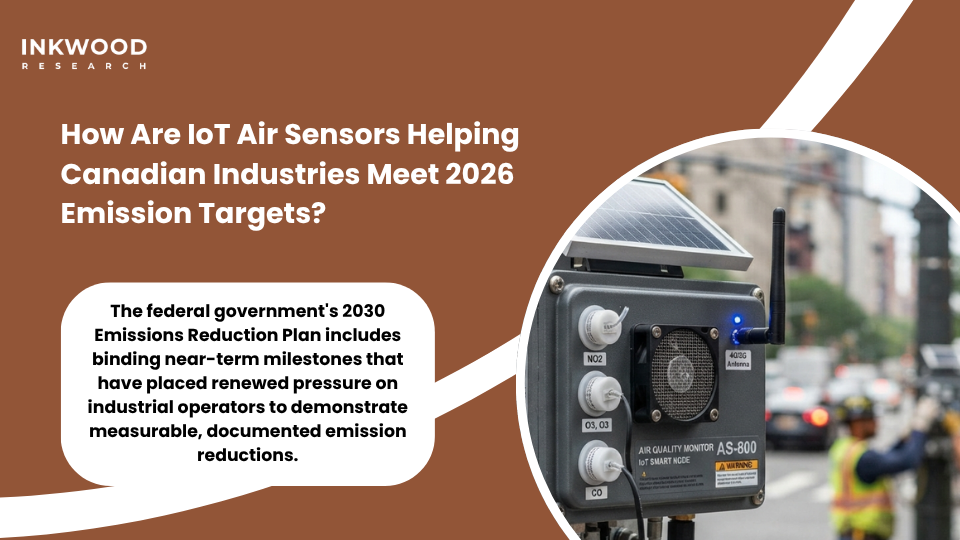
Across the border, Canada faces its own air quality compliance challenge, and it is arriving at a defining moment. The federal government’s 2030 Emissions Reduction Plan includes binding near-term milestones that have placed renewed pressure on industrial operators to demonstrate measurable, documented emission reductions.
However, Canada is currently facing a defining moment regarding its 2030 air quality and climate compliance goals, with recent projections indicating that the country is not on track to meet its legislated 2030 Emissions Reduction Plan target. The 2030 Plan originally targeted cutting greenhouse gas (GHG) emissions by 40–45% below 2005 levels, but updated analyses suggest Canada may only achieve reductions of 18–25% by 2030 under current policy trajectories. In this regard, IoT-based air pollution monitoring systems are emerging as a practical, scalable tool for the same.
Canada’s Regulatory Push for Real-Time Monitoring
Environment and Climate Change Canada (ECCC) administers the National Air Pollution Surveillance (NAPS) program, which forms the regulatory backbone for air quality measurement across the country. As industrial operators face tighter 2026 compliance timelines, many are supplementing the NAPS network with their own real-time Canada air quality IoT sensors market solutions, particularly in oil and gas, mining, pulp and paper, and heavy manufacturing sectors.
The operational advantages of IoT monitoring in this context are straightforward and compelling:
- Continuous monitoring eliminates the data gaps that periodic manual sampling creates, reducing regulatory exposure for facility operators.
- Remote access dashboards allow environmental compliance teams to track emissions from multiple facilities through a single cloud interface, improving operational efficiency across large industrial portfolios.
- Automated alerts notify operators immediately when threshold values are approached, enabling proactive corrective action before a violation occurs.
- Audit-ready reporting generates tamper-evident data logs that meet regulatory submission requirements without requiring additional manual processing, a meaningful time and cost saving for compliance teams.
Furthermore, the low-cost air quality sensors market demand is particularly pronounced in Canada’s resource sector, where facilities are often located in remote environments where deploying and servicing traditional monitoring equipment carries significant logistical and financial overhead.
What Does Canada’s Digital Air Strategy Mean for Health Tech Companies?

Beyond industrial compliance, Canada’s broader digital health and environmental strategy is opening significant opportunities for health technology companies. Federal investment in connected health infrastructure, including programs through Canada Health Infoway, is creating a policy environment where environmental IoT sensors for pollution control and personal health monitoring are increasingly viewed as complementary, integrated systems rather than separate domains.
The Canada Air Quality IoT Sensors Market Opportunity
Our analysis values the Canada air quality IoT sensors market at US$130.01 million in 2026, growing to US$418.80 million by 2034 at a 15.75% CAGR, matching the global market growth rate and reflecting consistent regulatory and investment tailwinds. For health technology companies, the opportunity is particularly compelling across three distinct segments:
- Clinical and research settings: Hospitals and academic institutions are integrating indoor air quality sensors market solutions into patient care environments and clinical trial protocols, where airborne pollutant exposure is increasingly recognized as a measurable variable in health outcomes.
- Smart building platforms: Developers and property managers are incorporating air quality monitoring into real-time building management systems to meet tenant wellness expectations and sustainability certifications such as WELL and LEED, creating recurring hardware and software demand.
- Public health surveillance networks: Municipal public health units across British Columbia, Ontario, and Quebec are piloting dense low-cost sensor networks to track community-level air quality as a social determinant of health, with several programs moving from pilot to permanent deployment.
Additionally, provincial-level digital health frameworks in these regions explicitly encourage adoption of smart air quality sensors market solutions, creating demand drivers that reinforce rather than duplicate federal initiatives. This layered regulatory environment strengthens the business case for health technology companies building Canadian-focused IoT air quality platforms.
What Are the Latest Developments in North American IoT Air Quality Innovation?
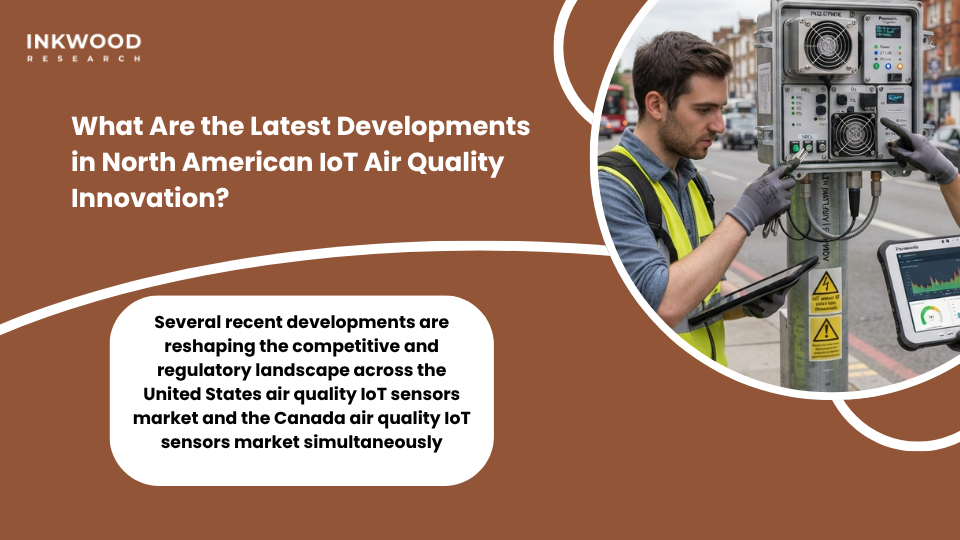
Several recent developments are reshaping the competitive and regulatory landscape across the United States air quality IoT sensors market and the Canada air quality IoT sensors market simultaneously:
- PurpleAir, whose low-cost particulate sensors are used by millions across North America, expanded its enterprise API platform in 2023-2024, enabling integration with corporate environmental monitoring dashboards and municipal smart city platforms. This move bridges the gap between consumer-grade and professional-grade air quality IoT sensors market applications.
- The US EPA’s Air Sensor Toolbox was updated in 2024 to include performance evaluation protocols specifically designed for low-cost IoT air quality monitoring market sensors. This regulatory legitimization is helping expand their use in compliance-adjacent applications beyond traditional reference monitor frameworks.
- Aeroqual expanded its Canadian market operations in 2024, partnering with environmental consulting firms to offer integrated Canada air quality IoT sensors market solutions for industrial operators preparing for 2025 and 2026 compliance milestones, directly addressing the near-term demand spike created by tightening federal timelines.
- Amazon Web Services (AWS) announced expanded IoT environmental monitoring integrations within AWS IoT Core over recent years. These integrations allow air pollution monitoring sensors market manufacturers to connect devices to cloud analytics pipelines with significantly reduced development overhead, accelerating the deployment of AI-powered monitoring platforms across North America.
Key Takeaways
- The United States air quality IoT sensors market grows from US$743.64 million in 2026 to US$2,161.31 million by 2034, driven by federal regulation, ESG demand, and startup-led innovation.
- The Canada air quality IoT sensors market grows from US$130.01 million in 2026 to US$418.80 million by 2034 at a 15.75% CAGR, with 2026 compliance timelines accelerating industrial IoT sensor adoption.
- Five US innovators, Clarity Movement, Aclima, eSensors, AirGradient, and Senseable City Lab, are redefining the air quality IoT sensors market with AI-driven, subscription-based platforms.
- Canada’s digital health and environmental strategy is creating targeted demand for health technology companies across clinical, smart building, and public health surveillance applications.
- The EPA’s updated Air Sensor Toolbox and ECCC’s NAPS program form the regulatory foundations shaping compliance demand in both markets.
- PurpleAir, Aeroqual, and AWS IoT Core are among the most consequential recent developments reshaping the competitive landscape across North America.
Conclusion
North America’s air quality IoT sensors market is at a compelling inflection point. In the US, startups are dismantling the assumption that regulatory-grade environmental monitoring requires expensive, stationary infrastructure. In Canada, tightening compliance timelines and digital health investment are creating a structured demand environment for IoT-based air pollution monitoring systems across industrial, clinical, and urban applications. Together, these dynamics position both the United States air quality IoT sensors market and the Canada air quality IoT sensors market as high-priority opportunities for technology providers, investors, and health technology companies seeking meaningful roles in the environmental compliance ecosystem.
Inkwood Research provides the market intelligence and strategic analysis needed to navigate this landscape with confidence.
Connect with our team to explore how our insights can support your positioning in the North American air quality IoT sensors market.
Frequently Asked Questions (FAQs)
Our analysis values the US market at US$743.64 million in 2026, projected to reach US$2,161.31 million by 2034 at a 14.27% CAGR.
IoT sensors provide continuous monitoring, automated threshold alerts, and audit-ready compliance data, reducing regulatory risk for Canadian industrial operators.
The Canada market is valued at US$130.01 million in 2026 and is projected to reach US$418.80 million by 2034 at a 15.75% CAGR.
Clarity Movement, Aclima, eSensors, AirGradient, and Senseable City Lab are among the most impactful innovators reshaping the US market.
It creates structured demand for IoT air quality platforms in clinical environments, smart buildings, and municipal public health surveillance networks.
Oil and gas, mining, pulp and paper, and heavy manufacturing are the primary sectors accelerating industrial IoT air quality sensor adoption ahead of 2026 compliance milestones.