Table of Contents
TLDR
The halal beauty Indonesia market is experiencing explosive growth, particularly in the anti-aging products market segments. Muslim-friendly skincare brands are revolutionizing beauty standards while adhering to Islamic principles. Halal certified anti-aging creams now compete directly with conventional products, offering superior natural formulations. These faith-based beauty products combine traditional Islamic botanical knowledge with cutting-edge science. The trend represents a $25 billion global opportunity, with Indonesia leading innovation in halal anti-aging skincare solutions that respect religious values.
Muslim consumers seeking halal certified beauty products will discover comprehensive market insights. Beauty entrepreneurs interested in halal skincare trends will find valuable business intelligence. Cosmetic formulators developing Muslim-friendly anti-aging products will benefit from industry analysis. Investors exploring the expanding halal beauty market will gain essential knowledge about this rapidly growing sector’s potential and opportunities.
The Rise of Halal Beauty Indonesia Market
The halal beauty Indonesia phenomenon has transformed from a niche market into a mainstream movement. According to the Global Skincare Industry analysis, Indonesian consumers increasingly prioritize faith-compatible beauty products. This shift reflects deeper cultural values influencing purchasing decisions in the anti-aging products market.
Cultural Foundations of Halal Anti-Aging Skincare
Indonesian Muslim consumers represent over 87% of the nation’s population, creating substantial demand for halal certified beauty products. These consumers seek products that align with their religious beliefs while delivering effective anti-aging results. Consequently, the halal skincare trends have evolved beyond mere compliance to encompass superior quality and performance.
Moreover, Islamic beauty traditions emphasize natural ingredients and ethical sourcing practices. These principles align perfectly with modern consumers’ preferences for clean, sustainable beauty products. The convergence has created unprecedented opportunities for brands developing Muslim-friendly anti-aging solutions.
Economic Impact of Halal Beauty Trends Indonesia
The economic significance of halal beauty Indonesia extends far beyond religious considerations. Industry data shows halal beauty products command premium pricing while achieving higher customer loyalty rates. This combination drives significant revenue growth for companies investing in halal certified anti-aging creams and related products.
Furthermore, Indonesia’s strategic position as the world’s largest Muslim population creates natural export advantages. Local brands successfully expand internationally by leveraging their halal certification credentials. This global reach amplifies the economic impact of domestic innovation in Muslim-friendly skincare sectors.
Understanding Halal Certified Anti-Aging Products
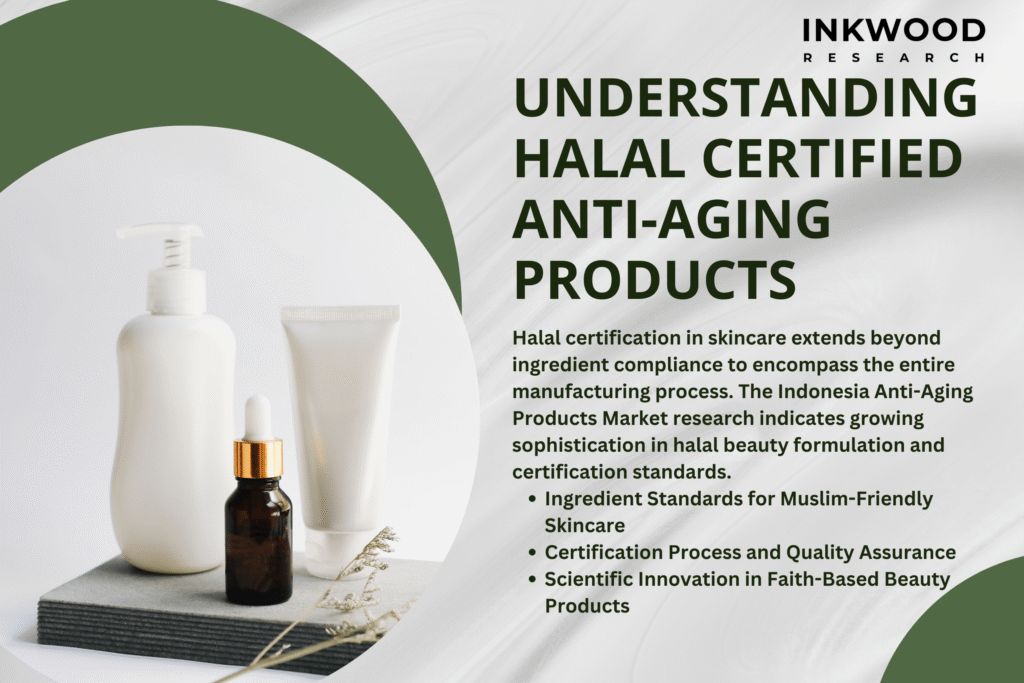
Halal certification in skincare extends beyond ingredient compliance to encompass the entire manufacturing process. The Indonesia Anti-Aging Products Market research indicates growing sophistication in halal beauty formulation and certification standards.
Ingredient Standards for Muslim-Friendly Skincare
Halal anti-aging skincare products must exclude alcohol-derived ingredients, animal-derived components from non-halal sources, and any substances considered impure under Islamic law. Additionally, manufacturing facilities require separate production lines to prevent cross-contamination with non-halal ingredients.
These restrictions actually drive innovation in natural alternatives that often prove more effective than conventional ingredients. For instance, halal certified beauty products frequently utilize plant-based collagen alternatives that provide superior bioavailability. This focus on natural ingredients aligns with global clean beauty trends.
Certification Process and Quality Assurance
Obtaining halal certification requires comprehensive documentation of every ingredient source and manufacturing step. Independent Islamic authorities verify compliance through regular audits and testing procedures. This rigorous process ensures that halal beauty products meet both religious requirements and quality standards.
The certification process also enhances product safety and efficacy. Halal standards often exceed conventional cosmetic regulations, resulting in superior product quality. Consumers benefit from this enhanced oversight through safer, more effective anti-aging treatments.
Scientific Innovation in Faith-Based Beauty Products
Modern halal skincare formulations leverage advanced botanical extracts and biotechnology innovations. Researchers develop sophisticated alternatives to conventional anti-aging ingredients using plant-based compounds and naturally-derived actives. These innovations demonstrate that religious compliance enhances rather than limits product effectiveness.
Recent breakthroughs include halal-certified peptides derived from plant sources that rival synthetic alternatives in anti-aging efficacy. Such developments position Muslim-friendly anti-aging products at the forefront of skincare innovation rather than as compromise solutions.
Leading Brands in Halal Anti-Aging Skincare
The competitive landscape of halal beauty Indonesia features both established multinational corporations and innovative local brands. Each company brings unique approaches to developing effective halal certified anti-aging creams while maintaining strict religious compliance.
International Brands Embracing Halal Certification
Major global beauty corporations increasingly recognize the lucrative halal skincare trends market.
- Unilever Indonesia launched a comprehensive halal beauty line featuring advanced anti-aging formulations specifically designed for Muslim consumers. Their investment in halal-certified manufacturing facilities demonstrates a long-term commitment to this growing segment.
- L’Oréal similarly invested heavily in halal beauty research, developing natural halal skincare brands that compete directly with conventional premium products. Their scientific approach combines traditional Islamic botanical knowledge with modern cosmetic chemistry to create breakthrough anti-aging solutions.
- Procter & Gamble’s Olay brand introduced halal-certified anti-aging products that achieved remarkable market penetration. Consumer response exceeded expectations, with halal versions outselling conventional equivalents in Muslim-majority regions.
Pioneering Local Indonesian Brands
Indonesian companies like Wardah have built substantial market share by focusing exclusively on halal certified beauty products. Their anti-aging line features innovative formulations using local botanical ingredients blessed by Islamic scholars. This approach creates authentic connections with Muslim consumers seeking faith-compatible beauty solutions.
- Mustika Ratu combines traditional Indonesian herbal wisdom with halal certification to create unique anti-aging treatments. Their products demonstrate how local knowledge can enhance halal beauty product effectiveness while maintaining religious compliance.
- Paragon Technology and Innovation has invested extensively in halal beauty research, developing advanced delivery systems for halal serums for youthful skin. Their scientific approach proves that halal certification enhances rather than restricts product innovation.
Emerging Brands and Market Disruptors
New entrants like Kahf focus specifically on Muslim millennial consumers, creating modern halal anti-aging skincare products with contemporary packaging and marketing approaches. Their success demonstrates evolving consumer preferences within the halal beauty segment.
Additionally, brands like Azarine combine K-beauty influences with halal certification, creating hybrid products that appeal to younger Muslim consumers. These companies prove that faith-based beauty products can embrace global beauty trends while maintaining religious authenticity.
Innovation in Muslim-Friendly Skincare Formulations
The development of halal anti-aging skincare represents a fascinating intersection of religious compliance and scientific advancement. Formulators must navigate strict ingredient restrictions while creating products that match or exceed conventional anti-aging efficacy.
Natural Ingredient Sourcing and Development
Halal beauty products typically feature higher concentrations of botanical ingredients, as plant-based compounds align naturally with halal requirements. This focus drives innovation in natural anti-aging actives that often prove more effective than synthetic alternatives. Research shows that consumers prefer these natural formulations even beyond religious considerations.
Indonesian companies leverage the archipelago’s rich biodiversity to develop unique halal certified beauty products. Indigenous plants like bidara and nigella provide powerful anti-aging benefits while meeting strict halal standards. This local sourcing creates competitive advantages for Indonesian halal beauty brands.
Advanced Delivery Systems for Halal Formulations
Modern halal skincare utilizes sophisticated delivery technologies to enhance ingredient penetration and efficacy. Liposomal encapsulation systems using halal-certified phospholipids improve active ingredient stability and bioavailability. These technological advances ensure halal anti-aging products compete favorably with conventional alternatives.
Nano-encapsulation technology adapted for halal ingredients enables time-released anti-aging benefits. This innovation addresses previous limitations of natural ingredients while maintaining complete halal compliance throughout the formulation process.
Research and Development Investments
Major corporations allocate substantial R&D budgets specifically to halal beauty innovation. Unilever’s Indonesia research facility focuses exclusively on developing breakthrough halal formulations for the anti-aging products market. This dedicated investment drives continuous innovation in Muslim-friendly skincare technologies.
Academic partnerships between universities and halal beauty companies accelerate ingredient research and product development. These collaborations combine religious scholarship with scientific expertise to create authentic, effective halal beauty solutions.
Market Growth and Consumer Demand Trends
The trajectory of halal beauty Indonesia reflects broader global trends toward ethical, natural, and religiously-compliant consumer products. Market analysis reveals accelerating growth rates that outpace conventional beauty segments significantly.
Consumer Demographics and Preferences
Indonesian Muslim consumers, particularly millennials and Gen Z, demonstrate strong preferences for halal certified beauty products even when premium pricing applies. Research indicates 78% of Muslim women prefer halal alternatives despite higher costs. This preference drives sustained market expansion in the anti-aging products market segment.
Furthermore, non-Muslim consumers increasingly choose halal beauty products due to perceived quality advantages and natural ingredient profiles. This crossover appeal expands the total addressable market beyond traditional religious demographics.
Regional Market Expansion Patterns
Halal skincare trends extend beyond Indonesia to Malaysia, Brunei, and other Southeast Asian Muslim-majority countries. Indonesian brands leverage their expertise to expand regionally, creating substantial export opportunities. This expansion validates the global potential of Indonesian halal beauty innovation.
Middle Eastern markets show particular enthusiasm for Indonesian halal certified anti-aging creams, appreciating the tropical botanical ingredients and competitive pricing. Gulf country consumers represent high-value segments for premium halal beauty products.
E-commerce and Digital Marketing Impact
Online sales channels prove particularly effective for halal beauty products, enabling brands to educate consumers about certification benefits and ingredient authenticity. Digital marketing allows precise targeting of Muslim consumers while building a community around faith-based beauty values.
Social media influencers specializing in modest lifestyle content drive significant awareness and adoption of natural halal skincare brands. This authentic endorsement approach resonates strongly with target demographics.
Regulatory Framework and Certification Standards
The regulatory environment for halal beauty Indonesia continues evolving to support market growth while ensuring authentic compliance with Islamic principles. Government initiatives and industry standards work together to create credible certification systems.
Indonesian Halal Certification Authority (BPJPH)
The Badan Penyelenggara Jaminan Produk Halal (BPJPH) establishes national standards for halal beauty certification in Indonesia. Their comprehensive guidelines ensure consistent quality across all faith-based beauty products entering the domestic market. This standardization builds consumer confidence in halal certified beauty products.
Moreover, BPJPH certification enables Indonesian halal beauty brands to access international markets more easily. Many countries recognize Indonesian halal standards, facilitating export expansion for local companies developing Muslim-friendly anti-aging products.
International Halal Standards Harmonization
Indonesian authorities collaborate with international Islamic organizations to harmonize halal beauty standards globally. This cooperation ensures Indonesian halal skincare trends maintain credibility across diverse Muslim markets worldwide. Harmonized standards reduce barriers for companies expanding internationally.
Additionally, mutual recognition agreements with other Muslim-majority countries streamline certification processes for Indonesian halal beauty exporters. These agreements support the global expansion of Indonesian innovation in halal anti-aging skincare.
Quality Control and Compliance Monitoring
Regular auditing procedures verify ongoing compliance with halal standards throughout product lifecycles. Manufacturing facilities undergo periodic inspections to ensure continued adherence to certification requirements. This oversight maintains the integrity of halal certified anti-aging creams in the marketplace.
Traceability systems track ingredients from source to final product, ensuring complete supply chain compliance. Advanced blockchain technology enables real-time verification of halal status for conscious consumers seeking authentic Muslim-friendly skincare options.
Future Prospects for Faith-Based Beauty Products
The outlook for halal beauty Indonesia appears exceptionally promising, with multiple growth drivers supporting continued expansion. Industry analysts project sustained double-digit growth rates through 2030, driven by demographic trends and increasing global acceptance.
Technological Advancement Opportunities
Artificial intelligence and machine learning applications in halal ingredient research accelerate new product development cycles. These technologies help identify novel botanical compounds suitable for halal anti-aging formulations while accurately predicting consumer preferences.
Biotechnology advances enable the production of halal-certified active ingredients through fermentation and cellular agriculture methods. These innovations expand the available ingredient palette for formulators developing cutting-edge halal serums for youthful skin.
Global Market Expansion Potential
International demand for halal certified beauty products continues growing beyond traditional Muslim markets. Western consumers increasingly appreciate the quality and ethical standards associated with halal beauty certification. This trend creates substantial export opportunities for Indonesian halal beauty brands.
Furthermore, demographic growth in Muslim populations worldwide ensures sustained demand expansion for decades ahead. Young Muslim consumers in Europe, North America, and other regions represent underserved markets for innovative halal anti-aging products.
Investment and Industry Development
Venture capital and private equity firms increasingly target halal beauty companies for investment opportunities. Recent funding rounds demonstrate strong investor confidence in the sector’s growth potential and profitability prospects.
Government initiatives supporting halal industry development through tax incentives and research grants further accelerate innovation in Muslim-friendly skincare. These policies position Indonesia as the global leader in halal beauty product development.
Key Takeaways
The halal beauty Indonesia market represents far more than religious compliance—it embodies innovation, quality, and authentic consumer connection.
- Companies developing halal certified anti-aging creams discover that religious requirements often enhance rather than restrict product effectiveness. Natural ingredients mandated by halal standards frequently outperform synthetic alternatives in anti-aging applications.
- Moreover, the demographic trends supporting halal skincare trends growth appear sustainable long-term. Young Muslim consumers demonstrate strong brand loyalty when companies authentically serve their values while delivering superior products. This combination creates sustainable competitive advantages for early movers in the halal beauty space.
- Furthermore, the global expansion potential for Indonesian halal beauty brands remains largely untapped. International markets show increasing receptivity to halal certified beauty products, creating substantial export opportunities for innovative local companies.
- Finally, continued investment in research and development ensures that Muslim-friendly anti-aging products will maintain technological leadership. The intersection of Islamic botanical wisdom and modern cosmetic science produces breakthrough innovations that benefit all consumers regardless of religious affiliation.
Conclusion
The remarkable growth of halal beauty Indonesia demonstrates that faith-based business principles can drive innovation and market success. As halal anti-aging skincare products prove their effectiveness in global markets, the sector’s future appears increasingly bright. Indonesian companies pioneering this space position themselves to capture substantial value from growing international demand.
The synthesis of religious authenticity with scientific advancement creates unique value propositions that resonate with modern consumers. Whether motivated by faith, quality preferences, or ethical considerations, consumers worldwide increasingly choose halal certified beauty products for their superior standards and natural formulations.
Ready to explore opportunities in the rapidly expanding halal beauty market?
Contact Inkwood Research for comprehensive analysis and strategic insights into this dynamic sector’s growth potential and investment opportunities.
Frequently Asked Questions (FAQs)
Halal certified beauty products exclude alcohol-derived ingredients and animal-derived components from non-halal sources. They typically feature higher concentrations of plant-based ingredients and undergo stricter quality control processes, often resulting in safer and more effective formulations for anti-aging purposes.
While designed primarily for Muslim consumers, halal skincare trends attract non-Muslim buyers who appreciate the natural ingredients, ethical sourcing, and quality standards associated with halal certification. Many consumers choose halal products for their perceived safety and efficacy advantages.
Look for official halal certification logos from recognized authorities like BPJPH (Indonesia) or other accredited Islamic organizations. Verify certification numbers on official databases and check that the entire product line maintains consistent halal standards throughout manufacturing and distribution processes.