Table of Contents

This analysis is brought to you by Inkwood Research, a leading market intelligence firm specializing in Asia-Pacific renewable energy ecosystems, wind turbine manufacturing technologies, and clean power adoption patterns. Based on our proprietary research methodologies and strategic partnerships with Asian wind manufacturers, energy cooperatives, and government renewable development agencies, we deliver actionable insights that empower strategic decision-making for enterprises navigating India’s wind energy transformation.
TLDR
India’s wind energy market transformation stems from aggressive localization strategies that reduce foreign dependencies. Domestic manufacturers now control production capacity exceeding 18,000 MW annually, while government policies mandate 64% local content requirements. Therefore, companies like Suzlon and Inox Wind leverage vertical integration to capture expanding market opportunities. Meanwhile, manufacturing investments drive technological advancement across blade production, turbine assembly, and component fabrication. Consequently, this evolution reshapes regional supply chains throughout the Asia-Pacific renewable sectors.
Energy sector executives evaluating renewable manufacturing investments will discover strategic localization frameworks. Moreover, procurement managers sourcing wind turbine components gain supply chain intelligence. Additionally, policy analysts tracking clean energy transitions have access to comprehensive market dynamics. Furthermore, investment professionals assessing renewable infrastructure opportunities find actionable competitive landscape insights across India’s evolving wind energy ecosystem.
Introduction: India Wind Energy Market

The wind energy market in India continues to expand as domestic wind turbine manufacturers reshape the country’s production landscape. According to our analysis, the market is expected to reach US$16968.00 million by 2034, progressing with a CAGR of 11.97% between 2026 and 2034. Over recent years, wind energy manufacturers in India have invested billions in expanding their capabilities. This shift in wind turbine manufacturing has become critical infrastructure for achieving energy independence.
Further, the wind energy market in India now demonstrates robust growth across multiple segments. Small wind turbine manufacturers in India have found their niche serving distributed generation needs in rural and remote areas. Meanwhile, wind energy power plant installations across India are accelerating the nation’s renewable adoption. This localization movement is transforming how the region approaches clean power development.
Domestic manufacturing capabilities determine competitive advantages in renewable infrastructure. The Ministry of New and Renewable Energy establishes frameworks that prioritize local component sourcing across wind projects. As a result, indigenous manufacturers capture market share previously held by international players. However, this transformation requires substantial capital investment and technological partnerships.
Indian wind farms now operate with predominantly domestically-produced equipment. Moreover, supply chain resilience improves through reduced import dependencies. Therefore, manufacturing localization accelerates project timelines while controlling costs effectively. These strategic shifts position India’s renewable sector for sustained long-term growth.
What Drives India’s Wind Energy Manufacturing Transformation?
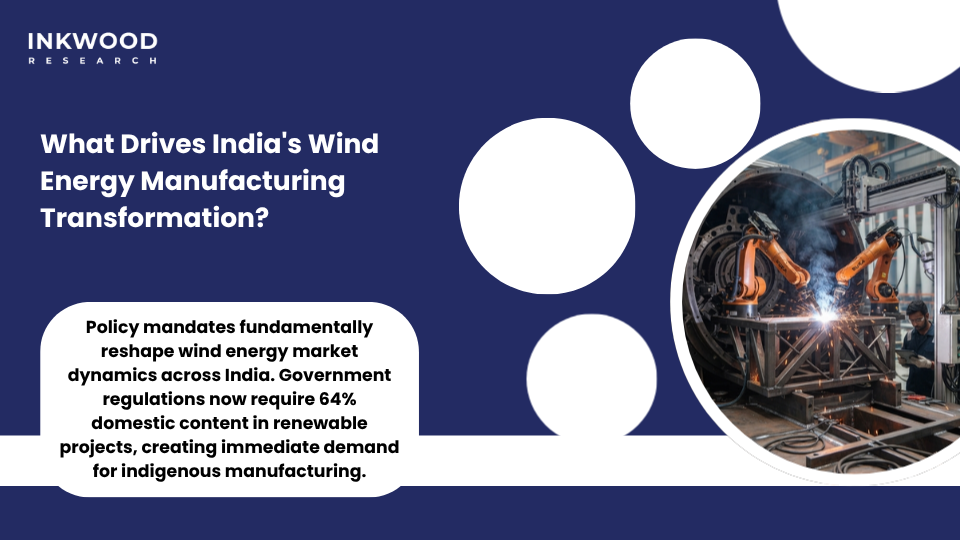
Policy mandates fundamentally reshape wind energy market dynamics across India. Government regulations now require 64% domestic content in renewable projects, creating immediate demand for indigenous manufacturing. Consequently, this framework accelerates local production capacity while reducing foreign equipment dependencies.
Manufacturing investments transform regional industrial ecosystems significantly. Domestic producers committed billions toward expanding blade fabrication, tower construction, and nacelle assembly capabilities. Moreover, these facilities generate employment across engineering, production, and logistics sectors throughout multiple states.
Strategic Wind Energy Market in India Positioning
Geographic advantages position India competitively within global manufacturing networks. Furthermore, abundant skilled labor pools and established heavy industry infrastructure support turbine production scaling. Additionally, proximity to emerging Asian markets creates export opportunities beyond domestic installations.
According to the Ministry of New and Renewable Energy, India maintains manufacturing capacity exceeding 18,000 MW annually. Therefore, production infrastructure supports ambitious renewable targets set for the coming decades. This foundation enables sustained market growth trajectories.
How Do Domestic Manufacturers Reshape India’s Wind Energy Market Dynamics?
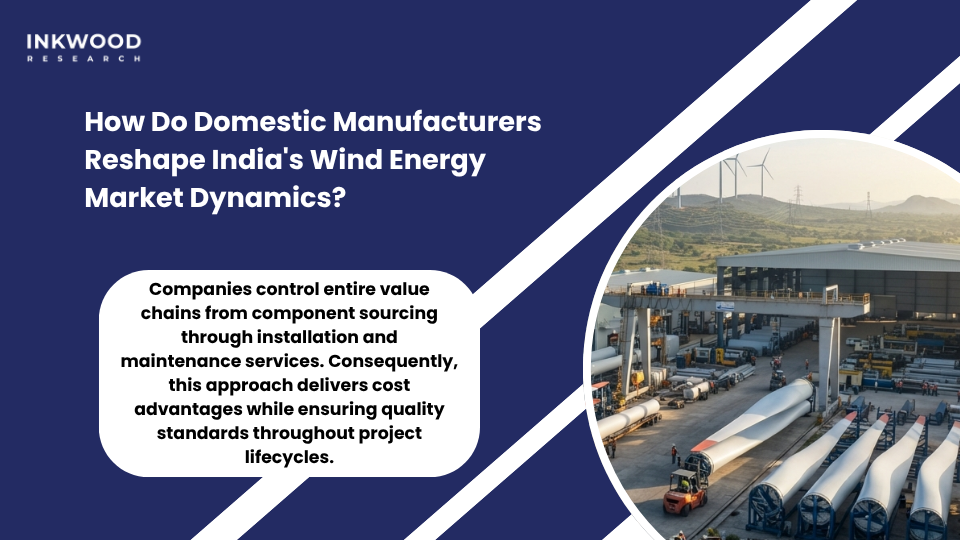
Vertical integration strategies define competitive positioning among leading manufacturers. Companies control entire value chains from component sourcing through installation and maintenance services. Consequently, this approach delivers cost advantages while ensuring quality standards throughout project lifecycles.
Market consolidation accelerates as domestic players capture share from international competitors. Moreover, localization requirements fundamentally alter procurement patterns across renewable developers. Therefore, indigenous manufacturers secure long-term supply agreements with major energy producers.
Wind Turbine Manufacturing Excellence Standards
Quality certifications ensure manufactured components meet international performance benchmarks. While testing facilities verify turbine reliability under diverse operational conditions, research partnerships with technical institutions advance design capabilities across manufacturers.
Technology transfer agreements facilitate knowledge acquisition from global turbine leaders. As domestic engineering teams adapt designs for India’s specific wind patterns and terrain, consequently, manufactured equipment optimizes energy capture across varied regional installations.
Why Is Localized Wind Turbine Manufacturing Critical for Energy Security?

Supply chain vulnerabilities expose renewable projects to international disruptions. Domestic manufacturing insulates installations from global trade tensions and logistics challenges. Therefore, localized production enhances energy infrastructure resilience significantly.
Strategic autonomy drives policy emphasis on indigenous capability development. Reducing import dependencies strengthens national security considerations around critical energy infrastructure. Additionally, local manufacturing supports broader industrial development objectives across manufacturing sectors.
Building Domestic Wind Turbine India Capacity
Investment commitments demonstrate confidence in long-term market expansion. Furthermore, manufacturers establish component supply networks spanning multiple states across India. Consequently, distributed production infrastructure reduces transportation costs while supporting regional economic development.
Workforce development programs train engineers and technicians for specialized manufacturing roles. Meanwhile, skill-building initiatives ensure adequate talent pipelines for expanding production facilities, and aligning with this, human capital investments prove essential for sustained industry growth.
Which Companies Lead Wind Energy Manufacturers in India Today?

Suzlon Energy dominates domestic turbine production with installed capacity exceeding 21 GW globally. The company maintains comprehensive manufacturing facilities across rotor blades, nacelles, and control systems. Moreover, recent orders demonstrate sustained market confidence in Suzlon’s technological capabilities.
Inox Wind strengthens its positioning through vertical integration strategies and expanded production capacity. The company secured major contracts delivering turnkey wind energy solutions across multiple states. Additionally, Inox investments in manufacturing infrastructure support accelerated project execution timelines.
Wind Energy Manufacturers in India: Competitive Landscape
Envision Group expands Indian operations through dedicated manufacturing facilities in Maharashtra and Tamil Nadu. On the other hand, ReGen Powertech advances gearless turbine technologies developed in collaboration with international partners.
Multiple manufacturers drive innovation across diverse technological approaches. Recent developments highlight Suzlon’s S144 turbine achieving India’s lowest carbon footprint verification. Sustainability considerations increasingly influence manufacturing processes and component sourcing decisions, and as a result, environmental performance becomes a competitive differentiation factor among producers.
What Innovations Define Domestic Wind Turbine India Production?

Digital monitoring systems optimize turbine performance throughout operational lifecycles. Manufacturers integrate predictive maintenance capabilities, reducing downtime and extending equipment longevity. Additionally, remote diagnostics enable rapid response to performance anomalies across distributed installations.
Wind Turbine Manufacturing Technological Advances
Blade design optimization enhances energy capture across varying wind conditions, while larger rotor diameters increase capacity factors at existing installation sites. Consequently, technological improvements deliver better project economics for developers and investors.
Component localization extends beyond turbines to encompass entire supply chains. Bearing manufacturers, electrical systems producers, and control unit suppliers establish domestic operations. Therefore, ecosystem development creates comprehensive manufacturing clusters supporting renewable infrastructure.
How Will Policies Shape the Wind Energy Market in India Forward?

Government targets call for 140 GW wind capacity in India by 2030, requiring substantial manufacturing expansion. Offshore wind development introduces new equipment specifications and installation requirements. Consequently, domestic manufacturers must adapt their capabilities for emerging market segments.
According to industry sources, renewable energy investments attracted significant capital commitments recently. Therefore, financial resources support manufacturing infrastructure development and technological advancement initiatives, while investment inflows validate market growth expectations.
Wind Energy Market Size in India Expansion Trajectory
Market projections indicate cumulative installed capacity reaching substantial levels over the coming years. Furthermore, manufacturing capacity must scale proportionally to support installation targets and export opportunities that emerge as domestic producers demonstrate international competitiveness.
Regulatory frameworks evolve to address grid integration challenges and land acquisition processes. Meanwhile, auction mechanisms determine project economics and manufacturing demand patterns. Consequently, policy stability becomes a critical factor influencing investment decisions across the value chain.
Key Takeaways
- Domestic manufacturing capabilities now support 18,000 MW annual production capacity across Indian facilities.
- Government mandates requiring 64% local content reshape procurement strategies throughout the renewable sector.
- Moreover, vertical integration strategies deliver competitive advantages for indigenous turbine manufacturers.
- Leading manufacturers like Suzlon and Inox Wind demonstrate technological sophistication through innovation initiatives.
- Hybrid tower technologies and digital monitoring systems enhance operational performance. Additionally, supply chain localization reduces import dependencies while strengthening energy security.
- Policy frameworks targeting 140 GW wind capacity by 2030 drive sustained manufacturing expansion.
- Offshore wind development creates new equipment requirements and market opportunities. Consequently, domestic producers position themselves for long-term growth across the evolving renewable landscape.
Conclusion
Manufacturing localization fundamentally transforms India’s renewable energy ecosystem. Strategic investments in domestic production capacity deliver energy security while supporting broader industrial development objectives. Moreover, technological innovations demonstrate the competitiveness of indigenous manufacturers on global stages.
Sustained policy support, combined with private sector commitment, positions India as a renewable manufacturing leader. Furthermore, comprehensive supply chain development creates resilient infrastructure supporting ambitious capacity targets. Therefore, the wind energy sector exemplifies successful industrial strategy execution.
Organizations seeking strategic insights into India’s renewable manufacturing landscape benefit from Inkwood Research’s comprehensive analysis. Our expert consultants deliver actionable intelligence supporting investment decisions and market entry strategies.
Contact our team to discuss how specialized research capabilities accelerate your renewable energy initiatives.
Frequently Asked Questions (FAQs)
Government policies mandating 64% domestic content create immediate manufacturing demand. Consequently, indigenous producers invest billions in capacity expansion, supporting renewable targets.
Suzlon Energy dominates with 21 GW global capacity, while Inox Wind strengthens through vertical integration. Additionally, Envision Group expands manufacturing facilities across Maharashtra and Tamil Nadu.
Local manufacturing reduces import dependencies and insulates projects from international supply disruptions. Therefore, indigenous production enhances renewable infrastructure resilience significantly.
Hybrid tower technologies reduce steel consumption while digital monitoring optimizes performance. Moreover, manufacturers achieve the lowest carbon footprint certifications through sustainable production processes.
Installed capacity exceeds 48 GW with manufacturing infrastructure supporting 18,000 MW annual production. Furthermore, government targets call for 140 GW by 2030.
Distributed generation requirements create demand for smaller capacity turbines serving rural electrification. Additionally, component supply opportunities emerge across comprehensive manufacturing ecosystems.