Table of Contents
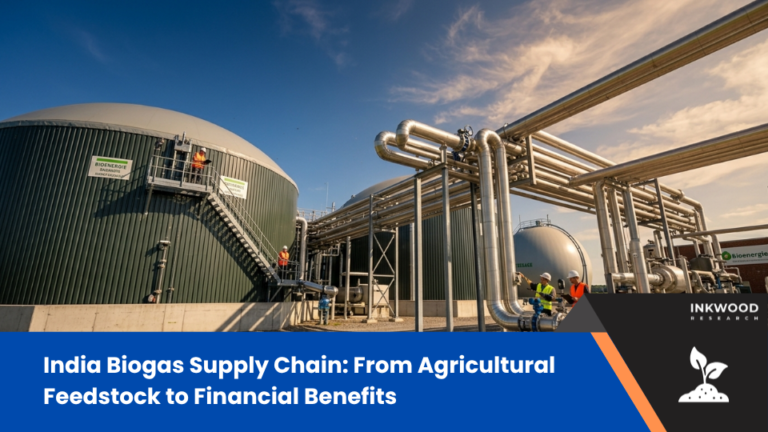
This analysis is brought to you by Inkwood Research, a leading market intelligence firm specializing in South Asian renewable energy ecosystems, agricultural biogas value chains, and rural energy transformation strategies. Our research team combines extensive experience analyzing India biogas market dynamics, feedstock logistics optimization, and fiscal benefit frameworks. Based on our proprietary research methodologies and strategic partnerships with Indian agricultural cooperatives, government renewable energy agencies, and biogas technology providers, we deliver actionable insights empowering strategic decision-making for enterprises navigating India’s biogas supply chain complexities and emerging market opportunities.
TLDR
The India biogas market grows from US$6,046.15 million in 2026 to US$12,178.81 million by 2034 with a remarkable 9.15% CAGR. Renewable energy supply chains transform agricultural waste into cooking gas, vehicle fuel, electricity heat applications. Feedstock optimization, upgrading technologies, distribution networks, and fiscal incentives drive market expansion. PlanET Biogas, Biogas Fuels International, and Air Liquide advance infrastructure development. Rural communities benefit from energy access while farmers capture additional income streams. Supply chain efficiency determines project economics and scalability across diverse geographic regions.
Agricultural biogas developers, rural energy project managers, supply chain logistics specialists, renewable energy investors, government policy analysts, cooking gas distributors, vehicle fuel suppliers, technology equipment providers, agricultural cooperative leaders, financial institutions, and international corporations exploring India biogas market opportunities will gain critical insights into feedstock sourcing strategies, logistics optimization, fiscal benefit structures, and supply chain integration pathways within Asia’s fastest-growing biogas ecosystem.
India Biogas Market Overview and Supply Chain Foundations

The India biogas market demonstrates explosive growth driven by abundant agricultural feedstock, government policy support, and expanding renewable energy demand. Market valuation reaches US$6,046.15 million in 2026, doubling to US$12,178.81 million by 2034 with an impressive 9.15% CAGR.
Consequently, supply chain development becomes critical infrastructure supporting rural energy transformation. Moreover, integrated value chains connect agricultural waste sources through production facilities to diverse end-use applications. These complex logistics require sophisticated coordination across feedstock procurement, processing operations, and distribution networks.
Market Scale and Geographic Distribution
India’s vast agricultural sector generates enormous organic waste volumes suitable for biogas production. States including Punjab, Haryana, Uttar Pradesh, and Gujarat lead dairy and livestock operations, providing concentrated feedstock sources. Meanwhile, sugarcane processing regions in Maharashtra and Tamil Nadu contribute agricultural residues. Urban centers generate municipal organic waste, complementing rural agricultural feedstocks. Therefore, geographic diversity requires tailored supply chain strategies matching regional characteristics.
Policy Framework Supporting Supply Chain Development
Government initiatives accelerate biogas infrastructure through subsidy programs and regulatory support. The National Biogas and Manure Management Programme provides financial assistance for household and community digesters. Similarly, the Sustainable Alternative Towards Affordable Transportation (SATAT) initiative targets compressed biogas development for vehicle fuel applications.
According to the Ministry of Petroleum and Natural Gas, these policies aim to establish 5,000 compressed biogas plants across India, supporting the cooking gas and transportation sectors. Consequently, favorable policy environments reduce investment barriers while improving project economics.
Feedstock Sourcing and Agricultural Waste Optimization
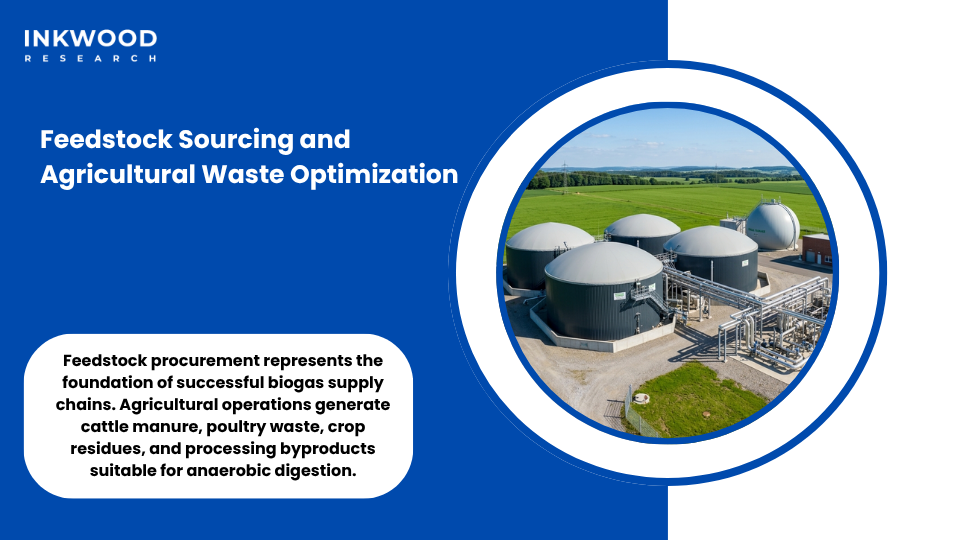
Feedstock procurement represents the foundation of successful biogas supply chains. Agricultural operations generate cattle manure, poultry waste, crop residues, and processing byproducts suitable for anaerobic digestion.
Furthermore, seasonal variations in feedstock availability require strategic planning and storage capabilities. Operators develop relationships with farming communities, ensuring consistent organic material supplies. These procurement strategies directly impact production costs and overall project viability.
Livestock Waste Collection Systems
Dairy cooperatives provide organized feedstock sources through established milk collection networks. Biogas operators leverage these existing logistics, collecting manure alongside milk procurement.
Similarly, large-scale poultry operations generate concentrated waste streams supporting centralized biogas facilities. Collection infrastructure investments reduce transportation costs while ensuring feedstock quality. Therefore, integration with agricultural value chains optimizes supply chain efficiency.
Crop Residue and Agro-Industrial Byproducts
Agricultural residues, including rice straw, wheat straw, and sugarcane bagasse, supplement livestock waste feedstocks. These materials require preprocessing for optimal biogas production but offer abundant availability.
Meanwhile, food processing facilities generate organic waste streams suitable for anaerobic digestion. Oil mills, sugar factories, and distilleries provide concentrated feedstock sources. Consequently, diversified feedstock portfolios improve supply security and production flexibility.
Feedstock Quality Management
Quality control ensures feedstock suitability for efficient biogas production. Moisture content, carbon-nitrogen ratios, and contamination levels affect digestion performance. Operators establish specifications guiding procurement while farmer education improves feedstock quality at the source. Laboratory testing identifies problematic materials before processing. These quality management systems maximize biogas yields while minimizing operational issues.
Production Technologies and Upgrading Infrastructure

Production facilities transform organic feedstocks into raw biogas through anaerobic digestion processes. Subsequently, upgrading technologies remove impurities, producing pipeline-quality biomethane suitable for cooking gas and vehicle fuel applications.
Technology selection balances capital costs against production efficiency and end-use requirements. Moreover, operators optimize digester designs matching feedstock characteristics and climate conditions across India’s diverse regions.
· Digester Technologies and Scale Options
Fixed dome digesters dominate household and small-scale applications, offering simplicity and low maintenance requirements. These systems suit rural communities with limited technical support infrastructure.
Conversely, commercial-scale facilities utilize continuous stirred tank reactors, achieving higher biogas yields. Modular designs enable progressive capacity expansion, matching demand growth. Therefore, technology choices reflect operational scale, feedstock types, and available technical expertise.
· Biogas Upgrading Systems
Upgrading technologies remove carbon dioxide, hydrogen sulfide, and moisture, producing biomethane that meets fuel specifications. Water scrubbing systems offer cost-effective solutions for medium-scale operations. Meanwhile, pressure swing adsorption and membrane separation achieve higher purity levels required for pipeline injection.
Companies like Air Liquide and PlanET Biogas provide advanced upgrading equipment adapted to the Indian market conditions. These technologies enable premium applications, including compressed biogas for vehicles.
· Energy Efficiency and Heat Integration
Combined heat and power configurations maximize energy recovery from biogas combustion. Waste heat supports digester temperature control, improving biogas production rates. Additionally, thermal energy serves facility heating requirements, reducing external energy consumption.
These integrated systems improve overall project economics while demonstrating comprehensive renewable energy utilization. Consequently, energy efficiency becomes a competitive differentiator.
Distribution Networks and Market Access Strategies

Distribution infrastructure connects biogas production facilities with diverse end-use markets. Cooking gas applications utilize bottled gas distribution networks reaching rural and urban households. Meanwhile, compressed biogas stations serve commercial vehicle fleets and public transportation.
Pipeline injection integrates upgraded biogas into natural gas networks where infrastructure exists. These varied distribution pathways require strategic planning to match production locations with market demands.
Bottled Biogas for Cooking Applications
Compressed biogas bottling enables distribution through existing LPG supply chains. Households receive renewable cooking gas without infrastructure modifications or behavioral changes.
Furthermore, established distribution networks reduce market entry barriers for biogas producers. Quality specifications ensure compatibility with conventional cooking appliances. Therefore, bottled biogas provides an accessible pathway reaching millions of rural households.
Vehicle Fuel Infrastructure Development
Compressed biogas refueling stations support the commercial transportation sector transition toward renewable fuels. Strategic locations along major highways serve long-haul truck operations.
Meanwhile, urban stations accommodate municipal bus fleets and commercial vehicles. Public-private partnerships facilitate infrastructure investments, combining government support with private sector efficiency. Consequently, refueling network expansion accelerates vehicle fuel market development.
Pipeline Integration Opportunities
Natural gas pipeline networks in urban regions accommodate upgraded biogas injection. This integration provides access to premium industrial and commercial markets. Pipeline operators establish quality specifications ensuring system compatibility and safety.
However, limited pipeline infrastructure in rural areas constrains this distribution pathway. Therefore, pipeline injection remains primarily an urban strategy complementing rural bottled gas approaches.
Fiscal Benefits and Economic Value Creation

Economic benefits extend across the biogas supply chain from farmers through producers to end users. Agricultural communities gain additional income from waste materials previously considered liabilities.
Meanwhile, biogas producers capture multiple revenue streams, including energy sales, waste tipping fees, and digestate fertilizer. End-users benefit from affordable renewable energy alternatives, reducing expenditures on conventional fuels. These distributed benefits create broad stakeholder support for market development.
Government Subsidies and Financial Incentives
Capital subsidies reduce upfront investment requirements for household and community biogas systems. For instance, the SATAT initiative supports compressed biogas infrastructure through purchase guarantees and preferential pricing.
Tax incentives, including accelerated depreciation, improve project returns for commercial operators. Consequently, government support mechanisms significantly enhance biogas economics.
Farmer Income Diversification
Agricultural producers develop additional revenue streams by selling organic waste to biogas facilities. Manure sales provide a consistent income, complementing volatile commodity markets.
Furthermore, digestate fertilizer outputs reduce chemical fertilizer expenses, improving farm profitability. Cooperative business models ensure equitable benefit sharing across farming communities. Therefore, biogas participation enhances agricultural economic resilience.
Consumer Cost Savings
Household biogas systems reduce cooking fuel expenditures while improving indoor air quality. Urban consumers access renewable cooking gas at competitive prices through established distribution channels.
Commercial vehicle operators benefit from lower fuel costs compared to diesel alternatives. These consumer savings drive adoption while creating sustainable demand for biogas production. Consequently, economic benefits reinforce market growth momentum.
Competitive Landscape and Technology Partnerships
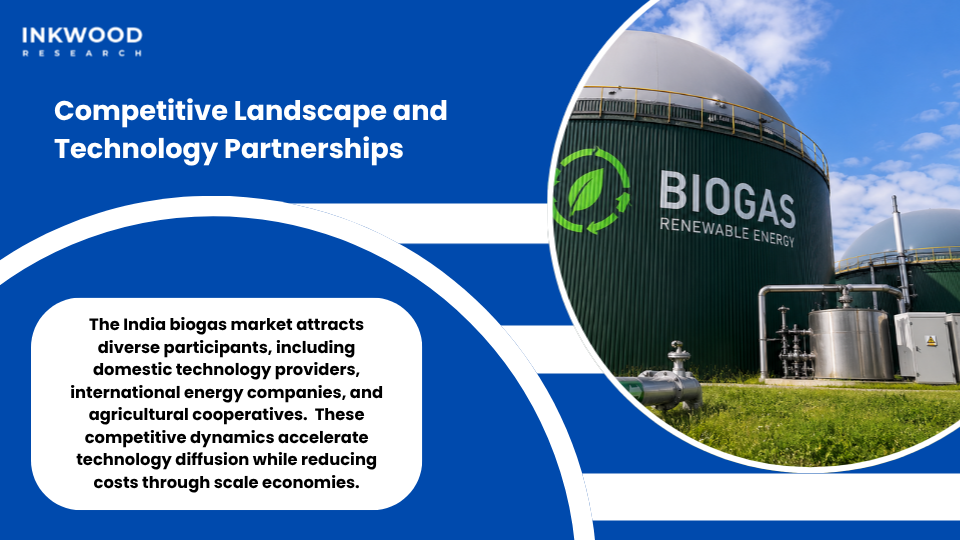
The India biogas market attracts diverse participants, including domestic technology providers, international energy companies, and agricultural cooperatives. Biogas Fuels International expands operations, leveraging global waste-to-energy expertise. Similarly, PlanET Biogas focuses on distributed rural energy solutions adapted to Indian conditions. Meanwhile, Air Liquide brings advanced upgrading technologies supporting premium market applications. These competitive dynamics accelerate technology diffusion while reducing costs through scale economies.
International Technology Transfer
European and American biogas companies partner with Indian firms, transferring proven technologies. Joint ventures combine international engineering expertise with local manufacturing capabilities and market knowledge.
These partnerships accelerate innovation while reducing technology costs through localization. Furthermore, knowledge transfer builds domestic technical capabilities supporting long-term industry development. Therefore, international collaboration benefits all market participants.
Domestic Innovation Ecosystems
Indian research institutions develop biogas technologies suited to local feedstock characteristics and operational conditions. Low-cost digester designs enable broader rural adoption. Meanwhile, mobile upgrading units serve distributed production facilities lacking permanent infrastructure.
These indigenous innovations address specific Indian market requirements that international technologies may overlook. Consequently, domestic R&D strengthens competitive positioning within the global biogas market.
Cooperative Business Models
Agricultural cooperatives operate community-scale biogas facilities serving member farmers. These cooperative structures ensure equitable benefit distribution while achieving economies of scale.
Members supply feedstock, receive cooking gas or electricity, and share financial returns. Governance structures promote transparency and accountability. Therefore, cooperative models demonstrate inclusive development pathways benefiting entire agricultural communities.
Key Takeaways
- The India biogas market demonstrates exceptional growth potential driven by abundant feedstock, supportive policies, and expanding renewable energy demand. Market expansion from US$6,046.15 million in 2026 to US$12,178.81 million by 2034, with a 9.15% CAGR, reflects fundamental supply chain development.
- Successful operations require integrated approaches spanning feedstock procurement, production optimization, and strategic distribution across diverse applications, including cooking gas, vehicle fuel, electricity heat.
- Feedstock optimization leverages agricultural waste streams from livestock operations, crop residues, and agro-industrial byproducts. Quality management ensures consistent production, while collection infrastructure reduces logistics costs.
- Production technologies balance capital requirements against efficiency objectives, with upgrading systems enabling premium applications. Companies, including PlanET Biogas, Biogas Fuels International, and Air Liquide, advance technology adoption through international partnerships and domestic innovation.
- Distribution strategies match production locations with market demands through bottled gas networks, refueling stations, and pipeline integration. Fiscal benefits extend across value chains, supporting farmers, producers, and consumers.
- Government incentives reduce investment barriers while improving project economics. Cooperative business models ensure inclusive development, benefiting entire agricultural communities.
- Success requires comprehensive supply chain integration, addressing feedstock logistics, production efficiency, and market access simultaneously. Regional variations demand tailored strategies matching local agricultural characteristics and infrastructure availability.
- Technology partnerships accelerate innovation while domestic capabilities strengthen long-term competitiveness. Therefore, supply chain excellence determines competitive positioning within India’s rapidly expanding biogas ecosystem.
Conclusion:
India’s biogas supply chain transforms agricultural waste into valuable renewable energy, supporting rural development and environmental sustainability. The sector demonstrates how integrated value chains create economic benefits across diverse stakeholders. Farmers gain additional income while communities access affordable cooking gas and vehicle fuel alternatives. These distributed benefits build broad-based support, accelerating market expansion.
Technology advancement reduces costs while improving efficiency across production and upgrading systems. International partnerships transfer proven expertise while domestic innovation addresses unique Indian market requirements. Government policies provide critical support through subsidies, purchase guarantees, and regulatory frameworks. These enabling conditions position India among global biogas market leaders.
Looking forward, supply chain optimization will determine how rapidly the India biogas market achieves its substantial growth potential. Investments in feedstock logistics, production capacity, and distribution infrastructure create foundations for sustained expansion. Companies establishing competitive positions today benefit from first-mover advantages in Asia’s fastest-growing biogas ecosystem.
For organizations seeking deeper insights into the India biogas market or supply chain development strategies, Inkwood Research offers comprehensive market intelligence and consulting services. Contact our team to explore how these transformative opportunities align with your strategic objectives and support your renewable energy commitments.
Frequently Asked Questions
What feedstock sources drive India’s biogas supply chain?
India’s biogas supply chain relies on cattle manure, poultry litter, rice straw, wheat straw, sugarcane bagasse, food processing waste, and municipal organic waste to ensure diversified and year round feedstock availability
How do farmers benefit financially from biogas supply chains in India?
Farmers earn steady income by supplying manure and crop residues to biogas plants, reduce chemical fertilizer costs through digestate use, and gain energy savings from on farm renewable biogas systems
What distribution strategies optimize market access for biogas producers in India?
Compressed biogas distribution in India leverages LPG networks, CBG fueling stations, and natural gas grid injection, while strategic plant locations reduce logistics costs and expand rural and urban market reach
How does the SATAT scheme support India’s compressed biogas market?
The SATAT scheme promotes compressed biogas production through assured offtake agreements, long term pricing mechanisms, and incentives for private investment in waste to energy and biomethane infrastructure
What are the key applications of compressed biogas in India?
Compressed biogas in India is used as transport fuel for CNG vehicles, industrial process energy, commercial cooking gas, and grid injected renewable gas supporting energy security goals
What challenges impact India’s biogas supply chain development?
Key challenges include feedstock aggregation logistics, financing constraints, technology performance variability, distribution infrastructure gaps, and regulatory approvals affecting project commissioning timelines