Table of Contents
This analysis is brought to you by Inkwood Research, a leading market intelligence firm specializing in IoT environmental monitoring, smart city infrastructure, and air quality technology ecosystems. Our research team combines deep expertise in AI-powered sensor networks, pollution control technologies, and real-time data analytics across North America, Europe, and Asia-Pacific. Through strategic partnerships with technology developers, smart city planners, and sustainability policymakers, we deliver actionable intelligence for businesses navigating the global air quality IoT sensors market.
TLDR
Artificial intelligence is doing something remarkable in the environmental monitoring space; it is converting raw sensor data into decisions that actively reduce pollution. This shift from passive measurement to active mitigation is giving rise to Air Quality as a Service (AQaaS), a model reshaping how cities, industries, and investors think about environmental IoT sensors. According to our analysis, the global air quality IoT sensors market is projected to grow from US$2.49 billion in 2026 to US$8.03 billion by 2034, reflecting a 15.75% CAGR, making it one of the fastest-growing segments within the broader IoT environmental monitoring landscape.
This blog is essential reading for smart city planners, sustainability officers, and environmental technology investors evaluating the global air quality IoT sensors market. Additionally, government policymakers designing urban air quality frameworks, health technology companies building sensor-based platforms, and corporate sustainability teams seeking AI-driven monitoring solutions will find targeted intelligence and strategic context here.
What Is Air Quality as a Service (AQaaS), and Why Does It Matter?
For most of the past decade, air quality monitoring worked on a simple principle: deploy sensors, collect data, generate reports. The data was accurate, the reports were detailed, yet air quality improvements remained frustratingly slow. The problem was not measurement; it was action. Traditional air pollution monitoring sensors market tools told cities and industries what pollution looked like, but offered little guidance on what to do next.
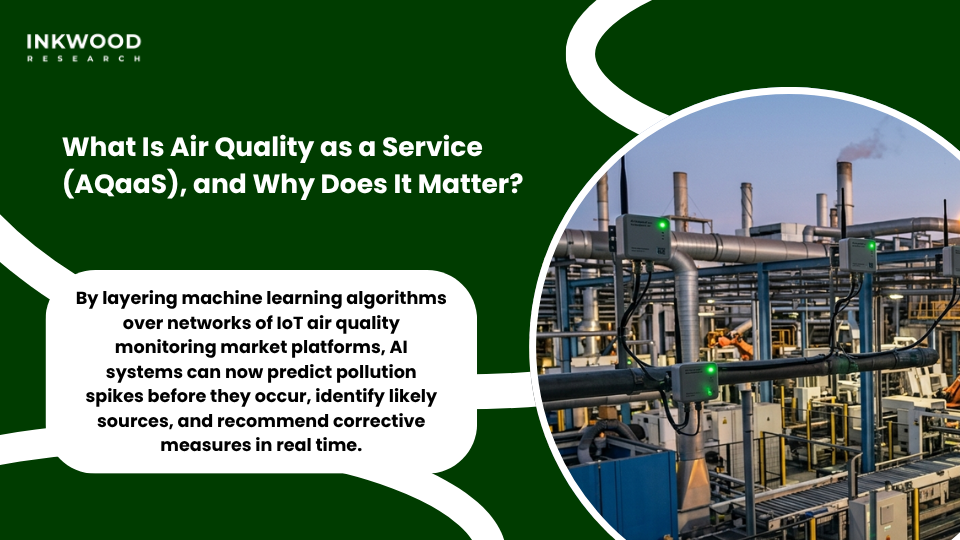
That gap is precisely where AI steps in. By layering machine learning algorithms over networks of IoT air quality monitoring market platforms, AI systems can now predict pollution spikes before they occur, identify likely sources, and recommend corrective measures in real time. This is the foundation of AQaaS, a cloud-connected model that transforms smart air quality sensors market devices from passive instruments into active mitigation tools.
From Static Data to Dynamic Decisions
The shift matters because air quality is not a static problem. Pollution levels change by the hour, influenced by traffic patterns, industrial emissions, weather conditions, and seasonal factors. Consequently, a monitoring system that reports yesterday’s data offers limited value to a city official trying to reduce today’s health risk.
AQaaS platforms address this directly, integrating IoT environmental sensors market infrastructure with real-time data analytics to recommend when to issue public health advisories, redirect traffic flows, or activate industrial emission controls, without waiting for a human analyst to interpret the numbers. Furthermore, cloud-connected outdoor air quality monitoring systems allow multiple stakeholders, regulators, urban planners, and industrial operators to access the same data simultaneously, improving coordination across the entire pollution management chain.
How Large Is the Global Air Quality IoT Sensors Market?
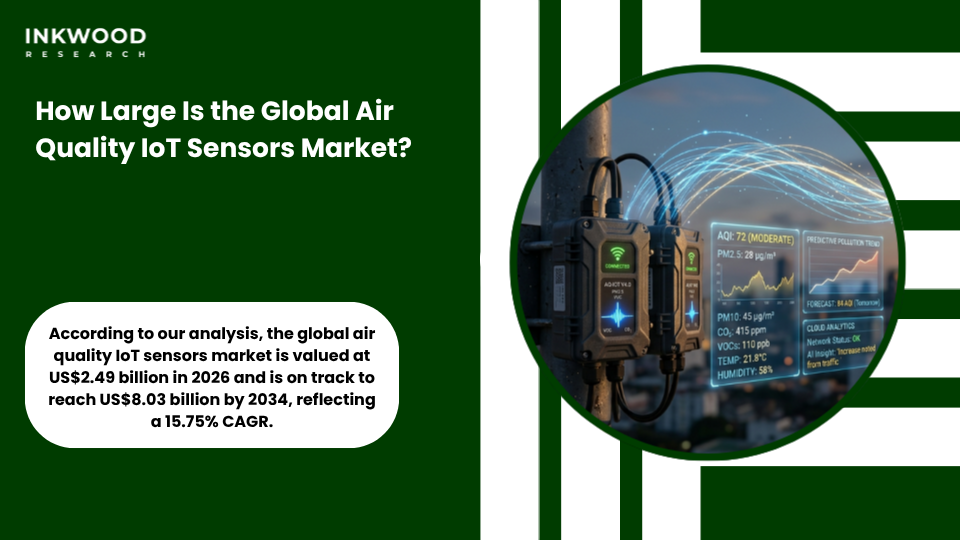
The scale of industry interest in this space is substantial. According to our analysis, the global air quality IoT sensors market is valued at US$2.49 billion in 2026 and is on track to reach US$8.03 billion by 2034, reflecting a 15.75% CAGR. That trajectory places it among the faster-growing segments within the broader IoT sector, driven by expanding smart city initiatives, tightening regulatory standards, and falling sensor hardware costs.
Moreover, the World Health Organization reports that 99% of the global population breathes air exceeding WHO guideline limits, underscoring why demand for AI-powered air quality monitoring systems is accelerating rather than plateauing. Each major region tells a distinct growth story.
Regional Breakdown: North America, Europe, and Asia-Pacific
- North America leads in absolute market value, with the region’s air quality IoT sensors market reaching US$873.65 million in 2026 and projected to climb to US$2,580.11 million by 2034 at a 14.50% CAGR. Federal investment in smart city infrastructure and growing industrial compliance requirements are the primary demand engines.
- Europe is growing from US$638.11 million in 2026 to US$2,034.78 million by 2034 at a 15.60% CAGR. The European Green Deal and revised EU air quality directives are creating structural demand for advanced outdoor air quality monitoring market systems across member states.
- Asia-Pacific is the fastest-growing region at a 17.68% CAGR, expanding from US$703.92 million in 2026 to US$2,588.34 million by 2034. Rapid urbanization, deteriorating urban air quality, and government-led smart city programs across China, India, and Southeast Asia collectively drive this expansion.
How Are AI and IoT Transforming Smart City Air Quality Monitoring?
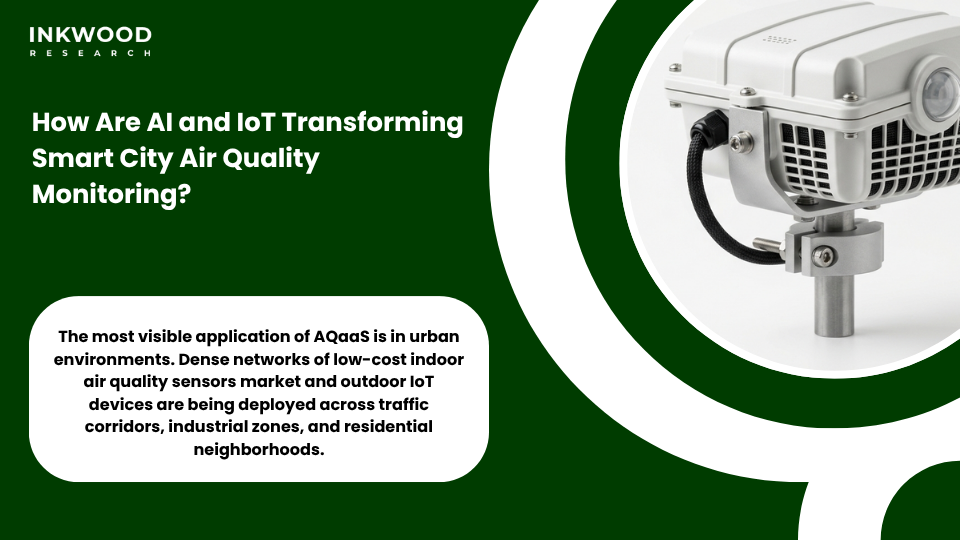
The most visible application of AQaaS is in urban environments. Dense networks of low-cost indoor air quality sensors market and outdoor IoT devices are being deployed across traffic corridors, industrial zones, and residential neighborhoods. Aligning with this, these sensor networks continuously feed data into cloud platforms, identifying pollution hotspots and generating actionable alerts, often within seconds of a threshold breach.
Smart City Air Quality Monitoring in Practice
Several capabilities distinguish AI-powered deployments from traditional monitoring approaches:
- Predictive alerts notify municipal authorities hours before pollution thresholds are breached, allowing preemptive interventions rather than reactive responses.
- Source attribution models use wind patterns, traffic data, and emissions inventories to identify likely pollution sources, a capability that manual analysis alone cannot deliver at scale.
- Hyperlocal mapping generates street-level pollution profiles, enabling micro-interventions such as targeted green corridors or temporary industrial activity restrictions.
- Citizen-facing dashboards translate complex sensor readings into accessible air quality indices, improving public health communication and community engagement.
Additionally, wireless air quality IoT sensors market developments are enabling mesh network deployments where sensors communicate with each other. This reduces infrastructure costs and improves data resilience in dense urban environments, a meaningful advantage for cities managing networks of hundreds or thousands of sensor nodes.
What Is Driving Investor Interest in AQaaS Platforms?
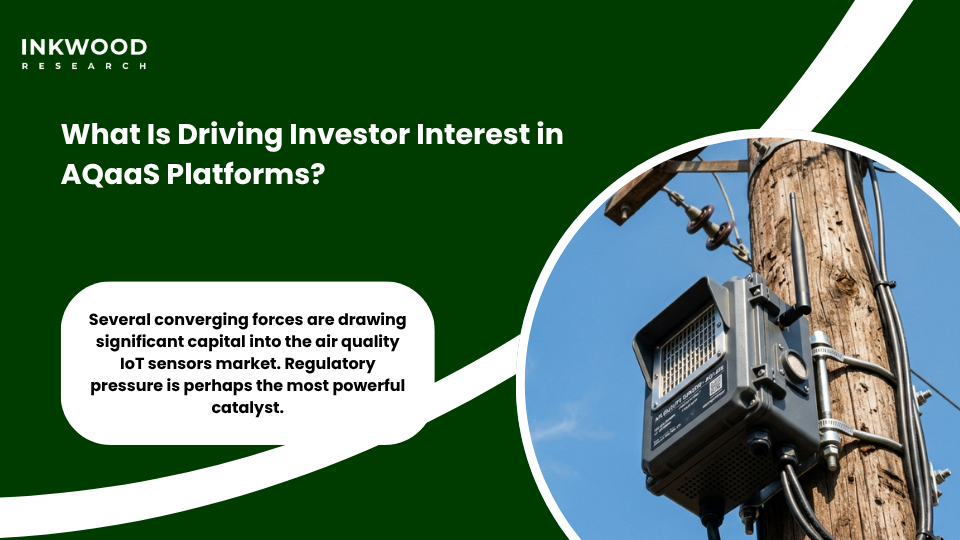
Several converging forces are drawing significant capital into the air quality IoT sensors market. Regulatory pressure is perhaps the most powerful catalyst. Besides, governments across North America and Europe are revising air quality standards upward, requiring industrial operators and municipal authorities to demonstrate continuous, verifiable monitoring, a mandate that AQaaS platforms are uniquely positioned to fulfill.
Furthermore, environmental, social, and governance (ESG) reporting requirements are creating corporate demand for IoT-based air pollution monitoring systems. Businesses operating near sensitive populations or within environmental compliance zones are investing in real-time monitoring not only to meet legal obligations, but to document environmental performance for investors and stakeholders.
The Business Case for Real-Time IoT Environmental Sensors
From a commercial perspective, AQaaS subscription models reduce upfront capital requirements for end users while providing vendors with predictable recurring revenue. Moreover, cloud-connected real-time air quality monitoring IoT solutions can be updated remotely as AI models improve, extending platform value without requiring physical hardware replacement.
As a result, this dynamic is attracting venture capital into environmental IoT sensor startups at a pace that reflects the market’s long-term potential, and signals that AQaaS is not simply a technology trend, but a durable commercial model.
Which Companies Are Leading the Air Quality IoT Sensors Market?
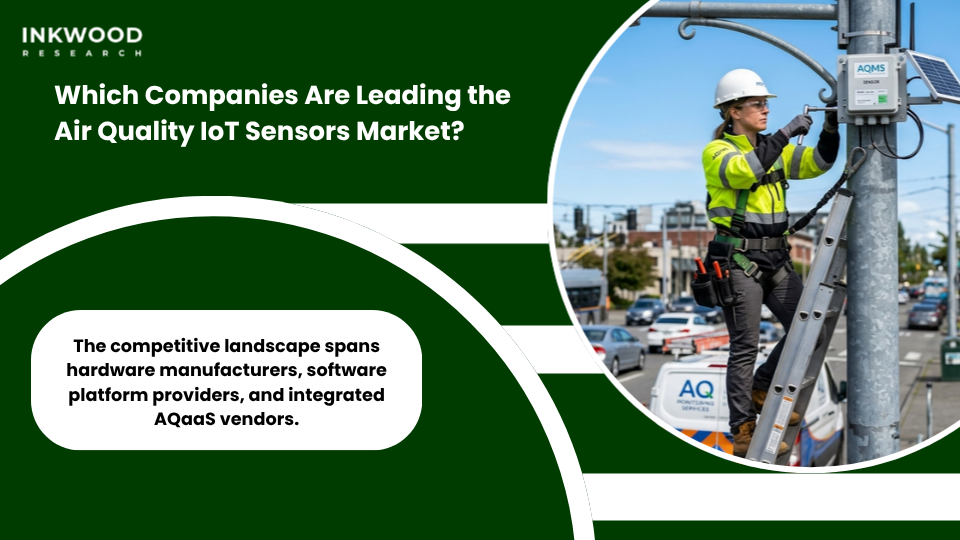
The competitive landscape spans hardware manufacturers, software platform providers, and integrated AQaaS vendors. Several organizations are defining the frontier of the global air quality monitoring market forecast across these dimensions:
- IQAir has built a globally recognized air quality data platform, combining its own sensor network with third-party data feeds to provide hyperlocal information for cities and businesses in more than 80 countries. Its AirVisual platform is used by government agencies and enterprises across multiple continents.
- Clarity Movement specializes in urban smart air quality sensor market applications, offering government-grade, solar-powered sensor nodes validated against regulatory reference monitors. The company has partnered with USAID and the United Nations to deploy networks across cities in Asia, Africa, and the Americas.
- Aeroqual develops precision air quality monitoring instruments for both regulatory and research applications. Its cloud-based platform integrates data from multiple sensor types, enabling AI-driven analysis and reporting across industrial and urban environments.
- Awair focuses on indoor air quality sensor market applications, providing enterprise-grade devices and analytics platforms for commercial buildings, schools, and healthcare facilities. Its systems link air quality data to HVAC automation for dynamic environmental control.
- Sensirion is a Swiss sensor manufacturer supplying particulate matter and gas sensors to a broad range of air quality monitoring system manufacturers globally, positioning it as a key supply-chain enabler throughout the industry.
What Are the Latest Developments in AI-Powered Air Quality Monitoring?
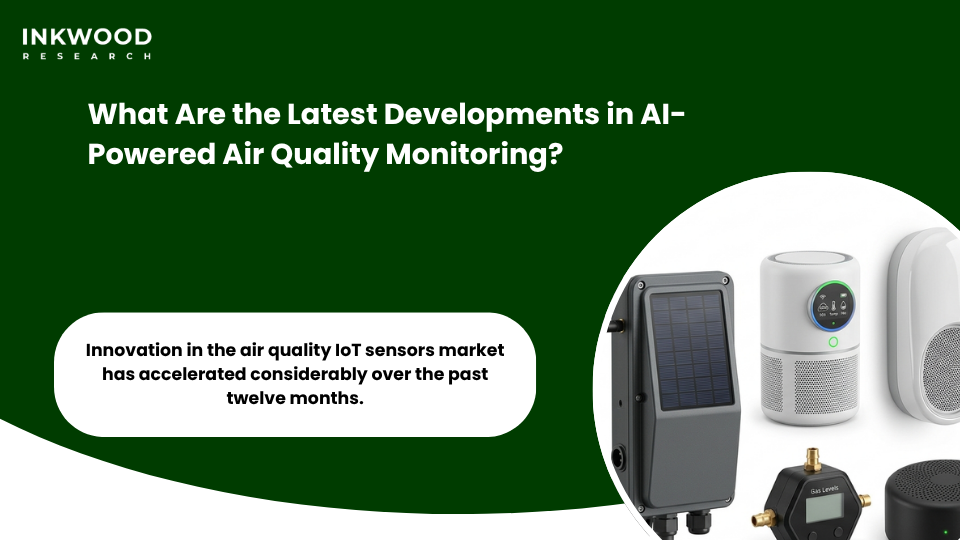
Innovation in the air quality IoT sensors market has accelerated considerably over the past twelve months. Several notable developments are reshaping the competitive and technical landscape:
- IQAir launched an expanded enterprise API platform in 2024, enabling smart city platforms and health technology applications to integrate real-time air quality data feeds directly into operational dashboards.
- Clarity Movement partnered with the United Nations Environment Programme in 2024 to scale low-cost sensor networks across developing cities in South Asia and Sub-Saharan Africa, demonstrating the global scalability of AQaaS models in resource-constrained environments.
- Google’s Environmental Insights Explorer expanded its air quality IoT sensors market APIs in 2024, enabling third-party developers to build hyperlocal pollution monitoring applications using satellite and sensor fusion data, bringing significant new competition into the AI-based environmental sensors segment.
- Honeywell announced expanded integration between its industrial IoT platforms and third-party IoT environmental sensors market networks in late 2024. Consequently, this has enabled automated compliance reporting for industrial facilities subject to air pollution monitoring regulations.
- The European Environment Agency has been piloting citizen science air quality networks using low-cost IoT sensors, with AI analysis validating data quality against reference station readings. This model could significantly lower the cost of comprehensive outdoor air quality monitoring market coverage across EU member states.
Key Takeaways
- The global air quality IoT sensors market grows from US$2.49 billion in 2026 to US$8.03 billion by 2034, with Asia-Pacific leading at a 17.68% CAGR.
- AI-powered AQaaS platforms are shifting air quality monitoring from passive measurement to active, real-time pollution mitigation.
- North America (US$873.65M → US$2,580.11M) and Europe (US$638.11M → US$2,034.78M) are expanding steadily on regulatory and smart city demand, while Asia-Pacific (US$703.92M → US$2,588.34M) outpaces both.
- Investor interest in AQaaS is accelerating, driven by regulatory mandates, ESG reporting needs, and scalable subscription-based revenue models.
- IQAir, Clarity Movement, Aeroqual, Awair, and Sensirion are among the key players shaping the competitive landscape across hardware, software, and platform segments.
- Recent developments from Google, Honeywell, and the European Environment Agency are reshaping the technology and data ecosystem for smart air quality sensors globally.
Conclusion
Air quality monitoring is no longer a compliance checkbox. As AI continues to transform the global air quality IoT sensors market, the ability to convert passive pollution data into active, real-time mitigation decisions is becoming both a competitive and regulatory imperative for cities, industries, and investors alike. The AQaaS model represents one of the most consequential shifts in the IoT environmental sensors market development in a generation, and the data suggests we are still in the early stages of that transformation.
Inkwood Research provides the market intelligence and strategic analysis needed to navigate this evolving landscape with confidence.
Connect with our team to explore how our insights can support your positioning in the global air quality IoT sensors market.
Frequently Asked Questions (FAQs)
AQaaS uses AI and cloud-connected IoT sensors to transform raw air quality data into real-time, actionable pollution mitigation decisions for cities and industries.
Our analysis values the market at US$2.49 billion in 2026, projected to reach US$8.03 billion by 2034 at a 15.75% CAGR.
Asia-Pacific leads with a 17.68% CAGR, driven by urbanization, smart city programs, and worsening air quality across major cities.
Regulatory compliance mandates, ESG reporting obligations, and scalable AQaaS subscription revenue models are collectively attracting investor capital into this space.
AI enables predictive alerts, source attribution, and hyperlocal pollution mapping, capabilities that passive sensor networks alone cannot consistently deliver.
Smart city operators, industrial manufacturers, healthcare facility managers, and commercial real estate operators are among the primary beneficiaries of real-time IoT air quality solutions.