Table of Contents
This analysis is brought to you by Inkwood Research, a leading market intelligence firm specializing in advanced energy storage technologies, next-generation battery materials, and solid-state electrolyte innovations. Our research team combines extensive experience analyzing sulfide electrolyte development, oxide ceramic processing, polymer-based battery systems, and manufacturing scale-up challenges across North America, Europe, and Asia-Pacific markets. Based on our proprietary research methodologies and strategic partnerships with solid-state battery manufacturers, materials suppliers, automotive OEMs, and research institutions, we deliver actionable insights that empower strategic decision-making for global enterprises navigating solid-state battery commercialization and material science breakthroughs.
TLDR
Solid-state batteries represent the next frontier in energy storage, replacing flammable liquid electrolytes with advanced solid materials like sulfides, oxides, and polymers. Manufacturing challenges, material stability issues, and high production costs currently impede North American commercialization, while Asia-Pacific leads with aggressive R&D investments. Europe focuses on EV applications and grid storage integration, positioning different regions for distinct advantages in the emerging solid-state battery market.
This blog aims to serve energy storage professionals, automotive engineers, battery technology investors, materials scientists, procurement specialists, and corporate strategists seeking comprehensive insights into solid-state battery chemistry, regional market dynamics, manufacturing roadblocks, and commercialization timelines across North America, Europe, and Asia-Pacific markets.
Understanding the Material Science Behind Solid-State Batteries
The transition from conventional lithium-ion batteries to solid-state configurations hinges entirely on electrolyte innovation. Traditional batteries rely on liquid or gel electrolytes, which pose fire risks and limit energy density. Meanwhile, solid-state batteries substitute these with ceramic, polymer, or composite materials. This fundamental shift enables higher energy storage, improved safety profiles, and longer operational lifespans.
According to Inkwood Research, the global solid-state battery market is expected to reach US$1,923.74 million in 2026 to US$25,208.41 million by 2034. Moreover, this represents a remarkable 37.94% compound annual growth rate. However, achieving commercial viability requires overcoming significant material science challenges.
The Three Primary Electrolyte Pathways
Material selection fundamentally determines battery performance characteristics. Each electrolyte class offers distinct advantages and limitations. Consequently, manufacturers must balance competing priorities of conductivity, stability, and manufacturing feasibility.
Sulfide-based materials deliver ionic conductivity approaching 10⁻² S/cm at room temperature. Furthermore, they enable excellent contact with electrode materials. Nevertheless, sulfides demonstrate extreme sensitivity to moisture and atmospheric oxygen. Additionally, their processing requires expensive dry-room manufacturing environments.
Oxide ceramics provide exceptional electrochemical stability windows. These materials resist degradation against high-voltage cathodes and lithium metal anodes. However, interfacial resistance remains problematic, particularly at room temperature. Sintering requirements also increase manufacturing complexity and production costs significantly.
Polymer systems offer processing simplicity and mechanical flexibility advantages. These materials conform readily to electrode surfaces, reducing interfacial impedance. Unfortunately, room-temperature ionic conductivity remains inadequate for most applications. Operating temperatures typically exceed 60-80°C to achieve acceptable performance levels.
Material Chemistry Innovations Breaking Through
Recent breakthroughs address longstanding material limitations through innovative chemistry approaches. Researchers worldwide pursue hybrid strategies combining multiple electrolyte classes. These composite materials leverage complementary strengths while mitigating individual weaknesses.
Chlorine-Iodine Composite Systems
Beijing Easpring developed chlorine-iodine composite sulfide electrolytes with enhanced stability. Incorporating iodine into sulfide structures improves interface compatibility dramatically. Subsequently, humidity sensitivity decreases while maintaining high ionic conductivity. These advancements enable more practical manufacturing conditions without stringent environmental controls.
Three-Dimensional Percolation Networks
Researchers created high-throughput three-dimensional composite polymer electrolytes through localized concentration engineering. These systems achieve superior ion transport via structured pathways. Consequently, room-temperature performance improves substantially compared to conventional polymer electrolytes.
LLZO Garnet Structures
Lithium-lanthanum-zirconium-oxide garnets offer wide electrochemical stability windows. Research indicates stability from 0.05 to 6 volts versus lithium metal. Additionally, these materials demonstrate excellent chemical compatibility with lithium anodes. However, grain boundary resistance and densification challenges persist throughout manufacturing processes.
Challenges Blocking North American Commercialization

Despite technological promise, multiple barriers impede commercial deployment across North American markets. Manufacturing infrastructure limitations, supply chain gaps, and cost structures create formidable obstacles. Moreover, established lithium-ion production ecosystems resist disruption from emerging technologies.
Manufacturing Scale-Up Complexities
QuantumScape’s Cobra process represents breakthrough ceramic separator manufacturing technology. This innovation improves production throughput by 200-fold compared to 2023 baseline methods. Nevertheless, achieving gigawatt-hour scale production remains years away from commercial reality.
Solid-state battery production demands fundamentally different manufacturing approaches than conventional batteries. Equipment suppliers must develop specialized tooling for ceramic processing, dry-room handling, and precision stacking. Additionally, quality control requirements exceed current industry standards significantly.
Cost Structure Disadvantages
The North America solid-state battery market reached US$430.84 million in 2026. Furthermore, projections show growth to US$5802.98 million million by 2034 at 38.41% CAGR. However, current production costs remain prohibitively high for mass-market applications.
Material costs for oxide and sulfide electrolytes exceed lithium-ion equivalents substantially. Sintering processes require high-temperature treatments that consume significant energy. Moreover, specialized dry-room environments add infrastructure expenses. Consequently, manufacturers struggle to achieve cost parity with established battery technologies.
Supply Chain Fragmentation
Critical raw materials concentrate in Asian markets, creating dependency risks. Lithium sulfide production, essential for sulfide electrolytes, relies heavily on Chinese and Japanese suppliers. Toyota partnered with Idemitsu Kosan to secure lithium sulfide supplies through dedicated facilities. However, North American manufacturers lack equivalent vertical integration strategies.
Additionally, specialized equipment suppliers remain predominantly Asian-based. Ceramic processing machinery, dry-room systems, and precision stacking equipment require significant lead times. These factors compound manufacturing delays and increase capital requirements for facility development.
Europe’s Strategic Focus: EVs, Grid Storage & Electronics
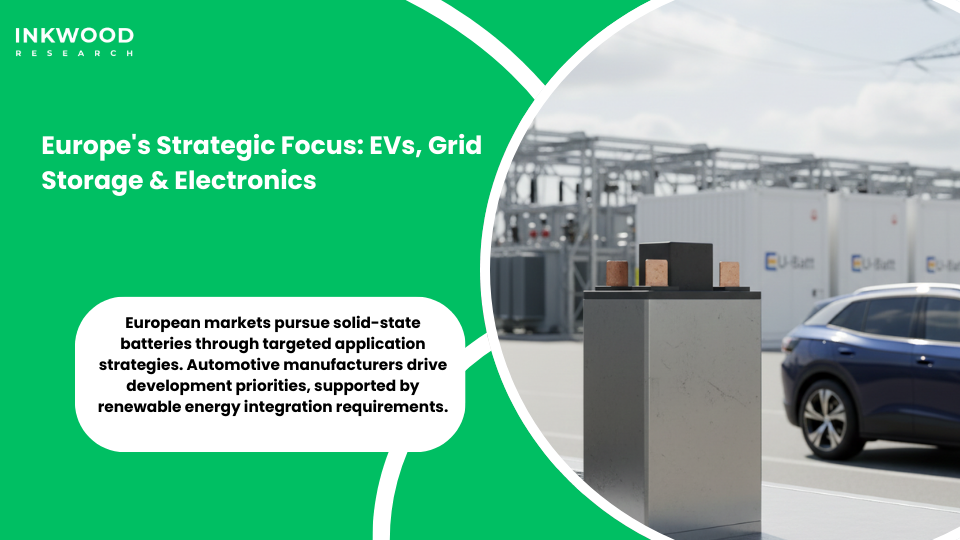
European markets pursue solid-state batteries through targeted application strategies. Automotive manufacturers drive development priorities, supported by renewable energy integration requirements. Additionally, consumer electronics applications provide near-term revenue opportunities.
Electric Vehicle Integration
European automakers aggressively pursue solid-state battery partnerships for premium EV segments. Stellantis validated Factorial Energy’s solid-state cells, achieving 375 Wh/kg energy density. These batteries charge from 15% to 90% in merely 18 minutes. Moreover, demonstration fleets incorporating solid-state technology launch throughout 2026.
The Europe solid-state battery market stood at US$354.89 million in 2026. Projections indicate expansion to US$4315.68 million by 2034, representing 36.65% CAGR growth. Consequently, European manufacturers prioritize automotive applications to capture this expanding market opportunity.
Grid-Scale Energy Storage
Renewable energy proliferation creates an urgent need for advanced storage solutions. Solid-state batteries offer superior safety profiles for large-scale installations. Furthermore, extended cycle life reduces total ownership costs compared to conventional alternatives.
German and French utilities explore solid-state technology for grid stabilization applications. Battery parks providing frequency regulation and peak shaving demonstrate economic viability. However, cost reductions remain necessary before widespread utility-scale deployment occurs.
Consumer Electronics Advantages
Samsung Electro-Mechanics targets mass production of oxide-based solid-state batteries by 2026. These batteries achieve 200 Wh/L energy density for wearable devices. Additionally, enhanced safety characteristics enable miniaturized designs impossible with liquid electrolytes.
European manufacturers leverage consumer electronics as entry markets for solid-state technology. Smaller-scale production reduces capital requirements while establishing manufacturing expertise. Subsequently, companies scale production volumes before transitioning to automotive applications.
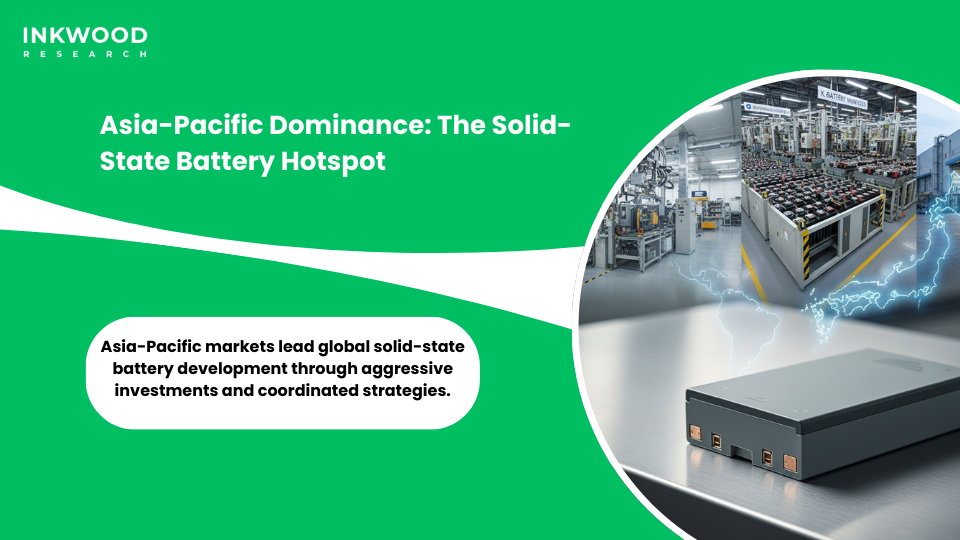
Asia-Pacific markets lead global solid-state battery development through aggressive investments and coordinated strategies. Government support, established supply chains, and manufacturing expertise create competitive advantages. Moreover, regional collaboration accelerates technology maturation timelines.
The Asia-Pacific solid-state battery market reached US$975.03 million in 2026. Projections show growth to US$13123.50 million by 2034 at 38.40% CAGR. Consequently, this region represents the largest market opportunity globally.
Japan’s Manufacturing Excellence
Toyota collaborated with Sumitomo Metal Mining on cathode material development for solid-state batteries. Production facilities targeting 2027 operations will supply Toyota’s EV programs. Additionally, Nissan advances sulfide-based all-solid-state batteries targeting 2028-2029 commercialization.
Japanese manufacturers leverage decades of materials science expertise in battery development. METI provides substantial financial support for production facility construction. Furthermore, established relationships between automakers and materials suppliers accelerate development cycles.
South Korea’s Aggressive Timeline
LG Energy Solution aims for solid-state battery mass production by 2030. Meanwhile, Samsung SDI targets the 2027 commercialization of prismatic cells. Additionally, SK On’s pilot line in Daejeon began operations in September 2025.
The South Korea solid-state battery market was valued at US$135.96 million in 2026. Projections indicate growth to US$1,779.55 million by 2034 at 37.92% CAGR. Consequently, Korean manufacturers pursue aggressive commercialization schedules to capture market leadership.
China’s Rapid Scaling
Dongfeng Motor expects mass production of solid-state batteries by September 2026. These batteries deliver 350 Wh/kg energy density, enabling a 1,000-kilometer EV range. Moreover, pilot production lines already operate at 0.2 GWh capacity.
Chinese manufacturers benefit from integrated supply chains and government subsidies. Municipal governments provide targeted support for solid-state battery industrial clusters. Additionally, automakers directly invest in battery technology development, accelerating commercialization timelines.
Material Performance Comparison and Selection
Selecting appropriate electrolyte materials requires balancing multiple performance parameters. No single material system satisfies all requirements simultaneously. Consequently, application-specific optimization determines ideal material choices.
Ionic Conductivity Requirements
Room-temperature ionic conductivity critically determines battery performance. Sulfide electrolytes achieve 1×10⁻³ to 1×10⁻² S/cm conductivity. Oxide systems range from 1×10⁻⁴ to 1×10⁻³ S/cm. Meanwhile, polymer electrolytes deliver 1×10⁻⁷ to 1×10⁻⁵ S/cm at ambient temperatures.
Higher conductivity enables faster charging and improved power delivery capabilities. However, materials with superior conductivity often sacrifice stability or manufacturing feasibility. Therefore, manufacturers must optimize trade-offs based on target applications.
Electrochemical Stability Windows
Voltage stability determines cathode material compatibility and overall energy density potential. Oxide electrolytes demonstrate the widest stability windows, often exceeding 5 volts. Sulfides offer moderate stability, requiring protective coatings against high-voltage cathodes. Polymers show limited high-voltage compatibility without extensive engineering.
Interface Engineering Challenges
Contact resistance between electrodes and solid electrolytes significantly impacts performance. Interface resistances often exceed 100 Ω·cm² without surface modifications. Consequently, researchers develop coating technologies and composite structures, reducing interfacial impedance.
Sulfide electrolytes achieve excellent electrode contact through plastic deformation during cycling. Oxide ceramics struggle to maintain contact due to high elastic moduli. Therefore, polymer interlayers or composite architectures improve oxide-electrode interfaces substantially.
Manufacturing Process Innovations
Production methods fundamentally determine commercialization feasibility and cost structures. Traditional battery manufacturing equipment cannot produce solid-state configurations directly. Hence, entirely new manufacturing paradigms emerge industry-wide.
Ceramic Separator Production
Corning developed Ribbon Ceramics technology for ultra-thin ceramic production. This roll-to-roll process enables wide-format manufacturing at lower costs. Moreover, lithium garnet materials processed through this method demonstrate improved uniformity and reduced defects.
ProLogium’s gigafactory achieves production efficiency 2.6 times greater than earlier facilities. Continuous wet coating for solid electrolytes doubles assembly speeds while reducing manufacturing costs. These innovations prove essential for achieving competitive cost structures.
Dry-Room Requirements
Sulfide electrolyte processing demands stringent environmental controls. Moisture levels must remain below 1% relative humidity consistently. Additionally, oxygen exposure degrades material properties irreversibly. Consequently, specialized dry-room facilities require substantial capital investments.
Equipment suppliers develop modular dry-room systems, reducing infrastructure costs. Localized atmospheric control around critical processing steps offers cost advantages. Nevertheless, dry-room requirements increase operational complexity and energy consumption compared to conventional manufacturing.
Cell Assembly Techniques
Solid-state battery assembly differs fundamentally from liquid electrolyte configurations. Ceramic separators require precision handling, preventing mechanical damage. Furthermore, achieving intimate electrode-electrolyte contact demands specialized pressing or sintering procedures.
Manufacturers explore various assembly approaches, including stacking, rolling, and folding methodologies. Samsung SDI pursues prismatic cells leveraging aluminum enclosures for improved safety. Meanwhile, LG Energy Solution develops pouch-type configurations maximizing energy density advantages.
Future Material Development Directions
Emerging material systems promise breakthrough performance beyond current electrolyte technologies. Researchers explore halide-based conductors, composite architectures, and novel processing techniques. Additionally, computational materials science accelerates discovery timelines significantly.
Halide Solid Electrolytes
Chloride superionic conductors combine sulfide-level conductivity with improved oxidation stability. These materials avoid sulfide sensitivity to moisture and oxygen exposure. Moreover, raw material costs potentially decrease compared to current systems.
Recent research indicates Li₃MCl₆ and Li₂M₂/₃Cl₄ systems demonstrate promising characteristics. However, interfacial compatibility requires additional optimization before commercial deployment occurs.
Composite Electrolyte Architectures
Combining multiple electrolyte types within single cells leverages complementary advantages. Oxide-sulfide composites pair sulfide conductivity with oxide stability. Meanwhile, polymer-ceramic hybrids improve electrode contact while maintaining reasonable conductivity.
LLZO-polymer composites reduce contact resistance by 40-70% compared to pure oxide systems. These hybrid approaches may enable faster commercialization than monolithic all-solid-state configurations.
Computational Materials Discovery
Artificial intelligence accelerates electrolyte discovery through high-throughput computational screening. Machine learning models predict ionic conductivity, stability windows, and interfacial properties rapidly. Consequently, experimental efforts focus on the most promising candidate materials. Development cycles shorten from years to months through computational guidance. Nevertheless, experimental validation remains essential before manufacturing implementation.
Key Takeaways
- The solid-state battery material landscape presents both immense opportunities and significant challenges. Sulfide, oxide, and polymer electrolytes each offer distinct advantages requiring application-specific optimization. North American commercialization faces manufacturing infrastructure gaps, cost disadvantages, and supply chain limitations that delay market entry.
- Europe strategically focuses on premium EV applications, grid storage integration, and consumer electronics markets. These targeted approaches leverage existing strengths while building manufacturing capabilities gradually. Meanwhile, Asia-Pacific markets lead globally through aggressive investments, government support, and integrated supply chains.
- Material innovations continue advancing rapidly through composite systems, improved processing techniques, and computational discovery methods. However, substantial work remains before solid-state batteries achieve cost parity with conventional lithium-ion technology. The next five years will prove critical as pilot production scales toward commercial volumes.
- Successfully navigating this transition requires coordinated efforts across materials science, manufacturing engineering, and supply chain development. Companies positioning strategically across these dimensions will capture disproportionate value as solid-state batteries transform energy storage markets globally.
Conclusion
The evolution from liquid to solid electrolytes represents the most significant battery technology shift in decades. Material selection fundamentally determines performance characteristics, manufacturing feasibility, and commercial viability. Consequently, understanding chemistry trade-offs proves essential for strategic decision-making.
Regional markets pursue distinct approaches reflecting local strengths and market priorities. North America must address manufacturing gaps and cost structures urgently. Europe leverages automotive expertise toward premium applications. Meanwhile, Asia-Pacific’s integrated ecosystems enable faster commercialization timelines.
As material innovations continue maturing, the global solid-state battery market will expand dramatically. Organizations investing strategically in manufacturing capabilities, supply chain development, and material partnerships will lead this transformation. The chemistry revolution has begun—success requires acting decisively today.
Partner with Inkwood Research to navigate solid-state battery market complexities. Our comprehensive intelligence services provide strategic insights enabling informed investment decisions, supplier selection, and technology roadmap development.
Contact our team today to discuss how we can support your solid-state battery strategy.
Frequently Asked Questions (FAQs)
Solid-state batteries use three primary electrolyte materials: sulfides, offering the highest ionic conductivity but requiring dry-room processing, oxides providing excellent stability with higher manufacturing costs, and polymers enabling simpler production yet needing elevated operating temperatures for adequate performance.
Commercial deployment faces multiple obstacles, including high manufacturing costs, material stability challenges, interfacial resistance issues, and supply chain limitations. Additionally, achieving gigawatt-hour scale production requires entirely new manufacturing equipment and processes compared to conventional battery production methods.
Asia-Pacific markets dominate through aggressive investments and government support, with Japan, South Korea, and China leading technology development. Europe focuses on automotive applications and grid storage, while North America addresses manufacturing infrastructure gaps and supply chain challenges limiting commercial deployment.