Table of Contents
This analysis is brought to you by Inkwood Research, a leading market intelligence firm specializing in Asia-Pacific healthcare technology ecosystems, diagnostic imaging equipment adoption patterns, and medical display infrastructure developments. Our research team combines extensive experience analyzing regional healthcare modernization initiatives, government investment programs, and medical device certification requirements across China, India, Japan, Southeast Asia, and Australia. Based on our proprietary research methodologies and strategic partnerships with Asian healthcare equipment manufacturers, hospital procurement networks, and diagnostic imaging associations, we deliver actionable insights that empower strategic decision-making for global enterprises navigating Asia-Pacific’s healthcare technology transformation and medical display market expansion.
TLDR
Asia-Pacific medical display monitors market demonstrates robust expansion globally, projected to grow from $792.55 million in 2026 to $1,347.08 million by 2034 at a 6.86% CAGR. Moreover, regional healthcare infrastructure investments, diagnostic imaging advancements, and aging population demographics fuel this momentum. Additionally, technological innovations in DICOM calibration, 4K resolution displays, and AI-integrated visualization platforms transform clinical workflows. Consequently, hospitals across China, India, Japan, Southeast Asia prioritize certified medical-grade monitors for radiology departments, surgical suites, and imaging centers.
Healthcare administrators planning diagnostic equipment purchases, medical imaging directors evaluating display technology investments, radiology department managers seeking DICOM-compliant solutions, and hospital procurement officers comparing regional market dynamics benefit from these insights. Furthermore, medical technology distributors expanding in Asia-Pacific markets, healthcare investment analysts tracking regional growth patterns, and clinical engineering teams implementing new imaging infrastructure gain valuable strategic perspectives.
Understanding Medical Display Market Dynamics: Asia-Pacific’s Dominance
Market Expansion in Asia-Pacific Healthcare Systems
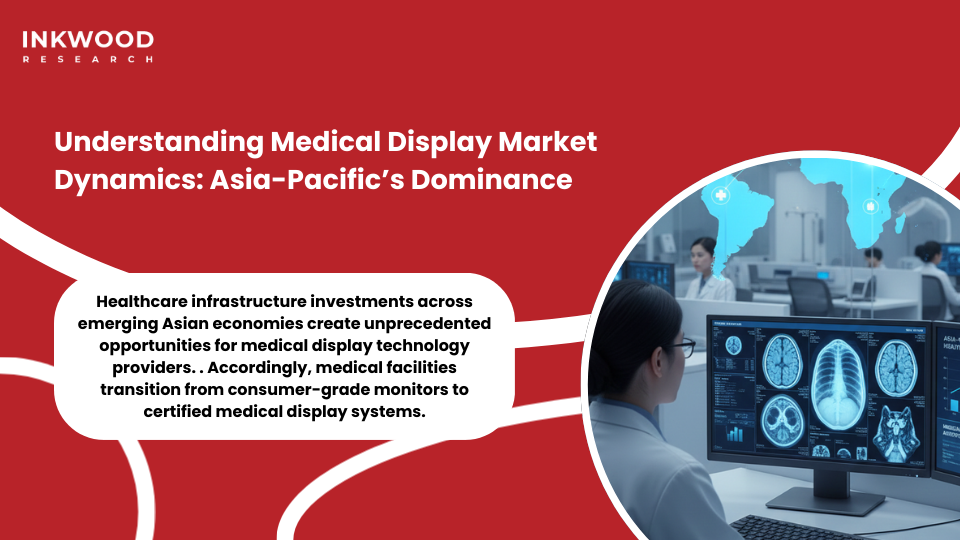
Asia-Pacific’s medical display monitors market demonstrates exceptional growth momentum, expanding from $792.55 million in 2026 to a projected $1,347.08 million by 2034. This represents a compound annual growth rate of 6.86%, significantly outpacing other global regions. Nevertheless, this acceleration reflects fundamental shifts in regional healthcare delivery models and diagnostic imaging priorities.
Healthcare infrastructure investments across emerging Asian economies create unprecedented opportunities for medical display technology providers. Governments in China, India, Indonesia, and Vietnam allocate substantial budgets toward hospital modernization programs. These initiatives prioritize diagnostic accuracy and clinical outcomes. Accordingly, medical facilities transition from consumer-grade monitors to certified medical display systems.
Regional population health challenges amplify demand for advanced visualization technologies. Chronic disease prevalence, aging demographics, and increasing healthcare utilization rates necessitate sophisticated diagnostic capabilities. Meanwhile, healthcare providers recognize that accurate image interpretation depends fundamentally on display quality. Therefore, investments in DICOM-compliant medical monitors become strategic priorities rather than discretionary purchases.
Healthcare Modernization Initiatives Across Regions
China’s Healthy China 2030 initiative drives massive healthcare infrastructure investments, particularly in tertiary hospitals and diagnostic centers. Similarly, India’s Ayushman Bharat program expands healthcare access across urban and rural populations. These policy frameworks create sustained demand for medical imaging equipment and associated display technologies.
Southeast Asian nations implement universal healthcare coverage programs that increase diagnostic imaging volumes substantially. Indonesia’s Jaminan Kesehatan Nasional program covers approximately 270 million citizens as of 2025. This expansion necessitates a comprehensive medical display infrastructure across thousands of healthcare facilities. Consequently, display manufacturers establish regional production facilities and distribution networks to serve these growing markets effectively.
Regional Market Performance Comparison
Asia-Pacific Growth Versus Global Markets
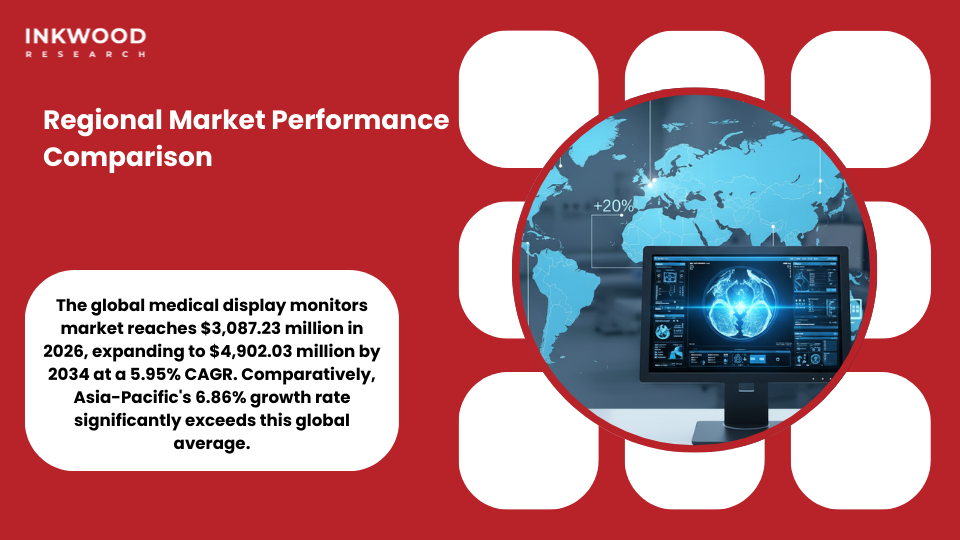
The global medical display monitors market reaches $3,087.23 million in 2026, expanding to $4,902.03 million by 2034 at a 5.95% CAGR. Comparatively, Asia-Pacific’s 6.86% growth rate significantly exceeds this global average. The Europe medical display monitors market demonstrates similar momentum, growing from $926.29 million to $1,491.20 million at a 6.13% CAGR. However, the mature North America medical display monitors market expands more modestly from $1,154.13 million to $1,747.08 million at a 5.32% CAGR.
These regional variations reflect distinct healthcare system characteristics and investment patterns. North America’s established medical imaging infrastructure limits incremental growth opportunities compared to Asia-Pacific’s expanding healthcare access. European markets balance between infrastructure replacement cycles and new facility development. Meanwhile, Asia-Pacific markets experience simultaneous infrastructure expansion and technology modernization.
China and India Lead Regional Growth
China dominates Asia-Pacific medical display adoption through sheer healthcare system scale and modernization velocity. The nation’s hospital construction boom and diagnostic capacity expansion create sustained equipment demand. Additionally, domestic manufacturers like Reshin compete aggressively in cost-sensitive segments while maintaining quality standards. This competitive dynamic accelerates overall market penetration.
India’s medical imaging market expands rapidly alongside healthcare infrastructure development and increasing diagnostic awareness. Private hospital chains invest heavily in advanced imaging capabilities to serve growing middle-class populations. Furthermore, medical tourism growth incentivizes Indian hospitals to adopt international-standard diagnostic equipment, including certified medical display monitors. These factors compound to drive robust market expansion.
Technology Adoption Patterns Across Healthcare Systems
DICOM Calibration Standards Drive Quality Requirements
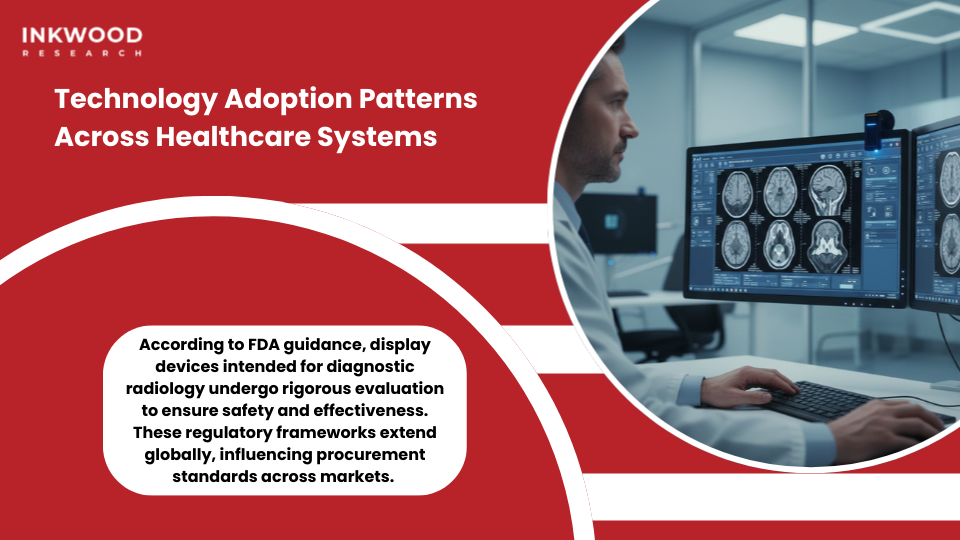
Medical display monitors for diagnostic imaging must comply with DICOM Part 14 standards, ensuring consistent grayscale reproduction and luminance uniformity. This technical requirement fundamentally distinguishes medical-grade displays from consumer monitors. Healthcare facilities increasingly recognize that diagnostic accuracy depends critically on proper display calibration and maintenance.
According to FDA guidance, display devices intended for diagnostic radiology undergo rigorous evaluation to ensure safety and effectiveness. These regulatory frameworks extend globally, influencing procurement standards across markets. Consequently, hospitals prioritize FDA-cleared or CE-marked display systems that meet international performance benchmarks.
Resolution and Brightness Specifications Evolution
Modern radiology workflows demand displays with a minimum 3-megapixel resolution for general diagnostic applications, while mammography applications require 5-megapixel or higher specifications. EIZO’s RadiForce RX670, launched in late 2024, offers a 30-inch 6-megapixel resolution with 1200 cd/m² brightness, setting new performance standards. These specifications enable radiologists to detect subtle abnormalities that lower-resolution displays might obscure.
Brightness levels significantly impact diagnostic confidence, particularly in ambient light conditions. Medical displays typically maintain 400-600 cd/m² luminance for diagnostic review applications, while surgical displays may require higher brightness levels for operating room visibility. Additionally, displays must maintain consistent brightness across their entire lifecycle, necessitating automatic calibration systems.
Competitive Landscape and Leading Manufacturers
Global Leaders Dominate Premium Segments
Barco maintains market leadership through exceptional image quality and brand reputation, particularly in high-acuity diagnostic imaging applications. The Belgian manufacturer’s dominance extends across radiology, mammography, and interventional procedures.
Similarly, EIZO from Japan commands premium segments through superior color accuracy and product longevity. Sony leverages extensive video technology expertise to deliver industry-leading surgical displays with 4K clarity.
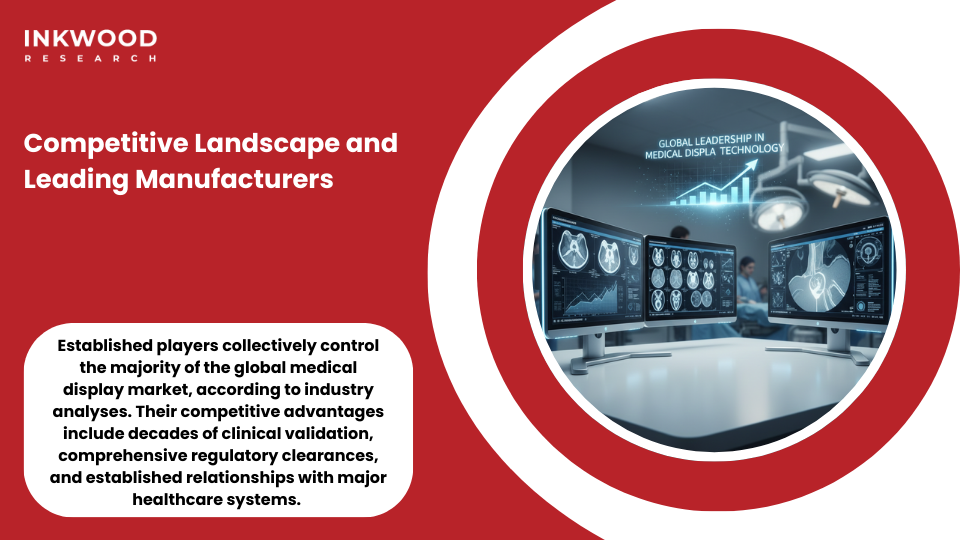
Established players collectively control the majority of the global medical display market, according to industry analyses. Their competitive advantages include decades of clinical validation, comprehensive regulatory clearances, and established relationships with major healthcare systems. However, regional manufacturers increasingly challenge these incumbents in cost-sensitive market segments.
Regional Manufacturers Expand Market Presence
Chinese manufacturer Reshin has successfully penetrated global markets by balancing quality with competitive pricing. The company’s displays meet international certification requirements while offering significant cost advantages compared to Japanese or European alternatives. This value proposition resonates particularly strongly in emerging markets, prioritizing healthcare access expansion over premium brand positioning.
LG and Samsung leverage their display technology leadership to compete effectively in the medical monitor segment. Both Korean manufacturers utilize their advanced LCD panel production capabilities to offer competitive products. Furthermore, their extensive distribution networks across the Asia-Pacific provide significant market access advantages. Consequently, they capture growing market share in clinical review and surgical display applications.
Recent Product Launches and Innovations
Barco’s Nexxis aVNA solution revolutionizes surgical visualization by enabling 4K video distribution with less than 30 milliseconds of latency. The system supports up to 1,000 connected devices within hospital networks, according to industry reports. This capability transforms operating room workflows by enabling flexible display configurations and multi-specialty collaboration.
LG secured FDA 510(k) clearance for its 32HS710S 4K surgical monitor in 2025, expanding its certified product portfolio. This approval demonstrates the company’s commitment to regulatory compliance and clinical validation. Meanwhile, EIZO continues advancing diagnostic display technology with enhanced AI integration capabilities for automated quality assurance and workflow optimization.
Clinical Applications Driving Display Demand
Radiology and Diagnostic Imaging Requirements
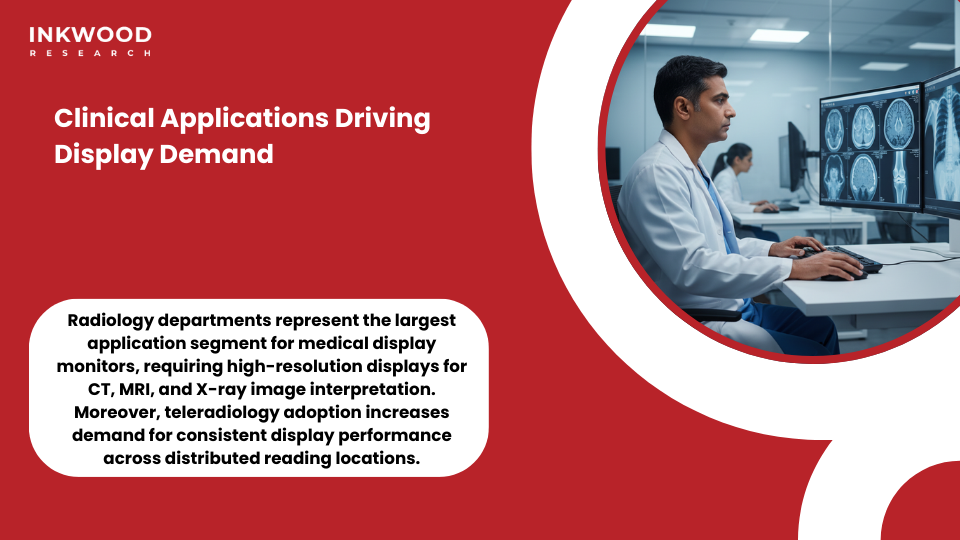
Radiology departments represent the largest application segment for medical display monitors, requiring high-resolution displays for CT, MRI, and X-ray image interpretation. Radiologists spend extended hours reviewing complex imaging studies, making display quality and ergonomics critical factors. Moreover, teleradiology adoption increases demand for consistent display performance across distributed reading locations.
PACS integration capabilities enable radiologists to access imaging studies efficiently across networked displays. Modern radiology workflows require seamless integration between imaging modalities, archiving systems, and display devices. Accordingly, display manufacturers develop comprehensive solutions that address connectivity, calibration management, and workflow optimization simultaneously.
Surgical Visualization Applications
Operating rooms increasingly adopt 4K and even 8K displays for minimally invasive procedures, where surgeons rely entirely on screen visualization. Enhanced resolution enables surgeons to distinguish subtle tissue structures and identify critical anatomical relationships. Furthermore, large-format displays facilitate collaboration among surgical team members during complex procedures.
As of recent updates in late 2024 and mid-2025, over 900 AI algorithms in total are specific to medical imaging, with hundreds of new clearances occurring within 2024 alone. Demonstrating growing sophistication in medical imaging interpretation, these AI tools require high-quality displays to present enhanced imagery effectively. Consequently, hospitals invest in advanced display technology to support emerging AI-assisted diagnostic capabilities.
Clinical Review and PACS Applications
Clinical review displays serve hospital-wide imaging access needs outside radiology departments. Emergency departments, intensive care units, and specialty clinics require DICOM-compliant displays for reliable image interpretation. However, these applications tolerate slightly lower specifications than primary diagnostic reading, enabling cost-effective display deployment across enterprise networks.
Healthcare systems increasingly recognize that consistent display quality throughout clinical workflows improves diagnostic confidence and patient outcomes. Therefore, standardizing on certified medical displays rather than consumer monitors becomes a strategic priority. This recognition drives sustained demand growth across all clinical application segments.
Regulatory Standards Shaping Market Growth

FDA Clearance Requirements for Medical Displays
In the United States, medical display devices for diagnostic radiology require FDA 510(k) clearance under 21 CFR 892.2050. This regulatory pathway evaluates display performance characteristics, DICOM compliance, and clinical validation. Manufacturers must demonstrate substantial equivalence to predicate devices or provide clinical evidence supporting safety and effectiveness.
The FDA’s quality system regulation, recently updated to align with ISO 13485:2016 standards effective February 2026, establishes comprehensive requirements for medical device manufacturing. Regulatory requirements ensure consistent product quality and traceability throughout production processes. Consequently, display manufacturers implement robust quality management systems to maintain regulatory compliance and market access.
International Standards and Certifications
European Union medical device regulations require CE marking based on conformity assessment procedures that evaluate clinical safety and performance. Asian regulatory authorities increasingly adopt international standards while developing region-specific requirements. Aligning with this, Japan’s Pharmaceuticals and Medical Devices Agency (PMDA) maintains stringent evaluation processes that influence broader Asian market standards.
IEC 60601-1 medical electrical equipment safety standards establish fundamental requirements for medical devices, including display monitors. Manufacturers must demonstrate compliance with these safety requirements through comprehensive testing and documentation. Additionally, electromagnetic compatibility standards ensure displays function reliably in clinical environments with multiple electronic devices operating simultaneously.
Key Takeaways
- Asia-Pacific medical display monitors market expands from $792.55 million in 2026 to $1,347.08 million by 2034 at 6.86% CAGR, outpacing global growth rates significantly.
- Regional healthcare modernization initiatives and infrastructure investments drive sustained demand across emerging markets. China and India lead regional expansion through hospital construction programs and diagnostic capacity development.
- Global market reaches $3,087.23 million in 2026, growing to $4,902.03 million by 2034 at a 5.95% CAGR overall. Europe demonstrates a 6.13% CAGR growth from $926.29 million to $1,491.20 million. North America expands more modestly from $1,154.13 million to $1,747.08 million at a 5.32% CAGR.
- Barco, EIZO, and Sony dominate premium market segments through technological excellence and established clinical validation.
- Regional manufacturers like Reshin, LG, and Samsung gain market share through competitive pricing and local service capabilities. Recent product launches emphasize 4K resolution, AI integration, and workflow optimization features.
- DICOM calibration standards, FDA clearance requirements, and international certifications shape market dynamics and competitive positioning.
- Radiology departments, surgical suites, and PACS applications drive distinct display specification requirements and purchasing patterns.
Conclusion
Asia-Pacific’s exceptional growth trajectory in medical display monitors reflects fundamental healthcare system transformations occurring across the region. Healthcare modernization initiatives, aging demographics, and chronic disease prevalence create sustained demand for advanced diagnostic imaging capabilities. Consequently, medical facilities prioritize investments in certified display technology that enables accurate clinical interpretation and improved patient outcomes.
The competitive landscape balances global technology leaders with emerging regional manufacturers, creating dynamic market conditions that benefit healthcare providers through innovation and value. Furthermore, evolving regulatory frameworks ensure consistent product quality while facilitating market access for qualified manufacturers.
Healthcare organizations evaluating medical display investments should consider comprehensive factors, including clinical application requirements, regulatory compliance, total cost of ownership, and vendor support capabilities. Strategic partnerships with experienced display technology providers enable healthcare systems to navigate these complex considerations effectively while optimizing clinical and operational outcomes.
For expert consultation on medical display monitor selection and implementation strategies tailored to your healthcare organization’s specific needs, connect with Inkwood Research’s healthcare technology specialists.
Frequently Asked Questions (FAQs)
Medical display monitors for general diagnostic radiology typically require a minimum 3-megapixel resolution, while mammography applications necessitate 5-megapixel or higher specifications. Moreover, displays must maintain DICOM Part 14 calibration standards for consistent grayscale reproduction and diagnostic accuracy across clinical workflows.
Asia-Pacific demonstrates a 6.86% CAGR compared to North America’s 5.32% due to healthcare infrastructure expansion, population health challenges, and government modernization initiatives. Additionally, emerging markets experience simultaneous facility construction and technology adoption, while mature markets focus primarily on replacement cycles.
Barco, EIZO, and Sony collectively control over 70% of the global market through premium product positioning and clinical validation. However, regional manufacturers like Reshin, LG, and Samsung gain market share through competitive pricing strategies and local service capabilities across Asia-Pacific markets.