Table of Contents
This analysis is brought to you by Inkwood Research, a leading market intelligence firm specializing in advanced battery technologies, artificial intelligence applications in energy storage, and electric vehicle market dynamics. Our research team combines extensive experience analyzing lithium-ion battery innovations, predictive maintenance systems, and battery management software across Asia-Pacific, Europe, and North America. Based on our proprietary research methodologies and strategic partnerships with battery manufacturers, automotive OEMs, AI technology providers, and energy management solution developers, we deliver actionable insights that empower strategic decision-making for global enterprises navigating the electric vehicle battery market transformation and smart battery technology adoption.
TLDR
Artificial intelligence revolutionizes the electric vehicle battery market efficiency through adaptive management systems, extending battery lifespan by up to 40%. Smart algorithms optimize EV battery technology, predict maintenance needs, and enhance EV battery performance across thermal management, charging cycles, and energy distribution. From CATL’s innovations in China to LG Energy Solution’s North American advancements, AI-driven battery systems transform lithium-ion EV battery operations while reducing EV battery costs and improving EV battery safety standards. Technology addresses critical challenges in EV battery supply chain optimization.
This comprehensive analysis benefits automotive executives implementing smart battery solutions, technology officers evaluating AI integration opportunities, investment analysts assessing battery management innovations, fleet operators optimizing electric vehicle operations, energy storage system developers, battery manufacturing strategists, and procurement teams navigating evolving EV battery manufacturing landscapes. Sustainability officers planning next-generation EV battery deployments and research teams exploring EV battery innovation will gain valuable market intelligence.
The Intelligent Battery Revolution: Where AI Meets Energy Storage
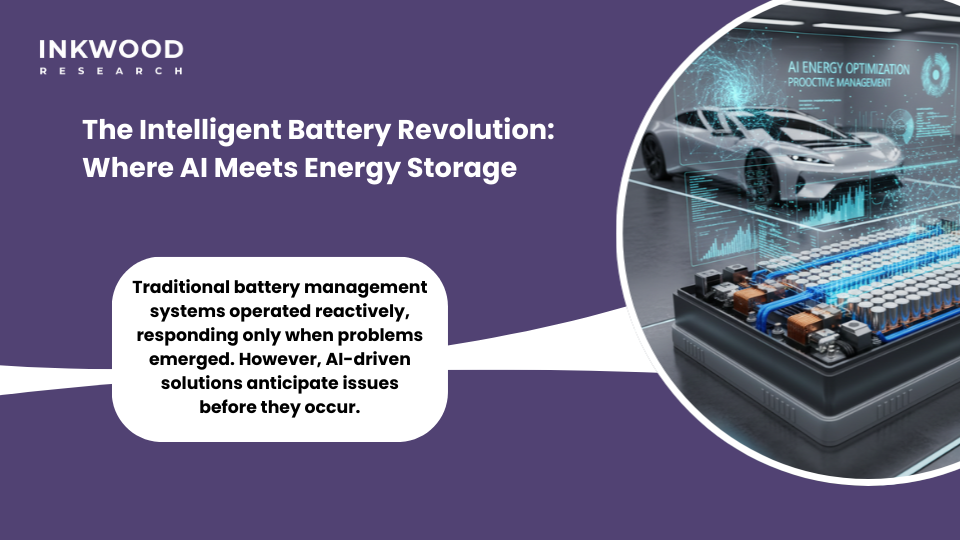
Picture your electric car battery learning from every journey you take. Modern artificial intelligence transforms this vision into reality within the electric vehicle battery market. Traditional battery management systems operated reactively, responding only when problems emerged. However, AI-driven solutions anticipate issues before they occur.
Understanding AI-Powered Battery Management
According to our research, AI-driven battery technology markets will reach unprecedented growth. Machine learning algorithms enhance battery state-of-health predictions, offering superior accuracy over conventional methods. Neural networks process vast amounts of operational data instantaneously. Reinforcement learning enables adaptive capabilities, improving EV battery performance dynamically.
These systems continuously monitor voltage, current, and temperature parameters. Moreover, they predict energy consumption patterns based on driving behaviors. Consequently, battery degradation slows significantly compared to traditional management approaches. AI-driven BMS technology can extend battery health by up to 87%, revolutionizing vehicle ownership economics.
The Shift from Reactive to Proactive Management
Traditional battery systems waited for problems to manifest. In contrast, intelligent systems detect anomalies milliseconds before failures occur. Advanced algorithms analyze thousands of data points per second. Subsequently, they adjust charging rates, thermal controls, and power distribution automatically.
This proactive approach prevents costly repairs and unexpected breakdowns. Furthermore, it optimizes energy efficiency during every charging cycle. Fleet operators particularly benefit from reduced downtime and maintenance costs. Individual drivers enjoy extended driving ranges and improved reliability.
Inside Asia’s EV Battery Innovation Hubs: From CATL to Panasonic to LG Energy Solution
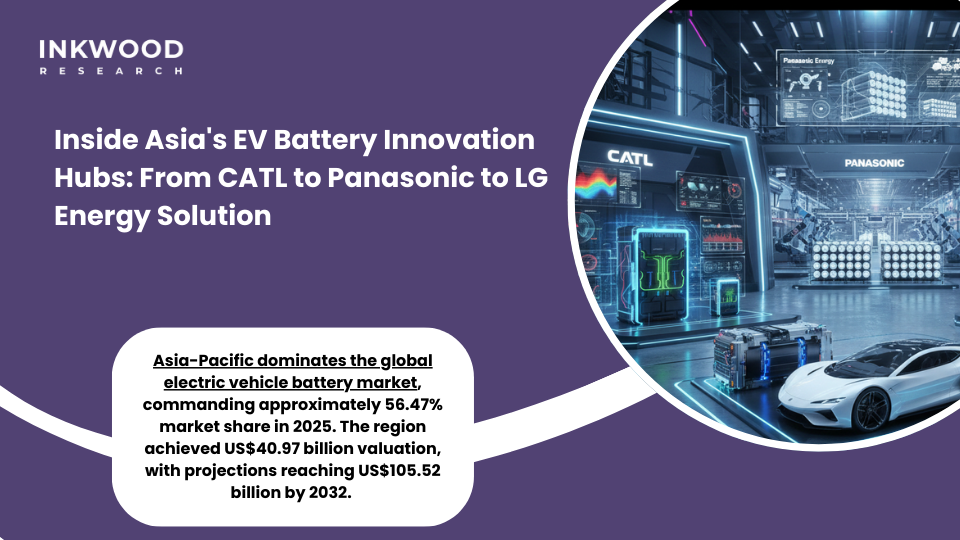
Asia-Pacific dominates the global electric vehicle battery market, commanding approximately 56.47% market share in 2025. The region achieved US$40.97 billion valuation, with projections reaching US$105.52 billion by 2032. This represents a remarkable 14.47% CAGR through the forecast period.
CATL: Global Market Leader in Battery Innovation
Contemporary Amperex Technology Co. Ltd. (CATL) holds 36.8% global market share, supplying industry giants including Tesla, Ford, and Volkswagen. Their advanced Qilin technology delivers 20% higher energy density than previous generations. Meanwhile, Shenxing superfast-charging batteries enable 320-mile ranges with just five-minute charging sessions.
In March 2025, CATL unveiled next-generation high-energy density lithium iron phosphate batteries, featuring significant improvements over conventional designs. These innovations incorporate AI-powered thermal management systems, optimizing performance across temperature ranges. Additionally, their battery recycling initiatives support circular economy principles.
Panasonic’s North American Expansion
Panasonic’s new Kansas gigafactory represents one of its most significant investments historically. Production began in July 2025, delivering 2170 cylindrical lithium-ion cells with 32 GWh annual capacity. This facility complements their Nevada operations, bringing combined North American output to 73 GWh annually.
The gigafactory will create 4,000 direct jobs and 8,000 indirect positions. Notably, it operates as a net-zero site using 100% renewable energy within the next decade. Their 4680 battery cells feature advanced AI-optimized designs, improving efficiency substantially. Tesla’s Cybertruck utilizes these innovative cells, delivering exceptional performance metrics.
LG Energy Solution’s Strategic Partnerships
Founded in 2020 after separating from LG Chem, LG Energy Solution holds more than 78,000 patents, making it the world’s top battery patent holder. Their strategic joint ventures span North America, Europe, and Asia. In February 2025, they announced an expanded partnership with General Motors, supplying Ultium battery cells.
Their advanced battery management systems incorporate proprietary AI algorithms. These optimize charging cycles, predict maintenance requirements, and enhance safety protocols. Furthermore, their 46-Series batteries, launched in 2024, demonstrate cutting-edge technology. Solid-state mass production targets 2030, promising revolutionary improvements in EV battery capacity and safety.
How Predictive Analytics Extends Battery Lifespan by 40%

Predictive maintenance revolutionizes battery longevity across the electric vehicle battery market. AI technology can extend battery health and performance by up to 87%, dramatically improving ownership economics. Traditional systems managed batteries reactively after problems developed. However, intelligent algorithms identify degradation patterns weeks before failures occur.
State of Health Monitoring
State of Health (SOH) estimation represents a critical battery management function. AI-powered systems analyze internal resistance changes, capacity fade, and electrochemical impedance. These measurements predict remaining useful life with unprecedented accuracy. Consequently, vehicle owners receive timely maintenance recommendations, preventing catastrophic failures.
Machine learning models process historical performance data continuously. They identify subtle degradation patterns invisible to conventional monitoring systems. Subsequently, charging protocols adjust automatically to minimize stress on battery cells. This intelligent optimization extends operational lifespans significantly beyond manufacturer specifications.
Charging Optimization Through Machine Learning
Smart charging algorithms transform how batteries receive and store energy. They analyze usage patterns, ambient temperatures, and grid conditions dynamically. Based on these factors, systems modify charging rates and stop voltages precisely. This prevents overcharging damage while maximizing energy storage efficiency.
Fast charging creates thermal stress, potentially degrading battery cells prematurely. Nevertheless, AI-controlled systems balance charging speed against long-term health impacts. They identify optimal charging windows when temperatures remain moderate. Furthermore, they distribute energy across cells evenly, preventing localized degradation hotspots.
Real-World Performance Data
Overall replacement rates in the Recurrent community reach only 2.5%, demonstrating exceptional battery durability. First-generation EVs, now 14 years old, frequently retain original packs. Modern vehicles equipped with AI management systems show even lower replacement rates. Additionally, predictive analytics reduces unexpected failures by identifying issues proactively.
Fleet operators report substantial cost savings through AI-enhanced battery management. Maintenance schedules optimize around predicted degradation patterns rather than arbitrary timeframes. Energy efficiency improvements reduce operational expenses significantly. Moreover, extended battery life improves vehicle resale values appreciably.
Smart Thermal Management: AI’s Role in Battery Safety
Temperature control represents the most critical factor affecting EV battery safety standards and performance. Lithium-ion batteries operate optimally within narrow temperature ranges. Excessive heat accelerates degradation, while cold conditions reduce capacity temporarily. Therefore, intelligent thermal management systems prove essential for reliability.
AI-Powered Temperature Regulation
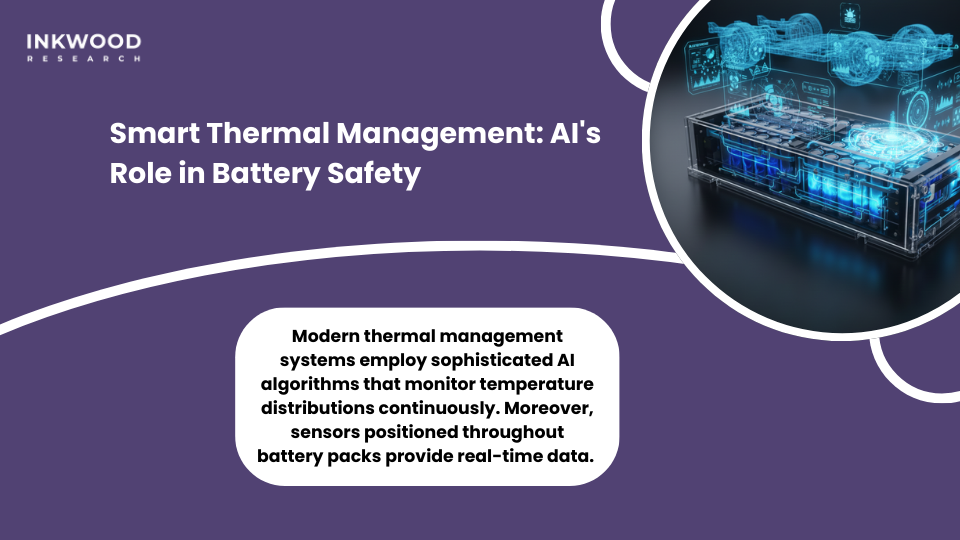
Modern thermal management systems employ sophisticated AI algorithms that monitor temperature distributions continuously. Moreover, sensors positioned throughout battery packs provide real-time data. Neural networks optimize temperature regulation, offering superior accuracy compared to traditional methods. These systems activate cooling or heating precisely when needed.
Advanced predictive models anticipate thermal loads before they materialize. They analyze driving patterns, ambient conditions, and charging schedules proactively. Consequently, thermal systems prepare for temperature changes rather than reacting afterward. This prevents dangerous overheating situations that could compromise battery safety.
Preventing Thermal Runaway Events
Thermal runaway represents the most serious battery safety concern. It occurs when internal temperatures rise uncontrollably, potentially causing fires. However, AI systems detect early warning signs milliseconds before cascade reactions begin. They immediately implement emergency cooling protocols and disconnect affected cells.
Data from the US National Transportation Safety Board shows only 25 out of 100,000 EVs catch fire, notably fewer than the 1,530 out of 100,000 combustion vehicles. AI-enhanced safety systems contribute significantly to these impressive statistics. Moreover, machine learning algorithms continuously improve threat detection capabilities through operational experience.
Climate Adaptation Technologies
Electric vehicles operate across diverse environmental conditions globally. Extreme cold reduces battery capacity substantially, while excessive heat accelerates degradation. AI systems adapt thermal management strategies based on local climate conditions automatically. They optimize preconditioning schedules, ensuring batteries reach ideal temperatures before operation.
In Sweden’s cold climate, advanced battery heating systems maintain performance during the winter months. Similarly, desert environments require robust cooling capabilities, preventing overheating damage. Intelligent algorithms balance energy consumption against thermal management needs efficiently. This ensures optimal performance regardless of external temperature variations.
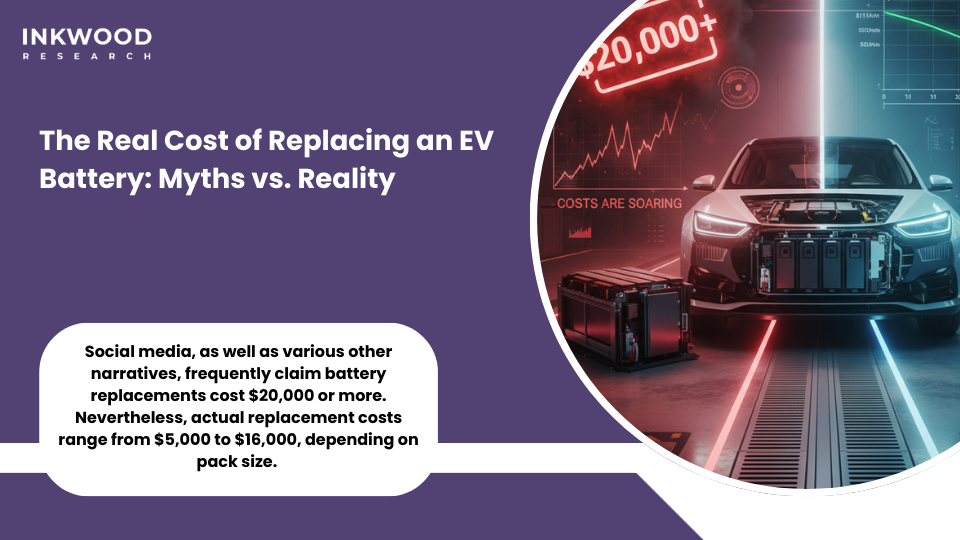
Battery replacement costs dominate consumer concerns regarding electric vehicle adoption. However, widespread misconceptions distort actual market realities. Europe’s electric vehicle battery market reached US$16.70 billion in 2025, projected to grow to US$39.82 billion by 2032 at a 13.22% CAGR.
Debunking Common Replacement Cost Myths
Social media, as well as various other narratives, frequently claim battery replacements cost $20,000 or more. Nevertheless, actual replacement costs range from $5,000 to $16,000, depending on pack size. Moreover, these out-of-pocket repairs occur extremely rarely. Most EV owners never face battery replacement decisions during vehicle ownership.
Battery prices have dropped dramatically from over $400/kWh in 2012 to $111/kWh by late 2024. CATL and BYD offered LFP cells as low as $56/kWh in early 2024. These declining costs directly reduce replacement expenses for consumers. Furthermore, projected 2030 prices around $50/kWh will make replacements comparable to engine repairs.
Warranty Protection Reality
Federal law mandates a minimum 8-year/100,000-mile warranty on EV batteries. California requires 10 years/150,000 miles coverage, with several states adopting similar requirements. Many manufacturers exceed these minimums significantly. Tesla offers up to 175,000-mile coverage on certain models.
Warranties cover replacement when battery capacity drops below 70% of the original capacity. However, modern batteries rarely degrade to this threshold during warranty periods. Approximately 90% of replacements occur under warranty coverage, meaning no cost to owners. Additionally, AI-enhanced battery management extends effective lifespan beyond warranty periods substantially.
Future Cost Projections
Industry leaders estimate 2030 cell prices at $32-$54/kWh, translating to $45-$65/kWh for complete packs. For a 100 kWh pack, replacement costs might reach $4,500-$5,000. This equals typical combustion engine replacement expenses. Moreover, battery prices continue declining as production scales increase globally.
European manufacturers benefit from increasing local production capacity, reducing transportation costs. Government incentives support battery manufacturing infrastructure development across the continent. Consequently, replacement costs will decrease further while availability improves dramatically. By 2030, battery replacement will represent only 30% of a $15,000 used vehicle’s value.
Are EV Batteries Really Greener? A Lifecycle Analysis
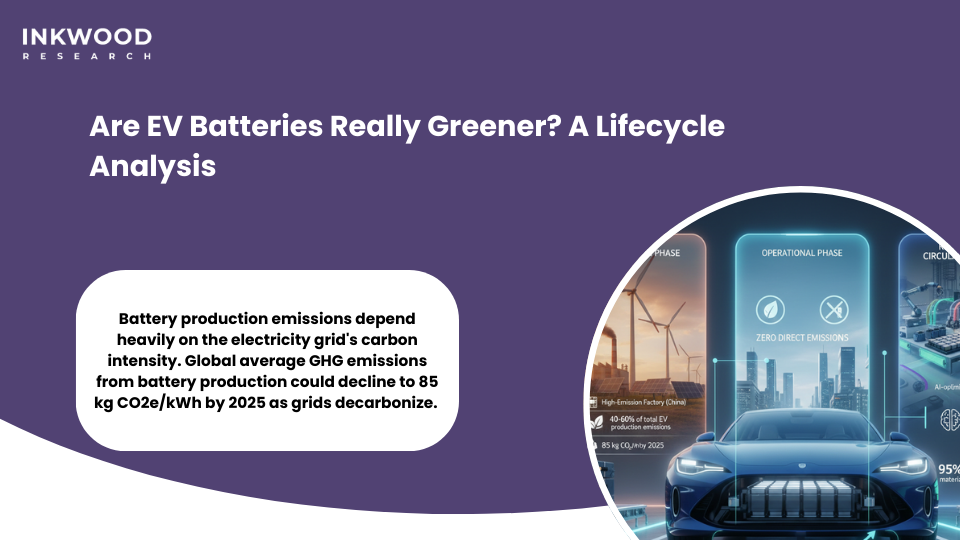
Environmental benefits of electric vehicles spark ongoing debates. Critics emphasize EV battery production carbon intensity, while proponents highlight operational emissions advantages. North America’s electric vehicle battery market, valued at US$11.72 billion in 2025, will grow to US$27.60 billion by 2032 at a 13.02% CAGR.
Production Phase Carbon Footprint
Producing large lithium-ion batteries accounts for 40-60% of total EV production emissions. Battery manufacturing requires significant energy, particularly in China, where most production occurs. However, the industry rapidly decarbonizes through renewable energy adoption. Sweden maintains relatively low emissions from battery production, averaging less than half of China’s levels.
Battery production emissions depend heavily on the electricity grid’s carbon intensity. Global average GHG emissions from battery production could decline to 85 kg CO2e/kWh by 2025 as grids decarbonize. Manufacturers increasingly establish facilities in regions with clean electricity sources. Furthermore, green power purchase agreements accelerate this transition significantly.
Operational Emissions Advantages
Electric vehicles produce zero direct tailpipe emissions during operation. Consequently, they dramatically reduce urban air pollution, improving public health outcomes. Total lifecycle emissions depend on the electricity generation sources powering vehicles. Regions with renewable energy grids maximize environmental benefits substantially.
US battery production capacity doubled since 2022, reaching more than 200 GWh in 2024, with nearly 700 GWh under construction. Domestic manufacturing reduces transportation emissions while supporting local economies. Moreover, US facilities increasingly utilize renewable energy sources, improving overall environmental profiles.
End-of-Life Recycling Solutions
Battery recycling recovers valuable materials, including lithium, cobalt, and nickel. These recycled materials reduce mining requirements and associated environmental impacts. EV battery recycling initiatives expand rapidly across North America and Europe. Second-life applications extend battery usefulness before recycling becomes necessary.
Batteries retaining 70-80% capacity after automotive use serve energy storage applications effectively. They support renewable energy integration and grid stabilization projects. Eventually, comprehensive recycling processes recover 95% of battery materials. This circular economy approach minimizes environmental footprints dramatically. Furthermore, AI systems optimize recycling processes, improving efficiency and recovery rates.
Competitive Landscape: Major Players Driving AI Battery Innovation
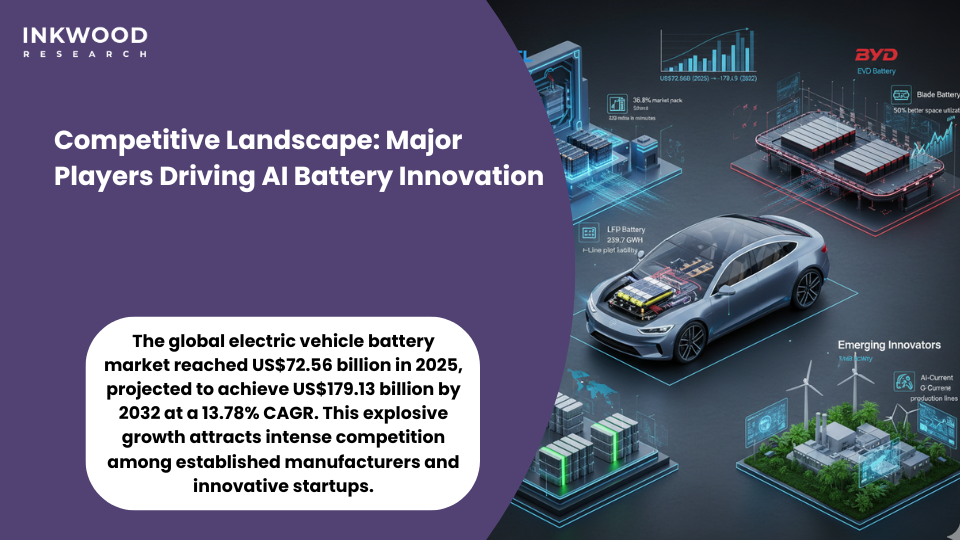
The global electric vehicle battery market reached US$72.56 billion in 2025, projected to achieve US$179.13 billion by 2032 at a 13.78% CAGR. This explosive growth attracts intense competition among established manufacturers and innovative startups.
CATL: Innovation and Market Dominance
CATL led the global EV battery market for seven consecutive years, holding 36.8% share in 2023 with 259.7 GWh produced. Their Qilin battery technology delivers unprecedented energy density improvements. Shenxing superfast-charging batteries enable a 400 km range with 10-minute charging.
In April 2025, CATL unveiled its upgraded Shenxing battery, promising a 320-mile range with five-minute charging. This breakthrough surpasses competitor offerings by approximately 70 miles. Their AI-enhanced battery management systems optimize performance across diverse operating conditions. Additionally, cell-to-pack technology eliminates traditional modules, increasing volumetric efficiency substantially.
BYD: Vertical Integration Strategy
BYD achieved 25.1% domestic market share in 2024 with 135.02 GWh installed capacity. Their vertically integrated approach produces batteries primarily for internal electric vehicle production. However, they selectively engage external partners for strategic collaborations.
Blade Battery technology incorporates lithium iron phosphate chemistry, ensuring superior safety. The innovative cell-to-pack design boosts space utilization by approximately 50%. Battery usage in Europe increased 263% year-over-year to 8.6 GWh in the first half of 2025. This aggressive international expansion challenges established Korean and Japanese manufacturers significantly.
Samsung SDI: Premium Market Focus
Samsung SDI develops Gen 6 & Gen 7 lithium-ion batteries with higher energy density, targeting 2025 mass production. Their solid-state batteries promise significantly higher range and safety. Silicon-anode batteries incorporate silicon, improving energy capacity by 40%.
The company completed the world’s largest pilot production line, “S-Line,” in 2023. Mass production plans target 2027 commercialization. Their high-nickel cathode batteries reduce reliance on costly cobalt. Furthermore, they serve premium automotive segments, including BMW, Audi, and Rivian exclusively.
Emerging Innovators: Northvolt and Others
European manufacturers gain momentum despite Asian dominance. Northvolt leads regional battery production efforts with sustainable manufacturing practices. The EU allocated €852 million in funding supporting next-generation battery manufacturing projects across the continent.
CALB built a zero-carbon AI-powered gigafactory in Portugal, advancing sustainability goals. Gotion High-Tech unveiled ultra-fast-charging G-Current batteries and all-solid-state Gemstone batteries. These innovations demonstrate growing European competitiveness in battery technology development. Moreover, government support accelerates domestic manufacturing capacity expansion substantially.
Latest Product Developments in AI-Enhanced Battery Systems
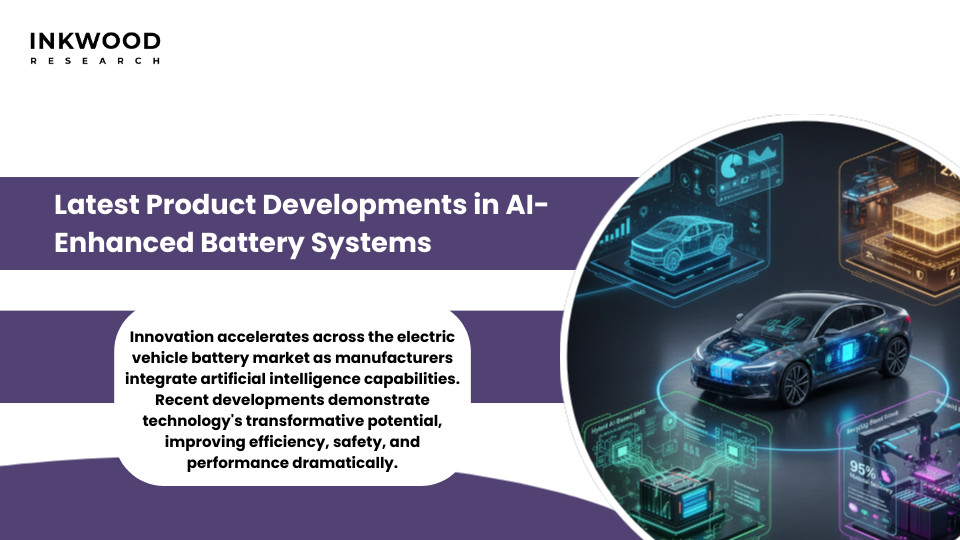
Innovation accelerates across the electric vehicle battery market as manufacturers integrate artificial intelligence capabilities. Recent developments demonstrate technology’s transformative potential, improving efficiency, safety, and performance dramatically.
Electra Vehicles’ EVE-Ai Technology
Electra introduced advanced EVE-Ai technology in the Tesla Cybertruck at CES 2025. This AI-powered system improves battery performance, predicts energy use, and extends battery life substantially. Key benefits include accurate range estimates, reducing errors by up to 20%.
EVE-Ai extends battery lifespan by up to 40% through predictive maintenance and smart charging. Operational efficiency improves as systems detect potential issues early. Recently, Electra integrated large language model technology, making complex battery analytics easily understandable. Fleet operators benefit from reduced downtime and maintenance costs significantly.
Panasonic’s Solid-State Advancements
Panasonic announced significant solid-state battery advancements in January 2025. These new batteries provide twice the energy density of conventional lithium-ion batteries. Consequently, vehicles achieve longer ranges and faster charging times substantially.
Solid-state technology eliminates liquid electrolytes, improving safety dramatically. Higher energy density enables smaller, lighter battery packs, maintaining equivalent range. Production scaling remains challenging, but Panasonic targets commercial deployment by 2030. Their partnership with Toyota accelerates development by leveraging complementary expertise effectively.
Hybrid AI-Based Battery Management Systems
Researchers proposed hybrid AI-based battery management systems combining conventional processes with neural networks. These systems demonstrate substantial improvements to battery performance and lifespan. Reinforcement learning algorithms enable adaptive energy management responding to dynamic conditions.
HAI-BMS provides predictive maintenance capabilities, identifying issues before failures occur. Real-time decision-making optimizes charging and discharging strategies continuously. The modular architecture scales effortlessly across various EV types. Furthermore, lightweight AI models designed for edge computing ensure low-latency performance.
China’s Sodium-Ion Battery Innovations
CATL announced its second-generation sodium-ion batteries in 2025 alongside a dedicated brand launch. These batteries offer improved energy density and faster charging compared to previous generations. HiNa launched new sodium-ion batteries in March 2025, showing promising advancements.
Sodium-ion technology provides cost advantages over lithium-ion alternatives. Materials abundance ensures supply chain resilience against lithium price volatility. However, energy density improvements remain necessary for widespread automotive adoption. BYD invests heavily in sodium-ion production for both EVs and battery storage applications.
Key Takeaways
- AI-driven battery management extends battery lifespan by up to 87% through predictive maintenance and optimized charging protocols
- The global electric vehicle battery market will grow from US$72.56 billion (2025) to US$179.13 billion (2032) at a 13.78% CAGR
- CATL dominates with a 36.8% market share, while LG Energy Solution holds 78,000 patents, demonstrating innovation leadership
- Battery replacement costs declined from $400/kWh (2012) to $111/kWh (2024), with projections reaching $50/kWh by 2030
- Only 2.5% of EV batteries require replacement, with 90% occurring under warranty at no owner cost
- Asia-Pacific commands 45% global market share valued at US$40.97 billion, growing to US$105.52 billion by 2032
- Thermal management AI systems prevent dangerous overheating, with EVs showing a 25 per 100,000 fire rate versus 1,530 for combustion vehicles
- Battery production emissions declining to 85 kg CO2e/kWh as manufacturers adopt renewable energy sources
- Solid-state batteries promise twice the energy density of current lithium-ion technology with commercial deployment by 2030
Conclusion
Artificial intelligence fundamentally transforms the electric vehicle battery market through unprecedented efficiency improvements and lifespan extensions. Smart software optimizes every aspect of battery operations from thermal management to charging protocols. Predictive analytics prevent failures before they occur, while machine learning adapts to individual usage patterns dynamically.
Major manufacturers, including CATL, Panasonic, and LG Energy Solution, lead innovation efforts across Asia-Pacific, Europe, and North America. Their combined investments in AI-enhanced battery systems accelerate technology adoption globally. Meanwhile, declining production costs make electric vehicles increasingly accessible to broader consumer markets.
The future promises even more remarkable advancements as solid-state batteries and sodium-ion alternatives mature. Battery replacement costs will drop below combustion engine repair expenses by 2030. Moreover, environmental benefits continue improving as renewable energy powers manufacturing facilities and vehicle charging infrastructure.
Are you ready to navigate the evolving electric vehicle battery market landscape? Inkwood Research provides comprehensive market intelligence and strategic insights, helping enterprises capitalize on emerging opportunities. Our expert analysts deliver actionable recommendations tailored to your specific business objectives. Contact us today for a consultation on optimizing your battery technology investments and competitive positioning.
Frequently Asked Questions (FAQs)
AI optimizes battery performance through predictive analytics, adaptive thermal management, and intelligent charging protocols. Systems analyze thousands of data points per second, adjusting operations to maximize efficiency while extending lifespan by up to 40%.
Replacement costs range from $5,000 to $16,000, depending on battery size and vehicle model. However, only 2.5% of EV owners require replacements, with 90% covered by manufacturer warranties. Battery prices continue declining from $111/kWh in 2024 toward the projected $50/kWh by 2030.
CATL dominates with 36.8% global market share, while LG Energy Solution holds 78,000 patents. Panasonic, Samsung SDI, and BYD drive innovation across Asia-Pacific. European manufacturers, including Northvolt and CALB, gain momentum through government-supported initiatives.