Table of Contents
This analysis is brought to you by Inkwood Research, a leading market intelligence firm specializing in energy, power, and utilities sectors. Our research team combines decades of experience analyzing battery technologies, automotive electrification trends, and Asia-Pacific manufacturing ecosystems. Based on our proprietary research methodologies and extensive industry partnerships, we deliver actionable insights that empower strategic decision-making for global enterprises navigating the energy transition.
TLDR
The China battery market commands approximately 80% of global lithium-ion batteries manufacturing capacity, valued at $49.66 billion in 2025. Furthermore, industry leaders CATL and BYD drive unprecedented innovation in electric vehicle battery technology while pioneering sodium-ion batteries and grid-scale energy storage solutions. Meanwhile, government incentives under the New Energy Vehicle policy accelerate adoption, with NEV sales exceeding 9 million units in 2024. Consequently, vertical integration strengthens supply chain resilience as manufacturers expand globally through gigafactories across Europe, Southeast Asia, and North America, positioning battery technology advancement at the forefront of sustainable transportation.
This comprehensive analysis benefits automotive executives, investment analysts, and procurement strategists evaluating battery manufacturing opportunities. Additionally, policymakers, renewable energy developers, and technology innovators seeking insights into lithium iron phosphate chemistry, energy storage systems, and supply chain dynamics will discover actionable intelligence. Moreover, business decision-makers exploring partnerships with Chinese manufacturers or analyzing competitive positioning in the battery cells sector gain strategic perspectives for navigating this rapidly evolving market through 2032.
China Battery Market Overview: Unprecedented Scale Meets Strategic Vision
The China battery market represents an industrial powerhouse unmatched in global manufacturing history. According to Inkwood Research, market valuation reached $49.66 billion in 2025 and projects explosive growth to $144.78 billion by 2032. This remarkable 16.52% CAGR reflects China’s strategic commitment to electrification dominance. What drives such extraordinary momentum?
Government Policy Creates Unstoppable Market Forces
Strong government incentives under the New Energy Vehicle policy fundamentally reshape transportation economics. Based on our research, subsidies and tax exemptions make electric vehicles increasingly affordable for consumers nationwide. China’s Ministry of Industry and Information Technology reports NEV sales exceeded 9 million units in 2024. Notably, this represents a penetration rate above 30% in passenger vehicle sales.
Moreover, renewable energy adoption accelerates dramatically across provinces. Wind and solar installations require massive grid-scale energy storage solutions to balance intermittent generation patterns. Therefore, battery demand extends far beyond transportation applications into critical infrastructure modernization.
Manufacturing Dominance Through Vertical Integration
China leads the global battery market production capacity, accounting for approximately 80% of lithium-ion cell manufacturing worldwide. Furthermore, technological advancement in LFP and emerging solid-state battery technology improves cost efficiency dramatically. Simultaneously, reduced dependence on scarce materials like cobalt strengthens supply chain sustainability.
Vertical integration among domestic manufacturers creates formidable competitive advantages. Consequently, Chinese companies control everything from raw material processing through cell production to pack assembly. This comprehensive ecosystem approach positions manufacturers to dominate both domestic and export markets through 2032.
Technology Leadership: CATL and BYD Redefine Innovation Standards
Contemporary Amperex Technology Co. Limited emerges as the undisputed global leader in battery manufacturing. Headquartered in Ningde, Fujian Province, CATL commands the largest market share worldwide. According to our analysis, CATL achieved 37.9% global market share in 2024 with 339.3 GWh installed capacity.
CATL Pioneering Cell-to-Pack Revolution
The company supplies virtually every major automotive manufacturer globally, including Tesla, BMW, Volkswagen, and Toyota. CATL’s product portfolio spans diverse chemistries, from high-nickel NMC for premium applications to cost-effective LFP batteries for mainstream vehicles. Additionally, cell-to-pack technology eliminates traditional battery modules to increase volumetric efficiency.
In April 2025, CATL unveiled its upgraded Shenxing battery, promising a 320-mile range with just five-minute charging. This breakthrough surpasses competitor offerings by approximately 70 miles while matching ultra-fast charging capabilities. Consequently, range anxiety concerns diminish substantially for potential EV adopters.
BYD Integration Strategy Delivers Competitive Edge
BYD Company Ltd operates differently from traditional battery suppliers through vertical integration. The company primarily produces batteries for its own electric vehicle lineup while selectively engaging external partners. Nevertheless, this strategy enables remarkable expansion in global markets.
According to recent market data, BYD achieved a 25.1% domestic market share in 2024 with 135.02 GWh installed capacity. Furthermore, lithium iron phosphate battery installations exceeded 100 GWh at 134.84 GWh. Remarkably, BYD’s share increased from 15% in 2020 to 26% by Q4 2024.
Meanwhile, BYD demonstrates particular strength in European market penetration during 2025. Battery usage in Europe increased 263% year-over-year to 8.6 GWh in the first half alone. This aggressive international expansion challenges established Korean and Japanese manufacturers significantly.
Sodium-Ion Battery Revolution: Disrupting Supply Chain Dependencies
Sodium-ion batteries emerge as a transformative technology with tremendous potential for large-scale stationary storage applications. CATL launched the first-generation sodium-ion battery in 2021, achieving energy densities approaching 160 Wh/kg. Consequently, this technology addresses critical supply chain vulnerabilities entirely.
Abundant Materials Eliminate Strategic Risks
Sodium represents one of Earth’s most abundant elements, eliminating lithium dependence entirely. Moreover, manufacturing processes largely mirror lithium-ion production, enabling existing facilities to adapt with minimal capital investment. Therefore, capacity expansion accelerates rapidly across multiple manufacturers simultaneously.
Additionally, sodium-ion batteries deliver superior low-temperature performance compared to lithium alternatives. These systems maintain functionality in extreme cold, where traditional batteries struggle significantly. Furthermore, fast-charging capabilities outperform LFP batteries, potentially reaching 80% capacity in just 15 minutes.
Commercial Applications Drive Market Adoption
HiNa Battery Technology established pilot production lines in Shanxi Province, targeting grid-scale storage applications specifically. Meanwhile, China’s National Development and Reform Commission includes sodium-ion batteries in strategic emerging industry plans. This government support signals a long-term commitment to technology development.
Industrial applications show particular promise for early adoption. Forklifts, mining equipment, and port machinery represent ideal opportunities given operational requirements. Electric bicycles and scooters, which dominate Chinese urban mobility, could transition to sodium-ion power systems. However, energy density improvements remain essential for broader market acceptance across passenger vehicles.
Grid-Scale Energy Storage: Infrastructure for Renewable Integration
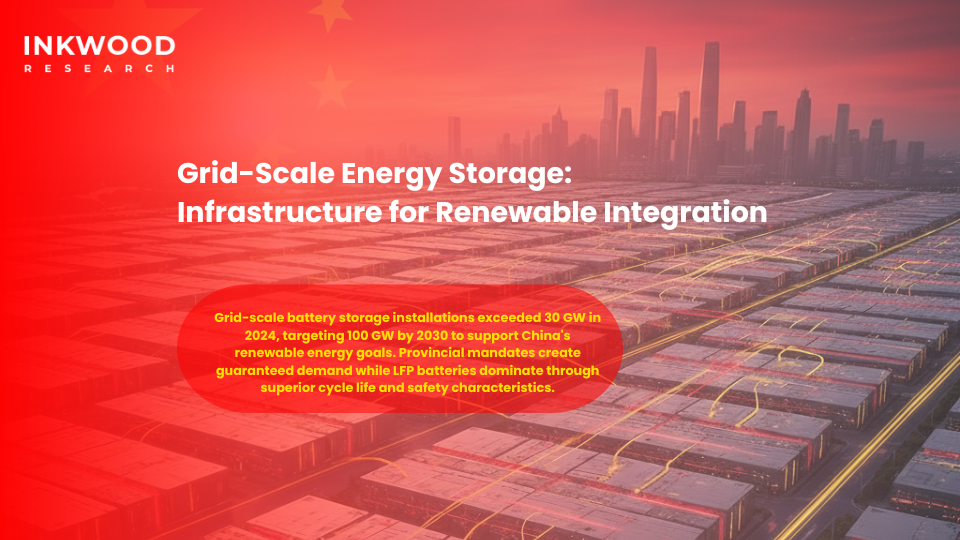
Grid-scale energy storage experiences explosive growth as China pursues ambitious renewable energy targets. The country aims to install over 400 GW of new renewable capacity by 2030. Consequently, proportional investment in storage infrastructure becomes essential for managing intermittent generation patterns.
Mandatory Storage Policies Create Guaranteed Demand
Provincial governments mandate storage installations alongside new wind and solar projects nationwide. This regulatory requirement creates guaranteed demand for multi-megawatt battery systems across all regions. Additionally, independent storage power stations emerge as standalone businesses, buying electricity during low-price periods.
According to China’s National Energy Administration, grid-scale battery storage installations exceeded 30 GW in 2024. Furthermore, projections indicate 100 GW capacity by 2030, representing more than threefold expansion. This massive infrastructure buildout requires unprecedented manufacturing scale and technological innovation.
Cost Declines Accelerate Economic Viability
Technological innovation drives grid-scale storage economics toward profitability rapidly. System costs decline through manufacturing scale and continuous technological improvements across components. LFP batteries dominate this segment due to superior cycle life characteristics and safety advantages.
Leading players like BYD and CATL offer complete turnkey solutions, including cells, battery management systems, thermal management, and grid integration capabilities. Meanwhile, flow batteries gain traction for ultra-long-duration storage applications in pilot projects. Retired EV batteries find second-life applications in stationary storage through cascaded utilization programs.
Competitive Landscape: Major Players Shaping Market Dynamics

The China battery market features intense competition among domestic giants and international players. According to our analysis, several key manufacturers drive innovation while capturing
significant market share through differentiated strategies.
1. CATL Maintains Unassailable Market Leadership
Contemporary Amperex Technology Co. Limited operates massive gigafactories across China, with international facilities under construction in Germany, Hungary, and the United States. The company pioneered cell-to-pack technology and continues pushing boundaries with breakthrough innovations. In June 2025, CATL launched a major IPO in Hong Kong, raising capital for global expansion initiatives.
Moreover, CATL announced plans to roll out battery-swapping and recycling technology across Europe. This strategic move could have significant ramifications for regional markets by addressing charging infrastructure limitations. Furthermore, facilities in Indonesia expect
production to begin in March 2026.
2. BYD Vertical Integration Drives Growth
BYD Company Ltd leverages unique advantages through complete vertical integration from raw materials to finished vehicles. This approach enables aggressive pricing strategies while maintaining quality control throughout production. Consequently, the company gains market share rapidly in both domestic and export markets.
Additionally, BYD announced price cuts in late May 2024, intensifying competitive pressure across the industry. Chief manufacturing officer Ni Jun warned at the World Economic Forum that brutal discount wars could drive smaller competitors from the market. Nevertheless, BYD’s scale advantages position it favorably for sustained competition.
3. Johnson Controls Brings Global Expertise
Johnson Controls Inc operates as a diversified industrial conglomerate with a significant presence in advanced energy storage and automotive battery solutions. Headquartered in Cork, Ireland, the company serves automotive, commercial, and residential markets through its Power Solutions division.
The company maintains extensive manufacturing operations across China, supplying both domestic automakers and international brands. Beyond traditional automotive applications, Johnson Controls develops lithium-ion battery systems for hybrid and electric vehicles through strategic partnerships. Manufacturing facilities in Chongqing and Shanghai serve the rapidly growing Chinese EV market.
4. LG Chem and Samsung SDI Face Market Pressure
Korean manufacturers LG Chem Ltd and Samsung SDI Co Ltd struggle to maintain market share against Chinese competitors. According to recent data, Korean companies collectively held 16.8% market share during the first eight months of 2025. However, this represents a decline of 3.8 percentage points compared to 2024.
Business stagnated at LG Energy Solution in 2024 with just 1.3% growth year-over-year. Meanwhile, Samsung SDI experienced the only decline among the top 10 players globally. These challenges reflect intense cost competition from Chinese manufacturers with superior scale advantages.
5. Panasonic Corporation Maintains Premium Position
Panasonic Corporation focuses on high-performance cylindrical cells for premium applications, particularly Tesla partnerships. However, the company faces pressure from expanding Chinese capacity in similar formats. Nevertheless, Panasonic’s quality reputation and established relationships maintain competitive positioning in select segments.
Latest Product Developments: Breakthrough Innovations from 2024-2025
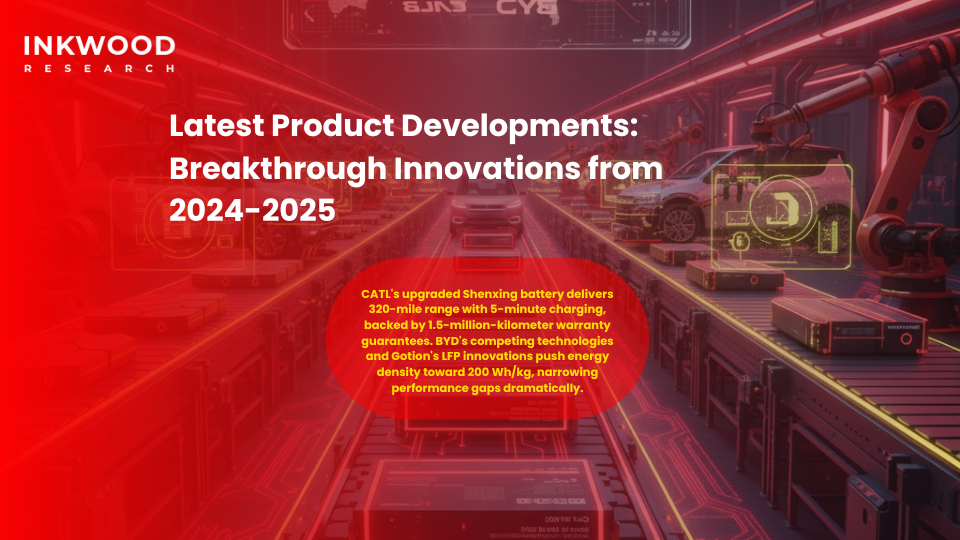
The China battery market demonstrates relentless innovation through continuous product launches and technological breakthroughs. These developments reshape industry standards while accelerating electric vehicle adoption globally.
CATL Shenxing Plus Ultra-Fast Charging System
In April 2025, CATL unveiled its upgraded Shenxing battery with revolutionary 5-minute charging capability. This breakthrough technology delivers a 320-mile range, surpassing competitor offerings by approximately 70 miles. Furthermore, the company launched Naxtra, a sodium-ion battery positioned as a more affordable and safer alternative.
Chief Technology Officer Gao Huan stated the innovation pushes “performance boundaries beyond limits.” Additionally, CATL announced its M3P chemistry warranty ensures less than 10% degradation over 1.5 million kilometers or 15 years. This unprecedented durability addresses long-term vehicle ownership concerns effectively.
BYD Blade Battery Platform Expansion
BYD continues refining its proprietary Blade Battery technology throughout 2024-2025. This lithium iron phosphate design maximizes volumetric efficiency while enhancing safety through structural cell design. Consequently, thermal runaway risks decrease substantially compared to traditional pack architectures.
Moreover, BYD announced a 5-minute charging technology in late 2024, directly challenging CATL’s market positioning. The company claims this advancement matches ultra-fast charging capabilities while maintaining cost advantages. Subsequently, fierce competition drives rapid technological progress, benefiting consumers globally.
Gotion High-Tech LFP Innovations
Gotion High-Tech Co Ltd achieved a 5.2% domestic market share through focused LFP battery development. The company partners with Volkswagen, supplying cells for European gigafactory projects. Furthermore, Gotion established manufacturing presence in Morocco and Europe to serve regional demand.
Recently, the company announced breakthrough energy density improvements approaching 200 Wh/kg for LFP chemistry. This advancement narrows performance gaps with NMC alternatives while maintaining cost and safety advantages. Therefore, LFP adoption accelerates across mainstream vehicle segments globally.
CALB Expanding Production Capacity
China Aviation Lithium Battery Co Ltd (CALB) secured a 6.61% market share through aggressive capacity expansion. The company operates multiple gigafactories across China while establishing an international presence in Thailand and Portugal. Additionally, CALB supplies cells to emerging electric vehicle manufacturers targeting cost-sensitive markets.
In 2024, CALB announced advanced cell designs incorporating silicon-based anodes for enhanced energy density. These innovations target premium vehicle applications requiring maximum range capabilities. Consequently, the company positions itself as a viable alternative to CATL and BYD.
Svolt Energy Developing Cobalt-Free Solutions
Svolt Energy Technology Co Ltd pioneered cobalt-free battery chemistries addressing ethical sourcing concerns. The company achieved a 3.2% market share through differentiated technology positioning. Furthermore, Svolt manufactures short-blade batteries, optimizing packaging efficiency for diverse vehicle architectures.
Throughout 2024-2025, Svolt expanded production capacity, targeting European automakers seeking supply chain diversification. The company established manufacturing facilities in Germany before economic challenges forced a strategic reassessment. Nevertheless, cobalt-free technology development continues to advance industry sustainability objectives.
Key Takeaways
- The China battery market commands 80% of global lithium-ion battery manufacturing capacity, valued at $49.66 billion in 2025, with projected growth to $144.78 billion by 2032.
- Sodium-ion batteries emerge as a transformative technology eliminating lithium dependency, with superior low-temperature performance and fast-charging capabilities approaching 80% in 15 minutes.
- Grid-scale energy storage installations exceeded 30 GW in 2024, targeting 100 GW by 2030 to support renewable energy integration and infrastructure modernization.
- Recent breakthroughs include CATL’s 5-minute charging Shenxing battery with 320-mile range and 1.5-million-kilometer warranty, redefining electric vehicle battery durability standards.
- Government NEV policy drives sales exceeding 9 million units in 2024, representing 30%+ market penetration through subsidies and tax exemptions nationwide.
- Korean manufacturers lose market share as Chinese competitors achieve 67.1% combined global capacity through scale advantages and cost leadership positioning.
- LFP battery technology dominates with 79.4% domestic market share, while ternary chemistries decline to 20.6% reflecting cost-performance optimization trends.
Conclusion: Strategic Partnerships Drive Sustainable Growth
The China battery market stands at the forefront of global electrification through unprecedented manufacturing scale and relentless innovation. CATL, BYD, and emerging players reshape industry dynamics while driving costs downward through technological advancement. Consequently, electric vehicles achieve price parity with conventional alternatives, accelerating mainstream adoption worldwide.
Government policy support remains unwavering, with NEV incentives and renewable energy mandates creating sustained demand through 2032. Furthermore, vertical integration strengthens supply chain resilience while reducing dependence on imported materials. Sodium-ion batteries and grid-scale storage solutions address critical infrastructure requirements supporting China’s decarbonization objectives.
International expansion through gigafactories in Europe, Southeast Asia, and North America positions Chinese manufacturers as indispensable partners for global automakers. However, geopolitical tensions and trade policies introduce uncertainty requiring strategic navigation. Nevertheless, technological leadership and cost advantages ensure continued market dominance.
For automotive executives, investment analysts, and policymakers, understanding China’s battery market dynamics becomes essential for strategic planning. The convergence of scale manufacturing, breakthrough innovation, and supportive policy creates an ecosystem unmatched globally. Consequently, partnerships with Chinese manufacturers offer competitive advantages while access to cutting-edge battery technology accelerates electrification timelines.
Ready to gain deeper insights into the China battery market? Inkwood Research offers comprehensive market intelligence, competitive analysis, and strategic consulting services tailored to your organization’s needs.
Contact our expert analysts today to explore how our proprietary research methodologies can inform your investment decisions, partnership strategies, and technology roadmaps. Let us help you navigate the complexities of the world’s largest battery market with confidence and clarity.
Frequently Asked Questions
What drives China's dominance in the global battery market?
China commands 80% of global lithium-ion battery manufacturing through massive production scale, vertical supply chain integration, and strong government policy support. Furthermore, companies like CATL and BYD achieved superior manufacturing expertise through producing over 70% of all EV batteries ever manufactured. This experience creates cost advantages, higher yields, and faster innovation cycles compared to international competitors.
How do sodium-ion batteries compare to lithium-ion technology?
Sodium-ion batteries eliminate lithium dependency using Earth’s most abundant elements while delivering superior low-temperature performance and fast-charging capabilities. However, the current energy density of around 160 Wh/kg limits passenger vehicle applications. Therefore, sodium-ion technology serves best in urban electric vehicles, two-wheelers, and stationary storage systems where cost advantages outweigh range requirements.
What recent innovations have CATL and BYD introduced?
CATL launched its upgraded Shenxing battery in April 2025, offering 5-minute charging with a 320-mile range and a 1.5-million-kilometer warranty using M3P chemistry. Meanwhile, BYD developed competing 5-minute charging technology while expanding its Blade Battery platform globally. Both companies pioneered breakthroughs in energy density, thermal management, and manufacturing efficiency that redefine electric vehicle performance standards.