Table of Contents
This analysis is brought to you by Inkwood Research, a leading market intelligence firm specializing in battery recycling technologies, global circular economy frameworks, and sustainable materials recovery innovations. Our research team combines extensive experience analyzing lithium-ion battery technologies, lead-acid recycling infrastructure, extended producer responsibility programs, and regulatory compliance frameworks across Europe, North America, and Asia-Pacific. Based on our proprietary research methodologies and strategic partnerships with battery manufacturers, recycling technology providers, government regulatory agencies, and circular economy organizations, we deliver actionable insights that empower strategic decision-making for global enterprises navigating the battery recycling revolution and sustainable supply chain transformation.
TLDR
Battery recycling technologies differ dramatically between lead-acid and lithium-ion systems. Lead-acid recycling achieves 99% recovery rates through established processes, while lithium-ion recycling involves complex hydrometallurgical and pyrometallurgical methods. Europe’s battery regulation mandates comprehensive due diligence for critical materials like cobalt and lithium starting August 2025. Meanwhile, North America’s Responsible Battery Recycling Act requires state-level compliance with extended producer responsibility frameworks. Emerging AI-driven robotics and closed-loop systems are revolutionizing recovery efficiency across all regions.
Business executives managing EV battery supply chains, sustainability officers developing circular economy strategies, investment analysts evaluating battery recycling opportunities, regulatory compliance professionals navigating international battery laws, and technology managers implementing automated recycling systems will find actionable insights here. Additionally, entrepreneurs exploring battery recycling startups and policymakers shaping regional battery regulations will benefit from this comparative analysis of technologies, costs, and market opportunities.
The Technology Divide: Lead-Acid vs Lithium-Ion Recycling Methods
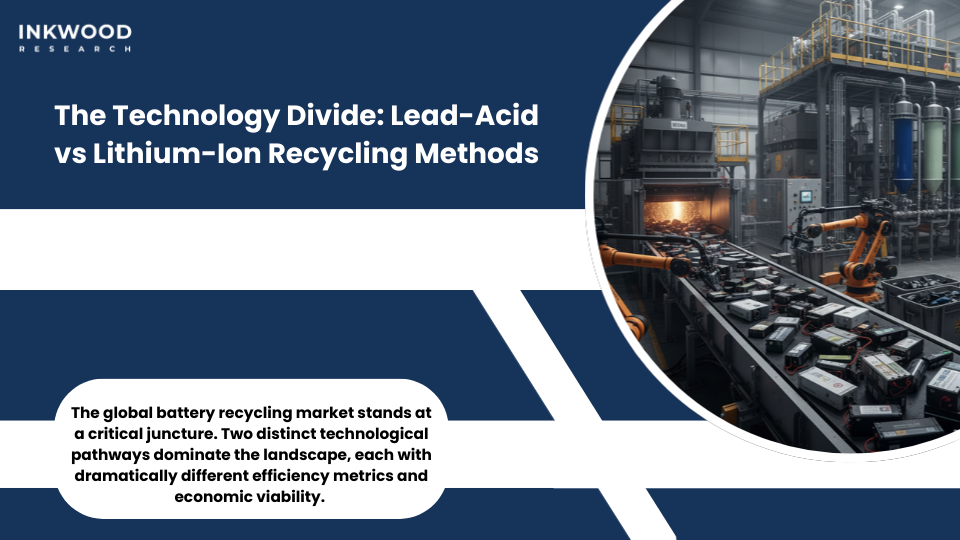
The global battery recycling market stands at a critical juncture. Two distinct technological pathways dominate the landscape, each with dramatically different efficiency metrics and economic viability. Lead-acid batteries achieve recycling rates above 99% in North America, making them the most recycled consumer product in the U.S. Moreover, it also establishes them as the gold standard for circular economy practices. This is primarily attributed to a long-standing closed-loop system that collects spent batteries, recovers lead and plastic, and feeds those materials directly into new battery production.
Conversely, lithium-ion systems present far more complex challenges. According to a 2023 study, roughly 59% of the world’s end-of-life batteries enter formal recycling channels. This disparity stems from fundamental differences in battery chemistry and structure. Moreover, the technologies required for each battery type vary significantly in complexity and capital requirements.
Lead-Acid: The Mature Recycling Infrastructure
Lead-acid battery recycling represents a well-established and economically viable process due to the high value of lead and other recoverable materials. The process begins with battery collection at designated centers. Subsequently, batteries undergo crushing operations where lead plates separate from plastic casings. Following this, smelting operations recover pure lead at temperatures exceeding 1,000 degrees Celsius.
The recovered lead returns directly to battery manufacturing facilities. Plastic components also find new life through separate recycling streams. This closed-loop system operates with remarkable efficiency across developed markets. However, environmental concerns persist regarding lead exposure during processing operations.
Lithium-Ion: Complex Chemistry Requires Advanced Solutions
Lithium-ion battery recycling involves significantly more intricate processes. The recycling process typically involves discharging the battery, dismantling it manually or through shredding, and then chemically treating the components. These steps separate valuable materials, including lithium, cobalt, and nickel. Nevertheless, the diversity of lithium-ion chemistries complicates standardized recycling protocols.
Cost Economics and Market Opportunities
Market dynamics reveal stark contrasts between lead-acid and lithium-ion recycling economics. The cost to break down battery materials ranges from $100 to $200 per metric ton for black mass paste, comparable to lead-acid processing expenses. Despite similar operational costs, revenue potential differs substantially between the two technologies.
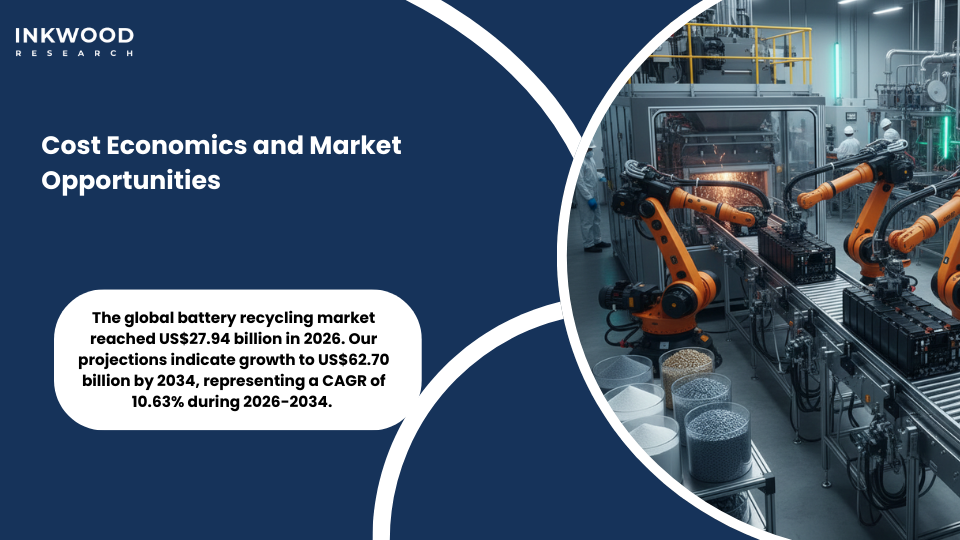
The global battery recycling market reached US$27.94 billion in 2026. Our projections indicate growth to US$62.70 billion by 2034, representing a CAGR of 10.63% during 2026-2034. Furthermore, regional markets demonstrate varying growth trajectories based on local regulatory frameworks and industrial capacity.
Regional Market Dynamics
Lead-acid batteries dominated the market with a significant revenue share in 2025, based on chemistry segmentation. This dominance reflects extensive usage of reusable lead and plastics for manufacturing purposes. However, lithium-ion recycling segments are experiencing rapid expansion driven by electric vehicle adoption.
Europe battery recycling market valuations stood at US$5,490.23 million in 2026. Expected growth reaches US$11,987.86 million by 2034, achieving a 10.25% CAGR. Meanwhile, the North America battery recycling market figures show US$6,135.72 million in 2026, expanding to US$13,586.66 million by 2034 at a 10.45% CAGR.
The Asia-Pacific battery recycling market leads globally with US$12,644.75 million in 2026. Projections point toward US$29,054.26 million by 2034, maintaining a robust 10.96% CAGR. This regional dominance stems from concentrated battery manufacturing capacity and supportive government policies.
Investment Opportunities in Battery Materials Recovery
By 2026, the battery recycling market is expected to reach $27.94 billion, followed by a sustained 10.63% compounded annual growth rate. Battery recycling forecasts indicate a rapid surge in recovered material over the next two decades. Material availability stood at around 200 kilotons in 2020 and is expected to reach 800 kilotons by 2025. By 2030, this could rise to 1,400 kilotons, climbing further to 3,400 kilotons by 2035. By 2040, recovered battery materials are projected to hit an impressive 7,300 kilotons. This dramatic supply expansion creates significant opportunities for materials recovery companies.
Critical minerals recovery presents particularly attractive economics. By 2031, recovery rates are expected to reach 95% for cobalt, copper, lead, and nickel, with lithium at 85%. These targets, part of a broader regulatory framework designed to ensure the sustainability and circularity of batteries within the EU market, ensure strong profit margins for advanced recycling facilities. Additionally, recovered materials command premium prices in constrained supply markets.
Europe’s Regulatory Revolution: Shaping the Global Battery Recycling Market
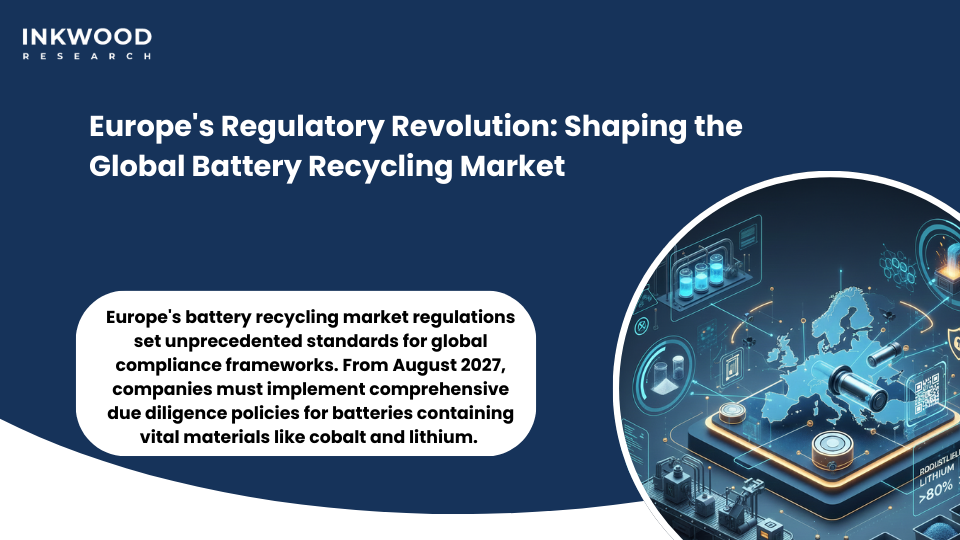
Europe’s battery recycling market regulations set unprecedented standards for global compliance frameworks. From August 2027, companies must implement comprehensive due diligence policies for batteries containing vital materials like cobalt and lithium. This requirement targets ethical and sustainable sourcing practices throughout supply chains. Moreover, the regulation introduces ambitious recycling efficiency and material recovery targets.
Extended Producer Responsibility Mandates
The regulation introduces ambitious targets for recycling efficiency and material recovery. These targets particularly focus on materials like cobalt and lithium. Notably, requirements increase progressively starting December 31, 2027. Consequently, manufacturers must redesign products with end-of-life processing in mind.
From February 2027, portable battery designs will evolve to allow easy removal and replacement by users, extending product lifespans significantly. This design-for-recycling mandate forces manufacturers to abandon permanently integrated battery systems. Furthermore, the requirement reduces electronic waste generation across consumer electronics categories.
Digital Product Passports and Traceability
Europe’s battery passport initiative transforms supply chain transparency. Each battery receives a digital identifier containing comprehensive lifecycle information. This passport tracks material origins, manufacturing processes, and recycling pathways. Subsequently, end users access complete information about battery contents and environmental impacts.
The system enables better reuse and recycling decision-making processes. Additionally, blockchain-based verification ensures data integrity throughout battery lifetimes. Companies must adapt information management systems to comply with these disclosure requirements. Otherwise, market access across European Union member states becomes restricted.
Impact on Battery Recycling Technologies
The European Union introduced stringent targets requiring at least 6% lithium and 16% cobalt from recycled sources by decade’s end. These mandates accelerate the development of advanced hydrometallurgical battery recycling and pyrometallurgical battery recycling technologies. Consequently, recycling plants must achieve a minimum 65% battery weight recovery by 2025.
North America’s Fragmented Approach to Battery Waste Management
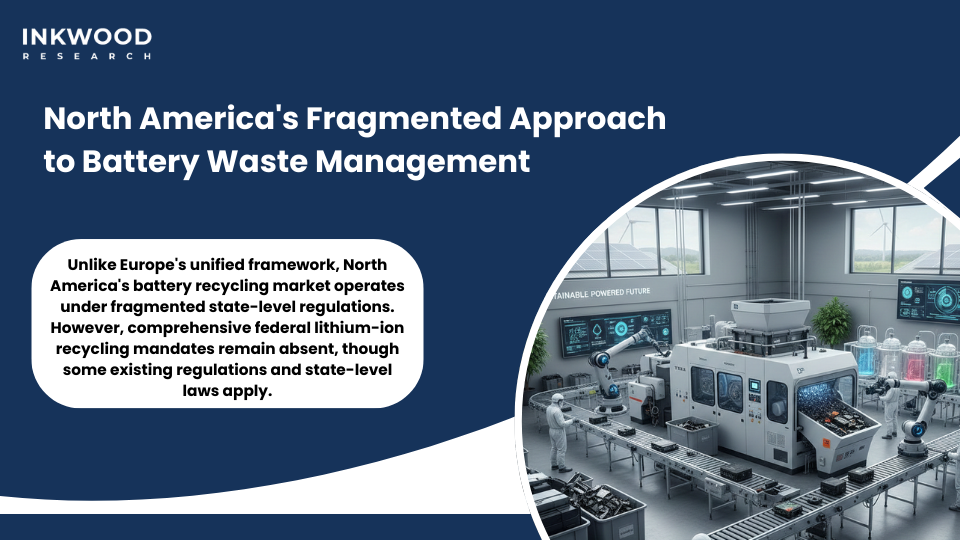
Unlike Europe’s unified framework, North America’s battery recycling market operates under fragmented state-level regulations. The Mercury-Containing and Rechargeable Battery Management Act requires companies and stores selling lead-acid and nickel-metal hydride batteries to accept and recycle used batteries. However, comprehensive federal lithium-ion recycling mandates remain absent, though some existing regulations and state-level laws apply.
State-Level Innovation and Challenges
Colorado’s Battery Stewardship Act of 2025 requires producers to join Battery Stewardship Organizations, with retailer compliance mandated by August 1, 2027. Similarly, Connecticut’s 2025 Act establishes producer responsibility by January 1, 2027. Meanwhile, California expanded electronic waste programs to include battery-embedded products starting January 1, 2026.
California revamped battery recycling through new laws overhauling extended producer responsibility schemes. These regulations mandate battery producers to create stewardship programs for collection and recycling. Additionally, the state extends e-waste programs to battery-embedded products. Thus, comprehensive coverage addresses previously unregulated waste streams.
Federal Incentives and Infrastructure Development
The Infrastructure Investment and Jobs Act (IIJA) includes funding for battery recycling research. Moreover, the legislation proposes task forces to develop extended producer responsibility frameworks. Nevertheless, implementation remains voluntary rather than mandated.
The Inflation Reduction Act sets stringent requirements for domestic EV battery supply chains, incentivizing critical mineral recycling. Specifically, significant portions of materials must originate from North America, free trade agreement countries, or domestic recycling operations. Consequently, companies investing in closed-loop battery recycling gain competitive advantages.
The Responsible Battery Recycling Act of 2022, California instructs retailers to establish collection systems for used rechargeable batteries. This requirement facilitates consumer participation in recycling programs. Furthermore, the act establishes clear responsibilities throughout the battery lifecycle. However, state-by-state variation complicates national compliance strategies.
Universal Waste Rule and Safety Standards
Federal law requires used nickel-cadmium and small sealed lead acid batteries to be managed as Universal Waste under 40 CFR Part 273. The Universal Waste Rule prohibits the disposal of these battery types. Instead, handlers must send them for recycling operations. Additionally, this framework eases regulatory burdens while encouraging recycling program development.
EPA guidance explains how current hazardous waste rules regulate lithium-ion batteries, concluding that most are hazardous waste at end-of-life. Nevertheless, batteries can be managed under universal waste standards until reaching destination facilities. This clarification provides operational guidance for battery handlers nationwide.
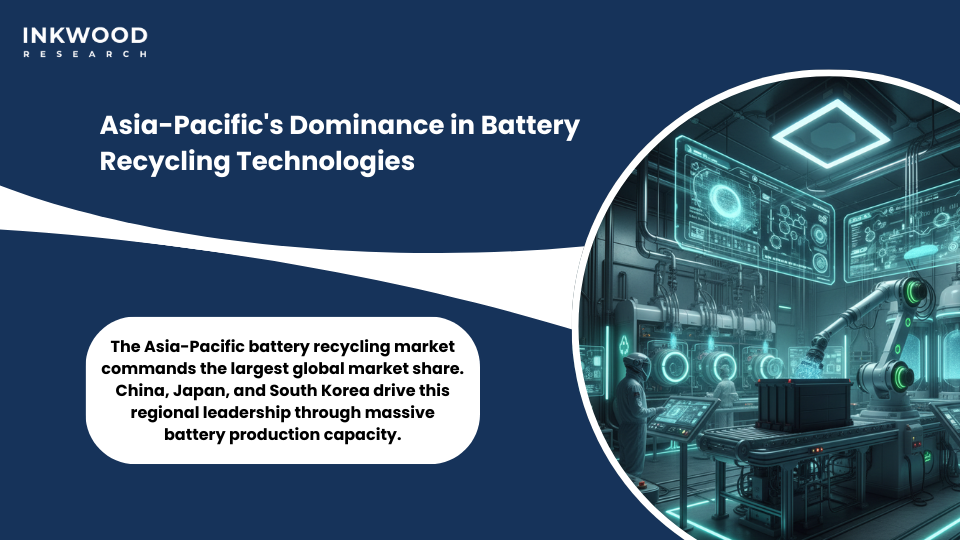
The Asia-Pacific battery recycling market commands the largest global market share. APAC dominated the global battery recycling market, accounting for a significant share in 2025. China, Japan, and South Korea drive this regional leadership through massive battery production capacity. Additionally, these countries are rapidly expanding recycling infrastructure to manage growing waste volumes.
China’s Regulatory Framework and Industrial Scale
China’s “New Energy Vehicle” regulations require battery manufacturers to take responsibility for recycling, further supporting market growth. Government policies include strict recycling mandates backed by subsidies and technology incentives. Consequently, Chinese companies lead global innovation in automated recycling technologies.
Hunan Brunp Recycling Technology, a CATL subsidiary, processes large volumes annually using AI-driven robotic disassembly. Their systems reduce material loss and chemical usage significantly. Similarly, Ganzhou Highpower Technology’s AI sorting systems deliver high accuracy in material separation, lowering recycling costs and energy consumption dramatically.
India’s Emerging Recycling Ecosystem
India’s battery recycling market was valued at $531.84 million in 2026, projecting growth to $1996.03 million by 2034 at a 17.98% CAGR. The Ministry of Mines launched a ₹1,500 crore incentive scheme supporting recyclers of e-waste, lithium-ion batteries, and end-of-life vehicles. Moreover, customs duty removal on waste and scrap in 2024 improves feedstock availability.
India introduced Battery Waste Management Rules 2025, mandating Extended Producer Responsibility targets for collection and material recovery. However, challenges persist, including non-standard battery designs, absent tracking systems for reused batteries, and inefficient logistics. Additionally, economic constraints affect recycling returns for certain chemistries like LFP.
Japan and South Korea’s Advanced Systems
Japan’s comprehensive laws regulate battery recycling, assigning vehicle manufacturers responsibility for batteries. The nonprofit JBRC manages Japanese battery recycling operations nationally. Furthermore, active programs promote battery reuse for home emergency power applications. This integrated approach maximizes material recovery and extends battery utility.
South Korea’s battery manufacturers invest heavily in recycling infrastructure development. Companies like LG Energy Solution build closed-loop systems that collect non-reusable batteries and production scraps. Subsequently, extracted materials feed back into production stages. These vertically integrated operations ensure supply chain resilience.
AI and Robotics: The Future of Closed-Loop Battery Systems
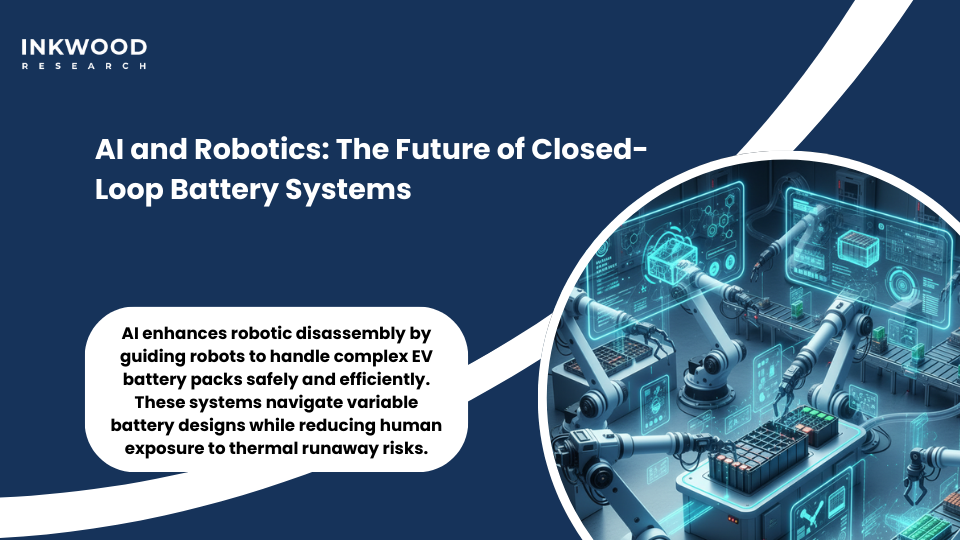
Artificial intelligence and robotics revolutionize battery recycling operations globally. AI enhances robotic disassembly by guiding robots to handle complex EV battery packs safely and efficiently. These systems navigate variable battery designs while reducing human exposure to thermal runaway risks. Importantly, costs decline from $0.64 per kilogram to $0.02 per kilogram through automation.
Automated Dismantling and Sorting
Circu Li-Ion uses AI-assisted disassembly with advanced 3D cameras and robotics, achieving high precision. Their system identifies and separates battery components with minimal material loss. Additionally, it enables the identification of reusable cells for second-life applications. Automation cuts labor costs substantially while reducing energy consumption.
Recirculate developed a robotic cell using a Kuka KR10 industrial robot equipped with specially designed tools. This robot autonomously detects, unscrews, and removes high-voltage battery pack components. Machine learning models identify battery types from manufacturers like Ford and Tesla with nearly 100% accuracy. Subsequently, systems automatically select the correct disassembly programs.
Predictive Analytics and Process Optimization
AI algorithms enable robots to adapt to non-standardized battery formats, streamlining disassembly for high-volume recycling. Real-time feedback from AI sensors ensures precision while minimizing waste generation. Furthermore, this technology proves crucial for scaling operations to meet the projected 1 million tons of battery waste by 2030.
ML algorithms will be instrumental in predicting material properties through robotics and AI, improving the efficiency and accuracy of material recovery. Deep learning models revolutionize battery sorting, classification, and disassembly processes. Consequently, automated systems enhance efficiency by reducing human error and occupational hazards.
Closed-Loop System Integration
Near-closed-loop systems will minimize material loss, reducing the carbon footprint of battery production. Digital twins and virtual twin experiences further optimize recycling workflows. These technologies enable near-zero waste while supporting circular economy objectives. Moreover, blockchain-based tracking systems certify ethical sourcing throughout supply chains.
AI-powered robots now sort used EV batteries by chemistry type, improving recycling efficiency by 25% while reducing toxic waste generation. Machine learning optimizes every production stage from raw material selection to assembly line automation. Additionally, AI-driven robotics transform battery assembly lines with greater precision than manual operations.
Competitive Landscape: Major Players Driving Innovation
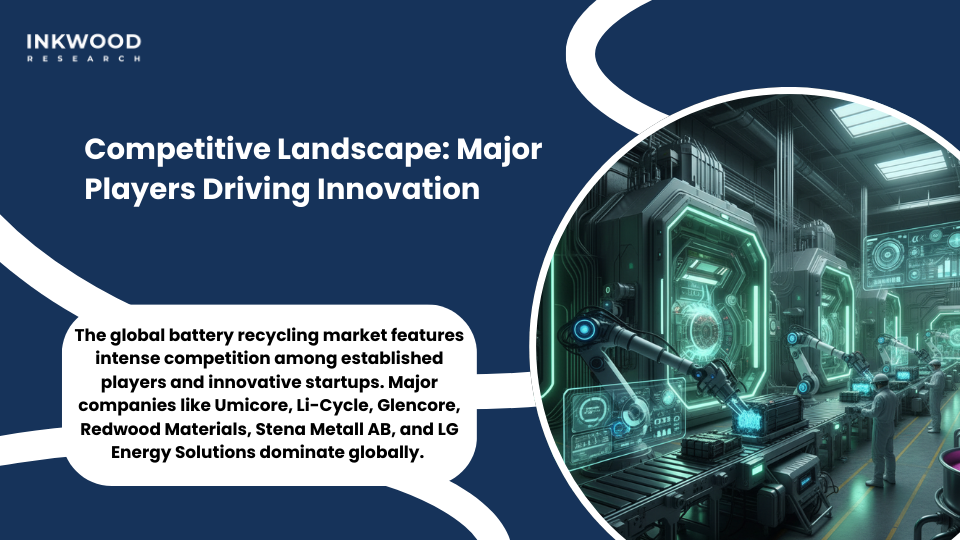
The global battery recycling market features intense competition among established players and innovative startups. Major companies like Umicore, Li-Cycle, Glencore, Redwood Materials, Stena Metall AB, and LG Energy Solutions dominate globally. These companies leverage advanced recycling technologies and extensive global networks. Moreover, they establish partnerships with EV manufacturers, consumer electronics firms, and industrial battery suppliers.
Redwood Materials: Closed-Loop Pioneer
Founded by JB Straubel, Tesla’s co-founder and former CTO, Redwood Materials focuses on sustainable materials utilization. The company recovers more than 95% of key battery elements, including aluminum, cobalt, copper, graphite, and lithium. Redwood’s South Carolina site aims for 100 GWh cathode active material production with partnerships locking in demand from Toyota and Panasonic.
Redwood secured a $2 billion conditional low-cost loan from the US Department of Energy’s Advanced Technology Vehicles Manufacturing Loan Program. The company plans to build a facility in Charleston, South Carolina, establishing US-based supply chains. Additionally, Redwood acquired German recycling company Redux in 2023, expanding European operational capacity.
Li-Cycle and Strategic Partnerships
Li-Cycle opened an Arizona factory in May that breaks down battery packs efficiently without dismantling or discharging. Their facility takes full packs directly into shredders submerged in solution, minimizing fire risk. Subsequently, the facility sifts aluminum, copper, and plastics for separate recycling streams. The remaining “black mass” travels to Rochester, New York, hub facilities.
Ultium Cells LLC, a joint venture between LG Energy Solution and General Motors, partnered with Li-Cycle to recycle crucial battery components. This collaboration recycles aluminum, cobalt, lithium, and nickel from disposed EV battery cells. Furthermore, it demonstrates automakers’ commitment to circular supply chain development.
BASF’s European Leadership
BASF operates a black-mass facility processing 15,000 tonnes annually, creating steady recycled material supplies. The commercial-scale black mass plant in Schwarzheide, Germany, ranks among Europe’s largest facilities. Additionally, BASF built a strong partner network covering all battery recycling value chain steps.
Emerging Players and Regional Champions
American Battery Technology Company pioneered a battery recycling process, separating and recovering critical materials from end-of-life batteries. Their “de-manufacturing” approach extracts metals and purifies battery materials, matching or exceeding virgin-sourced specifications. Meanwhile, Fortum signed agreements with Marubeni Corporation, developing sustainable lithium-ion battery recycling chains focusing on graphite recovery.
In December 2024, Ace Green Recycling announced a merger with Athena Technology Acquisition Corp. II, valued at $250 million. The merger accelerates expansion plans, including a flagship battery recycling plant in Texas. This consolidation trend strengthens market positions through increased processing capacity.
Latest Product Developments and Strategic Partnerships
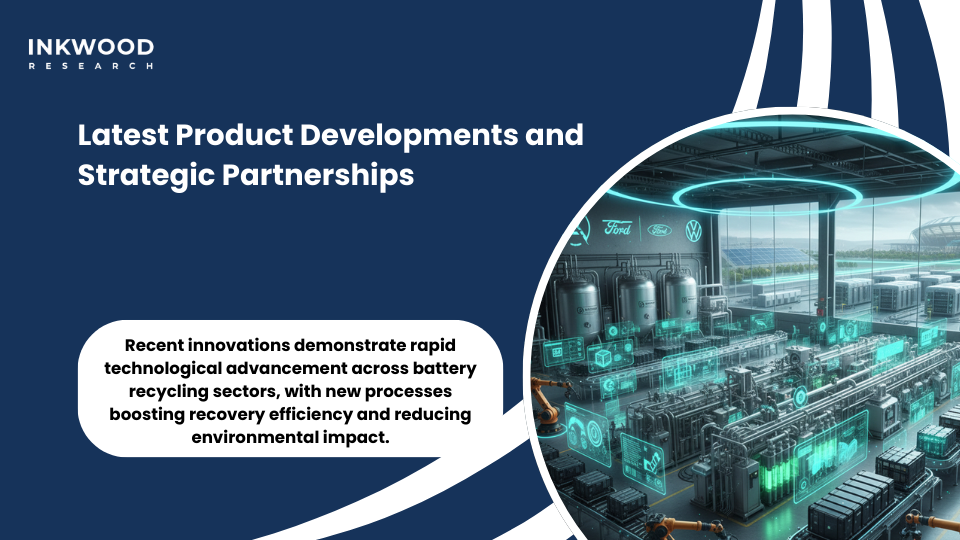
Recent innovations demonstrate rapid technological advancement across battery recycling sectors, with new processes boosting recovery efficiency and reducing environmental impact. Ascend Elements uses a “hydro-to-cathode” process, skipping unnecessary steps, reducing carbon emissions by nearly 50% compared to traditional methods. This streamlined approach improves economic viability while enhancing environmental performance.
Automaker Integration Strategies
Mercedes-Benz launched an integrated plant with Primobius at Kuppenheim, achieving recovery rates above 96%. This project demonstrates automakers taking direct control of supply chains. Similarly, Volkswagen Group UK expanded partnerships with Ecobat to recycle EV batteries, supporting circular energy economy development. Ecobat’s new UK lithium-ion recycling center marks its third globally after Germany and Arizona.
GM Ultium Cells partners with Redwood to recycle production scrap from battery plants, feeding recovered materials back into new EV manufacturing. Additionally, Ford invested $50 million into Redwood in 2021, partnering to build closed-loop battery recycling supply chains handling production scrap and end-of-life packs.
Second-Life Battery Applications
Through the Redwood Energy division, the company turns partially degraded packs into stationary energy storage. Diagnostics determine whether batteries retain usable capacity, often 50% to 80% of their original energy. Qualified packs reconfigure into modular storage units with proprietary control systems. One standout project includes a 12 MW / 63 MWh solar-powered microgrid in Nevada.
Second-life EV batteries combine into large-scale energy storage systems similar to Tesla Powerpack, storing excess renewable energy from wind and solar farms. Amsterdam Arena uses second-life Nissan LEAF batteries storing energy from rooftop solar panels, providing backup power during grid outages.
Technology Licensing and Knowledge Transfer
In July 2025, Easpring Finland New Materials received a EUR 115 million grant from Business Finland to construct a cathode active material factory in Kotka. Once operational, the facility supports battery production for approximately 750,000 electric vehicles annually. This investment reinforces Europe’s battery supply chain, reducing reliance on Chinese CAM production.
Key Takeaways
- The global battery recycling market transformation accelerates through technological innovation, regulatory pressure, and strategic partnerships. Lead-acid recycling maintains 99% efficiency through established processes, while lithium-ion systems advance rapidly through AI-driven automation. Consequently, businesses must evaluate technology pathways that align with regional regulatory requirements.
- Europe’s battery recycling market regulations set global standards requiring comprehensive due diligence and material recovery targets. Meanwhile, the North America battery recycling market operates under fragmented state-level frameworks with federal incentive support. Asia-Pacific battery recycling market dominates with 57% global revenue share driven by Chinese manufacturing capacity and Indian growth potential.
- Hydrometallurgical battery recycling and pyrometallurgical battery recycling technologies achieve recovery rates exceeding 95% for critical materials. Moreover, closed-loop battery recycling systems integrate AI and robotics, reducing processing costs by 97%. Companies investing in automated infrastructure gain competitive advantages in securing raw material supplies.
- Strategic partnerships between automakers, battery manufacturers, and recycling companies create vertically integrated supply chains. These collaborations ensure stable material flows while meeting sustainability commitments. Furthermore, second-life battery applications extend product utility before final recycling, maximizing economic and environmental value.
Conclusion
Battery recycling stands at an inflection point where regulatory mandates, technological capabilities, and market economics align. The transformation from linear disposal to circular recovery systems accelerates across all major markets. Subsequently, companies embracing advanced recycling technologies secure competitive positioning in constrained materials markets.
However, significant challenges remain. Standardization across battery chemistries, development of collection infrastructure, and scaling of AI-driven processing systems require continued investment. Regulatory harmonization between regions would further accelerate circular economy adoption.
At Inkwood Research, we help businesses navigate this complex landscape through comprehensive market intelligence and strategic guidance. Our experts analyze technological trends, regulatory developments, and competitive dynamics shaping battery recycling markets. Contact our team to explore how circular battery supply chains can enhance your sustainability objectives while securing critical material supplies for long-term growth.
Frequently Asked Questions (FAQs)
Lead-acid recycling achieves 99% recovery rates through straightforward crushing, smelting, and material separation processes. Lithium-ion recycling requires complex hydrometallurgical or pyrometallurgical methods to separate diverse materials, including lithium, cobalt, nickel, and manganese, from varied battery chemistries.
Europe implements unified regulations requiring comprehensive due diligence, extended producer responsibility, and minimum recycled content quotas. North America operates under fragmented state-level frameworks with voluntary federal incentives rather than mandatory national standards.
AI-driven robotics automate battery disassembly, reducing costs from $0.64 to $0.02 per kilogram while improving material recovery rates to 95%+. Machine learning optimizes sorting accuracy, predicts equipment maintenance needs, and enables real-time process adjustments for maximum efficiency.