Table of Contents
This analysis is brought to you by Inkwood Research, a leading market intelligence firm specializing in European renewable energy systems, circular economy frameworks, and photovoltaic waste management technologies. Our research team combines extensive experience analyzing WEEE compliance strategies, mechanical thermal laser recycling innovations, and material recovery processes across Germany and the broader European Union. Based on our proprietary research methodologies and strategic partnerships with German recycling facilities, solar manufacturers, and environmental agencies, we deliver actionable insights that empower strategic decision-making for global enterprises navigating Germany’s solar panel recycling market evolution.
TLDR
Germany transforms solar panel recycling from an environmental obligation into an export opportunity through rigorous WEEE regulations and advanced processing technologies. The market reached US$52.18 million in 2026 and projects growth to US$149.92 million by 2034. German companies pioneer efficient mechanical thermal laser methods that recover silicon, silver, and aluminum while maintaining strict environmental standards. This combination positions Germany as the blueprint for sustainable photovoltaic waste management worldwide.
European solar manufacturers seeking WEEE compliance guidance, international recycling companies exploring German partnerships, environmental policy makers benchmarking best practices, renewable energy developers planning end-of-life strategies, and investment analysts evaluating circular economy opportunities will discover comprehensive insights into Germany’s regulatory frameworks, technological innovations, and market mechanisms shaping efficient solar panel recycling ecosystems across Europe.

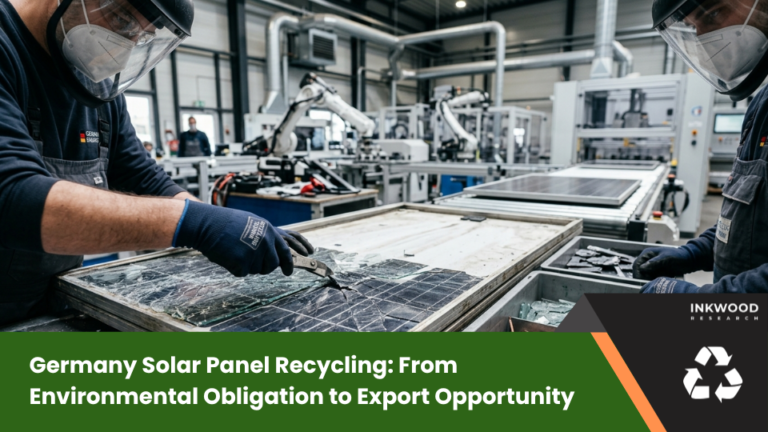
Germany quietly builds what might become its next major export industry while the world focuses on renewable energy deployment. The country’s solar panel recycling market demonstrates how environmental regulations transform into economic opportunities. Moreover, through decades of environmental leadership, Germany developed comprehensive systems that now position it as a global recycling powerhouse.
Solar panels installed across Germany during the early solar boom now approach retirement age. This creates both challenge and opportunity for the nation’s recycling infrastructure. However, Germany prepared for this moment through systematic policy development and technological innovation. Consequently, what other countries view as a looming waste crisis becomes a strategic advantage.
The recipe involves more than technology alone. It combines regulatory rigor, industrial precision, and circular economy thinking that characterizes German engineering. Additionally, international interest grows as nations recognize they face similar challenges. Germany’s approach offers proven methodologies that others can adapt to local circumstances.
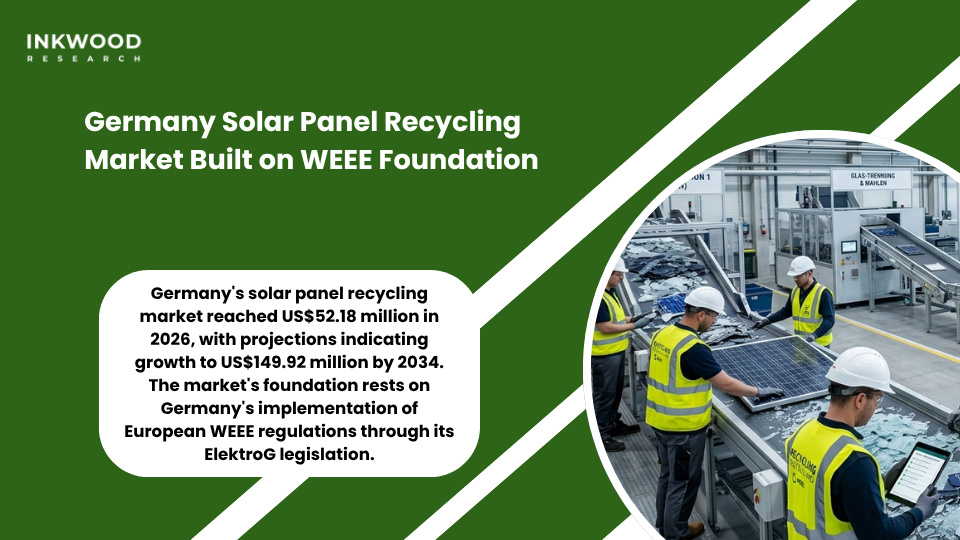
Germany’s solar panel recycling market reached US$52.18 million in 2026, with projections indicating growth to US$149.92 million by 2034. This represents a compound annual growth rate of 14.10% during the forecast period. The market’s foundation rests on Germany’s implementation of European WEEE regulations through its ElektroG legislation.
The WEEE Directive transformed how Germany manages electronic waste, including photovoltaic panels. Since October 2015, solar modules fall under this comprehensive framework. Aligning with this, manufacturers must register products with Stiftung EAR, Germany’s official electrical equipment register. This creates accountability throughout the product lifecycle.
Extended Producer Responsibility forms the cornerstone of Germany’s approach to waste management. Manufacturers bear financial and operational responsibility for collecting and recycling their products. This incentivizes design improvements that facilitate recycling while ensuring adequate funding for end-of-life processing. Consequently, Germany developed one of Europe’s most robust recycling infrastructures.
Nationwide Collection Network Ensures Material Recovery
Germany’s electronic waste management system is supported by a significantly large infrastructure, featuring around 2,400 municipal recycling centers. Furthermore, as of July 2022, regulations introduced an additional 25,000 collection sites, often located at electronics retailers. Solar panels reach these facilities through multiple channels, depending on their origin. Residential installations utilize municipal recycling centers where disposal remains free for end users. Meanwhile, commercial and industrial systems follow business-to-business protocols.
Manufacturers organize collections based on market share rather than individual product tracking. This pooled approach reduces administrative burden while maintaining producer accountability. Further, full containers trigger manufacturer pickups according to predetermined schedules. The system balances efficiency with environmental responsibility through careful coordination.
Collection efficiency directly influences recycling success rates. Germany’s mature infrastructure ensures minimal leakage from proper disposal channels. Furthermore, enforcement mechanisms penalize non-coxcvbjkl;1.mpliance through substantial fines. These elements combine to create high participation rates across all stakeholder groups.
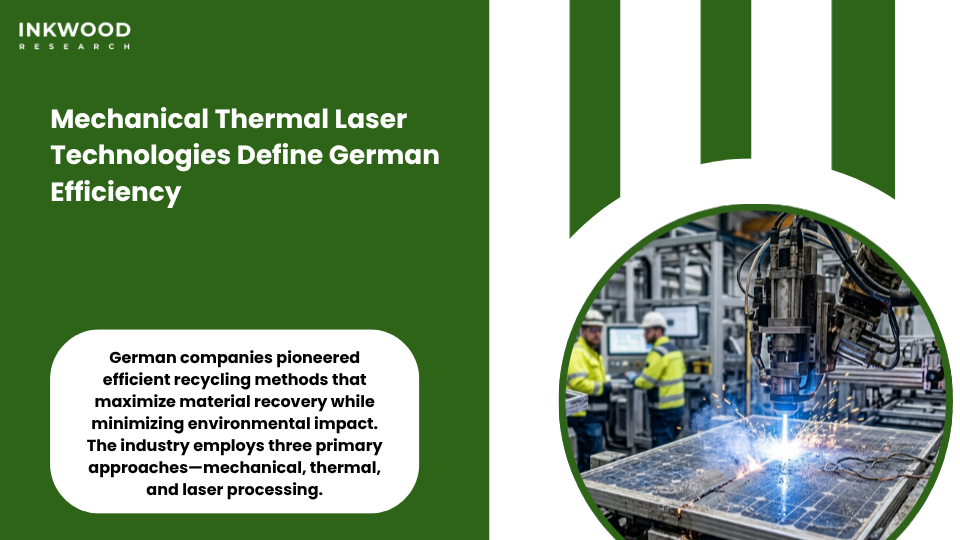
German companies pioneered efficient recycling methods that maximize material recovery while minimizing environmental impact. The industry employs three primary approaches—mechanical, thermal, and laser processing. Each method offers distinct advantages depending on panel type and desired material purity. Together, they enable comprehensive recycling capabilities.
Mechanical recycling dominates current operations due to its cost-effectiveness and established infrastructure. Panels undergo systematic dismantling that separates aluminum frames, junction boxes, and glass covers. Additionally, shredding and grinding then reduce remaining materials into constituent components. This approach efficiently recovers bulk materials like glass and aluminum that constitute most panel weight.
Thermal processes complement mechanical methods by recovering high-purity silicon and metals. Controlled heating removes plastic encapsulants, allowing the extraction of valuable semiconductor materials. Laser technologies represent the cutting edge of German recycling innovation. Precision targeting enables selective material removal without damaging surrounding components. As a result, these advanced techniques recover materials suitable for reuse in new panel production.
Reiling Group Demonstrates Industrial Scale Achievement
Reiling PV-Recycling exemplifies German excellence in solar panel recycling operations. The company’s facility in Münster processes thousands of metric tons annually using mechanical methods optimized for maximum throughput. Plans envision expansion to 50,000 metric tons per year, reflecting growing market demand.
The company recently achieved breakthroughs in silicon recovery that enhance economic viability. Traditional mechanical processing efficiently recovers glass and aluminum but struggles with high-purity silicon extraction. Reiling’s innovations address this limitation through supplementary processing steps. Subsequently, recovered silicon meets quality standards for industrial applications.
Consequently, Reiling’s success demonstrates how established German industrial expertise translates to emerging markets. The company leverages decades of glass recycling experience to optimize photovoltaic panel processing. This knowledge transfer accelerates the development of best practices that others can replicate. Moreover, it proves that recycling achieves profitability alongside environmental benefits.
Emerging Technologies Promise Higher Recovery Rates
German startups push recycling technology boundaries through innovative approaches. Flaxres developed mobile recycling units housed in shipping containers that travel directly to decommissioning sites. Flash lamp annealing technology exposes panels to high-intensity light pulses that delaminate components. This eliminates the costly transportation of intact panels to central facilities.
The mobile approach particularly suits large solar parks undergoing decommissioning or repowering. On-site processing reduces logistics costs while accelerating project timelines. Additionally, equipment rental models lower entry barriers for smaller operations. These innovations reflect German engineering’s characteristic focus on practical problem-solving.
Research continues to advance pyrolysis and chemical processing techniques. These methods target specific materials that resist mechanical separation. For instance, polymer encapsulants require high temperatures or solvents for effective removal. German research institutions collaborate with industry partners to commercialize laboratory innovations. This ecosystem supports continuous technological improvement.
Resource Efficiency Principles Drive Material Recovery Systems
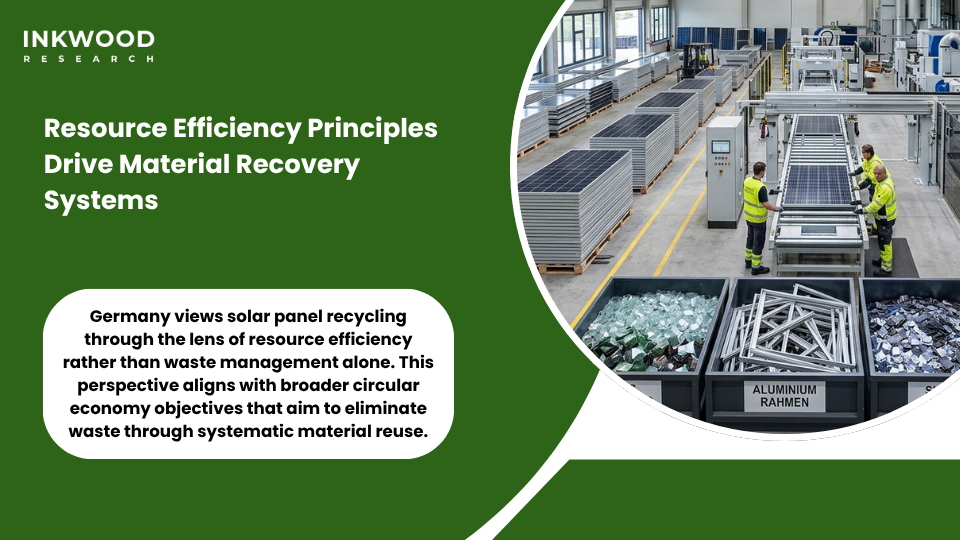
Germany views solar panel recycling through the lens of resource efficiency rather than waste management alone. This perspective aligns with broader circular economy objectives that aim to eliminate waste through systematic material reuse. Recovered silicon, silver, and aluminum return to industrial supply chains, reducing dependence on virgin material extraction.
Glass recovery particularly demonstrates circular economy principles in action. Although recovered glass rarely achieves the purity levels required for new photovoltaic panels, it finds applications across the construction and packaging industries. Similarly, aluminum frames enter established metal recycling streams that supply automotive and building sectors. Each material follows pathways optimized for its specific properties.
Economic incentives support circular material flows through market mechanisms. Recyclers sell recovered materials to manufacturers seeking cost-effective alternatives to virgin inputs. Meanwhile, regulations create a preference for recycled content in new products. Together, these push and pull factors strengthen circular economy infrastructure across Germany’s industrial landscape.
Panel Testing Extends Lifecycle Before Recycling
Not all decommissioned panels require immediate recycling. Many retain significant efficiency despite age or cosmetic damage. German facilities, therefore, conduct comprehensive testing before processing decisions. Panels passing efficiency thresholds enter second-life markets where they provide continued service at reduced cost.
Testing protocols evaluate electrical performance through certified flash testers that measure residual power output. Plus, electroluminescence imaging detects microcracks and cell damage invisible to visual inspection. Additional safety tests ensure grounding and insulation integrity. Only panels failing these criteria proceed to recycling.
Second-life applications extend panel utility while deferring recycling costs. Developing markets particularly value cost-effective solar solutions that established markets retire. Furthermore, repowering projects often generate functional panels unsuited for premium installations. These find homes in less demanding applications, maximizing total resource utilization.
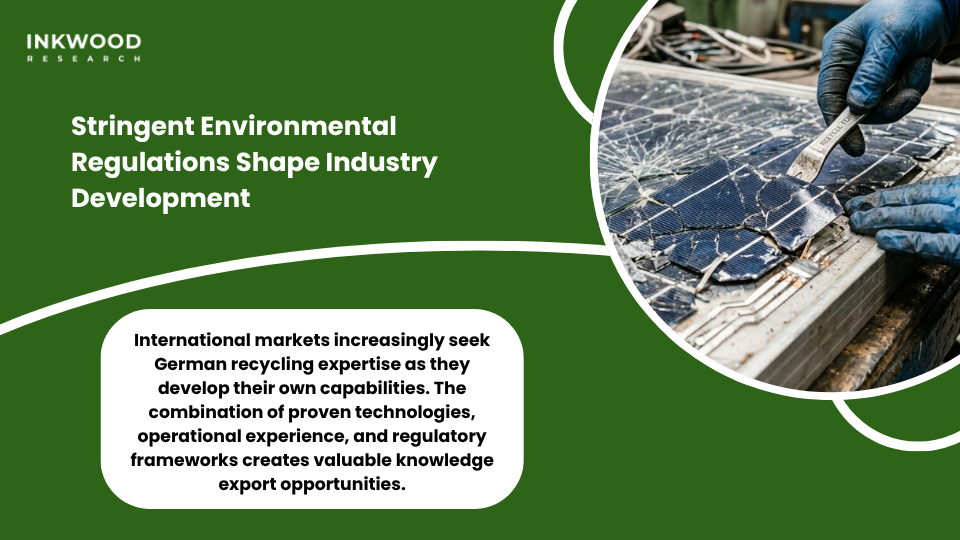
Germany continuously refines its recycling regulations to address emerging challenges. The latest WEEE amendments clarify producer responsibilities for photovoltaic panels placed on the market after August 2012. These changes respond to European Court of Justice rulings that sought greater legal certainty around extended producer responsibility applications.
Member states must transpose updated directives into national law by October 2025. Germany’s ElektroG legislation will incorporate these modifications to maintain alignment with European frameworks. Additionally, comprehensive WEEE reviews mandated by December 2026 may introduce further refinements. This ongoing evolution ensures regulations keep pace with market developments.
Online marketplace obligations represent recent regulatory focus. Platform operators must verify seller WEEE compliance before listing electronic products. Non-registered sellers face marketplace exclusion, creating strong compliance incentives. Additionally, these measures close loopholes that previously enabled regulatory avoidance through e-commerce channels.
Eco-Design Standards Influence Future Panel Manufacturing
Emerging eco-design requirements will reshape photovoltaic panel manufacturing to facilitate recycling. The EU Ecodesign Directive mandates that products incorporate recyclability considerations from initial design phases. For solar panels, this means using materials and construction methods that enable efficient disassembly.
Furthermore, current panels optimize for longevity and performance, sometimes at recycling’s expense. Strong adhesives that ensure weather resistance complicate material separation. Also, future designs must balance durability requirements with end-of-life processing needs. German manufacturers already invest in research addressing this challenge.
Smart adhesives that deactivate on demand represent one promising avenue. Temperature-sensitive compounds allow easy separation when panels reach recycling facilities. Alternative encapsulation methods reduce polymer usage that currently hinders silicon recovery. Consequently, these innovations emerge from collaboration between manufacturers and recyclers who understand practical processing constraints.
German Expertise Becomes Global Recycling Blueprint
International markets increasingly seek German recycling expertise as they develop their own capabilities. The combination of proven technologies, operational experience, and regulatory frameworks creates valuable knowledge export opportunities. German companies leverage this positioning through consulting services, technology licensing, and joint venture partnerships.
Developing markets particularly value turnkey solutions that accelerate infrastructure development. Rather than replicating decades of trial and error, they adopt refined German methodologies. Equipment manufacturers export processing systems adapted to local conditions. Meanwhile, consultants provide training and operational guidance, ensuring successful technology transfer.
European neighbors study German implementation when designing national recycling systems. The ElektroG framework demonstrates how to translate WEEE requirements into practical operational procedures. Collection network design, producer coordination mechanisms, and enforcement approaches all offer replicable models. This influence extends Germany’s environmental leadership beyond its borders.
Key Takeaways
- Germany’s solar panel recycling market demonstrates how environmental regulation drives industrial innovation and creates export opportunities.
- The WEEE framework establishes comprehensive producer responsibility that ensures adequate recycling infrastructure funding.
- Mechanical thermal laser technologies enable efficient material recovery at industrial scales. Companies like Reiling demonstrate profitability alongside environmental stewardship through optimized processing methods.
- Mobile recycling innovations address logistical challenges while reducing costs. Continuous research advances recovery rates and material purity.
- Circular economy principles guide Germany’s approach beyond simple waste management. Recovered materials return to industrial supply chains, reducing virgin resource consumption.
- Second-life markets extend panel utility before recycling becomes necessary. Future eco-design requirements will further enhance recyclability from manufacturing inception.
- International interest in German expertise creates knowledge export opportunities. Proven methodologies, established technologies, and regulatory frameworks become valuable exports themselves. This positions Germany as a global leader shaping sustainable photovoltaic lifecycle management worldwide.
Conclusion: From Regulatory Burden to Economic Opportunity
Germany transforms solar panel recycling from a compliance obligation into a competitive advantage through systematic development of expertise and infrastructure. The recipe combines stringent environmental regulations with German engineering excellence and circular economy thinking. Moreover, this approach demonstrates how environmental leadership creates economic value rather than imposing costs.
The market’s projected growth reflects both increasing waste volumes and expanding service offerings. As other nations develop recycling requirements, German companies stand ready to support their transitions. Technology exports, consulting services, and operational partnerships all represent revenue opportunities beyond domestic market activities.
Future success requires continued innovation as panel designs evolve and material compositions change. However, Germany’s research infrastructure and industry collaboration ensure technological adaptation. The foundation built through decades of environmental policy provides competitive moats difficult for newcomers to replicate.
Ready to understand how Germany’s recycling expertise can benefit your organization?
Inkwood Research offers detailed market intelligence and strategic guidance tailored to your solar panel recycling needs. Contact our expert team to discover actionable insights driving circular economy success.
Frequently Asked Questions
What regulations govern solar panel recycling in Germany?
Germany regulates solar panel recycling under the EU WEEE Directive through the ElektroG law, requiring manufacturers to register panels with Stiftung EAR and finance proper collection and recycling.
Which materials can German recyclers recover from solar panels?
German recycling facilities recover valuable materials including glass, aluminum, silicon, silver, and copper using advanced mechanical and thermal processing technologies.
How does Germany’s solar panel recycling infrastructure compare globally?
Germany has one of the most advanced solar panel recycling systems globally, supported by extensive collection networks and specialized processing facilities across the country.
Why is Germany considered a leader in solar panel recycling in Europe?
Germany leads due to strong environmental regulations, early adoption of photovoltaic waste policies, and significant investments in recycling infrastructure.
What role does the EU WEEE Directive play in solar panel recycling?
The EU WEEE Directive requires producers to take responsibility for end-of-life photovoltaic panels, ensuring systematic collection, recycling, and environmentally safe disposal.
How do high recycling rates benefit Germany’s solar industry?
High recycling rates help recover valuable raw materials, reduce environmental impact, and support a circular economy within Germany’s renewable energy sector.