Table of Contents
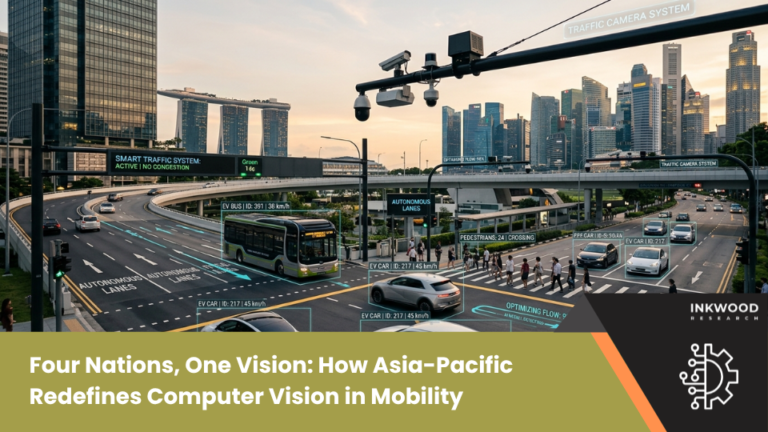
This analysis is brought to you by Inkwood Research, a leading market intelligence firm specializing in Asia-Pacific automotive technology, intelligent transportation systems, and AI-powered mobility ecosystems. Our research team combines deep expertise in autonomous driving regulations, smart city infrastructure, and computer vision deployment across China, Japan, South Korea, and India. Through strategic partnerships with regional OEMs, government mobility agencies, and technology developers, we deliver actionable insights for enterprises navigating the Asia-Pacific computer vision applications in mobility market.
TLDR
The Asia-Pacific computer vision applications in mobility market is projected to grow from US$16.35 billion in 2026 to US$50.15 billion by 2034 at a 15.04% CAGR, the fastest-growing major region globally. Four distinct national strategies are driving this expansion. China is scaling smart city and EV infrastructure at a pace no other country matches. Japan is using computer vision in mobility to solve a demographic crisis. South Korea is engineering its way into global SDV leadership. India, meanwhile, is building an intelligent transportation foundation from the ground up, faster than most expected.
This blog is essential reading for automotive executives, mobility technology investors, smart city strategists, and policy planners evaluating opportunities across Asia-Pacific. Additionally, ADAS developers, autonomous vehicle platform providers, transportation infrastructure teams, and market entry strategists focusing on China, Japan, South Korea, and India will find targeted intelligence on competitive dynamics, regulatory environments, and technology adoption trends across the region.
How Is Asia-Pacific Driving the Global Computer Vision in Mobility Market?
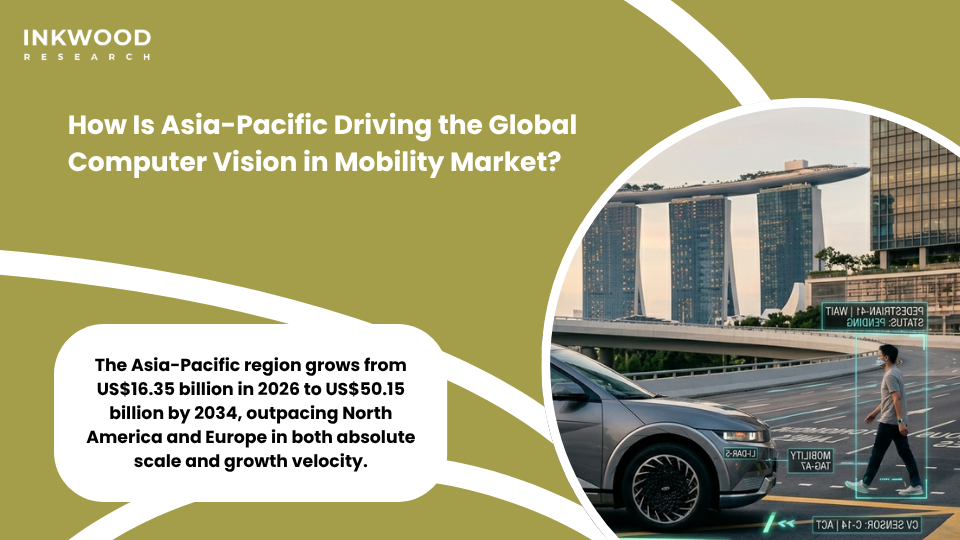
Asia-Pacific is not simply participating in the global computer vision in transportation market, but actively setting its pace. The Asia-Pacific region grows from US$16.35 billion in 2026 to US$50.15 billion by 2034, outpacing North America and Europe in both absolute scale and growth velocity. What makes this trajectory especially interesting is how differently each country within the region is arriving at the same destination.
Rather than following a single playbook, AI computer vision mobility market growth across Asia-Pacific reflects four genuinely distinct national strategies. China is building infrastructure at scale. Japan is solving a social problem. South Korea is pursuing technology sovereignty. India is creating an entirely new mobility ecosystem. Together, these approaches are making Asia-Pacific the most diverse and consequential region in the global intelligent mobility computer vision market.
Why Asia-Pacific Leads in Autonomous Driving Momentum
Several structural factors explain the Asia-Pacific’s leadership. Rapid urbanization, aging populations in some markets, and government-backed smart city programs are all accelerating demand for computer vision mobility solutions. Furthermore, regional governments are not waiting for private sector momentum; they are creating it through national AI strategies, autonomous vehicle legislation, and intelligent infrastructure investment programs that directly support the automotive computer vision systems market.
Plus, the APEC Policy Support Unit’s work on intelligent transportation reflects the regional consensus that computer vision for autonomous vehicles and smart transportation are central to economic competitiveness through 2030 and beyond. Consequently, the region’s investment in real-time computer vision transportation systems is being driven from the top of government, not just from the private sector.
China: How Is EV Infrastructure Accelerating Computer Vision in Transportation?

China’s computer vision applications in mobility market is growing from US$7.97 billion in 2026 to US$25.29 billion by 2034 at a 15.52% CAGR, the fastest among all four markets discussed here. To understand this growth, it helps to recognize that China is not simply deploying computer vision transportation technology within its existing mobility framework. Rather, it is building an entirely new transportation infrastructure layer, one in which AI computer vision mobility is embedded by design from the outset.
The country’s electric vehicle adoption rate is integral to this story. As China’s Ministry of Industry and Information Technology (MIIT) continues advancing its intelligent connected vehicle (ICV) standards, the relationship between EV infrastructure and computer vision in transportation is becoming increasingly direct. Charging networks, vehicle-to-everything (V2X) communication nodes, and roadside sensing units are all being deployed simultaneously, creating a cooperative perception environment that individual vehicle sensors alone cannot achieve.
Smart City Programs and Road-Level Computer Vision
China’s smart city programs are among the most ambitious deployments of computer vision for traffic monitoring and mobility management anywhere in the world. Cities including Shenzhen, Hangzhou, and Wuhan are operating AI-managed traffic systems that use roadside cameras and edge computing to optimize signal timing in real time, reducing congestion and lowering emissions across millions of daily commuters.
Furthermore, China’s major automotive and technology companies are actively shaping the computer vision automotive market through rapid product development and ecosystem partnerships. Here’s how:
- Baidu Apollo: Baidu’s autonomous driving platform has accumulated over ten million kilometers of real-world autonomous testing miles. Its Robotaxi service, Apollo Go, is operating commercially across multiple Chinese cities, generating the operational data that refines real-time computer vision transportation systems at scale.
- Huawei: Through its Intelligent Automotive Solution (IAS) division, Huawei is supplying automotive computer vision systems market participants with lidar, camera systems, and AI compute hardware. Its MDC (Mobile Data Center) platform underpins intelligent driving across several domestic OEM programs.
- BYD: As the world’s largest EV manufacturer by volume, BYD is integrating computer vision for ADAS systems across its full vehicle lineup, making advanced perception technology accessible at mainstream price points rather than limiting it to premium segments.
Regulatory Tailwinds Supporting China’s Computer Vision Mobility Market
China’s regulatory environment is one of the most proactive in the world for autonomous driving technology.
- The MIIT’s Technical Requirements for the Function of Intelligent Connected Vehicles establishes mandatory ADAS feature standards for new vehicles, a mandate that directly lifts the floor of computer vision automotive market demand across the entire passenger vehicle segment.
- Additionally, dedicated testing zones for Level 3 and Level 4 autonomous vehicles now exist in over 20 Chinese cities, providing real-world validation environments that accelerate the maturation of computer vision for autonomous vehicles market applications.
Japan: How Is Computer Vision Restoring Mobility Independence to an Aging Population?
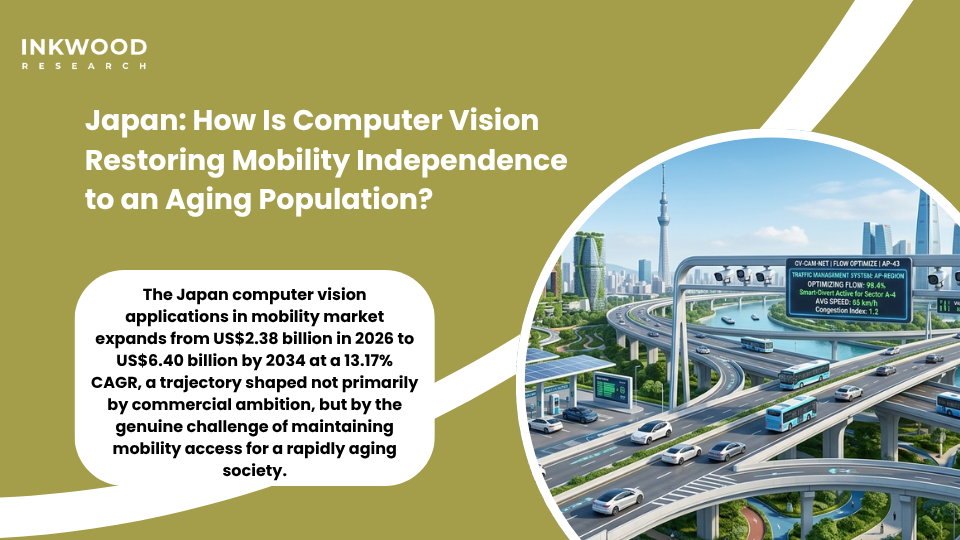
Japan’s approach to computer vision in mobility is rooted in a social imperative that no other country faces quite so urgently. The Japan computer vision applications in mobility market expands from US$2.38 billion in 2026 to US$6.40 billion by 2034 at a 13.17% CAGR, a trajectory shaped not primarily by commercial ambition, but by the genuine challenge of maintaining mobility access for a rapidly aging society.
Japan’s National Institute of Population and Social Security Research projects that by 2040, over one-third of Japan’s population will be aged 65 or older. For a country where rural communities depend heavily on personal vehicle use, and where public transportation networks thin out significantly beyond major urban centers, this demographic reality creates structural demand for autonomous driving technology that is unlike anything driven by commercial competition alone. Consequently, computer vision for autonomous vehicles in Japan is as much a public welfare solution as it is a technology product.
SDV Ambitions: Japan’s Global Market Target
Beyond the demographic urgency, Japan has set an explicit national technology ambition in the software-defined vehicle (SDV) space. The Ministry of Economy, Trade and Industry (METI) has outlined strategic goals for Japanese automakers to capture a significant share of the global SDV market, with intelligent mobility computer vision capabilities central to that positioning.
Toyota, Honda, and Nissan are each advancing computer vision mobility solutions from distinct angles.
- Toyota: Toyota’s Woven City project near Mount Fuji is a real-world testbed for smart transportation computer vision, a fully connected community where autonomous vehicles, intelligent infrastructure, and AI systems interact continuously. The project’s findings are feeding directly into Toyota’s next-generation computer vision applications in the connected vehicles development pipeline.
- Honda: Honda received approval from Japan’s government to operate Level 3 autonomous vehicles on public roads, making it one of the first automakers in the world to achieve this milestone in a production vehicle context. Its SENSING Elite system relies on computer vision for pedestrian detection and advanced sensor fusion to manage highway driving with hands-free operation under defined conditions.
- Nissan: Nissan’s ProPILOT Assist 2.0 system brings advanced driver assistance systems computer vision market capabilities to mainstream vehicle segments, including hands-on-wheel highway lane centering and multi-lane navigation support, technologies that build the ADAS foundation for more advanced autonomy over time.
Digital Twins and Urban Mobility Management in Japan
Japanese cities are also deploying digital twin technology to complement vehicle-level computer vision transportation technology. By creating real-time digital replicas of urban road networks, planners can model traffic behavior, test signal optimization strategies, and predict congestion before it occurs.
Moreover, these digital environments serve as simulation layers for validating AI computer vision mobility market applications before physical deployment, significantly reducing the development cost and risk of deploying computer vision for traffic monitoring systems across complex urban environments.
South Korea: How Is South Korea Building a Global Leadership Position in Intelligent Mobility?
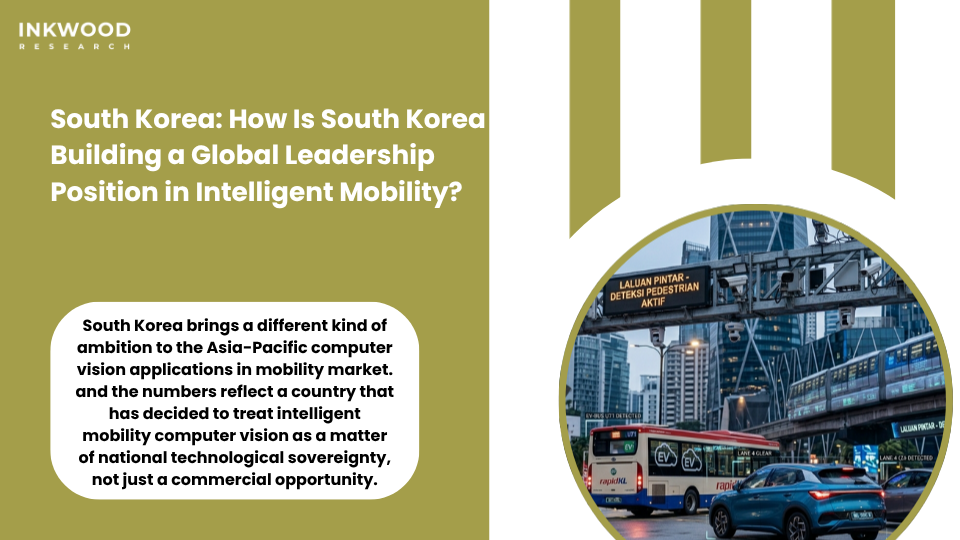
South Korea brings a different kind of ambition to the Asia-Pacific computer vision applications in mobility market. The South Korea computer vision applications in mobility market grows from US$1.65 billion in 2026 to US$4.54 billion by 2034 at a 13.50% CAGR, and the numbers reflect a country that has decided to treat intelligent mobility computer vision as a matter of national technological sovereignty, not just a commercial opportunity.
South Korea’s government has committed substantial public investment to AI and mobility infrastructure. The Ministry of Science and ICT’s AI National Strategy places AI-powered transportation systems among the highest-priority applications for national R&D funding, alongside healthcare AI and smart manufacturing. Furthermore, Korea’s existing strength in semiconductor manufacturing, battery technology, and consumer electronics gives its automotive computer vision systems market participants a supply chain advantage that few countries can match.
Hyundai, Kia, and the Mobility Group’s Computer Vision Strategy
The Hyundai Motor Group, encompassing Hyundai, Kia, and Genesis, is arguably the most vertically integrated automotive group in the world when it comes to computer vision for autonomous vehicles.
Through its 2021 acquisition of Boston Dynamics and its majority stake in Motional (a joint venture with Aptiv), the group has assembled a portfolio of robotics, autonomous driving, and machine vision mobility technology capabilities that extends well beyond traditional automotive manufacturing.
- Motional: The Hyundai-Aptiv joint venture operates commercial autonomous ride-hailing services in the United States and is developing next-generation robotaxi platforms built on computer vision mobility solutions and sensor fusion architectures that are among the most sophisticated commercially deployed systems globally.
- Hyundai: Hyundai’s own ADAS lineup, marketed under the SmartSense umbrella, brings computer vision for ADAS systems to mainstream vehicle segments across the Korean domestic market and globally. Each new model generation expands the feature set, gradually building the automotive computer vision systems market foundation for higher autonomy levels.
- Samsung and SK Hynix: While not automotive OEMs, both companies supply the AI semiconductor and memory technologies that power real-time computer vision transportation systems globally, giving South Korea a unique dual role as both a vehicle manufacturer and a critical technology supplier to the broader computer vision in mobility market.
Seoul’s Smart Infrastructure and Digital Twin Deployments
- Seoul is among the most actively instrumented cities globally for computer vision for traffic monitoring and mobility management.
- The city operates an extensive network of roadside cameras and AI traffic management systems, and has been piloting smart city mobility computer vision market applications, including autonomous bus corridors and V2X communication infrastructure across key urban arteries.
- Additionally, Seoul’s digital twin program, developed in collaboration with technology partners, creates a continuously updated virtual model of the city’s road network that supports both traffic optimization and autonomous vehicle testing validation.
From Smart Cities to Autonomous Vehicles: How Is India Scaling Its Computer Vision Mobility Market?
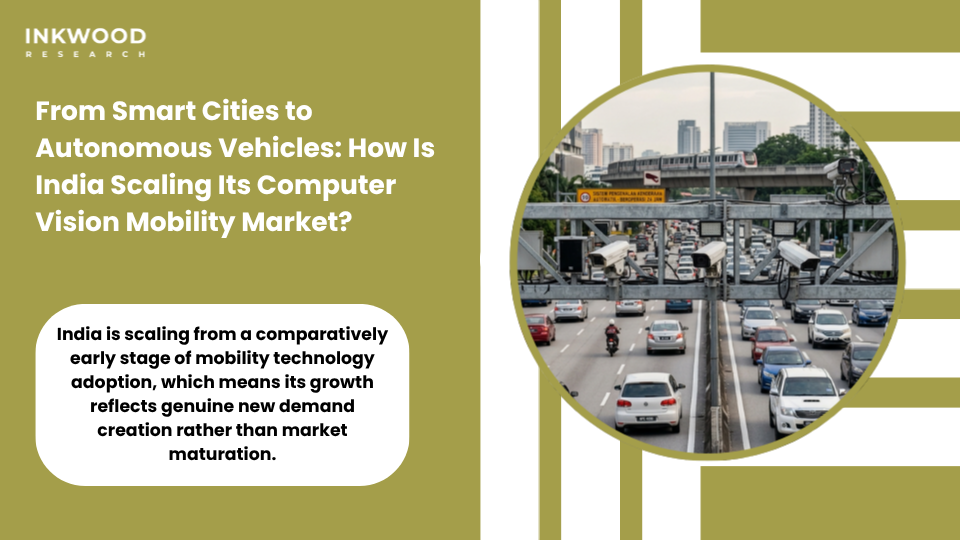
India’s entry into the computer vision applications in mobility market carries a scale and speed that is genuinely remarkable. The India computer vision applications in mobility market grows from US$1.60 billion in 2026 to US$6.19 billion by 2034 at an 18.40% CAGR, the highest growth rate among all four countries in this analysis, and indeed among the highest in the global computer vision in transportation market. What makes this particularly significant is that India is scaling from a comparatively early stage of mobility technology adoption, which means its growth reflects genuine new demand creation rather than market maturation.
The Indian government’s approach to intelligent transportation systems is ambitious and multidimensional. The Ministry of Road Transport and Highways (MoRTH) has been progressively raising vehicle safety standards, including mandatory fitment of ADAS features on vehicles above certain weight categories, which directly expands the addressable advanced driver assistance systems computer vision market across one of the world’s largest and fastest-growing vehicle fleets.
Smart Cities Mission and Traffic Intelligence
India’s Smart Cities Mission, overseen by the Ministry of Housing and Urban Affairs, is deploying computer vision for traffic monitoring infrastructure across 100 designated smart cities. These deployments include AI-powered traffic management centers, camera-based incident detection systems, and adaptive signal control, collectively building a national transportation infrastructure vision systems layer that is increasingly sophisticated in its analytical capability.
Furthermore, India’s technology sector is playing an active role in shaping the domestic computer vision mobility solutions market development. Tata Consultancy Services, Infosys, and a growing cohort of mobility-focused startups are developing AI-powered transportation systems tailored to India’s specific road conditions, including mixed traffic environments, varied infrastructure quality, and high pedestrian density scenarios that challenge algorithms trained primarily on Western or East Asian road data.
Key Players Shaping India’s Computer Vision Automotive Market
- Tata Motors: Through Tata’s partnership with Nvidia for the ADAS and autonomous driving platform in its next-generation commercial and passenger vehicles, the company is embedding computer vision for autonomous vehicles into mainstream Indian vehicle production at a pace that few anticipated just five years ago.
- Mahindra & Mahindra: Mahindra’s EV portfolio, including its BE and XEV series, is being designed with automotive computer vision systems market integration from the ground up, positioning the company for ADAS feature expansion as India’s regulatory standards tighten further.
- Ola Electric: Beyond its core electric scooter business, Ola is developing machine vision mobility technology capabilities for its vehicles through its Ola Krutrim AI initiative, demonstrating how India’s EV and AI sectors are converging within the computer vision in mobility market.
India’s Freight and Logistics Opportunity
Beyond passenger vehicles, India’s freight and logistics sector represents a particularly compelling opportunity for computer vision transportation technology. Moreover, the commercial vehicle segment offers large-scale demand for logistics and mobility vision technology, including lane departure warning, forward collision detection, and driver monitoring systems that improve both safety and operational efficiency across long-haul freight corridors.
Key Takeaways
- The Asia-Pacific computer vision applications in mobility market grows from US$16.35 billion in 2026 to US$50.15 billion by 2034 at a 15.04% CAGR, making it the fastest-growing major region globally in computer vision in transportation.
- China leads in absolute scale (US$7.97B to US$25.29B, 15.52% CAGR), driven by EV infrastructure, MIIT intelligent connected vehicle standards, and smart city deployments from Baidu Apollo, Huawei, and BYD.
- Japan is scaling intelligent mobility computer vision as a social necessity, addressing demographic aging through autonomous mobility solutions, supported by Honda’s Level 3 approval, Toyota’s Woven City, and METI’s SDV strategy.
- South Korea (US$1.65B to US$4.54B, 13.50% CAGR) is pursuing technology sovereignty in AI computer vision mobility, with the Hyundai Motor Group’s Motional JV and Samsung’s semiconductor supply chain creating a vertically integrated competitive position.
- India records the region’s highest growth at 18.40% CAGR (US$1.60B to US$6.19B), powered by MoRTH safety mandates, the Smart Cities Mission, and rapid integration of computer vision automotive market capabilities by Tata Motors, Mahindra, and Ola Electric.
- Across all four markets, government policy, from China’s ICV standards to India’s ADAS mandates, is the single most important accelerator of computer vision mobility solutions market growth, creating sustained structural demand alongside private sector innovation.
Conclusion
Asia-Pacific’s rise in the computer vision applications in mobility market is not a single story but four distinct national journeys converging on the same destination. China is building scale. Japan is solving demographics. South Korea is engineering sovereignty. India is creating entirely new demand.
Together, these trajectories are making Asia-Pacific the most dynamic and strategically consequential region in the global computer vision in transportation market through 2034 and beyond. For businesses, investors, and policymakers, the opportunity lies in understanding each market’s unique drivers rather than treating Asia-Pacific as a monolithic block.
Inkwood Research provides the regional depth and market intelligence needed to navigate these four distinct landscapes with confidence.
Connect with our team to explore how our analysis can support your positioning in the Asia-Pacific computer vision mobility solutions market.
Frequently Asked Questions
Which Asia-Pacific country leads the computer vision applications in mobility market?
China leads in absolute market size, growing from US$7.97 billion in 2026 to US$25.29 billion by 2034, driven by EV infrastructure and government-backed intelligent connected vehicle standards.
Why does India have the highest computer vision mobility market growth rate in Asia-Pacific?
India is scaling from an early adoption base, with government ADAS mandates, Smart Cities Mission deployments, and rapid EV sector growth collectively creating new demand at a 18.40% CAGR through 2034.
How is Japan using computer vision technology to address its aging population?
Japan is deploying autonomous driving and ADAS systems to maintain mobility access for elderly citizens in rural areas, with Honda’s Level 3 approval and Toyota’s Woven City testbed leading development.
What makes South Korea's intelligent mobility computer vision market distinctive?
South Korea combines OEM depth from Hyundai and Kia with semiconductor supply chain strength from Samsung and SK Hynix, creating a vertically integrated position across both vehicle and technology dimensions.
How does China's smart city infrastructure support its computer vision in transportation market?
China deploys roadside AI cameras, V2X nodes, and edge computing across major cities, creating cooperative perception environments that enhance vehicle-level computer vision systems with infrastructure-level sensing data.
What long-tail computer vision transportation applications are emerging across Asia-Pacific?
Digital twin-based traffic optimization, autonomous freight corridors, V2X cooperative perception, and AI-managed urban mobility management are the highest-growth long-tail computer vision transportation technology market applications across the region through 2034.