
Table of Contents
This analysis is brought to you by Inkwood Research, a leading market intelligence firm specializing in North American cloud infrastructure, federal technology policy, and AI-driven cloud migration services. Our research team brings deep expertise in US federal cloud mandates, AI cloud migration ROI analysis, and enterprise migration strategies across BFSI, healthcare, and manufacturing. Through strategic partnerships with federal technology advisors and enterprise cloud providers, we deliver actionable intelligence for stakeholders navigating the United States AI-driven cloud migration services market.
TLDR
The United States AI-driven cloud migration services market is projected to grow from US$920.29 million in 2026 to US$7,409.74 million by 2034 at a 29.79% CAGR. Federal cloud mandates, accelerating AI integration, and the convergence of AI-enabled DevOps and cloud migration are together driving this expansion. Yet the US faces a unique and growing tension: rising AI-driven cloud demands are straining the national power grid, creating an infrastructure challenge as consequential as the migration itself.
Federal technology officers, enterprise CIOs, and cloud architects navigating US compliance frameworks will find this analysis directly relevant. Additionally, AI cloud migration consulting services providers, cloud migration ROI analysts, and investors tracking the United States AI-driven cloud migration services market will gain targeted intelligence on federal mandates, AI integration trends, and energy infrastructure constraints shaping the US cloud modernization strategy through 2034.
How Do Federal Cloud Mandates Shape the United States AI-Driven Cloud Migration Market?
The United States AI-driven cloud migration services market operates within one of the world’s most structured regulatory environments for cloud adoption. Federal cloud mandates are directly accelerating enterprise investment in intelligent cloud migration services across government-adjacent industries, creating a compliance-driven demand floor that commercial market forces alone could not replicate.
Most notably, FedRAMP establishes standardized security requirements for cloud services used by federal agencies, creating a compliance baseline that cascades into the broader commercial market. Enterprises serving federal clients must align their AI cloud migration strategy with FedRAMP Authorization requirements, a process that demands rigorous AI-based workload assessment tools and documented, auditable compliance chains throughout the migration lifecycle.
The United States AI-driven cloud migration services market is projected to grow from US$920.29 million in 2026 to US$7,409.74 million by 2034 at a 29.79% CAGR. This trajectory reflects not just commercial momentum, but the structural demand that federal mandates are generating across every regulated sector.
NIST Cloud Computing Standards are establishing a reference architecture for secure, compliant government cloud deployments. Key federal drivers shaping this growth include:
- Zero Trust Architecture mandates requiring AI-driven application dependency mapping to verify every workload, user, and access point
- Executive orders on cybersecurity that mandate cloud security improvements, accelerating the adoption of cloud migration automation frameworks AI
- Federal cloud-first policies that require agencies to evaluate cloud-based alternatives before investing in on-premises infrastructure
Together, these mandates are driving adoption of automated cloud migration using AI across government, defense, healthcare, and financial services, making the United States one of the most consequential markets for AI cloud migration solutions globally.
How Is AI Integration Transforming US Enterprise Cloud Migration Strategies?
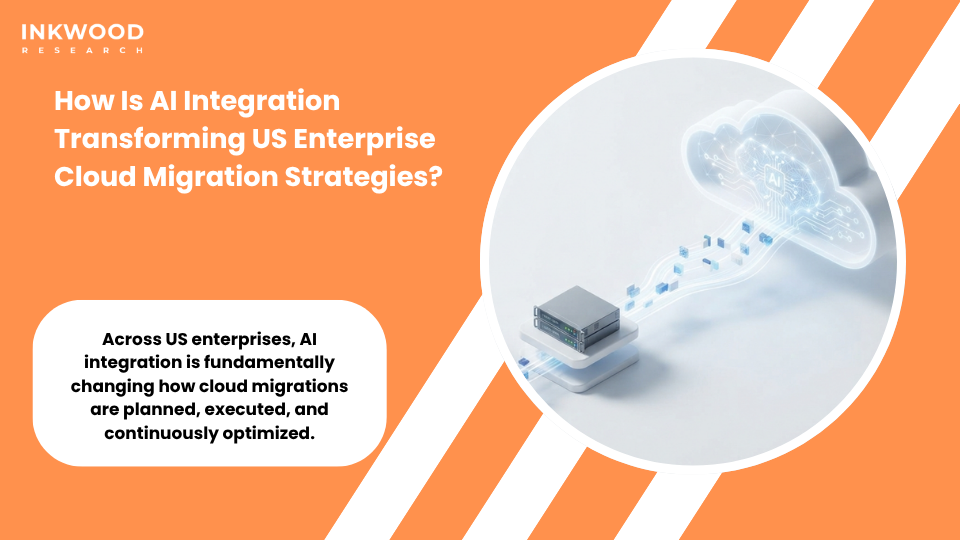
Across US enterprises, AI integration is fundamentally changing how cloud migrations are planned, executed, and continuously optimized. Traditional approaches, manual infrastructure assessments, static planning tools, and error-prone manual testing are giving way to AI-driven cloud migration services that automate critical decision points across the entire migration lifecycle, from initial workload discovery through post-migration performance tuning.
The most impactful AI integration trends shaping the United States AI-driven cloud migration services market include:
- Generative AI in cloud transformation: Large language models now assist architects in generating migration playbooks, identifying compatibility issues, and drafting compliance documentation, tasks that previously required weeks of specialist effort.
- Machine learning in cloud migration: Predictive models analyze historical migration datasets to forecast timelines, cost overruns, and technical risk factors with increasing accuracy, enabling proactive rather than reactive management.
- AI-enabled DevOps and cloud migration: Continuous integration and deployment pipelines leverage AI to orchestrate workload movements without downtime, particularly for mission-critical enterprise systems where availability is non-negotiable.
- AI cloud migration ROI analysis: Advanced analytics platforms quantify migration benefits in real time, enabling IT and finance leaders to demonstrate cloud migration cost optimization using AI to executive and board-level stakeholders.
Furthermore, autonomous cloud migration platforms are emerging as the next generation of intelligent cloud migration services in the US market. These platforms combine AI-driven application dependency mapping with robotic process automation cloud migration capabilities, substantially compressing migration timelines compared to manual approaches. For large US enterprises managing complex legacy estates, particularly in the BFSI and healthcare sectors, this capability is increasingly a strategic differentiator rather than a marginal improvement.
Can the US Electric Grid Keep Up with AI-Driven Cloud Demands?
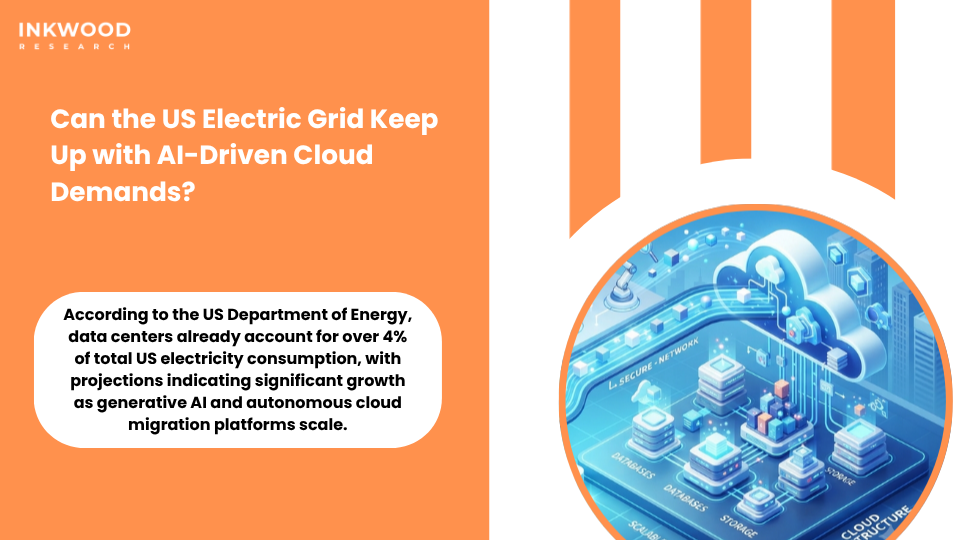
Here is where the US AI cloud migration story encounters its most consequential tension. The same AI workloads driving demand for AI cloud migration solutions are placing extraordinary pressure on the national power infrastructure. Hyperscale data centers, the physical backbone underpinning every AI-driven cloud migration services deployment, are consuming energy at an accelerating rate that the existing grid was not designed to accommodate.
According to the US Department of Energy, data centers already account for over 4% of total US electricity consumption, with projections indicating significant growth as generative AI and autonomous cloud migration platforms scale. This creates a strategic dilemma that every enterprise planning an AI cloud migration strategy must now factor into its planning:
- Capacity constraints in several US regions are already affecting data center expansion timelines, potentially delaying AI-powered cloud transformation projects in high-demand markets
- Rising electricity costs directly impact cloud migration cost optimization using AI, as energy-intensive AI inference and training workloads increase the total cost of cloud operations
- Federal and state sustainability mandates increasingly require enterprises to demonstrate carbon-efficient cloud modernization using artificial intelligence strategies
The challenge, however, is also driving meaningful innovation across the industry. Hyperscalers competing in the United States AI-driven cloud migration services market are responding by:
- Scaling renewable energy procurement agreements specifically to power AI cloud infrastructure deployments
- Investing in advanced liquid cooling and AI-optimized hardware to improve data center energy efficiency per workload
- Developing edge computing architectures that distribute AI workloads geographically, reducing centralized grid pressure in constrained markets
For enterprise cloud architects, these grid dynamics add a new planning dimension to multi-cloud migration AI solutions, one that balances performance, compliance, cost, and energy sustainability as interconnected variables rather than separate concerns.
Which Industries Are Leading US AI Cloud Migration Adoption?
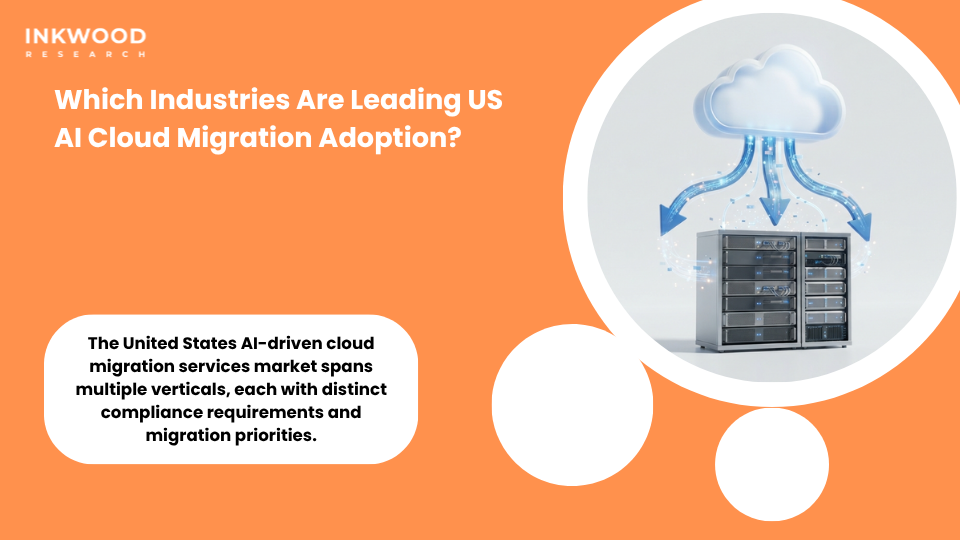
The United States AI-driven cloud migration services market spans multiple verticals, each with distinct compliance requirements and migration priorities. Three sectors stand out as the primary adoption leaders:
BFSI: The Compliance and Performance Imperative
Cloud migration services for the BFSI sector AI represent the highest-demand segment in the US market. Banks and insurers are deploying AI cloud migration solutions to modernize core banking systems, automate risk assessment, and meet evolving regulatory obligations under frameworks including SOX, Dodd-Frank, and FFIEC cloud guidance. Additionally, the shift to real-time payments and AI-driven fraud detection is accelerating demand for low-latency cloud infrastructure that only AI-optimized deployments can reliably deliver.
Healthcare: Compliance, Data Volume, and Clinical AI
Healthcare cloud migration AI solutions are growing rapidly, driven by the need to process large volumes of electronic health records, genomic datasets, and medical imaging data. AI-based workload migration to cloud platforms enables healthcare providers to accelerate clinical AI deployment while maintaining strict HIPAA compliance. Moreover, the integration of predictive analytics for cloud migration into healthcare IT planning is enabling providers to map complex clinical data dependencies before migration, reducing the risk of disruption to patient care workflows.
Manufacturing: Connecting OT and IT Through Intelligent Cloud
AI cloud migration for manufacturing industry applications is expanding rapidly as US manufacturers adopt industrial IoT and predictive maintenance systems. Hybrid cloud migration using AI enables manufacturers to bridge operational technology (OT) environments with cloud-based analytics platforms, creating the unified data architectures that Industry 4.0 strategies require. Furthermore, AI-driven digital transformation services in manufacturing are delivering measurable productivity gains, supporting the AI cloud migration ROI analysis that manufacturing CFOs increasingly demand before approving migration investments.
Key Players and Latest Developments in the US AI Cloud Migration Market
The competitive landscape for the United States AI-driven cloud migration services market is evolving quickly, with major players differentiating through AI capabilities, compliance depth, and vertical specialization. Recent developments reflect both consolidation and rapid innovation:
- Microsoft expanded Azure Government cloud capabilities through 2024-2025, introducing AI-powered migration assessment tools built specifically for US federal compliance requirements, strengthening its position across defense, civilian agencies, and regulated commercial sectors
- AWS launched migration acceleration programs targeting US healthcare and BFSI clients, integrating machine learning in cloud migration to reduce technical risk for regulated workloads moving to multi-cloud environments
- Google Cloud advanced its Dual Run migration methodology, enabling enterprises to operate workloads simultaneously on-premises and in cloud environments using intelligent workload migration using AI, reducing migration risk without operational disruption
- IBM deepened its AI cloud migration consulting services portfolio through partnerships with US federal system integrators, combining AI-enabled DevOps and cloud migration with zero trust security architecture for government clients
- Accenture launched dedicated cloud migration managed services with AI practices focused on AI cloud migration ROI analysis and cloud migration cost optimization using AI for large US enterprise clients across multiple verticals
Beyond individual company moves, the broader market is seeing the emergence of specialized smart cloud transition services providers that focus exclusively on AI-driven migration for specific regulated industries, a development that reflects the increasing sophistication and vertical specificity of enterprise demand in the United States AI-driven cloud migration services market.
Key Takeaways
- The United States AI-driven cloud migration services market grows from US$920.29 million (2026) to US$7,409.74 million (2034) at a 29.79% CAGR, making it the largest single-country AI cloud migration market globally
- Federal mandates, FedRAMP, NIST cloud standards, Zero Trust Architecture, and cloud-first policies are structural demand catalysts that make compliance central to the US AI cloud migration strategy
- Generative AI, machine learning, and autonomous cloud migration platforms are transforming US enterprise migration from manual, risk-prone processes into intelligent, automated workflows
- US electric grid capacity and energy sustainability are emerging as material constraints on AI-driven cloud transformation growth, requiring integrated energy and migration planning
- BFSI, healthcare, and manufacturing lead US adoption of cloud migration services with AI, each driven by distinct compliance requirements, data volumes, and operational complexity
Conclusion
The United States AI-driven cloud migration services market stands at a defining inflection point. Federal mandates are creating structural, policy-backed demand. AI integration is accelerating migration capabilities at every level of the enterprise stack. Meanwhile, emerging infrastructure constraints are testing the resilience of the nation’s cloud strategy in ways that demand sophisticated, multidimensional planning.
For enterprises and technology providers, navigating this environment requires more than technical expertise; it demands strategic intelligence about regulatory trends, energy economics, AI capability trajectories, and the evolving AI cloud migration ROI analysis landscape.
Inkwood Research delivers the market intelligence and consulting depth needed to support confident decisions across this complex market.
Connect with our team to explore how our insights can advance your intelligent cloud migration services strategy.
Frequently Asked Questions (FAQs)
The market grows from US$920.29 million in 2026 to US$7,409.74 million by 2034 at a 29.79% CAGR, the largest single-country AI cloud migration market globally.
FedRAMP requires documented security compliance, driving enterprises to deploy AI-based workload assessment tools and cloud migration automation frameworks to meet government standards.
BFSI, healthcare, and manufacturing lead, driven by regulatory compliance requirements and the need for AI-based workload migration to cloud platforms at scale.
It verifies every user, workload, and access point continuously, requiring AI-driven application dependency mapping to ensure every migrated workload meets federal security standards.
AI analyzes workload usage patterns, rightsizes cloud resources in real time, and eliminates idle capacity, delivering measurable cost reductions post-migration across enterprise environments.
They orchestrate migrations with minimal human intervention using AI. Leading providers are piloting them for non-critical workloads, with regulated industry adoption expanding as compliance validation matures.