Table of Contents

This analysis is brought to you by Inkwood Research, a leading market intelligence firm specializing in enterprise automation technologies, intelligent process automation ecosystems, and AI-driven digital workforce solutions. Our research team combines extensive experience analyzing autonomous RPA platforms, cognitive automation frameworks, and enterprise deployment strategies across North America, Europe, and Asia-Pacific. Through strategic partnerships with automation vendors, enterprise IT teams, and technology consultants, we deliver actionable insights that support decision-making for global organizations navigating the autonomous RPA transformation.
TLDR
Enterprise automation is undergoing a fundamental shift, moving from rule-following bots to systems capable of learning, deciding, and adapting. According to our analysis, the global Autonomous Robotic Process Automation (RPA) Bots market is projected to grow from US$2.24 billion in 2026 to US$24.06 billion by 2034, reflecting a remarkable 34.57% CAGR. This growth signals more than market expansion; it marks a structural change in how enterprises design digital work. Traditional automation tools are steadily giving way to autonomous RPA bots capable of handling ambiguous, complex, and judgment-heavy tasks at scale.
This blog is essential reading for CIOs, enterprise architects, and automation strategy leaders evaluating the next phase of their digital workforce investments. Additionally, technology investors tracking AI-driven automation growth, operations executives exploring intelligent process automation bots, and consultants advising on autonomous RPA solutions for enterprises will find rigorous, forward-looking analysis here.
What Are Autonomous RPA Bots, and Why Do They Matter?

Autonomous robotic process automation (RPA) bots are advanced software robots that can independently execute business processes, make contextual decisions, and continuously improve their performance using artificial intelligence and machine learning. Unlike traditional RPA bots, which require strict rule-based instructions and human supervision, autonomous RPA bots can adapt to changing data, analyze patterns, and optimize workflows without constant manual intervention.
These bots act like a digital workforce, automating complex business tasks across enterprise systems. For years, robotic process automation bots handled repetitive, structured tasks, copying data, filling forms, and generating reports. They were fast and reliable, but fundamentally limited. Feed them an unexpected input, and they would either fail silently or require human intervention.
The emergence of autonomous RPA bots changes that picture entirely. These next-generation systems combine traditional automation with machine learning, natural language processing, and AI-based decision frameworks. As a result, they can interpret unstructured data, handle exceptions independently, and continuously improve their performance over time. Furthermore, they can operate across systems without rigid pre-programmed pathways, adapting their behavior based on context.
According to our analysis, the global autonomous robotic process automation (RPA) bots market is set to reach US$24.06 billion by 2034, growing at a 34.57% CAGR from US$2.24 billion in 2026. This trajectory reflects how rapidly enterprises across sectors are moving beyond legacy automation. The question is no longer whether to automate; it is whether your automation infrastructure is built to learn.
What Makes Autonomous Different from Traditional?
Traditional RPA bots follow deterministic rules: if condition A, then action B. They work well for highly predictable workflows, but break down quickly when processes involve variation, ambiguity, or judgment calls.
Autonomous RPA bots, by contrast, are built on probabilistic reasoning. They assess multiple possible responses, select the most appropriate one, and flag edge cases for review rather than failing outright. Moreover, they learn from corrections over time, building increasingly accurate behavioral models. Consequently, the gap between human and automated decision-making narrows with every iteration.
How Are Autonomous RPA Bots Different from Traditional RPA?
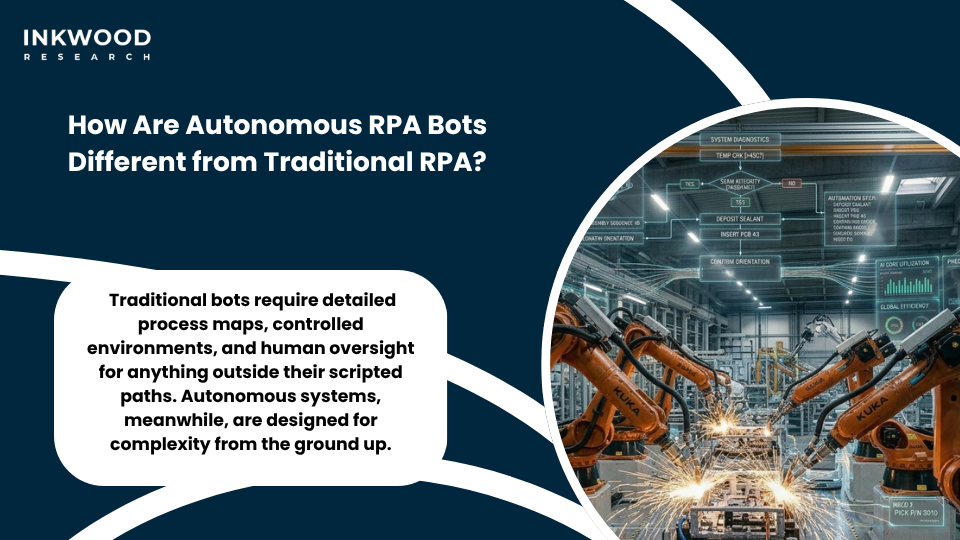
The distinction between traditional and autonomous RPA automation is not merely technical; it is operational. Traditional bots require detailed process maps, controlled environments, and human oversight for anything outside their scripted paths. They are efficient within narrow boundaries, but they do not scale gracefully to complex, multi-system workflows.
Autonomous systems, meanwhile, are designed for complexity from the ground up. Several key differences define this evolution:
- Contextual awareness: Autonomous bots interpret the meaning of data, not just its format, allowing them to process emails, scanned documents, and unstructured inputs with consistent accuracy.
- Exception handling: Rather than stopping on unexpected inputs, intelligent RPA bots apply learned heuristics to resolve or escalate exceptions intelligently.
- Process mining integration: Many next-generation RPA platforms now include built-in process discovery, identifying automation opportunities without manual analysis.
- Self-optimization: Self-learning automation bots refine their own workflows based on outcome data, reducing the need for ongoing manual tuning.
Together, these capabilities represent a shift from automation as a tool to automation as a cognitive robotic process automation capability embedded in enterprise operations. Businesses that understand this distinction are better positioned to extract genuine competitive value from their automation investments.
Top Industries Leading the Adoption of Autonomous RPA
The adoption of AI-powered RPA bots is accelerating across virtually every industry, though the pace and application focus vary significantly by sector. Understanding where autonomous automation delivers the most immediate return helps enterprises prioritize their deployment strategies.
· Financial Services and Insurance
Financial institutions were among the earliest adopters of traditional RPA, and they are now leading the transition to autonomous digital workforce automation. Banks use intelligent bots for fraud detection, loan processing, regulatory reporting, and customer onboarding. Additionally, insurance companies deploy autonomous systems to process claims and cross-reference policy data.
Plus, it also identifies anomalies, tasks that previously required experienced human analysts. Regulators have also taken notice. The Bank for International Settlements has published guidance on operational resilience for AI-enabled financial services, signaling that autonomous automation is now a mainstream consideration for central banking and supervisory policy.
· Healthcare and Life Sciences
Healthcare providers face enormous administrative burdens; billing, prior authorization, scheduling, and compliance documentation consume significant clinical resources. Autonomous RPA bots are increasingly deployed to manage these workflows, freeing clinical staff for patient-facing work. Moreover, in pharmaceutical research, intelligent process automation bots accelerate clinical trial data aggregation and regulatory submission processes, compressing timelines meaningfully.
· Manufacturing and Supply Chain
Manufacturers use enterprise automation bots for inventory management, supplier communications, quality reporting, and demand forecasting. The integration of autonomous RPA with IoT sensor data is particularly powerful, enabling real-time adjustments to production schedules based on supply chain signals. Consequently, downtime and over-production events are reduced without manual intervention.
How AI Powers the Next Generation of RPA Automation

The intelligence behind autonomous RPA bots is not a single technology. In fact, it is a layered combination of AI disciplines, each addressing a different dimension of automated decision-making. Understanding how these components interact explains why next-generation RPA automation is qualitatively different from its predecessors.
Natural language processing enables bots to read and interpret text-based inputs, contracts, emails, and customer queries, with near-human comprehension. Computer vision extends this capability to visual documents, allowing autonomous systems to extract structured data from scanned invoices, identity documents, and handwritten forms. Furthermore, machine learning models trained on historical process data allow bots to predict the most likely correct action in novel situations rather than defaulting to rigid rules.
The European Commission‘s AI strategy explicitly references intelligent process automation as a core productivity enabler for the European digital economy, reflecting how mainstream this technology has become. According to our research, enterprises combining RPA with AI capabilities report significantly faster implementation timelines and higher bot accuracy rates compared to traditional rule-based deployments. Additionally, the integration of decision-aware automation bots with enterprise resource planning systems is creating genuinely closed-loop operational environments where human intervention is reserved for strategic decisions, not routine processing.
Which Companies Are Driving the Global Autonomous RPA Market?
The competitive landscape for is dynamic and fast-evolving, with several major players making significant moves in autonomous robotic process automation recent months.
UiPath: Expanding the Autonomous Frontier
- UiPath has positioned its platform around the concept of the “fully autonomous enterprise,” integrating large language models directly into its automation workflows. The company’s 2024 release of UiPath Autopilot introduced conversational interfaces for bot creation, significantly lowering the technical barrier for enterprise deployment.
- Furthermore, UiPath’s process mining capabilities now operate continuously, automatically surfacing new automation candidates from live system data rather than requiring manual process discovery exercises. This integration of discovery and execution within a single platform reflects where the market is heading.
Automation Anywhere: AI-Native Automation
- Automation Anywhere‘s Automation 360 platform has evolved significantly toward an AI-native architecture. The company’s introduction of AutomationAnywhere CoE Manager with AI governance tools addresses a critical enterprise concern: how to deploy autonomous RPA solutions for enterprises responsibly at scale.
- Additionally, the company’s acquisition of Process Discovery capabilities has strengthened its ability to compete on end-to-end automation lifecycle management, from identification through deployment and optimization.
Microsoft and ServiceNow: Platform Giants Enter the Space
- Microsoft’s Power Automate continues to expand its AI-driven robotic process automation bots capabilities through Copilot integration, embedding autonomous automation directly into Microsoft 365 workflows. This approach leverages existing enterprise infrastructure rather than requiring standalone automation platforms.
- ServiceNow, meanwhile, has deepened its automation capabilities through AI-powered workflow orchestration, positioning intelligent automation bots as core components of its enterprise service management platform. Consequently, both companies are bringing autonomous automation to enterprise buyers who may not consider themselves “automation companies” at all.
What Are the Latest Developments in Autonomous RPA Automation?
The pace of innovation in autonomous RPA bots has accelerated noticeably through 2024 and into 2025 and 2026. Several developments are particularly significant for enterprise decision-makers.
- Agentic AI frameworks: Vendors including UiPath, Automation Anywhere, and SAP are building “agentic” automation capabilities, systems where multiple AI agents collaborate on complex tasks, dividing work and reconciling outputs without human coordination. This represents a meaningful step toward genuine autonomous digital workforce automation at the task-portfolio level.
- Generative AI for bot creation: The ability to describe an automation workflow in plain language and have the system generate the underlying bot logic is transforming implementation timelines. Enterprises that previously required specialist developers to build robotic process automation bots can now deploy functional automations in hours rather than weeks.
- Multi-bot orchestration: Enterprise deployments increasingly involve large populations of autonomous RPA bots working in coordinated networks. Orchestration platforms now manage bot workloads dynamically, routing tasks to available bots based on real-time capacity and capability matching.
- AI governance integration: As regulatory scrutiny of AI systems increases globally, leading vendors are embedding governance dashboards directly into their platforms. These tools track bot decision histories, flag anomalous behaviors, and support audit trail requirements, capabilities that are becoming a purchase requirement for regulated industries.
Key Takeaways
- The global autonomous robotic process automation (RPA) bots market is set to grow from US$2.24 billion in 2026 to US$24.06 billion by 2034 at a 34.57% CAGR, reflecting rapid enterprise adoption worldwide.
- The shift from traditional RPA to autonomous RPA automation is driven by AI capabilities, machine learning, NLP, and computer vision, which enable bots to handle complexity and learn over time.
- Financial services, healthcare, and manufacturing are the leading sectors, with autonomous RPA solutions for enterprises delivering measurable returns in exception handling, compliance, and cost reduction.
- Major platforms, including UiPath, Automation Anywhere, Microsoft, and ServiceNow, are competing to define the intelligent automation bots standard, with agentic AI and generative bot creation emerging as key differentiators.
- AI governance and audit trail capabilities are becoming essential purchasing criteria as regulated industries scale their AI-powered RPA bots deployments.
- Enterprises that combine process mining with autonomous execution within a single platform are achieving faster ROI and broader automation coverage than those managing these stages separately.
Conclusion
The evolution from basic automation to autonomous RPA bots is not a future scenario; it is already underway across global enterprises. As AI capabilities become more deeply embedded in next-generation RPA automation platforms, the operational potential of digital workforces expands significantly. Organizations that invest now in the architecture, governance, and talent to support intelligent process automation bots will be far better positioned to capture the productivity and competitive advantages ahead.
Inkwood Research provides the market intelligence and strategic analysis needed to navigate this transformation with confidence.
Connect with our team to explore how our insights can support your autonomous automation strategy.
Frequently Asked Questions (FAQs)
Autonomous RPA bots are AI-powered automation systems that handle complex, variable tasks independently, learning from data and adapting without manual reprogramming.
Traditional bots follow fixed rules and fail on unexpected inputs. Autonomous bots use AI to interpret context, handle exceptions, and self-optimize over time.
Financial services, healthcare, and manufacturing lead adoption, using autonomous bots for fraud detection, claims processing, and supply chain automation, respectively.
Yes. Most autonomous RPA platforms combine machine learning, NLP, and computer vision to enable intelligent decision-making across unstructured and variable workflows.
The market is projected to reach US$24.06 billion by 2034 from US$2.24 billion in 2026, driven by enterprise AI adoption and demand for intelligent workforce automation.
The future points toward agentic AI, multi-bot systems that collaborate on complex tasks, combined with generative AI for rapid bot creation and stronger governance tools.