Table of Contents
This analysis is brought to you by Inkwood Research, a leading market intelligence firm specializing in unmanned aerial systems, advanced battery technologies, and European aerospace ecosystems. Our research team combines extensive experience analyzing UAV propulsion systems, regulatory frameworks, and defense modernization programs across the United Kingdom, Germany, France, and broader European Union markets. Based on our proprietary research methodologies and strategic partnerships with European battery manufacturers, defense contractors, aviation safety agencies, and agricultural technology providers, we deliver actionable insights that empower strategic decision-making for global enterprises navigating Europe’s sustainability-driven UAV battery transformation and regulatory harmonization.
TLDR
The Europe UAV battery market is projected to reach $1.95 billion by 2032, growing at a 13.80% CAGR. EU sustainability policies, defense modernization, and regulatory harmonization by EASA drive unprecedented innovation. Meanwhile, lithium-based batteries dominate commercial applications across drone operations, precision agriculture, and infrastructure monitoring. European manufacturers balance performance demands with environmental compliance, positioning the region as a global leader.
This analysis serves defense procurement specialists, commercial drone operators, battery technology developers, and investment analysts tracking European aerospace markets. Additionally, sustainability officers, regulatory compliance teams, and agricultural technology managers will discover actionable insights for strategic planning and market entry decisions.
Europe UAV Battery Market Overview
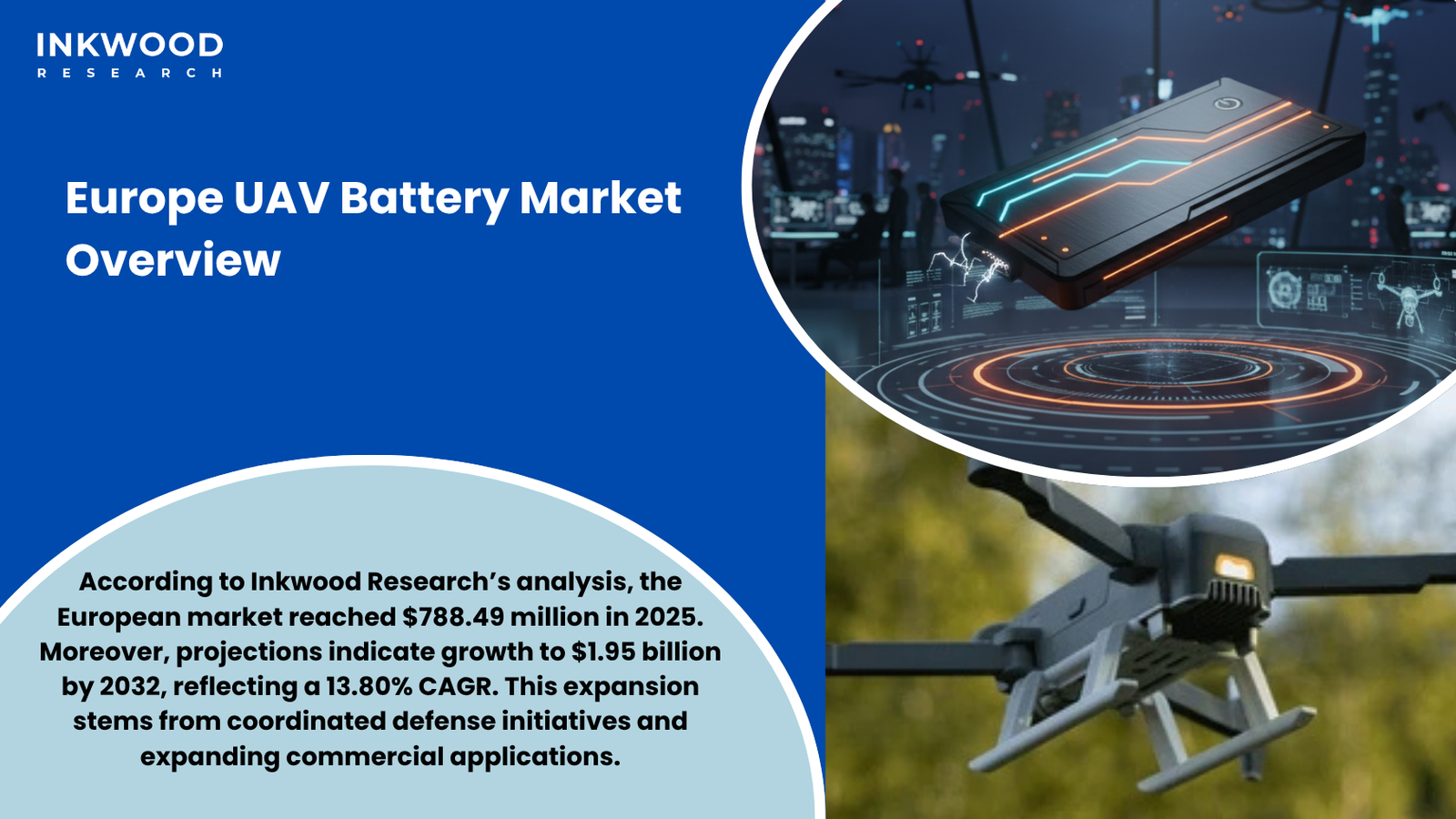
According to Inkwood Research’s analysis, the European market reached $788.49 million in 2025. Moreover, projections indicate growth to $1.95 billion by 2032, reflecting a 13.80% CAGR. This expansion stems from coordinated defense initiatives and expanding commercial applications.
Market Fundamentals Drive Unprecedented Growth
European Union policies promoting autonomous aerial mobility accelerate adoption. Drone operations now serve urban logistics and public services across member states. Meanwhile, defense collaborations among NATO allies drive joint procurement programs. These partnerships require standardized power solutions for unmanned surveillance systems.
Regulatory harmonization efforts by the European Union Aviation Safety Agency establish consistent operational frameworks. Consequently, cross-border drone operations expand market opportunities for battery manufacturers. EASA regulations enable manufacturers to scale production across multiple countries efficiently.
Sustainability Commitments Shape Industry Direction
Europe’s commitment to sustainable transportation creates favorable conditions for eco-friendly technologies. Research partnerships connect universities, battery developers, and UAV producers throughout the region. Furthermore, government funding initiatives target advanced materials research, accelerating next-generation battery chemistries.
Commercial sectors increasingly integrate drone technology into operational workflows. Agriculture, energy infrastructure, and logistics generate sustained demand for reliable power systems. These applications require lithium-based batteries that perform consistently across varied weather conditions.
EU Sustainability Policies Transforming Battery Development
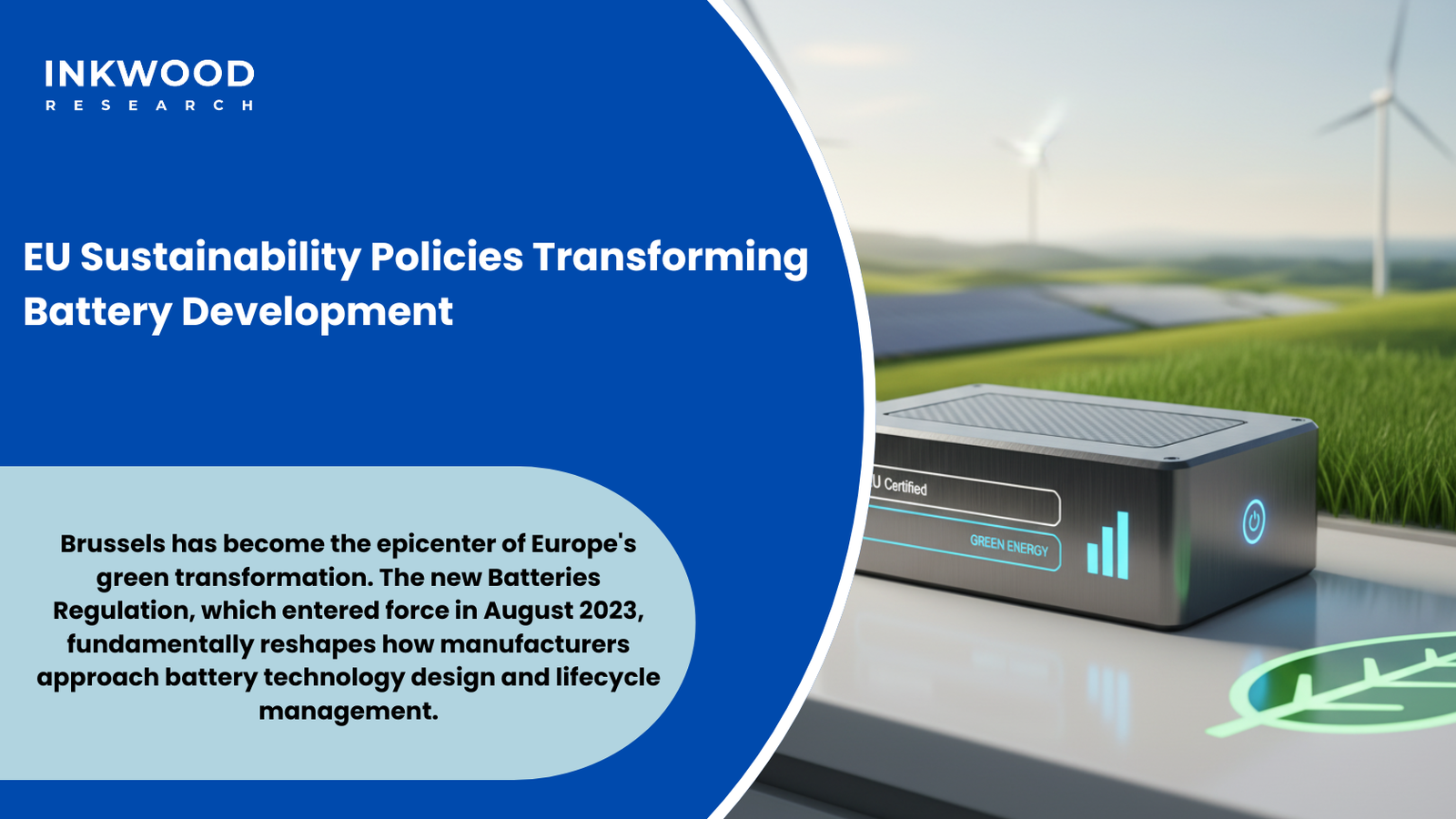
Brussels has become the epicenter of Europe’s green transformation. The new Batteries Regulation, which entered force in August 2023, fundamentally reshapes how manufacturers approach battery technology design and lifecycle management.
Circular Economy Principles Reshape Manufacturing
The regulation aims to minimize environmental impact throughout batteries’ entire life cycles. Companies must now consider sourcing, collection, recycling, and repurposing from initial design stages. Consequently, manufacturers invest heavily in sustainable chemistries and recovery infrastructure.
Based on our analysis, Europe leads globally in establishing comprehensive battery sustainability standards. These requirements extend beyond consumer electronics to include specialized applications like unmanned aerial systems. Battery developers must meet stringent environmental objectives while maintaining performance characteristics.
Innovation Through Environmental Compliance
Interestingly, regulatory pressure drives innovation rather than hindering it. European manufacturers develop advanced thermal management technologies and recycling processes. Additionally, research initiatives explore solid-state architectures promising superior performance with reduced environmental footprints.
The European Green Deal’s zero pollution ambitions strengthen strategic autonomy. Our research indicates that manufacturers prioritizing environmental compliance gain competitive advantages in procurement programs. Defense contractors and commercial operators increasingly favor suppliers demonstrating sustainability commitments.
Standardization Enables Market Expansion
Harmonized regulations across member states simplify market entry for innovative solutions. Previously, manufacturers navigated complex national requirements that varied significantly. Now, EASA regulations provide consistent frameworks enabling efficient scaling.
According to industry compliance reports, standardization reduces certification costs substantially. Companies can obtain approvals valid across all EU member states, accelerating time-to-market for new battery technologies.
Lithium-Based Batteries Dominate European Applications
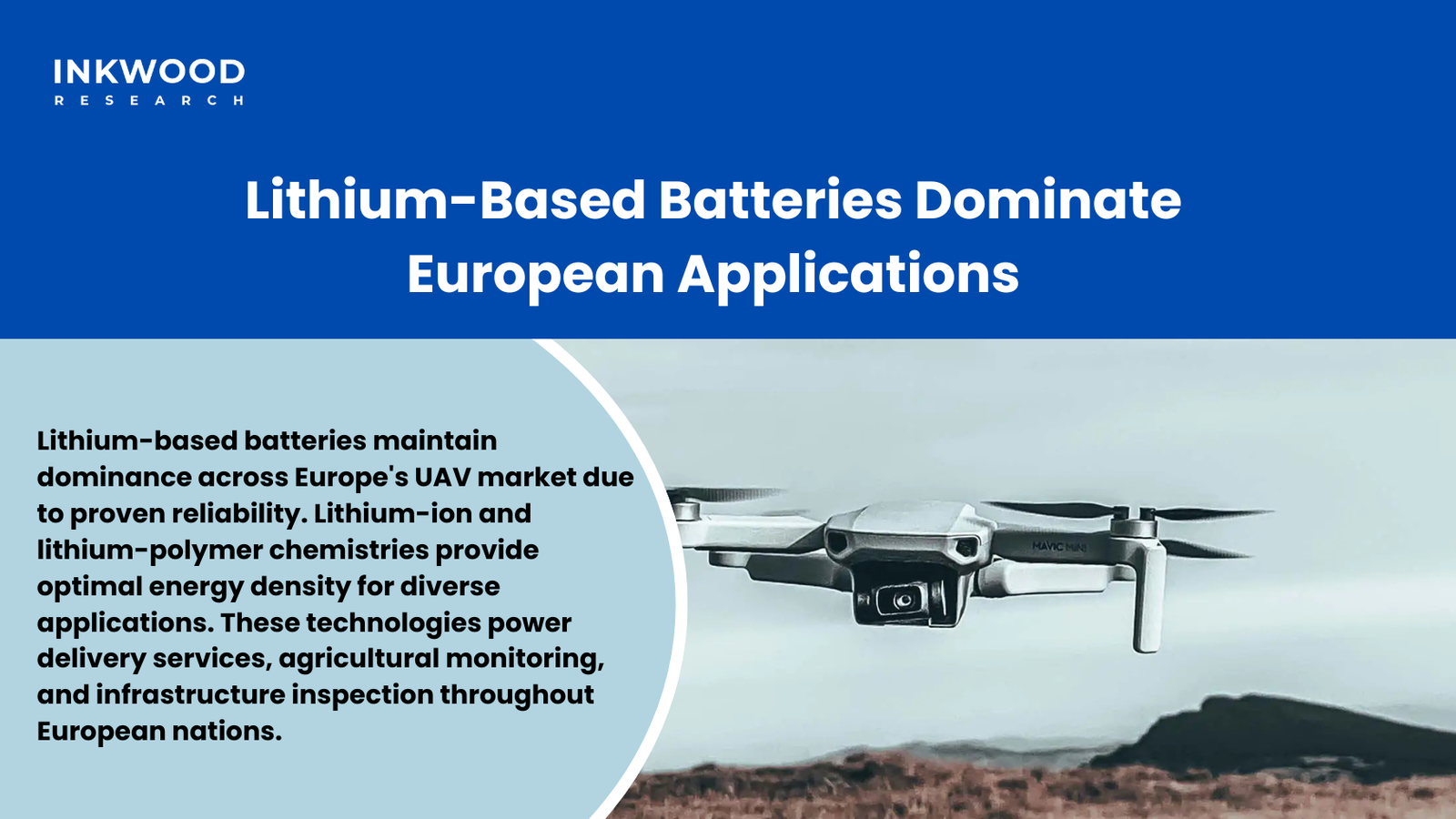
Lithium-based batteries maintain dominance across Europe’s UAV market due to proven reliability. Lithium-ion and lithium-polymer chemistries provide optimal energy density for diverse applications. These technologies power delivery services, agricultural monitoring, and infrastructure inspection throughout European nations.
Performance Characteristics Meet Market Demands
European manufacturers prioritize systems meeting stringent safety regulations established by aviation authorities. Additionally, batteries must satisfy environmental standards governing production and disposal. Declining costs through manufacturing scale economies make lithium batteries economically viable.
Defense procurement programs across Europe favor lithium-based power systems for tactical UAVs. These applications require lightweight configurations without compromising mission duration. Our findings indicate that military specifications drive continuous improvement in battery performance.
Supply Chain Advantages Accelerate Adoption
Europe’s established supply chains for lithium battery components enable rapid production scaling. Consequently, manufacturers respond quickly to growing demand across military and commercial applications. Investment opportunities emerge for vendors offering customized solutions optimized for specific European requirements.
Cold-weather operations in Scandinavia demand specialized battery formulations. Similarly, extended-endurance missions supporting border security initiatives require advanced energy management systems. Manufacturers developing application-specific solutions capture premium market segments.
Next-Generation Chemistries on the Horizon
Research institutions collaborate with battery manufacturers to develop lithium-sulfur and solid-state architectures. These next-generation chemistries promise superior performance characteristics compared to current technologies. Moreover, they align with Europe’s sustainability objectives through improved recyclability.
According to recent industry analysis, prototype batteries achieving 500+ Wh/kg energy density entered testing phases in late 2024. Such advancements could revolutionize long-endurance applications across commercial and defense sectors.
Defense Modernization Meets Commercial Innovation
Defense budgets across Europe increasingly allocate resources toward unmanned systems. The UK Ministry of Defence prioritizes intelligence, surveillance, and reconnaissance capabilities, and in turn, these investments create robust demand for high-performance power solutions.
Military Requirements Drive Technical Innovation
Defense contractors develop advanced battery solutions specifically engineered for long-endurance maritime patrol drones. These systems monitor coastal waters and offshore installations under challenging conditions. Consequently, batteries must withstand harsh marine environments while delivering consistent performance.
German defense allocations support unmanned systems for reconnaissance and tactical operations. The Federal Ministry of Defence requires batteries meeting stringent military specifications. Meanwhile, automotive manufacturers leverage electric vehicle expertise, applying thermal management technologies to aerial applications.
Commercial Sectors Fuel Market Expansion
Commercial operators benefit from favorable regulations established by national aviation authorities. The UK Civil Aviation Authority enables drones for infrastructure inspection, emergency response, and delivery services. Energy companies utilize battery-powered UAVs for offshore wind farm inspections.
Agricultural enterprises throughout rural regions adopt precision farming techniques enabled by drones. These applications require power systems to monitor livestock and crop conditions across extensive territories. Based on our research, agricultural adoption accelerates particularly in Germany’s Bavaria region.
Healthcare Applications Demonstrate Critical Importance
The UK’s pharmaceutical and healthcare sectors pioneer medical drone delivery programs. These initiatives connect urban hospitals with rural clinics, demanding rapid-charging batteries supporting time-sensitive missions. Technology hubs in London and Cambridge foster innovation through collaborative research.
Industrial sectors across Germany’s manufacturing heartland deploy inspection drones for quality control. Warehouse management and supply chain optimization require reliable batteries supporting multiple daily operational cycles. Germany’s Industry 4.0 initiatives accelerate the integration of autonomous systems.
Europe UAV Battery Market: Competitive Landscape and Market Leaders
The Europe UAV battery market features diverse players bringing specialized expertise. According to our analysis, leading companies include Intelligent Energy, HES Energy Systems, Epsilor, and Tadiran Batteries, and each manufacturer pursues distinct strategies for capturing market share.
Intelligent Energy: Fuel Cell Pioneer
- Intelligent Energy holds a strategic position through pioneering hydrogen fuel cell technology. The UK-based company specializes in systems that dramatically increase UAV operational duration. Their modular designs integrate seamlessly with lithium batteries, creating hybrid architectures.
- Engineering expertise enables customization to match specific voltage and current requirements. Furthermore, partnerships with European defense contractors supply fuel cell solutions for reconnaissance programs. Manufacturing facilities adhere to aerospace quality standards demanded by military specifications.
Tadiran Batteries: Long-Endurance Solutions
- Tadiran Batteries develops lithium-ion systems for applications requiring extended operational periods. The company focuses on batteries delivering consistent performance under extreme environmental conditions. Their products serve both commercial and defense segments across Europe.
- Technical support services assist operators in optimizing battery performance for specific missions. Additionally, Tadiran invests in research exploring next-generation chemistries. This commitment positions the company competitively for future market opportunities.
Epsilor: Defense-Grade Power Systems
- Epsilor specializes in high-performance batteries for tactical UAV applications. The Israeli company maintains a significant European market presence through partnerships with defense contractors. Their products meet stringent military specifications for reliability and durability.
- Manufacturing facilities in Israel support European operations through established supply chains. Moreover, Epsilor participates actively in research initiatives advancing battery technologies. Collaborative projects connect the company with European research institutions.
HES Energy Systems: Hydrogen Innovation
- HES Energy Systems develops hydrogen fuel cell solutions, extending drone flight durations significantly. The company targets applications requiring multi-hour operational capabilities. Their systems appeal to commercial operators prioritizing reduced carbon emissions.
- Integration support services help customers transition from battery-only configurations to hybrid systems. Training programs cover hydrogen handling and fuel cell maintenance procedures. This comprehensive approach differentiates HES in competitive markets.
Emerging Players and Strategic Partnerships
Additional manufacturers, including Inventus Power, Plug Power, and Sion Power, expand market presence. Strategic partnerships between battery developers and UAV manufacturers accelerate innovation cycles. According to recent reports, collaboration increasingly drives technological advancement.
Regional Analysis: UK and Germany Lead Adoption
The United Kingdom emerges as a significant market driven by defense modernization and commercial innovation. Military investments prioritize unmanned intelligence and surveillance capabilities for domestic security, while defense contractors based in the UK develop advanced battery solutions for maritime patrol applications.
United Kingdom: Innovation Hub
Commercial operators leverage favorable regulations for infrastructure inspection and delivery services. Energy companies utilize battery-powered UAVs for offshore installations requiring harsh environment capabilities. Agricultural enterprises adopt precision farming techniques, monitoring livestock and crops.
Technology hubs foster innovation through collaborative research exploring solid-state batteries. The country’s aerospace supply chains facilitate domestic production while maintaining quality standards. Established manufacturing infrastructure supports both military and commercial aviation applications.
Germany: Manufacturing Powerhouse
Germany commands substantial influence through manufacturing prowess and technological leadership. Battery chemistry research benefits from automotive manufacturers diversifying into UAV power systems. Industrial sectors deploy inspection drones for quality control and warehouse management.
Commitment to Industry 4.0 initiatives accelerates autonomous system integration into manufacturing environments. Agricultural cooperatives utilize precision farming drones for crop health monitoring. The renewable energy sector employs UAVs for wind turbine inspections across expansive installations.
France and Spain: Emerging Opportunities
France demonstrates strong growth potential through its aerospace industry presence and defense investments. Spain’s agricultural sector increasingly adopts precision farming technologies requiring reliable power systems. Both nations benefit from EU regulatory harmonization, enabling cross-border operations.
Key Takeaways
- Market Growth :Europe UAV battery market projected to reach $1.95 billion by 2032, growing at 13.80% CAGR driven by defense modernization and commercial expansion
- Regulatory Leadership : EASA harmonization and EU sustainability policies create a favorable environment for innovation while ensuring environmental compliance
- Technology Dominance : Lithium-based batteries maintain market leadership through proven reliability, declining costs, and established supply chains
- Application Diversity:Commercial applications span agriculture, infrastructure inspection, delivery services, and healthcare, complementing robust defense demand
- Regional Leaders : UK and Germany lead adoption through defense investments, favorable regulations, and strong aerospace manufacturing ecosystems
- Innovation Pipeline : Next-generation chemistries, including solid-state and lithium-sulfur architectures, promise revolutionary performance improvements
Conclusion:
Conclusion
The Europe UAV battery market stands at the intersection of sustainability, innovation, and strategic necessity. EU policies drive environmental compliance while fostering technological advancement across defense and commercial sectors. Lithium-based batteries currently dominate, yet emerging chemistries promise transformative capabilities.
Regional leaders demonstrate how coordinated policy frameworks accelerate market development. The UK and Germany leverage aerospace expertise, defense investments, and favorable regulations to capture leadership positions. Meanwhile, regulatory harmonization by EASA enables efficient scaling across member states.
Looking ahead, Europe’s commitment to sustainable transportation and autonomous mobility ensures continued market expansion. Battery manufacturers prioritizing environmental compliance, performance optimization, and application-specific solutions will thrive. The convergence of defense modernization and commercial innovation creates unprecedented opportunities.
Are you ready to capitalize on Europe’s UAV battery transformation? Connect with Inkwood Research for customized market intelligence and strategic consultation supporting your investment decisions.
Frequently Asked Questions
What drives the Europe UAV battery market growth?
Defense modernization programs, EU sustainability policies, EASA regulatory harmonization, and expanding commercial applications across agriculture, logistics, and infrastructure monitoring drive market growth. Additionally, government funding for advanced materials research accelerates innovation.
Why do lithium-based batteries dominate European markets?
Lithium-based batteries offer optimal energy density, proven reliability, declining costs through scale economies, and established supply chains. Furthermore, they meet stringent safety and environmental regulations while supporting diverse applications from tactical military operations to commercial delivery services.
How do EU regulations impact battery technology development?
EU regulations drive innovation by requiring environmental compliance throughout product lifecycles. The Batteries Regulation promotes circular economy principles, encouraging manufacturers to develop sustainable chemistries and recycling infrastructure. Moreover, EASA harmonization enables efficient market scaling across member states.