Table of Contents
This analysis is brought to you by Inkwood Research, a leading market intelligence firm specializing in Chinese industrial policy, new energy vehicle manufacturing, and Asia-Pacific battery technology ecosystems. Our research team combines extensive experience analyzing government subsidy programs, supply chain dynamics, and manufacturing capacity expansion across China’s Pearl River Delta, Yangtze River Delta, and Beijing-Tianjin-Hebei regions. Based on our proprietary research methodologies and strategic partnerships with Chinese battery manufacturers, automotive enterprises, policy research institutions, and government development agencies, we deliver actionable insights that empower strategic decision-making for global enterprises navigating China’s electric vehicle battery market transformation and manufacturing excellence.
TLDR
China’s electric vehicle battery market dominates globally through comprehensive government incentives, including RMB 520 billion tax exemptions, manufacturing subsidies, and strategic industrial policies. China’s electric vehicle battery market reached US$29.55 billion in 2025, projected to achieve US$74.99 billion by 2032. Government support drives EV battery manufacturing capacity expansion, technology innovation, and supply chain integration. CATL and BYD benefit from targeted subsidies, enhancing EV battery production capabilities. Policy frameworks accelerate lithium-ion EV battery adoption while establishing China’s global electric vehicle battery market leadership position.
This comprehensive policy analysis benefits international automotive executives planning China market entry strategies, investment analysts evaluating government support impacts, battery manufacturers assessing competitive landscapes, supply chain strategists navigating regulatory environments, and business development teams exploring partnership opportunities. Policy researchers studying industrial development frameworks, procurement specialists optimizing sourcing strategies, and strategic planners forecasting EV battery market trends will gain critical intelligence on China’s policy-driven growth.
China’s Strategic Policy Framework for EV Battery Dominance

China’s ascent to global electric vehicle battery market leadership stems from deliberate, comprehensive policy orchestration. The China electric vehicle battery market achieved US$29.55 billion valuation in 2025, projected to reach US$74.99 billion by 2032 at a 14.23% CAGR. This remarkable trajectory reflects sustained government commitment spanning over fifteen years.
New Energy Vehicle Industry Development Plan
In November 2020, the State Council published the NEV Industry Development Plan (2021-2035), establishing comprehensive targets for electric vehicle adoption. The plan maintains a 20% NEV sales target by 2025. Additionally, it mandates that 80% of newly purchased public vehicles must be NEVs starting in 2021.
This strategic framework addresses multiple dimensions simultaneously. Technology development receives prioritized attention through breakthrough targets for batteries, drive motors, and control systems. Meanwhile, recycling technology advancement ensures sustainable material flows. Furthermore, manufacturing capabilities scale to meet ambitious production targets nationwide.
Dual-Credit System Implementation
In December 2023, NEV credit requirements for 2024 and 2025 were announced at 28% and 38% respectively. This dual-credit system forces automakers to produce or purchase NEV credits. Consequently, manufacturers without adequate electric vehicle portfolios face substantial financial penalties.
The multiplier system rewards low-fuel-consumption vehicles while penalizing inefficient models. Credits can be traded between manufacturers, creating market mechanisms encouraging electrification. Moreover, the system tightens progressively, ensuring continuous industry advancement. Proposed requirements for 2026-2027 suggest even more aggressive targets approaching.
Long-Term Decarbonization Goals
China’s dual-carbon target aims for a carbon peak before 2030 and carbon neutrality by 2060. Electric vehicles represent a critical pathway toward achieving these ambitious objectives. Battery manufacturing capacity expansion aligns directly with national climate commitments. Subsequently, policy frameworks ensure sustained support for decades ahead.
The automotive sector contributes significantly to transportation emissions currently. Therefore, aggressive electrification targets address climate goals while building industrial competitiveness. China accounts for 75% of global lithium-ion battery production, demonstrating policy effectiveness in building manufacturing dominance.
RMB 520 Billion Tax Incentive Package: Breaking Down the Benefits
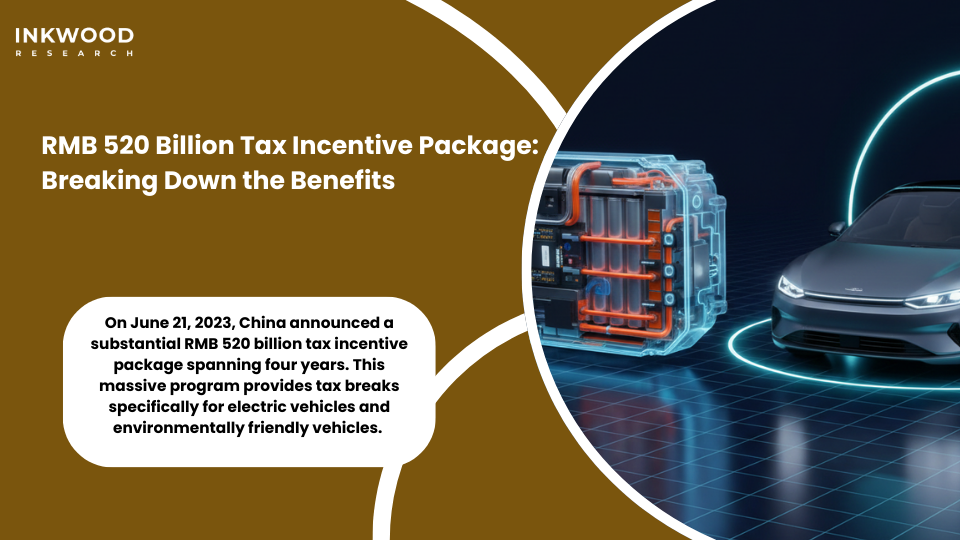
On June 21, 2023, China announced a substantial RMB 520 billion tax incentive package spanning four years. This massive program provides tax breaks specifically for electric vehicles and environmentally friendly vehicles. The package represents the largest tax incentive ever offered to China’s automotive industry.
Purchase Tax Exemption Structure
NEVs purchased in 2024 and 2025 receive a complete exemption from purchase tax, saving up to RMB 30,000 (US$4,170) per vehicle. This substantial benefit directly reduces consumer costs, stimulating demand significantly. For 2026-2027, the exemption is reduced by half, capped at RMB 15,000 (US$2,078).
Purchase tax typically represents 10% of the vehicle price, including VAT. Consequently, exemptions make electric vehicles substantially more affordable compared to combustion alternatives. Consumers save thousands of dollars on every purchase, accelerating adoption rates dramatically. Moreover, phased reduction encourages early purchases while maintaining long-term support.
Impact on Consumer Behavior
According to Ministry of Commerce data, NEV share of new car sales increased from one-eighth in 2021 to one-quarter in 2022. Forecasts project over 30% in 2024 and approximately 40% by 2025. These dramatic increases demonstrate tax incentive effectiveness in driving consumer choices.
Without purchase tax exemptions, electric vehicles would cost significantly more than combustion equivalents. The savings bridge price gaps effectively, making EVs competitive economically. Furthermore, continued exemptions through 2027 provide certainty for both consumers and manufacturers. Planning horizons extend confidently into the future.
Economic Stimulus Effects
The RMB 520 billion package stimulates the entire automotive value chain comprehensively. Battery manufacturers benefit from increased production volumes and economies of scale. Meanwhile, component suppliers expand operations to meet growing demand. Charging infrastructure development accelerates supporting vehicle deployment nationwide.
Local economies gain from manufacturing job creation and technology development investments. China’s EV manufacturing industry has a cost advantage of 20 percent compared with Western markets. Tax incentives amplify these competitive advantages, solidifying China’s global manufacturing leadership position substantially.
Direct Manufacturing Subsidies: How Much Support Do Battery Makers Receive?
Beyond consumer-facing tax incentives, Chinese battery manufacturers receive substantial direct government subsidies. These financial supports accelerate capacity expansion, technology development, and international competitiveness significantly.
CATL’s Government Support Trajectory
According to CATL’s annual reports, government subsidies rose from $76.7 million in 2018 to $809.2 million in 2023. This tenfold increase reflects the government’s commitment to supporting market leaders. Meanwhile, their 43.1% Chinese market share and 36.8% global share justify continued investment.
These subsidies support multiple business functions simultaneously. Research and development receive substantial funding for breakthrough technologies. Manufacturing capacity expansion benefits from capital support, reducing financial burdens. Additionally, export activities gain assistance through various support mechanisms.
BYD’s Subsidy Growth Pattern
According to BYD’s annual reports, direct government subsidies totalled €3.4 billion from 2018 to 2022. They increased massively from approximately €0.2 billion in 2020 to €2.1 billion in 2022 alone. This acceleration coincides with BYD’s aggressive capacity expansion and market share gains.
BYD’s vertical integration strategy benefits particularly from government support. Their blade battery technology development received R&D subsidies. Manufacturing facilities across multiple regions obtained local government incentives. Furthermore, export initiatives gained financial assistance, facilitating international expansion.
Supporting Smaller Battery Manufacturers
EVE Energy, ranking 4th in China, received $208.9 million in subsidies in 2023. Smaller manufacturers also benefit from government support, ensuring competitive diversity. This multi-tiered approach prevents monopolistic market structures while encouraging innovation broadly.
Regional governments compete to attract battery manufacturing investments. They offer land at below-market rates, provide tax holidays, and subsidize infrastructure development. Consequently, manufacturers negotiate favorable terms when establishing new facilities. Competition among regions ultimately benefits the entire industry.
Indirect Support Mechanisms
Other important forms of government support include below-market debt and equity, discriminatory government procurement, and subsidized input purchases. These indirect mechanisms prove difficult to quantify but represent substantial value nonetheless.
State-owned banks provide preferential lending rates to battery manufacturers. Government entities preferentially purchase domestically-produced batteries for public vehicle fleets. Raw materials like steel often come at subsidized prices. Together, these advantages compound significantly over time.
Regional Manufacturing Clusters and Local Government Support
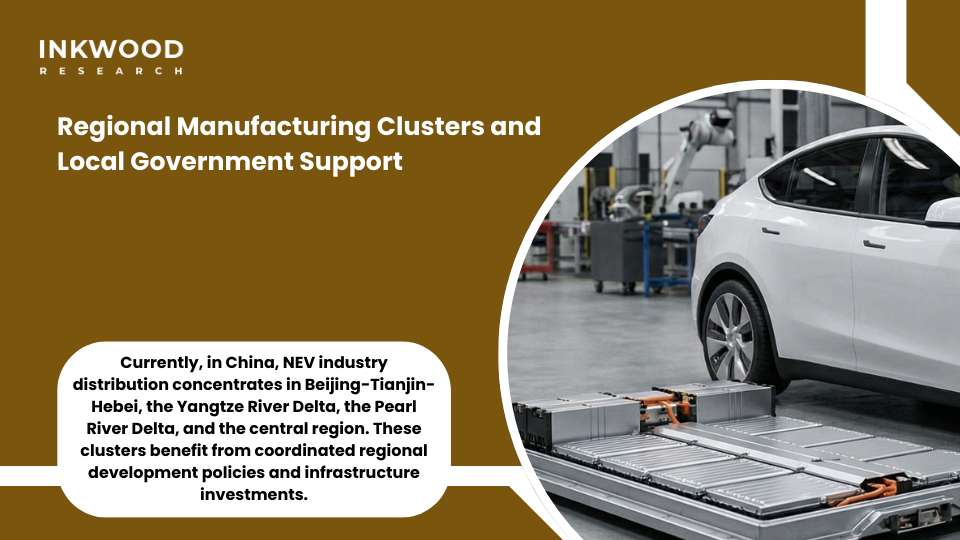
Currently, in China, NEV industry distribution concentrates in Beijing-Tianjin-Hebei, the Yangtze River Delta, the Pearl River Delta, and the central region. These clusters benefit from coordinated regional development policies and infrastructure investments.
Shanghai’s Implementation Plan
Shanghai issued the “Implementation Plan for Accelerating the Development of New Energy Vehicle Industry (2021-2025)” to drive regional NEV industry growth. The plan includes specific manufacturing targets, infrastructure development goals, and technology innovation objectives.
Local policies complement national frameworks by addressing region-specific needs. Shanghai focuses on attracting international partnerships and technology transfers. Meanwhile, it invests heavily in charging infrastructure supporting widespread adoption. Manufacturing zones receive streamlined permitting and regulatory support.
Chengdu’s Aggressive Incentives
Chengdu wants 800,000 EVs on the road by 2025, awarding up to 50 million yuan to carmakers developing new EV models. Additionally, individual consumers receive 8,000 yuan for acquiring an EV. These substantial local incentives supplement national programs effectively.
Regional competition drives innovation in policy design and implementation. Cities recognize economic development opportunities from battery manufacturing. They invest aggressively in attracting manufacturers through comprehensive support packages. Consequently, companies negotiate highly favorable terms when selecting facility locations.
Supply Chain Ecosystem Development
Manufacturing clusters naturally attract complementary suppliers and service providers. Component manufacturers locate near assembly facilities, reducing transportation costs. Research institutions establish partnerships with local manufacturers. Furthermore, talent pools develop around major manufacturing centers.
Government policies actively cultivate these ecosystems through coordinated planning. Industrial parks receive infrastructure investments, including power, transportation, and telecommunications. Educational institutions align curricula with industry workforce needs. Innovation centers facilitate technology transfer between research and manufacturing.
Securing Global Supply Chains: From Lithium Mines to Battery Cells
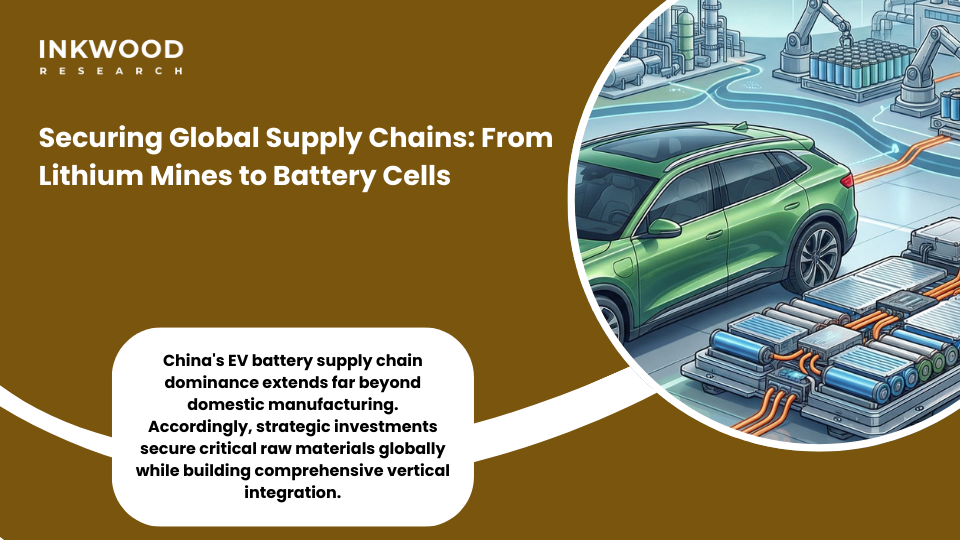
China’s EV battery supply chain dominance extends far beyond domestic manufacturing. Accordingly, strategic investments secure critical raw materials globally while building comprehensive vertical integration.
Lithium Resource Acquisition Strategy
China is the leading power in worldwide lithium-ion battery manufacture, though it imports 80% of its lithium needs. However, Chinese companies have acquired majority stakes in lithium mines globally. This ensures reliable material access despite limited domestic reserves.
Chinese enterprises invested billions in Australian, Chilean, and African lithium operations. These strategic acquisitions secure long-term supply agreements at favorable prices. Government policies support overseas resource investments through financing and diplomatic channels. Consequently, China controls significant portions of global lithium supply chains.
Processing and Refining Dominance
China stands as the leading refiner of battery metals globally, hosting significant shares of cathode, anode, and electrolyte production. This processing dominance proves even more critical than raw material ownership. Refined materials require sophisticated technology and substantial capital investments.
Processing capacity takes years to develop and demands significant expertise. Chinese companies invested early, building unassailable leads in refining technologies. Furthermore, environmental regulations in other countries make processing economically challenging. China’s integrated approach from mining to processing to manufacturing creates formidable competitive moats.
Component Manufacturing Integration
China accounts for 75% of global lithium-ion battery production and 70% of cathode capacity. Additionally, it dominates anode and electrolyte production along with battery component manufacturing. This comprehensive control ensures supply chain resilience and cost advantages.
Vertical integration allows rapid innovation implementation across entire value chains. Technology improvements in cathode materials quickly translate to battery performance gains. Cost reductions in upstream processes benefit downstream manufacturers immediately. Moreover, coordinated development accelerates time-to-market for innovations substantially.
Export Control Considerations
The Chinese government’s proposed export restrictions on advanced LFP technologies could limit technology transfer. These potential controls demonstrate China’s awareness of technological advantages. Protecting intellectual property and manufacturing know-how maintains competitive positions internationally.
Export restrictions serve multiple strategic purposes simultaneously. They encourage foreign manufacturers to establish Chinese operations, accessing technologies locally. Meanwhile, they prevent competitors from replicating Chinese innovations rapidly. However, restrictions must balance competitiveness against international cooperation requirements carefully.
Government-Funded R&D Driving Battery Technology Breakthroughs
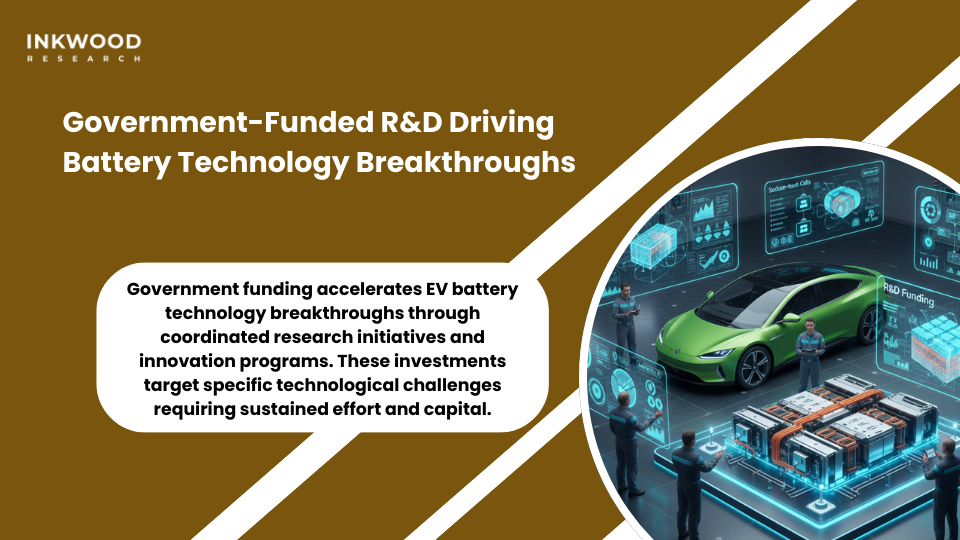
Government funding accelerates EV battery technology breakthroughs through coordinated research initiatives and innovation programs. These investments target specific technological challenges requiring sustained effort and capital.
National Innovation Programs
China operates multiple national innovation programs focusing on battery technology advancement. These initiatives coordinate research across universities, government laboratories, and corporate R&D centers. Funding priorities target energy density improvements, safety enhancements, and cost reductions simultaneously.
Collaborative research structures pool expertise from diverse institutions. Academic researchers contribute fundamental scientific understanding. Corporate laboratories focus on commercialization pathways. Meanwhile, government facilities address large-scale manufacturing challenges. This coordinated approach accelerates innovation substantially compared to isolated efforts.
Solid-State Battery Development
Chinese manufacturers invest heavily in solid-state battery technology, promising revolutionary improvements. CATL advances solid-state battery development targeting higher energy density. Government grants support research addressing technical challenges preventing commercialization currently.
Solid-state technology eliminates liquid electrolytes, improving safety dramatically. Higher energy density enables longer ranges without weight penalties. However, manufacturing at scale presents significant challenges. Government-funded research accelerates solutions to production obstacles systematically.
Sodium-Ion Battery Innovations
CATL announced its second-generation sodium-ion batteries in 2025 alongside a dedicated brand launch. These alternatives address lithium supply concerns while offering cost advantages. BYD also invests heavily in sodium-ion production for diverse applications.
Sodium abundance ensures supply chain resilience against material shortages. Manufacturing processes leverage existing lithium-ion production infrastructure. Government support accelerates commercialization timelines, bringing products to market faster. Meanwhile, energy density improvements continue narrowing performance gaps with lithium-ion alternatives.
Battery Recycling Technology
Recycling technology development receives substantial government funding, addressing end-of-life battery management. Circular economy principles drive policy priorities, ensuring material recovery. Advanced recycling processes recover 95% of battery materials for reuse.
Second-life applications extend battery usefulness beyond automotive service. Batteries retaining 70-80% capacity serve energy storage applications effectively. Government programs facilitate connections between the automotive and stationary storage sectors. This maximizes economic value while minimizing environmental impacts comprehensively.
Competitive Analysis: CATL, BYD, and Domestic Champions
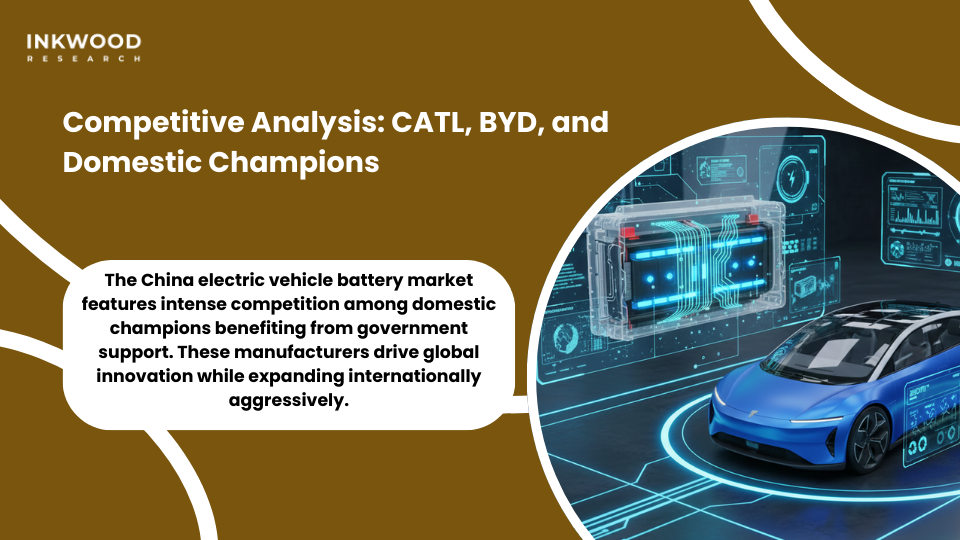
The China electric vehicle battery market features intense competition among domestic champions benefiting from government support. These manufacturers drive global innovation while expanding internationally aggressively.
CATL: Unrivaled Global Leadership
- CATL achieved 37.9% global market share in 2024 with 339.3 GWh installed capacity. Their product portfolio spans diverse chemistries from high-nickel NMC to cost-effective LFP batteries. Cell-to-pack technology eliminates traditional modules, increasing volumetric efficiency substantially.
- In April 2025, CATL unveiled its upgraded Shenxing battery, promising a 320-mile range with five-minute charging. This breakthrough surpasses competitors by approximately 70 miles. They supply virtually every major automotive manufacturer globally, including Tesla, BMW, Volkswagen, and Toyota.
BYD: Vertical Integration Powerhouse
- BYD achieved 25.1% domestic market share in 2024 with 135.02 GWh installed capacity. Their lithium iron phosphate installations exceeded 100 GWh at 134.84 GWh. Market share increased from 15% in 2020 to 26% by Q4 2024.
- BYD’s blade battery technology incorporates LFP chemistry, ensuring superior safety. The cell-to-pack design boosts space utilization by approximately 50%. Battery usage in Europe increased 263% year-over-year to 8.6 GWh in the first half 2025. This aggressive international expansion challenges Korean and Japanese manufacturers significantly.
CALB: Emerging Global Player
- In 2023, CALB unveiled the world’s first high-energy, long-life battery cell with 314 Ah capacity and more than 15,000 cycles. In 2024, they began constructing a zero-carbon AI-powered gigafactory in Portugal. This marks a major step in the European expansion strategy.
- Their focus on long-life batteries addresses commercial vehicle and energy storage applications. Partnerships with automotive manufacturers expand globally. Government support facilitates international investments and technology transfers. Moreover, their sustainability initiatives align with global environmental standards.
Gotion High-Tech: Technology Innovation Focus
- At its 13th Technology Conference in 2023, Gotion unveiled the 5C ultra-fast-charging G-Current battery, a high-nickel Stellary battery with 50% cost reduction, and the all-solid-state Gemstone battery. These innovations demonstrate technological leadership across multiple battery categories.
Volkswagen counts among their major investors, providing strategic partnerships and market access. Specializing in lithium-ion and energy storage systems, they participate in national innovation programs. Government backing supports their ambitious R&D initiatives and global expansion plans.
Latest Manufacturing Expansions and Capacity Additions
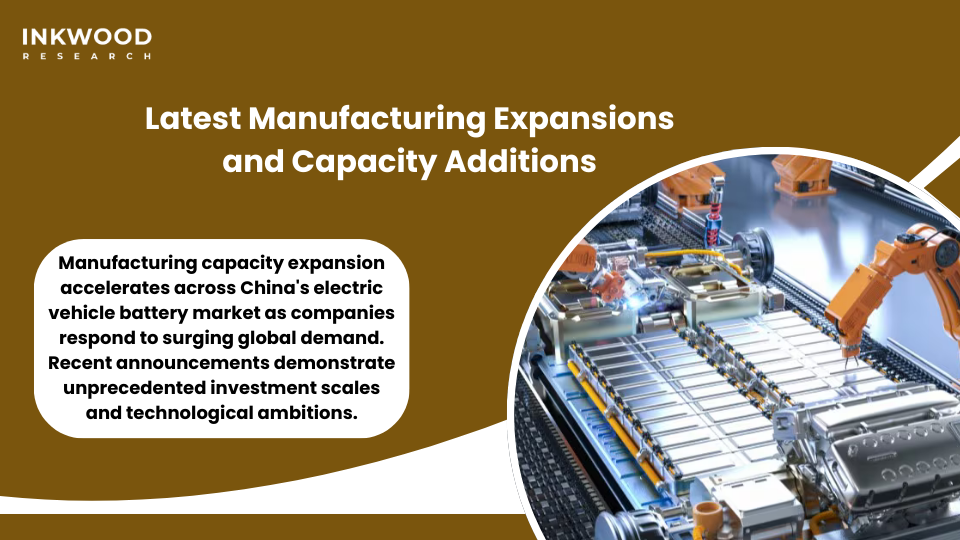
Manufacturing capacity expansion accelerates across China’s electric vehicle battery market as companies respond to surging global demand. Recent announcements demonstrate unprecedented investment scales and technological ambitions.
CATL’s Capacity Expansion
CATL announced multiple gigafactory projects across China and internationally. Their domestic facilities expand continuously, meeting domestic and export demand. Meanwhile, international facilities in Europe, North America, and Southeast Asia position them near key automotive manufacturing centers.
Production capacity targets exceed 500 GWh annually by 2025. This massive scale provides economies of scale, reducing costs substantially. Advanced manufacturing technologies improve quality while accelerating production rates. Furthermore, automation increases efficiency while reducing labor requirements.
BYD’s International Expansion
BYD focuses on international market penetration through strategic facility investments. European operations expand rapidly, serving growing regional demand. Their vertical integration strategy extends globally, ensuring supply chain control internationally.
Manufacturing facilities produce both batteries and complete vehicles simultaneously. This integration provides unique advantages in cost control and product optimization. Technology transfers from domestic operations accelerate international facility ramp-ups. Moreover, local production avoids potential trade barriers and tariffs.
CALB’s European Gigafactory
CALB’s zero-carbon gigafactory in Portugal represents substantial European investment. The facility incorporates AI-powered production technologies, optimizing efficiency. Additionally, renewable energy powers operations, aligning with European sustainability requirements.
This investment demonstrates Chinese manufacturers’ commitment to serving European markets directly. Local production provides proximity advantages, reducing transportation costs and lead times. Furthermore, it addresses potential regulatory concerns about imported batteries. Employment creation strengthens relationships with host governments.
Regional Hub Development
New manufacturing clusters emerge in less-developed regions through government incentives. These investments create employment and economic development opportunities broadly. Regional governments compete aggressively to attract battery manufacturing through comprehensive support packages.
Infrastructure investments accompany manufacturing facility development. Power generation capacity increases, supporting energy-intensive production processes. Transportation networks improve the facilitation of material inflows and product outflows. Educational institutions establish programs to train the workforce for specialized manufacturing roles.
Key Takeaways
- China’s electric vehicle battery market reached US$29.55 billion in 2025, growing to US$74.99 billion by 2032 at a 14.23% CAGR
- RMB 520 billion tax incentive package provides complete purchase tax exemptions through 2025, saving consumers up to RMB 30,000 per vehicle
- CATL government subsidies increased from $76.7 million (2018) to $809.2 million (2023), demonstrating escalating support for market leaders
- BYD received €3.4 billion in direct government subsidies from 2018-2022, with €2.1 billion in 2022 alone
- China accounts for 75% of global lithium-ion battery production and 70% of cathode capacity, dominating entire supply chains
- NEV sales increased from one-eighth of new car sales in 2021 to one-quarter in 2022, projected to reach 40% by 2025
- Regional governments compete with comprehensive support packages, including land subsidies, tax holidays, and infrastructure investments
- Chinese companies secured majority stakes in global lithium mines despite importing 80% of their lithium needs
- Advanced technology exports face potential restrictions protecting intellectual property and manufacturing advantages
- Manufacturing cost advantages of 20% compared to Western markets amplify government support effectiveness
Conclusion:
Government incentives fundamentally drive China’s electric vehicle battery market dominance through comprehensive, multi-layered support mechanisms. The RMB 520 billion tax incentive package stimulates consumer demand while direct manufacturing subsidies accelerate capacity expansion. Regional competition among local governments amplifies national policies, creating irresistible investment environments.
CATL, BYD, and other domestic champions leverage government support to build technological leadership and manufacturing scale. Strategic supply chain investments from lithium mines to battery cells ensure long-term competitive advantages. Meanwhile, government-funded R&D accelerates breakthrough technologies, including solid-state and sodium-ion batteries.
China’s integrated approach from policy design through implementation to international expansion creates formidable competitive positions. Manufacturing cost advantages combined with technological innovation challenge established players globally. Furthermore, vertical integration from raw materials to finished batteries provides resilience against supply disruptions.
Are you ready to navigate China’s complex electric vehicle battery market landscape? Inkwood Research provides comprehensive policy analysis and market intelligence, helping enterprises develop effective China strategies.
Our expert analysts deliver actionable insights on government programs, competitive dynamics, and emerging opportunities. Contact us today for a consultation on optimizing your China market approach and partnership strategies.
Frequently Asked Questions
How much government support do Chinese battery manufacturers receive?
CATL received $809.2 million in government subsidies in 2023, while BYD obtained €3.4 billion from 2018-2022. Support includes direct subsidies, preferential financing, tax incentives, and indirect benefits like subsidized inputs and below-market land prices.
What are China's main policy tools for supporting EV battery manufacturing?
China employs RMB 520 billion in tax exemptions, saving consumers up to RMB 30,000 per vehicle, direct manufacturing subsidies, dual-credit system requirements, regional incentive packages, and government-funded R&D programs. These comprehensive tools address demand, supply, and innovation simultaneously
How does China control global battery supply chains?
China accounts for 75% of global lithium-ion battery production, 70% of cathode capacity, and dominates refining of battery metals. Strategic investments in global lithium mines secure raw materials despite importing 80% of its needs. Vertical integration from mining to manufacturing creates comprehensive control.